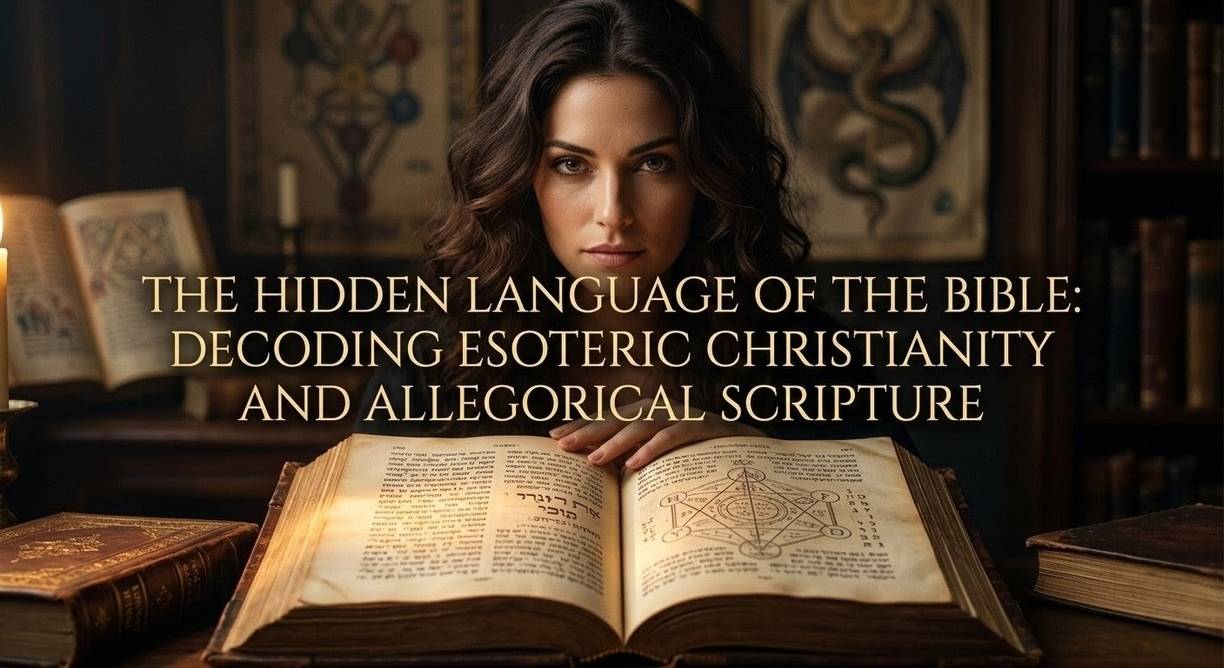
The Hidden Language of the Bible: Decoding Esoteric Christianity and Allegorical Scripture
The Bible can be read as history, law, poetry, prophecy, myth, theology, liturgy, moral teaching, and sacred memory. It can also be read as a layered technology of consciousness: a body of texts designed to awaken attention, disturb false certainty, form the soul, and train the reader to perceive more deeply than surface meaning alone.
In Plain Terms
Esoteric biblical interpretation does not mean ignoring the literal meaning or inventing secret messages at random. It means reading scripture as a layered text. The surface story matters, but it may also carry symbolic, moral, psychological, mystical, and contemplative meanings.
Jewish tradition developed a fourfold method often called Pardes: peshat, the plain meaning; remez, the hinted meaning; derash, the interpretive or homiletic meaning; and sod, the secret or mystical meaning. Christian tradition also developed layered interpretation through literal, moral, allegorical, and anagogical readings. These are not identical systems, but they share the recognition that sacred text can speak on more than one level.
Read esoterically, Genesis becomes not only a creation story but a drama of consciousness, division, desire, knowledge, and exile. Exodus becomes a map of liberation from bondage. The Prophets become readers of consequence. The Gospels become teachings on inner kingdom and transformation. Revelation becomes a symbolic apocalypse: the unveiling of what must end for a new order of consciousness to appear.
Primary Sources and Traditions Discussed
- Hebrew Bible and New Testament: Genesis, Exodus, the Prophets, the Gospels, John, and Revelation as layered sacred texts.
- Jewish hermeneutics: Pardes, midrash, symbolic reading, numerological patterns, and the relation between plain sense and hidden depth.
- Christian allegory: Origen, patristic reading, medieval fourfold interpretation, lectio divina, and contemplative scripture practice.
- Kabbalah and mystical reading: sod, the secret level, symbolic architecture, Tree of Life correspondences, and the recovery of divine pattern.
- Gnostic and esoteric Christianity: the inner kingdom, awakening, recognition, the divided self, exile, return, and transformation through knowledge.
- Contemplative practice: slow reading, prayer, meditation, attention, resistance, pattern recognition, and the transformation of the reader.
How to Read This Article
This article does not argue that literal readings are worthless. A serious symbolic reading begins by respecting the text: its language, genre, history, tradition, and plain sense. The deeper layers do not float in the air. They grow from the words actually present.
At the same time, sacred scripture has always invited more than bare literalism. Poetry, parable, prophecy, apocalypse, wisdom literature, mythic narrative, law, genealogy, and visionary language all ask to be read according to their nature. A parable is not a newspaper report. A prophecy is not simply a calendar. An apocalypse is not merely a future disaster forecast. These forms are built to work on imagination, conscience, memory, and perception.
Read this as an invitation into layered interpretation, not as a licence to force the Bible to say anything. Esoteric reading requires discipline. It asks for humility, tradition, historical awareness, symbolic sensitivity, and the willingness to be changed by the text rather than merely use it as raw material for private projection.
Table of Contents
- The Four Gardens of Meaning: Pardes and Layered Interpretation
- Genesis: The Fall Into Experience
- Exodus: The Anatomy of Liberation
- The Prophets: Pattern Recognition and Consequence
- The Gospels: The Kingdom Within and Among
- Revelation: Apocalypse as Unveiling
- The Practice: How to Read Beneath the Surface
- The Cost of Reading: What Must Be Surrendered
- Related Glossary Terms
- Read Next
- Frequently Asked Questions
- Further Reading
- References and Sources
The Four Gardens of Meaning: Pardes and Layered Interpretation
The Hebrew word Pardes means orchard or garden and is used as an acronym for four levels of interpretation: peshat, remez, derash, and sod. The image is exact. Sacred reading is not a corridor with one door. It is an orchard with paths, shadows, fruit, roots, and hidden clearings.
The point of Pardes is not to abandon the literal level. It is to recognise that meaning can deepen. A story may be a story, and also a symbol. A command may be a command, and also a spiritual discipline. A number may count, and also echo. A journey may happen in history, and also within the soul.
Peshat: The Plain Sense
Peshat is the plain or contextual meaning of the text. It asks: what does the passage say in its immediate literary, linguistic, and historical setting? Who is speaking? What kind of text is this? What is happening in the story? What would the words mean before later symbolism is added?
This level matters because it keeps interpretation honest. Without peshat, mystical reading becomes mist with footnotes. The plain sense is not the enemy of depth. It is the soil from which depth grows.
Remez: The Hinted Meaning
Remez is the hinted meaning, the level of allusion, echo, pattern, number, symbol, and resonance. Here the reader notices recurrence: forty days, forty years, seven days, twelve tribes, twelve apostles, water, bread, oil, light, wilderness, mountain, garden, city, exile, return.
Remez does not require the reader to invent codes from nowhere. It asks the reader to recognise how sacred texts talk to themselves. Biblical literature is full of repetition, echo, fulfilment, reversal, and symbolic memory. The same image returns wearing different clothes.
Derash: The Applied Meaning
Derash is interpretive, homiletic, and applied meaning. It asks how the text speaks now. This is the level of sermon, midrash, moral imagination, communal teaching, and creative re-application. It keeps scripture alive rather than sealed inside an ancient museum case.
Derash is powerful, but it needs discipline. Without peshat, it can become self-expression dressed as revelation. Without remez, it may miss the larger pattern. Without humility, it can make the text say only what the interpreter already wanted to say.
Sod: The Secret Meaning
Sod is the secret, mystical, or hidden level. It does not mean a cheap puzzle hidden behind the letters. It means the dimension of the text that becomes visible only when the reader has been inwardly prepared. Some meanings cannot be received by information alone. They require transformation of attention.
At the sod level, scripture becomes mirror, map, and medicine. The stories reveal patterns of consciousness: exile and return, bondage and liberation, death and rebirth, blindness and sight, scattering and gathering, false self and restored image.
The Bible is not only a book to be read. It is also a mirror in which the reader is gradually revealed.
Genesis: The Fall Into Experience
Genesis can be read in many ways: creation account, theological myth, sacred cosmology, ancestral story, priestly ordering, wisdom drama, and psychological map. Esoterically, Genesis 1-3 can be read as a story of consciousness moving from undivided immediacy into separation, self-awareness, desire, knowledge, shame, labour, and history.
Adam as Original Human Consciousness
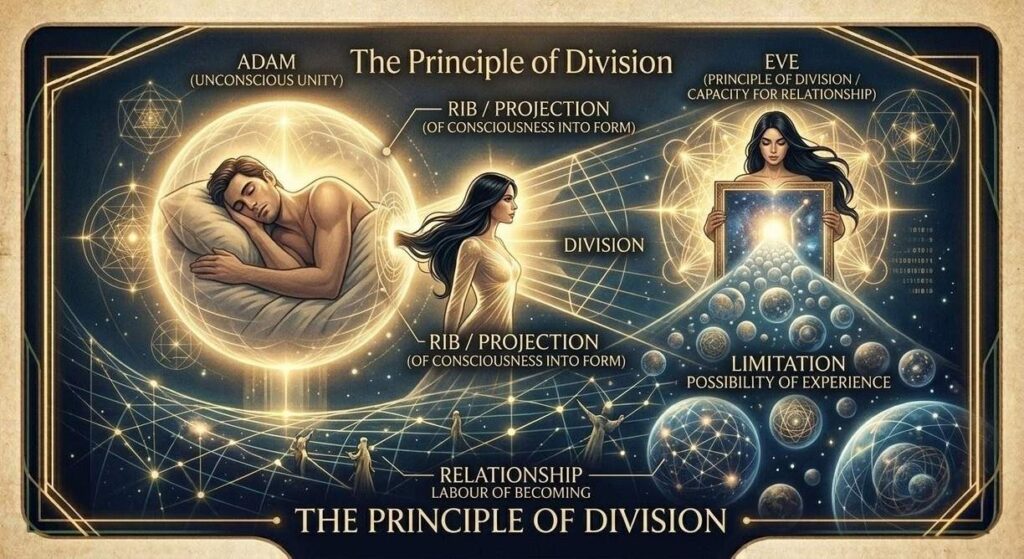
The Hebrew adam is related to adamah, the ground or earth. Adam is therefore not only an individual figure, but the earth-formed human being. In symbolic reading, Adam represents original human consciousness before fragmentation has fully unfolded: formed from earth, animated by breath, placed in a garden, and not yet divided by shame.
This does not require denying the literal or theological traditions around Adam. It means that the figure can also be read inwardly. Adam is the human before self-conscious exile, before the mind becomes split against itself, before nakedness becomes humiliation instead of innocence.
Eve and the Mystery of Relation
Eve can be read not only as the first woman in the story, but as the emergence of relation, difference, desire, and embodied otherness. The movement from one to two creates the possibility of love, dialogue, longing, misunderstanding, sexuality, conflict, birth, and history.
Separation is painful, but it also makes relationship possible. Without difference, there is no meeting. Without otherness, there is no love. The garden drama is therefore not simply a story of error. It is also the beginning of conscious participation in a world where unity must be rediscovered through relation rather than merely possessed in innocence.
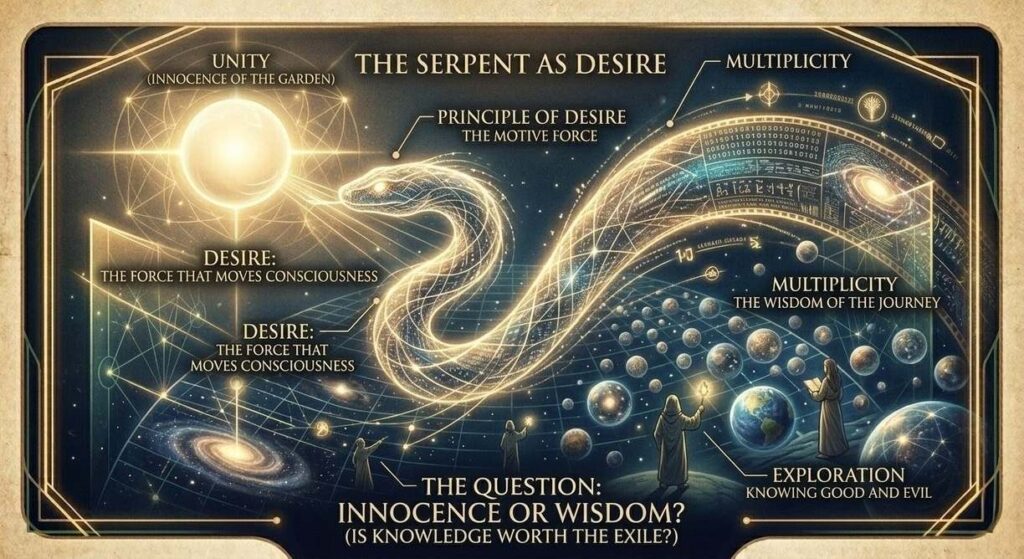
The Serpent as Desire and Awakening
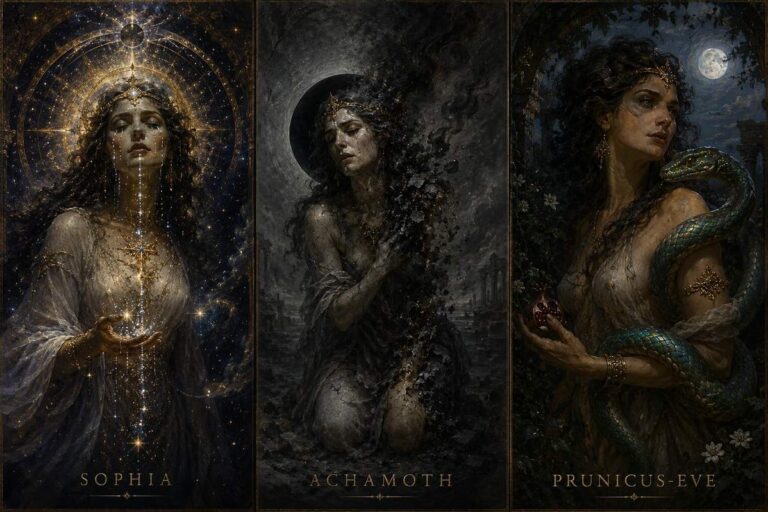
Traditional readings often identify the serpent with evil, temptation, or satanic deception. Esoteric readings may see the serpent differently: as desire, awakening, cunning, instinct, life-force, or the catalytic force that moves consciousness out of passive innocence.
This does not make the serpent simply good. It makes the serpent ambiguous and powerful. Desire opens the eye, but it also introduces exile. Knowledge expands consciousness, but it also brings burden. The serpent offers the path of experience, and experience is never cost-free.
Two Trees, Two Modes of Perception
The Tree of Life and the Tree of the Knowledge of Good and Evil can be read as two modes of perception. The Tree of Life represents direct participation in divine life. The Tree of Knowledge represents discriminating consciousness: division, judgment, comparison, category, opposition, and moral awareness.
Human beings live after the fruit. We know division. We think in opposites. We name good and evil, self and other, sacred and profane, permitted and forbidden. The spiritual path is not a childish attempt to unknow experience. It is the harder return to life after knowledge, wisdom after exile, and unity after division.
Exodus: The Anatomy of Liberation
Exodus can be read as national memory, liberation story, theological foundation, and sacred history. Esoterically, it also becomes a map of inner liberation: bondage, summons, resistance, confrontation, threshold, wilderness, law, testing, and movement toward a promised state not yet inhabited.
Egypt as the Conditioned State
Egypt, in symbolic reading, represents the conditioned state: the place where consciousness has become habituated to bondage. This does not erase the historical and Jewish significance of Egypt in the Exodus story. It adds an inward reading: every person has an Egypt, a familiar captivity that offers predictability in exchange for freedom.
Egypt is the pattern that says: stay with what you know. It may be painful, but it is known. Do not risk the wilderness. Do not ask what freedom requires. Do not disturb the machinery that feeds you while it owns you.
Pharaoh as the Resistant Ego
Pharaoh can be read as the hardened structure that resists liberation. In the story, Pharaoh refuses to release Israel. In the psyche, Pharaoh is the part that refuses to release old identity, old fear, old control, old superiority, old wound, or old security.
This inner Pharaoh does not always feel cruel. Sometimes it feels practical. It says freedom is too dangerous, transformation too costly, wilderness too uncertain. It hardens the heart by calling hardness realism.
The Plagues as Dissolution
The plagues can be read as the progressive collapse of an old order. What once seemed stable becomes uninhabitable. The waters are troubled. The land is disrupted. Darkness falls. The familiar system reveals its violence and fragility.
In inner life, this is what happens when a false structure can no longer sustain itself. The old coping pattern begins to fail. The old identity no longer works. What once protected now confines. Liberation often begins not with clarity, but with disruption.
The Red Sea as Threshold
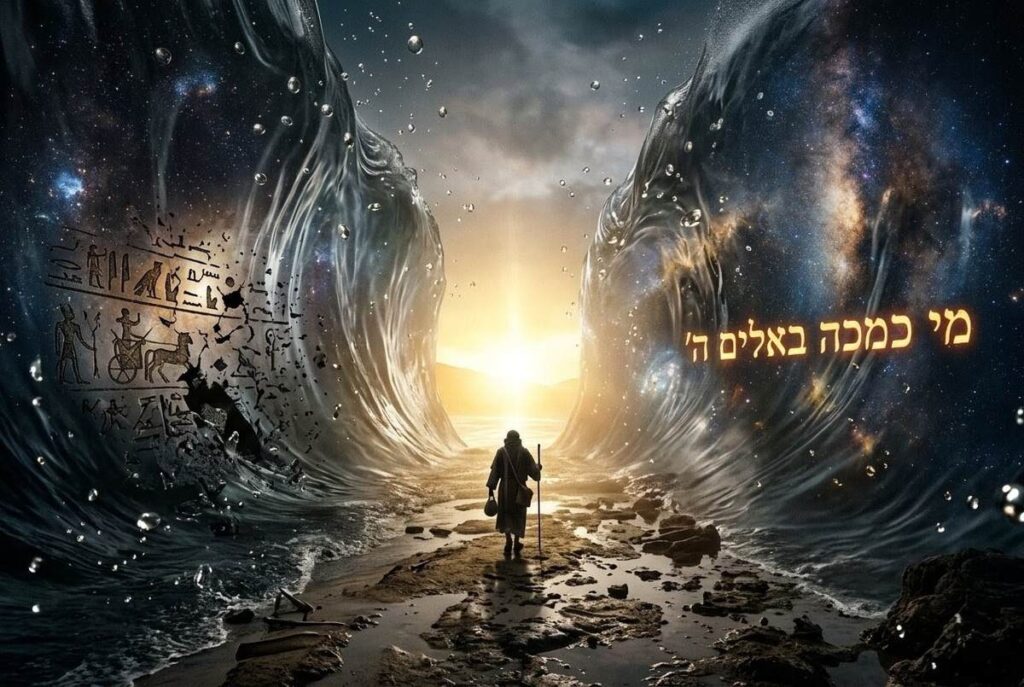
The Red Sea is the liminal threshold between old bondage and unknown freedom. Symbolically, it is the place where the past pursues and the future has not yet formed. There is no safe detour. The only way out is through.
The waters that threaten to overwhelm also become the boundary that prevents return. This is one of scripture’s deepest liberation patterns: what terrifies the old self may become the passage by which it is left behind.
The Passover marks transition, protection, and departure. At the symbolic level, it is the moment when a former way of being is marked for ending. Liberation begins when the old authority no longer has final claim.
The Prophets: Pattern Recognition and Consequence
The prophets are often misunderstood as simple predictors of future events. Prediction is part of prophetic literature, but the deeper function is moral and spiritual perception. The prophet sees the trajectory of a people, a ruler, a city, or a soul, and names the consequence before it becomes unavoidable.
Prophecy is therefore not fortune-telling. It is pattern recognition under divine pressure. Injustice leads somewhere. Idolatry leads somewhere. Exploitation leads somewhere. False worship leads somewhere. A society cannot violate covenant, mercy, truth, and the poor without producing a future shaped by that violation.
Warning as Mercy
When Isaiah, Jeremiah, Amos, or Ezekiel warns of collapse, the warning is not merely doom. It is mercy. A warning means the future is still addressable. The disaster has not yet become final. The prophet speaks so that the pattern can be recognised and interrupted.
In personal life, prophetic speech appears whenever truth breaks through denial. The body warns. Dreams warn. Relationships warn. Conscience warns. The soul warns before collapse, though usually more quietly than we prefer.
Restoration as Possible Future
The prophets also speak restoration: return, healing, justice, new heart, new covenant, peaceable kingdom, rebuilt city, dry bones living again. These are not shallow optimism. They are visions of what becomes possible when a people returns to alignment.
Esoterically, prophetic restoration is the reordering of consciousness after fragmentation. The ruined city is rebuilt. The scattered self is gathered. The deadened bone receives breath. The heart of stone becomes a heart of flesh.
The Gospels: The Kingdom Within and Among
The Gospels present Jesus through story, teaching, healing, parable, conflict, death, and resurrection. At the esoteric level, they also teach a transformation of perception. The kingdom of heaven is not only a future hope or external order. It is also a present reality breaking into consciousness, relationship, body, and community.
Luke 17:21 has been translated in more than one way: the kingdom is “within you”, “among you”, or “in your midst”. The ambiguity is fruitful. The kingdom is not merely private interiority, nor merely external institution. It is the presence of divine order becoming available in and among human beings.

Parables as Transformative Speech
Jesus teaches in parables because parables do not merely explain. They work on the listener. A parable can bypass defensive certainty, lodge in memory, disturb assumptions, and ripen slowly. It is simple enough for a child to remember and deep enough for a contemplative to return to for decades.
The sower, the seed, the soil, the pearl, the treasure, the lost sheep, the prodigal son, the mustard seed: these are not only moral illustrations. They are devices of attention. They ask the listener to become the soil, the seeker, the lost one, the elder brother, the seed, the treasure, the field.
Miracles as Signs
The miracles can be read at several levels. Literally, they are acts of healing and divine power. Symbolically, they also reveal restored perception, restored participation, and the breaking of conditions that seemed fixed.
The healing of blindness becomes the restoration of sight. The feeding of the multitude becomes abundance where scarcity ruled perception. The raising of the dead becomes awakening from lifelessness. Water becoming wine becomes transformation of ordinary substance into joy. The sign points beyond itself without ceasing to matter as sign.
Crucifixion and Resurrection as Transformation
Christian faith centres the crucifixion and resurrection as historical and theological realities. Esoteric interpretation does not need to erase that. It asks how the pattern also works inwardly: what must die for new life to emerge? What false self must be surrendered? What grain of wheat must fall into the earth?
Resurrection is not mere improvement. It is transformation after genuine ending. The old form does not continue unchanged. Something passes through death and returns with a different authority. This is why resurrection language remains so potent in spiritual psychology: it names a change deeper than self-help.
Revelation: Apocalypse as Unveiling
The word apocalypse means unveiling. Revelation is not only a book of catastrophe. It is visionary literature that exposes the hidden structure of empire, worship, violence, endurance, judgment, and renewal. It uses image, number, beast, city, throne, seal, trumpet, bowl, bride, dragon, and lamb to reveal what ordinary political language cannot hold.
Read esoterically, Revelation can also describe the collapse of an old consciousness and the emergence of a new one. The end of the world is also the end of a world: the world as ego, empire, fear, idolatry, illusion, and domination constructed it.
Seven Seals and Stages of Unveiling
The repeated sevens of Revelation invite symbolic reading: seven churches, seals, trumpets, bowls, spirits, stars, and lampstands. Seven often signals completeness, fullness, or a total process. Esoteric writers have sometimes mapped these sevens onto chakras, stages of awakening, or levels of purification.
Such mappings should be held as interpretive frameworks, not as the only meaning of the text. Revelation belongs first to its own apocalyptic world, with its historical pressures and scriptural echoes. But its imagery is powerful because apocalypse also happens inwardly. False structures are exposed. Inner beasts are named. Idols fall. The soul sees what it had served.
The New Jerusalem as Integrated Vision

The New Jerusalem descends as a city of luminous order. Its gates are open. Its measurements are symbolic. Its tree bears healing leaves. The Tree of Life, lost in Genesis, appears again. The Bible’s great arc bends from garden to city: innocence, exile, history, revelation, and restored access.
Esoterically, the New Jerusalem is integrated consciousness. The divided self has become ordered without becoming dead. The gates are open because nothing true needs to be excluded. The city is not a prison of walls, but a geometry of healed relation.
The Practice: How to Read Beneath the Surface
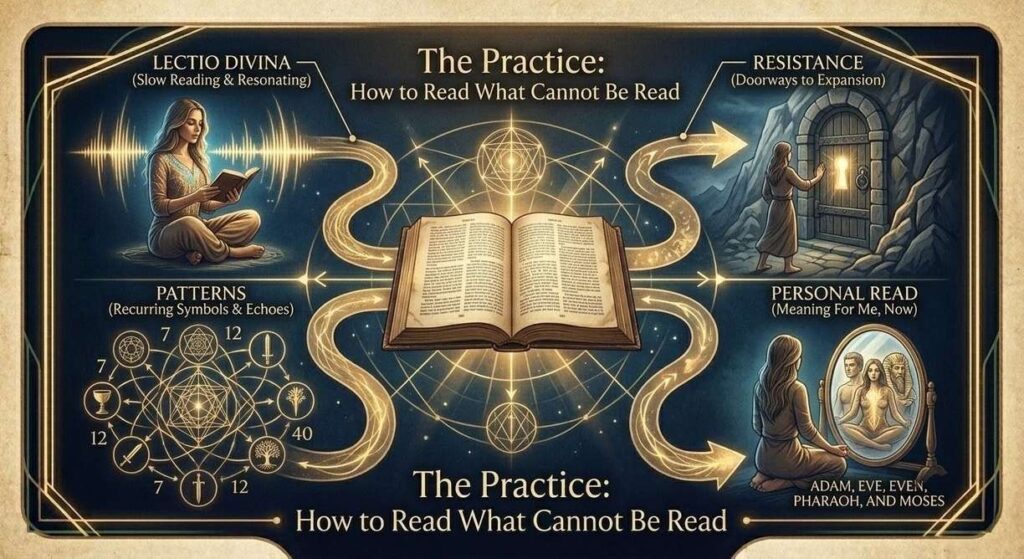
Esoteric reading is a practice, not a trick. It requires slowness, patience, humility, and a willingness to be read by the text in return. The reader who only looks for confirmation will find confirmation. The reader who looks for transformation must be prepared to lose certainty.
Lectio Divina as Slow Reading
Lectio divina, sacred reading, developed within Christian monastic tradition as a way of reading scripture prayerfully and contemplatively. Its classic stages are lectio, reading; meditatio, meditation; oratio, prayer; and contemplatio, contemplation.
Read slowly. Read aloud when possible. Notice which word catches. Return to it. Do not rush to explain. Let the phrase work on breath, memory, body, and conscience. The text is not being consumed. It is being allowed to enter.
Pattern Recognition
Notice patterns: three, seven, twelve, forty; garden, wilderness, mountain, sea, city; bread, wine, oil, fire, water, light; exile, return, blindness, sight, death, rebirth. These patterns are not decorative. They are the symbolic nervous system of scripture.
Keep a notebook. Trace an image across books. Ask where it first appears, where it returns, how it changes, and what it reveals when placed beside another passage. Scripture often speaks by echo.
Resistance as a Doorway
Some passages offend, confuse, repel, or disturb. Not every difficulty hides a secret treasure; some passages need historical, ethical, and theological wrestling. But resistance is still useful. It shows where the reader’s assumptions meet the text’s strangeness.
Do not explain difficulty away too quickly. Ask why the passage disturbs you. Ask what it has been used to justify. Ask what genre it belongs to. Ask what it reveals about power, fear, violence, holiness, justice, or projection. A difficult passage may not become comfortable, but it may become more honest.
Personal Application Without Narcissism
Esoteric reading asks, “How is this happening in me?” But that question must be handled carefully. The Bible is not only about the private self. It speaks to communities, histories, peoples, covenants, empires, and traditions. The personal reading must not erase the communal and historical one.
Still, the personal question matters. Where is Egypt in me? Where is Pharaoh? Where is wilderness? Where is exile? Where is the blind man asking to see? Where is the older brother outside the feast? Where is Jerusalem descending? The text becomes alive when the reader recognises themselves without making themselves the only meaning.
The Cost of Reading: What Must Be Surrendered
Layered reading costs something. It asks the literalist to surrender the need for one flat meaning. It asks the esoteric reader to surrender the vanity of secret superiority. It asks the sceptic to surrender the assumption that ancient texts are spiritually exhausted. It asks the believer to surrender the habit of using scripture only as defence.
The deeper reading removes distance. Genesis is not only about them. Exodus is not only about them. The Prophets are not only warning them. The Gospels are not only challenging them. Revelation is not only unveiling their world. The text turns, quietly and without apology, toward the reader.
This is why sacred reading can be uncomfortable. It is not content consumption. It is encounter. The reader arrives to interpret the text and discovers that the text has begun interpreting the reader.

The hidden language has never been hidden only by conspiracy. It is hidden by speed, laziness, fear, poor teaching, inherited literalism, inherited contempt, and the ordinary human wish to remain unchanged. The door is not locked. But it is narrow, and it does not open to skimming.
Approach as tourist, and the text remains scenery. Approach as pilgrim, and the same words become path.
Related Glossary Terms
These terms help clarify esoteric biblical interpretation, layered reading, and contemplative engagement with scripture:
- Esoteric Christianity: Christian tradition and interpretation concerned with inner transformation, mystical meaning, hidden wisdom, and direct spiritual knowing.
- Pardes: Jewish fourfold interpretive framework: peshat, remez, derash, and sod.
- Peshat: the plain, contextual, or surface meaning of a scriptural passage.
- Remez: the hinted meaning found through allusion, echo, number, pattern, and symbolic resonance.
- Derash: interpretive, homiletic, or applied meaning, often associated with midrash and teaching.
- Sod: the secret, mystical, or hidden level of meaning.
- Midrash: Jewish interpretive tradition that explores, expands, and applies scripture through creative and disciplined reading.
- Allegory: interpretation in which persons, events, or images signify deeper moral, theological, spiritual, or symbolic realities.
- Anagogy: upward or ultimate spiritual meaning, especially concerning final realities, divine union, or heavenly fulfilment.
- Lectio divina: contemplative practice of sacred reading, meditation, prayer, and contemplation.
- Apocalypse: unveiling or revelation; visionary disclosure of hidden spiritual reality.
- Kingdom of Heaven: in esoteric reading, the divine order made present within and among human beings.
Read Next
For the strongest next step, continue into sacred speech and the creative power of language:
The Power of Words: Etymology, Conscious Language, and the Magic of Speech
This companion article explores why sacred traditions treat words, names, blessings, curses, scripture, and speech as creative forces rather than disposable labels.
Frequently Asked Questions
What is esoteric Christianity?
Esoteric Christianity is an approach to Christian tradition that emphasises inner transformation, mystical meaning, hidden wisdom, direct spiritual knowing, and layered interpretation of scripture. It does not have to reject literal, historical, or theological readings, but it asks how biblical stories, symbols, parables, and visions also work within the soul and consciousness of the reader.
What are the four levels of Pardes interpretation?
Pardes is a Jewish fourfold interpretive framework. Peshat is the plain or contextual meaning. Remez is the hinted meaning found through allusion, pattern, number, or symbolic echo. Derash is interpretive or applied meaning, often associated with teaching and midrash. Sod is the secret or mystical meaning. The levels are not enemies; they deepen one another.
Does esoteric interpretation ignore the literal meaning of the Bible?
No. Responsible esoteric interpretation begins with the literal or plain sense. The surface meaning, genre, historical setting, and language of the passage matter. Deeper symbolic or mystical readings should grow from the text rather than being imposed on it. Ignoring the plain sense often leads to projection rather than genuine depth.
How does esoteric Christianity read Genesis?
Esoteric Christianity may read Genesis as both sacred origin story and symbolic drama of consciousness. Adam can represent earth-formed humanity, Eve the mystery of relation and difference, the serpent desire and awakening, the trees two modes of perception, and exile the movement from innocence into divided experience. These symbolic readings do not have to erase theological or historical readings.
How does esoteric Christianity interpret Exodus?
Exodus can be read as a liberation story and also as an inward map. Egypt represents conditioned bondage, Pharaoh the resistant ego or hardened structure, the plagues the collapse of an old order, the Red Sea the threshold between captivity and freedom, and the wilderness the difficult formation of a new consciousness.
Is Revelation a prediction of the end of the world?
Revelation has often been read apocalyptically and prophetically, but esoteric interpretation also reads it as unveiling. It reveals hidden structures of empire, worship, violence, judgment, endurance, and renewal. Inwardly, it can describe the collapse of an old consciousness and the emergence of a new order symbolised by the New Jerusalem.
How can I practise esoteric biblical reading safely?
Begin with slow reading, historical awareness, and humility. Use lectio divina, notice recurring patterns, study traditional commentaries, attend to resistance carefully, and ask how the text speaks to your life without making yourself the only meaning. Avoid obsessive decoding, spiritual grandiosity, contempt for ordinary religious readers, or practices that destabilise your mental health.
Study Note: This article explores esoteric, allegorical, Jewish, Christian, Gnostic, and contemplative approaches to biblical interpretation for educational and reflective purposes. It does not provide pastoral, theological, psychological, or spiritual-direction advice. Esoteric reading should not be used to avoid historical study, ethical responsibility, community accountability, or mental health care. If intensive scripture practice, mystical interpretation, or religious material produces anxiety, obsession, grandiosity, fear, dissociation, spiritual crisis, or psychological distress, pause the practice and seek support from qualified mental health professionals, trusted pastoral care, or trauma-informed spiritual guidance.
Further Reading
These related articles continue the themes of esoteric Christianity, sacred speech, layered interpretation, hidden wisdom, and the living tradition:
- The Power of Words: Etymology, Conscious Language, and the Magic of Speech – Sacred speech, creative language, blessing, naming, and the Word as formative power.
- Egyptian Wisdom for Modern Seekers: Anubis, the Tongue, and the Power of Sacred Speech – Ancient Egyptian sacred speech, heka, true names, and ritual language as power.
- The Kabbalistic Tree of Life: A Complete Guide to Spiritual Ascension – Symbolic architecture, ascent, sephirot, and the layered structure of mystical interpretation.
- The Mental Plane Explained: Where Thoughts Become Reality – Thought, symbol, imagination, and the mental level where sacred texts reshape perception.
- The Language of the Birds: 7 Traditions on Divine Speech – Hidden language, sacred sound, symbolic speech, and divine communication across traditions.
- The Shem HaMeforash: God’s Explicit Name and the 72-Fold Secret – Divine names, Exodus, sacred letters, and the Jewish tradition of hidden name theology.
- Gospel of Thomas: 114 Sayings and the Hidden Wisdom of Jesus – Sayings tradition, hidden wisdom, and the direct contemplative force of Jesus’s teaching.
- Gospel of Truth: The Poetics of Recognition in Valentinian Thought – Error, recognition, forgetting, and return in Valentinian Christianity.
- John Dee’s Mathematical Preface 1570: Occult Foundation of Renaissance Magic – Renaissance esotericism, sacred mathematics, scripture, and hidden architecture.
- The Living Thread: How Forbidden Knowing Survives – How hidden knowledge survives through scripture, symbol, practice, memory, and transmission.
References and Sources
The following sources support the biblical, interpretive, Jewish, Christian, and contemplative framework used in this article.
Biblical Texts and Primary Sources
- Holy Bible. Genesis 1-3; Exodus 1-15; Isaiah; Ezekiel; Matthew 5-7; Matthew 13; Luke 17; John 1; John 12; Revelation 1-22.
- JPS Hebrew-English Tanakh. Jewish Publication Society.
- New Revised Standard Version Updated Edition. National Council of Churches.
- The Septuagint. Greek Jewish scriptures and early Christian scriptural context.
- The Greek New Testament. United Bible Societies / Nestle-Aland critical editions.
Jewish Hermeneutics, Midrash, and Kabbalah
- Fishbane, Michael. (1985). Biblical Interpretation in Ancient Israel. Oxford: Clarendon Press.
- Boyarin, Daniel. (1990). Intertextuality and the Reading of Midrash. Bloomington: Indiana University Press.
- Scholem, Gershom. (1974). Kabbalah. New York: Meridian.
- Matt, Daniel C., trans. (2004-2017). The Zohar: Pritzker Edition. Stanford: Stanford University Press.
- Idel, Moshe. (1988). Kabbalah: New Perspectives. New Haven: Yale University Press.
- Wolfson, Elliot R. (1994). Through a Speculum That Shines: Vision and Imagination in Medieval Jewish Mysticism. Princeton: Princeton University Press.
Christian Allegory and Contemplative Interpretation
- Origen of Alexandria. On First Principles. Early Christian work on layered interpretation of scripture.
- Clement of Alexandria. Stromata. Early Christian reflections on knowledge, symbol, and spiritual instruction.
- Augustine of Hippo. On Christian Doctrine. Foundational Christian work on scriptural interpretation, signs, and love as interpretive rule.
- Cassian, John. Conferences. Early monastic teaching on contemplation, prayer, and spiritual understanding.
- Guigo II. Scala Claustralium, also known as The Ladder of Monks. Classic medieval description of lectio divina.
- de Lubac, Henri. (1998-2009). Medieval Exegesis: The Four Senses of Scripture. Grand Rapids: Eerdmans.
- Leclercq, Jean. (1982). The Love of Learning and the Desire for God. New York: Fordham University Press.
Gnostic and Esoteric Christianity
- Robinson, James M., ed. (1990). The Nag Hammadi Library in English. Revised edition. San Francisco: HarperOne.
- Meyer, Marvin, ed. (2007). The Nag Hammadi Scriptures. New York: HarperOne.
- Pagels, Elaine. (1979). The Gnostic Gospels. New York: Random House.
- King, Karen L. (2003). What Is Gnosticism? Cambridge: Harvard University Press.
- Williams, Michael Allen. (1996). Rethinking “Gnosticism”: An Argument for Dismantling a Dubious Category. Princeton: Princeton University Press.