The Gateway of Sound: Mantra and Nada Yoga
Sound is one of the most direct ways consciousness learns to gather itself. A tone enters the body. A syllable vibrates through the chest and skull. A repeated phrase steadies attention. A chant gives the breath a shape. A bell, mantra, psalm, prayer, hum, drone, or inner sound can become a thread through the noise.
The Gateway of Sound is the third of the Five Gateways because it stands between effort and receptivity. Breath is always available. Sensation is always present. Sound must either be produced or discovered. The mantra is produced through voice, breath, rhythm, and repetition. Nada, the inner sound, is discovered through silence, listening, and refined attention. Together, they form a sonic path from vibration into stillness.
This article explores mantra, japa, Nada Yoga, sacred sound, inner listening, and sonic practice as methods for concentration, stabilisation, and direct knowing. It treats sound carefully: not as magical spectacle, not as fake physics, and not as a guaranteed shortcut to awakening. Sound practice can steady the nervous system, refine attention, deepen prayer, and open subtle perception. It can also become overstimulating, dissociative, or confusing if forced. The aim is not louder spirituality. The aim is clearer listening.

In Plain Terms
The Gateway of Sound is the practice of using sound, mantra, chant, prayer, vibration, silence, and inner listening to gather attention and deepen awareness.
Mantra practice uses repeated sound, sacred syllable, prayer, or phrase as an anchor for attention. It may be spoken aloud, whispered, repeated mentally, or linked with breath.
Nada Yoga is the contemplative practice of listening inwardly for subtle sound. It should be approached gently, especially by readers with tinnitus, anxiety, dissociation, trauma sensitivity, or a tendency to chase unusual experiences.
The discernment issue is false authority. False authority often enters through voice: the guru’s tone, the group chant, the algorithmic recommendation, the AI adviser, the polished spiritual phrase. Sound practice restores the seeker’s own listening, so borrowed certainty can be heard before it is obeyed.
Sources and Traditions Discussed
- Yoga and mantra traditions: especially japa, pranava, Om, sacred syllables, breath-linked repetition, and the four levels of sound.
- Nada Yoga: especially inner listening, anahata nada, and sound as a route from vibration into silence.
- Hatha Yoga Pradipika: especially the final chapter’s discussion of inner sound and meditative absorption.
- Mandukya Upanishad: especially the symbolic reading of Om as waking, dreaming, deep sleep, and silence beyond the syllable.
- Christian hesychasm: especially the Jesus Prayer as repeated prayer linked with breath, heart, attention, and inner stillness.
- Sufi remembrance: especially dhikr, sacred repetition, breath, rhythm, and the remembrance of unity.
- Hermetic and Gnostic resonances: including vocal formulae, divine names, ascent language, and sound as symbolic transformation.
- Modern neuroscience and physiology: including rhythm, auditory attention, vocalisation, breath, autonomic regulation, and the caution needed around tinnitus, overstimulation, and dissociation.
- False-authority discernment: the way voice, tone, repetition, group sound, AI fluency and borrowed certainty can bypass direct knowing when listening becomes passive obedience.
How to Read This Article
This article uses the language of vibration, mantra, inner sound, sacred syllable, subtle listening, and sonic gnosis. Read these terms as contemplative and traditional language, not as proof that every inner sound is mystical or that every frequency claim is scientifically established.
Sound practice can be gentle and stabilising, but it can also become intense for some people. Repetition, chanting, ear-closing practices, silence, and inward listening may interact with tinnitus, trauma, panic, dissociation, obsessive spiritual seeking, sleep disturbance, or altered-state sensitivity.
The safest sign of good sound practice is integration: clearer attention, steadier breath, softer speech, deeper listening, and a more grounded return to ordinary life.
Sound becomes a gateway when vibration no longer scatters attention, but gathers it into listening.
Table of Contents
- Sound as the Third Gateway
- Sound, Body, and Nervous System
- Mantra as Deliberate Production
- Selecting a Mantra or Sacred Phrase
- False Authority and the Borrowed Voice
- Japa: The Practice of Repetition
- The Four Levels of Sound
- Nada Yoga: Listening to the Unstruck
- Inner Sound, Tinnitus, and Discernment
- Shabda, Nada, Bindu, Shunya
- Practical Protocols for Sonic Practice
- Troubleshooting the Gateway
- The Thread Extended
- The Gnostic Reading: Sound Against Fragmentation
- Related Glossary Terms
- Read Next
- Frequently Asked Questions
- Further Reading
- References and Sources
Sound as the Third Gateway
The Gateway of Sound follows breath and sensation because sound needs a body that can listen. Breath gives rhythm. Sensation gives grounding. Sound gives vibration a direction. When the voice is linked with breath and the body is steady enough to receive it, sound becomes more than noise. It becomes practice.
The sound gateway has two movements. The first is production: mantra, chant, prayer, psalm, hum, sacred syllable, spoken text, or repeated phrase. The second is discovery: listening inwardly for subtle sound, silence, resonance, and the field from which sound arises.
Production trains attention through repetition. Discovery trains attention through receptivity. One gives the mind something to hold. The other teaches the mind how to listen without grasping. Together, they create a balanced sonic discipline: voice and ear, effort and surrender, word and silence.
Sound is powerful because it does not remain outside the body. It enters through air conduction, bone conduction, vibration, rhythm, breath, posture, memory, and meaning. A chant is heard by the ears, felt by the chest, shaped by the tongue, carried by the breath, and remembered by the nervous system.
In the Five Gateways route, sound is not decoration after breath and sensation. It is the first gateway where the practitioner actively shapes the field through vocalised rhythm. The body becomes instrument. The breath becomes carrier. The ear becomes witness. The mind, usually scattered by many signals, is invited into one thread of tone.
Sound, Body, and Nervous System
Sound is mechanical vibration moving through a medium. In human practice, however, sound is never only physics. It is also perception, rhythm, attention, emotion, memory, meaning, breath, and bodily resonance. A mantra is not powerful because it belongs to a fantasy frequency chart. It is powerful when repetition, intention, vibration, and attention begin to organise the practitioner.
Vocal sound travels through both air and bone. When you chant, hum, pray aloud, or repeat a syllable, the vibration is heard externally and internally. The skull, throat, mouth, chest, diaphragm, and inner ear all participate. This is why vocal practice can feel different from silent reading. The body is not just understanding sound. It is producing and receiving it.
Bone Conduction and Embodied Listening
Bone conduction means that vibration moves through the bones and tissues of the head as well as through the air. This gives vocalisation a strangely intimate quality. The voice is not merely projected outward. It returns inward through the body’s own architecture.
Gentle humming is a simple example. It can make the lips, face, throat, skull, chest, or belly feel subtly alive. Some people find this settling. Others may find it irritating or overstimulating. The practice should always be adjusted to the person. A sound that helps one nervous system settle may make another feel crowded.
This is where the previous gateways matter. Breath gives the voice rhythm. Sensation tells the practitioner whether the sound is settling or agitating. Without breath and sensation, sound practice can become a dramatic engine with no brakes.
Rhythm, Repetition, and Attention
Repetition gives attention a track. The mind wanders less because it has a recurring object. Breath settles into rhythm. The body anticipates the next syllable. The voice becomes a metronome for awareness.
Modern research on meditation, chanting, prayer, and rhythmic sound is still developing, and it should not be inflated into universal proof. Still, it gives useful support to an old intuition: repeated sound can affect attention, self-referential thought, emotional tone, breath rhythm, and autonomic state.
The practical point is simple. Sound can train attention because it gives awareness something patterned, embodied, and repeatable. The syllable becomes a steady vessel across the noisy river.

Mantra as Deliberate Production
A mantra is a sacred syllable, word, phrase, prayer, or formula repeated as a practice object. In some traditions, a mantra is received through initiation from a teacher. In others, widely used phrases are public and devotional. In all cases, mantra should be approached with respect for the tradition from which it comes.
Mantra practice does not work by novelty. It works by repetition. The modern mind often wants variety, new techniques, new sounds, and new identities. Mantra asks for something simpler and harder: return to the same sound until the sound begins to work on the one repeating it.
The mantra gives the mind a single thread. The thread may be vocal, whispered, mental, rhythmic, breath-linked, or heart-linked. Over time, the phrase can become less like something the practitioner says and more like a current that carries attention back from distraction.
This is why mantra is found across traditions. The forms differ, but the contemplative principle is recognisable: repeated sacred sound can gather the scattered self.
Yet the sound itself is not the whole practice. The relationship to the sound matters. A mantra can become devotion, concentration, remembrance, nervous-system rhythm, or a small inner chapel. It can also become performance, compulsion, identity, escape, or borrowed spiritual costume. The difference is not always obvious at first. This is why sound must be joined to discernment.
Selecting a Mantra or Sacred Phrase
Choosing a mantra is not the same as collecting an exotic object. Sound carries context. The mantra belongs to a tradition, language, lineage, devotional field, or symbolic world. A respectful practitioner asks: can I use this phrase sincerely, steadily, and humbly?
Some widely known examples include:
- Om or AUM: a central syllable in Indian traditions, often treated as a sound-symbol of totality, consciousness, and the ground of experience.
- Om mani padme hum: a Tibetan Buddhist mantra associated with compassion and Avalokiteshvara.
- The Jesus Prayer: “Lord Jesus Christ, Son of God, have mercy on me”, often used in Eastern Christian hesychasm, sometimes with the added phrase “a sinner”.
- La ilaha illallah: an Islamic declaration of divine unity, used in some Sufi contexts as remembrance.
- IAO: a vocal formula appearing in ancient Mediterranean esoteric, Hermetic, and magical contexts, including material relevant to late antique religious practice.
These examples are not interchangeable decorations. They belong to different worlds. A Christian prayer, a Buddhist mantra, a Sanskrit seed syllable, a Sufi remembrance, and a Hermetic vocal formula carry different meanings, obligations, and atmospheres.
The safest rule is to begin with a phrase you can inhabit honestly. Sincerity matters more than spiritual glamour. A simple sacred word repeated with attention may do more than a grand formula worn like a borrowed robe.

False Authority and the Borrowed Voice
False authority often enters through voice before it enters through doctrine. A tone can seduce before an idea is tested. A chant can create belonging before discernment awakens. A teacher’s cadence can feel like certainty. A group phrase can become a social password. An AI adviser can sound calm, fluent and wise while lacking body, conscience, history, sacrifice or accountability.
This is where the Gateway of Sound meets Neo Gnosticism and False Authority. False authority is not only a wrong claim. It is the replacement of direct knowing by borrowed certainty. Sound is one of the ways that certainty becomes emotionally convincing. The voice can carry warmth, rhythm, confidence, repetition and social pressure. The body may begin obeying before the mind has asked whether obedience is wise.
The borrowed voice appears in many forms. It may be the guru whose every sentence feels final. It may be the group chant that dissolves individual hesitation into collective momentum. It may be the algorithmic voice of recommendation: watch this, believe this, buy this, fear this, desire this. It may be the AI-generated spiritual paragraph that sounds balanced enough to bypass the discomfort of real discernment.
Sound practice does not solve this by making the seeker suspicious of every voice. That would only create another prison. It solves it by refining listening. The practitioner learns to hear tone, pressure, rhythm, compulsion, soft coercion, false calm and inflated certainty. They learn to ask: what happens in the body as this voice enters? Does breath open or vanish? Does the jaw tighten? Does the chest soften or brace? Does the sound invite presence, or demand surrender?
The body matters here. The body against the algorithm is also the body against the borrowed voice. The body hears more than words. It hears pace, volume, pressure, silence, performance and demand. It can register manipulation before the intellect has built a sentence around it.
This does not mean every uncomfortable voice is false. True speech can disturb. Honest teaching can challenge. A needed word may expose avoidance. The test is subtler: does the voice return the seeker to direct knowing, conscience and embodied responsibility, or does it make the seeker more dependent on the voice itself?
Sound practice restores a private sanctuary of listening. The mantra becomes a chosen thread rather than a borrowed leash. Silence becomes a place where the seeker’s own discernment can re-form. The ear learns to distinguish guidance from hypnosis, resonance from pressure, devotion from obedience, and truth from tone.
Before obeying a voice, listen to what it does to your breath.
This is not suspicion. It is sonic discernment. The borrowed voice loses power when the seeker can hear it clearly.
Japa: The Practice of Repetition
Japa means repetition of a mantra or sacred phrase. It may be counted on a mala, timed, linked with breath, spoken aloud, whispered, or repeated mentally. The point is not to hurry through numbers. The point is to return again and again to the sound until attention becomes less scattered.
Preparation
Sit comfortably with the spine upright, or walk slowly if seated practice feels too static. Let the breath settle. Keep the jaw soft. If using beads, move one bead per repetition. If not, use a timer and avoid obsessing over count.
Begin aloud. Let the voice be simple and unperformed. You are not singing for an audience. You are giving attention a body.
Before beginning, feel the feet or the seat beneath you. Notice the throat, mouth and jaw. The sound should arise from a body that has been invited into practice, not from a mind trying to drag the body behind it.
Execution
A gentle progression may look like this:
- Audible repetition: speak or chant softly enough that you can hear yourself without strain.
- Whispered repetition: reduce the sound until breath and lip movement carry the phrase.
- Mental repetition: allow the sound to continue inwardly, heard in the mind’s ear.
- Resting: stop repeating and listen to what remains.
The final silence is important. Mantra is not only the sound. It is also the space that sound reveals.
During japa, notice whether the repetition becomes softer, steadier and more embodied, or whether it becomes tense and compulsive. A mantra should gather the person, not split them into a performer and a taskmaster. When the practice turns harsh, return to breath and sensation.
The Four Levels of Sound
Some Sanskrit traditions describe four levels of sound. These are subtle and should not be treated as rigid psychological stages. They offer a useful contemplative map: sound moving from gross speech into deeper silence.
- Vaikhari: gross spoken sound, audible through the mouth and ear.
- Madhyama: inner or intermediate sound, often experienced as whisper, thought-sound, or subtle mental repetition.
- Pashyanti: seeing sound, where sound and meaning are not yet fully separated into ordinary language.
- Para: the deepest or transcendent level, where sound rests in source before becoming audible.
Japa can be understood as a movement from Vaikhari towards subtler sound. At first, the mantra is spoken. Then it is whispered. Then it becomes mental. Eventually, in some accounts, it becomes ajapa japa: repetition that seems to continue without deliberate effort, linked with breath, heart, or awareness itself.
This should not be forced. A practice that repeats itself naturally is very different from an obsessive loop that cannot stop. If mantra becomes compulsive, frightening, or intrusive, pause the practice and return to grounding.
The four levels also warn against spiritual impatience. The gross sound is not inferior because it is audible. It is the doorway. A spoken syllable, sincerely repeated, may be more transformative than an imagined subtle state pursued with hunger.
Nada Yoga: Listening to the Unstruck
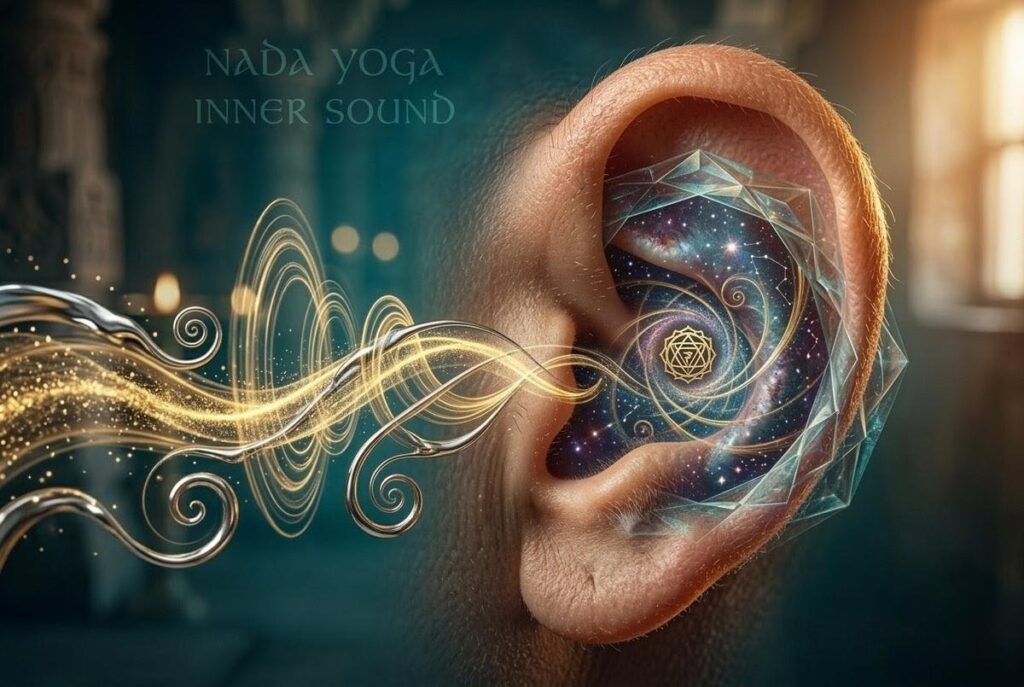
Nada Yoga is the yoga of sound. In one important form, it involves listening inwardly for anahata nada, often translated as the unstruck sound. “Unstruck” means sound not produced by an external impact. It points towards an inner or subtle sound heard in deep listening.
Traditional descriptions may speak of bells, flutes, bees, ocean, thunder, humming, or subtle tones. These descriptions are poetic and experiential. They should not be turned into a checklist or used to override medical reality. If you hear persistent ringing, buzzing, whooshing, or tonal sound, especially if it is distressing, one-sided, sudden, or associated with hearing changes, seek appropriate medical or audiological assessment.
The Hatha Yoga Pradipika and Inner Listening
The Hatha Yoga Pradipika devotes part of its final chapter to inner sound and meditative absorption. It describes listening inwardly as a way of drawing the mind away from outward distraction and into subtler states of attention.
Some traditional instructions involve closing the ears and listening internally. For modern readers, this should be done gently, briefly, and without pressure. Ear-closing practices can intensify internal sound, pressure, heartbeat, bodily noise, or tinnitus. That does not automatically make what is heard spiritually meaningful.
A safer beginner approach is simple: sit quietly, let the breath settle, listen to external sounds without chasing them, then notice whether there is a softer layer of inner auditory experience. Do not demand results. Listening matures by patience, not by pressing harder on the practice.
Inner Sound, Tinnitus, and Discernment
Sound practice needs one very clear distinction: inner sound as contemplative experience should not be confused with tinnitus or other hearing conditions. Tinnitus can involve ringing, buzzing, hissing, pulsing, clicking, roaring, or tonal sound. It may be temporary or persistent, mild or distressing. It can be linked with hearing loss, medication, stress, jaw tension, noise exposure, infection, neurological factors, or other causes.
Do not dismiss persistent ringing as “spiritual sound”. Do not intensify ear-closing practices to force a result. Do not use mystical interpretation to avoid medical care. If inner sound is distressing, new, one-sided, pulsatile, associated with dizziness, hearing loss, pain, pressure, neurological symptoms, or sleep disruption, seek qualified assessment.
For contemplative practice, the safer question is not “is this sound mystical?” but “does this listening make me steadier, kinder, more embodied, and more present?” If the answer is no, return to simpler practice: breath, sensation, walking, ordinary sound, and grounding.
This caution matters because false authority can turn symptoms into signs too quickly. A distressing inner sound may be spiritualised by a teacher, forum, AI answer, or personal mythology before the body has been cared for. Discernment keeps the ear human. It allows mystery without abandoning medicine, embodiment or common sense.

Shabda, Nada, Bindu, Shunya
Some sound traditions describe a movement from shabda, spoken word or sound, to nada, inner sound, to bindu, point or seed, to shunya, emptiness or spaciousness. This can be read as a contemplative sequence rather than a mechanical ladder.
Begin with sound. The sound gathers attention. When the sound ends, listen to the resonance. The resonance becomes subtler. At times, attention may feel drawn towards a point: a felt centre in the heart, throat, brow, or simply the centre of awareness. Then even that point may dissolve into silence.
This sequence should be approached as poetic practice language, not as a guaranteed internal event. Some sessions produce quiet. Some produce boredom. Some produce emotion. Some produce nothing dramatic at all. That is not failure. Sonic practice is not measured by fireworks. It is measured by the gradual refinement of listening.
The sequence also protects against spiritual theatrics. Sound leads to resonance. Resonance leads to listening. Listening leads to silence. Silence leads back to life. If sound practice makes the practitioner louder, harsher, more inflated, or less able to listen, something has gone off-key.

Practical Protocols for Sonic Practice
The following protocols are gentle starting points, not advanced instructions. Use them lightly. Adjust for your own body, tradition, health, nervous system, and life rhythm.
Morning Japa: Establishing the Tone
Begin with five to ten minutes of audible japa in the morning. Choose one mantra or sacred phrase. Sit upright or walk slowly. Let the breath be natural. Repeat the sound without pushing the voice.
After a few minutes, reduce the volume to a whisper. Then let the mantra continue mentally for a short period. End by sitting quietly and listening. Notice whether the body feels more settled, more agitated, or unchanged.
The aim is not to conquer the morning. The aim is to tune the first layer of attention before the day gathers speed.
Evening Listening: The Quiet Threshold
Before sleep, avoid intense sonic practice. Instead, try five to fifteen minutes of gentle listening. Sit upright if lying down makes you sleepy. Let the breath settle. Listen first to external sounds: room, house, wind, distant traffic, night. Then listen to the silence around those sounds.
If inner sound appears, notice it without chasing it. If nothing appears, rest in ordinary listening. The practice is the listening itself, not the production of a special sound.
Stress Mantra: Interrupting the Loop
During stress, repeat a short phrase quietly for one to three minutes. This could be a prayer, mantra, sacred word, or simple grounding phrase such as “breathing here” or “return”. Let the sound slow the breath and give the mind one thing to hold.
The mantra does not solve the situation by itself. It changes your relationship to the nervous-system loop. Once steadier, you may be able to act more clearly.
The Borrowed Voice Check
Use this when a teacher, video, AI adviser, group chant, recommendation, or spiritual phrase feels unusually compelling. Pause. Feel the feet. Let the jaw soften. Ask silently: is this voice returning me to direct knowing, or making me dependent on itself?
Then listen to the body. Do not rush to a verdict. Notice breath, throat, chest, belly, hands, and posture. The point is not to reject the voice automatically. The point is to include the body and restore the space in which discernment can speak.
Troubleshooting the Gateway
Dryness and Mechanical Repetition
Mantra sometimes becomes dry. This is not always a problem. Repetition has seasons. Some days the phrase feels alive. Some days it feels plain, quiet, and ordinary.
If practice feels mechanical, slow down. Feel the meaning of the phrase. Let the sound vibrate in the chest or throat. Connect the repetition with breath. Reduce the number and increase the attention. One sincere minute is better than thirty minutes of muttering while the mind shops for distractions.
Frustration With Nada
If you hear nothing inwardly, do not force it. Nada Yoga is not a performance exam. Listening takes time, and not every practitioner will experience inner sound in the same way. Some may never hear anything dramatic, yet still benefit from the discipline of listening.
If you hear persistent ringing, buzzing, or whooshing, do not automatically interpret it as nada. Treat persistent or distressing sound as a possible hearing issue first. Medical caution is not anti-spiritual. It is grounded care for the body that makes practice possible.
Overstimulation and Energy Phenomena
Sound practice can sometimes stir strong sensations: heat, vibration, emotion, trembling, visual imagery, spaciousness, grief, or agitation. These may be meaningful, but they are not destinations.
If sound practice becomes too intense, stop. Open your eyes. Feel the floor. Drink water. Eat something simple if needed. Walk. Do an ordinary task. Speak with someone steady. Return to breath and sensation before returning to sound.
Do not chase kundalini-style phenomena through louder chanting, longer sessions, sleep deprivation, or obsessive listening. Sound should deepen integration, not overload the nervous system.
Dependence on a Teacher’s Voice
Sometimes the issue is not the mantra, but the voice carrying it. A practitioner may become dependent on a teacher’s recordings, tone, presence, cadence, approval, or emotional atmosphere. The voice begins as support, then becomes the gatekeeper of practice.
This is a subtle form of authority capture. A healthy teacher helps the practitioner listen more clearly. An unhealthy authority trains the practitioner to need the teacher’s voice in order to feel real, safe, awakened or chosen. The difference matters.
A simple test: can the practice remain steady when the teacher is absent? Can the mantra become your own responsibility? Can silence return without panic? If not, slow down and restore grounding. The gateway should open inward, not bind the ear to a single external source.
The Thread Extended
The sound, produced or discovered, concentrates. Concentration steadies attention. Steady attention opens into listening. Listening reveals silence. Silence returns the practitioner to life with a different ear.
The Gateway of Sound is not separate from the other gateways. Breath carries mantra. Sensation receives vibration. Vision may later give sound a geometric companion through yantra and mandala. Movement integrates rhythm into action. Silence receives the final echo.
You sound. You listen. You return. The thread continues through vibration towards the stillness from which every sound arises and into which every sound disappears.
This return is the mark of healthy practice. The voice does not become a shrine to itself. The mantra does not become an identity. The inner sound does not become a private mythology. Sound opens the way back to the ordinary world with a listening that is less reactive, less hungry, and more awake.
The Gnostic Reading: Sound Against Fragmentation
Gnostic myth often describes the human condition as fragmentation: the divine spark scattered, distracted, misnamed, and trapped inside false patterns of identity. In a symbolic reading, sound practice answers fragmentation through repetition, coherence, and remembrance.
The repeated sacred phrase gathers what the world has scattered. The voice returns to one sound. Breath and word become one rhythm. The mind, usually dispersed through many corridors, is invited back into a single chamber.
This does not mean mantra is a weapon against life. It is not there to drown out ordinary responsibility, relationship, grief, or thought. It is there to create enough inner steadiness for direct knowing to survive contact with noise.
In Gnostic terms, false rule depends on forgetfulness. The mantra remembers. The inner sound listens beneath the outer noise. The practitioner does not escape the world through vibration. They learn how to inhabit the world without being entirely governed by its static.
The borrowed voice is part of that static. It may sound holy, therapeutic, rational, scientific, compassionate, or algorithmically balanced. But if it replaces direct knowing, it remains false authority wearing a beautiful tone. The Gnostic ear does not despise voices. It tests them through breath, body, conscience, silence, relationship and time.
The deepest sound practice may end not in sound, but in more truthful silence.
Related Glossary Terms
For quick definitions, use the main ZenithEye Glossary. The key terms for this article are:
Read Next
Continue with: The Gateway of Vision: Yantra and Mandala Practice
If sound gathers attention through vibration and listening, vision gives attention a sacred form. Yantra and mandala practice carry the gathered mind into geometry, image, centre, afterimage, and the contemplative discipline of seeing.
Within Practice & Method
This article belongs to The Five Gateways and Contemplative Techniques, the Practice & Method route where breath, sensation, sound, vision, movement, and silence become practical entrances into direct knowing.
Frequently Asked Questions About Mantra and Nada Yoga
What is the Gateway of Sound?
The Gateway of Sound is the practice of using mantra, chant, prayer, vibration, silence, and inner listening to gather attention and deepen awareness. It is one of the Five Gateways because sound links breath, body, rhythm, meaning, and attention in a direct and embodied way.
What is the difference between mantra and Nada Yoga?
Mantra practice involves producing or repeating a sacred syllable, word, prayer, or phrase. Nada Yoga involves listening inwardly for subtle sound, often called anahata nada or the unstruck sound. Mantra emphasises repetition and production. Nada Yoga emphasises receptivity and listening. The two can support one another when approached gently.
How do I choose a mantra safely and respectfully?
Choose a mantra or sacred phrase you can use sincerely and respectfully. Some mantras belong to specific lineages or initiatory contexts, while others are widely used in public devotional practice. Avoid choosing a phrase only because it sounds exotic. Sincerity, continuity, humility, and respect for the tradition matter more than novelty.
How does sound practice help with false authority?
Sound practice can help reveal false authority by refining listening. A teacher, group, feed, or AI adviser may sound confident, calm or sacred, but the practitioner learns to notice tone, pressure, bodily response, and dependence. The aim is not suspicion, but clearer hearing before obedience.
Is Om or AUM tied to one exact frequency?
No. Modern claims that Om must be chanted at one special frequency, such as 432 Hz, should be treated cautiously. Traditional practice does not depend on one fixed tuning number. The value of Om practice lies in breath, vibration, attention, symbolic meaning, repetition, and the silence that follows the sound.
What is anahata nada?
Anahata nada means unstruck sound, a subtle inner sound described in yogic traditions. It may be approached through quiet listening, but it should not be confused with tinnitus or hearing conditions. Persistent, distressing, one-sided, pulsatile, or sudden inner sound should be assessed medically rather than automatically interpreted as mystical.
Can sound practice trigger intense experiences?
Yes, some people may experience strong emotion, heat, vibration, imagery, trembling, agitation, or altered states during chanting or inner listening. These effects should not be chased. If practice becomes overwhelming, stop, open your eyes, ground through the body, drink water, walk, rest, and seek support if symptoms persist.
How long should I practise mantra or Nada Yoga each day?
Begin gently. Five to ten minutes of simple mantra practice is enough for many beginners. Nada Yoga should also begin briefly and without expectation. Longer practice is not automatically better. Quality of attention, steadiness, grounding, and integration matter more than duration.
How does sound practice relate to Gnostic practice?
In a Gnostic symbolic reading, sound practice gathers the scattered self and interrupts forgetfulness. A repeated sacred phrase creates remembrance, coherence, and inward return. The deeper aim is not sound for spectacle, but stable attention, clear listening, and direct knowing carried back into ordinary life.
Study and Safety Note
This article explores mantra, japa, Nada Yoga, sacred sound, inner listening, vibration, altered states, and Gnostic symbolism for educational and reflective purposes. It does not provide medical, psychological, psychiatric, audiological, trauma, meditation-instruction, or spiritual-direction advice.
If you experience persistent or distressing ringing, buzzing, pulsatile sound, hearing loss, dizziness, ear pain, pressure, sleep disruption, or sudden change in hearing, consult an audiologist or qualified healthcare professional. Do not assume tinnitus or auditory symptoms are spiritual experiences.
If chanting, mantra, silence, or inner listening produces panic, dissociation, derealisation, depersonalisation, insomnia, compulsive repetition, intrusive sounds, intense heat, involuntary movements, depression, suicidal thoughts, or difficulty functioning, stop the practice and seek appropriate support.
Sound practice should return you to life more whole: clearer in speech, steadier in breath, softer in listening, and more grounded in the ordinary world.
For the authority layer, read this article beside Neo Gnosticism and False Authority. Sonic practice is healthiest when it restores listening, not when it makes the seeker dependent on a borrowed voice.
Further Reading
These ZenithEye links continue the themes of sound, breath, sensation, vision, altered states, nervous-system regulation, false authority, and integration:
- The Gateway of Vision: Yantra and Mandala Practice – The next gateway in the live Five Gateways route, carrying gathered attention into sacred form, symbol, and contemplative seeing.
- Neo Gnosticism and False Authority – Gurus, algorithms, AI advisers, spiritual outsourcing and the theft of direct knowing.
- The Gateway of Breath: Pranayama Techniques for Altered States – Breath as the first gateway, stabilising the nervous system before sonic practice deepens.
- The Gateway of Sensation: Body Scan and Somatic Awareness – Grounding attention in the body before working with vibration, mantra, and inner sound.
- The Body Against the Algorithm – The political and spiritual necessity of bodily presence in a screen-trained age.
- The Five Gateways to Direct Knowing: A Complete Map – The wider gateway architecture of breath, sensation, sound, vision, and movement.
- Creating Personal Practice: How to Combine the Five Gateways – How to sequence breath, sensation, sound, vision, and movement into a sustainable daily structure.
- The Gateway of Movement: Walking Meditation and Circulation – Movement as the grounding and integration of sound, breath, and visual practice.
- Kundalini Phenomena: The Physiology of Spiritual Emergence – Understanding energetic activation, altered states, and the importance of integration.
- The Discipline of Solitude: Extended Alone Time as Gateway to Recognition – The quiet conditions that support inner listening, mantra, and contemplative depth.
- States of Knowing: What Happens When Consciousness No Longer Belongs to You – Altered states, absorption, destabilisation, and the need for grounded discernment.
- Contemplative Techniques: Methods for Stabilisation – Integrating sonic practice into a broader contemplative framework.
- Integration and Grounding After Awakening – Returning from intense practice into body, relationship, ordinary tasks, and steady life.
- Nervous System Regulation: The New Meditation and Embodied Spirituality – How regulation, embodiment, and safety support contemplative practice.
References and Sources
The following sources support the historical, traditional, contemplative, physiological, and safety framework used in this article.
Primary Sources and Classical Texts
- Svatmarama. Hatha Yoga Pradipika, especially chapter 4 on nada, absorption, and inner sound. Various translations, including Swami Muktibodhananda.
- Mandukya Upanishad. Classical Vedantic source for Om, the four states of consciousness, and the silence beyond A-U-M.
- Patanjali. Yoga Sutras. Classical source for concentration, meditation, absorption, and the disciplined path of yoga.
- Gheranda Samhita. Classical hatha yoga text on purification, posture, mudra, breath, meditation, and samadhi.
- Shiva Samhita. Classical hatha yoga text discussing subtle anatomy, prana, chakras, and yogic practice.
- Discourse on the Eighth and Ninth. Nag Hammadi Codex VI,6, a Hermetic text with prayer, ascent, and sacred vocal formulae.
- Gregory Palamas. The Triads. Foundational hesychast theology associated with stillness, prayer, and divine light.
Yoga, Sound, Mantra, and Tantra Studies
- Beck, Guy L. Sonic Theology: Hinduism and Sacred Sound. University of South Carolina Press, 1993.
- Beck, Guy L., ed. Sacred Sound: Experiencing Music in World Religions. Wilfrid Laurier University Press, 2006.
- Padoux, Andre. Vac: The Concept of the Word in Selected Hindu Tantras. SUNY Press, 1990.
- Flood, Gavin. The Tantric Body: The Secret Tradition of Hindu Religion. I. B. Tauris, 2006.
- Feuerstein, Georg. The Yoga Tradition: Its History, Literature, Philosophy and Practice. Hohm Press, 1998.
- Mallinson, James and Singleton, Mark. Roots of Yoga. Penguin Classics, 2017.
- Avalon, Arthur, Sir John Woodroffe. The Serpent Power. Luzac, 1919.
Christian, Sufi, and Comparative Repetition Practice
- Ware, Kallistos. The Power of the Name: The Jesus Prayer in Orthodox Spirituality. SLG Press, 1974.
- The Philokalia. Selected writings on prayer, watchfulness, inner stillness, and the Jesus Prayer.
- Lings, Martin. What is Sufism? University of California Press, 1975.
- Schimmel, Annemarie. Mystical Dimensions of Islam. University of North Carolina Press, 1975.
- Nasr, Seyyed Hossein. Islamic Spirituality: Foundations. Routledge, 1987.
Sound, Brain, Breath, and Physiology
- Kalyani, B. G., et al. “Neurohemodynamic Correlates of OM Chanting: A Pilot Functional MRI Study.” International Journal of Yoga, 4(1), 3-6, 2011.
- Bernardi, L., et al. “Effect of Rosary Prayer and Yoga Mantras on Autonomic Cardiovascular Rhythms.” BMJ, 323, 1446-1449, 2001.
- Newberg, Andrew B. and Iversen, Jeremy. “The Neural Basis of the Complex Mental Task of Meditation: Neurotransmitter and Neurochemical Considerations.” Medical Hypotheses, 61(2), 282-291, 2003.
- Perry, Christopher M., et al. Studies on chanting, humming, respiration, and autonomic effects in contemplative and psychophysiological research.
- Lehrer, Paul and Gevirtz, Richard. “Heart Rate Variability Biofeedback: How and Why Does It Work?” Frontiers in Psychology, 5, 756, 2014.
- Russo, Marc A., Santarelli, Danielle M., and O’Rourke, Dean. “The Physiological Effects of Slow Breathing in the Healthy Human.” Breathe, 13(4), 298-309, 2017.
- Zaccaro, Andrea, et al. “How Breath-Control Can Change Your Life: A Systematic Review on Psycho-Physiological Correlates of Slow Breathing.” Frontiers in Human Neuroscience, 2018.
Meditation Safety, Tinnitus, Trauma, and Integration
- Baguley, David, McFerran, Don, and Hall, Deborah. “Tinnitus.” The Lancet, 382(9904), 1600-1607, 2013.
- Treleaven, David A. Trauma-Sensitive Mindfulness: Practices for Safe and Transformative Healing. W. W. Norton, 2018.
- van der Kolk, Bessel. The Body Keeps the Score: Brain, Mind, and Body in the Healing of Trauma. Viking, 2014.
- Ogden, Pat, Minton, Kekuni, and Pain, Clare. Trauma and the Body: A Sensorimotor Approach to Psychotherapy. W. W. Norton, 2006.
- Grof, Stanislav and Grof, Christina. Spiritual Emergency: When Personal Transformation Becomes a Crisis. Tarcher, 1989.
- Lindahl, Jared R., et al. “The Varieties of Contemplative Experience: A Mixed-Methods Study of Meditation-Related Challenges in Western Buddhists.” PLOS ONE, 12(5), 2017.
Gnostic and Hermetic Context
- Robinson, James M., ed. The Nag Hammadi Library in English. Revised edition. HarperOne, 1990.
- Meyer, Marvin, ed. The Nag Hammadi Scriptures. HarperOne, 2007.
- Layton, Bentley. The Gnostic Scriptures. Yale University Press, 1987.
- Brakke, David. The Gnostics: Myth, Ritual, and Diversity in Early Christianity. Harvard University Press, 2010.
- King, Karen L. What Is Gnosticism?. Harvard University Press, 2003.
- Copenhaver, Brian P. Hermetica: The Greek Corpus Hermeticum and the Latin Asclepius. Cambridge University Press, 1992.