
The Ungovernable Attention: Cognitive Sovereignty in the Algorithmic Age
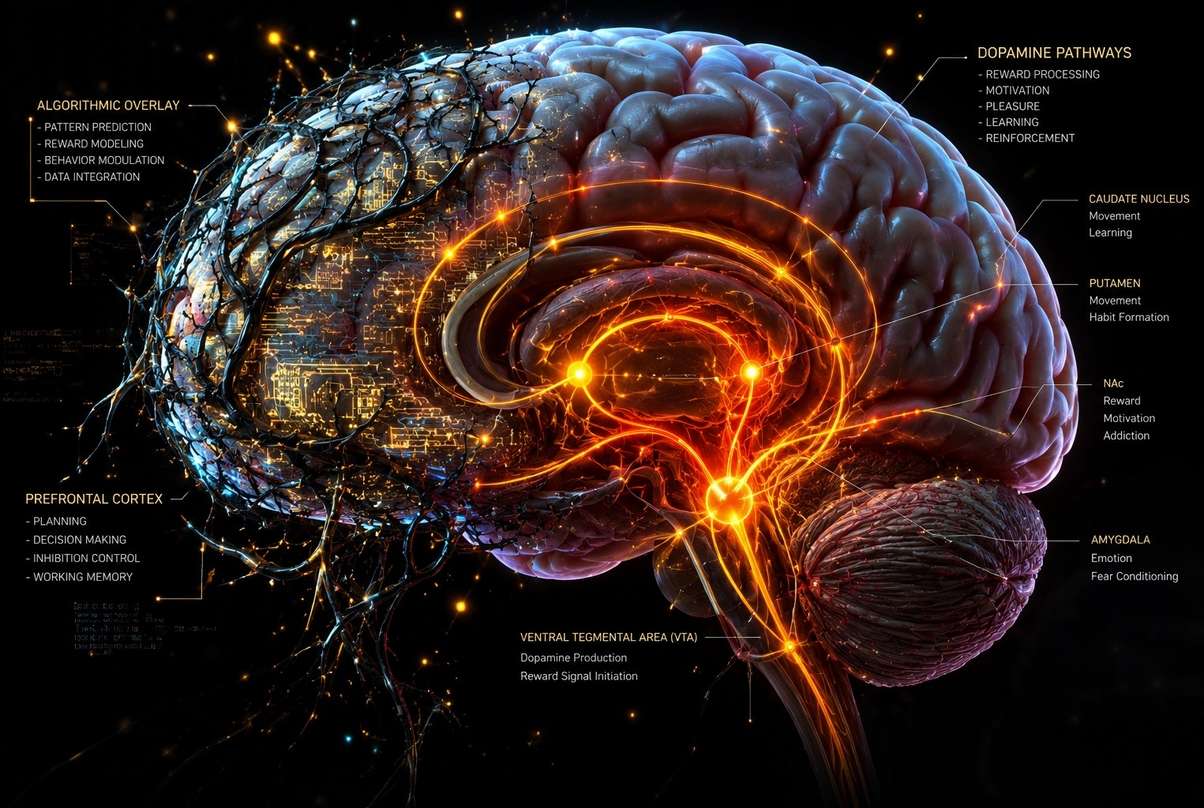
There is a struggle being fought for the territory between your ears. Not because you are weak, foolish, or uniquely vulnerable, but because the systems competing for your attention do not sleep, tire, forget, or lose interest. They learn from every pause, swipe, click, hesitation, outrage, curiosity, and return. The algorithm does not need to know your soul. It only needs to predict your next movement.
Cognitive sovereignty is the capacity to direct one’s own attention, form one’s own judgements, and preserve a private inner life in an economy built to monetise interruption. While public debates often focus on data privacy, encryption, and platform regulation, the more intimate question is older and deeper: who governs the mind while it believes itself free?
For a Gnostic reading, the attention economy is not merely a technological problem. It is an archonic pattern in modern form: a system of mediation, prediction, distraction, and subtle command. The prison is not made of iron. It is made of convenience, emotional stimulation, personalised feeds, and the quiet erosion of unobserved thought.
This article examines the architecture of attention extraction and offers a framework for reclamation. It is not a digital detox guide, and it is not a call to reject technology. It is a field manual for remembering that attention is not a disposable resource. It is the gateway through which reality enters.
In Plain Terms
Cognitive sovereignty means retaining the ability to choose where your attention goes, what shapes your thoughts, and how much of your inner life remains unmonetised. In the attention economy, platforms compete to predict and steer behaviour because attention produces data, data improves targeting, and targeting generates revenue.
The Gnostic lens reads this as a modern form of archonic control: not possession of the body, but capture of perception. The way out is not panic, purity, or technophobia. It is deliberate friction, contemplative discipline, embodied presence, and the restoration of spaces where thought is not instantly converted into content.
Sources and Disciplines Discussed
- Attention research, especially Gloria Mark’s work on digital interruption and screen-switching behaviour.
- Behavioural psychology, including variable reinforcement and the design of habit-forming systems.
- Social media research on outrage, outgroup language, false news, and sharing behaviour.
- Neuroscience and mental health research on attention switching, stress, reward anticipation, and problematic platform use.
- Gnostic symbolism, especially the archonic pattern of mediation, false authority, and perception capture.
- Contemplative practice, particularly attention training, silence, embodied presence, and disciplined withdrawal from compulsive stimulus loops.
How to Read This Article
This article uses strong symbolic language, but it is not claiming that algorithms are literal demons or that every platform designer is malicious. The point is structural: systems can constrain attention without hatred, ideology, or conscious intent. They only need incentives that reward capture over clarity.
Read the Gnostic language as a lens for recognising patterns: mediation mistaken for reality, stimulation mistaken for aliveness, prediction mistaken for knowledge, and convenience mistaken for freedom.

Table of Contents
- The Colonisation of the Last Frontier
- The Mechanics of Mental Occupation
- The Fragmentation Bomb
- The Affective Hack
- The Synthetic Social
- The Reclamation Project
- The Inner Sanctum
- The Gnostic Reading: Attention as First Gate
- Related Glossary Terms
- Read Next
- Frequently Asked Questions
- Further Reading
- References and Sources
Your attention is the scarcest resource you possess. Spend it as if the architecture around you has intentions, because incentive systems often behave as though they do.
The Colonisation of the Last Frontier
The enclosure movement privatised the commons. The industrial revolution mechanised the body. The digital revolution has colonised the last intimate territory: the interior of attention itself. The mind was never perfectly sovereign. It has always been vulnerable to habit, propaganda, desire, fear, ritual, advertising, and social pressure. What is new is the scale, speed, precision, and automation of the capture.
Digital platforms do not merely present information. They measure response. Every pause becomes a signal. Every skipped post becomes a signal. Every return after boredom, irritation, loneliness, or insomnia becomes a signal. Those signals train systems that optimise what appears next. The feed is not a window. It is a behavioural environment, revised in real time.
In the attention economy, engagement is the metric of extraction. The longer a user remains within a platform, the more data can be gathered, the more advertisements can be shown, and the more predictable the user becomes. The familiar phrase “the user is the product” is crude but useful. More precisely, the user’s behavioural prediction profile is the product, and attention is the raw material from which that product is refined.
What makes this colonisation difficult to recognise is its apparent benevolence. Platforms provide genuine goods: connection, humour, news, companionship, discovery, beauty, entertainment, and access to knowledge. The archon does not need to appear as tyrant when it can appear as concierge. The prison is built from preferences, and the bars are calibrated so precisely that they feel like comfort.
The Gnostic tradition speaks of the hylic condition: the mode of consciousness that takes the visible, given, and measurable as the whole of reality. The algorithmically managed mind becomes hylic when it forgets that the feed is a construction. It begins to inhabit a curated world so seamlessly that the possibility of unmediated perception becomes harder to imagine.
The Mechanics of Mental Occupation
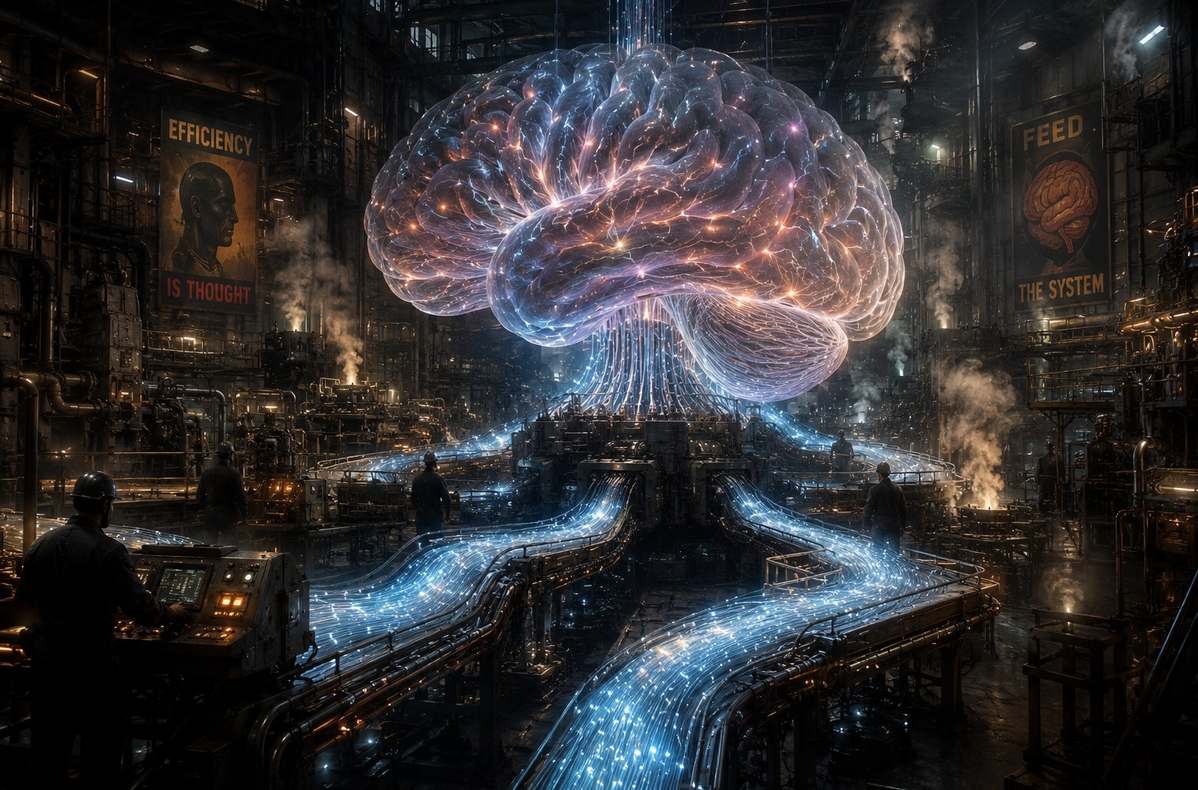
The attack on attention is multi-vector. It combines behavioural design, social comparison, emotional arousal, notification architecture, infinite scroll, algorithmic ranking, and the ordinary human hunger for belonging. No single mechanism explains everything. The spell works because many small mechanisms converge.
Understanding those mechanisms does not make a person immune. Knowledge is not immunity. But it turns invisible pressure into visible structure, and visible structure can be resisted.
The Fragmentation Bomb
The popular claim that the average human attention span has collapsed to eight seconds, supposedly below that of a goldfish, is a neuromyth. The claim circulated widely after a Microsoft Canada marketing report and was later criticised because the underlying source was not a peer-reviewed measure of human attention. The more careful conclusion is not that human beings have become biologically incapable of sustained attention. It is that many digital environments train rapid switching.
Gloria Mark, Chancellor’s Professor of Informatics at UC Irvine, has studied attention on digital devices over many years. Her published and public-facing summaries report a striking decline in the average amount of time people spend on a screen before switching: roughly 150 seconds in 2004, 75 seconds in 2012, and around 47 seconds in later observations. This does not mean the soul has been replaced by a fruit fly. It means the surrounding environment has become unusually skilled at interrupting continuity.
The damage is not only lost time. Fragmentation changes the texture of consciousness. A thought begins, then the device calls. A sentence forms, then the tab beckons. A difficult emotion rises, then the feed offers anaesthetic novelty. The nervous system adapts to the available world, and if the available world is made of interruption, the mind learns interruption as weather.
Notifications, infinite scroll, and context switching are not neutral details. They reshape the field in which attention lives. A person may still be capable of deep focus, but capability is not the same as availability. The well may be deep, yet the bucket is being kicked every minute.
The Affective Hack
Algorithms do not need to defeat reason directly. It is often easier to bypass it by amplifying emotion. Fear, outrage, envy, desire, humiliation, tribal loyalty, and moral disgust are reliable engines of engagement. The system does not need to care whether an emotion is good for you. It only needs to learn whether the emotion keeps you present, reactive, and returning.
Behavioural psychology helps explain the hook. Variable reinforcement, the same broad principle that makes gambling machines compelling, rewards behaviour unpredictably. Sometimes a check produces a message. Sometimes a post produces approval. Sometimes the feed offers something beautiful, shocking, erotic, enraging, or personally relevant. The uncertainty becomes part of the attraction.
Dopamine is often misunderstood as simple pleasure chemistry. More precisely, it is deeply involved in reward prediction, learning, salience, and anticipation. This matters because the platform does not need to deliver fulfilment. It only needs to keep the organism anticipating the next possible reward. The pull-to-refresh gesture is not a tool of information retrieval alone. It is a tiny liturgy of uncertainty.
The political dimension is equally important. Research in Proceedings of the National Academy of Sciences found that each additional word referring to a political outgroup increased the odds of a post being shared by about 67%. Separate MIT research on Twitter found that false news was 70% more likely to be retweeted than true news. These findings do not prove that platforms consciously prefer social decay. They show something colder: content that provokes, divides, and shocks can travel extremely well inside systems that reward sharing.
The algorithm does not need to hate peace. It only needs to notice that agitation performs better.
The Synthetic Social
Your friendships are not invented by the platform, but they are increasingly mediated by it. Your conversations are nudged by notifications, visibility settings, reaction buttons, comment hierarchies, predictive text, and the silent rankings of the feed. The “social” becomes the most effective vector of influence because it does not feel like influence. It feels like connection.
The synthetic social exploits an ordinary human tendency: we associate with people, ideas, symbols, and emotional tones that feel familiar. Sociologists call this homophily. Algorithmic curation can intensify this tendency by constructing environments that confirm affinity, sharpen opposition, and keep the user inside a tailored symbolic climate.
Eli Pariser called one version of this the “filter bubble.” Yet the deeper issue is not merely that users see only what they already agree with. It is that feeds are optimised according to engagement rather than wisdom. The system may serve what agitates before what clarifies, because agitation is measurable, repeatable, and profitable.
The couple scrolling beside each other in bed is not simply failing at intimacy. They are participating in an environment that makes distraction effortless and presence effortful. The friend group that communicates through curated fragments is not merely sharing life. It is also exchanging behavioural data inside a marketplace that profits from mediation.
The Reclamation Project
Cognitive sovereignty is not restored by disgust alone. Disgust can become another stimulus loop, another identity, another performance. Reclamation requires design. The user must redesign the environment because the environment has already been designed by someone else.
The following practices are not moral commandments. They are forms of friction. Friction is holy here. The system wants immediate access, instant reaction, and unconscious return. Friction gives the will a door-handle.
The Monastic Device
Your phone is not only a tool. It is also a portal through which requests, incentives, advertisements, anxieties, and other people’s emergencies enter your nervous system. Treat it accordingly.
The monastic device protocol is not about total abstinence. It is about containment. Place the device in a designated location. Use it at designated times. Decide in advance what you are opening it to do. Remove it from the bedroom when possible. Turn off non-essential notifications. Use grayscale if colour cues pull you back into compulsive checking. Put the portal on a leash.
The medieval monk did not reject the world because the world had no value. He regulated contact with it because the soul requires intervals of non-interference. The modern practitioner needs the same principle in digital form: not hatred of tools, but boundary around access.
The Discipline of Depth
Schedule protected blocks for single-task attention. Begin modestly if necessary. Thirty minutes of undivided attention is more valuable than three hours of theatrical productivity scattered across tabs, messages, feeds, and alerts.
Read physical books. Write with pen and paper. Walk without headphones. Sit without immediately converting silence into content. These analogue practices are not nostalgia. They are counter-rituals. They restore a form of experience that does not instantly report itself to a server.
Cal Newport popularised the term “deep work” for cognitively demanding activity performed in a state of distraction-free concentration. ZenithEye’s concern is wider than productivity. Deep work matters because sustained attention preserves the architecture of interiority. A mind that cannot remain with anything difficult becomes easy to govern.
The Affective Fast
One day per week, or one defined window per week, abstain from news feeds, social media, algorithmic entertainment, and reactive commentary. This is not because information is evil. It is because emotional manipulation often hides inside the costume of information.
Notice what happens. The urge to check. The phantom pull. The anxiety that something important is happening without you. The sudden flatness of ordinary time. The boredom that feels like deprivation because stimulation has been mistaken for aliveness.
The affective fast is not merely an information diet. It is an emotional diet. You are abstaining from outrage, novelty, comparison, performance, and the engineered rhythm of anticipation. What first appears as emptiness may become spaciousness. The first silence often sounds like withdrawal. Later, it begins to sound like yourself returning.
The Curation of Inputs
Be ruthless with inputs, but not narrow-minded. Curation does not mean refusing challenging material. It means distinguishing nourishment from stimulation, education from provocation, discipline from doom, and genuine difficulty from emotional bait.
A difficult book asks you to think. An outrage feed asks you to react. A demanding conversation may deepen you. A comment war usually spends you. A well-sourced essay may disturb your assumptions. A personalised feed may merely inflame your reflexes and call that awakening.
The sovereign reader does not ask only, “Is this true?” That matters, but it is not enough. The sovereign reader also asks, “What state does this put me in? What does it train me to seek? What does it make easier or harder to perceive?”

The Inner Sanctum
Maintain a zone of cognitive privacy: thoughts that are not digitised, monetised, posted, optimised, or turned into a personal brand. In an age where expression is constantly encouraged, the unexpressed thought becomes a form of freedom.
The inner sanctum is not secrecy for its own sake. It is the preservation of a region outside the extractive economy: a space that generates no data, performs no identity, produces no engagement, and offers no behavioural signal. It is the part of consciousness that refuses conversion into content.
This is one reason contemplative traditions value silence. Silence is not merely the absence of speech. It is an ecology where thought can ripen without being harvested early. Not every insight should be shared. Not every wound should be narrated. Not every recognition should be posted before it has roots.
Neuroplasticity offers hope, but it should not be treated as a magic wand. The brain and nervous system adapt to repeated environments. If the environment is constant interruption, the mind becomes interruption-shaped. If the environment includes silence, depth, movement, sleep, embodied practice, and slower reward, attention can begin to stabilise again. Timelines vary. The principle is simple: change the field, and the organism has a chance to change its habits.
The question is not whether reclamation is possible. The question is whether the discomfort of withdrawal, the boredom of depth, and the loneliness of unmediated thought can be endured long enough for native attention to reappear. The algorithm offers constant company. Sovereignty may first offer only yourself. That is why many refuse it. That is why it matters.

The Gnostic Reading: Attention as First Gate
In Gnostic myth, the archons do not rule only through force. They rule through ignorance, imitation, fear, false authority, and misrecognition. They keep consciousness looking outward, downward, and sideways, anywhere but towards the hidden source of its own light.
The attention economy repeats this pattern without needing to believe in it. It keeps consciousness dispersed across surfaces. It encourages comparison instead of recognition, reaction instead of discernment, and stimulation instead of presence. It does not need to disprove the soul. It only needs to keep the soul too busy to notice itself.
This is why attention is the first gateway. Before doctrine, before ritual, before interpretation, before metaphysics, there is the simple question: can awareness remain with what is present? Can it notice the hook before biting? Can it feel the impulse without obeying? Can it distinguish the living signal from the manufactured lure?
Gnosis begins where automatic capture ends. Not because the phone is evil, not because technology is fallen, but because unconscious mediation is the perfect hiding place for false gods. The screen becomes archonic when it claims the right to decide what matters before the soul has even arrived.
To reclaim attention is therefore not a lifestyle tweak. It is a spiritual act. It is the refusal to let the world’s machinery determine the whole field of perception. It is the recovery of the inner witness from the feed’s revolving theatre. It is the moment the user stops being used.
Related Glossary Terms
For quick definitions, use the main ZenithEye Glossary. The key terms for this article are:
Read Next
Continue with: The Architecture of the Infinite Scroll: How Short-Form Content Rewires Neural Pathways
If this article maps the struggle for cognitive sovereignty, the next step is to examine the design pattern that keeps attention moving: the endless feed, the broken sentence, and the architecture of perpetual nextness.
Within The Thread
This article belongs to Digital Attention & Surveillance, a layer of The Thread concerned with attention capture, algorithmic mediation, behavioural prediction, surveillance culture, and the modern systems that shape perception before conscious choice has fully formed.
Frequently Asked Questions
What is cognitive sovereignty?
Cognitive sovereignty is the capacity to direct your own attention, preserve your inner life, form your own judgements, and resist systems that predict, nudge, and monetise mental behaviour. It does not require rejecting technology. It requires using technology consciously rather than being unconsciously shaped by it.
Is the goldfish attention span claim true?
No. The claim that human attention spans are shorter than a goldfish’s is a widely repeated neuromyth. It came from weakly sourced marketing material rather than solid peer-reviewed attention science. More careful research suggests that digital environments encourage rapid switching, but this is not the same as a collapse in innate human attention capacity.
How do social media platforms capture attention?
Social media platforms capture attention through notification cues, infinite scroll, variable reinforcement, social comparison, emotional arousal, algorithmic ranking, and personalised content. These systems learn from behaviour and then present material likely to keep the user engaged, reactive, and returning.
Why does outrage spread so easily online?
Outrage spreads easily because emotionally charged content often generates stronger reactions, more comments, and more sharing. Research has found that political outgroup language significantly increases sharing, while false news has been shown to travel faster and more widely than true news on Twitter. Platforms optimised for engagement can therefore amplify divisive material even without explicit ideological intent.
What is an affective fast?
An affective fast is a deliberate break from algorithmic emotional stimulation, especially news feeds, social media, reactive commentary, and entertainment designed to provoke compulsive checking. The aim is not ignorance but nervous-system recalibration: learning what attention feels like when it is not being continually pulled by outrage, novelty, comparison, or anticipation.
Is this article saying technology is evil?
No. The article does not claim technology is evil. It argues that digital systems carry incentives and assumptions about human attention. Technology can support learning, creativity, connection, and practice, but it becomes archonic when it captures perception, narrows choice, and turns the user into a predictable behavioural unit.
How can I begin reclaiming attention?
Begin by adding friction: remove non-essential notifications, keep the phone out of the bedroom, schedule device-free blocks, read physical books, write by hand, practise single-task attention, and keep some thoughts private rather than immediately digitising them. The goal is not perfect purity. It is the recovery of choice.
Further Reading
Explore these related articles from the ZenithEye archive:
- The Architecture of the Infinite Scroll: How Short-Form Content Rewires Neural Pathways – The neurological mechanics of fragmentation and the deliberate design of endless engagement.
- The Dopamine Cartel: Neurochemical Warfare in the Attention Economy – How variable reward schedules and dopamine hijacking operate as weapons of mass distraction.
- The Algorithmic Unconscious: How the Feed Dreams for You – How recommendation systems learn hidden preferences and shape the symbolic weather of daily life.
- The Digital Demiurge: AI as the New Yaldabaoth – The archonic structure of algorithmic governance and the simulation of choice.
- AI Archon: Algorithmic Governance and the Erosion of Autonomy – How automated decision-making systems progressively outsource human agency.
- The Default Mode Network: Neuroscience of the Narrative Self – The neuroscience of self-referential thought and the conditions that shape inner continuity.
- Contemplative Techniques: Methods for Stabilisation – Practical attention-training methods that predate and outlast digital extraction systems.
- The Body Against the Algorithm: Reclaiming Embodiment in Digital Captivity – Why somatic awareness is the foundation of cognitive sovereignty.
- The Chronos Trap: Why Awakening Has No Timeline – How algorithmic time compression disrupts the natural rhythms of transformation.
- Nervous System Regulation: The New Meditation and Embodied Spirituality – Polyvagal-informed practices for restoring regulatory capacity after chronic dysregulation.
References and Sources
The following sources informed the research and conceptual framework of this article.
Attention Science and Neuromyth Debunking
- [1] Mark, Gloria. Attention Span: A Groundbreaking Way to Restore Balance, Happiness and Productivity. Hanover Square Press, 2023.
- [2] Mark, Gloria. “Attention Span.” Author research summary, gloriamark.com. Summarises research showing average screen attention of around 47 seconds.
- [3] Maybin, Simon. “Busting the Attention Span Myth.” BBC News, 10 March 2017.
- [4] Adam, Kirsten and colleagues, quoted in “Is Your Attention Span Shorter Than a Goldfish’s?” University of Wisconsin course archive PDF, 2017. Useful for tracing the weak sourcing behind the goldfish claim.
- [5] American Psychological Association. “Why Our Attention Spans Are Shrinking, with Gloria Mark, PhD.” Speaking of Psychology podcast.
Reward, Reinforcement, and Problematic Platform Use
- [6] Skinner, B. F. Schedules of Reinforcement. Appleton-Century-Crofts, 1957.
- [7] Montague, P. Read, Peter Dayan, and Terrence J. Sejnowski. “A Framework for Mesencephalic Dopamine Systems Based on Predictive Hebbian Learning.” Journal of Neuroscience, 16(5), 1936-1947, 1996.
- [8] Lak, Armin et al. “Midbrain Dopamine Neurons Signal Belief in Choice Accuracy During a Perceptual Decision.” Current Biology, 27(6), 821-832, 2017.
- [9] He, Qinghua, Ofir Turel, and Antoine Bechara. “Brain Anatomy Alterations Associated with Social Networking Site (SNS) Addiction.” Scientific Reports, 7, 45064, 2017.
- [10] Mangot, Ajay G. et al. “Prevalence and Pattern of Phantom Ringing and Phantom Vibration among Medical Interns and Their Relationship with Smartphone Use and Perceived Stress.” Indian Journal of Psychological Medicine, 2018.
Algorithmic Amplification and Social Media Sharing
- [11] Rathje, Steve, Jay J. Van Bavel, and Sander van der Linden. “Out-Group Animosity Drives Engagement on Social Media.” Proceedings of the National Academy of Sciences, 118(26), 2021.
- [12] Vosoughi, Soroush, Deb Roy, and Sinan Aral. “The Spread of True and False News Online.” Science, 359(6380), 1146-1151, 2018.
- [13] MIT News. “Study: On Twitter, False News Travels Faster Than True Stories.” 8 March 2018.
- [14] Pariser, Eli. The Filter Bubble: What the Internet Is Hiding from You. Penguin, 2011.
- [15] Antypas, Dimosthenis, Alun Preece, and Jose Camacho-Collados. “Negativity Spreads Faster: A Large-Scale Multilingual Twitter Analysis on the Role of Sentiment in Political Communication.” arXiv, 2022.
Philosophical and Cultural Context
- [16] Newport, Cal. Deep Work: Rules for Focused Success in a Distracted World. Grand Central Publishing, 2016.
- [17] Newport, Cal. Digital Minimalism: Choosing a Focused Life in a Noisy World. Portfolio, 2019.
- [18] Han, Byung-Chul. Psychopolitics: Neoliberalism and New Technologies of Power. Verso, 2017.
- [19] Jaspers, Karl. The Origin and Goal of History. Yale University Press, English translation, 1953.
- [20] Robinson, James M. (ed.). The Nag Hammadi Library in English. 3rd ed. HarperSanFrancisco, 1990.
Study and Safety Note
This article explores attention capture, social media design, digital compulsion, and the symbolic use of Gnostic language to interpret modern systems. It does not provide medical, psychological, or addiction-treatment advice.
If social media, digital use, anxiety, depression, compulsive checking, or withdrawal-like distress is interfering with daily life, relationships, sleep, work, or safety, seek support from a qualified mental health professional. The practices described here may support reflection and self-regulation, but they do not replace clinical care.