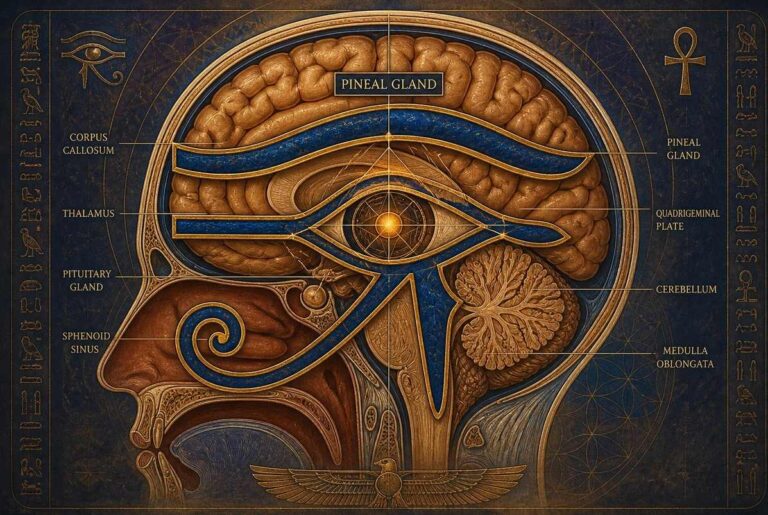

Neuroplasticity and Transformation: 7 Ways Mystical Experience Rewires the Self
Here is the strangeness: you are not who you were yesterday, and not because of some philosophical abstraction. Your brain has physically changed overnight. Synapses have strengthened or withered. Neural forests have grown new branches while others have been pruned back. The hardware of your selfhood is in constant, restless motion–whether you notice or not.
Neuroplasticity is the name science gives to this phenomenon: the brain’s capacity to reorganise itself by forming new neural connections throughout life. Once, neurologists believed the adult brain was fixed, a crystallised structure like dried clay. We now know it behaves more like a living woodland–pathways worn by repetition, clearings opened by new experience, territories abandoned when neglected. The metaphor of “rewiring” has become popular, though as researchers note, this engineering image risks distorting the messy, biological reality. Unlike electrical circuits, neural change is gradual, conditional, and never as precise as swapping one component for another.
But what happens when neuroplasticity encounters something that refuses to be mapped by conventional experience? What occurs in the brain during those moments the mystics have always described–when the self dissolves, when reality reveals itself as something other than assumed, when consciousness seems to no longer belong entirely to the individual?
Table of Contents
- The Neuroscience of Unmaking
- Seven Pathways of Neural Transformation
- The Shadow Side of Neural Transformation
- The Recursion: Brain Changing Mind Changing Brain
- The Question That Remains
- Frequently Asked Questions
- Further Reading
- References and Sources

The Neuroscience of Unmaking
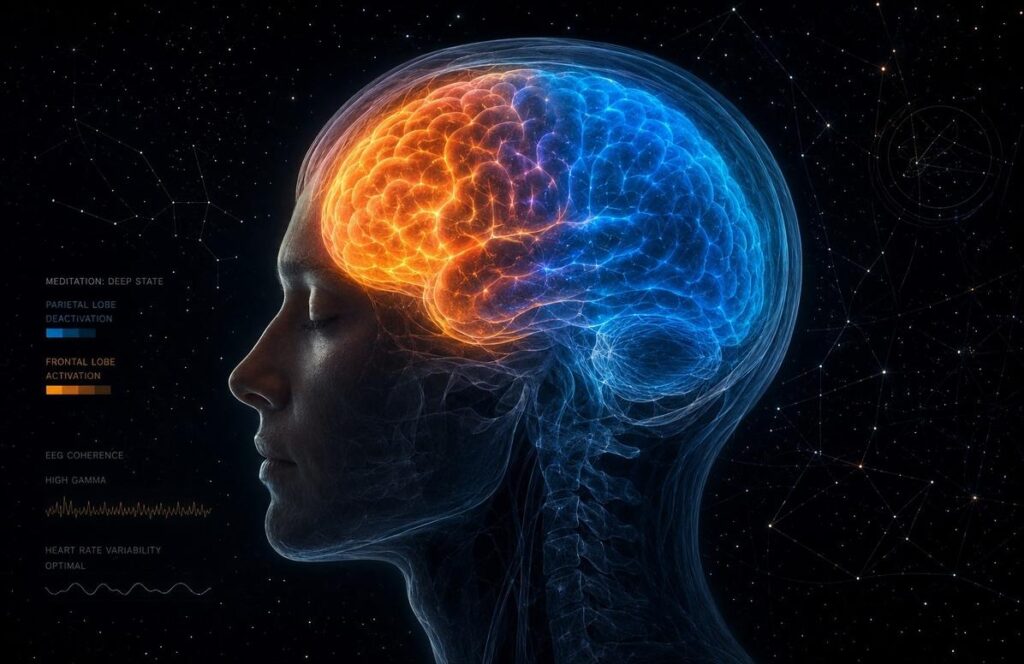
Andrew Newberg’s neuroimaging studies of meditating Tibetan Buddhist monks and praying Franciscan nuns revealed something unexpected: during peak contemplative states, the brain’s orientation association area–the parietal region responsible for distinguishing self from other–shows decreased activity. The boundaries blur. The usual neurological distinctions between “me” and “not-me” become permeable. Concurrently, the frontal lobe, governing attention and concentration, shows increased activation. The brain is not shutting down; it is redirecting.
This is not malfunction. It is the brain doing precisely what evolution equipped it to do: adapt to novel information. When confronted with experiences that violate ordinary categorisation–unity consciousness, temporal dissolution, encounters with what feels like infinite intelligence–the brain cannot simply file these under existing headings. It must build new architecture.
The implications are profound. Mystical experience does not merely provide interesting content for an unchanged mind. It forces structural renovation. As researchers in neuroplasticity have observed, experience can modify brain structure long after development is complete–and those physical changes are widely thought to be part of how transformation is stored.
Consider what this means for the traditional understanding of spiritual awakening. The ancients spoke of metanoia–change of mind, change of heart, change of being. They lacked the vocabulary of synaptic pruning and dendritic arborisation, yet they described precisely what neuroscience now confirms: genuine transformation requires physical rewiring, not merely intellectual assent.
Seven Pathways of Neural Transformation
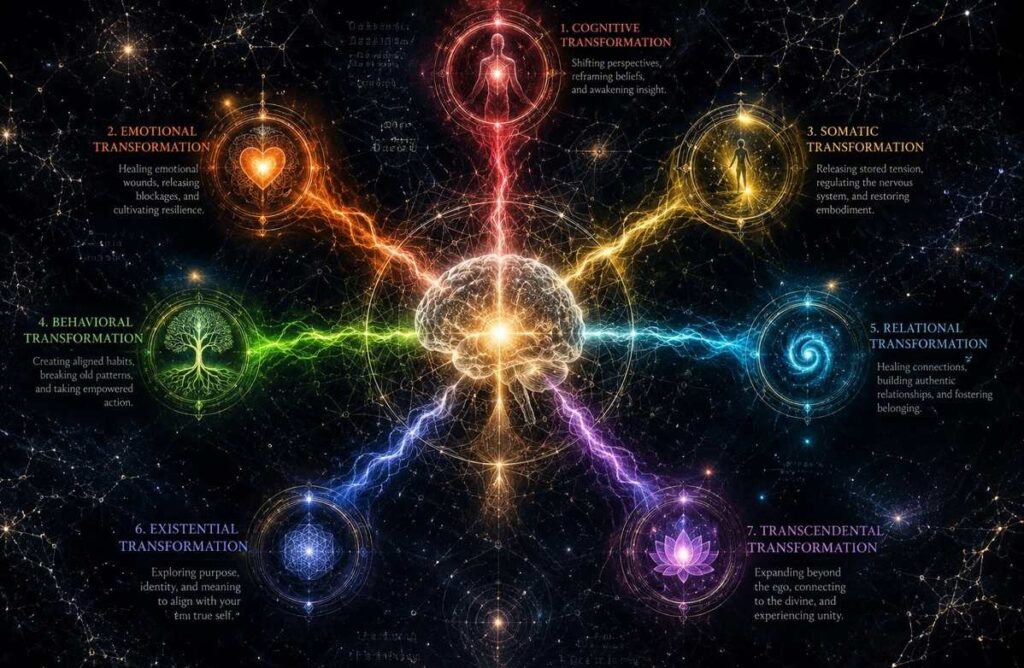
The following seven pathways describe mechanisms through which mystical and contemplative experience alters neural structure. Each is supported by peer-reviewed research, though the intersection of peak experience and long-term transformation remains an active frontier in neuroscience.
1. The Dissolution of Default Mode
The default mode network (DMN) generates our sense of narrative self–the running autobiography that maintains continuity from moment to moment. During mystical experience, DMN activity often decreases dramatically. The storyteller falls silent. Without this constant self-referential chatter, the brain experiences reality unmediated by the usual filters.
Post-experience, this DMN modulation can persist. The self-narrative becomes less compulsory, less convincing. The mystic returns to ordinary consciousness but cannot entirely resume the old identification with the internal monologue. The brain has learned–physically learned–that the self is more provisional than previously assumed.
2. Amygdala Recalibration
The amygdala processes threat, fear, and emotional salience. Intensive contemplative practice has been shown to reduce amygdala reactivity while increasing prefrontal regulation. This is not suppression of emotion but transformation of relationship to it.
The mystic does not become unfeeling. Rather, the brain develops enhanced capacity to hold intense experience without immediate categorisation as threat. The sacred terror becomes tolerable. The overwhelming becomes navigable. Neural pathways that once triggered fight-or-flight in response to existential intensity are gradually supplemented by circuits that permit staying present.
3. Increased Integration Between Hemispheres
The corpus callosum connecting brain hemispheres shows measurable differences in long-term meditators. A 2013 diffusion tensor imaging study found significantly increased fractional anisotropy–a marker of white-matter integrity–in anterior corpus callosum regions of experienced practitioners compared to matched controls. Mystical experience often involves what feels like simultaneous knowing: analytical and intuitive, linear and holistic, temporal and eternal.
This integration manifests practically. The transformed individual can speak of ineffable experience without abandoning intellectual rigour. They can engage analytical reasoning while maintaining awareness of its limitations. The brain has become more spacious, capable of entertaining multiple modes simultaneously.
4. Neurochemical Reshaping
The neurochemical landscape of mystical experience supports plasticity, though popular narratives require careful examination. Research on exogenous DMT demonstrates its capacity to promote neuroplasticity through 5-HT2A receptor activation and sigma-1 receptor engagement, with documented neuroprotective effects against hypoxic stress. However, recent studies have challenged whether endogenous DMT reaches concentrations sufficient to function as a primary brain signalling molecule. What remains established is that profound contemplative states alter the brain’s chemical environment–modulation of serotonin, oxytocin, and vasopressin creates windows of heightened malleability.
These neurochemical cascades do not merely produce temporary states. They create conditions for structural change. The brain bathed in these compounds becomes more capable of retaining new patterns. The mystical moment is thus a window of heightened plasticity–a rare opportunity for genuine rewiring.
5. Gamma Synchrony and Coherent Firing
Advanced meditators show unusually high gamma wave activity–oscillations associated with insight, binding of disparate information, and conscious awareness itself. Research demonstrates that long-term Buddhist practitioners self-induce sustained high-amplitude gamma-band oscillations and phase-synchrony during meditation, differing significantly from control subjects.
This coherence may underlie the sense of unity so frequently reported. When neural populations fire in synchrony across normally distinct territories, the brain experiences itself as integrated rather than modular. The felt sense of separation–between self and world, between knower and known–has neurological correlates in desynchronised firing. The mystical state represents, at least partially, a shift toward coherent oscillation.
6. Hippocampal Transformation and Memory Reconsolidation
The hippocampus, crucial for memory formation and spatial navigation, participates in the temporal distortions characteristic of mystical experience. Time expands, contracts, or seems to dissolve entirely. Past and future collapse into an eternal present.
More significantly, profound experience can trigger memory reconsolidation–neural processes by which established memories become temporarily labile, capable of modification. Traumatic patterns, limiting beliefs, rigid self-concepts: all become susceptible to revision during the heightened plasticity of transformative states. The brain can literally rewrite its history, updating emotional associations and narrative structures.
7. Long-Term Potentiation and the Consolidation of Insight
Mystical experiences often produce insights that feel immediately obvious yet prove difficult to integrate. “I saw that love is the fundamental reality,” someone reports, “but I keep forgetting.” This forgetting has neural correlates. Without consolidation, even profound experiences fade like dreams.
However, repeated practice–meditation, contemplation, ethical engagement, service–strengthens synaptic connections through long-term potentiation. The insight becomes embodied, automatic, less dependent on deliberate recall. The transformed individual does not constantly remind themselves of unity; they perceive it increasingly as default. The brain has been rewired to recognise what was always present but previously unnoticed.
The Shadow Side of Neural Transformation
We must speak of what the enthusiasm for neuroplasticity obscures. The metaphor of rewiring suggests precision, control, mechanical improvement. The reality is messier. Neural change is conditional, uneven, shaped by circumstance rather than wish.
Stroke survivors regain function through recruitment of alternative circuits–but the original pathways remain damaged. The brain builds detours, not restorations. Similarly, mystical transformation does not erase previous conditioning. Old patterns persist, potentially reactivated under stress. The enlightened individual remains capable of anger, fear, attachment. They have simply developed additional pathways–alternative routes that become more accessible with practice.
There is also the question of what is lost. Neural pruning eliminates as well as creates. The transformed brain may sacrifice certain capacities for others. The mystic’s reduced identification with personal narrative can manifest as diminished ambition, less competitive drive, altered relationship to conventional achievement. These are not failures of integration but features of rewiring. The brain reallocates resources according to new priorities.
Most critically, neuroplasticity requires effort, repetition, and time. The weekend workshop promising permanent transformation through single mystical experience misunderstands the biology. The window of heightened plasticity must be followed by consolidation–sustained practice that stabilises new patterns. Without this, the brain reverts to established configurations. The vision becomes memory rather than transformation.

The Recursion: Brain Changing Mind Changing Brain
Here is the profound recursion that neuroscience reveals: consciousness shapes brain shapes consciousness. The mystical experience itself–however triggered–modifies neural architecture. This modified brain then generates different experiences, perceptions, and behaviours. These new experiences further reshape the brain. The spiral continues, potentially toward increasing coherence or increasing fragmentation.
This explains why genuine transformation feels irreversible even when difficult. The brain has been altered. Return to previous functioning would require not merely forgetting an insight but physically reverting neural structure. This is possible–trauma can undo progress, neglect can allow atrophy–but it requires as much biological work as the original transformation.
The mystics spoke of purification, of dying before you die, of the work of ages compressed into moments. Neuroscience translates this into synaptic language: the gradual strengthening of certain pathways, the pruning of others, the consolidation of coherent firing patterns across distributed networks. The vocabulary differs. The phenomenon remains recognisably the same.
The Question That Remains
Neuroplasticity explains how transformation becomes possible, even how it becomes permanent. It does not explain why mystical experience occurs, why it carries the specific content it does, why it seems to reveal something true about reality rather than merely generating pleasant brain states.
The materialist interpretation holds that mystical experience is entirely reducible to neural events–complex patterns of firing that generate illusions of transcendence. The perennialist interpretation suggests that brains evolved to perceive genuine features of reality, and mystical experience represents accurate perception of what is usually filtered out.
Neuroplasticity itself cannot adjudicate between these positions. It merely describes the mechanism by which either interpretation, once adopted, becomes neurologically entrenched. The brain wires itself to perceive reality in ways consistent with its fundamental assumptions. The materialist brain becomes increasingly skilled at detecting material explanations. The contemplative brain develops enhanced capacity for perceiving subtle dimensions.
Perhaps the deepest teaching of neuroplasticity is this: your brain is not a camera recording fixed reality but an instrument that participates in constructing what it perceives. Transformation is possible because the instrument itself can be modified. And the modification of the instrument modifies what becomes perceivable.
The mystics have always insisted that the knower and the known are not ultimately separate. Neuroscience, in its own vocabulary, confirms this interdependence. The brain that seeks transformation is transformed by the seeking. The transformed brain discovers what it was seeking had always been present–but only the transformed brain could recognise it.
You are not who you were when you began reading this. Synapses have shifted, however minutely. The question is whether you will direct this ceaseless change toward awakening or allow it to continue its unconscious drift. The brain will rewire itself regardless. The only choice is what it becomes.
Frequently Asked Questions
What is neuroplasticity and how does it relate to mystical experience?
Neuroplasticity is the brain’s capacity to reorganise itself by forming new neural connections throughout life. Mystical experience forces structural renovation by presenting the brain with information that violates ordinary categorisation, requiring new neural architecture rather than mere intellectual assent.
Does meditation physically change the brain?
Yes. Neuroimaging studies have demonstrated measurable changes in brain structure and function following long-term contemplative practice, including altered activity in the default mode network, amygdala, corpus callosum, and gamma wave patterns. These changes are physical, not merely subjective.
What happens in the brain during a mystical experience?
Research by Andrew Newberg and others shows decreased activity in the parietal orientation association area–responsible for self-other boundaries–alongside increased frontal lobe activation. Advanced meditators also show high-amplitude gamma synchrony and altered default mode network activity during peak states.
Can one mystical experience permanently rewire the brain?
A single peak experience opens a window of heightened plasticity, but permanent rewiring requires consolidation through sustained practice. Without repeated reinforcement via meditation, ethical engagement, and contemplation, the brain tends to revert to established neural configurations.
What is the default mode network and why does it matter for spirituality?
The default mode network generates the narrative self–the running autobiography that maintains personal continuity. During mystical experience, DMN activity often decreases, reducing self-referential chatter and allowing unmediated perception of reality. Post-experience, this modulation can persist, making the self-narrative less compulsory.
Does DMT play a role in endogenous mystical states?
While exogenous DMT promotes neuroplasticity through 5-HT2A and sigma-1 receptor activation, recent research has challenged whether endogenous DMT reaches sufficient concentrations to function as a primary signalling molecule in the brain. Its role in naturally occurring mystical states remains debated.
How long does it take for contemplative practice to change the brain?
Measurable changes have been observed after several weeks to months of consistent practice, though significant structural alterations typically require years. The timeline varies based on practice intensity, baseline neural patterns, and individual neurochemistry. Neuroplasticity is gradual, conditional, and never instantaneous.
Further Reading
- States of Knowing: What Happens When Consciousness Unravels — A phenomenological exploration of altered states and the dissolution of ordinary perception.
- The Transformation: What Actually Changes After Mystical Experience — Integration, grounding, and the long-term consequences of peak spiritual events.
- Default Mode Network Dissolution and the Self — Deep dive into DMN neuroscience and its implications for ego dissolution.
- The Physiology of Mystical Experience: How the Brain Changes — Neurochemical and structural correlates of peak consciousness.
- Embodiment Practices for Grounding Awakening — Somatic methods for stabilising neuroplastic transformation.
- Dark Night: Depression or Transformation? — Discerning between pathological decline and necessary dissolution in the spiritual path.
- Community in Integration: Solitary vs. Supported Practice — The role of relational context in sustaining neural and spiritual transformation.
- The Living Thread: How Forbidden Knowing Survives — The historical transmission of contemplative knowledge across centuries.
References and Sources
The following sources represent the peer-reviewed studies and scholarly works underlying this article’s claims.
Primary Research Studies
- Newberg, A., d’Aquili, E., and Rause, V. (2001). Why God Won’t Go Away: Brain Science and the Biology of Belief. Free Press.
- Newberg, A. et al. (2002). “Meditation mapped in monks.” BBC News / University of Pennsylvania SPECT studies.
- Lutz, A., Greischar, L.L., Rawlings, N.B., Ricard, M., and Davidson, R.J. (2004). “Long-term meditators self-induce high-amplitude gamma synchrony during mental practice.” Proceedings of the National Academy of Sciences, 101(46), 16369–16373.
- Luders, E., Thompson, P.M., Kurth, F., Hong, J.Y., Phillips, O.R., Wang, Y., et al. (2013). “Bridging the Hemispheres in Meditation: thicker callosal regions and enhanced fractional anisotropy (FA) in long-term practitioners.” NeuroImage, 87, 182–190.
- Tang, Y.Y., Lu, Q., Geng, X., Stein, E.A., Yang, Y., and Posner, M.I. (2010). “Short-term meditation induces white matter changes in the anterior cingulate.” Proceedings of the National Academy of Sciences, 107(35), 15649–15652.
- Szabo, A., Kovacs, A., Riba, J., Djurovic, S., Rajnavolgyi, E., and Frecska, E. (2016). “The endogenous hallucinogen and trace amine N,N-dimethyltryptamine (DMT) displays potent protective effects against hypoxia via sigma-1 receptor activation.” Frontiers in Neuroscience, 10, 423.
- Nichols, D.E. (2017). “N,N-dimethyltryptamine and the pineal gland: Separating fact from myth.” Journal of Psychopharmacology, 32(1), 30–36.
- Pei, Y., Asif-Malik, A., and Canales, J.J. (2025). “Exploring DMT: Endogenous role and therapeutic potential.” Neuropharmacology.
Scholarly Monographs
- Donaldson, Z.R., and Hen, R. (2015). “From psychiatric disorders to animal models: the role of neuroplasticity.” In Neurobiology of Brain Disorders, Elsevier.
- Doidge, N. (2007). The Brain That Changes Itself: Stories of Personal Triumph from the Frontiers of Brain Science. Viking Penguin.
- Laycock, D. (1978). The Complete Enochian Dictionary. Askin Publishers. (Note: included for cross-reference on constructed languages and neuroplasticity of linguistic systems.)
Comparative Studies
- Nader, K., Schafe, G.E., and LeDoux, J.E. (2000). “Fear memories require protein synthesis in the amygdala for reconsolidation after retrieval.” Nature, 406(6797), 722–726.
- Sara, S.J. (2000). “Retrieval and reconsolidation: toward a neurobiology of remembering.” Learning and Memory, 7(2), 73–84.
Safety Notice: This article explores neuroscience and contemplative practice. It does not constitute medical, psychological, or spiritual advice. If you are experiencing dissociation, paranoia, spiritual emergency symptoms, or neurological concerns, please contact professional emergency services or a trauma-informed therapist. Contemplative practice complements but does not replace clinical mental health treatment.