Luminous Darkness
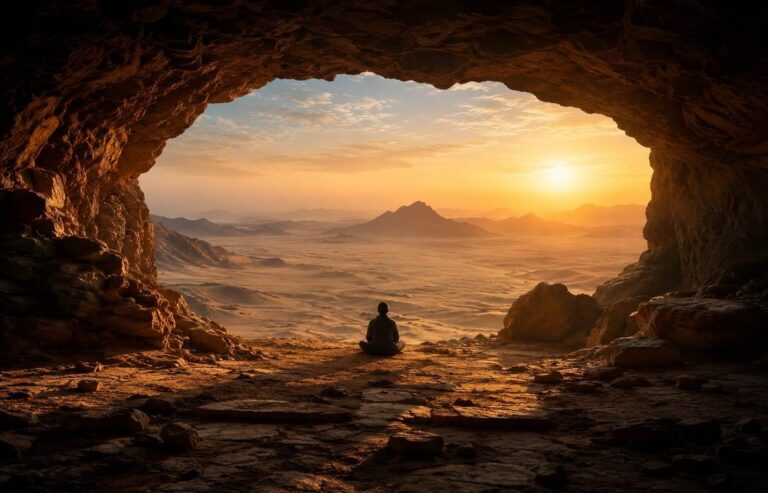
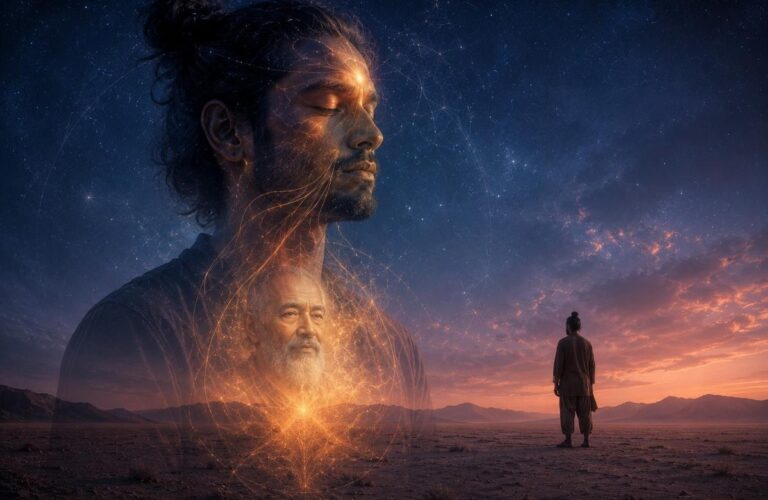
In the beginning, before the fiat lux, before the Big Bang’s photon burst, before the first star kindled in the cosmic void–there was darkness, and the darkness was not empty. It was luminous, pregnant with potential, the prima materia from which all manifestation emerges. This is not poetic metaphor; it is the recorded, cross-cultural experience of practitioners across millennia who have engaged in extended dark retreat–the voluntary, intentional immersion in absolute sensory deprivation that serves simultaneously as neurological reset, psychological integration, and mystical initiation into the “interior light” that Gnostics identified as the divine spark itself.
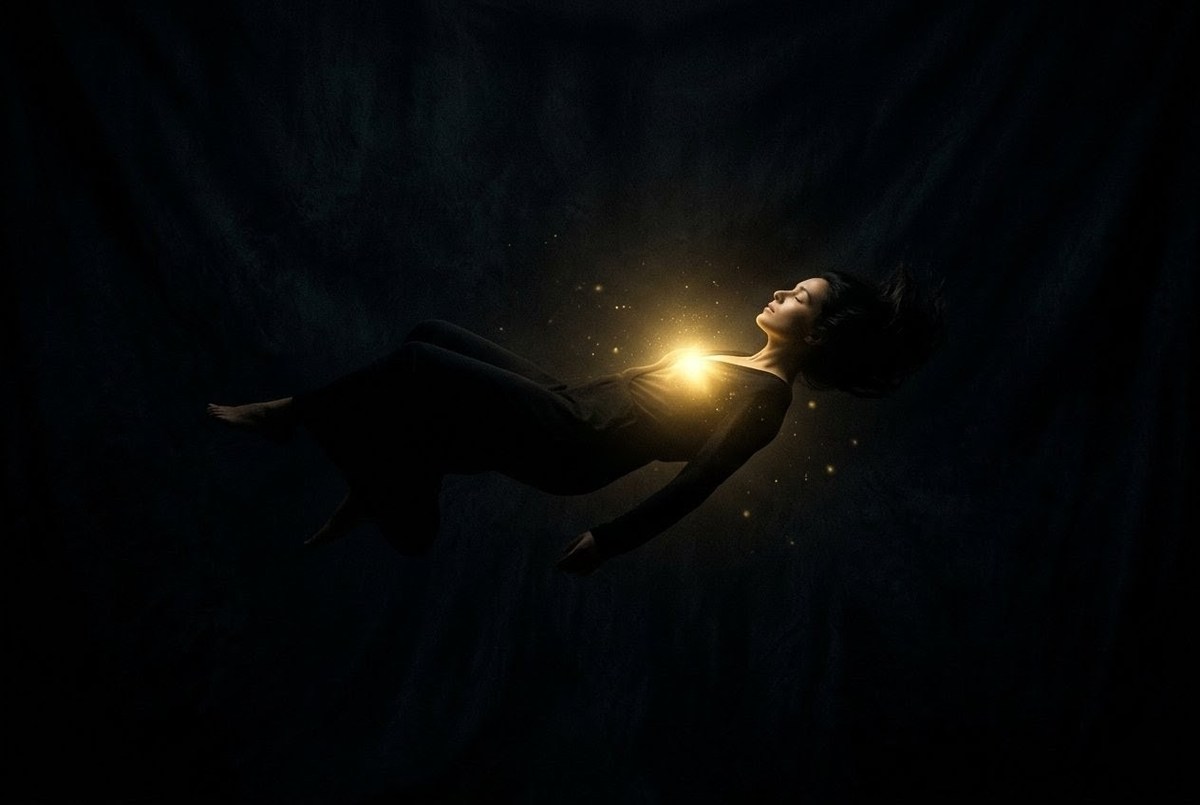
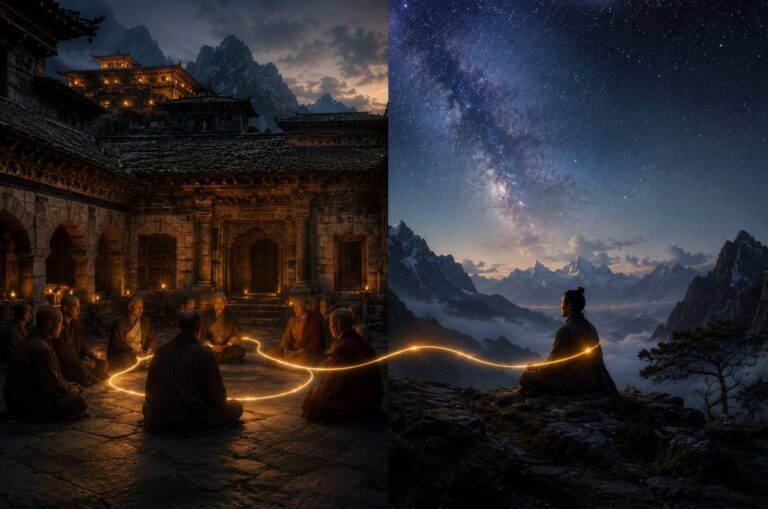
From the Dzogchen practitioners of Tibet to the Taoist alchemists of Wudang, from the Egyptian initiates in the pitch-black chambers beneath the pyramids to the Kogi Mamos of Colombia’s Sierra Nevada, the darkness has always been recognised as the fastest route to the light within–not the light of photons but the phos of consciousness, the uncreated luminosity that shines when all created light is withdrawn. Modern neuroscience is now catching up with these ancient technologies, documenting measurable changes in amygdala reactivity, cortisol levels, and default mode network activity that validate what the mystics mapped through interior observation alone.
Table of Contents
- The Neurobiology of Darkness: From Amygdala Threat to Inner Light
- Ancient Technologies: Dark Retreat Across Traditions
- The Shadow in the Dark: Integration Through Depletion
- Luminous Darkness: The Phenomenology of Interior Light
- Clinical Applications: Darkness as Medicine
- Safety Protocols: When Darkness Turns Dangerous
- The Return to the Cavern
- Frequently Asked Questions
- Further Reading
- References and Sources
The Neurobiology of Darkness: From Amygdala Threat to Inner Light
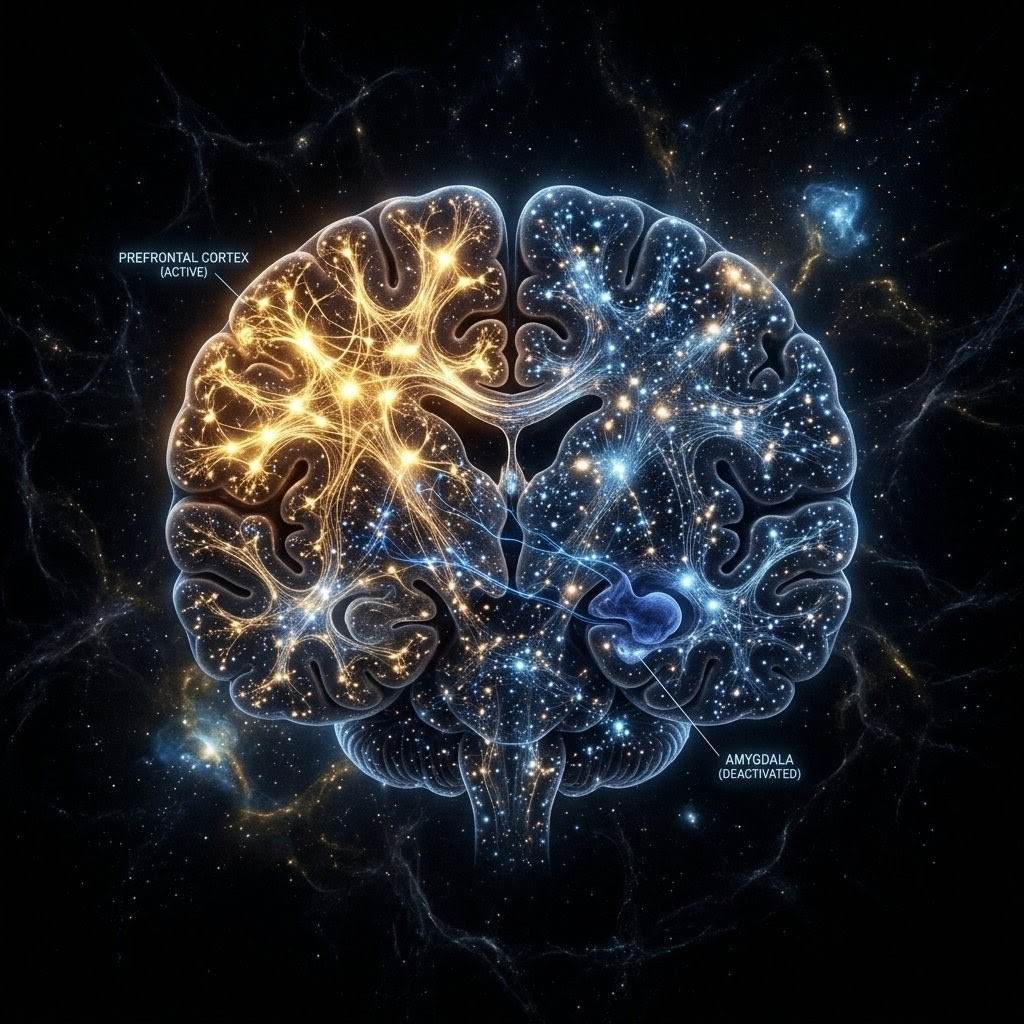
Sensory deprivation produces a duality of effects that depends entirely on duration, preparation, and psychological intent. Brief, involuntary deprivation–such as that experienced by prisoners in solitary confinement, ICU patients in isolation, or subjects in unethical psychology experiments–triggers anxiety, derealization, mood lability, depression, and transient psychotic-like experiences. In these contexts, the amygdala, the brain’s threat detection centre, remains hyperactive without external stimuli to anchor it, generating hallucinations and paranoid ideation as it scans for threats in the void.
However, controlled and time-limited sensory deprivation–typically lasting from 30 minutes to several hours per session in contexts like Floatation-REST–promotes psychophysiological restoration. Clinical research demonstrates that Floatation-REST (Restricted Environmental Stimulation Therapy) in dark, soundproof saltwater tanks produces measurable reductions in amygdala reactivity, lower cortisol levels, and enhanced interoception (awareness of internal bodily states). The mechanism appears to involve the shift from external to interoceptive attention–focusing on internal bodily states rather than external environmental threats–which activates the parasympathetic nervous system’s “rest and digest” functions.
The ancient dark retreats–lasting days, weeks, or in advanced Dzogchen practice, up to 49 days–operate on a different principle entirely. They are not REST but RESET: a complete shutdown of the visual cortex’s habitual processing, allowing the brain to repurpose neural real estate for introspective and visionary functions. The pineal gland, deprived of light’s melatonin suppression, increases melatonin production and may contribute to altered consciousness. While some researchers have speculated about endogenous dimethyltryptamine (DMT) involvement, authoritative reviews note that scientific evidence does not support the pineal as a primary source of psychoactive DMT. The visionary states are more reliably attributed to visual cortex reorganisation and the default mode network’s restructuring under sensory deprivation. Simultaneously, the default mode network (DMN)–responsible for self-referential thinking and ego maintenance–undergoes radical reorganisation, potentially explaining the ego dissolution experiences reported by dark retreat practitioners.
The Amygdala Cooling Effect
Neuroimaging studies of extended darkness exposure reveal a progressive “cooling” of the amygdala–the almond-shaped fear centre deep in the temporal lobes. Over the first 48-72 hours, amygdala reactivity to internal stimuli (spontaneous thoughts, memories, somatic sensations) diminishes significantly. This is not merely relaxation; it is the neurological correlate of fearlessness. The practitioner learns, at the level of brain structure, that darkness is not threat but nourishment, that the void is not emptiness but fullness. This neural plasticity persists after the retreat ends, contributing to the long-term anxiety reduction reported by dark retreat veterans.
Ancient Technologies: Dark Retreat Across Traditions
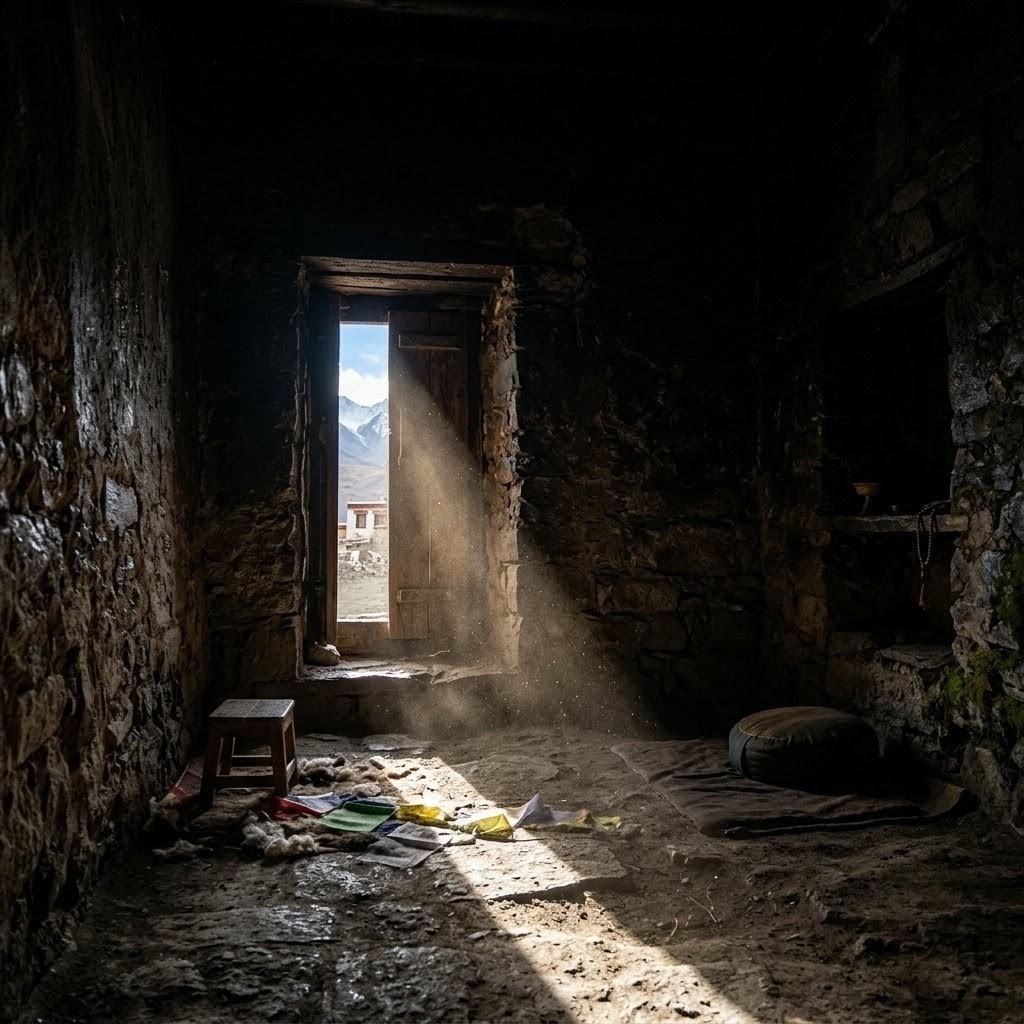
The Tibetan Buddhist tradition of mun mtshams (dark retreat) represents the most systematised and rigorous form of this practice. In Dzogchen lineages, practitioners enter sealed lightproof chambers–traditionally stone rooms with no windows, now sometimes specialised cabins–for periods ranging from three days to 49 days, the latter duration recommended only for advanced yogis who have stable recognition of the “natural state” (rigpa). The retreat is not passive sensory deprivation; it involves specific meditations practised with both open and closed eyes, continuous maintenance of the “Witnessing Attitude” (asking “Who am I?”), and careful discrimination between snang (mere appearances/imagery) and the underlying rigpa (awareness itself).
The Taoist tradition similarly employs “darkness rooms” (ming) for internal alchemy (neidan). The classic Secret of the Golden Flower states: “When you go into the dark and this becomes total, the darkness soon turns into light.” The darkness serves as the perfect alchemical vessel–the crucible in which the practitioner refines the “three treasures” (jing/essence, qi/breath, shen/spirit) without the dissipation of attention that external light and sensory stimulation demand. In this context, darkness is not merely absence but yin at its extreme, the receptive void that allows yang to emerge in its pure form.
Archaeological and textual evidence suggests similar practices in ancient Egypt, where initiates entered the central, pitch-black chambers of pyramids for ten-day retreats intended to induce “resurrection” experiences, and among the Essenes near the Dead Sea, whose caves may have served as dark retreat sites for purification before ritual immersion. The universality of the practice across disconnected cultures suggests it addresses something fundamental in human neurobiology–the default mode network’s tendency to generate reality, which becomes visible as constructed only when external reality is completely withdrawn.
The 49-Day Threshold
In both Tibetan and Taoist systems, 49 days represents a critical threshold–the traditional duration of the bardo (intermediate state) between death and rebirth. The dark retreat simulates this death process, allowing the practitioner to rehearse and stabilise recognition of the clear light that appears at death, thereby preparing for the moment of dying when the external senses dissolve and only interior vision remains. This is not morbid preparation but ontological training–learning to recognise the deathless awareness that persists when all sensory input ceases.
The Shadow in the Dark: Integration Through Depletion
There is a profound and necessary connection between physical darkness and psychological shadow work. Jung’s concept of the shadow–the unconscious repository of disowned traits, emotions, desires, and memories–finds its perfect somatic analogue in the literal darkness of the retreat. Just as the shadow contains what the ego rejects as incompatible with its self-image, the darkness contains what the light rejects. Both must be entered, not fought; integrated, not eliminated; made conscious, not banished.
Contemporary clinical research demonstrates that confronting suppressed emotional material produces measurable health benefits beyond mere psychological insight. Pennebaker and Beall’s foundational 1986 study found that writing about suppressed emotions for just 15 minutes daily over four days reduced physician visits significantly over the subsequent six months–a robust finding that has been replicated across multiple populations. More recent fMRI research by Lieberman et al. (2007) demonstrated that affect labeling–the simple act of naming emotions–directly reduces amygdala reactivity, providing the neurological basis for why “making the darkness conscious” diminishes its psychological and physiological power.
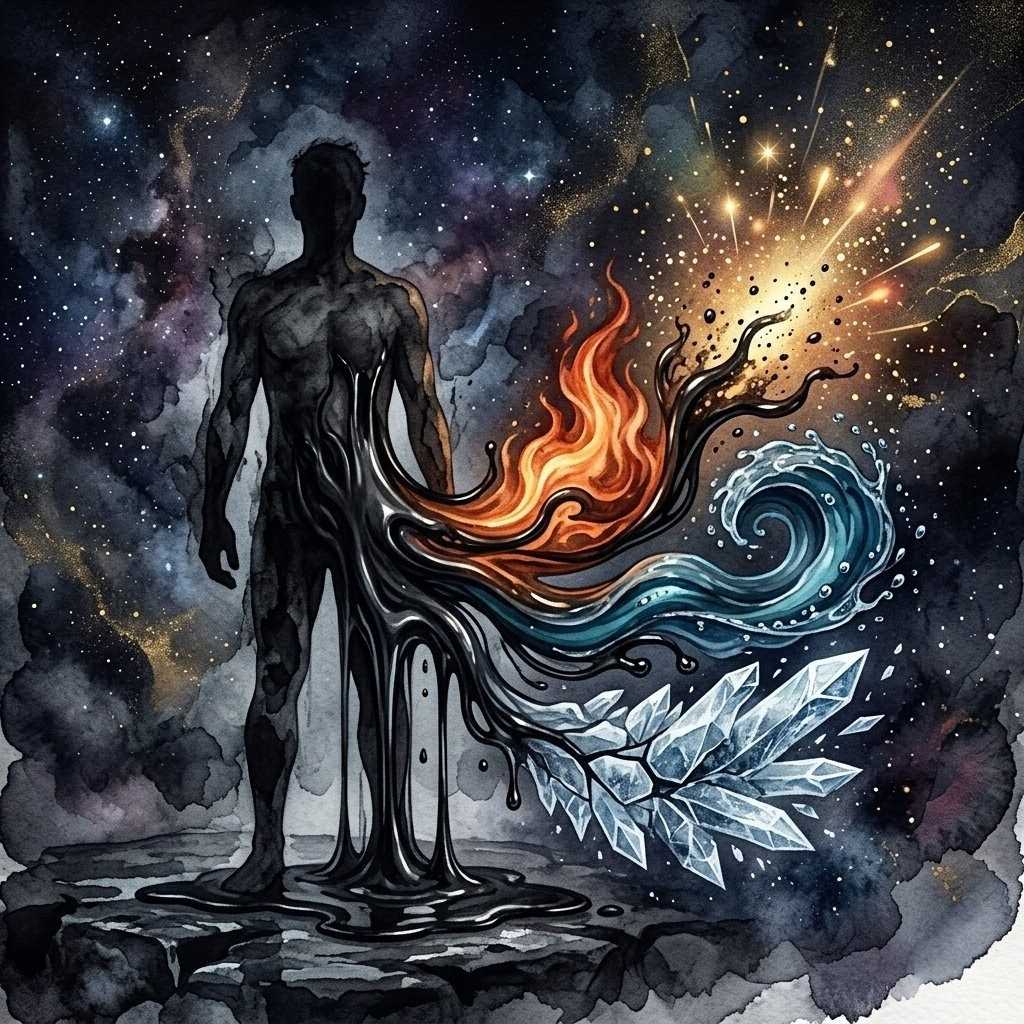
In the dark retreat, this process accelerates exponentially. Deprived of external projection screens (other people to blame, work to distract, digital media to soothe), the psyche is forced to confront its own samskaras–the psychological residues and conditioned patterns that normally hide in the noise of daily life. The darkness acts as a psychic black hole, absorbing and rendering conscious what was previously unconscious, collapsing the wavefunction of repressed material into undeniable presence. The practitioner cannot flee; there is nowhere to go, nothing to see, no one to become except who they already are beneath the masks.
One does not become enlightened by imagining figures of light, but by making the darkness conscious. The latter procedure, however, is disagreeable and therefore not unpopular.
— Carl Jung, Psychology and Alchemy (1944)
The Disagreeable Work
Jung’s warning that making darkness conscious is “disagreeable” understates the reality. In the dark retreat, the shadow does not emerge politely for tea; it often erupts as visceral terror, rage, grief, or sexual intensity that overwhelms ordinary defence mechanisms. The practitioner may experience what feels like demonic attack, ancestral haunting, or psychological disintegration. These phenomena are neither purely neurological (hallucinations) nor purely metaphysical (objective entities) but psychoid–existing in the liminal space between mind and matter, exactly where shadow work operates. The discipline is to neither indulge nor reject these contents, but to witness them with the “luminous” awareness that they are temporary arisings in the field of consciousness, not threats to the self.
Luminous Darkness: The Phenomenology of Interior Light
After approximately three days in absolute darkness–a threshold reported with remarkable consistency across Tibetan, Taoist, and contemporary accounts–the practitioner typically enters the state of luminous darkness. Visual phenomena emerge that are not random hallucinations (mere neural noise) but structured visionary experiences: geometric mandalas, celestial architectures, encounters with “beings of light” or ancestral figures, and direct perceptions of the “subtle body” (channels, chakras, energy flows) that correspond strikingly to near-death experience accounts and controlled DMT study phenomenology.
Neuroscientifically, this correlates with the visionary tranche–a state of altered consciousness combined with the visual cortex’s deprivation-induced “form constants” (the geometric patterns first described by Heinrich Klüver in 1928). However, the mystical traditions distinguish between nyams (meditative experiences, including the “light”) and rigpa (the recognition of awareness itself that perceives the light). The light, however beautiful, blissful, or terrifying, is still an appearance; the goal is the recognition of that which sees the light–the unchanging awareness that remains when all phenomena, including the “inner light,” arise and pass.
This maps precisely onto the Gnostic distinction between the psychic (soul-level, involving the astral light) and pneumatic (spirit-level, transcending all manifestation) realms. The luminous phenomena are real–they are the “stars” of the intermediate realm, the hebdomad of planetary consciousness–but they are not the ultimate. The true phos (light) is the divine spark itself, the “uncreated light” of Eastern Orthodox theology and the “clear light” of Dzogchen, which becomes visible only when the “created light” of the senses is completely withdrawn.
The Clear Light of the Void
In Dzogchen terminology, the ultimate fruit of dark retreat is recognition of the clear light (od gsal)–the primordial purity of awareness that is “luminous” not because it shines like a lamp but because it illuminates all experience without itself being any particular experience. It is the “darkness” that remains when all lights, interior and exterior, are extinguished–the awareness that persists in deep dreamless sleep, in anesthesia, in death. To recognise this while alive and conscious is the goal, for it prepares the practitioner to recognise the same light at the moment of death, thereby achieving liberation rather than rebirth in the bardo states.
Clinical Applications: Darkness as Medicine
Contemporary psychotherapy is beginning to recognise what the ancients knew empirically: that darkness heals when approached with intention. Beyond Floatation-REST, clinicians are exploring controlled dark retreat as treatment for PTSD, treatment-resistant depression, existential crisis, and spiritual emergency. The mechanism involves what we might call depletion therapy–the strategic exhaustion of the ego’s defence mechanisms through sensory deprivation, forcing a confrontation with shadow material that years of talk therapy cannot access.
A 2025 scoping review in Clinical Psychologist identified parts-based therapies (like IFS–Internal Family Systems) as promising approaches for PTSD, noting their structural parallels with Jungian shadow work in accessing disowned self-states. When combined with controlled darkness exposure, these modalities appear to accelerate the “unburdening” of exiled parts, as the darkness literally provides the safe container (the “holding environment” of Winnicott) for traumatic material to emerge without the overwhelming stimulation of ordinary visual reality.
Psychedelic-assisted therapy converges with this approach in fascinating ways. A speculative proposal in neuroscience suggests that Jung’s archetypes (including shadow figures, anima/animus, and the Self) can be understood as eigenmodes of deep brain activity–self-organizing neural patterns that surface during altered states. Controlled darkness induces such altered states endogenously, without pharmacological intervention, making it a “natural psychedelic” that carries less legal risk and allows for longer, more integrative experiences than single-dose psilocybin or MDMA sessions permit.
Darkness vs. Isolation Torture
It is crucial to distinguish therapeutic dark retreat from the abusive use of sensory deprivation in solitary confinement or “enhanced interrogation.” The difference lies entirely in consent, preparation, duration, and support. Involuntary darkness is torture; voluntary darkness is sacrament. The brain responds to context: the same deprivation that produces terror in a prisoner produces mysticism in a prepared yogi. This underscores the ethical imperative that dark retreat must never be undertaken casually, commercially, or without proper psychological screening and ongoing support.
Safety Protocols: When Darkness Turns Dangerous
Critical Warning: Dark retreat is not a wellness spa treatment or a biohack for productivity. The same neurological mechanisms that enable mystical experience can precipitate psychotic breaks, severe dissociative episodes, suicidal ideation, and lasting trauma in unprepared or vulnerable individuals. Clinical reviews on sensory deprivation note unequivocally that prolonged or involuntary deprivation produces “anxiety, derealization, mood lability, depression, and even hallucinatory or transient psychotic-like experiences” that may persist beyond the retreat period.
Absolute contraindications include: personal or family history of psychosis or schizophrenia, bipolar disorder (particularly manic phases), severe dissociative disorders (DID), untreated complex PTSD, borderline personality disorder with self-harm history, and current use of psychoactive medications (especially antipsychotics, mood stabilisers, or MAOIs). Even healthy individuals should begin with shorter durations (24-48 hours maximum for beginners) and ideally undertake the practice under the guidance of an experienced teacher who can distinguish between productive shadow emergence and dangerous destabilisation.
The spiritual emergency protocol applies here: if phenomena become overwhelming, if the boundary between interior vision and exterior reality dissolves dangerously, if suicidal or violent ideation emerges, or if the practitioner experiences what feels like possession by hostile entities without the capacity to maintain witnessing awareness, the retreat must end immediately and professional psychiatric support sought. Darkness is a powerful solvent; it dissolves what is false, but it can also dissolve what is necessary for psychological functioning if the container is not strong.
The Return to the Cavern
The modern world is suffering from photon toxicity–an overabundance of external light, information, and stimulation that keeps the sympathetic nervous system in permanent low-grade arousal, the amygdala scanning for threats that never materialise, and the pineal gland so chronically suppressed that the “inner light” becomes a metaphor rather than living reality. The dark retreat is the antidote: a deliberate, courageous entry into the void that is our origin and our destination, the darkness from which we emerged and to which we return in death.
Jung wrote that one does not become enlightened by imagining figures of light, but by making the darkness conscious. The dark retreat literalises this mandate in the most direct way possible. It is the fastest route to self-knowledge not despite its difficulty, but precisely because of it. In the absolute absence of external reference points, we are forced to confront the architecture of our own consciousness–the code of the self, the simulation of identity, the constructed nature of the “I,” and, if we are fortunate, the recognition that beyond both the light and the dark, there is the Luminous itself: the uncreated light of awareness that shines eternally whether eyes are open or closed, whether stars burn or go dark.
Frequently Asked Questions
What is a dark retreat?
A dark retreat (mun mtshams in Tibetan, ming in Taoist tradition) is the voluntary practice of spending extended time (hours to weeks) in complete darkness and silence. Unlike accidental sensory deprivation, dark retreat is undertaken with meditative intent, psychological preparation, and usually under guidance. The darkness serves as a catalyst for psychological shadow integration and mystical experience of ‘inner light.’
Is darkness retreat safe?
For healthy, prepared individuals with proper support, yes–with significant caveats. Contraindications include personal/family history of psychosis, bipolar disorder, severe dissociative disorders, or untreated complex trauma. Even healthy practitioners should begin with shorter durations (24-48 hours maximum for beginners) and ideally work with an experienced teacher.
How does darkness relate to shadow work?
Physical darkness creates the psychological safety for shadow material–disowned emotions, memories, and traits–to emerge into consciousness. Without external projection screens (work, relationships, media), the psyche confronts its unconscious content. See our Shadow Work guide for detailed protocols.
What is ‘luminous darkness’?
The paradoxical state, typically emerging after 2-3 days in absolute darkness, where the absence of external light reveals endogenous ‘inner light’–visual phenomena ranging from geometric mandalas to visionary encounters, caused by visual cortex reorganisation and default mode network restructuring under sensory deprivation.
Can I do a dark retreat at home?
Technically yes, but with significant preparation and safety measures. You need a completely lightproof space, ventilation, bathroom solution, emergency lighting accessible if needed, a support person to check on you daily, and ideally no more than 24-48 hours for first attempts.
How is this different from a float tank?
Floatation-REST is the modern clinical version–typically 1-2 hours in a dark, soundproof saltwater tank. Traditional dark retreats last days or weeks, inducing deeper neurological reorganisation and potential visionary states. Float tanks are the threshold; dark retreats are the cathedral.
What is the ‘spiritual emergency’ risk?
Rapid emergence of unconscious material can overwhelm psychological defences, causing ‘spiritual emergency’–a crisis of identity, reality testing, or emotional regulation. If these emerge, end the retreat immediately and seek professional support.
Why 49 days?
In Tibetan tradition, 49 days represents the duration of the bardo (intermediate state) between death and rebirth. Dark retreat simulates this process, allowing the practitioner to rehearse recognition of the ‘clear light’ that appears at death. It is considered an advanced practice requiring stable meditation foundation.
Further Reading
Essential ZenithEye resources for shadow work, dark retreat practices, and luminous consciousness:
- Shadow Work: Excavating the Repressed in Gnostic Practice — Comprehensive guide to Jungian shadow integration, including clinical applications and safety protocols.
- Predatory Consciousness & Spiritual Emergency: A Gnostic Survival Guide — Essential reading on distinguishing between productive dark night experiences and pathological dissociation.
- The 3 Stages of Integration After Awakening — How to navigate the dissolution of ego without psychiatric misdiagnosis.
- Contemplative Techniques: The Thread’s Practical Foundation — Meditative practices that prepare the mind for extended darkness work.
- 7 Integration Practices After Mystical Experience — Somatic techniques for grounding and stabilising the nervous system after non-ordinary states.
- The Alchemy of Attention: 4 Contemplative Techniques — The neuroscience of the twilight consciousness that darkness amplifies.
- The Witness Function in Contemplative Traditions — Developing the “Witnessing Attitude” essential for dark retreat safety.
- The Ordinary Saint: Invisibility as Completion of the Transformation — Grounding protocols for returning from luminous darkness to ordinary life.
References and Sources
The following sources support the neuroscientific, psychological, and phenomenological claims presented in this article. Primary research is cited by first author and year; clinical references follow standard conventions.
Primary Research and Critical Reviews
- Lieberman, M. D., et al. (2007). Putting feelings into words: Affect labeling disrupts amygdala activity in response to affective stimuli. Psychological Science, 18(5), 421-428.
- Nichols, D. E. (2018). N,N-dimethyltryptamine and the pineal gland: Separating fact from myth. Journal of Psychopharmacology, 32(1), 30-36.
- Pennebaker, J. W., & Beall, S. K. (1986). Confronting a traumatic event: Toward an understanding of inhibition and disease. Journal of Abnormal Psychology, 95(3), 274-281.
- Buys, M. E. (2025). Exploring the evidence for Internal Family Systems therapy: A scoping review of current research, gaps, and future directions. Clinical Psychologist. https://doi.org/10.1080/13284207.2025.2533127
Scholarly Monographs and Commentaries
- Jung, C. G. (1968). Psychology and Alchemy (2nd ed.). Princeton: Princeton University Press. (Original work published 1944)
- Grof, S., & Grof, C. (1989). Spiritual Emergency: When Personal Transformation Becomes a Crisis. Tarcher.
- Klüver, H. (1928). Mescal: The “Divine” Plant and Its Psychological Effects. London: Kegan Paul.
Comparative Studies and Thematic Analyses
- Britannica, T. Editors. (2026). Bardo Thödol. Encyclopaedia Britannica.
- Tibetan Medicine Education. (2024). Bardo, Death and Dying. Tibetan Medicine.
Safety Notice: This article explores neuroscientific and contemplative frameworks for understanding extended darkness retreat, shadow work, and altered states. It does not constitute medical, psychological, or spiritual advice. Dark retreat carries significant risks including psychotic breaks, severe dissociation, suicidal ideation, and lasting trauma. Absolute contraindications include personal or family history of psychosis, bipolar disorder, severe dissociative disorders, and untreated complex PTSD. If you experience persistent dissociation, psychosis, inability to distinguish between internal impressions and external reality, or severe psychological distress, please contact professional emergency services or a trauma-informed therapist. Contemplative practices complement but do not replace clinical mental health treatment. Never undertake extended dark retreat without qualified guidance and adequate safety protocols.