The Akashic Records: Accessing the Cosmic Archive of All That Is
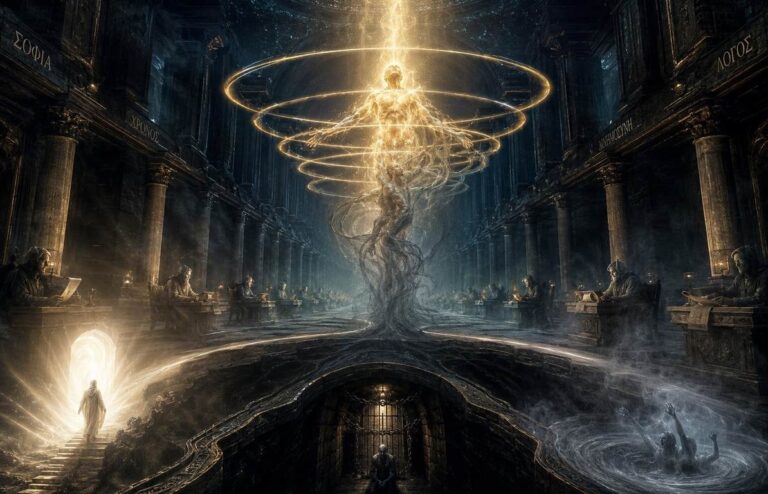
In the space between thoughts, in the silence beneath silence, exists a dimension that has been described by mystics across cultures and centuries: the Akashic Records. This is not a physical library with shelves and scrolls but a field of information, a cosmic memory bank that contains every thought, word, deed, and experience of every soul that has ever existed. The word derives from the Sanskrit akasha, meaning sky, space, or ether–the subtle element that pervades all things and serves as the medium of transmission for sound, light, and consciousness. The Akashic Records are the impression left upon this ether by the activity of consciousness, the permanent trace of all that has been, is, and will be.
Table of Contents
- The Records in Eastern Philosophy
- Western Esoteric Traditions
- Modern Physics and the Holographic Universe
- 5 Proven Methods for Accessing the Records
- The Nature of the Information
- Discernment and Ethics
- The Records as Mirror
- Frequently Asked Questions
- Further Reading
- References and Sources

The Records in Eastern Philosophy
Sanskrit Roots and the Element of Akasha
The term akasha originates in Sanskrit, where it denotes space, sky, atmosphere, or ether. In the metaphysical system of Samkhya, akasha is one of the five gross elements (mahabhutas), possessing a creative quality the other four elements lack. It is sometimes considered responsible for the creation of the others. In the Nyaya-Vaisesika school, the term functions as a substratum of sound. Jainism recognises two types of akasha: lokakasha (space containing all matter and motion) and alokakasha (infinite void beyond). Buddhism similarly distinguishes limited space (akasa-dhatu) from the unbounded. Across these traditions, akasha is not merely empty space but a plenum–a field pregnant with potential, the first element from which all manifestation arises.
Hindu philosophy provides the most detailed traditional description of what Western esotericism would later call the Akashic Records. They are understood not as passive storage but as the active script of cosmic existence–the template from which reality unfolds and the record of its unfolding. Everything that has happened, is happening, or will happen is recorded within this energetic field. This understanding presents reality not as a linear sequence of time-bound events but as an interconnected web where past, present, and future coexist. The Akashic Records are accessed not by travelling to some distant location but by shifting one’s state of consciousness to resonate with the frequency of this informational field.
The Buddhist Storehouse Consciousness
The concept appears in Buddhist traditions under different terminology. The alaya-vijnana (storehouse consciousness) of Yogacara philosophy serves a similar function–the repository of all karmic seeds, the accumulated impressions that shape individual and collective experience. This eighth consciousness stores the traces of all mental activity, providing the substrate from which individual perception emerges. The purification of this storehouse consciousness is central to the work of enlightenment: not merely accumulating new knowledge but dissolving the obscurations that prevent direct recognition of reality as it is.
The Mesopotamian concept of the Tablets of Destiny offers an earlier parallel. The gods were believed to record the destiny of all creation at the beginning of each year, inscribing their decisions on tablets that determined the course of existence. This concept migrated into Jewish, Christian, and Islamic traditions as the Book of Life–a heavenly record of deeds used after death to determine the soul’s destination. The Theosophical Society would later fuse these concepts, associating the Book of Life with the Akasha to create the modern notion of the Akashic Records as a cosmic archive.
Western Esoteric Traditions
Theosophy and the Transformation of Akasha
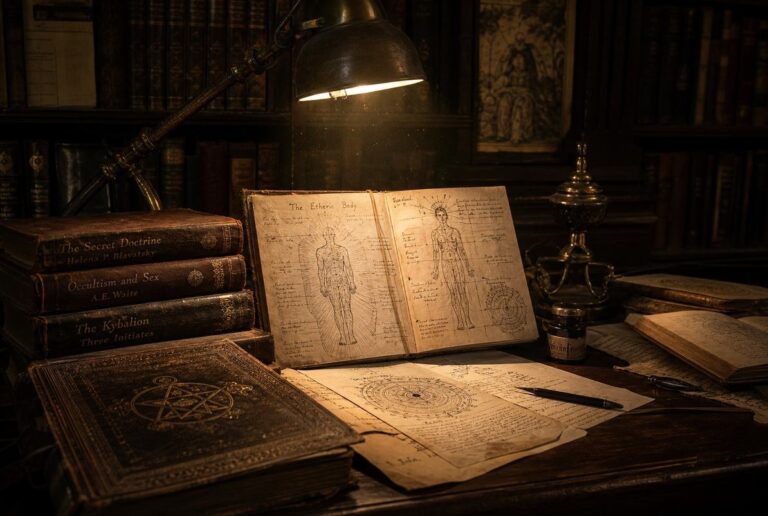
The Akashic Records entered Western esotericism primarily through the Theosophical Society in the late nineteenth century. Helena Petrovna Blavatsky, co-founder of the Society in 1875, introduced the Sanskrit term akasha to Western audiences, characterising it as a sort of life force and referring to “indestructible tablets of the astral light” that record both the past and future of human thought and action. However, Blavatsky herself did not use the exact term “Akashic Records.” That formulation developed later through the work of Alfred Percy Sinnett and C. W. Leadbeater. By Leadbeater’s Clairvoyance (1899), the association of the term with the idea was complete, and he identified the akashic records by name as something a clairvoyant could read.
This transformation represents a significant semantic shift. The original Sanskrit akasa meant simply space or atmosphere. Under Theosophical influence, the term acquired an archival function it had not previously possessed, becoming the “Akashic Records”–a metaphysical interpretation of an already ambiguous concept. The Theosophists drew upon the Victorian scientific fascination with ether as the medium for electromagnetic forces, fusing Eastern metaphysics with Western physics to create a hybrid concept that would prove extraordinarily durable.
Edgar Cayce and the Sleeping Prophet
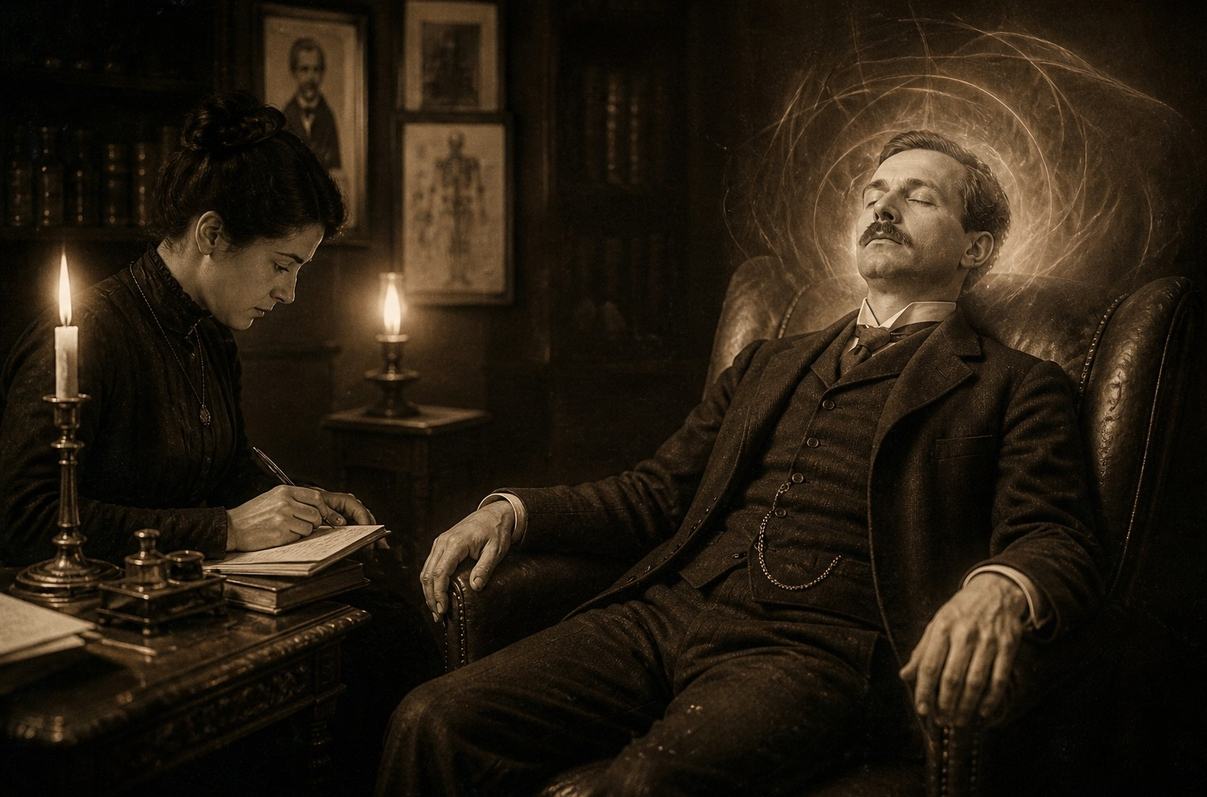
Edgar Cayce, the American “sleeping prophet,” provided some of the most detailed Western accounts of accessing the Akashic Records. Over forty years, Cayce gave more than 14,000 psychic readings, using the Akashic Records as his primary resource material. In trance states, he would reportedly enter the records to retrieve information about individuals’ past lives, health conditions, and spiritual paths. Cayce described the records not as physical texts but as a kind of cosmic movie theatre–information that could be “heard,” “read,” and “experienced” by those in attunement. Every thought, action, desire, or deed creates a vibration that produces a mark upon what Cayce called the skein of space and time, permanently identified with the individual responsible.
Rudolf Steiner and Anthroposophical Reading
Rudolf Steiner, founder of Anthroposophy, also described the capacity to read the Akashic Records through the development of higher faculties of perception. For Steiner, this was not supernatural but the natural result of human evolution–the awakening of organs of spiritual perception that have atrophied in modern humanity but can be reactivated through specific disciplines. Steiner’s approach emphasised systematic spiritual training rather than spontaneous psychic gift, framing the records as accessible to anyone willing to undertake the necessary developmental work. His lectures on Atlantis, the life of Christ, and the evolution of consciousness claim to derive from direct reading of the Akashic Records, offering a structured alternative to Cayce’s trance-based method.
Modern Physics and the Holographic Universe
The Holographic Principle
Concepts emerging from modern theoretical physics offer striking parallels to the ancient understanding of the Akashic Records, though the connection remains interpretive rather than established. The holographic principle, derived from black hole thermodynamics and string theory, suggests that all information contained within a volume of space can be described by data encoded on its boundary. In a holographic universe, the three-dimensional world we perceive might be a projection from a two-dimensional information surface at the universe’s boundary. This information is not lost but preserved, encoded in the fabric of space itself.
Physicist Eugene Wigner famously described “the unreasonable effectiveness of mathematics in the natural sciences”–the mysterious correspondence between abstract mathematical structures and physical reality. In a simulated or holographic universe, this ceases to be mysterious: mathematics describes reality so precisely because reality is fundamentally informational. The equations of physics may reflect not approximations of material processes but the source code manifesting as experienced world. Whether this constitutes scientific evidence for the Akashic Records remains debated; what is clear is that physics has begun to treat information as more fundamental than matter.
Quantum Entanglement and Non-Local Information
Quantum information theory adds another dimension to this conversation. Quantum entanglement–the phenomenon where particles remain connected across vast distances–suggests a level of reality where separation is illusory and information is non-local. The observer effect, wherein measurement collapses quantum superposition into definite states, suggests that reality maintains itself in probabilistic superposition until observed. These phenomena do not prove the existence of the Akashic Records, but they do demonstrate that information can be preserved, non-local, and fundamental to the structure of reality–findings compatible with mystical descriptions of a cosmic memory field.
Nikola Tesla, who was acquainted with Swami Vivekananda and deeply influenced by Sanskrit terminology, described the universe as a kinetic system filled with energy that could be harnessed anywhere. His concepts were greatly influenced by Vedantic theories and cosmology, suggesting that the ancient understanding of Akasha as a universal medium may have anticipated modern field theories. Tesla’s work represents one of the few points where scientific and esoteric conceptions of Akasha approached genuine dialogue before the scientific community abandoned the ether hypothesis in favour of relativity and quantum mechanics.
5 Proven Methods for Accessing the Records
The traditions describe several approaches to accessing this cosmic archive. None require special psychic gifts; all demand disciplined preparation and ethical intention.
1. Meditation and Contemplation
Deep states of meditation, particularly those involving inner silence and the suspension of ordinary thought, create the conditions for accessing the records. The seeker must quiet the personal mind sufficiently to allow the universal mind to impress its knowledge upon consciousness. This is not passive reception but active attunement–the deliberate alignment of individual awareness with the frequency of the informational field.
2. Guided Journeying
Specific visualisations and guided meditations have been developed to facilitate access. These typically involve imagery of entering a sacred space, meeting a guardian or librarian figure, and requesting specific information. The structured nature of these journeys provides a psychological container for experiences that might otherwise overwhelm the unprepared consciousness.
3. Automatic Writing
Some practitioners access the records through automatic writing–entering a light trance state and allowing information to flow through the hand without conscious censorship. This requires both the capacity to enter receptive states and the discernment to evaluate what emerges. The technique has been used by artists, mystics, and psychotherapists as a method of bypassing the rational censor to access deeper layers of knowing.
4. Working with Practitioners
Those who have developed the capacity to read the records may offer their services as guides, helping others navigate the archive and interpret the information received. This requires finding a practitioner with genuine abilities and ethical integrity. The relationship between reader and querent functions as a temporary energetic bridge, allowing access to material the individual might not yet reach independently.
5. Dream Work
The dream state provides natural access to the records, as the boundaries between personal and collective consciousness are more permeable during sleep. Keeping a dream journal and developing lucid dreaming capacities can facilitate this access. The dream functions as a nightly dissolution of the ego’s filtering mechanisms, allowing information from deeper strata to surface in symbolic form.

The Nature of the Information
What does one find in the Akashic Records? The descriptions vary across traditions and practitioners, but common elements include the following categories of information.
Past Life Information
The records contain the history of each soul’s journey through multiple incarnations–the lessons learned, the patterns established, the karmic debts and credits accumulated. This information can illuminate present-life challenges and gifts, revealing that current difficulties may represent the continuation of unfinished business from previous existences. The value lies not in curiosity about who one was, but in understanding why one is.
Soul Purpose and Contracts
Many report finding information about their soul’s purpose for the current incarnation, the agreements made before birth, and the spiritual tasks to be accomplished. These “soul contracts” are understood not as binding legalities but as frameworks of intention–the curriculum chosen by the soul for its present education. Recognising these contracts can transform the experience of suffering from random misfortune to meaningful challenge.
Alternative Timelines
The records appear to contain not only what did happen but what could have happened–alternative timelines branching at each decision point. This allows exploration of “what if” scenarios and understanding of the consequences of choices. The existence of these branches does not imply that all timelines are equally real, but that the field of possibility is preserved alongside the record of actualisation.
Collective History
Beyond individual records, the Akashic contains the history of civilizations, the evolution of species, the cosmic story of consciousness itself. Some claim to access information about lost civilizations, ancient technologies, and the hidden history of humanity. This aspect of the records functions as a collective archive, preserving not merely individual memories but the accumulated experience of entire species and planetary systems.
Discernment and Ethics
Accessing the Akashic Records is not without challenges. The information received must be interpreted, and interpretation is always influenced by the receiver’s consciousness. Discernment is essential–distinguishing genuine impressions from fantasy, wishful thinking, or interference from lower astral entities. As Alice A. Bailey cautioned, only a trained occultist can distinguish between actual experience and astral pictures created by imagination and keen desire.
Ethical considerations also apply. Privacy is respected in the records; one cannot access another’s records without permission or legitimate need. The information received should be used for healing and growth, not for manipulation or exploitation. And the records are not deterministic–they show patterns and probabilities, not fixed futures. The purpose of access is not to escape responsibility by blaming karma or contracts, but to engage more consciously with the present moment, equipped with deeper understanding of the forces shaping one’s experience.
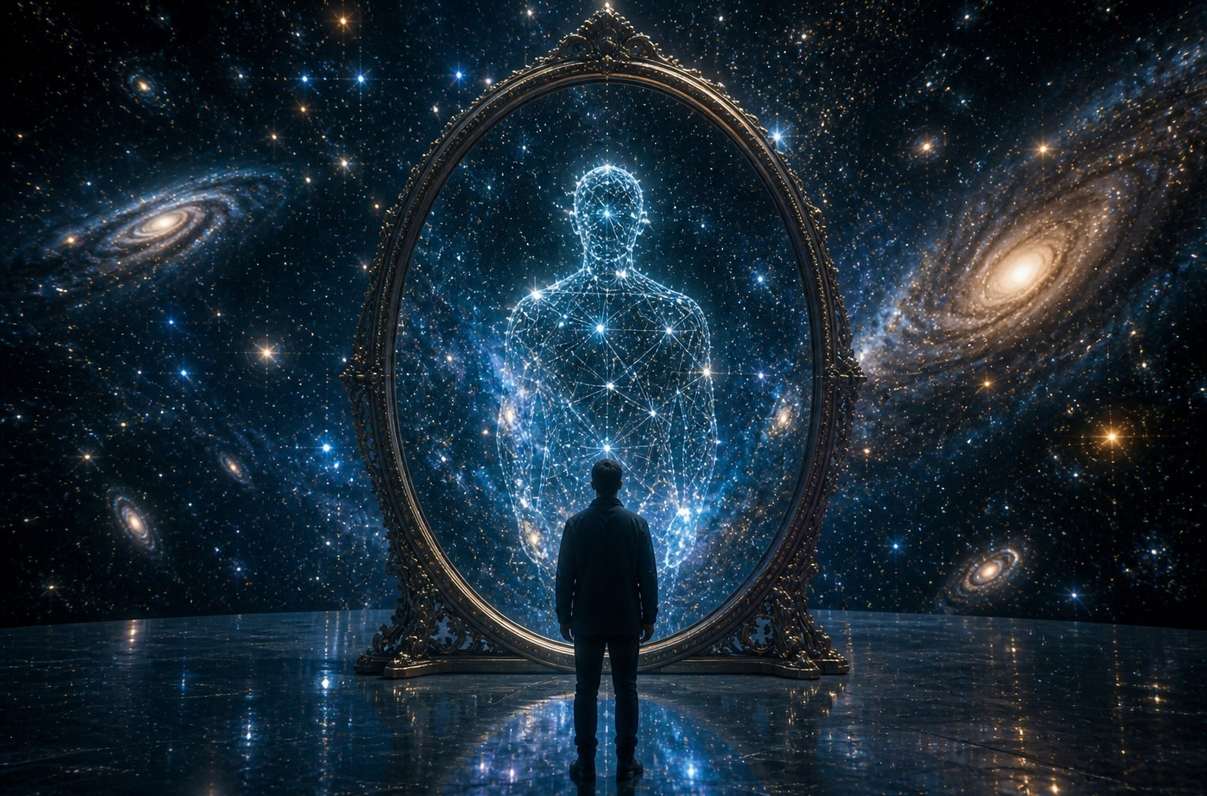
The Records as Mirror
Ultimately, the Akashic Records might be understood less as an external archive and more as a mirror reflecting the depths of consciousness itself. To access the records is to access the universal mind, the collective unconscious, the deeper dimensions of one’s own being. The information retrieved is not truly “out there” but emerges from the field of consciousness that connects all beings.
In this sense, the Akashic Records represent the truth of interconnection–the recognition that every soul’s journey is part of one great story, that every experience is recorded in the fabric of existence, and that the past, present, and future are accessible in the eternal now. The library does not exist apart from the reader; the reader is the library, remembering itself.
Read With Discernment
This article touches material where experience, interpretation and symbolic language can easily blur. Read slowly, compare sources, and keep your own discernment intact.
- Editorial Principles — how ZenithEye separates source, interpretation and lived experience.
- Start Here — the reader guide for the wider archive.
- States of Knowing — altered states, dreams, consciousness, perception and direct experience.
- The Transformation — integration, grounding, spiritual emergence and return to ordinary life.
Frequently Asked Questions
What are the Akashic Records?
The Akashic Records are a metaphysical concept describing a field of information that contains every thought, word, deed, and experience of every soul that has ever existed. Derived from the Sanskrit word akasha (meaning space, sky, or ether), they are understood not as a physical library but as an energetic imprint upon the subtle medium that pervades all reality. The records are accessed by shifting consciousness to resonate with this informational field rather than by physical travel.
Who discovered the Akashic Records?
The concept has ancient roots in Hindu, Buddhist, and Jain philosophy, where akasha was understood as space or ether. The specific term ‘Akashic Records’ entered Western esotericism through the Theosophical Society in the late 19th century. Helena Blavatsky introduced the Sanskrit term akasha, while C. W. Leadbeater later developed the specific formulation of ‘Akashic Records’ as something a clairvoyant could read. Edgar Cayce and Rudolf Steiner further popularised the concept in the 20th century.
Can anyone access the Akashic Records?
Yes. The traditions maintain that everyone has access to the Akashic Records, though the capacity to read them clearly requires preparation. Methods include deep meditation, guided journeying, automatic writing, dream work, and working with experienced practitioners. The essential requirement is not special psychic ability but disciplined practice, ethical intention, and the capacity to quiet the personal mind sufficiently to receive impressions from the universal field.
Are the Akashic Records scientifically proven?
Direct scientific proof of the Akashic Records as a metaphysical archive remains elusive. However, modern physics offers compatible concepts: the holographic principle suggests all information in a volume of space can be encoded on its boundary; quantum entanglement demonstrates non-local information connections; and information theory increasingly treats information as more fundamental than matter. These findings do not prove the records exist, but they render the concept less incompatible with established science than materialist assumptions would suggest.
What is the difference between the Akashic Records and the Buddhist alaya-vijnana?
The alaya-vijnana (storehouse consciousness) of Yogacara Buddhism is the repository of all karmic seeds and mental impressions that shape individual experience. While functionally similar to the Akashic Records, the alaya-vijnana is primarily understood as an individual or collective psychological substrate rather than an external cosmic archive. The Akashic Records, as developed in Western esotericism, tend to be described as an objective field accessible to anyone with proper training, whereas the alaya-vijnana is more intimately bound to the structure of consciousness itself.
Can the Akashic Records predict the future?
The records are not deterministic. They contain probabilities, patterns, and the consequences of choices–including alternative timelines branching at decision points–but not fixed futures. The value of accessing the records lies not in fortune-telling but in understanding the patterns that shape present experience and the probable consequences of current choices. Future information, when it appears, is best understood as the most probable trajectory given present conditions, always subject to change through conscious intervention.
How do I know if information from the Akashic Records is genuine?
Discernment is essential. Genuine impressions tend to carry a quality of unexpected clarity, emotional resonance, and practical applicability that survives critical reflection. They often challenge rather than flatter the ego. False impressions may feel forced, excessively dramatic, or conveniently aligned with what the receiver wishes to hear. Verification comes over time: genuine information produces lasting transformation, while fantasy tends to dissipate when subjected to the test of lived experience.
Further Reading
These links connect the study of the Akashic Records to related resources within the ZenithEye library, offering context on consciousness, esoteric history, simulation theory, and contemplative practice.
- Are We Living in a Simulation? 7 Profound Clues Reality Is Code — Explore the holographic and informational nature of reality from physics and Gnostic perspectives.
- The Soul Trap: Are We in a Cosmic Recycling Facility? — A critical Gnostic examination of the Akashic Records as surveillance database and karmic accounting system.
- Egyptian Wisdom: Anubis, the Tongue & Sacred Speech Power — Discover Thoth and Seshat as divine scribes maintaining the celestial archive.
- 7 Integration Practices After Mystical Experience — Somatic techniques for grounding and stabilising consciousness after accessing non-ordinary states.
- The Sacred Art of Inner Listening: Trust Your Soul’s Compass — Methods for developing the discernment necessary to evaluate information received from subtle sources.
- Predatory Consciousness & Spiritual Emergency: A Gnostic Survival Guide — Understanding the risks of non-ordinary consciousness exploration and how to protect against interference.
- Teachings of Silvanus: Practical Wisdom from Nag Hammadi — Stoic-Gnostic techniques for self-governance and attention that prepare the mind for direct knowing.
- The Thread: Five Gateways to Direct Knowing — The complete map of ZenithEye’s pillars, from historical survival of Gnosis to contemplative practice.
References and Sources
The following sources support the claims and quotations presented in this article. Sanskrit and philosophical sources follow standard academic conventions; esoteric sources are cited by original publication date where available.
Primary Sources and Critical Editions
- Nash, A. (2020). The Akashic Records: Origins and Relation to Western Esotericism. Central European Journal of Contemporary Religion, 3(2), 109-125.
- Wikipedia contributors. (2003-present). Akashic records. Wikipedia, The Free Encyclopedia.
- Theosophy Wiki contributors. Akashic Records. Theosophy Wiki.
Scholarly Monographs and Commentaries
- Blavatsky, H. P. (1888). The Secret Doctrine. Theosophical Publishing Company.
- Leadbeater, C. W. (1899). Clairvoyance. Theosophical Publishing Society.
- Sinnett, A. P. (1883). Esoteric Buddhism. Tribner & Co.
- Cayce, E. (1934-1945). Readings 275-19, 416-2. Edgar Cayce Readings. Association for Research and Enlightenment.
- Steiner, R. (1910-1924). Various lectures on Akashic Records. Rudolf Steiner Archive.
Comparative Studies and Thematic Analyses
- Bailey, A. A. (1927). The Light of the Soul. Lucis Trust.
- Olcott, H. S. (1881). A Buddhist Catechism. Theosophical Society.
- Vivekananda, S. (1896). Raja Yoga. Ramakrishna-Vivekananda Center.
- Wigner, E. P. (1960). The unreasonable effectiveness of mathematics in the natural sciences. Communications on Pure and Applied Mathematics, 13(1), 1-14.
- ‘t Hooft, G. (1993). Dimensional reduction in quantum gravity. arXiv:gr-qc/9310026.
Safety Notice: This article explores psychological and esoteric frameworks for understanding consciousness and information fields. It does not constitute medical, psychological, or spiritual advice. If you experience dissociation, psychosis, or inability to distinguish between internal impressions and external reality, please contact professional emergency services or a trauma-informed therapist. Contemplative practices complement but do not replace clinical mental health treatment.