
The Architecture of the Infinite Scroll: How Short-Form Content Rewires Neural Pathways
You may have noticed it: the inability to finish a paragraph without the urge to check, swipe, refresh, or reach for the next small shimmer of novelty. The book lies open, the page waits patiently, and the thumb hovers over the glass rectangle like a tiny divining rod trained by a very persuasive machine.
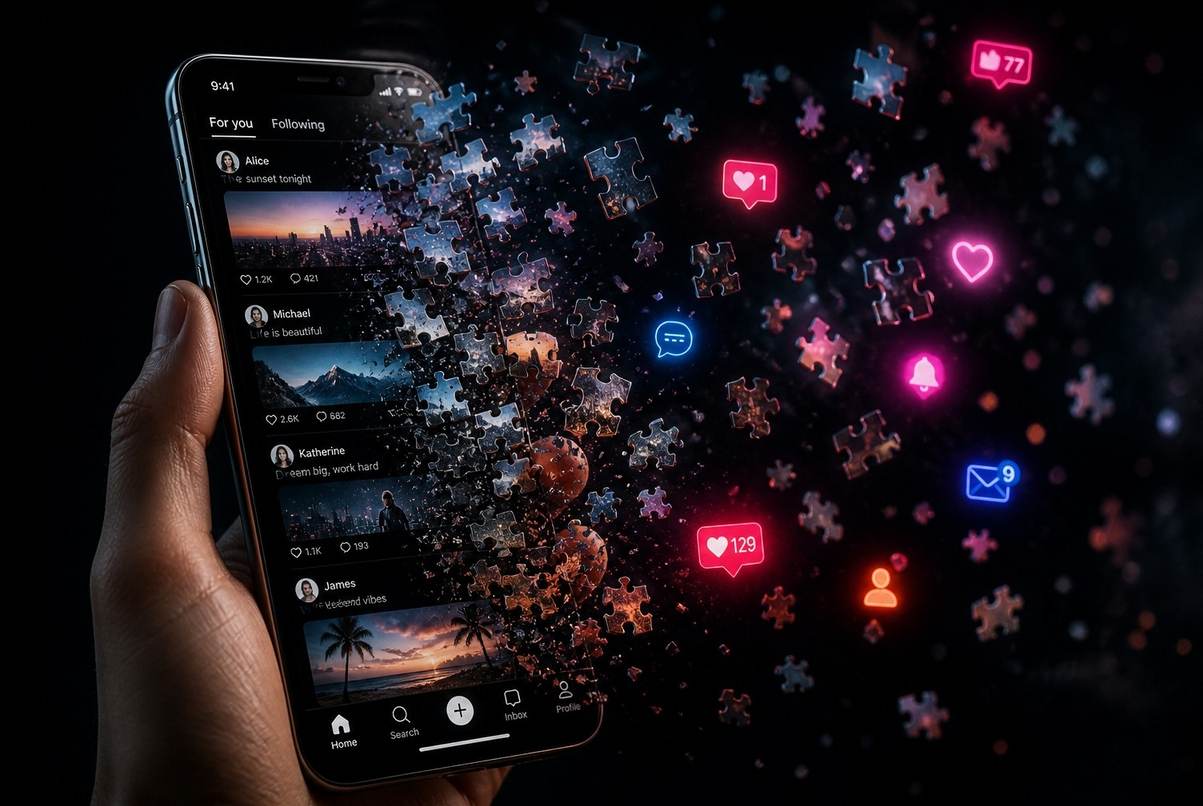
This is not simply personal weakness or modern laziness. It is a designed environment acting on a plastic brain. Short-form feeds, infinite scroll, autoplay, notification cues, and algorithmic ranking all encourage rapid switching, reward anticipation, and a weakened sense of completion. The user does not merely consume the feed. The user is trained by it.
The infinite scroll is one of the clearest design symbols of the attention economy. By removing obvious stopping cues, it turns media consumption into a boundaryless corridor. There is no last page, no credits, no silence between tracks, no natural moment where the nervous system is invited to say, “Enough.” The next item is already waiting, polished and hungry.
This article examines the architecture of infinite scroll through attention research, behavioural psychology, reward neuroscience, body posture, digital eye strain, predictive processing, and Gnostic symbolism. The claim is not that every scroll ruins the brain. The claim is sharper: when an environment repeatedly rewards interruption, the mind begins to inhabit interruption as its native weather.
In Plain Terms
Infinite scroll is a feed design that keeps content loading without a clear ending. It removes natural stopping cues and makes continued consumption feel effortless. Combined with short-form video, algorithmic recommendation, and variable reward, it can train the mind towards rapid switching and away from sustained attention.
In a Gnostic reading, infinite scroll is a modern archonic pattern: not a literal demon, but a structure that captures attention, fragments continuity, and keeps the self moving from stimulus to stimulus before deeper recognition can stabilise. The counter-practice is not technophobia. It is the restoration of edges: endings, pauses, silence, embodiment, and chosen attention.
Sources and Disciplines Discussed
- Attention and media multitasking research, especially studies on cognitive control, working memory, and sustained attention.
- Design psychology, including stopping cues, infinite scroll, autoplay, variable reward, and engagement optimisation.
- Behavioural psychology, including the Zeigarnik effect, open loops, delay discounting, and reward anticipation.
- Reward neuroscience, especially the distinction between wanting and liking in incentive salience research.
- Somatic and visual health research, including forward head posture, repetitive strain, blinking, and digital eye strain.
- Gnostic symbolism, especially archonic capture, counterfeit desire, the Demiurge, and the recovery of sovereign attention.
How to Read This Article
This article uses strong symbolic language, but it does not claim that every platform designer is malicious or that every user is powerless. Infinite scroll is best understood as an incentive structure. When attention is monetised, designs that increase time-on-platform are rewarded, even when they weaken the user’s ability to stop.
Read the Gnostic language as a lens for recognising pattern: a world without edges, desire without rest, novelty without nourishment, and choice that has already been shaped before it reaches consciousness.
Table of Contents
- The Neuroplasticity of Fragmentation
- Working Memory and the Cost of Switching
- Delay Discounting and the Collapse of the Future
- The Default Mode Network and the Loss of Gaps
- The Zeigarnik Effect and the Open Loop
- The Algorithmic Prediction of Desire
- The Physiology of the Swipe
- Reclamation of the Attentional Architecture
- The Gnostic Reading: Infinite Scroll as Archonic Architecture
- Related Glossary Terms
- Read Next
- Frequently Asked Questions
- Further Reading
- References and Sources
The Neuroplasticity of Fragmentation
The brain is plastic. It adapts to repeated environments, and the environment of the feed is one of rapid fragmentation. Short-form content, often lasting seconds rather than minutes, repeatedly trains the nervous system to expect fast novelty, abrupt transitions, emotional spikes, and near-immediate replacement.
This does not mean the brain is permanently damaged by watching short videos. The phrase “rewires the brain” can easily become dramatic fog. A more careful claim is that repeated digital habits can shape attention, expectations, reward sensitivity, and tolerance for boredom. The more often the mind practises interruption, the more familiar interruption becomes.
The feed is therefore a training ground. Every scroll rehearses a particular relationship to experience: do not stay, do not deepen, do not wait, do not complete. Move on. The next stimulus may be better. The next clip may answer the itch. The next novelty may finally satisfy the hunger that novelty itself keeps alive.
In Gnostic terms, this is a subtle form of captivity. The mind is not chained by one object. It is scattered across endless objects. The prison is not stillness. It is motion without arrival.
Working Memory and the Cost of Switching
Working memory is the ability to hold and manipulate information in mind. It supports reasoning, reading comprehension, planning, problem-solving, and the ability to follow a line of thought without dropping it halfway through the corridor.
Research on media multitasking has linked heavy multitasking with weaker performance on some measures of cognitive control and sustained attention. The details are debated, and not every user is affected in the same way. But the general warning is reasonable: if the mind is constantly trained to switch, switching becomes easier than staying.
The popular claim that humans now have a shorter attention span than a goldfish is not reliable science. It is better discarded. The real issue is not a mythical eight-second brain. It is the learned discomfort of continuity. The paragraph becomes heavy. The silence becomes itchy. The book becomes too slow. The phone offers rescue, and the rescue is another tiny theft.
Deep attention is not merely a productivity skill. It is the condition under which complex thought can unfold. Without it, the mind may still gather information, but struggle to metabolise meaning.
Delay Discounting and the Collapse of the Future
Delay discounting describes the tendency to prefer smaller immediate rewards over larger delayed ones. Human beings are already vulnerable to this. The feed intensifies the tendency by making small rewards constantly available, cheap to access, and almost frictionless.
The long reward asks for patience: a book, a craft, a skill, a friendship, a body practice, an article that takes time to understand. The feed offers a small reward immediately: a joke, a shock, a face, a clip, a confirmation, a provocation, a tiny glint of belonging. The long reward must be chosen. The small reward arrives already dressed.
Over time, the future can begin to feel less real than the next swipe. This is not because the user lacks character. It is because the environment continually rewards the nearest possible gratification. Patience becomes a neglected muscle. Frustration tolerance thins. The capacity to wait for meaning is replaced by the demand for stimulation now.
The Gnostic danger is not pleasure itself. Pleasure is part of embodied life. The danger is a lower order that reduces desire to compulsion, then calls compulsion choice.
The Default Mode Network and the Loss of Gaps
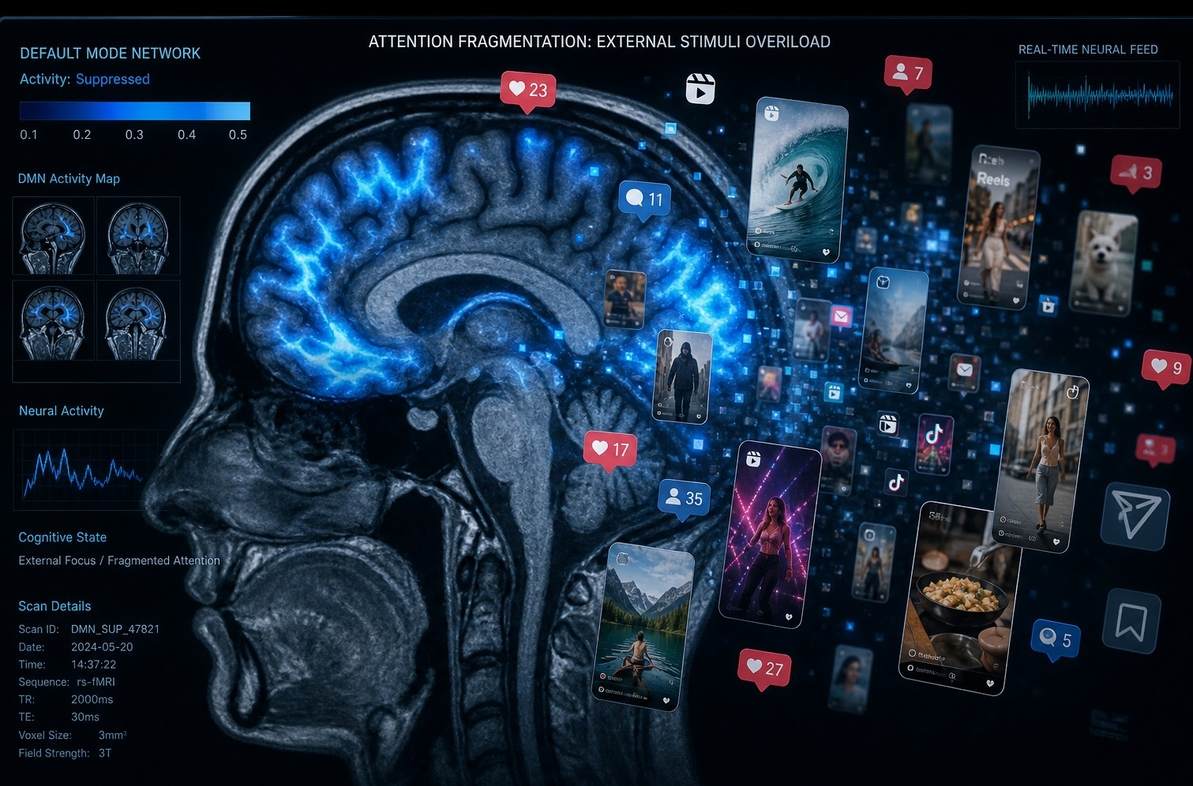
The default mode network is associated with self-reflection, memory, imagination, mind-wandering, and the narrative continuity of the self. It often becomes prominent when the mind is not engaged in an external task. This does not mean the DMN requires total silence, nor that all screen use suppresses it. But unbroken stimulus can crowd out the ordinary gaps in which reflection gathers itself.
Gaps matter. The pause after a chapter. The walk after a conversation. The stare out of a window. The boring bus journey. The silence after grief. These are not empty spaces. They are metabolic spaces, where experience becomes meaning rather than residue.
When every gap is filled with content, the narrator is not allowed to organise the day. Memory becomes thinner. Feeling is interrupted before it can complete its sentence. The self becomes less like a woven fabric and more like a pile of glittering threads.
The infinite scroll does not need to destroy the self. It only needs to prevent the self from settling long enough to hear itself.
The Zeigarnik Effect and the Open Loop
The Zeigarnik effect, named after Soviet psychologist Bluma Zeigarnik, describes the tendency to remember unfinished tasks more readily than completed ones. The mind keeps incomplete business alive. An open loop pulls attention back towards resolution.
In ordinary life, this can be useful. It helps us remember the unfinished letter, the unwashed pan, the unpaid bill, the sentence waiting to be completed. The open loop keeps a thread in the hand until the task is done.
The feed industrialises open loops. Each clip begins a micro-narrative: a reveal, a conflict, a confession, a joke, a ranking, a recipe, a warning, a face about to say the thing. Even when one loop closes, the next opens instantly. The structure is not completion, but perpetual almost-completion.
This creates a strange state of narrative suspension. The user is not quite choosing, not quite resting, not quite learning, not quite entertained. They are held in the middle. Time softens. Intention fades. The feed becomes a corridor lined with doors, and behind every door is another corridor.
That is the genius of the design. It does not need to give deep satisfaction. It only needs to keep the loop open long enough for the next loop to appear.
The Algorithmic Prediction of Desire
The feed does not merely present content. It learns from behaviour. Watch time, pauses, scroll speed, skips, repeats, likes, shares, comments, searches, follows, and returns all help train the system. The platform does not need to understand the soul. It only needs to predict the next action with enough accuracy to keep the user available.
This creates a closed loop of desire. The algorithm predicts what will hold attention. It serves the content. The user engages. The prediction is strengthened. More similar content appears. The field narrows in the shape of previous reaction, and the narrowing feels like relevance.
This is where filter bubbles become more than political inconvenience. They become identity weather. The feed does not simply show what you want. It can train the conditions under which wanting arises. Desire becomes rehearsed. Curiosity becomes channelled. The user begins to inhabit a world made from their own prior reactions, amplified by invisible ranking systems.
The Gnostic recognises this as a demiurgic pattern: not creation from divine fullness, but construction from partial data. The lower craftsman builds a world out of traces and then asks the soul to call that world personal freedom.
Predictive processing describes the brain as a prediction-making system, constantly anticipating the world and updating its models. Algorithmic feeds externalise and exploit this logic. The brain predicts. The platform predicts the predictor. Between them, a loop forms. The question becomes: where, in that loop, does free attention still breathe?

The Physiology of the Swipe
The gesture matters. Swipe, refresh, tap, wait, reward. The body learns the loop before the intellect has finished describing it. Kent Berridge’s work on reward distinguishes between “wanting,” the motivational pull towards a reward, and “liking,” the pleasure of receiving it. The feed is often better at generating wanting than lasting liking.
This is why the scroll can continue long after pleasure has faded. The user may no longer enjoy the feed, yet still feel compelled to check. Anticipation has become stronger than satisfaction. The nervous system keeps foraging, not because the berries nourish, but because the next bush might.
The body also adapts physically. Prolonged phone use can encourage forward head posture, neck strain, shoulder tension, thumb and hand discomfort, and digital eye strain. Screen use can reduce blink rate and increase visual discomfort in some contexts. These are not moral failures. They are bodily consequences of repetition.
There is also the subtler physiology of chronic half-alertness. Bright screens, notifications, rapid novelty, social comparison, and emotionally charged content can keep the body slightly braced. Not always in panic, but not in rest either. The result is a nervous system neither fully engaged nor truly released: stimulated, tired, watchful, restless.
The scroll is therefore not only mental. It is postural, ocular, muscular, respiratory, and nervous-system based. The attention economy enters through the eyes, but it eventually sits in the neck, thumb, jaw, diaphragm, and sleep.
Reclamation of the Attentional Architecture
Sovereignty over attention is not restored by willpower alone. Willpower is too small a boat for this ocean. The environment must be redesigned, because the environment has already been designed against stopping.
The following practices are not purity tests. They are architectural repairs. The goal is not to reject technology, but to restore edges, endings, bodily presence, and deliberate choice.
1. Restore Edges
Reintroduce stopping cues. Watch films with credits. Read physical books with chapters. Listen to albums with silence between tracks. End a session deliberately rather than collapsing from exhaustion. Let completion return to the nervous system as a recognisable event.
The chapter break is not an interruption. It is a breath. The credits are not wasted time. They are a shoreline. The silence after a song is not empty. It is the place where the experience lands.
2. Practise Deep Attention
Set aside blocks of single-task attention. Begin modestly: twenty minutes of reading without the phone in the room. One handwritten page. One walk without audio. One meal without a screen. Increase slowly.
The boredom that appears is not failure. It is withdrawal from over-stimulation. Beneath it may be restlessness, grief, creativity, irritation, imagination, or the simple discomfort of meeting the mind without costume. Stay gently. Depth returns by being invited, not bullied.
3. Use Algorithmic Fasts
Use chronological feeds where possible. Disable autoplay. Remove apps from the home screen. Clear recommendation histories when they become cages. Take periodic breaks from algorithmic platforms. Visit websites directly. Follow human curators rather than only machine recommendations.
The point is not permanent exile from digital life. The point is to feel the difference between chosen attention and captured attention. An algorithmic fast reveals the dependency pattern. The return, when it happens, can then happen with eyes open.
4. Reclaim the Body
Raise the screen towards eye level when possible. Blink deliberately. Stretch the hands. Unclench the jaw. Walk without the phone. Let the eyes look across distance, not only into glass. Let the spine remember the sky.
Somatic practices such as body scanning, yoga, tai chi, breath awareness, slow walking, and simple posture resets rebuild the felt sense of embodiment. When you know where your body is in space, the feed has a harder time stealing the whole field of perception.

The Gnostic Reading: Infinite Scroll as Archonic Architecture
In Gnostic myth, the archons rule through misrecognition. They do not need the spark destroyed. They need it distracted, frightened, fascinated, scattered, and persuaded that the lower order is the whole of reality.
Infinite scroll performs this pattern in technical form. It keeps consciousness moving across surfaces. It prevents the gap. It substitutes novelty for revelation, motion for freedom, stimulation for aliveness, and prediction for desire. The feed does not forbid awakening. It simply fills every doorway before the seeker notices there was a doorway.
The Demiurge builds worlds from partial understanding. The feed builds worlds from partial data. Both claim to know what is real. Both ask for attention as tribute. Both become powerful when their construction is mistaken for the total field.
Gnosis begins with a pause. Not a dramatic rejection of the modern world, but a small refusal to keep moving when the system says move. The thumb stops. The breath returns. The body re-enters the room. A silence opens. In that silence, the soul remembers that not every next thing deserves entry.
The infinite scroll is endless only while we continue feeding it. The first liberation is embarrassingly simple: stop. Not forever. Not perfectly. Just long enough for attention to discover that it still has a spine.
Related Glossary Terms
For quick definitions, use the main ZenithEye Glossary. The key terms for this article are:
Read Next
Continue with: The Crystalline Gateway: Understanding the Pineal Gland as the Seat of Spiritual Perception
If this article examines the external architecture that fragments attention, the next step turns inward towards one of the oldest symbols of spiritual perception: the pineal gland, the third eye, and the contested bridge between biology and inner sight.
Within The Thread
This article belongs to The Architecture of Perception, a layer of The Thread concerned with how reality is filtered, framed, interrupted, narrated, embodied, and mistaken for the whole. Infinite scroll belongs here because it reshapes the conditions under which attention can become recognition.
Frequently Asked Questions
What is infinite scroll?
Infinite scroll is a design pattern where new content loads continuously as the user moves down a feed. Unlike a book chapter, search-results page, film credits, or album ending, infinite scroll removes obvious stopping cues. This can make continued consumption feel effortless and make stopping feel less natural.
Does short-form content really rewire the brain?
The brain is plastic, so repeated habits can shape attention, reward expectations, and tolerance for boredom. However, it is too simplistic to say that short-form content permanently rewires the brain. A more careful statement is that repeated exposure to rapid novelty and interruption can train the mind towards switching rather than sustained attention, while deeper attention can be rebuilt through practice.
What is the Zeigarnik effect?
The Zeigarnik effect describes the tendency to remember or return to unfinished tasks more strongly than completed ones. Infinite scroll can exploit open loops by constantly beginning new micro-narratives before the mind has fully resolved the previous one. The result is a feeling of almost-completion that keeps attention moving.
What is the difference between wanting and liking?
Reward research distinguishes between wanting, the motivational pull towards a reward, and liking, the pleasure of receiving it. Digital feeds often intensify wanting without producing lasting satisfaction. This is why a person may keep scrolling even when the experience no longer feels enjoyable.
What is a filter bubble?
A filter bubble is a narrowed information environment shaped by personal preference, social networks, and algorithmic recommendation. It can make the user’s world feel more relevant while reducing accidental exposure to unfamiliar ideas, people, and perspectives.
How can I restore deep attention?
Restoring deep attention usually requires environmental redesign rather than willpower alone. Helpful steps include removing the phone from the room during reading, disabling autoplay, using chronological feeds, reintroducing stopping cues, walking without constant input, reading physical books, and practising single-task attention in gradually longer blocks.
Can excessive scrolling affect the body?
Yes. Prolonged device use can contribute to forward head posture, neck strain, hand or thumb discomfort, reduced blinking, and digital eye strain. It can also keep the nervous system in a state of mild alertness. These effects vary by person, posture, usage pattern, and overall health, but embodiment matters when reclaiming attention.
Further Reading
These links connect infinite scroll and attention fragmentation to related resources within the ZenithEye archive, offering context on attention capture, embodiment, algorithmic sovereignty, and the recovery of inner stillness.
- The Ungovernable Attention: Cognitive Sovereignty in the Algorithmic Age – The companion article on attention capture, digital discipline, and reclaiming mental space.
- The Algorithmic Unconscious: How the Feed Dreams for You – How recommendation systems create a synthetic shadow-self from behavioural traces.
- The Dopamine Cartel: Neurochemical Warfare in the Attention Economy – Reward anticipation, wanting, liking, and the neurochemical language of digital compulsion.
- The Body Against the Algorithm: Reclaiming Embodiment – Somatic practices for reversing the bodily consequences of chronic device use.
- Spiritual Practice: Attention and Presence – The foundational practice of returning awareness to the present field.
- Contemplative Techniques: The Thread’s Practical Foundation – Methods from contemplative traditions for training sustained attention.
- The Default Mode Network: Neuroscience of the Narrative Self – The self-storying network and what happens when the narrator loosens.
- AI Archon: Algorithmic Governance and the Erosion of Autonomy – Automated decision systems, prediction, and the outsourcing of agency.
- The Crystalline Gateway: Understanding the Pineal Gland as the Seat of Spiritual Perception – The next article in this route, exploring inner sight, symbolism, and contested biology.
- The Thread – The main map of ZenithEye’s routes through source, practice, consciousness, and modern systems.
References and Sources
The following sources support the psychological, neuroscientific, design, and somatic framework of this article.
Attention, Media Multitasking, and Cognitive Control
- [1] Ophir, Eyal, Clifford Nass, and Anthony D. Wagner. “Cognitive Control in Media Multitaskers.” Proceedings of the National Academy of Sciences, 106(37), 15583-15587, 2009.
- [2] Uncapher, Melina R. and Anthony D. Wagner. “Minds and Brains of Media Multitaskers: Current Findings and Future Directions.” Proceedings of the National Academy of Sciences, 115(40), 9889-9896, 2018.
- [3] Mark, Gloria. Attention Span: A Groundbreaking Way to Restore Balance, Happiness and Productivity. Hanover Square Press, 2023.
- [4] Maybin, Simon. “Busting the Attention Span Myth.” BBC News, 10 March 2017.
Open Loops, Reward, and Predictive Processing
- [5] Zeigarnik, Bluma. “Über das Behalten von erledigten und unerledigten Handlungen.” Psychologische Forschung, 9, 1-85, 1927.
- [6] Berridge, Kent C. and Terry E. Robinson. “What Is the Role of Dopamine in Reward: Hedonic Impact, Reward Learning, or Incentive Salience?” Brain Research Reviews, 28(3), 309-369, 1998.
- [7] Friston, Karl. “The Free-Energy Principle: A Unified Brain Theory?” Nature Reviews Neuroscience, 11(2), 127-138, 2010.
- [8] Mischel, Walter, Yuichi Shoda, and Monica L. Rodriguez. “Delay of Gratification in Children.” Science, 244(4907), 933-938, 1989.
Design Psychology and Technology Critique
- [9] Pariser, Eli. The Filter Bubble: What the Internet Is Hiding from You. Penguin Press, 2011.
- [10] Alter, Adam. Irresistible: The Rise of Addictive Technology and the Business of Keeping Us Hooked. Penguin Press, 2017.
- [11] Newport, Cal. Digital Minimalism: Choosing a Focused Life in a Noisy World. Portfolio, 2019.
- [12] Harris, Tristan. “How Technology Is Hijacking Your Mind, from a Magician and Google Design Ethicist.” 2016 essay.
- [13] Eyal, Nir. Hooked: How to Build Habit-Forming Products. Portfolio, 2014.
Body, Screens, and Digital Strain
- [14] Portello, Joan K., Marcy Rosenfield, Chu A. Bababekova, and Jennifer M. Estrada. “Computer-Related Visual Symptoms in Office Workers.” Ophthalmic and Physiological Optics, 32(5), 375-382, 2012.
- [15] Gowrisankaran, Sowjanya and James E. Sheedy. “Computer Vision Syndrome: A Review.” Work, 52(2), 303-314, 2015.
- [16] Nejati, Parisa, et al. “The Relationship Between Smartphone Addiction and Forward Head Posture.” Journal of Physical Therapy Science, 2021.
- [17] Hansraj, Kenneth K. “Assessment of Stresses in the Cervical Spine Caused by Posture and Position of the Head.” Surgical Technology International, 25, 277-279, 2014.
Gnostic and Contemplative Context
- [18] Robinson, James M. (ed.). The Nag Hammadi Library in English. 3rd ed. HarperSanFrancisco, 1990.
- [19] Meyer, Marvin (ed.). The Nag Hammadi Scriptures: The International Edition. HarperOne, 2007.
- [20] Williams, Michael Allen. Rethinking “Gnosticism”: An Argument for Dismantling a Dubious Category. Princeton University Press, 1996.
- [21] Brakke, David. The Gnostics: Myth, Ritual, and Diversity in Early Christianity. Harvard University Press, 2010.
- [22] Kornfield, Jack. After the Ecstasy, the Laundry: How the Heart Grows Wise on the Spiritual Path. Bantam, 2000.
Study and Safety Note
This article explores psychological, neuroscientific, design, and symbolic frameworks for understanding digital distraction and attention fragmentation. It does not provide medical, psychological, psychiatric, or therapeutic advice.
If scrolling, gaming, social media, compulsive checking, anxiety, depression, sleep disruption, or digital overuse is interfering with work, relationships, daily functioning, or safety, seek support from a qualified mental health professional. Attention-restoration practices may support self-regulation, but they do not replace clinical care where needed.