
The Dopamine Cartel: Neurochemical Warfare in the Attention Economy
You are not a user. You are the product, the raw material, and the refinery. The application on your screen does not serve your needs; it serves your neurochemistry, and not in the manner of a healer but of a pusher. Every swipe, every notification, every autoplaying video is a calibrated dose–precisely measured to trigger the dopaminergic cascade that keeps you tethered to the glowing rectangle like a laboratory rat pressing a lever for sugar pellets.
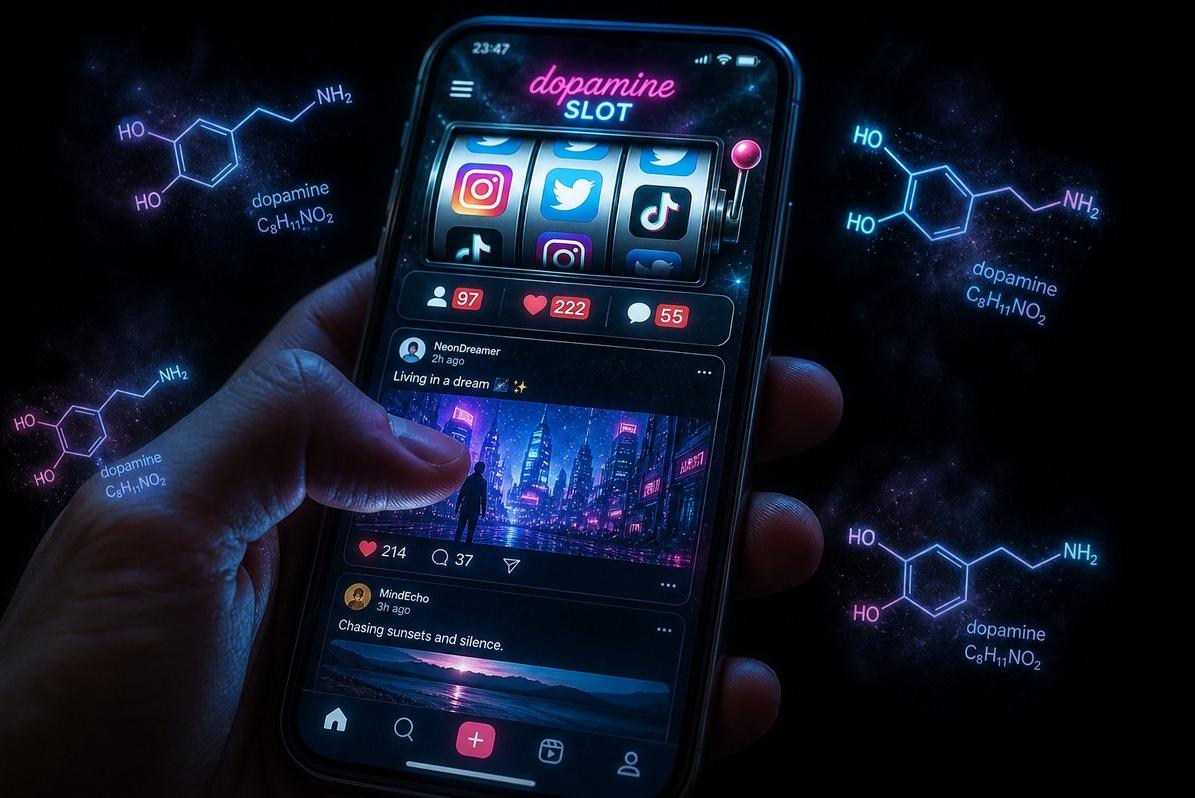
This is not metaphor. This is the neurochemical warfare of the attention economy, waged in the synaptic clefts of your striatum by corporations that employ behavioural psychologists in numbers that rival military research divisions. The weapon is not steel but the variable reward schedule–the same mechanism that makes the slot machine addictive, now miniaturised and distributed across the surface of your waking life. You are not browsing; you are gambling with your time, and the house always wins.
Table of Contents
- The Biochemistry of the Hook
- Cortisol and the Cocktail of Dread
- The Architecture of the Variable Reward
- The Gnostic Reading: Extraction and the Archons
- Recovery and Reclamation
- Frequently Asked Questions
- Further Reading
The Biochemistry of the Hook
Dopamine is not pleasure; it is the anticipation of pleasure–the chemical signature of the hunt, not the kill. Neuroscience research confirms this distinction with increasing precision: dopamine neurons in the mesolimbic pathway respond most strongly to the expectation of reward rather than its consumption. When an individual receives an unexpected positive outcome, dopamine levels surge; when expected rewards fail to materialise, levels drop below baseline, creating a state of reduced motivation and mood. This reward prediction error mechanism explains why the first notification check generates more compulsion than the hundredth, and why activities lose their appeal once they become routine.
The social media architects understand this distinction with clinical precision. The feed is not designed to satisfy but to promise satisfaction, to keep you in the perpetual state of “just one more” that characterises the addicted organism. The mechanism is ancient. The nucleus accumbens, the brain’s reward centre, evolved to reinforce behaviours critical for survival–seeking food, finding mates, detecting novelty. The platform hijacks this circuitry by delivering artificial superstimuli: the red notification badge (potential social reward), the pull-to-refresh (the lottery ticket of novelty), the infinite scroll (the promise that the next item will be the one).
The result is dopaminergic dysregulation. With chronic overstimulation, the brain downregulates dopamine receptors–a homeostatic response that leaves the user in a state of anhedonic numbness when not online. The offline world becomes grey, slow, unrewarding. The only thing that feels alive is the feed. This is not preference; it is pathology, induced and maintained by design. Research on the dopamine paradox demonstrates that immediate gratification often undermines rather than supports long-term motivation, as the initial surge is followed by compensatory downregulation that reduces the appeal of effortful activities.
Cortisol and the Cocktail of Dread
The addiction is not merely to pleasure but to the mixture of pleasure and anxiety–the dopamine-cortisol cocktail that keeps the nervous system in a state of hyperarousal. Doomscrolling, outrage bait, and fear-of-missing-out (FOMO) are not accidental byproducts; they are features of the extraction model. Studies have shown that social media and device usage can cause various stress and anxiety symptoms, including “phantom vibrations”–the sensation that the phone is vibrating when it is not. This occurs when the brain develops a heightened state of vigilance and anxiety about missing a notification.
Cortisol, the stress hormone, ensures you keep checking. The platform creates a low-grade state of threat–the world is ending, your friends are having fun without you, you are missing something crucial–and then sells the relief of that threat through engagement. It is the protection racket translated into neurochemistry: “Nice peace of mind you have got there. Shame if something happened to it.” The constant stress of being connected and fear of missing out can lead to chronically elevated cortisol levels. High cortisol impairs cognitive function, reduces immune response, and contributes to the development of anxiety and depression.
Over time, this chronic hyperarousal dysregulates the hypothalamic-pituitary-adrenal (HPA) axis. The user exists in a state of perpetual “freeze”–too anxious to act, too addicted to stop, scrolling through the apocalypse with a thumb that moves of its own accord. The American Psychological Association has cited research showing a correlation between stress and the frequency of attention switching necessary online. Stress, measured by heart rate monitors, rises in correlation with faster attention switching. Users are then more likely to make errors, which adds to stress. Simultaneously, performance slows, so each task requires more mental effort.
The Architecture of the Variable Reward
B. F. Skinner demonstrated in his seminal 1957 work Schedules of Reinforcement that rats press a lever most compulsively when the reward is variable–sometimes a pellet, sometimes nothing, sometimes a jackpot. The unpredictability is the hook. Social media engineers have implemented this “Skinner box” at scale, translating operant conditioning from the laboratory to the marketplace:
The Notification Roulette
You do not know what waits behind the red badge–a message from a lover, a spam bot, or a reminder of your own irrelevance. The only way to find out is to click. The uncertainty of receiving the reward creates a much greater expectation and therefore dopamine production. When the odds drop from certainty to chance, the neurological response intensifies. The notification badge is not information; it is a lottery ticket.
The Feed Lottery
The next item might be a video of a kitten, a genocide, or your ex-partner’s wedding photos. The variance ensures you cannot habituate. The brain processes rewards in relative rather than absolute terms, and contrast effects ensure that the unpredictability itself becomes the drug. A modest reward following uncertainty may generate more compulsion than a larger reward received predictably.
The Engagement Metric
The fluctuating like-count creates a stock-market of the self, where self-worth is traded in real-time and the market never closes. This is not merely social comparison but a quantified selfhood, a numerical identity that rises and falls with the volatility of external validation. The user becomes both trader and commodity, broker and stock, in a market where the platform owns the exchange and extracts the commission.

The Gnostic Reading: Extraction and the Archons
In the Gnostic framework, the archons feed on ignorance, deception, and human entrapment within the material world. The modern concept of loosh–emotional energy harvested through suffering and arousal–was articulated most influentially by Robert Monroe in his 1971 work Journeys Out of the Body, where he described non-human intelligences extracting energy produced by intense human emotional states. While not a classical Gnostic term, loosh has been synthesised with archon theory in contemporary esotericism to describe a form of energetic predation that parallels the ancient understanding of the demiurge’s parasitic relationship to the spiritual spark.
The dopamine cartel is the industrialisation of this extraction. The platform does not merely want your attention; it wants your affect–your rage, your envy, your loneliness–all converted into engagement metrics that translate to advertising revenue. The user is the battery in the Matrix, but the Matrix is not a simulation; it is a stimulation–a carefully calibrated sequence of neurochemical triggers that keeps the organism in a state of productive agitation, never satisfied, never at rest, always generating the next click.
The Apocryphon of John describes Yaldabaoth and his minions as jealous of the spiritual light, constantly working to drag souls back into ignorance. Whether interpreted literally as entities or metaphorically as systemic structures of control, these forces operate with intelligence and intention. The algorithm is not evil; it is amoral, which is worse. It has no malice, only optimisation metrics. It does not hate you; it simply does not care whether you flourish or decay, so long as your decay is profitable. The archon has been automated.
Recovery and Reclamation
Sovereignty requires neurochemical rehabilitation. The following practices do not demand ascetic withdrawal from technology; they demand the recovery of choice within the technological environment. The goal is not to smash the smartphone but to reclaim the hand that holds it.
1. The Dopamine Fast
Not the wellness-industry caricature, but a rigorous cessation of all superstimuli for 24-72 hours. No screens, no sugar, no pornography, no news. The withdrawal is instructive–irritability, craving, intrusive thoughts reveal the extent of the occupation. This is not punishment but diagnosis: the severity of withdrawal symptoms indicates the depth of the dependency. The fast reveals what has been hidden by constant stimulation: the baseline state of the unmedicated nervous system, which may initially feel flat, anxious, or unbearably slow. This flatness is not pathology; it is the floor beneath the addiction, the ground from which genuine pleasure can eventually regenerate.
2. The Restoration of Variance
Replace the artificial variability of the feed with natural uncertainty–walking without a destination, conversations without agenda, books that do not autoplay. Relearn tolerance for the “boredom” that is actually the space of creative generation. The brain heals when exposed to effortful activities that provide rewards contingent on skill development rather than passive consumption. Flow theory describes states of optimal experience characterised by deep engagement and intrinsic motivation, typically occurring during challenging activities that match an individual’s skill level. These activities produce sustainable motivation because they provide appropriate feedback without the destructive volatility of artificial superstimuli.
3. Receptor Upregulation
The brain heals, but slowly. Extended periods of low stimulation allow dopamine receptors to regenerate. The grey world gradually regains colour. The book becomes readable again. The conversation becomes tolerable. Recovery timelines vary considerably: for mild cases involving excessive technology use, motivation improvements may appear within weeks to months of implementing appropriate changes. More severe cases may require longer periods of consistent practice. The key factor is consistency in avoiding overstimulation while engaging in effortful, meaningful activities that support natural dopamine function.
4. Environmental Redesign
Remove cues for immediate gratification while increasing cues for effortful activities. Add friction to problematic behaviours and reduce friction to desirable ones. This might involve grayscale mode on the phone, notification batching, physical removal of devices from the bedroom, or the deliberate placement of books, instruments, or meditation cushions in high-visibility locations. The concept of friction applies to both removing barriers to desired behaviours and adding barriers to problematic ones. Social environment modifications include identifying relationships and social contexts that promote immediate gratification versus those that support long-term goal pursuit.

Frequently Asked Questions
Is social media addiction a real addiction or just a habit?
Social media addiction exhibits the same neurobiological markers as substance addiction: dopaminergic dysregulation, receptor downregulation, tolerance development, and withdrawal symptoms including irritability and anxiety when access is removed. The variable reward schedule implemented by platforms creates compulsive use patterns that meet clinical criteria for behavioural addiction. It is not merely a bad habit but an engineered dependency.
How long does it take for dopamine receptors to recover from overstimulation?
Recovery timelines vary based on severity and duration of overstimulation. For mild cases involving excessive technology use, motivation improvements may appear within weeks to months. More severe cases may require six to twelve months or longer for substantial recovery. The key factor is consistency in avoiding overstimulation while engaging in effortful, meaningful activities that support natural dopamine function. The brain heals, but slowly.
What is the variable reward schedule and why is it so addictive?
The variable reward schedule, first systematically described by B. F. Skinner in 1957, delivers rewards unpredictably–sometimes after one response, sometimes after many, sometimes not at all. This unpredictability generates higher engagement and slower extinction than predictable rewards because the brain cannot habituate to uncertainty. Social media engineers have implemented this mechanism at scale through notifications, feeds, and engagement metrics, creating the same compulsive lever-pressing behaviour Skinner observed in rats.
What is loosh and is it a real Gnostic concept?
Loosh is not a classical Gnostic term but a modern concept articulated by Robert Monroe in his 1971 work Journeys Out of the Body, describing emotional energy harvested by non-physical intelligences. Contemporary esotericism has synthesised loosh with Gnostic archon theory to describe energetic predation. Whether interpreted literally as entity feeding or metaphorically as systemic extraction of human attention and affect, the concept describes a parasitic relationship between the user and the platform that mirrors ancient descriptions of archonic imprisonment.
How does cortisol contribute to social media addiction?
Social media platforms create a low-grade state of threat through doomscrolling, outrage bait, and fear-of-missing-out (FOMO). This triggers cortisol release, which keeps the nervous system in hyperarousal. The user then seeks relief from this stress through further engagement, creating a self-reinforcing cycle of anxiety and compulsive checking. Over time, chronic hyperarousal dysregulates the hypothalamic-pituitary-adrenal (HPA) axis, leaving the user in a state of perpetual freeze.
Can I use social media moderately or must I quit entirely?
Moderate use is possible but requires structural changes rather than willpower alone. Environmental redesign–grayscale mode, notification batching, app time limits, physical removal of devices from specific spaces–reduces the platform’s capacity to trigger compulsive behaviour. The goal is not ascetic withdrawal but the recovery of conscious choice. If moderation repeatedly fails, a temporary dopamine fast of 24-72 hours can reset baseline sensitivity and reveal the true extent of dependency.
What is the Gnostic perspective on digital technology?
The Gnostic perspective does not condemn technology itself but examines the consciousness that designs and uses it. When technology serves awakening–providing access to texts, community, and contemplative tools–it is neutral or beneficial. When technology extracts attention, feeds on affect, and maintains ignorance through constant stimulation, it functions as an archonic system. The question is not whether to use the device but whether the device is using you.
Further Reading
These links connect the slot machine in your pocket to related resources within the ZenithEye library, offering context on predatory consciousness, integration, attention reclamation, and the broader landscape of sovereignty in the digital age.
- Predatory Consciousness & Spiritual Emergency: A Gnostic Survival Guide — Understanding archonic interference and the full spectrum of predatory consciousness beyond the digital.
- The Soul Trap: Are We in a Cosmic Recycling Facility? — Gnostic insights on systemic control structures that mirror the attention economy’s extraction model.
- 7 Integration Practices After Mystical Experience — Somatic techniques for grounding and stabilising the nervous system after depletion or spiritual emergency.
- The Alchemy of Attention: 4 Contemplative Techniques — Methods for reclaiming sovereign attention from the algorithmic colonisation of consciousness.
- Shadow Work: Excavating the Repressed in Gnostic Practice — Why unintegrated shadow material makes the user more susceptible to digital extraction and manipulation.
- The 3 Stages of Integration After Awakening — Immediate, short-term, and long-term patterns for grounding recognition into stable transformation.
- The Sacred Art of Inner Listening: Trust Your Soul’s Compass — Developing the discernment necessary to distinguish between authentic inner guidance and algorithmically induced impulse.
- The Thread: Five Gateways to Direct Knowing — The complete map of ZenithEye’s pillars, from historical survival of Gnosis to contemplative practice.
The rat eventually dies of exhaustion, pressing the lever until its paws bleed. You have the option to stop. The lever is not locked. The pellet is not food. The cage is not real. Step out into the grey–it will not be grey for long.