Doomscrolling and the Cortisol Cascade: Addiction to the Apocalypse
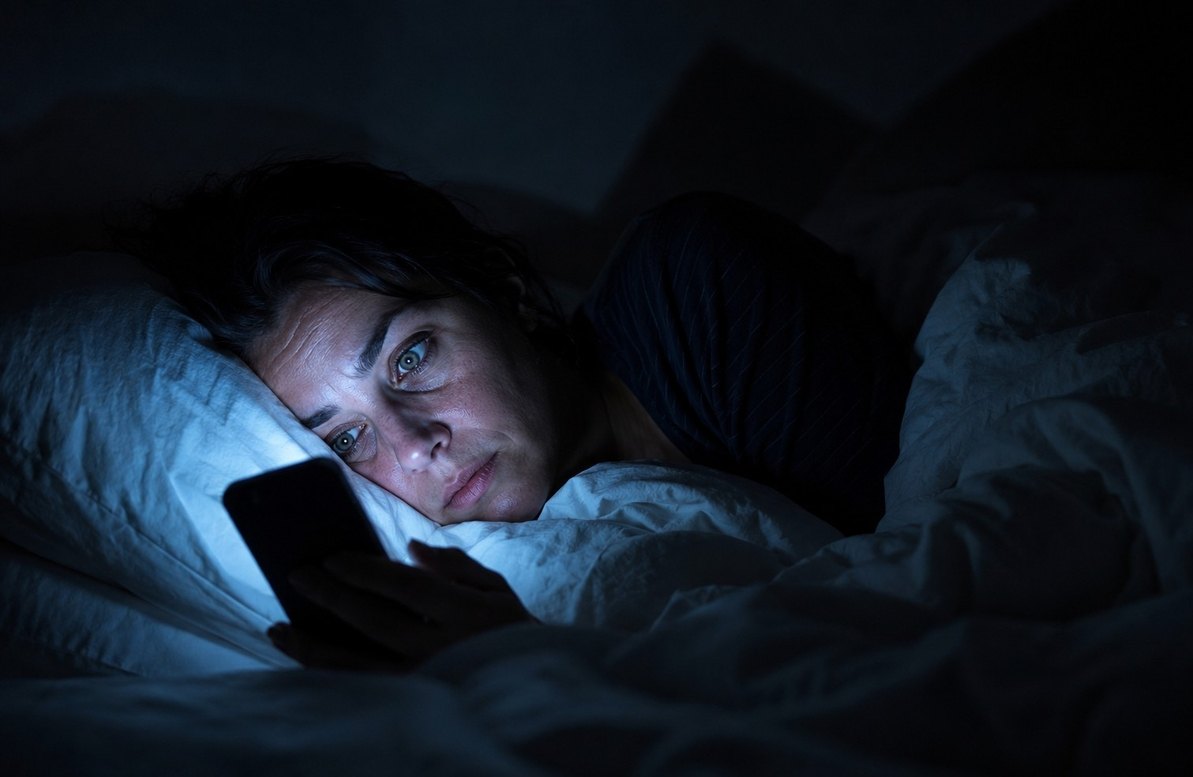
You wake at 03:00, the amygdala already firing. Before consciousness has fully assembled, the hand finds the phone, the thumb finds the feed, and the eyes begin scanning for updates. Has the war escalated? Has the climate threshold been breached? Has the market collapsed? You are not seeking information; you are seeking the hit–the cortisol spike that confirms you are right to be afraid, that the world is as dreadful as your chemistry suggests, that the vigilance is warranted.
This is doomscrolling: the compulsive consumption of negative news, the digital equivalent of picking at a scab. It masquerades as civic responsibility–“I need to stay informed”–but it functions as self-harm, a repetitive trauma rehearsal that keeps the nervous system in a state of chronic hyperarousal. The platform knows this. The algorithm serves catastrophe because catastrophe captures attention, and attention is the currency of the realm.
According to the American Academy of Sleep Medicine, 38% of U.S. adults report that consuming news on their devices before bed worsens their sleep, with younger adults aged 25 to 34 most affected at 43%. A 2022 study in the journal Health Communication found that the average doomscrolling session lasts approximately two hours and twenty-four minutes, frequently extending well past the user’s intended stopping point. The same research revealed that people who doomscroll for more than two hours daily report anxiety levels two and a half times higher than those who limit news consumption to under thirty minutes. These figures suggest a behaviour that has moved far beyond mere habit into the territory of behavioural addiction.

Table of Contents
- The Compulsion of Catastrophe
- The Biochemistry of Bad News
- The Trauma Bond with the Feed
- The Simulation of Action
- The Temporal Collapse
- Strategies for Sovereignty
- Frequently Asked Questions
- Further Reading
- References and Sources
Awareness without action is merely refined helplessness. The feed replaces the possibility of meaningful response with the paralysis of overwhelming information.
ZenithEye Editorial Position
The Compulsion of Catastrophe
The Anatomy of the 3am Scroll
The 3am scroll is not a rational information-gathering exercise. It is a limbic ritual. The amygdala, that almond-shaped sentinel of threat detection, does not wait for the prefrontal cortex to sign off on its activations. It fires on pattern recognition, on partial matches, on the mere suggestion of danger. By the time the thinking brain has booted up, the stress cascade is already underway.
The cortisol awakening response–the natural surge of cortisol that occurs within thirty to forty-five minutes of waking–can be disrupted by chronic stress. Research published in 2025 found that individuals showing an atypical blunted cortisol awakening response displayed reduced amygdala grey matter volume when exposed to chronic social overload. In other words, the very brain structure responsible for threat detection begins to atrophy under the weight of perpetual digital vigilance. The 3am scroll is not merely a bad habit; it is a neurobiological feedback loop that erodes the architecture of resilience.
From Information to Infliction
There is a critical distinction between staying informed and staying inflamed. News consumption, at its best, equips citizens with the knowledge required for democratic participation. Doomscrolling, by contrast, strips away context, nuance, and proportion. It delivers the emotional payload of catastrophe without the analytical framework required to process it.
The transition from information to infliction happens gradually. A user begins by checking headlines. Then they check comments. Then they check related stories. Then they check updates. Each click is a micro-dose of uncertainty, and uncertainty is the substrate upon which anxiety breeds. The feed transforms the user from a citizen into a spectator, and from a spectator into a victim of their own attention.
The Biochemistry of Bad News
Negativity Bias and the Evolutionary Ledger
The human brain exhibits a negativity bias–an evolutionary inheritance that prioritised the detection of threats over the appreciation of beauty. The organism that ignored the rustle in the grass was eaten; the one that ignored the sunset merely missed a pretty view. This asymmetry is hard-wired into the limbic system and has been demonstrated across decades of cognitive psychology research.
Social media engineers exploit this bias with surgical precision. Negative content triggers the release of cortisol and adrenaline, preparing the body for fight or flight. But in the digital context, there is no fleeing, no fighting–only the paralysis of the freeze response, the thumb continuing to scroll while the body remains immobilised on the sofa. This creates a dissociative state: the mind is hyperaroused, the body is hypoaroused, and the self is fragmented between them.
The Cortisol Cascade and HPA Dysregulation
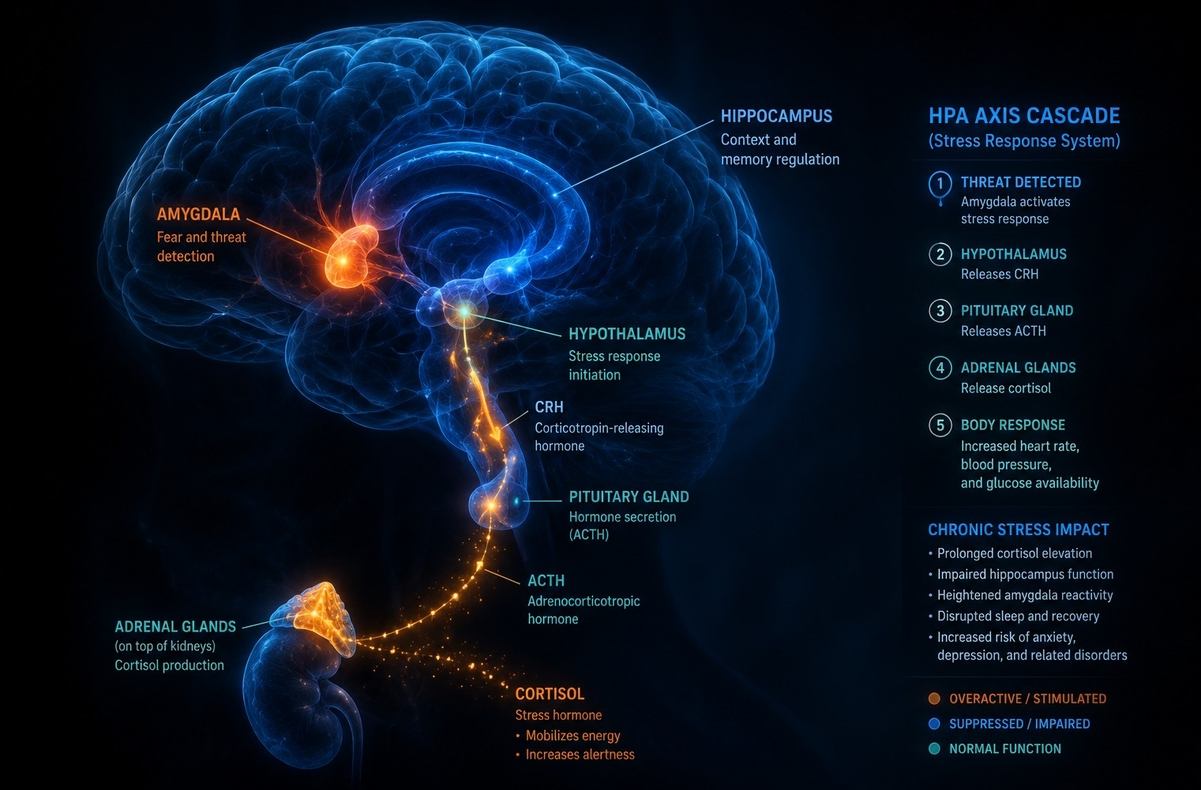
The hypothalamic-pituitary-adrenal axis governs the body’s stress response. When the brain perceives a threat–whether physical or symbolic–the hypothalamus signals the pituitary, which signals the adrenal glands to release cortisol. This cascade is adaptive in acute emergencies. When activated chronically, however, the axis begins to dysregulate.
A mathematical model published by NIH researchers explains that prolonged HPA activation causes the functional masses of the pituitary corticotrophs and adrenal cortex to grow over weeks. When the stressor is removed, these glands do not immediately shrink. Cortisol dynamics may normalise within days, but ACTH responses remain blunted for weeks, and full recovery can take months. This means that the doomscroller who decides to “cut back” is not merely fighting a habit–they are waiting for glandular architecture to recalibrate. The body, in its wisdom, takes time to trust that the emergency has ended.
The cortisol cascade has physical consequences that extend far beyond mood. Chronic elevation suppresses immune function, disrupts digestive processes, fragments sleep architecture, and impairs glucocorticoid receptor feedback. You are literally making yourself sick with “awareness.”
The Dissociative Split
Dissociation is not always dramatic. It does not require trauma in the clinical sense. It can be as subtle as the gap between your racing mind and your frozen body, between your hypervigilant eyes and your exhausted adrenals. This is the dissociative split of the doomscroller: the self divided against itself, one part compulsively seeking threat, the other part unable to mobilise any response.
Neuroimaging research has linked this split to default mode network dysfunction. When the brain is at rest, the default mode network supports introspection and memory consolidation. Prolonged passive scrolling overactivates this network, leading to rumination and negative self-focus. Short rest is restorative; hours of passive consumption leave the individual feeling worse than when they began.

The Trauma Bond with the Feed
Intermittent Reinforcement and Platform Design
Doomscrolling creates a psychological bond with the platform that mirrors the mechanism known as trauma bonding. The platform alternates between threat–the bad news–and relief–the ability to check whether the threat has worsened. This intermittent reinforcement creates a powerful addiction: the anxiety is unbearable, the feed promises relief, the feed provides more anxiety, and the cycle tightens.
Intermittent reinforcement is the same psychological principle that makes slot machines addictive. The brain’s dopamine system responds not to reward itself, but to the anticipation of reward. A like, a share, a new headline–these are the digital equivalent of the cherry symbol lining up. The near-misses keep the user pulling the lever. The platform does not need to deliver happiness; it merely needs to deliver unpredictability.
The Disaster Junkie
The user becomes a disaster junkie, unable to look away from the slow-motion car crash of the world. This is not moral failure. It is the predictable outcome of a nervous system trained on unpredictability. The Gnostic tradition might read this as the demiurge’s final trap: the conversion of natural compassion for suffering into a compulsive spectatorship that generates more suffering–the user suffers, the victims suffer, and the platform profits from the engagement.
Whether one frames it theologically or neurologically, the outcome is identical. Compassion becomes consumption. Concern becomes compulsion. The human capacity for empathy is hijacked by an architecture designed to monetise distress.
A Gnostic Reading
The Gnostic texts speak of archons–ruling powers that shape reality not by brute force, but by deception and distortion. They do not destroy the divine spark; they merely convince it that it is powerless. The doomscroller’s predicament bears an uncomfortable resemblance to this ancient diagnosis. The feed does not destroy your capacity for action; it merely floods you with so much information that action becomes unthinkable.
This is not to say that smartphones are archons in any literal sense. It is to say that the architecture of attention has become, in effect, a system of governance that operates below the threshold of conscious consent. The Gnostic call to gnosis–to knowing–was always a call to recognise the mechanisms of one’s own captivity. The first step toward sovereignty is seeing the cage.

The Simulation of Action
Awareness Without Agency
Doomscrolling offers the feeling of action without the fact. By “knowing” about the crisis, the user simulates participation: “At least I am aware.” But awareness without action is merely refined helplessness. The feed replaces the possibility of meaningful response with the paralysis of overwhelming information. You know everything; you do nothing.
Psychologists have a term for this: learned helplessness. First described by Martin Seligman in the 1970s, it arises when repeated exposure to uncontrollable adverse events leads individuals to believe they have no control over outcomes–even when such control becomes available. The digital newsfeed is a near-perfect delivery system for learned helplessness. The problems are global, systemic, abstract; the user is local, individual, powerless. The gap between knowledge and agency creates a despair that is chemically indistinguishable from depression.
The Learned Helplessness of the Feed
The learned helplessness of the feed is reinforced by what researchers call “headline anxiety.” Continuous exposure to negative headlines elevates feelings of anxiety and creates a sense of helplessness, particularly among teens and young adults. The relentless nature of the news cycle exacerbates the issue: updates are instant and non-stop, leading to a constant state of alertness that worsens mental health over time.
The tragedy is that the user often believes they are performing a civic duty. They are “staying informed.” They are “bearing witness.” But witness without witness-bearing–without testimony, without action, without community–is merely voyeurism. The feed transforms the moral impulse to care into a neurological impulse to check, and then to check again.
The Temporal Collapse
The Eternal Present of the Algorithm
Doomscrolling collapses temporal perspective. All crises are immediate, all disasters are present, all emergencies demand attention now. The algorithm flattens history into an eternal, terrifying present. There is no context, no causation, no development–only the endless now of the latest update.
This temporal flattening is not accidental. It is the logical consequence of a business model that monetises engagement. Outrage engages more than analysis. Fear engages more than perspective. The algorithm is not evil; it is amoral, and it has learned that amorality pays.
The Erosion of Narrative Hope
Without a sense of narrative–problem, struggle, resolution–there is only the static of permanent crisis. The future ceases to exist as a possibility; it becomes merely the site of the next catastrophe. This erodes what psychologists call “narrative hope,” the capacity to imagine oneself moving through difficulty toward a different state of affairs.
History offers an antidote. The present is not uniquely catastrophic; it is merely the one you are experiencing. Pandemics, wars, and collapses have punctuated human history before, and humans have endured them. Perspective restores proportion. The temporal collapse of the feed is reversible, but it requires deliberate effort to reinsert distance between oneself and the endless now.
Strategies for Sovereignty
The News Fast
Complete abstinence from news for thirty days. The world will not end–or if it does, you will hear about it from someone. The restoration of equilibrium requires the absence of the toxin. Research on behavioural addiction consistently shows that total abstinence, even for short periods, resets dopamine sensitivity and restores prefrontal regulatory capacity.
Thirty days is long enough for the HPA axis to begin recalibrating. It is long enough for sleep to deepen, for digestion to normalise, for the background hum of anxiety to attenuate. The news fast is not ignorance; it is a controlled experiment in sanity.
The Return to Local
Action counters despair. Engage with your immediate environment–gardening, community work, manual craft, conversation with neighbours. The local is the only sphere where agency is unambiguous. You cannot fix the climate in a feed, but you can plant a tree. You cannot end a war in a comment section, but you can feed a stranger.
The return to local is not escapism. It is the recognition that the global is always mediated, always abstract, always partial, whereas the local is immediate, tactile, and whole. The body learns agency through contact with soil, wood, water, and other bodies. These contacts restore the nervous system’s trust in the world.
Temporal Expansion
Read history. Read geology. Read cosmology. The present is not uniquely catastrophic; it is merely the one you are experiencing. Perspective restores proportion. When you understand that empires have risen and fallen, that species have come and gone, that the Earth has endured bombardments and ice ages, the urgency of the feed begins to look like a marketing strategy rather than a moral imperative.
Temporal expansion also means reading long-form journalism rather than headlines, books rather than threads, poetry rather than posts. The form of the medium shapes the form of the mind. Slow reading trains slow thinking, and slow thinking is the enemy of panic.
The Ritual of Closure
Set a timer for news consumption. When it rings, stop. The world does not require your continuous monitoring; that is the illusion of the feed. The ritual of closure creates a boundary between the world of information and the world of embodiment. It says: I will attend to the world, but I will not be consumed by it.
Effective rituals are sensory. Light a candle before you read the news; extinguish it when you finish. Wash your hands. Step outside. These gestures signal to the limbic system that the threat-scanning period has ended and the safety period has begun. The nervous system responds to ritual more reliably than to willpower.
Nervous System Restoration
The final strategy is not behavioural but physiological. The doomscroller’s nervous system requires active restoration, not merely the absence of stress. This means cold-water immersion to stimulate the vagus nerve, breathwork to downregulate sympathetic activation, walking meditation to re-establish interoceptive awareness, and weightlifting to discharge frozen fight-or-flight energy.
Research on nervous system regulation confirms that bottom-up interventions–those that work through the body rather than the mind–are often more effective for chronic digital stress than top-down cognitive strategies. The body must be convinced it is safe before the mind can believe it.

Follow the Modern Systems Route
This article belongs to ZenithEye’s modern systems route: AI, attention capture, digital governance, simulation, and the old patterns wearing new technical masks.
- AI, Technology & Archonic Systems — the wider route for AI and control-system articles.
- Digital Attention & Surveillance — attention capture, screens, metrics and behavioural loops.
- The Thread — the main map of the archive.
- Editorial Principles — how ZenithEye frames symbolic and contemporary interpretation.
What is doomscrolling and why is it addictive?
Doomscrolling is the compulsive consumption of negative news and social media content. It is addictive because it exploits the brain’s negativity bias and triggers cortisol and adrenaline release. The intermittent reinforcement of threat followed by relief creates a trauma-bond-like cycle with the platform.
How does doomscrolling affect cortisol levels?
Doomscrolling chronically activates the hypothalamic-pituitary-adrenal axis, leading to elevated cortisol. Over time, this causes HPA axis dysregulation that can take weeks to months to resolve. Physical consequences include immunosuppression, digestive disruption, and fragmented sleep.
What is the negativity bias in social media?
Negativity bias is the evolutionary tendency to prioritise threat detection over positive stimuli. Social media algorithms exploit this by promoting alarming content, which captures attention more effectively than neutral or positive material.
Can doomscrolling cause learned helplessness?
Yes. Continuous exposure to global crises that feel beyond individual control creates headline anxiety and learned helplessness. The gap between knowledge and agency produces a despair that is neurologically similar to depression.
What is a news fast and how long should it last?
A news fast is a deliberate abstinence from news consumption. A thirty-day period is recommended to allow the HPA axis and dopamine system to begin recalibrating. It is a temporary boundary, not a permanent disengagement from civic responsibility.
How do I stop doomscrolling before bed?
Set a hard cutoff thirty to sixty minutes before sleep. Leave devices in another room. Replace scrolling with a sensory ritual such as reading, journaling, or a warm shower. Blue light combined with emotionally charged content disrupts circadian rhythm and sleep quality.
Is doomscrolling a form of digital self-harm?
Clinically, doomscrolling functions as repetitive trauma rehearsal that keeps the nervous system in chronic hyperarousal. While it masquerades as staying informed, it often produces the same biochemical profile as chronic stress and can be understood as a behavioural addiction.
Further Reading
- The Dopamine Cartel: Neurochemical Warfare in the Attention Economy — Explores how platforms hijack dopamine circuitry to monetise distress and capture cognitive resources.
- The Architecture of the Infinite Scroll — Examines how short-form content architecture rewires neural pathways and fragments sustained attention.
- Nervous System Regulation: The New Meditation — A practical framework for bottom-up physiological restoration through cold exposure, breathwork, and somatic practices.
- Predatory Consciousness: Recognition and Defence — Identifies how attention-extraction systems operate as forms of psychological predation and how to recognise them.
- The Digital Demiurge: AI as the New Yaldabaoth — A Gnostic analysis of algorithmic governance and the architecture of digital captivity.
- Default Mode Network Dissolution and the Self — Investigates how passive digital consumption dysregulates the DMN and amplifies rumination.
- Contemplative Techniques for the Modern Seeker — Offers structured practices for reclaiming attention and restoring interoceptive awareness.
- Integration and Grounding After Mystical Experience — While focused on post-awakening integration, its principles of embodiment and local engagement apply directly to digital detoxification.
- The Withdrawal of Consent: Breaking the Karmic Contract of Compliance — Explores how conscious revocation of unconscious agreements restores personal sovereignty.
- Fear: The Opposite of Love and the Engine of Spiritual Transformation — Examines how chronic fear states distort perception and how recognition dissolves their grip.
References and Sources
The following sources informed the research and claims presented in this article. They are grouped by disciplinary category for clarity.
Primary Research and Clinical Studies
- Karin, O. et al. (2020). “A new model for the HPA axis explains dysregulation of stress hormones on the timescale of weeks.” PMC / NIH. This mathematical model demonstrates that gland-mass changes in the pituitary and adrenal cortex explain why HPA dysregulation persists for weeks after chronic stress cessation.
- McLaughlin, B. et al. (2022). “Doomscrolling: A habit of compulsive consumption of negative news.” Health Communication. Established the average session duration (2h 24m) and the correlation between daily doomscrolling duration and anxiety severity.
- American Academy of Sleep Medicine (2025). “Doomscrolling Affecting Many Americans’ Sleep.” Poll of 2,007 U.S. adults, June 2025. Found 38% of adults report device-based news consumption worsens sleep.
- Henze, L. et al. (2025). “Social stress, cortisol awakening response and sex.” PMC / Biology of Sex Differences. Demonstrated that chronic social overload correlates with reduced amygdala grey matter volume in individuals with blunted cortisol awakening response.
- Frontiers in Psychiatry (2025). “Neuroimmunological impact of media-induced stress.” Proposed a framework linking chronic media stress to elevated IL-6, TNF-alpha, and C-reactive protein via HPA axis dysregulation.
Media Psychology and Behavioural Studies
- Seligman, M.E.P. (1972). “Learned helplessness.” Annual Review of Medicine. The foundational clinical framework for understanding how uncontrollable adverse events produce passivity and despair.
- Psychology Today (2021). “Trauma Bonding in the Digital Age.” Explores how intermittent reinforcement in digital communication accelerates addictive attachment patterns.
- Pew Research Center (2022). “News Consumption and Stress.” Found 56% of Americans report that following the news causes them stress, rising to 72% among those who follow news very closely.
- Psychology Today (2023). “Why Digital News Can Make Us Feel Helpless.” Examines how algorithmic newsfeeds create internal attributions of helplessness and recommends the “Three Good Things” exercise as countermeasure.
Philosophical and Cultural Context
- The Gnostic hermeneutic framework draws on the Nag Hammadi Library, particularly the Apocryphon of John (NHC II,1) and the Hypostasis of the Archons (NHC II,4), regarding the deception of perceptual captivity.
- Rowan Center LA (2026). “Why is Gen Z ‘Bed Rotting’?” Discusses dopamine fatigue, DMN overactivation, and HPA axis dysregulation from chronic digital consumption.
Safety Notice: This article explores the neurobiological and psychological effects of compulsive digital news consumption. It does not constitute medical, psychological, or psychiatric advice. If you are experiencing severe anxiety, depression, or suicidal thoughts, please contact your local emergency services or a mental health professional. The strategies presented here complement but do not replace clinical mental health treatment.