Contemporary Gnostic Experiences in a Digital Age: Why These Ancient Texts Speak to Modern Seekers
The Gospel of Thomas speaks to modern seekers because it does not behave like a spiritual system built for passive belief. It offers no birth story, no miracle sequence, no passion narrative, no neat devotional arc. Instead, it gives 114 sayings attributed to the living Jesus: compressed, cryptic, paradoxical, and often deliberately resistant to easy consumption.
That makes Thomas strangely contemporary. In a digital age shaped by feeds, fragments, quotations, search results, and competing authorities, a sayings gospel feels familiar at first glance. Yet Thomas does something very different from the feed. It does not scatter attention into novelty. It slows attention into interpretation. Each saying asks the reader to stop, turn inward, and discover whether the words are merely interesting or actually transformative.
This article explores why ancient Gnostic and Thomasine texts still speak to modern seekers: direct knowing over second-hand certainty, present recognition over deferred salvation, paradox over binary thinking, and spiritual practice without total dependence on institutional mediation. It also keeps the scholarship careful. The Gospel of Thomas is not simply “the original Christianity”, nor is its exact relationship to the canonical gospels settled. It is a layered text, a difficult witness, and one of the most powerful doorways into the diversity of early Christian wisdom traditions.

In Plain Terms
The Gospel of Thomas is a collection of 114 sayings attributed to Jesus, preserved in Coptic in Nag Hammadi Codex II, with Greek fragments also known from Oxyrhynchus.
It speaks to modern seekers because it emphasises interpretation, direct recognition, present realisation, and inner transformation rather than a simple demand for passive belief or institutional obedience.
Its digital-age relevance is not that Thomas predicted the internet. It is that its form trains the opposite of algorithmic distraction: slow reading, contemplative interpretation, paradox, and the recovery of direct knowing beneath information overload.
Sources and Traditions Discussed
- The Gospel of Thomas, especially its sayings form, opening promise, present-kingdom language, and call for interpretation.
- Nag Hammadi Codex II, the Coptic manuscript context in which the complete Gospel of Thomas was preserved.
- Oxyrhynchus papyri, especially Greek fragments associated with Thomas before the Nag Hammadi discovery.
- Thomasine Christianity and Syrian traditions, including the wider Thomas literature, Edessa associations, and the need for caution around historical reconstruction.
- Early Christian diversity, including scholarly debate over whether Thomas preserves early independent tradition, later redaction, or both.
- Gnostic and proto-Gnostic themes, including gnosis, hidden sayings, present recognition, solitary transformation, and the critique of external mediation.
- Contemplative practice, especially slow reading, interpretation, journalling, dialogue, embodied attention, and practice with sayings.
- Digital-age spiritual culture, including information overload, algorithmic mediation, narrative saturation, decentralised access to sources, and the hunger for direct knowing.
How to Read This Article
This article treats the Gospel of Thomas as a powerful contemplative and historical text, not as a simple replacement for all other Christian sources. Thomas should be read carefully, alongside scholarship, context, translation history, and awareness of early Christian diversity.
The text’s language of hidden sayings, interpretation, life, death, kingdom, solitude, and transformation can be spiritually charged. Read it slowly. Do not turn it into spiritual superiority, anti-community reflex, or proof that all institutions are worthless. Direct knowing still needs humility, ethics, dialogue, and grounding.
When this article speaks of algorithms, mediation, and digital modernity, it is making a contemporary resonance, not a claim that ancient Thomasine communities anticipated modern technology. The resonance is symbolic and practical: how does a seeker recover depth in an age of surface?
The Gospel of Thomas does not give the reader a story to consume. It gives sayings that must be interpreted, carried, tested, and lived.
Table of Contents
- The Living Voice in the Age of Algorithms
- The Oxyrhynchus Prelude
- The Sayings Gospel: Antidote to Narrative Overwhelm
- Direct Knowing in an Age of Mediation
- Saying 13 and the Drama of Transmission
- Paradox as Cognitive Technology
- The Kingdom as Present Reality
- The Digital Thomas: Archival Gnosis Decentralised
- Thomasine Traditions and Edessa
- From Thomas to Practice: Four Protocols for the Contemporary Seeker
- The Thomasine Critique of Algorithmic Modernity
- The Twin Beckons
- Related Glossary Terms
- Read Next
- Frequently Asked Questions
- Further Reading
- References and Sources
The Living Voice in the Age of Algorithms
The Gospel of Thomas opens with a challenge. These are “secret sayings” spoken by the living Jesus, and whoever discovers their interpretation will not taste death. The force of that opening lies not only in secrecy, but in interpretation. The reader is not asked merely to believe a report. The reader is asked to find meaning, and the finding itself matters.
This is one reason Thomas speaks so strongly to modern seekers. The digital age gives us endless access to words, voices, teachings, clips, summaries, reactions, threads, and interpretations. What it often fails to give is recognition. Information arrives faster than the soul can digest. The result is not wisdom, but spiritual indigestion with excellent bandwidth.
Thomas interrupts this. A saying is not content in the ordinary sense. It is not designed to be consumed and replaced by the next item. A saying is meant to stay in the mouth of the mind. It irritates, clarifies, resists, opens, and sometimes waits for years before revealing why it would not leave.
The “living voice” in Thomas is therefore not only an ancient literary device. It is a contemplative experience. The text does not behave like a museum object when read slowly. It behaves like a question still asking itself through the reader.
That does not mean Thomas escaped history or floats above scholarship. It belongs to real manuscript traditions, real early Christian diversity, real debates over dating, influence, redaction, and theological classification. But its power for contemporary readers lies in the way history becomes practice. The ancient saying becomes a modern mirror.
The Oxyrhynchus Prelude
Thomas was not wholly unknown before the Nag Hammadi discovery. Greek fragments from Oxyrhynchus, commonly identified as P.Oxy. 1, 654, and 655, preserved portions of sayings later found in the Coptic Gospel of Thomas. These fragments showed that a Greek sayings tradition was circulating before the complete Coptic text came to light.
The 1945 discovery of the Nag Hammadi codices changed everything because it gave scholars the complete Coptic version of Thomas in Codex II. Suddenly, the fragments had a larger body. The sayings could be read as a whole collection rather than as tantalising shards.
The scholarly debate remains active. Some researchers have argued that Thomas preserves early and sometimes independent Jesus traditions. Others argue that Thomas shows knowledge of the synoptic gospels or later Syriac harmonising traditions. A careful reading does not force the issue into one slogan. Thomas is probably best approached as layered: some sayings may preserve early forms, while the collection as we have it reflects later transmission, arrangement, translation, and theological development.
This matters for modern seekers because romantic certainty can become another kind of sleep. Thomas does not need to be “older than everything” to be spiritually potent. Its authority does not depend on winning every historical argument. Its authority, for practice, is tested in the quality of recognition it awakens.
The Sayings Gospel: Antidote to Narrative Overwhelm
Modern consciousness is saturated with narrative. News narratives. Personal branding narratives. Political narratives. Trauma narratives. Identity narratives. Platform narratives. Entertainment universes thick enough to require maps, podcasts, and minor priesthoods of lore.
Narrative is not the enemy. Human beings need story. Story preserves memory, carries meaning, and gives shape to suffering. But narrative can also hypnotise. It can make us live in explanation rather than experience. It can turn the self into an endlessly revised script.
Thomas offers a different form: sayings without narrative scaffolding. There is no detailed chronology to follow, no scene-setting comfort, no plot that carries the reader forward. The saying stands there like a locked door with the key hidden in the reader’s own attention.
This makes Thomas a strange antidote to digital fragmentation. On the surface, it too is fragmentary. But the feed fragments in order to keep attention moving. Thomas fragments in order to make attention stop. The feed says: next. Thomas says: stay.
What you look for has already come, but you do not recognise it.
Gospel of Thomas, Saying 51, paraphrased
A saying such as this is not an information unit. It is a spiritual interruption. It asks whether the seeker has mistaken distance for depth, delay for reverence, and future fulfilment for present blindness.
Thomas does not rescue the reader from interpretation. It makes interpretation unavoidable. That is why it still bites.
Direct Knowing in an Age of Mediation
The Gospel of Thomas repeatedly unsettles the assumption that truth must arrive only through official channels. It does not remove the need for teachers, study, translation, community, or careful interpretation. But it does refuse the idea that living recognition can be fully outsourced to an institution.
This is one reason Thomas resonates with many modern readers who have lost trust in inherited religious authority but still hunger for spiritual seriousness. The modern seeker is often neither conventionally religious nor comfortably secular. They distrust empty dogma, but they also sense that consumer spirituality is too thin. Thomas speaks to that tension with unusual directness.
In Saying 13, Jesus tells Thomas, “I am not your teacher”, after Thomas recognises that ordinary comparison cannot name him. In Saying 108, the one who drinks from the living mouth becomes like the speaker, and hidden things are revealed. Whatever one makes of these sayings historically or theologically, their contemplative force is clear: real transmission is participatory. The reader is not meant to remain a spectator.
This has digital-age relevance. Our age is saturated with mediation: platforms mediate attention, algorithms mediate discovery, institutions mediate authority, influencers mediate desire, search engines mediate knowledge, and social metrics mediate worth. Thomas does not solve this by telling the seeker to reject all mediation. It solves it more dangerously: by asking whether the seeker can still recognise directly.
The question is not whether one has access to texts. Many now do. The question is whether the text has access to the reader’s actual life.
Saying 13 and the Drama of Transmission
Saying 13 is one of the most striking dialogues in the Gospel of Thomas. Jesus asks his disciples to compare him. Peter and Matthew offer categories. Thomas says his mouth cannot say what Jesus is like. The failure of speech becomes the condition for deeper transmission.
The scene is not anti-language. Thomas itself is made of language. It is a warning about premature naming. Peter and Matthew classify. Thomas recognises the insufficiency of classification. He does not have a better label. He has reached the limit of labelling.
That is why the private “three words” matter. The text refuses to reveal them. It leaves a silence at the centre of the transmission. The reader is not allowed to possess the secret as information. The hiddenness protects the saying from becoming another object of display.
Modern readers should be careful not to turn this into spiritual elitism. The point is not that Thomas joins an exclusive club. The point is that genuine recognition cannot always be reduced to public slogans. Some knowledge must be lived before it can be spoken, and some knowledge becomes false when spoken too soon.
Paradox as Cognitive Technology
Thomas often speaks in paradox because ordinary spiritual language becomes too blunt at the threshold of direct recognition. The sayings reverse, collapse, and unsettle familiar categories: inside and outside, male and female, life and death, poverty and wealth, finding and losing, child and parent, solitary and complete.
Paradox is not decorative confusion. It is a technology of attention. It forces the mind to stop treating spiritual truth as a flat proposition. The saying cannot be swallowed quickly. It must be held.

Saying 7, with its strange image of lion and human, refuses a single easy reading. Is the lion passion, instinct, death, appetite, animal force, worldly power, or something else? Does the human transform the lion, or become consumed by what should have been integrated? The saying works precisely because it resists being pinned down.
Saying 22 is even clearer in its challenge to duality. It speaks of making the two one, the inner like the outer, the upper like the lower, and male and female no longer opposed in the ordinary way. Whatever the exact interpretation, the direction is unmistakable: the kingdom is not entered by remaining trapped inside binary division.
This is deeply relevant now. Digital culture rewards binary outrage. Algorithms thrive on division, opposition, identity sorting, and reaction. Thomas trains a different capacity: the ability to hold a riddle without immediately turning it into a weapon.
The Kingdom as Present Reality
One of the most radical aspects of Thomas is its language of present realisation. The kingdom is not simply postponed to a future apocalyptic event. It is inside and outside. It is spread out, yet unseen. What the seeker looks for has already come, but is not recognised.
This does not mean Thomas erases all future hope or all ethical demand. It means the text refuses to let spiritual life become pure postponement. The decisive shift is not only in the calendar. It is in perception.
Modern seekers often live inside deferred fulfilment. The next course. The next device. The next retreat. The next relationship. The next stage of healing. The next identity upgrade. The next version of the self who will finally be authorised to live.
Thomas cuts across that delay. Its present-kingdom language asks whether the seeker is waiting for what can only be recognised now. This is not a lazy “everything is already fine” spirituality. It is more demanding than that. If the kingdom is already present yet unseen, then the obstacle is not absence but perception, attachment, ignorance, and divided attention.
That makes Thomas useful in a time when the future feels unstable. Climate anxiety, technological acceleration, political turbulence, economic pressure, and social fragmentation all weaken the old promise that history will simply progress into salvation. Thomas does not offer comfort by guaranteeing a smooth future. It offers a harder comfort: do not postpone recognition until the world becomes easier to read.
The Digital Thomas: Archival Gnosis Decentralised
The Nag Hammadi discovery moved texts once buried in an Egyptian jar into modern scholarship, translation, digitisation, and global access. Whatever one thinks about the spiritual meaning of the discovery, its practical effect is extraordinary: texts once available only to specialists now circulate among ordinary readers, seekers, practitioners, and independent researchers.

This decentralisation has gifts and dangers. The gift is access. A solitary reader can compare translations, read scholarship, join discussions, and practise with the text outside formal religious structures. The danger is decontextualisation. A quote can float free from manuscript, tradition, translation, debate, and ethical seriousness. The same internet that liberates access can flatten depth into aesthetic fragments.
Thomas is therefore both helped and endangered by the digital age. Its sayings are short enough to circulate easily, but deep enough to be distorted by shallow circulation. A saying can become a meme, a mantra, a weapon, a consolation, or a doorway. The difference lies in the reader’s quality of attention.
The digital Thomas asks a simple question: will access become recognition, or just another tab?
Thomasine Traditions and Edessa
Thomas traditions are often associated with Syriac Christianity and with Edessa, modern Urfa, a city long connected with early Christian memory, borderland exchange, and the development of distinctive Syriac religious literature. Texts such as the Acts of Thomas belong to this wider Thomasine world, though they are not the same text as the Gospel of Thomas.
Here again, caution matters. It is tempting to build a single clean lineage: Jesus, Thomas, Edessa, India, hidden gnosis, modern seeker. The historical material is more complex. Thomasine Christianity includes multiple texts, communities, theological tendencies, ascetic themes, and regional traditions. The Gospel of Thomas itself must not be reduced to a simple travel itinerary.
Still, the Edessene and Syriac associations help readers understand that Thomas was not merely a lonely curiosity. It belonged to a wider world in which the apostle Thomas, the twin, became a powerful figure for transmission, secrecy, ascetic practice, and spiritual identity.

From Thomas to Practice: Four Protocols for the Contemporary Seeker
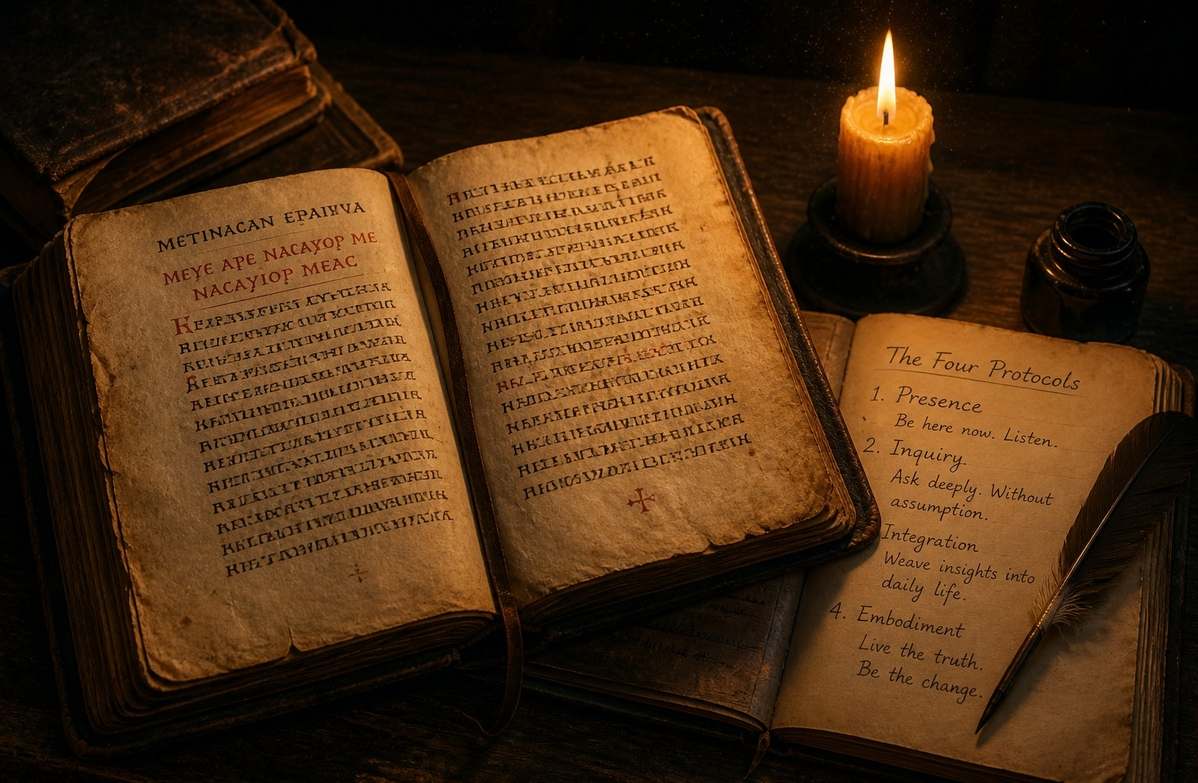
Contemporary engagement with Thomas should not stop at fascination. A saying gospel asks to be practised. These four protocols translate the text into slow, grounded work without pretending to replace scholarship, tradition, or community.
1. Lectio Divina: Slow Declassification
Choose one saying. Read it aloud slowly. Read it again. Notice the word or phrase that catches. Do not rush to explain. Let the saying work like a seed in the field of attention.
This borrows from the Christian practice of lectio divina: reading, meditation, prayer, contemplation. With Thomas, the practice becomes a slow encounter with compressed wisdom. The saying is not there to be conquered. It is there to change the quality of seeing.
2. Journal Interpretation: The Living Archive
Write your response to a saying today. Return to it weeks or months later. What changed? What did you miss? What opened? What resisted? What did you understand too quickly?
Thomas begins with the promise of discovering interpretation. That discovery is not always instant. A journal becomes a record of relationship with the text. The same saying may accuse, comfort, confuse, and illuminate at different stages of life.
3. Group Dialogue: Networked Recognition
Thomas can be read alone, but it also benefits from honest dialogue. Share interpretations without rushing towards authority. Listen for how another person hears the saying differently. Ask what the difference reveals.
The aim is not consensus. It is widening. A good group does not flatten the saying into one approved meaning. It helps each reader notice blind spots, projections, and hidden openings.
4. Embodied Practice: The Somatic Protocol
Take a saying into the body. Sit with it during breath practice. Walk with it. Notice where it contracts the body, where it opens the chest, where it produces resistance, where it feels too sharp, too beautiful, or too strange.
For example, “make the two one” can become a meditation on inner division. “Pass by” can become a practice of non-attachment. Present-kingdom sayings can become a discipline of seeing ordinary life without postponement.
Embodied practice prevents Thomas from becoming only intellectual ornament. A saying has not truly been read until it has touched breathing, speech, desire, action, and the way one meets another human being.
The Thomasine Critique of Algorithmic Modernity
Thomas does not mention algorithms, platforms, metrics, feeds, or recommendation systems. Its critique becomes contemporary by resonance. The text asks questions that digital modernity urgently needs: who mediates what you see? Who trains what you desire? Who profits from your confusion? Who benefits when the kingdom is always elsewhere?
Algorithmic culture often operates through prediction and reinforcement. It learns what holds attention, then returns more of it. Desire becomes trackable. Outrage becomes profitable. Identity becomes a data pattern. Spiritual hunger becomes a market segment wearing handmade beads and a subscription prompt.
Thomas replies with a different technology: aphorism, paradox, present recognition, direct interpretation, and refusal of passive reception. It does not give the seeker more content. It gives the seeker a demand: interpret, recognise, become whole, see what is already spread out before you.
This is not a rejection of digital tools. It is a challenge to digital sleep. The same screen can deliver distraction or open a manuscript. The same network can scatter or gather. The difference is not in the device alone, but in the discipline of attention brought to it.
Thomas offers no nostalgic escape into the past. It offers a method for not being swallowed by the present’s loudest machinery.
The Twin Beckons
Didymos Judas Thomas carries a name of doubleness: “Didymos” in Greek and “Thomas” in Aramaic both carry the meaning of twin. This doubled name has invited centuries of reflection. Twin of whom? Of Jesus? Of the reader? Of the hidden self seeking recognition through the text?
For contemplative reading, the twin is a powerful image. Thomas becomes the figure who stands beside the seeker as a mirror of concealed possibility. Not because the reader becomes historically identical with Thomas, but because the text invites a recognition of likeness: the living voice speaks, the hidden things are sought, and the reader discovers that the distance between teacher and seeker is not what it seemed.
The twin is not an excuse for inflation. It is an invitation to responsibility. If the hidden saying speaks to you, it must become life, not only fascination. If the kingdom is present, then attention must change. If the two are to become one, then inner division must be addressed in the body, in relationships, in speech, and in ordinary conduct.
The Gospel of Thomas survives as a text, but also as a test. Does the reader want another ancient object to admire, or a saying sharp enough to alter the way the world is seen?
The twin beckons. The jar is open. The screen glows. The saying waits. Now the question belongs to the reader.
Related Glossary Terms
For quick definitions, use the main ZenithEye Glossary. The key terms for this article are:
Read Next
Continue with: Asceticism and Discipline: The Technology of Transformation
If this article explores Thomas as a doorway into direct recognition, the next step asks what kind of discipline makes recognition stable: restraint, attention, habit interruption, digital minimalism, and transformation without repression.
Within Practice & Method
This article belongs to Contemplative Techniques and also touches Modern Resonances, where ancient texts, direct knowing, digital-age searching, and practical interpretation meet.
Frequently Asked Questions About Contemporary Gnostic Experiences
How is the Gospel of Thomas different from the canonical gospels?
The Gospel of Thomas is a sayings gospel: it presents 114 sayings attributed to Jesus rather than a narrative account of his birth, ministry, death, and resurrection. Its emphasis falls on interpretation, direct recognition, present realisation, and transformation through understanding. This makes it very different in form and focus from the narrative gospels of Matthew, Mark, Luke, and John.
Why does the Gospel of Thomas resonate with modern digital seekers?
Thomas resonates because modern seekers often face information overload, institutional mistrust, digital mediation, and hunger for direct experience. The text offers a counter-practice: slow interpretation, paradox, present recognition, and direct engagement with sayings rather than passive consumption of endless content.
Is the Gospel of Thomas Gnostic?
Scholars debate the classification. Thomas appears in the Nag Hammadi Library and shares themes often associated with Gnostic or proto-Gnostic spirituality, such as hidden sayings, direct knowledge, present realisation, and transformation through interpretation. Yet it does not contain the full mythological system found in some classic Gnostic texts. It is often safest to call it Thomasine and to note its strong resonance with Gnostic themes.
What does the Twin mean in the Gospel of Thomas?
The name Didymos Judas Thomas carries the meaning of twin in both Greek and Aramaic. In contemplative interpretation, the twin can symbolise the reader’s hidden likeness to the living voice of the text: the deeper self that recognises what ordinary identity has forgotten. Historically, it also belongs to wider Thomas traditions in early Christianity.
How can I practise with the Gospel of Thomas?
Begin slowly. Choose one saying, read it aloud, sit with it, write your response, return to it over time, discuss it with others without forcing closure, and notice how it affects your body, choices, speech, and perception. Thomas works best as contemplative practice, not as quotation collection.
What is the meaning of Saying 114?
Saying 114 is one of the most difficult and debated passages in Thomas. It uses ancient symbolic language about becoming male, which many interpreters read alongside Saying 22 as a reference to transcending binary division or restoring spiritual wholeness. It should not be used to support misogyny or modern gender contempt. It requires historical context, caution, and careful interpretation.
How does Thomas critique algorithmic culture?
Thomas does not directly address algorithms, but it challenges patterns that algorithmic culture intensifies: passive consumption, mediation of attention, binary thinking, deferred fulfilment, and external authority over perception. Its sayings train slow recognition rather than rapid reaction, making it useful for seekers trying to recover depth in a distracted age.
Study and Safety Note
This article explores the Gospel of Thomas, Nag Hammadi, Gnostic and Thomasine traditions, digital-age spirituality, contemplative interpretation, and direct knowing for educational and reflective purposes. It does not provide medical, psychological, psychiatric, crisis, meditation-instruction, religious, or spiritual-direction advice.
Ancient mystical texts can be powerful, but they should not be used to avoid mental health care, practical responsibility, ethical accountability, or grounded community. If spiritual reading intensifies anxiety, depression, dissociation, grandiosity, paranoia, compulsive certainty, or difficulty functioning, pause the material and seek qualified support.
The best test of interpretation is not cleverness. It is whether the reading makes life more honest, embodied, compassionate, and clear.
Further Reading
These ZenithEye links continue the themes of Thomas, sayings gospels, digital-age gnosis, contemplative practice, and direct recognition:
- Asceticism and Discipline: The Technology of Transformation – The next article in the live Contemplative Techniques route, exploring restraint, habit interruption, and disciplined transformation.
- The Gospel of Thomas: The Secret Words of the Living Jesus – A focused guide to Thomas as a no-story sayings gospel and contemplative text.
- Sayings Gospels in Nag Hammadi: Thomas, Philip, and the Wisdom of Jesus – A comparative route through non-narrative gospel traditions.
- The Gospel of Thomas: Why It Speaks to the Modern Seeker – A companion article on Thomas, present recognition, and modern spiritual searching.
- Digital Minimalism as Mystical Practice – Practical strategies for reducing digital noise so contemplative reading can deepen.
- Recognition Beyond Position: Seeing Without Hierarchy – A deeper look at direct knowing beyond institutional rank or social position.
- The Discipline of Solitude: Extended Alone Time as Gateway to Recognition – Why solitude is a laboratory for Thomasine reading and inner listening.
- What Is Gnosticism? Defining the Undefinable – Essential context for Gnostic movements, shared motifs, and the difficulty of the category.
- The Nag Hammadi Library: A Complete Reader’s Guide – A wider map of the codices, tractates, and reading routes.
- Transmission and Lineage: How the Gnosis Travels – How esoteric knowledge moves through text, practice, community, secrecy, and reinterpretation.
- Modern Resonances: Ancient Wisdom in Contemporary Practice – How ancient sources continue to speak inside modern psychological and technological conditions.
- The Thread – The wider route through ZenithEye’s symbolic, historical, contemplative, and contemporary architecture.
References and Sources
The following sources support the historical, textual, Gnostic, Thomasine, and digital-culture framework used in this article.
Primary Sources and Critical Editions
- [1] The Gospel of Thomas. Nag Hammadi Codex II,2.
- [2] The Book of Thomas the Contender. Nag Hammadi Codex II,7.
- [3] The Gospel of Philip. Nag Hammadi Codex II,3.
- [4] The Gospel of Truth. Nag Hammadi Codex I,3 and XII,2.
- [5] The Acts of Thomas. Syriac and Greek Thomasine tradition, various critical editions and translations.
- [6] The Oxyrhynchus Papyri, including P.Oxy. 1, 654, and 655, Greek fragments associated with the Gospel of Thomas.
- [7] Robinson, James M. (ed.). The Nag Hammadi Library in English. Revised edition. HarperOne, 1990.
- [8] Meyer, Marvin (ed.). The Nag Hammadi Scriptures. HarperOne, 2007.
- [9] Layton, Bentley (ed.). Nag Hammadi Codex II, 2-7. Brill, 1989.
- [10] Patterson, Stephen J., Robinson, James M., and Bethge, Hans-Gebhard. The Fifth Gospel: The Gospel of Thomas Comes of Age. Trinity Press International, 1998.
Thomas Scholarship and Early Christian Diversity
- [11] Davies, Stevan L. The Gospel of Thomas and Christian Wisdom. Seabury Press, 1983.
- [12] Koester, Helmut. Ancient Christian Gospels: Their History and Development. Trinity Press International, 1990.
- [13] Meyer, Marvin W. The Gospel of Thomas: The Hidden Sayings of Jesus. HarperSanFrancisco, revised edition, 2004.
- [14] Valantasis, Richard. The Gospel of Thomas. Routledge, 1997.
- [15] DeConick, April D. The Original Gospel of Thomas in Translation. T&T Clark, 2006.
- [16] Perrin, Nicholas. Thomas and Tatian: The Relationship between the Gospel of Thomas and the Diatessaron. Brill, 2002.
- [17] Gathercole, Simon. The Composition of the Gospel of Thomas. Cambridge University Press, 2012.
- [18] Goodacre, Mark. Thomas and the Gospels: The Case for Thomas’s Familiarity with the Synoptics. Eerdmans, 2012.
- [19] Ehrman, Bart D. Lost Christianities: The Battles for Scripture and the Faiths We Never Knew. Oxford University Press, 2003.
- [20] Pagels, Elaine. Beyond Belief: The Secret Gospel of Thomas. Random House, 2003.
Gnostic Context and Nag Hammadi Studies
- [21] Layton, Bentley. The Gnostic Scriptures. Yale University Press, 1987.
- [22] Brakke, David. The Gnostics: Myth, Ritual, and Diversity in Early Christianity. Harvard University Press, 2010.
- [23] King, Karen L. What Is Gnosticism?. Harvard University Press, 2003.
- [24] Williams, Michael Allen. Rethinking “Gnosticism”: An Argument for Dismantling a Dubious Category. Princeton University Press, 1996.
- [25] Pearson, Birger A. Ancient Gnosticism: Traditions and Literature. Fortress Press, 2007.
- [26] Turner, John D. “The Book of Thomas the Contender.” In Nag Hammadi Codex II, 2-7, edited by Bentley Layton. Brill.
- [27] Klijn, A. F. J. The Acts of Thomas: Introduction, Text, and Commentary. Brill, 2003.
Syriac, Edessene, and Thomasine Context
- [28] Drijvers, H. J. W. Cults and Beliefs at Edessa. Brill, 1980.
- [29] Brock, Sebastian P. The Luminous Eye: The Spiritual World Vision of Saint Ephrem. Cistercian Publications, 1992.
- [30] Murray, Robert. Symbols of Church and Kingdom: A Study in Early Syriac Tradition. Cambridge University Press, 1975.
- [31] Attridge, Harold W. “The Original Language of the Acts of Thomas.” In studies on early Christian apocrypha and Syriac tradition.
- [32] Odes of Solomon. Early Christian hymn collection associated with Syriac-speaking traditions, various editions and translations.
Digital Culture, Attention, and Contemporary Spirituality
- [33] Simon, Herbert A. “Designing Organizations for an Information-Rich World.” In Martin Greenberger, ed., Computers, Communications, and the Public Interest. Johns Hopkins University Press, 1971.
- [34] Davenport, Thomas H. and Beck, John C. The Attention Economy: Understanding the New Currency of Business. Harvard Business School Press, 2001.
- [35] Wu, Tim. The Attention Merchants: The Epic Scramble to Get Inside Our Heads. Knopf, 2016.
- [36] Williams, James. Stand Out of Our Light: Freedom and Resistance in the Attention Economy. Cambridge University Press, 2018.
- [37] Zuboff, Shoshana. The Age of Surveillance Capitalism. PublicAffairs, 2019.
- [38] Turkle, Sherry. Alone Together: Why We Expect More from Technology and Less from Each Other. Basic Books, 2011.
- [39] Gazzaley, Adam and Rosen, Larry D. The Distracted Mind: Ancient Brains in a High-Tech World. MIT Press, 2016.
- [40] Campbell, Heidi A. Digital Religion: Understanding Religious Practice in New Media Worlds. Routledge, 2012.
- [41] Hoover, Stewart M. Religion in the Media Age. Routledge, 2006.