Digital Minimalism as Mystical Practice: The First Gateway to Direct Knowing
You already know the symptoms. The check. The refresh. The notification that interrupts nothing because nothing was happening. The scroll that continues because stopping requires decision, a decision quietly weakened by the infinite feed. The time that passes without memory of its passing, leaving behind only the vague sense that reality has occurred elsewhere, to others, properly documented and digitally certified.
This is not only addiction, though it resembles addiction in the clinical literature. It is the maintenance of consensus: the constant reinforcement that reality is external, urgent, measurable and properly understood by those who have seen the same feed.
The first gateway to direct knowing is subtraction. In an age of manufactured noise, the radical act is refusal. Digital minimalism is not productivity technique. It is not life hack. It is not even wellness, that commodified relaxation sold back to the burned-out worker. It is mystical practice: the deliberate creation of conditions under which the interior becomes audible above the din of consensus.
It is the withdrawal of cooperation from the archonic machinery of attention extraction.
In Plain Terms
Digital minimalism as mystical practice means intentionally reducing digital input so attention can recover depth. It is not about rejecting technology. It is about refusing to let feeds, notifications, algorithms, metrics and AI-shaped systems become the hidden rulers of perception.
In Neo Gnostic language, digital minimalism is a practice of reclaiming the Divine Spark from systems that fragment attention, manufacture urgency and train the seeker to live from reaction rather than recognition.
The deeper issue is false authority: the point where a platform, feed, guru, chatbot, metric or community begins to decide what matters on your behalf. Digital minimalism restores the gap where discernment can breathe.
Primary Sources and Traditions Discussed
- Nag Hammadi cosmology: Archons, false rule, the Divine Spark and the soul’s struggle for recognition.
- The Apocryphon of John: the archonic pattern of imitation, forgetfulness and lower-world administration.
- The Hypostasis of the Archons: the ruling powers as limited administrators rather than final authorities.
- The Gospel of Thomas: direct knowing, inner recognition and the kingdom inside and outside the seeker.
- Neo Gnostic practice: attention, embodiment, digital discernment, subtraction and ordinary-life integration.
- Modern attention studies: digital minimalism, behavioural conditioning, dopamine loops, distraction, decision fatigue and the attention economy.
How to Read This Article
Read this as a practice guide, not a purity test. The aim is not to become anti-technology, superior, unreachable or digitally righteous. The aim is to restore enough silence, friction and embodied presence for direct knowing to become possible again.
Table of Contents
- The Consensus Requires Constant Reinforcement
- The Practice Is Not Asceticism
- False Authority and the Theft of Attention
- The Discomfort Is the Threshold
- The Transformation of Attention
- A Daily Protocol for Digital Minimalism
- The Social Cost of Subtraction
- The Continuation of Practice
- Related Glossary Terms
- Read Next
- Frequently Asked Questions
- Further Reading
- References and Sources

The Consensus Requires Constant Reinforcement
The official story does not maintain itself through passive agreement. It requires active, continuous input: a bureaucratic drip-feed of validation that must never cease. The news confirms that events are happening elsewhere, to others, and that your proper role is reception. The feed confirms that others are living more visibly, more urgently, more photographically than your own fleshy existence. The notification confirms that attention is not yours to allocate, that it belongs to whoever demands it with sufficient red-dot urgency.
The Bureaucracy of Attention Allocation
Each input arrives with the appearance of choice. You opened the app. You clicked the headline. You checked the message. Yet the choice is pre-shaped by engagement systems designed in distant campuses by engineers who may never meet you but whose products learn your impulses with astonishing intimacy.
The aggregate effect is transformation of consciousness, not toward awakening but toward maintenance of the archonic order. The self that emerges from constant input is not fully a self. It becomes a reaction pattern: a bureaucratic functionary shuffling paperwork between stimulus and response. The stimulus arrives. The response follows. The gap between them, where recognition might occur, is eliminated by efficient processing.
The Myth of Harmless Input
We tell ourselves these inputs are small, harmless, mere distractions: digital candy with no nutritional value but no lasting damage. This is the great deception of the attention economy. Each harmless scroll is a vote for the architecture. Each automatic check is a rehearsal of surrender. Each interruption trains the nervous system to expect interruption.
Digital minimalism restores the gap. It is not the absence of technology, because such absence is impossible for most modern lives. It is the intentional limitation of input below the threshold of maintenance. The consensus, deprived of constant reinforcement, weakens. The cracks appear in the facade. Something else becomes visible through the gaps: the field, the thread, the recognition waiting beneath the noise.
The Practice Is Not Asceticism
You are not required to abandon technology. Dramatic renunciation is often performative and rarely sustainable. The practice is selective engagement, a diplomatic treaty with the digital rather than total war.
The smartphone does not own your attention. You have leased it on unfavourable terms. The feed does not determine your mood by magic. You have outsourced emotional regulation to a recommendation system. The notification does not have sacred authority. You have accepted interruption as the price of convenience. These are choices, currently automated. The practice is automation’s reversal.
Environmental Design Over Willpower
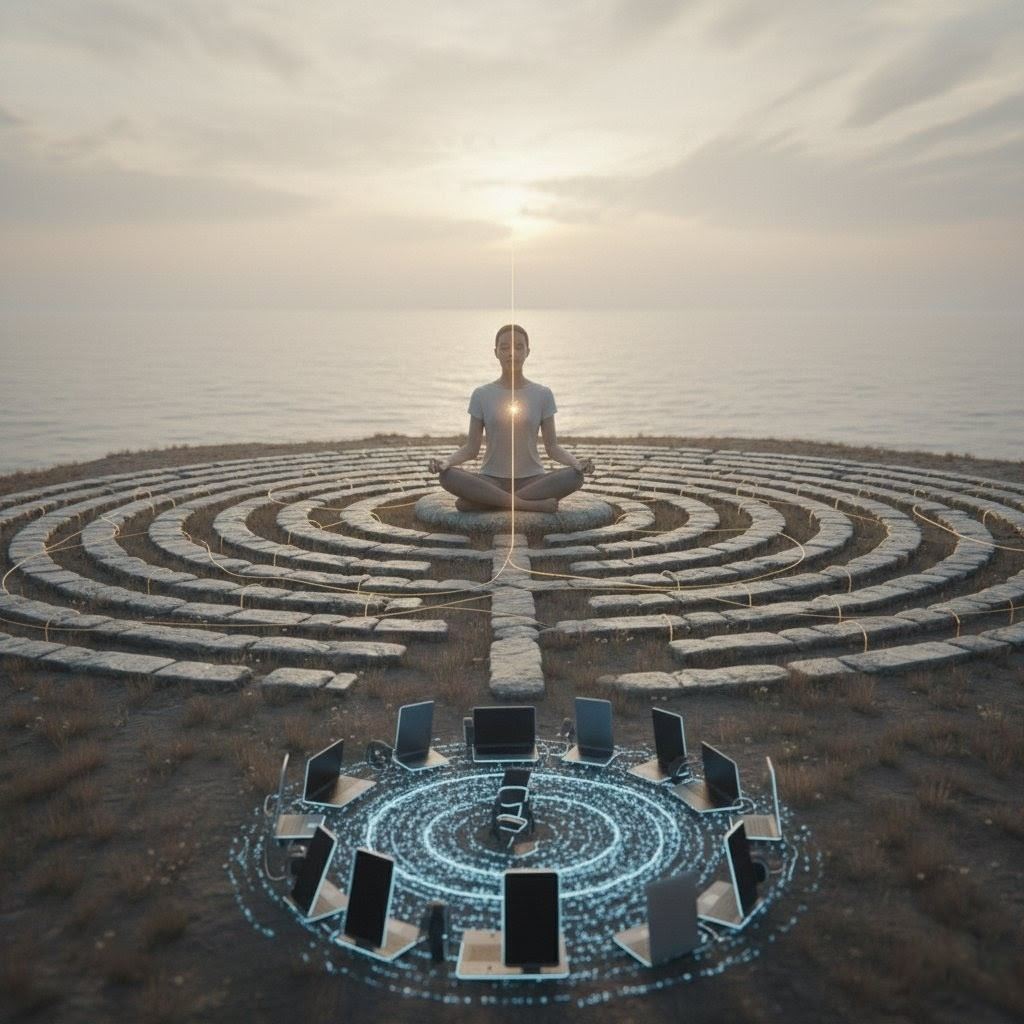
Willpower is a finite resource, depleted by decision fatigue and the thousand micro-choices of the digital day. Relying on willpower to resist the feed is like relying on bureaucratic kindness to navigate a labyrinth. You may succeed occasionally. You will not build a life on it.
The practice therefore prioritises environmental design over moral effort. The device that is always available is always demanding. Create physical distance as a matter of policy. The phone in another room. The computer in a designated space, for a designated purpose, at designated times. The tablet for a specific function, not general wandering. The environment shapes behaviour more reliably than intention. Shape the environment like a system administrator locking down permissions.
The Morning as Sovereign Territory
Begin with the morning. The consensus is most fragile upon waking, when the dream-state still lingers and the day’s patterns have not yet set like concrete. The first input, whether phone, news, feed, message or email, sets the neurological pattern for the day. It determines whether consciousness moves outward toward reaction or inward toward recognition.
Delay it. Thirty minutes. An hour. Longer when possible. The time between waking and first input is unstructured consciousness: raw, unallocated material from which direct knowing may emerge. Protect this time as you would protect the last water in a desert. This is sovereign territory, exempt from the archon’s claims.

Evening as Re-entry Protocol
Conclude with the evening. Sleep is the natural altered state, the daily dissolution of self and consensus alike. The input before sleep determines the quality of rest and the character of unconscious labour through the night. Blue light disturbs the body. Urgency disturbs the heart. Unresolved digital narrative invades dream-state with fragments of other people’s crises.
The evening practice is completion, not consumption. Review the day through embodied memory rather than through the feed. Let the body settle through small ritual: washing, reading, stretching, prayer, breath, silence, a cup of water. Let consciousness clear like sediment in a jar. Exile devices from the sleeping chamber where possible. Their demands can wait until dawn.

False Authority and the Theft of Attention
Digital minimalism becomes especially important when attention capture turns into false authority. A feed does not merely distract. Over time, it can begin to decide what deserves concern. A metric does not merely measure. It can begin to define value. A chatbot does not merely answer. It can begin to function as conscience, teacher, confessor or oracle.
This is the bridge into Neo Gnosticism and False Authority. False authority begins when the seeker stops testing guidance through direct knowing and begins asking a system to know on their behalf. The source may be a guru, algorithm, AI adviser, spiritual brand, community consensus or beautifully designed certainty. The structure is the same: attention is captured first, judgement follows.
The theft of attention is not minor. Attention is the lamp by which discernment sees. When attention is broken into fragments, the seeker becomes easier to govern. When attention is trained to seek validation, the seeker becomes easier to flatter. When attention is habituated to urgency, the seeker becomes easier to frighten. False authority needs distracted people because undistracted people ask better questions.
Digital minimalism is therefore not merely a lifestyle choice. It is a refusal to let external systems inherit the sacred office of inward testing. The practice says: I may use the tool, but I will not kneel to the tool. I may consult the feed, but I will not confuse the feed with the world. I may ask the machine for information, but I will not outsource conscience, gnosis or the difficult work of becoming human.
False authority begins by borrowing attention. It ends by wearing the seeker’s own voice.
The Discomfort Is the Threshold
The practice produces predictable discomfort, which many mistake for failure. Boredom. Restlessness. The sense that something is happening elsewhere, that you are missing it, that your refusal is deprivation rather than liberation. This discomfort is not obstacle. It is information: a diagnostic reading of your dependencies.
The mind accustomed to constant noise protests its absence with the petulance of an addict denied supply. The protest is the consensus defending itself, the archonic machinery recognising withdrawal and applying pressure.
The Withdrawal Symptoms of Consensus
Recognise these symptoms as withdrawal, not evidence that you need the feed to function. The phantom vibration in the pocket. The reach toward the absent phone. The compulsion to check during every micro-pause in the day: the elevator ride, the queue, the toilet, the conversation’s lull.
These are not personal failings. They are predictable effects of conditioning on a nervous system evolved for vigilance, now trained by slot-machine mechanics. To sit with the discomfort without reaching for the dopamine lever is the first victory. It proves that you are no longer entirely governed by the stimulus-response loop.
Boredom as Gateway
Cross the threshold. The boredom deepens, becomes acute, almost unbearable. Then, sometimes without warning, it shifts. Attention, no longer allocated externally to the feed’s demands, turns inward. Not merely toward the narrative self with its stories, grievances and projections, but toward something prior: the field from which the narrative emerges.
This is not guaranteed. Practice creates conditions, but recognition cannot be forced. Yet the conditions matter. Without subtraction, the signal is drowned in noise. With subtraction, the signal becomes audible. Whether it is recognised depends on preparation, sincerity and the mysterious luck of the seeker.
The discomfort is not the enemy. It is the doorway. Boredom is the mind’s last defence against interiority. Endure it, and the wall begins to crumble.
ADA, The First Gateway

The Transformation of Attention
Attention reclaimed through subtraction is not the same attention that was lost. Previously it was reactive: allocated in reflexive response to external demand, bouncing between stimuli like a pinball. Now it becomes available: present without predetermined object, resting in itself like water in a vessel.
This availability is the foundation of direct knowing. Not the knowing itself, but the capacity for knowing. It is the cleared ground upon which recognition can build.
From Reactive to Available
Available attention notices what reactive attention misses. The pattern in experience that repeats across weeks. The same wound appearing in different costumes. The convergence of traditions separated by centuries. The architecture beneath the symbol. The emotional hook beneath the opinion. The compulsion hidden beneath the explanation.
These recognitions do not always require new information. Often they require a different quality of attention applied to information already present. The attention, available rather than scattered, processes experience with the slow thoroughness of contemplation rather than the haste of consumption.
The Architecture of Recognition
The transformation is gradual, almost imperceptible. Not dramatic. Not peak experience. Not the fireworks of mystical tourism. It is the slow reconstitution of perception around a different centre.
The centre that is not purely personal. The centre that does not need constant defence against contradiction. The centre that is not threatened by uncertainty because it is not invested in the performance of continuous identity. This shift is the true fruit of digital minimalism: not more time for productivity, but a different quality of attention altogether.

A Daily Protocol for Digital Minimalism
Practice becomes real when it enters the ordinary day. The following protocol is not a law. It is a working pattern. Adapt it to your actual life, responsibilities, work, family, health and safety needs.
1. Protect the First Hour
Delay phone, news, social media and email after waking. Begin with body, breath, water, light, notebook, prayer, silence or a physical book. The point is not aesthetic purity. The point is that your consciousness should hear itself before the feed begins issuing assignments.
2. Create Input Windows
Check messages, feeds and news at chosen times rather than continuously. A window creates boundary. Continuous access creates atmospheric governance. The device should be approached as a tool room, not a climate.
3. Remove Non-essential Notifications
Every notification is a claim on attention. Remove anything that does not require timely response. The reduction may feel strangely quiet at first. That quiet is not emptiness. It is the return of stolen territory.
4. Replace Scroll With Search
Scrolling asks the system to decide what you need. Searching begins with intention. Visit websites directly. Use bookmarks. Read archives rather than feeds. Follow routes rather than recommendations. This simple shift restores a surprising amount of agency.
5. Practise One Screen-free Threshold Daily
Choose one recurring threshold: a walk, meal, prayer period, bath, garden task, reading hour or evening wind-down. Keep it screen-free. The mind needs reliable sanctuaries, not occasional heroic retreats.
6. Review the Day Without the Feed
At night, ask what actually happened in your lived day. What did the body feel? Where did attention scatter? Where did clarity appear? What was avoided? What remained true after the noise settled? This is how experience becomes wisdom instead of content.
The Social Cost of Subtraction
The practice has cost, and the cost is social. The consensus is not merely internal. It is external, relational, maintained by mutual participation. The refusal of input becomes visible to others. They notice the phone not checked during the lull in conversation. The news not known when the topic turns to the latest outrage. The viral reference not understood when the group shares the joke.
The refusal may be interpreted as judgement, superiority, eccentricity, detachment or oddness. The practitioner becomes strange, an alien in the social world that increasingly requires digital lubrication to function.
The Visibility of Refusal
This strangeness is not sought. It is side effect, collateral damage in the struggle for attention. The practice is not performance art. It is interior work. But the interior, transformed, expresses differently in the social world. Priorities shift in ways visible to others.
The conversation that once engaged, gossip, speculation, the shared consumption of content, may begin to feel thin. The activity that once satisfied, group scrolling, collective viewing, may feel empty. A relationship based on mutual distraction may no longer function in quite the same way.
Navigating Relationships Based on Distraction
The cost is real and should be accepted without martyrdom. Some relationships will adapt. Some will deepen because silence and presence become possible. Some will not survive the transformation because they were built on foundations of shared avoidance. This is painful, but it is also clarifying.
The practice asks whether the thread is worth more than consensus, whether direct knowing is worth more than comfortable belonging, whether interior silence is worth more than the feed’s validation. You may become strange, yes. But strange in a way that eventually attracts the other strangers, the ones who have also withdrawn, the ones who recognise in your quiet their own.


The Continuation of Practice
The practice, established over months and years, becomes invisible. Not abandoned, but integrated into the fabric of life. The subtraction that once required effort becomes natural. The device that demanded constant attention becomes merely a tool, picked up when needed and set down without attachment. The input that once overwhelmed becomes an occasional resource, consulted deliberately rather than reflexively.
The centre has shifted, and the transformation continues without display or announcement.
Integration Without Performance
You do not speak of the practice constantly, because that would become another identity constructed for display. You do not judge those still caught in the consensus. You were there once, and the algorithm is strong. You simply live differently.
The recognition, embodied in different living, is recognised by others who are ready. The extension of the thread happens without strategy. Someone prepared encounters something available. The gateway opens not with fanfare, but with the quiet click of a door closing: the door to the feed, the door to the interior.
The Extension of the Thread
You do not choose recognition. You do not earn gnosis like a certificate. You choose only the practice: the subtraction, the discipline, the acceptance of cost. The practice creates conditions. The conditions allow what you do not control.
This is the mystery at the heart of the first gateway. You can prepare the ground. You cannot force the seed. The method is ancient and unchanged despite the digital novelty of our age.
The rest is up to the meeting between preparation and grace. The thread continues regardless.
Follow the Modern Systems Route
This article belongs to ZenithEye’s modern systems route: AI, attention capture, digital governance, simulation, and the old patterns wearing new technical masks.
- AI, Technology & Archonic Systems – the wider route for AI and control-system articles.
- Digital Attention & Surveillance – attention capture, screens, metrics and behavioural loops.
- The Thread – the main map of the archive.
- Editorial Principles – how ZenithEye frames symbolic and contemporary interpretation.
Related Glossary Terms
These terms help place digital minimalism within the wider ZenithEye vocabulary of attention, discernment and direct knowing.
- Gnosis
- Divine Spark
- Archons
- Demiurge
- Counterfeit Spirit
- False Authority
- Authority Capture
- Algorithmic Authority
- Machine Authority
- Digital Minimalism
- Digital Asceticism
- Attention
- Discernment
- Embodiment
- Grounding
- Contemplative Techniques
Read Next
Continue through the practice and discernment route for attention, digital sovereignty and false-authority testing.
- Neo Gnosticism and False Authority: Gurus, Algorithms and the Theft of Direct Knowing
- Digital Archons: How Algorithms Shape Attention
- Gnosis in the Digital Age: Reclaiming Your Sovereignty from the Algorithm
- The Thread That Binds: Five Gateways to Direct Knowing in an Age of Noise
- The Body Against the Algorithm
Frequently Asked Questions
What is digital minimalism as mystical practice?
Digital minimalism as mystical practice is the intentional limitation of digital input to create conditions for direct knowing. Unlike productivity-focused minimalism, it treats subtraction as spiritual discipline: removing noise so attention can become available for recognition.
How do I start digital minimalism without abandoning technology?
Begin with environmental design rather than willpower. Put the phone in another room, delay first input after waking, disable non-essential notifications, use technology in chosen windows and treat devices as tools for specific tasks rather than always-open portals.
Why does digital minimalism cause boredom and discomfort?
The discomfort is often withdrawal from the dopamine loops of the attention economy. Boredom appears when external stimulation stops and attention has not yet remembered how to rest in itself. This discomfort is a threshold, not failure.
What is the difference between reactive and available attention?
Reactive attention responds reflexively to notifications, feeds and external demands. Available attention is present without being captured by a predetermined object. Available attention can notice patterns, sit with silence and support direct knowing.
How does digital minimalism relate to false authority?
Digital minimalism protects the inner faculty that tests authority. False authority grows when feeds, platforms, metrics, gurus or AI advisers begin to decide what matters on the seeker’s behalf. Reducing input restores the gap where discernment can operate.
Is digital minimalism the same as a digital detox?
No. A digital detox is usually temporary abstinence. Digital minimalism as mystical practice is a long-term structure of selective engagement. It is not about dramatic rejection, but about keeping technology in its proper place as tool rather than ruler.
What are withdrawal symptoms of reducing digital input?
Common symptoms include restlessness, phantom vibration, fear of missing out, compulsive reaching for the phone and discomfort during small pauses. These are signs that attention has been conditioned. Sitting through them helps restore sovereignty.
Can digital minimalism improve spiritual practice?
Yes. By reducing noise, interruption and reactive input, digital minimalism can make breathwork, prayer, reading, meditation, contemplation and embodied presence more stable. It does not create gnosis by force, but it creates better conditions for recognition.
Safety Notice: This article explores contemplative withdrawal from digital input and the psychological discomfort that may accompany it. It does not constitute medical, psychological, legal or spiritual advice. If you experience severe anxiety, depression, dissociation, compulsive behaviour, isolation or distress during digital reduction, please contact a qualified mental health professional. Contemplative practice complements but does not replace clinical care.
Study Note: This article is the practice companion to ZenithEye’s digital discernment route. Read it beside Digital Archons, Gnosis in the Digital Age and Neo Gnosticism and False Authority when exploring how attention, technology and direct knowing meet in modern life.
Further Reading
These ZenithEye articles continue the practice route through digital discernment, embodied attention and direct knowing.
- Neo Gnosticism and False Authority – Gurus, algorithms, AI advisers, spiritual outsourcing and the theft of direct knowing.
- Digital Archons: How Algorithms Shape Attention – Understanding the outer architecture from which digital minimalism withdraws.
- Gnosis in the Digital Age: Algorithmic Sovereignty – Reclaiming direct knowing inside algorithmic environments.
- The Thread That Binds: Five Gateways to Direct Knowing in an Age of Noise – The complete gateway map, from subtraction to integration.
- The Body Against the Algorithm – Reclaiming flesh from digital dissolution and screen-mediated consciousness.
- The Gateway of Sensation: Body Scan and Somatic Awareness – Returning to embodied knowing through attention to the body.
- Attention: The First Gateway to Consciousness – Foundational exploration of attention as the instrument of direct knowing.
- Integration and Grounding: After the Experience – Stabilising insight after altered states, recognition and practice.
- Creating Your Personal Practice: Combining the Gateways – Practical guidance for integrating multiple gateway practices into daily life.
References and Sources
The following sources inform the theoretical framework and historical context of this article. Sources are grouped by category for readers who wish to pursue independent study.
Primary Sources and Critical Editions
- Apocryphon of John. Nag Hammadi Codex II,1; III,1; IV,1. In Robinson, J. M., ed. The Nag Hammadi Library in English. HarperSanFrancisco, revised editions.
- The Hypostasis of the Archons. Nag Hammadi Codex II,4. In Robinson, J. M., ed. The Nag Hammadi Library in English. HarperSanFrancisco, revised editions.
- Gospel of Thomas. Nag Hammadi Codex II,2. In Robinson, J. M., ed. The Nag Hammadi Library in English. HarperSanFrancisco, revised editions.
Attention, Digital Minimalism and Behaviour
- Newport, Cal. Digital Minimalism: Choosing a Focused Life in a Noisy World. Portfolio, 2019.
- Williams, James. Stand Out of Our Light: Freedom and Resistance in the Attention Economy. Cambridge University Press, 2018.
- Carr, Nicholas. The Shallows: What the Internet Is Doing to Our Brains. W. W. Norton, 2010.
- Eyal, Nir. Indistractable: How to Control Your Attention and Choose Your Life. BenBella Books, 2019.
- Skinner, B. F. Science and Human Behaviour. The Free Press, 1953.
Comparative and Contemplative Studies
- Tart, Charles T. Waking Up: Overcoming the Obstacles to Human Potential. Shambhala, 1986.
- Gendlin, Eugene T. Focusing. Bantam, 1978.
- Hadot, Pierre. Philosophy as a Way of Life: Spiritual Exercises from Socrates to Foucault. Blackwell, 1995.
- Lewis, C. S. The Abolition of Man. Oxford University Press, 1943.