The Subtle Body: Mapping the Energy Anatomy of Human Consciousness
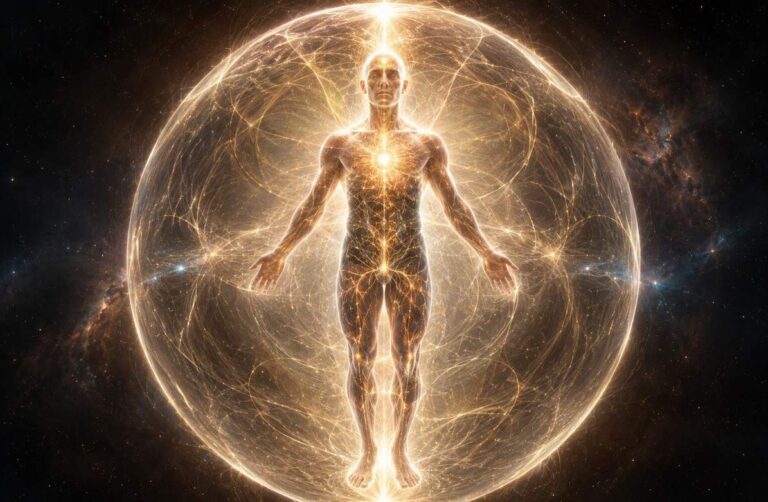
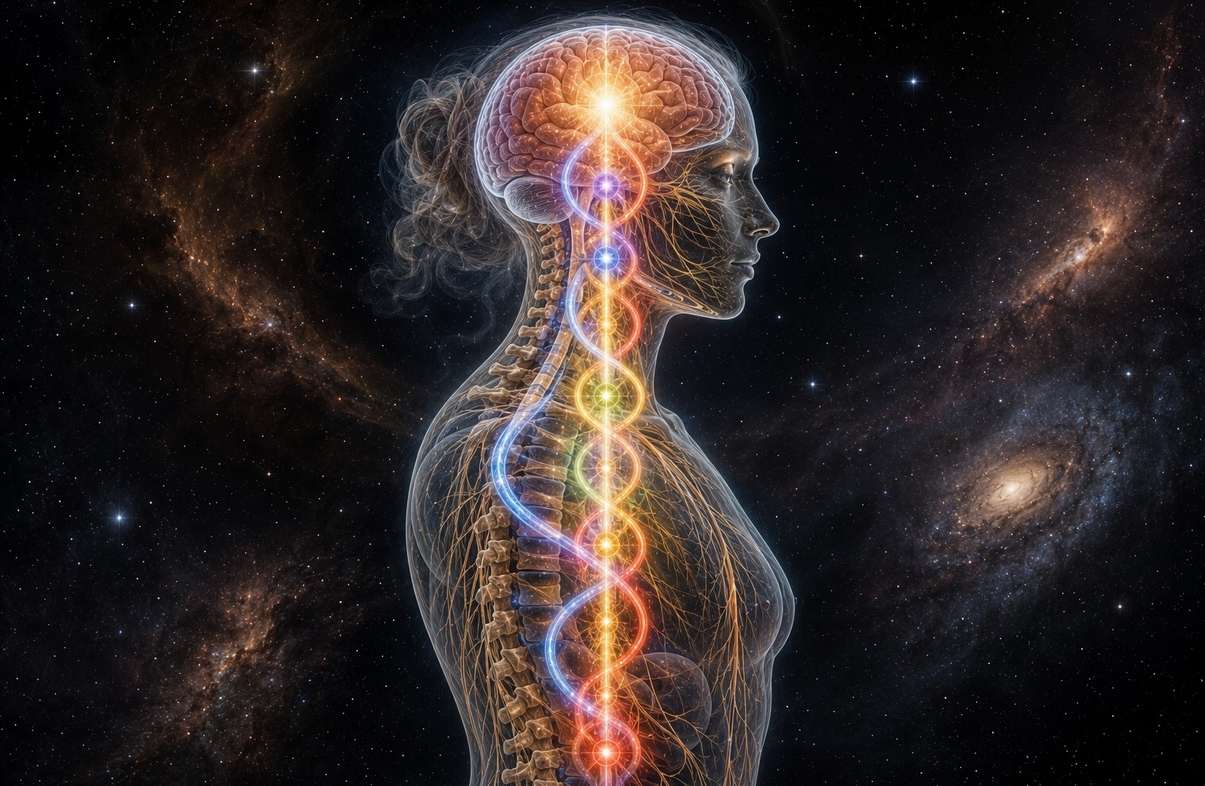
The subtle body is the name many traditions give to the energetic, symbolic, experiential, and contemplative anatomy that seems to underlie ordinary physical awareness. Yoga speaks of koshas, chakras, nadis, prana, and kundalini. Tibetan Buddhism speaks of channels, winds, and drops. Taoist practice speaks of qi, meridians, dantian, and internal alchemy. Western esotericism speaks of the etheric double, astral body, aura, and light body.
These systems differ. They do not share one simple map, and they should not be flattened into a single universal diagram. Yet they all circle the same deep question: what is the human being when body, breath, mind, energy, awareness, imagination, memory, and spirit are read together?
This article approaches the subtle body as a careful bridge between traditional practice and modern discernment. It does not claim that chakras, nadis, kundalini, or aura layers are medically proven structures. It also does not dismiss the language as meaningless simply because it cannot be photographed like a bone or measured like blood pressure. The subtle body is best approached as the body as lived from within: breath, sensation, vitality, mood, symbol, presence, and the felt architecture of consciousness.
In Plain Terms
The subtle body is a traditional and experiential map of how life is felt from inside the body: breath, sensation, emotion, vitality, attention, imagination, intuition, dream, spiritual experience, and presence.
Yogic language describes the human being through five koshas, or sheaths, along with chakras, nadis, prana, and kundalini. Other traditions use different maps, such as qi and meridians, channels and winds, aura layers, etheric body, or light body.
The grounded view is this: subtle body maps are not medical anatomy, but practices linked with them can affect breath, attention, body awareness, nervous-system regulation, mood, posture, and the way a person inhabits experience.
Primary Sources and Traditions Discussed
- Yoga and Vedanta, especially koshas, prana, nadis, chakras, kundalini, and the layered human being.
- The Taittiriya Upanishad, especially the five koshas or sheaths that veil the Self.
- Hatha Yoga traditions, especially subtle channels, breath practice, kundalini, mudra, and the body as a vehicle of awakening.
- Tibetan Buddhism, especially channels, winds, drops, subtle body practice, dream yoga, and bardo-related contemplative systems.
- Taoist and Chinese traditions, including qi, meridians, dantian, daoyin, qigong, and internal alchemy.
- Western esotericism, including etheric body, astral body, aura, light body, and subtle-field symbolism.
- Modern physiology and contemplative research, especially breath, autonomic regulation, heart rate variability, interoception, fascia, body awareness, and nervous-system safety.
- Gnostic and Hermetic resonances, especially the human being as microcosm, the body as symbolic temple, and the need to integrate spirit with incarnation.
How to Read This Article
This article handles subtle body language as traditional, symbolic, contemplative, and experiential. It does not treat chakras, nadis, kundalini, meridians, or aura layers as medically proven physical structures. Nor does it reduce them to fantasy simply because they are not visible on ordinary scans.
Subtle body maps are useful when they help people become more embodied, attentive, ethical, grounded, compassionate, and aware. They become risky when they encourage diagnosis without training, fear of invisible blockages, spiritual grandiosity, rejection of medical care, or intense energy practices without preparation.
Read this as a bridge: one foot in ancient practice, one foot in modern discernment. The subtle body may not be measurable in the same way as the physical body, but the practices surrounding it can change how the physical body is inhabited.
The subtle body is the body as lived from the inside: breath, sensation, energy, feeling, image, memory, attention, and presence woven into one field of experience.
Table of Contents
- Beyond the Physical: What Is the Subtle Body?
- The Five Koshas: Five Sheaths of Consciousness
- The Chakra System: Seven Wheels of Energy
- The Nadis: Subtle Channels of Energy
- Kundalini: The Sleeping Serpent
- The Aura and Extended Energy Fields
- Working With the Subtle Body: Five Practical Methods
- The Integration of Dimensions
- The Gnostic Reading: Body, Breath, and Hidden Architecture
- Related Glossary Terms
- Read Next
- Frequently Asked Questions
- Further Reading
- References and Sources
Beyond the Physical: What Is the Subtle Body?
Western medicine maps the body through anatomy and physiology: bones, muscles, organs, nerves, glands, blood, fascia, cells, hormones, immune systems, and biological processes. This approach has saved lives and should not be casually dismissed. If a bone is broken, a gland is failing, a heart is struggling, or the nervous system is in distress, symbolic anatomy is not enough. The physical body needs skilled physical care.
Yet many contemplative traditions argue that the human being cannot be understood through dense anatomy alone. The lived body includes breath, sensation, mood, charge, vitality, posture, dream, presence, subtle perception, attention, and the mysterious feeling of being more than a mechanism. The subtle body is a language for that interior dimension.
In yoga, the subtle body may be discussed through koshas, chakras, nadis, prana, and kundalini. In Tibetan Buddhist systems, practice may involve channels, winds, and drops. In Taoism and Chinese medicine, qi moves through meridians and is refined through internal alchemy. In Western esotericism, the astral body, etheric body, aura, and light body describe extended forms of perception and identity.
Subtle Does Not Mean Unreal
The word “subtle” does not mean imaginary. It means fine, difficult to grasp, not immediately obvious, or not reducible to ordinary gross matter. A thought is subtle. A mood is subtle. A shift in atmosphere is subtle. A trauma response can be subtle until the body suddenly speaks more loudly.
The subtle body gives traditional language to these fine dimensions of experience. It is the body as felt, not merely the body as dissected. It is the body as breath, energy, symbol, memory, rhythm, and field. That does not make every claim about it automatically true. It does make the subject worth careful attention.
Modern research can support some practical effects of subtle body practices without proving the whole metaphysical model. Breath practices can affect heart rate variability and autonomic regulation. Yoga can influence mood, stress, interoception, posture, and embodied self-awareness. Meditation can alter attention and emotional reactivity. Fascia and body-awareness research raise useful questions about how experience is organised through the whole body.
None of this proves chakras as literal wheels of energy, or nadis as physical tubes beside nerves. It does show that ancient body practices were often exploring real dimensions of embodied experience, even when their maps were symbolic, ritual, and contemplative rather than biomedical.
The Five Koshas: Five Sheaths of Consciousness
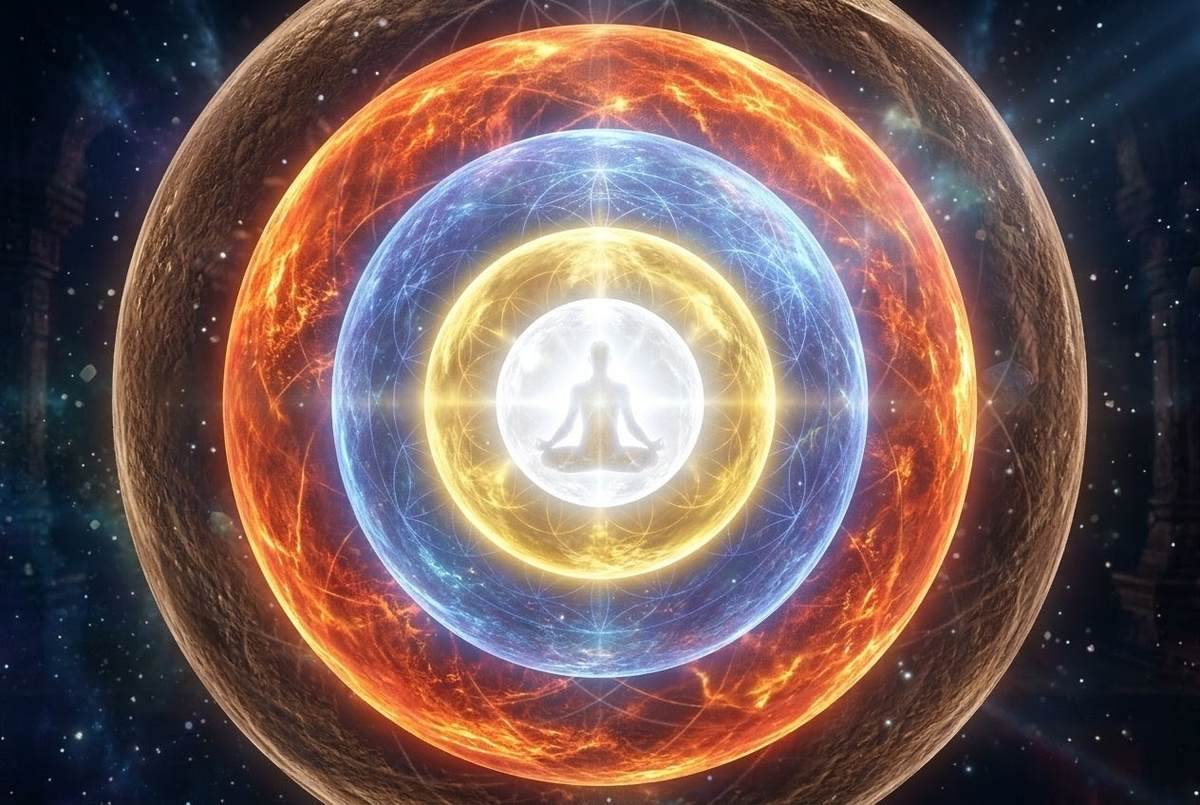
Yogic and Vedantic traditions describe the human being through five koshas, or sheaths. This model is associated with the Taittiriya Upanishad, where the Self is approached through progressively subtler layers of embodiment and experience. The koshas are not stacked like separate coats. They interpenetrate, more like currents moving through one sea.
Annamaya Kosha: The Food Body
Annamaya kosha is the physical body, the body made of food. It is sustained by nourishment, water, sleep, movement, sunlight, minerals, breath, and care. It includes flesh, bone, blood, gut, muscle, skin, organs, fascia, and nervous system.
This sheath should not be despised as “merely physical”. It is the doorway through which all practice begins. Without the food body, there is no sitting, breathing, chanting, fasting, walking, praying, or awakening in human form. The densest layer is still sacred because it is the place where consciousness becomes lived.
Pranamaya Kosha: The Energy Body
Pranamaya kosha is the vital energy body, the sheath of prana. It is closely linked with breath, vitality, circulation, movement, appetite, warmth, expression, and life force. In practice, many people first notice this sheath through tingling, heat, vibration, pulsing, breath expansion, or a sense of current moving through the body.
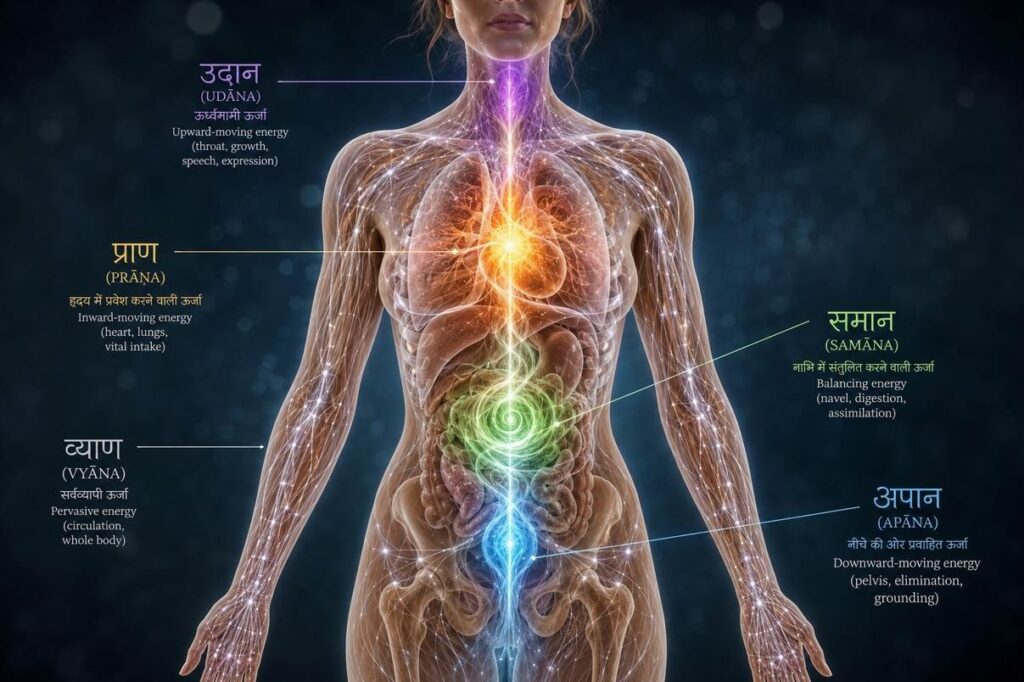
Yogic tradition describes five major pranas or vital winds. Prana governs inward movement and respiration. Apana governs downward and outward movement, including elimination. Samana governs digestion and assimilation. Udana governs upward movement, speech, growth, and expression. Vyana governs circulation and diffusion throughout the body.
These should be read as traditional energetic functions, not as replacements for medical physiology. Their value lies in helping practitioners notice how life moves through breath, belly, voice, circulation, elimination, attention, and vitality.
Manomaya Kosha: The Mental Body
Manomaya kosha is the mental and emotional sheath. It includes ordinary thought, sensory processing, internal dialogue, emotional response, memory patterns, and the sense of “me” reacting to experience. This is the layer where mental habits and emotional conditioning shape perception.
In yogic language, the mind is shaped by vrittis, fluctuations, and samskaras, impressions left by past experience. Modern psychology might speak of conditioning, trauma patterns, schemas, attachment responses, and nervous-system habits. The languages differ, but both recognise that the present moment is often coloured by unfinished past.
Vijnanamaya Kosha: The Wisdom Body
Vijnanamaya kosha is the sheath of wisdom, discernment, insight, and witnessing awareness. It is associated with buddhi, the capacity to see clearly, discriminate, and know more deeply than reactive thought.
This layer is not cleverness. Cleverness can belong entirely to the restless mind. Vijnanamaya is quieter. It sees patterns without rushing to possess them. It can witness thought without becoming thought. It can recognise a desire without automatically obeying it. It is the lamp behind the weather.
Anandamaya Kosha: The Bliss Body
Anandamaya kosha is the bliss sheath. This is not ordinary pleasure or emotional happiness. It refers to a subtle layer of peace, contentment, spaciousness, and devotional fullness that may appear when the grosser layers quieten.
Even this bliss sheath is still a sheath. In Vedantic language, the Self or atman is beyond all koshas. Bliss is near the threshold, but it is not something the ego can own. The moment bliss becomes a trophy, the mind has already turned it into possession.
The Chakra System: Seven Wheels of Energy
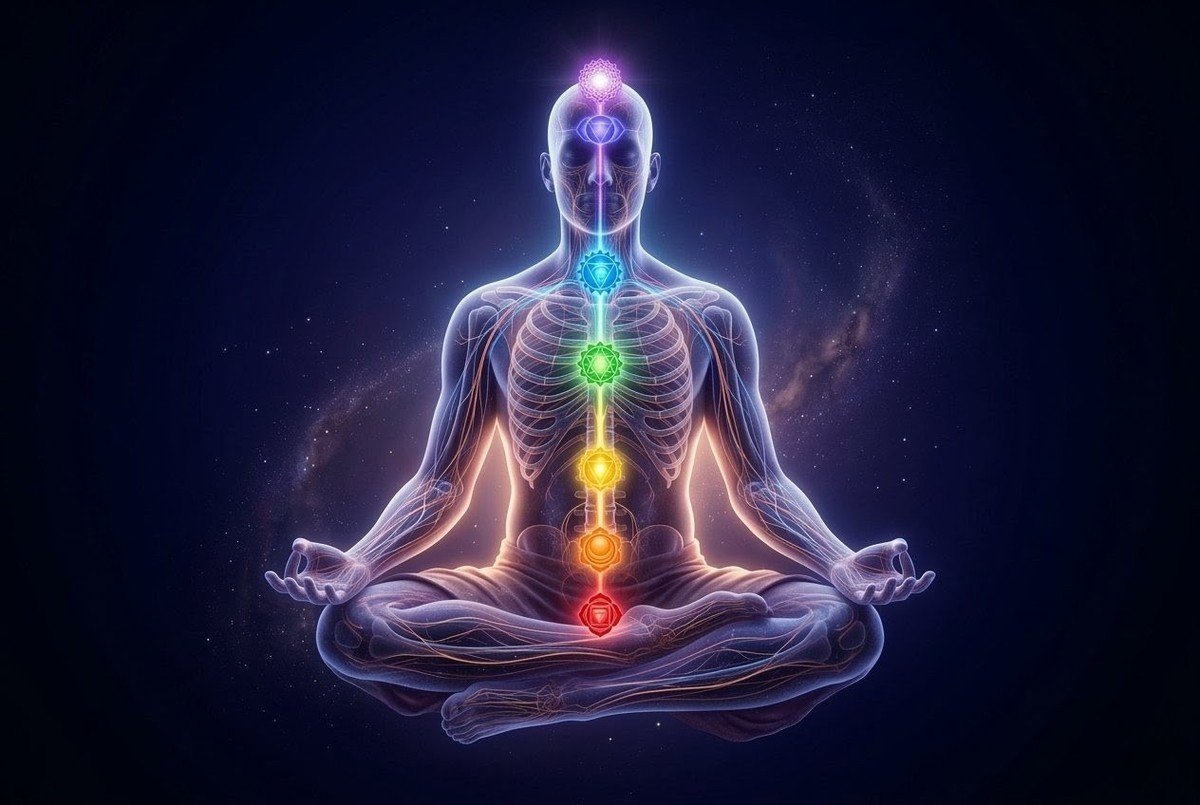
The chakra system is one of the best-known subtle body maps. The Sanskrit word chakra means wheel, disc, or centre. In modern yoga and esoteric practice, chakras are often described as energy centres aligned along the spine, each associated with body regions, psychological themes, colours, elements, sounds, deities, and states of consciousness.
The popular seven-chakra system is a modern synthesis, influenced by older Tantric sources, Theosophy, Western esotericism, psychology, and global yoga culture. Traditional chakra systems vary. Some texts describe more or fewer centres. Associations with colours, glands, elements, sounds, and psychological traits differ across lineages.
Handled carefully, the chakra system can be useful as a contemplative map. It invites the practitioner to ask: where do I feel grounded or unsafe? Where is pleasure flowing or frozen? Where is will healthy or distorted? Where is the heart open or defended? Where is truth spoken or swallowed? Where is vision clear or clouded? Where is spiritual connection embodied rather than imagined?
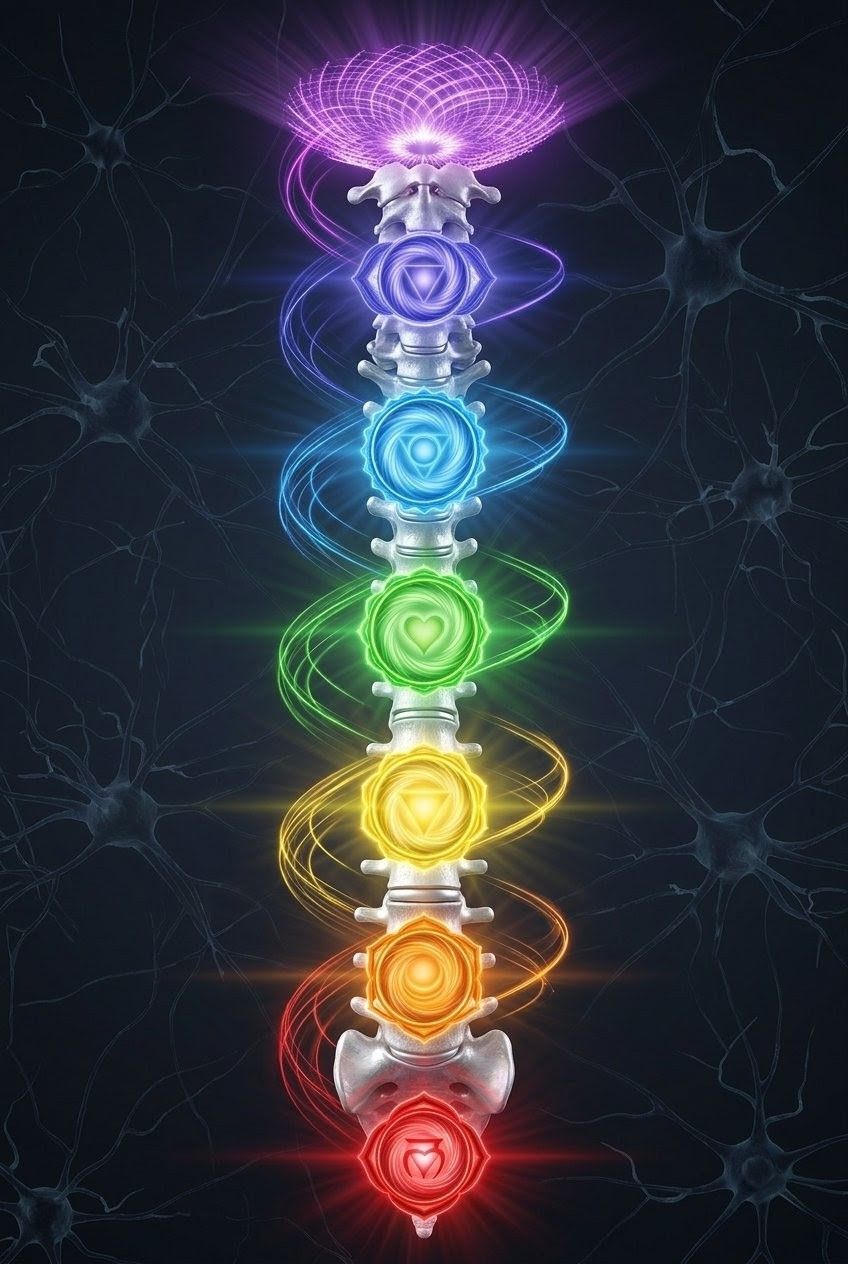
1. Muladhara: Root
Muladhara, the root centre, is traditionally located at the base of the spine. It is associated with grounding, survival, body, earth, fear, stability, and belonging. In practice, root work means learning to inhabit the body, feel the ground, respect limits, and build enough safety for deeper practice.
Root imbalance should not be reduced to a mystical blockage. Anxiety, insecurity, dissociation, and survival fear can have trauma, social, financial, medical, and relational causes. Spiritual language should deepen compassion, not replace real support.
2. Svadhisthana: Sacral
Svadhisthana, the sacral centre, is associated with water, creativity, sexuality, pleasure, emotion, flow, and relational movement. It asks whether life can move without becoming either frozen or flooded.
Healthy sacral practice includes emotional literacy, creative expression, bodily respect, relational boundaries, and a non-shaming relationship with desire. It does not mean indulging every impulse or spiritualising sexual confusion. Flow needs containment, just as water needs banks.
3. Manipura: Solar Plexus
Manipura, the solar plexus centre, is associated with fire, digestion, agency, will, confidence, transformation, and personal power. It is the place where raw experience is metabolised into usable strength.
In balanced expression, Manipura gives courage, discipline, clarity, and self-respect. In distortion, it can become domination, shame, collapse, rage, or obsession with control. Fire can transform when contained. Without containment, it consumes.
4. Anahata: Heart
Anahata, the heart centre, is associated with air, love, compassion, grief, relationship, devotion, and the bridge between lower and upper centres. It is often treated as the central balancing point of the chakra system.
Heart practice is not sentimental softness. It includes grief, forgiveness, courage, boundaries, and the ability to stay open without abandoning discernment. A heart without boundaries leaks. A boundary without heart becomes a wall.
5. Vishuddha: Throat
Vishuddha, the throat centre, is associated with ether, voice, communication, listening, truth, purification, and expression. It asks whether inner reality can become honest speech without violence or cowardice.
Throat practice includes speaking clearly, listening deeply, keeping vows, using words carefully, chanting, singing, silence, and learning when not to speak. The throat is the bridge where breath becomes word. Use it with care.
6. Ajna: Third Eye
Ajna, the third-eye centre, is associated with inner vision, intuition, pattern recognition, imagination, discernment, and command. It is not a licence to believe every image, dream, or psychic impression. True vision includes the ability to test vision.
Ajna practice may include meditation, visualisation, dream work, study, contemplation, and symbolic perception. Its shadow is projection: seeing one’s own fear, desire, or fantasy and calling it revelation.
7. Sahasrara: Crown
Sahasrara, the crown centre, is associated with spiritual openness, transcendence, divine connection, and the release of narrow ego-identification. Some traditions treat it differently from the other chakras, more as a portal or culmination than a centre in the same sense.
Crown work must be grounded. Spiritual openness without body, ethics, relationship, and psychological steadiness can become dissociation or inflation. The crown flower needs roots.
The Nadis: Subtle Channels of Energy
In yogic subtle anatomy, nadis are channels through which prana moves. Traditional texts describe thousands of nadis, though three are especially important in many hatha yoga and Tantric systems: ida, pingala, and sushumna.
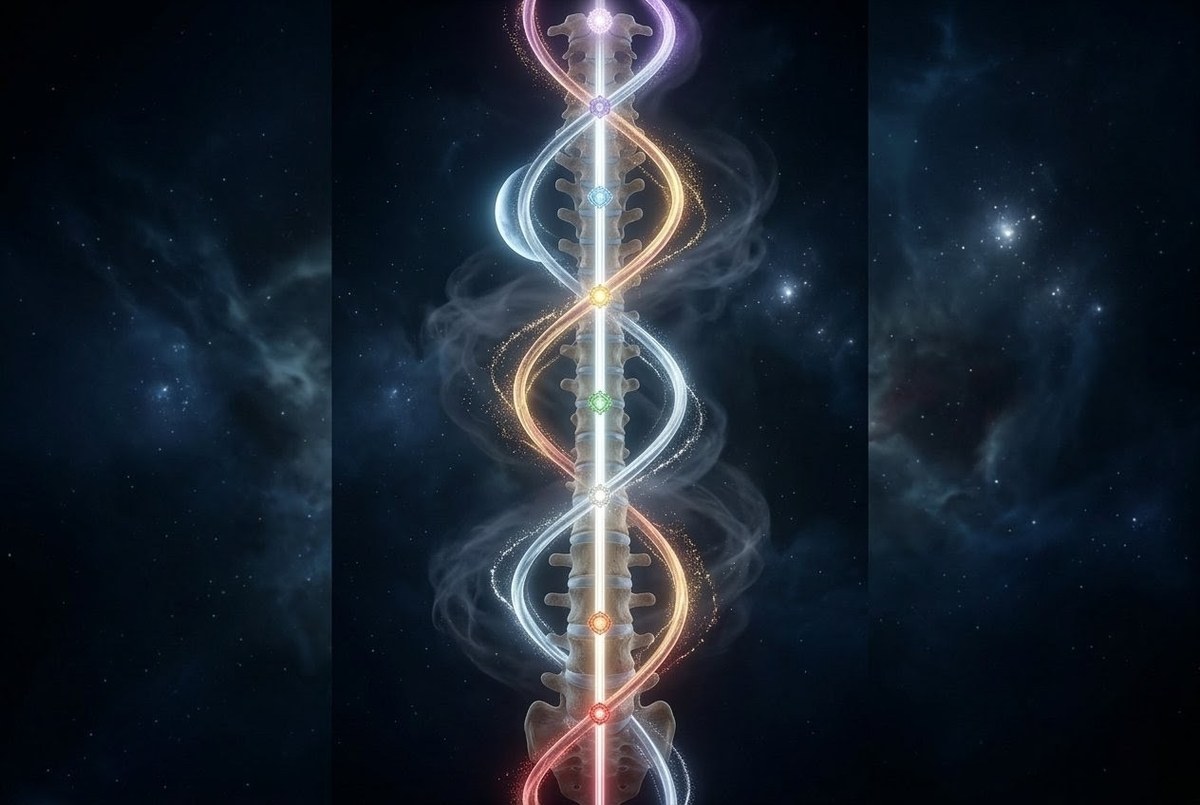
Ida: The Lunar Channel
Ida is often described as the lunar channel. It is associated with cooling, receptivity, inwardness, rest, imagination, and the left side of the subtle body. Some modern writers link it symbolically with parasympathetic tone or right-hemisphere style, though these correlations should be treated as suggestive rather than exact.
In lived practice, ida points toward the capacity to receive, soften, reflect, and listen. Its imbalance may appear as passivity, withdrawal, dreaminess, melancholy, or avoidance of action.
Pingala: The Solar Channel
Pingala is often described as the solar channel. It is associated with warmth, action, outward movement, focus, vitality, and the right side of the subtle body. Modern comparisons sometimes link it with sympathetic activation or left-hemisphere style, again as correspondence rather than direct physiology.
In practice, pingala gives energy, action, direction, and clarity. Its imbalance may appear as restlessness, aggression, overwork, heat, control, or inability to rest.
Sushumna: The Central Channel
Sushumna is the central channel. It is associated with spiritual ascent, integration, and the opening that becomes possible when the opposing currents are balanced. Kundalini is traditionally said to rise through sushumna, activating or piercing the centres along the way.
Symbolically, sushumna is the middle way within the body. It is not dull compromise. It is the path where polarity becomes current. Lunar and solar, inward and outward, rest and action, silence and speech begin to work as one instrument.
Alternate Nostril Breathing
Nadi shodhana, often translated as alternate nostril breathing or channel purification, is used to balance the subtle currents. Physically, slow nasal breathing can influence attention, respiratory rhythm, and autonomic regulation. Traditionally, it is said to balance ida and pingala and prepare the central channel.
Practise gently. Breathwork should never be forced. People with panic, trauma, cardiovascular issues, respiratory conditions, pregnancy, seizure history, or significant mental health vulnerabilities should use caution and seek appropriate guidance.
Kundalini: The Sleeping Serpent
Kundalini is one of the most powerful and misunderstood concepts in subtle body traditions. It is often symbolised as a coiled serpent at the base of the spine, representing latent spiritual power, Shakti, or the deep evolutionary force of consciousness.
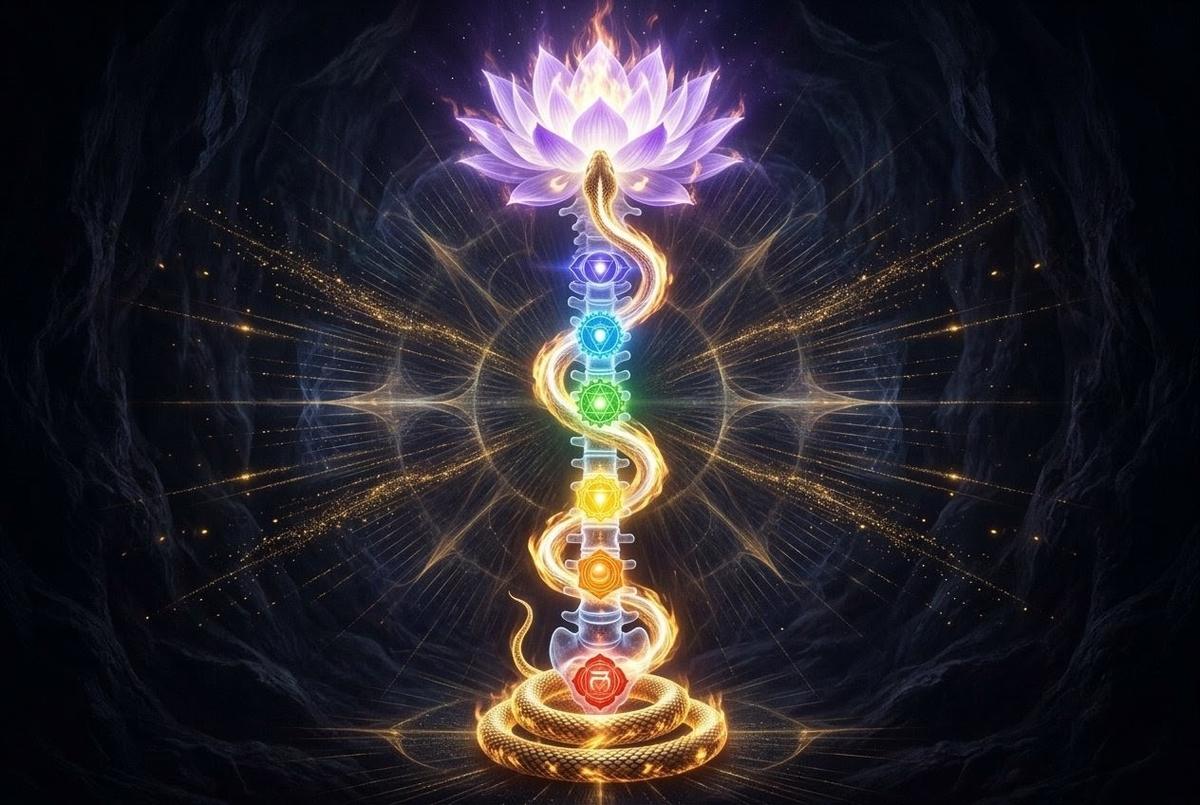
In hatha yoga and Tantric traditions, kundalini awakening may be described as the rising of this energy through the central channel, activating the chakras and transforming the practitioner’s consciousness. Reports may include heat, vibration, spontaneous movement, altered perception, emotional release, visionary experience, or profound states of unity.
These experiences should be handled with respect and caution. Not every heat sensation is kundalini. Not every tremor is awakening. Not every altered state is spiritual progress. The nervous system, trauma history, sleep, stress, psychiatric vulnerability, medication, breath intensity, and expectation can all shape what happens in practice.
Traditional systems placed kundalini work within preparation: ethical discipline, teacher guidance, grounding, breath training, body purification, devotion, and gradual development. Modern seekers often encounter the imagery without the container. That is the risk. The serpent is not a decorative symbol. It is a language for deep force, and deep force needs a stable vessel.
Kundalini Awakening and Safety
Kundalini-related experiences can be beautiful, transformative, confusing, or destabilising. Some people report insomnia, agitation, emotional volatility, pressure sensations, fear, dissociation, involuntary movements, or difficulty functioning. These experiences should not be romanticised.
Grounding matters. Slow practice matters. Professional support matters when symptoms become intense. A person in crisis does not need someone declaring them “chosen” or “ascending”. They need safety, sleep, food, calm, skilled help, and a practice container that respects both spirit and nervous system.
The Aura and Extended Energy Fields
Many esoteric traditions describe an aura or extended field around the body. This field may be understood as etheric, emotional, mental, spiritual, or bioenergetic, depending on the tradition. Practitioners may report sensing colour, pressure, warmth, density, boundary, or atmosphere around themselves or others.
Scientific claims here need special care. Kirlian photography and Gas Discharge Visualisation are often presented as proof of the aura, but Kirlian images primarily show corona discharge influenced by moisture, pressure, conductivity, and other physical factors. They should not be treated as straightforward photographs of a spiritual field.
That does not make aura language useless. People do experience relational fields. Nervous systems respond to one another. Presence, gaze, tone, posture, emotion, scent, breath, and subtle behavioural cues affect the felt atmosphere between bodies. The aura, read carefully, can be a contemplative language for interpersonal sensitivity, energetic boundaries, and the felt extension of presence beyond the skin.
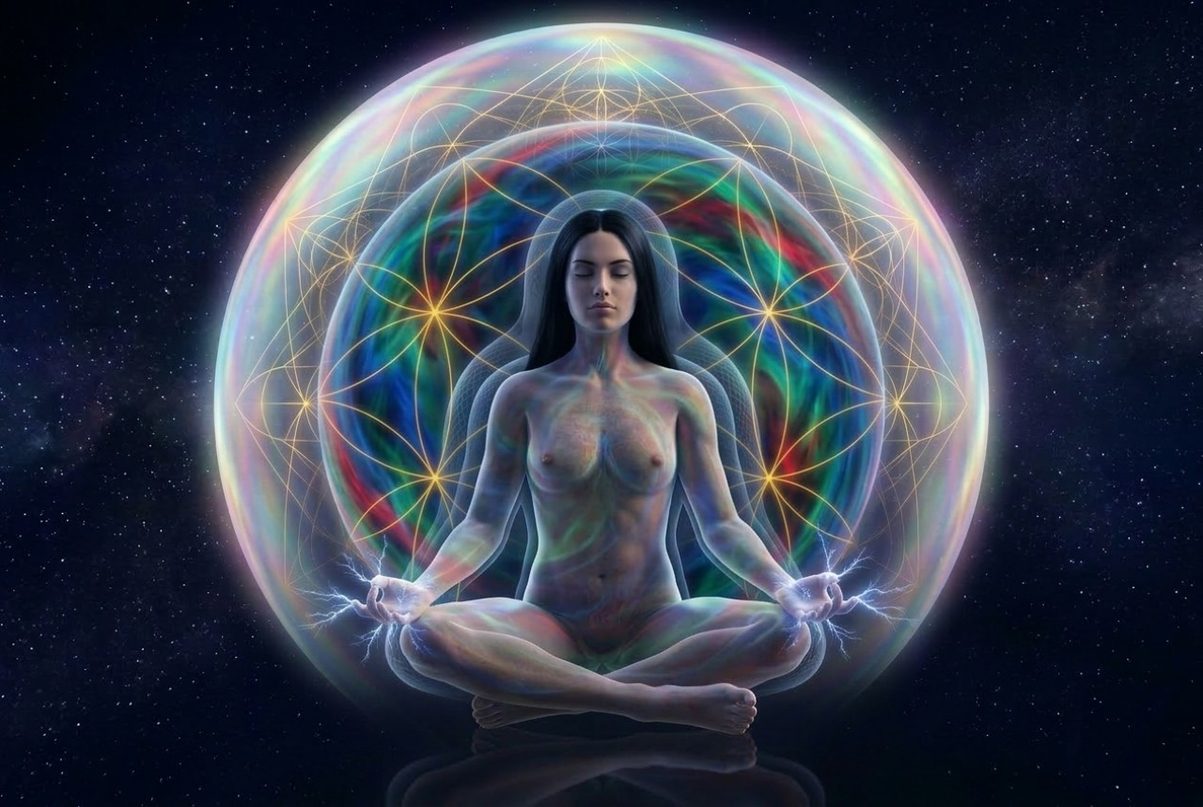
Energetic Boundaries
A useful way to work with aura language is through boundaries. Do you feel porous around certain people? Do you collapse when someone is angry? Do you become hyper-alert in crowded spaces? Do you leave conversations feeling drained, agitated, expanded, or clear?
These questions do not require supernatural certainty. They require honest interoception. The body often knows the quality of a field before the mind explains it. Energetic boundary work may include grounding, breath, visualisation, consent, saying no, leaving unsafe spaces, reducing overstimulation, and choosing relationships that support steadiness rather than depletion.
Working With the Subtle Body: Five Practical Methods
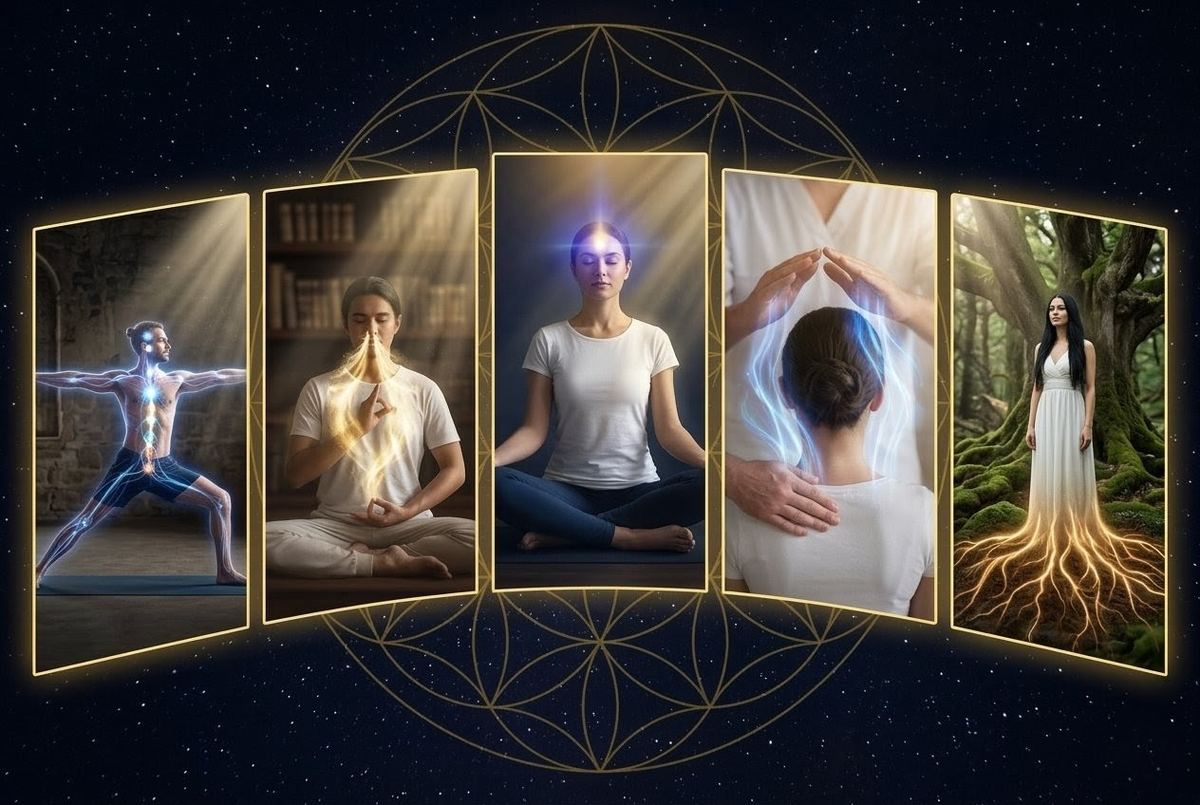
Subtle body work should not remain theoretical. Its value appears through practice, embodiment, and the gradual refinement of attention. The aim is not to collect unusual sensations. The aim is to become more present, regulated, compassionate, discerning, and alive.
1. Yoga and Movement
Yoga postures, walking meditation, qigong, tai chi, slow stretching, dance, and mindful movement can all awaken subtle body awareness. Movement helps attention descend from the head into breath, spine, belly, hips, hands, feet, and ground.
Forward bends may feel calming. Backbends may feel opening or stimulating. Twists may feel clearing. Standing postures may build grounding. None of these effects should be forced into one rigid interpretation. The body is not a slogan. Listen carefully, especially around injury, trauma, chronic illness, and fatigue.
2. Breathwork and Pranayama
Breath is one of the most direct bridges into the subtle body. Simple breath awareness, lengthened exhale, coherent breathing, alternate nostril breathing, mantra with breath, and gentle pranayama can change state quickly. That speed is useful, and it is also why caution matters.
Clinical research suggests that slow breathing and certain pranayama practices can influence heart rate variability and autonomic regulation. Traditional language speaks of prana. Modern physiology speaks of respiratory rhythm, vagal tone, carbon dioxide balance, arousal, and nervous-system regulation. Both languages point toward the same practical fact: breath changes experience.
Do not force breath retention, hyperventilation, intense practices, or long sessions without proper support. Breath is a key, but it is also a lever. It should be used with care, patience, and respect for the nervous system.
3. Meditation
Meditation works across the koshas. Breath awareness stabilises pranamaya kosha. Observing thought clarifies manomaya kosha. Witnessing awareness opens vijnanamaya kosha. Deep absorption may reveal glimpses of anandamaya kosha.
Chakra meditation, body scan, mantra, visualisation, open awareness, loving-kindness, and contemplative prayer can all be used to refine subtle perception. The safest foundation is simple: sit, breathe, feel the body, notice what arises, return gently, and avoid turning every sensation into a spiritual announcement.
4. Energy Healing and Body-Based Support
Reiki, acupuncture, pranic healing, craniosacral work, bodywork, somatic therapy, and other modalities may be understood by practitioners as working with subtle energy, body memory, nervous-system regulation, or all three. Their claims vary, and evidence varies. They should not be treated as replacements for medical diagnosis or treatment.
The most grounded approach is integrative: use qualified medical care when needed, and use supportive body-based or energy practices when they are safe, ethical, and genuinely helpful. A healing method should make a person more stable and functional, not more dependent, frightened, or inflated.
5. Lifestyle and Environment
The subtle body is affected by ordinary life. Sleep, food, sunlight, movement, emotional climate, noise, digital overstimulation, relationships, work rhythms, nature, and household atmosphere all shape the field of experience.
The yogic yamas and niyamas, ethical foundations such as non-harm, truthfulness, moderation, cleanliness, contentment, discipline, self-study, and devotion, can be read as subtle body hygiene. Ethics are not decorative. They are structural support. Without ethics, energy practice can become voltage without wiring.
The Integration of Dimensions
The subtle body offers a way to understand human experience as layered rather than flat. You are not only tissue. You are not only thought. You are not only emotion. You are not only spiritual longing. You are a continuum of body, breath, energy, mind, discernment, memory, relation, imagination, and awareness.
Integration means these layers begin to communicate. The body is not ignored. The breath is not forced. The emotions are not spiritualised away. The mind is not demonised. The intuition is not worshipped uncritically. The spiritual opening is not used to escape practical life. Each layer finds its place in the whole.
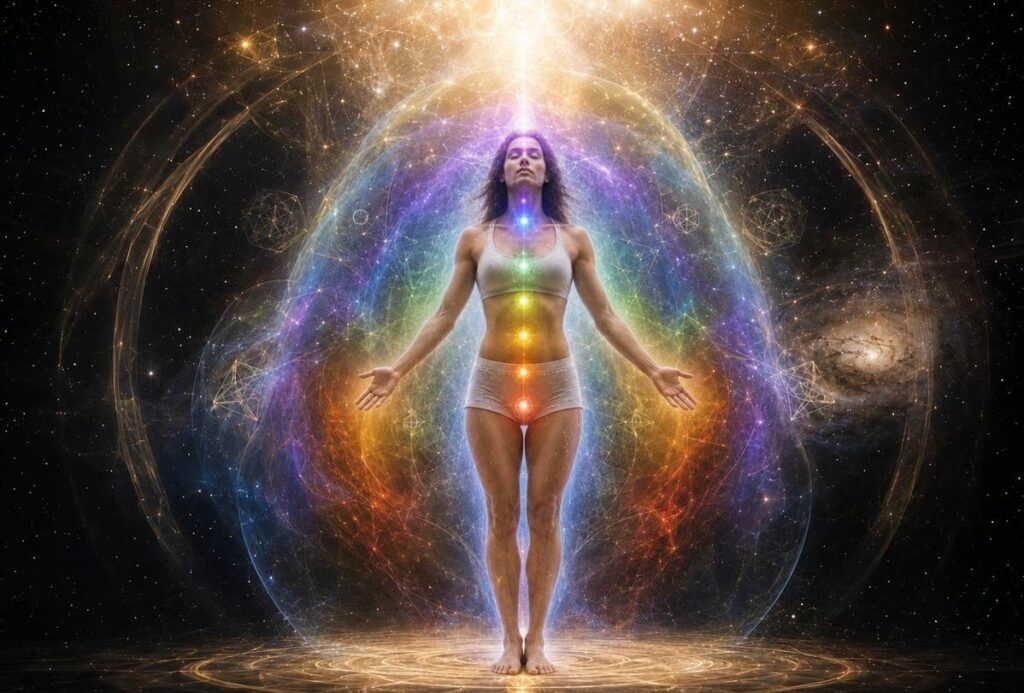
The subtle body is not an escape route from incarnation. It is a deeper way of inhabiting incarnation. The path does not ask you to abandon the physical body for luminous abstraction. It asks you to realise that the physical body is already woven with breath, mind, presence, symbol, field, and mystery.
When subtle body practice matures, it becomes quieter. Less fireworks, more steadiness. Less craving for special states, more capacity to listen. Less obsession with invisible anatomy, more reverence for the visible life in front of you. The light body becomes trustworthy only when it can remain kind, embodied, and useful in ordinary life.
The Gnostic Reading: Body, Breath, and Hidden Architecture
Gnostic tradition often speaks of the human being as more than the visible organism. The body is not always treated kindly in Gnostic literature, and some texts express a strong suspicion of material existence. Yet a more careful reading must avoid crude body-hatred. The real issue is not the body as such, but ignorance, false identity, captivity, and unconscious rule.
Subtle body practice can be read as one way of refusing that unconscious rule. Breath becomes known. Sensation becomes known. Emotion becomes known. Desire becomes known. Vision becomes testable. Energy becomes something to ground rather than worship. The body is no longer an inert prison or a decorative spiritual metaphor. It becomes a field of recognition.
In this sense, the subtle body sits close to the heart of The Thread. It asks how hidden architecture becomes visible through practice. It asks how the human being is shaped by breath, habit, attention, memory, image, relation, fear, and longing. It asks how direct knowing can descend into the nervous system without losing its clarity.
The Gnostic danger is always false authority. In subtle body work, false authority can appear as fear of invisible blockages, inflated claims, untrained diagnosis, energetic dependency, or the belief that special sensations prove spiritual superiority. The liberating path is different: careful practice, ethical grounding, humility, embodiment, and the slow recognition that the body is already a text.
The subtle body, read wisely, does not replace the physical body. It teaches the seeker to inhabit the physical body with deeper attention.
Related Glossary Terms
For quick definitions, use the main ZenithEye Glossary. The key terms for this article are:
Read Next
Continue with: The Gateway of Breath: Pranayama Techniques for Altered States
If this article maps the subtle body, the next step enters the most direct practical gateway into it: breath. Pranayama links body, nervous system, attention, prana, regulation, and altered state work, making it the natural continuation from subtle anatomy into lived practice.
Within Practice & Method
This article belongs to Contemplative Techniques, the Practice & Method route where breath, body awareness, subtle anatomy, grounding, movement, sound, vision, silence, and integration become practical supports for direct knowing.
Frequently Asked Questions About the Subtle Body
What is the subtle body?
The subtle body is a traditional and experiential map of the human being beyond gross physical anatomy. It includes breath, energy, sensation, emotion, attention, imagination, intuition, dream, spiritual awareness, and the felt sense of presence. Yoga describes it through koshas, chakras, nadis, prana, and kundalini. It should be treated as a contemplative model, not as a replacement for medical anatomy.
Are chakras scientifically proven?
Chakras have not been proven as physical anatomical structures in the way nerves, glands, or organs are. They belong primarily to yogic, Tantric, and later esoteric models of subtle anatomy. However, chakra practice may influence body awareness, breathing, emotion, attention, posture, and nervous-system regulation. They are best used as symbolic and contemplative maps rather than medical facts.
What are the five koshas?
The five koshas are sheaths of the human being described in Vedantic and yogic tradition. They are annamaya kosha, the food or physical body; pranamaya kosha, the energy body; manomaya kosha, the mental-emotional body; vijnanamaya kosha, the wisdom or discernment body; and anandamaya kosha, the bliss body. They describe layers of experience that veil the Self.
What are ida, pingala, and sushumna?
Ida, pingala, and sushumna are three primary nadis, or subtle channels, in yogic anatomy. Ida is often described as lunar, cooling, and receptive. Pingala is solar, warming, and active. Sushumna is the central channel through which kundalini is said to rise when the polar currents are balanced. These are traditional subtle body concepts, not confirmed physical nerves.
Is kundalini awakening dangerous?
Kundalini experiences can be transformative, but they can also be destabilising if intense, forced, or unsupported. Some people report heat, vibration, involuntary movements, insomnia, fear, emotional volatility, pressure sensations, dissociation, or disorientation. Kundalini practice should be approached gradually, with grounding, ethical preparation, and experienced guidance. Anyone experiencing severe distress should pause practice and seek qualified medical or mental health support.
Can subtle body practices replace medical treatment?
No. Subtle body practices such as yoga, meditation, breathwork, energy healing, visualisation, or chakra work can support self-awareness and wellbeing, but they do not replace medical care, therapy, medication, diagnosis, emergency support, or trauma treatment. Persistent physical or psychological symptoms should be discussed with qualified professionals.
How can I begin sensing the subtle body safely?
Begin gently. Practise body scan, slow breathing, walking meditation, simple yoga, grounding through the feet, and quiet observation of sensation. Avoid forcing energy upward, intense breath retention, prolonged visualisation, or trying to awaken kundalini quickly. The safest subtle body practice makes you more grounded, stable, kind, and present in ordinary life.
How does the subtle body relate to Gnostic practice?
In a Gnostic reading, subtle body practice can help reveal the hidden architecture of attention, breath, sensation, desire, fear, imagination, and embodiment. It is not about escaping the body, but recognising where consciousness is bound, fragmented, or asleep, then bringing direct knowing into lived experience.
Study and Safety Note
This article explores subtle body traditions, yoga, breathwork, chakras, nadis, kundalini, aura language, energy healing, contemplative practice, and embodied spirituality for educational and reflective purposes. It does not provide medical, psychological, psychiatric, trauma, nutritional, breathwork, meditation-instruction, or spiritual-direction advice.
Subtle body practices can be meaningful, but they do not replace qualified healthcare, therapy, medication, diagnosis, emergency services, or trauma-informed support. Approach breathwork, kundalini practice, chakra meditation, energy healing, fasting, and intense visualisation gradually.
If practice produces panic, insomnia, dissociation, derealisation, depersonalisation, mania, psychosis, involuntary movements, severe emotional distress, suicidal thoughts, or inability to function, pause the practice and seek appropriate professional support.
Further Reading
These ZenithEye links continue the themes of subtle body practice, breath, embodiment, grounding, consciousness, and spiritual integration:
- The Gateway of Breath: Pranayama Techniques for Altered States – Breath as the practical bridge into prana, nervous-system regulation, and subtle body awareness.
- The Gateway of Sensation: Body Scan and Somatic Awareness – Direct body awareness through sensation, grounding, interoception, and somatic attention.
- Embodiment Practices for Grounding Awakening – How to stabilise expanded awareness in ordinary life and the physical body.
- Contemplative Techniques: Methods for Stabilisation – Meditation practices for attention, silence, witnessing, and stabilising inner recognition.
- The Gateway of Movement: Walking Meditation and Circulation – Movement as a subtle body practice, grounding method, and contemplative discipline.
- The Gateway of Sound: Mantra and Nada Yoga – Sound, vibration, mantra, listening, and sonic stabilisation.
- Left Brain, Right Brain, and the Neuroscience of Spiritual Integration – Hemispheric integration, attention, embodiment, and contemplative development.
- The Divine Architecture Within: How Your Body Mirrors the Universe – Esoteric anatomy, body symbolism, microcosm and macrocosm, and embodied correspondence.
- States of Knowing: What Happens When Consciousness Unravels – Altered states, non-ordinary awareness, spiritual destabilisation, and integration.
- Integration and Grounding: Embodying the Received Tradition – Somatic and practical approaches to stabilising subtle body openings.
- Lucid Dreaming as Practice Platform: The Tibetan Milam – Dream practice, subtle body awareness, and consciousness during sleep states.
- The Kundalini Emergency: When the Serpent Power Overwhelms the Vessel – A grounded look at intense kundalini-related experiences and spiritual emergency.
References and Sources
The following sources support the yogic, contemplative, subtle body, comparative, and physiological framework used in this article.
Primary Yogic and Esoteric Texts
- [1] Taittiriya Upanishad. Classical source for the pancha kosha model of five sheaths.
- [2] Hatha Yoga Pradipika. Attributed to Svatmarama. Foundational hatha yoga text describing nadis, breath practice, kundalini, mudra, and subtle body methods.
- [3] Shiva Samhita. Classical hatha yoga text discussing subtle anatomy, prana, chakras, and yogic practice.
- [4] Gheranda Samhita. Classical hatha yoga text on purification, posture, mudra, breath, meditation, and samadhi.
- [5] Patanjali. Yoga Sutras. Classical source for concentration, meditation, absorption, and the stilling of mental fluctuations.
- [6] Sat-Cakra-Nirupana. Influential Tantric text on chakras, translated and popularised in English through Arthur Avalon’s The Serpent Power.
Yoga, Chakras, and Subtle Body Studies
- [7] Feuerstein, Georg. The Yoga Tradition: Its History, Literature, Philosophy and Practice. Hohm Press, 1998.
- [8] Johari, Harish. Chakras: Energy Centers of Transformation. Destiny Books, 2000.
- [9] White, David Gordon. The Alchemical Body: Siddha Traditions in Medieval India. University of Chicago Press, 1996.
- [10] Samuel, Geoffrey. The Origins of Yoga and Tantra: Indic Religions to the Thirteenth Century. Cambridge University Press, 2008.
- [11] Mallinson, James and Singleton, Mark. Roots of Yoga. Penguin Classics, 2017.
- [12] Avalon, Arthur, Sir John Woodroffe. The Serpent Power. Luzac, 1919.
- [13] Flood, Gavin. The Tantric Body: The Secret Tradition of Hindu Religion. I. B. Tauris, 2006.
- [14] Eliade, Mircea. Yoga: Immortality and Freedom. Princeton University Press, 1958.
Tibetan, Taoist, and Comparative Energy Anatomy
- [15] Wangyal Rinpoche, Tenzin. The Tibetan Yogas of Dream and Sleep. Snow Lion, 1998.
- [16] Mullin, Glenn H. The Six Yogas of Naropa. Snow Lion, 1996.
- [17] Kohn, Livia. Daoism and Chinese Culture. Three Pines Press, 2001.
- [18] Kohn, Livia. Chinese Healing Exercises: The Tradition of Daoyin. University of Hawai‘i Press, 2008.
- [19] Unschuld, Paul U. Medicine in China: A History of Ideas. University of California Press, 1985.
- [20] Johnson, Don Hanlon, ed. Bone, Breath, and Gesture: Practices of Embodiment. North Atlantic Books, 1995.
Breath, Physiology, and Contemplative Research
- [21] Shaffer, Fred and Ginsberg, J. P. “An Overview of Heart Rate Variability Metrics and Norms.” Frontiers in Public Health, 5, 258, 2017.
- [22] Lehrer, Paul and Gevirtz, Richard. “Heart Rate Variability Biofeedback: How and Why Does It Work?” Frontiers in Psychology, 5, 756, 2014.
- [23] Streeter, C. C., et al. “Effects of Yoga on the Autonomic Nervous System, Gamma-Aminobutyric-Acid, and Allostasis in Epilepsy, Depression, and Post-Traumatic Stress Disorder.” Medical Hypotheses, 78(5), 571-579, 2012.
- [24] Brown, Richard P. and Gerbarg, Patricia L. The Healing Power of the Breath. Shambhala, 2012.
- [25] Mehling, Wolf E., et al. “Body Awareness: A Phenomenological Inquiry into the Common Ground of Mind-Body Therapies.” Philosophy, Ethics, and Humanities in Medicine, 6, 6, 2011.
- [26] Kabat-Zinn, Jon. Full Catastrophe Living. Delacorte, 1990.
- [27] Tang, Yi-Yuan, Hölzel, Britta K., and Posner, Michael I. “The Neuroscience of Mindfulness Meditation.” Nature Reviews Neuroscience, 16, 213-225, 2015.
Embodiment, Trauma, and Integration
- [28] van der Kolk, Bessel. The Body Keeps the Score: Brain, Mind, and Body in the Healing of Trauma. Viking, 2014.
- [29] Ogden, Pat, Minton, Kekuni, and Pain, Clare. Trauma and the Body: A Sensorimotor Approach to Psychotherapy. W. W. Norton, 2006.
- [30] Treleaven, David A. Trauma-Sensitive Mindfulness: Practices for Safe and Transformative Healing. W. W. Norton, 2018.
- [31] Gendlin, Eugene. Focusing. Bantam, 1978.
- [32] Payne, Peter, Levine, Peter A., and Crane-Godreau, Mardi. “Somatic Experiencing: Using Interoception and Proprioception as Core Elements of Trauma Therapy.” Frontiers in Psychology, 2015.
- [33] Craig, A. D. “How Do You Feel? Interoception: The Sense of the Physiological Condition of the Body.” Nature Reviews Neuroscience, 2002.
- [34] Grof, Stanislav and Grof, Christina. Spiritual Emergency: When Personal Transformation Becomes a Crisis. Tarcher, 1989.
- [35] Lindahl, Jared R., et al. “The Varieties of Contemplative Experience: A Mixed-Methods Study of Meditation-Related Challenges in Western Buddhists.” PLOS ONE, 12(5), 2017.
Western Esoteric and Gnostic Context
- [36] Regardie, Israel. The Tree of Life: An Illustrated Study in Magic. Later editions.
- [37] Fortune, Dion. The Mystical Qabalah. Williams & Norgate, 1935.
- [38] Leadbeater, C. W. The Chakras. Theosophical Publishing House, 1927.
- [39] Robinson, James M. (ed.). The Nag Hammadi Library in English. Revised edition. HarperOne, 1990.
- [40] Meyer, Marvin (ed.). The Nag Hammadi Scriptures. HarperOne, 2007.
- [41] Layton, Bentley. The Gnostic Scriptures. Yale University Press, 1987.
- [42] Brakke, David. The Gnostics: Myth, Ritual, and Diversity in Early Christianity. Harvard University Press, 2010.