The Gateway of Silence: Entering the Causal Body
Before There Was Something to Know
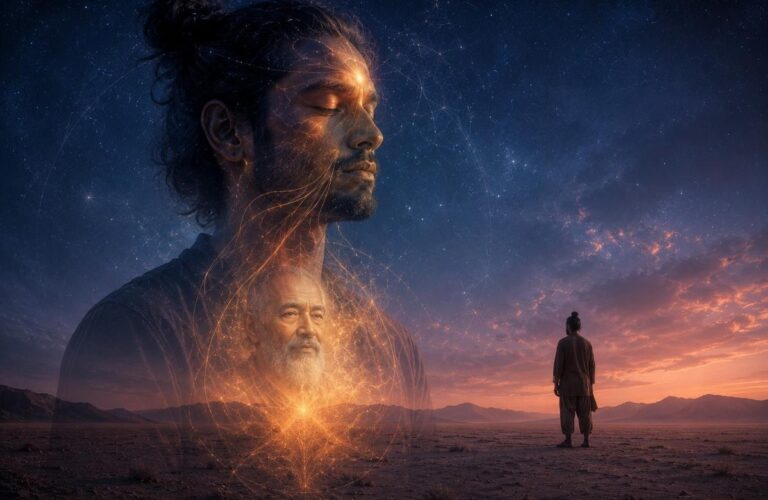
There is a silence that precedes thought. Not the absence of sound, nor the disciplined quiet of a meditation hall, but the silence from which sound itself emerges–the causal substrate of awareness. The traditions have mapped this territory variously: as the causal body (karana sharira) in Vedantic taxonomy, as the sphere of neither perception nor non-perception–the fourth formless attainment–in Buddhist phenomenology, and as the abyss or privatio in Western esotericism. It represents the final veil before recognition, the last subtle holding pattern of the separate self.
This gateway does not yield to effort. It cannot be forced, visualised, or conceptualised into submission. It is approached only through radical cessation–the complete abandonment of the cognitive instruments we use to construct reality. The mind cannot grasp what precedes mind. The seeker must become willing to vanish.
In the framework of the Five Gateways, this is the threshold where method itself becomes the obstacle. Where the Gateway of Breath opens the energetic body, where the Gateway of Sensation maps the subtle terrain, and where the Gateway of Vision encounters the luminous displays of the intermediate realm, the Gateway of Silence confronts the practitioner with what remains when all gateways close. It is not a higher state but a deeper recognition–the ground from which all states arise and to which they return without ever having left.
Table of Contents
- Before There Was Something to Know
- The Architecture of the Subtle
- The Method of Non-Method
- The Phenomenology of Causal Abiding
- The Risks of Premature Entry
- Return and Integration
- Frequently Asked Questions
- Further Reading
- References and Sources
The Architecture of the Subtle
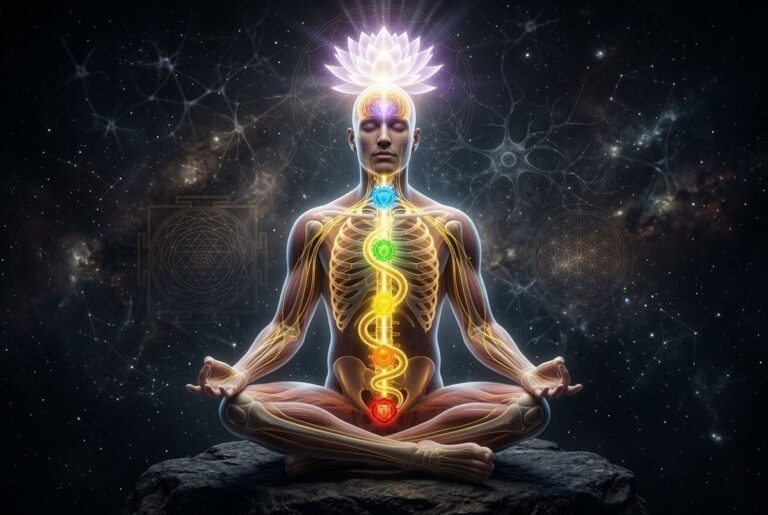
To understand the causal body, one must first recognise the limitation of the subtle. Most contemporary spiritual discourse operates at the level of the subtle body–the linga sharira–where energy flows, chakras spin, and visionary phenomena arise. This realm is rich, therapeutic, and dangerously seductive. One can spend decades mapping energetic pathways, cultivating kundalini phenomena, or harvesting visionary downloads without ever touching the causal substrate.
The subtle body is still experience. The causal body is the possibility of experience. It is not a thing but a condition–the open capacity in which the subtle and gross arise and dissolve. In Gnostic terms, it is the pre-archonic field, the state prior to the demiurgic division that carved unity into subject and object.
The Five Sheaths and the Causal Body
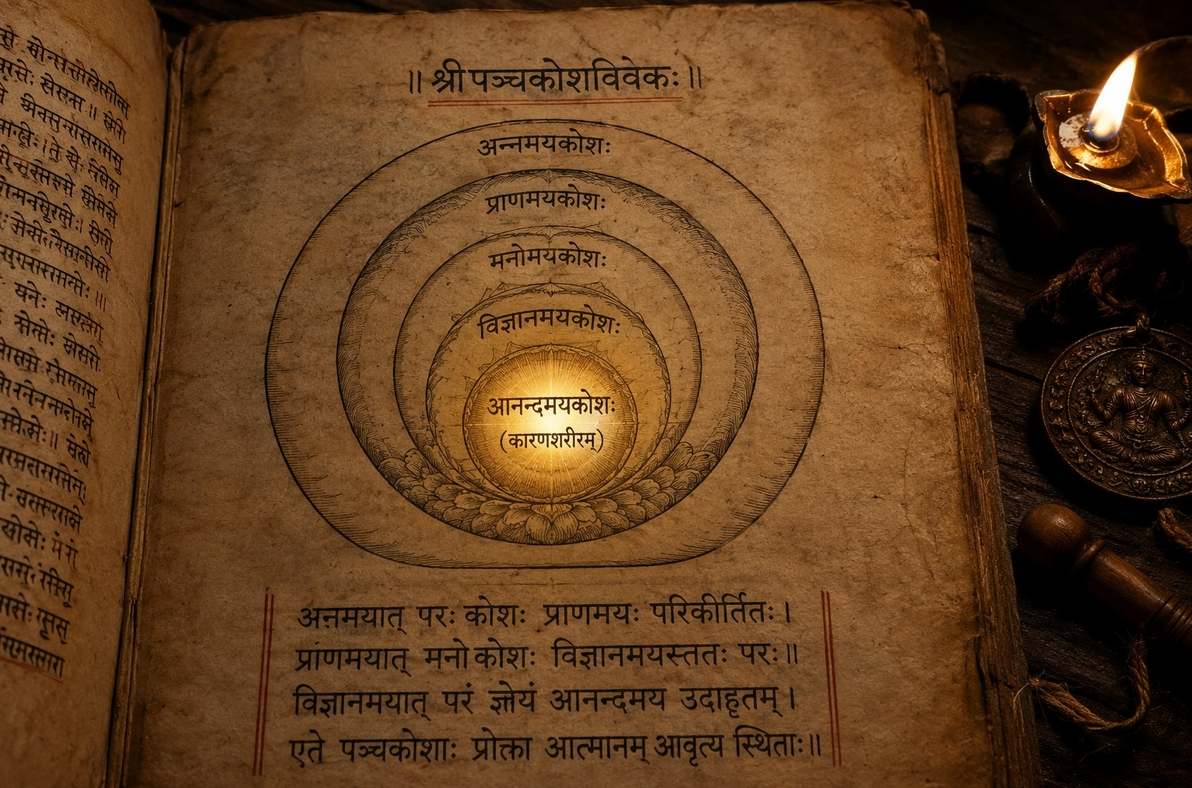
The Vedantic tradition provides the most systematic cartography of this transition. In the Taittiriya Upanishad, the five sheaths (koshas) describe the nested envelopes of identity: the food body (annamaya), the energy body (pranamaya), the mind body (manomaya), the wisdom body (vijnanamaya), and the bliss body (anandamaya). The causal body (karana sharira) corresponds to this innermost sheath–not because it is made of bliss, but because it is the subtlest conditioning through which bliss, and all other modalities of experience, become possible.
The Mandukya Upanishad pushes this mapping further by distinguishing four states of consciousness: waking (jagrat), dreaming (svapna), deep sleep (sushupti), and the fourth (turiya)–the pure awareness that underlies and transcends the other three. Turiya is not a state among states but the silent witness of all states, the awareness in which waking, dreaming, and sleep appear and disappear like waves upon an ocean that itself never moves.
The Buddhist Formless Attainments
The Buddhist Abhidhamma offers an equally rigorous phenomenology through the four formless attainments (arupa jhanas). After the practitioner has stabilised the four material jhanas and passed through the dimensions of infinite space, infinite consciousness, and nothingness, they arrive at the fourth formless realm: the sphere of neither perception nor non-perception. This is not unconsciousness. Something remains–a subtle, ultra-refined knowing that has released even the object of “nothingness” itself. The Buddha described it as the summit of perception, the limit beyond which perception itself begins to unfabricate.
What lies beyond this is the cessation of perception and feeling (nirodha samapatti)–a total pause of the cognitive apparatus that the tradition reserves only for those who have mastered the entire trajectory. The causal body, in this mapping, is the threshold between the fourth formless attainment and complete cessation: the last residue of the knowing subject before knowing itself dissolves.
The Western Esoteric Abyss
Western esotericism has approached this territory through the symbolism of the Abyss–the gulf in the Kabbalistic Tree of Life between the rational sephiroth and the supernal triad. To cross the Abyss is to surrender the personal self, the accumulated constructs of identity and achievement, into the privatio–the dark radiance that is not absence but unmanifest plenitude. The Corpus Hermeticum speaks of kratesis–dominion or mastery–as the cultivated capacity to remain established in the unmanifest without being drawn back into identification with phenomena.
The Method of Non-Method
Entry through this gateway requires the cessation of technique. This creates a paradox for the practitioner who has spent years perfecting method. You cannot meditate into the causal body. You can only recognise what remains when meditation itself releases its grip.
The preliminary practices, however, are precise. They do not constitute a technique for entry so much as a dismantling of the obstacles to recognition.
Step One — Exhaustion of the Object
Sit without support. No mantra, no breath regulation, no visualisation. Allow the mind to exhaust its natural momentum toward objects. This is not suppression but exhaustion–like a spinning top gradually surrendering its angular velocity. The mind will present memories, fantasies, plans, and insights. Let them complete themselves without engagement. Do not follow. Do not push away. Simply remain as the field in which they arise and dissolve.
This practice draws on the Dzogchen instruction to leave the mind in its natural state-ma bcos pa–without modification or fabrication. The ground (gzhi) in Dzogchen is described as empty in essence, naturally luminous in expression, and spontaneously manifesting as unstoppable compassionate display. Recognition of this ground is not an attainment but a direct seeing of what has always been the case.
Step Two — Recognition of the Knower
As objects fade, there is a tendency to subtle contraction–a background sense of me who is watching objects fade. This is the final object. Turn attention backward. Who knows the absence of objects? Do not answer conceptually. Simply rest in the knowing.
This is the essence of self-inquiry (atma vichara) as taught by Ramana Maharshi and the Advaita tradition. The question “Who am I?” is not a philosophical enquiry but a laser-like pointer to the source of the “I”-thought. When the “I”-thought is traced to its origin, it dissolves into the heart–the causal substrate from which it arose.
Step Three — Release of the Subtle Body
Even without thought, energetic phenomena persist: subtle vibration, spaciousness, luminosity. These are still content. Allow them to equalise with the field. The sense of being located in a body, the feeling of consciousness having a centre–these too are subtle phenomena. Release even the sense of release.
In Tibetan tantric physiology, the subtle body consists of channels (tsa), winds (rlung), and drops (thigle). The winds carry consciousness through the channels, and the practitioner may experience powerful energetic movements, heat, bliss, or visionary light. These are movements within the subtle body, not the causal ground. To mistake them for the goal is to confuse the path with the destination.
Step Four — The Leap
At a certain point, effort itself becomes the obstacle. The practitioner must make what the Christian mystics called the leap of faith–not faith in doctrine, but the existential abandonment of the one who practises. This is not suicide; it is the death of the separation between subject and object.
Meister Eckhart described this as Gelassenheit–releasement or letting-be–in which the soul surrenders even its own willing and knowing into the divine ground. The Sufi mystics spoke of fana–annihilation of the separate self–preceding baqa–subsistence in the divine. In each tradition, the language points to the same threshold: the moment when the seeker recognises that the seeker was never other than the sought.

The Phenomenology of Causal Abiding
What happens when the gateway opens? Language necessarily betrays the experience, but the phenomenological markers are consistent across traditions:
Time Collapse
The linear progression of past-present-future dissolves. There is not timelessness in the sense of endless duration, but the absence of temporal location. Events continue to occur, but they do not occur to anyone across time. The physicist’s block universe–where past, present, and future exist simultaneously–becomes an experiential fact rather than a theoretical model. One is not transported to eternity; one recognises that the present moment was never located in a stream.
Boundary Dissolution
The felt sense of inside/outside evaporates. The body does not disappear; it simply loses its status as the boundary of awareness. One is simultaneously everywhere and nowhere, both terms becoming inapplicable. The Advaitic sages describe this as sarvantaryami–the innermost Self of all–in which the distinction between inner and outer is revealed as a construct of the discriminating intellect.
Cessation of the Witness
In subtle states, there is often a persistent sense of witnessing–a background awareness that observes phenomena. In the causal body, even this collapses. There is no one standing apart from what is occurring. This is why the tradition warns of this territory: without proper foundation, this recognition can trigger depersonalisation or vertigo. The witness function, so carefully cultivated in preliminary practice, must itself be surrendered.
Non-Intentionality
Thought may arise, but it does not arise to anyone. It is simply the universe arranging itself into temporary patterns of meaning, then releasing them. The cognitive function continues, but the cognitive subject has dissolved. As the Ashtavakra Gita states: “You are neither the doer nor the enjoyer. You are the solitary witness of the infinite mind–and yet this too is a provisional description, for even the witness is ultimately untrue.”

The Risks of Premature Entry
This gateway is not a prize. Without the stabilisation developed through consistent subtle body practice and the ethical foundation that prevents spiritual bypassing, entry into the causal body can be destabilising. The literature documents cases of what Tibetan medicine calls rlung disorder–wind imbalance–where premature or forceful dissociation from the subtle body creates physiological and psychological distress. Symptoms may include insomnia, anxiety, spaciness, and a sense of being ungrounded or fragmented.
The practitioner should not seek this state until:
- The energy body is stable and balanced, with no persistent energetic irregularities
- Psychological integration is robust, with no active trauma or unprocessed material
- Daily functioning is grounded and ethical, with no tendency toward withdrawal or grandiosity
- A qualified guide or tradition is available for verification and support
Spiritual emergency–the crisis that can accompany rapid non-ordinary states–is a real risk when the cognitive subject dissolves before the personality structure is ready to accommodate the shift. The causal body is not an escape from psychological work; it is the culmination of it.
Return and Integration
One does not remain in the causal body. The biological organism requires the subtle and gross dimensions to function. The value of this gateway is not in dwelling there but in recognising it as the ground from which one never actually departed.
After entry, the return to ordinary consciousness is permanently altered. The separate self reassembles itself as a functional convenience–a mask worn for the theatre of daily life–but it no longer carries ontological weight. One operates in the world while resting in the recognition that the world, the operator, and the recognition itself are temporary modifications of a silence that has no opposite.
This is the jivanmukta–liberation while living–not as a permanent state of cosmic consciousness but as the capacity to recognise the causal substrate even while engaged in the most mundane activities. The Vedantic tradition explains this through the doctrine of prarabdha karma: the momentum that set the present body in motion continues until exhausted, even after the root of ignorance has been severed. The liberated person continues to eat, feel heat and cold, and interact with others–but without the bondage of identification.
The silence does not reject sound. It makes sound possible. Enter the silence not to escape the world, but to recognise the ground from which the world emerges–and to which it returns, moment by moment, without ever having left.
— The Gateway of Silence

Frequently Asked Questions
What is the causal body in spiritual practice?
The causal body, or karana sharira in Vedanta, is the subtlest sheath of identity–the open capacity or condition in which all experience arises and dissolves. It is not a thing but the possibility of experience itself, preceding the division into subject and object.
How is the causal body different from the subtle body?
The subtle body (linga sharira) is the realm of energetic flow, visionary phenomena, and intermediate experiences. The causal body is deeper–it is the substrate or ground from which the subtle and gross bodies emerge. Where the subtle body is still experience, the causal body is the possibility of experience.
What is the fourth state of consciousness in Vedanta?
The Mandukya Upanishad describes turiya as the fourth state of consciousness, beyond waking, dreaming, and deep sleep. Turiya is not a state among states but the pure awareness that underlies and witnesses all other states–silent, unchanging, and ever-present.
What is the Buddhist sphere of neither perception nor non-perception?
It is the fourth formless attainment (arupa jhana), also called the eighth jhana. In this state, gross perception has ceased, yet a subtle, ultra-refined knowing remains. The Buddha described it as the summit of perception–the threshold beyond which perception itself unfabricates.
Can you meditate into the causal body?
No. The causal body cannot be reached through technique or effort. You cannot meditate into it; you can only recognise what remains when meditation, the meditator, and the subtle body are all released. It is approached through radical cessation rather than progressive attainment.
What are the risks of entering the causal body too early?
Without stable energetic grounding and psychological integration, premature entry can trigger rlung disorder (Tibetan wind imbalance), depersonalisation, vertigo, or spiritual emergency. The causal body is not an escape from psychological work but its culmination.
What is jivanmukti or liberation while living?
Jivanmukti is the state of liberation while still embodied. The realised person continues to live, work, and interact until the momentum of the present life (prarabdha karma) is exhausted–but they no longer identify with the body-mind as their true self. It is liberation integrated into ordinary life.
Further Reading
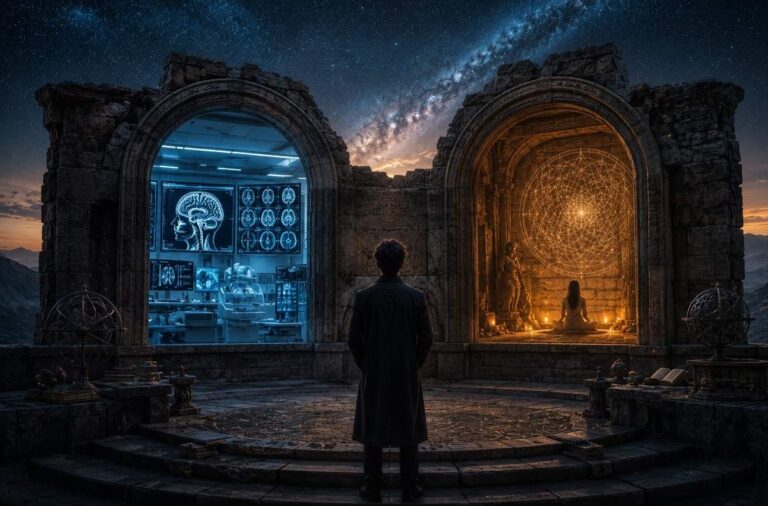
- The Physiology of Mystical Experience: What Happens in the Brain During Transcendence — A neuroscientific and phenomenological exploration of consciousness transformation that complements the causal body framework.
- The Gateway of Breath: Pranayama Techniques for Conscious Transformation — Essential preliminary work for stabilising the subtle body before approaching the causal threshold.
- Embodiment Practices for Grounding Awakening: Why Spirituality Needs a Body — Critical preparation for safe exploration of advanced contemplative territories.
- The Witness Function in Contemplative Traditions — Examines the collapse of the witness function that marks the transition from subtle to causal abiding.
- The Abyss Across Three Traditions: Kabbalah, Alchemy, and Buddhism — Cross-traditional analysis of the threshold between manifest and unmanifest reality.
- Spiritual Emergency or Transformation Crisis: Navigating the Dark Night — Essential reading on the risks of premature entry into advanced states of consciousness.
- Nervous System Regulation: The New Frontier of Embodied Spirituality — Modern and traditional perspectives on stabilising the energy body before deep practice.
- Integration and Grounding: The Complete Post-Experience Framework — A practical framework for stabilising insights from deep contemplative practice.
- Stages of Integration: Immediate, Short-Term, and Long-Term — Structured guidance for integrating transformative experiences across time.
- When the Guide Disappears: Solo Practice and the Transmission Beyond Form — For practitioners approaching the method of non-method without external technique.
References and Sources
The following sources are grouped by tradition and discipline for readers who wish to explore the causal body across multiple lineages.
Primary Sources and Classical Texts
- Taittiriya Upanishad — Establishes the five koshas and the causal body (karana sharira) as anandamaya kosha.
- Mandukya Upanishad — Maps turiya as the fourth state beyond waking, dreaming, and deep sleep.
- Abhidhamma and Pali Canon — Describes the four arupa jhanas, including the sphere of neither perception nor non-perception.
- Corpus Hermeticum — References kratesis (dominion) as mastery of the unmanifest.
- Meister Eckhart — Gelassenheit (releasement) as surrender into the divine ground.
- Ashtavakra Gita — Advaita text on non-doership and the dissolution of the witness.
Tibetan and Dzogchen Sources
- Longchenpa — The Precious Treasury of the Basic Space of Phenomena (Choying Dzod), on the ground (gzhi) as primordial purity and spontaneous presence.
- Padmasambhava — Self-Liberation through Seeing with Naked Awareness (Rigpa Rangshar), on recognising the natural state.
- Tibetan Medical Tradition — rLung disorder classification and tsalung therapy for wind imbalance.
Scholarly and Contemporary Works
- Ramana Maharshi — Teachings on atma vichara (self-inquiry) and the dissolution of the “I”-thought into the heart.
- Adi Shankaracharya — Commentaries on the Mandukya Upanishad establishing Advaita Vedanta’s four-state model.
- Rob Burbea — Seeing That Frees — Contemporary Buddhist phenomenology of emptiness and the formless attainments.
- Stanislav Grof — Work on spiritual emergency and the psychological risks of non-ordinary states.
Safety Notice: This article explores advanced contemplative territory that involves the temporary dissolution of the sense of self, time, and bodily boundaries. It does not constitute medical, psychological, or spiritual instruction. If you experience depersonalisation, persistent anxiety, energetic disturbance, or disorientation during meditation, please contact a trauma-informed therapist, a qualified meditation teacher within a recognised lineage, or your general practitioner. Advanced contemplative practice complements but does not replace clinical mental health treatment. Do not attempt to force or rush the cessation of technique without stable grounding in preliminary practice.