

The Kundalini Emergency: When the Serpent Power Overwhelms the Vessel
The Fire That Cleanses Can Also Consume
There is a phenomenon increasingly reported in transpersonal clinics, therapy practices, and even emergency settings that conventional medicine struggles to diagnose. The patient presents with seizures that do not appear on EEGs, with hallucinations that lack the chaotic signature of psychosis, with chest pains that cardiac monitors declare imaginary. They are software engineers, baristas, university students–ordinary people who have been “biohacking” their consciousness through breathwork apps, YouTube kundalini tutorials, or weekend yoga intensives. They have awakened something ancient, and it is devouring them from the inside.
This is the Kundalini emergency: not the gentle rising of energy described in glossy spiritual manuals, but the explosive, uncontrolled eruption of the serpent power (kundalini-shakti) before the nervous system has developed the capacity to conduct it. The tradition warns of this. The texts speak of prerequisites–purification of the nadis, stabilisation of the lower chakras, guidance from one who has walked the path. Modernity ignores these warnings. The result is a growing epidemic of spiritual crisis that transpersonal psychologists Stanislav and Christina Grof identified as one of the ten major types of spiritual emergency, a framework they established through decades of research at the Esalen Institute and beyond.

Table of Contents
- The Fire That Cleanses Can Also Consume
- The Anatomy of Premature Awakening
- The Phenomenology of Crisis
- Differentiation from Pathology
- Emergency Protocols
- Prevention and Proper Preparation
- The Gnostic Perspective
- Frequently Asked Questions
- Further Reading
- References and Sources
The Anatomy of Premature Awakening
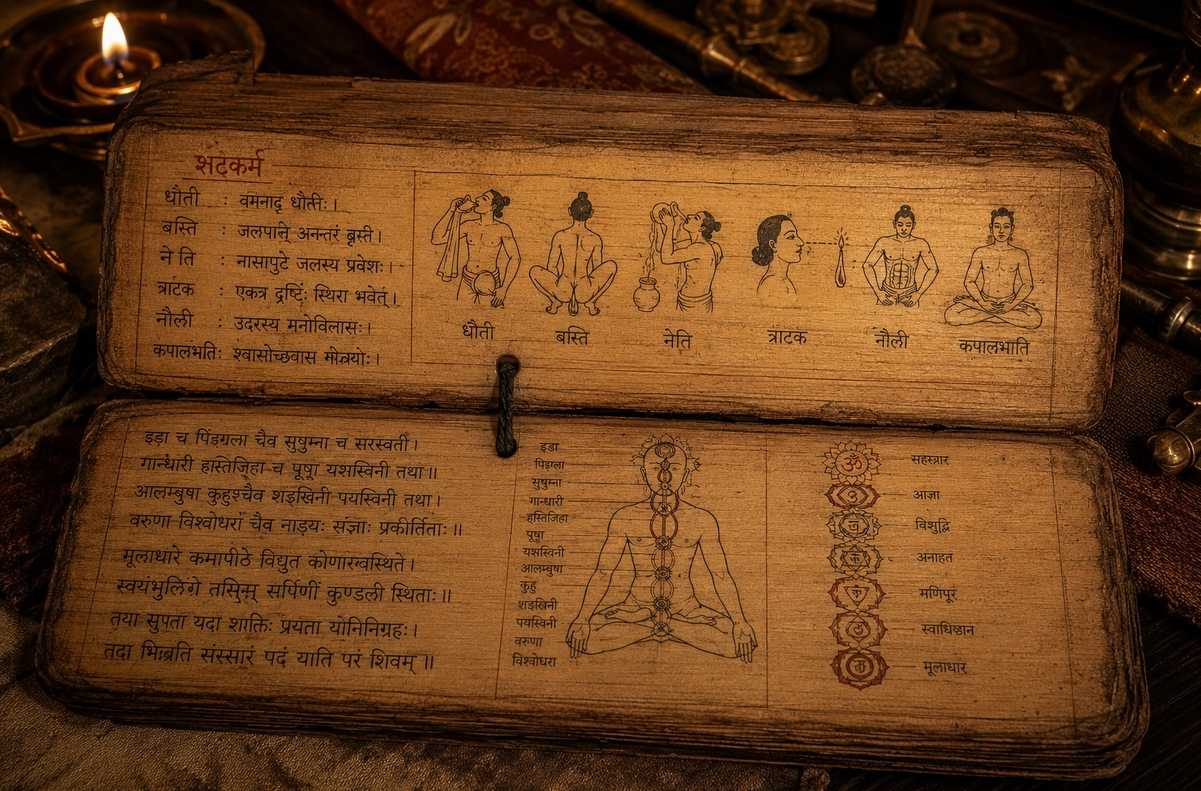
Kundalini is not merely metaphor. It is the body’s bioelectric potential, the latent energy coiled at the base of the spine that, when activated, fundamentally rewires the nervous system. In traditional frameworks, this process takes years of preparation. The Hatha Yoga Pradipika–the fifteenth-century manual by Svatmarama–establishes a rigorous sequence: first shatkarma (the six purification practices), then asana (posture), then pranayama (breath control), and only then the subtler practices of mudra and bandha that directly awaken the serpent power.
The Classical Prerequisites
Svatmarama is unambiguous on this point: when fat or mucus is excessive, the six cleansings must be performed before breath control practice. Those in whom the doshas are balanced need not perform them. The six cleansings–<dhauti, basti, neti, trataka, nauli, and kapalbhati–are not optional hygiene but energetic prerequisites. Blocked nadis (energy channels) prevent prana from entering the central sushumna channel, and without sushumna activation, the practitioner cannot attain unmani–the state beyond mind that is the goal of Hatha Yoga.
The Sat-chakra-nirupana–the sixteenth-century tantric text that maps the chakra system in detail–describes the sequential piercing of each lotus: Kundalini, roused by the fire of kama-vayu (the air of desire) and the power of breath retention, must be led upward through svadhisthana, manipura, anahata, vishuddha, and ajna before reaching the thousand-petalled sahasrara. Each chakra must be stabilised before the next is opened. This is electrical engineering: you do not run high voltage through wiring rated for household current.
The Modern Pathways to Crisis
The contemporary practitioner, however, encounters kundalini through pathways that bypass the classical safeguards:
- Intensive breathwork — Holotropic, Wim Hof, or pranayama taught without foundation in shatkarma or asana
- Psychedelic-assisted therapy — that inadvertently activates the energy body without integration support
- Spontaneous awakening — during trauma processing, extreme stress, or near-death experience
- “Energy transmissions” — from charismatic teachers operating outside lineage safeguards, where shaktipat is administered to unprepared recipients
When the energy rises without the necessary sattva (clarity) and ojas (vital stability), it follows the path of least resistance–which often means burning through psychological defenses, flooding the sympathetic nervous system, and creating what Tibetan medicine calls rlung disorder (wind imbalance) and Ayurveda identifies as vata derangement. The symptoms are real, physiological, and profoundly destabilising.
The Phenomenology of Crisis
The Kundalini emergency manifests across four domains. The presentation is remarkably consistent across case studies collected by psychiatrist Lee Sannella in his clinical work on Kundalini phenomena, the Grofs’ transpersonal research, and contemporary clinical literature.
Somatic Symptoms
- Intense heat or burning sensations moving through the body, often tracing the spinal column
- Involuntary kriyas (jerking, shaking, spontaneous postures) that the individual cannot control
- Pressure in the skull or at the ajna chakra (third eye) accompanied by crushing headaches
- Heart palpitations that feel like cardiac arrest but show normal ECG
- Insomnia that persists for weeks as the body refuses to enter parasympathetic rest
Perceptual Disturbances
- Hyperacusis and photophobia (sensitivity to sound and light) as the senses amplify
- Visual snow, auras, or the perception of “energy” as visible phenomena
- Synesthesia–blending of sensory channels
- Time dilation or the sensation that reality has become “thin” or permeable
Cognitive and Emotional Disintegration
- Racing thoughts that feel “download-like”–too rapid to process or integrate
- Emotional flooding: sudden access to repressed trauma without the container to hold it
- Depersonalisation or derealisation (the “simulation” feeling)
- Paradoxical combination of cosmic consciousness and acute anxiety
Spiritual Inflation and Deflation
- Grandiose delusions of being “chosen” or having a world-saving mission
- Alternating with crushing worthlessness and fear of insanity
- The conviction that one is dying, going mad, or has “broken” reality permanently
This oscillation between inflation and deflation is one of the most reliable markers distinguishing Kundalini emergency from primary psychosis. The experiencer typically maintains some meta-awareness even while overwhelmed–a thread of witnessing that psychotic breakdown tends to sever entirely.

Differentiation from Pathology
The Diagnostic Challenge
Kundalini emergency mimics bipolar mania, schizophrenia, and temporal lobe epilepsy. The diagnostic literature–including Lee Sannella’s clinical collection of Kundalini cases and the Grofs’ transpersonal research–emphasises that conventional psychiatric assessment often misidentifies these crises as psychotic disorders, leading to suppression with antipsychotic medication rather than supportive integration.
The difference lies in the organisation of symptoms and the presence of insight. The Kundalini experiencer typically maintains meta-awareness–“I know this is happening to me”–even while overwhelmed. The phenomena follow energetic logic: they track along spinal channels, respond to grounding practices, intensify with spiritual practice and reduce with mundane activity. Psychosis, by contrast, tends toward chaotic, disorganised content that lacks this somatic coherence.
Key Differentiators
Temporal correlation: Symptoms began with specific spiritual practice, trauma, or psychedelic experience. There is a clear before and after.
Somatic focus: Physical sensations precede and dominate psychological content. The crisis is embodied before it is cognitive.
Volitional response: Symptoms reduce with grounding, eating heavy foods, stopping practice, and physical labour. Psychosis does not respond to dietary or environmental intervention.
Structural coherence: Experiences map onto energetic anatomy (chakras, nadis, sushumna) rather than random neural firing. The content is symbolic but systematic.

Emergency Protocols
Immediate Grounding
If you are experiencing Kundalini crisis, the first imperative is to stop all spiritual practice immediately. No meditation, no breathwork, no energy work, no mantra. The energy must be brought down and stabilised.
- Eat heavy, grounding foods — root vegetables, meat if you consume it, dense grains, ghee. Avoid fasting, raw food, or stimulants during the acute phase.
- Walk barefoot on earth. Lie on the ground. The energy must be earthed through direct contact with soil, grass, or stone.
- Cold showers to stimulate the vagus nerve and downregulate sympathetic activation.
- Physical labour — cleaning, gardening, exercise that exhausts the body without stimulating the mind. The energy needs a physical outlet.
- Establish routine. Regular sleep, regular meals, regular waking. Vata imbalance thrives on irregularity; structure is medicine.
Professional Support
Seek help from practitioners who understand spiritual emergency:
- The International Spiritual Emergence Network (ISEN) — the continuation of the original Spiritual Emergence Network founded by the Grofs, now operating as a global resource directory
- Transpersonal psychologists familiar with Grof’s framework on spiritual crisis and holotropic states
- Chinese medicine practitioners who understand qi disorder and can work with the energetic body directly
- Ayurvedic doctors who can diagnose vata derangement and prescribe grounding dietary and herbal protocols
What to Avoid
- Psychiatric medication unless absolutely necessary–for instance, if the person is suicidal or unable to meet basic needs. Medication suppresses symptoms without resolving the energetic flow and may prolong the underlying process.
- Hospitalisation unless suicidal or unable to care for basic needs. The environment is often retraumatising and may lead to misdiagnosis.
- Charismatic healers offering “energy healing” — often worsens the overload by adding external energy to an already overwhelmed system.
- Continuing spiritual practice in the hope of “pushing through.” This is the most dangerous response; the energy will not be forced into submission.

Prevention and Proper Preparation
For those considering kundalini work, the classical prerequisites remain the safest foundation:
- Establish a stable daily life before seeking extraordinary experiences. A chaotic external environment amplifies internal chaos.
- Work with a teacher in an established lineage who understands the risks and can recognise early warning signs. The guru is not a luxury; they are a safety mechanism.
- Purify the physical body through appropriate diet and exercise before attempting energy work. The shatkarmas exist for a reason.
- Develop ego strength and psychological integration. Kundalini does not fix trauma; it amplifies everything. Unprocessed material becomes fuel for the fire.
- Understand that awakening is not an achievement but a responsibility. The energy, once awakened, must be lived with for the remainder of the incarnation.
The Hatha Yoga Pradipika warns with unusual severity: “Just as lions, elephants and tigers are controlled by and by, so the breath is controlled by slow degrees, otherwise it kills the practitioner himself.” This is not hyperbole. It is a clinical observation written in the vocabulary of a pre-modern world.
The Gnostic Perspective
From a modern Gnostic reading, Kundalini can be understood as the divine spark (pneuma) attempting to return to the pleroma through the spinal column–the axis mundi that connects the material and celestial realms. The archonic forces of the material body–the neurological defense mechanisms, the trauma patterns, the ego structure–resist this ascent, creating the crisis.
The goal is not to force the energy but to dissolve the resistance through gnosis–recognition that the body, the energy, and the crisis are all temporary modifications of awareness itself. The serpent is not the enemy. The unprepared vessel is. In the Apocryphon of John, Yaldabaoth creates the material body as a prison for the divine light; the Gnostic task is not to destroy the prison but to recognise that the prisoner was never other than the free light itself.
This perspective does not negate the physiological reality of Kundalini emergency. Rather, it contextualises it: the crisis is the friction between the ascending light and the accumulated density of material identification. The resolution is not suppression but recognition–followed by the slow, patient work of integration.
The serpent rises whether invited or not. The question is whether you have built the vessel to hold the fire, or whether you will be burned to ash and forced to rebuild from the ground up. Prevention is wisdom. Crisis is the harsh teacher for those who would not listen.
— The Kundalini Emergency
Frequently Asked Questions
What is a Kundalini emergency?
A Kundalini emergency is an uncontrolled, explosive eruption of kundalini-shakti–the latent bioelectric energy coiled at the base of the spine–before the nervous system has developed the capacity to conduct it safely. Unlike a gentle awakening, it produces severe somatic, perceptual, cognitive, and emotional symptoms that can mimic psychosis or neurological disorder.
How do I know if I am having a Kundalini emergency or a psychotic breakdown?
Key differentiators include: temporal correlation with spiritual practice or trauma; somatic focus with symptoms tracking along spinal energy channels; maintained meta-awareness (you know something is happening to you); and response to grounding practices. Psychosis tends toward chaotic, disorganised content without energetic coherence.
What should I do immediately during a Kundalini crisis?
Stop all spiritual practice immediately. Eat heavy, grounding foods. Walk barefoot on earth. Take cold showers to stimulate the vagus nerve. Engage in physical labour that exhausts the body without stimulating the mind. Establish strict routine. Do not attempt to push through with more practice.
What is shatkarma and why is it important before pranayama?
Shatkarma refers to the six purification practices (dhauti, basti, neti, trataka, nauli, kapalbhati) described in the Hatha Yoga Pradipika. They cleanse the nadis (energy channels) and balance the doshas. Svatmarama insists these must precede pranayama because blocked channels prevent safe energy movement, and imbalanced doshas create instability when prana is amplified.
Can psychiatric medication help with Kundalini emergency?
Psychiatric medication should be avoided unless absolutely necessary–for instance, if the person is suicidal or unable to meet basic needs. Medication suppresses symptoms without resolving the energetic flow and may prolong the underlying process. Grounding, routine, dietary intervention, and transpersonal psychological support are preferred first-line responses.
What is rlung disorder and how does it relate to Kundalini crisis?
Rlung disorder is a Tibetan medical diagnosis of wind or pranic imbalance. Symptoms include anxiety, insomnia, spaciness, racing thoughts, and emotional volatility–closely matching the Kundalini emergency profile. Tibetan medicine and Ayurveda both recognise that premature or forceful energetic practices can destabilise the subtle winds that govern mental and physical function.
How can Kundalini awakening be prevented from becoming an emergency?
Prevention follows the classical prerequisites: purify the body through shatkarma, stabilise the lower chakras, work with a qualified teacher in an established lineage, develop psychological integration and ego strength before attempting advanced practice, and maintain a stable daily life. Awakening is not an achievement to rush toward but a responsibility to prepare for.
Further Reading
- Spiritual Emergency or Transformation Crisis: Navigating the Dark Night — A comprehensive framework for understanding and managing spiritual crisis across traditions.
- Embodiment Practices for Grounding Awakening: Why Spirituality Needs a Body — Essential somatic stabilisation techniques for those in energetic crisis.
- Kundalini Phenomena and the Physiology of Awakening: A Complete Guide — The physiological and energetic anatomy of the serpent power in health and crisis.
- The Gateway of Breath: Pranayama Techniques for Conscious Transformation — Safe, foundational breathwork practices that respect the classical prerequisites.
- Breathwork: Ancient Technology, Modern Application — Understanding how contemporary breathwork methods relate to–and diverge from–traditional safeguards.
- Psychosis and Mysticism: Shared Territory, Divergent Paths — Clinical and contemplative perspectives on distinguishing spiritual emergence from psychiatric disorder.
- Nervous System Regulation: The New Frontier of Embodied Spirituality — Modern neuroscience and traditional wisdom on stabilising the energy body.
- Integration and Grounding: The Complete Post-Experience Framework — Long-term stabilisation after overwhelming energetic or mystical experiences.
- Stages of Integration: Immediate, Short-Term, and Long-Term — Structured guidance for recovering from and integrating transformative crises.
- Spiritual Inflation: How to Recognise Yourself Before the Cosmos Does — Understanding the inflation-deflation cycle common in Kundalini and other awakening crises.
References and Sources
The following sources are grouped by tradition and discipline for readers who wish to explore the Kundalini emergency across multiple frameworks.
Primary Classical Texts
- Svatmarama. Hatha Yoga Pradipika (15th century CE). Chapter 2, Verses 21-22 on shatkarma prerequisites; Chapter 2, Verse 15 on gradual breath control.
- Sat-chakra-nirupana (16th century CE). Purnananda. Describes sequential Kundalini activation through the six chakras.
- Gheranda Samhita (17th century CE). Sage Gheranda. Seven-limb system with shatkarma as foundational purification.
Transpersonal Psychology and Clinical Literature
- Grof, S. and Grof, C. (eds.). (1989). Spiritual Emergency: When Personal Transformation Becomes a Crisis. Tarcher. Identifies Kundalini awakening as one of ten major types of spiritual emergency.
- Grof, C. and Grof, S. (2017). “Spiritual Emergency: The Understanding and Treatment of Transpersonal Crises.” International Journal of Transpersonal Studies, 36(2).
- Sannella, L. (1976). Kundalini: Classical and Clinical. Clinical collection of Kundalini cases with diagnostic and therapeutic recommendations.
Traditional Medical Systems
- Tibetan Medical Tradition — rLung (wind) disorder classification and tsalung therapy for pranic imbalance.
- Ayurvedic Classical Texts — Charaka Samhita and Sushruta Samhita on vata derangement, sleep disorders, and the three doshas.
- Telles, S. et al. (2015). “Ayurvedic Doshas as Predictors of Sleep Quality.” International Journal of Yoga, 8(2). Peer-reviewed study linking vata dominance to insomnia and poor sleep quality.
Gnostic and Esoteric Sources
- Apocryphon of John (NHC II,1). Nag Hammadi Library. Yaldabaoth and the creation of the material body as prison for the divine light.
- Gospel of Philip (NHC II,3). On the bridal chamber (nymphon) and the union of light with light.
Safety Notice: This article explores the physiological, psychological, and energetic risks associated with premature Kundalini awakening and advanced spiritual practice. It does not constitute medical, psychological, or spiritual instruction. If you are experiencing seizures, persistent insomnia, suicidal ideation, or inability to care for your basic needs, please contact emergency services, your general practitioner, or a trauma-informed mental health professional immediately. The grounding protocols described are complementary measures and do not replace clinical mental health treatment. Do not discontinue prescribed medication without consulting your physician. Spiritual practice should always be undertaken with qualified guidance and respect for traditional safeguards.