What Is The Transformation? The Difficult Passage From Recognition To Integration
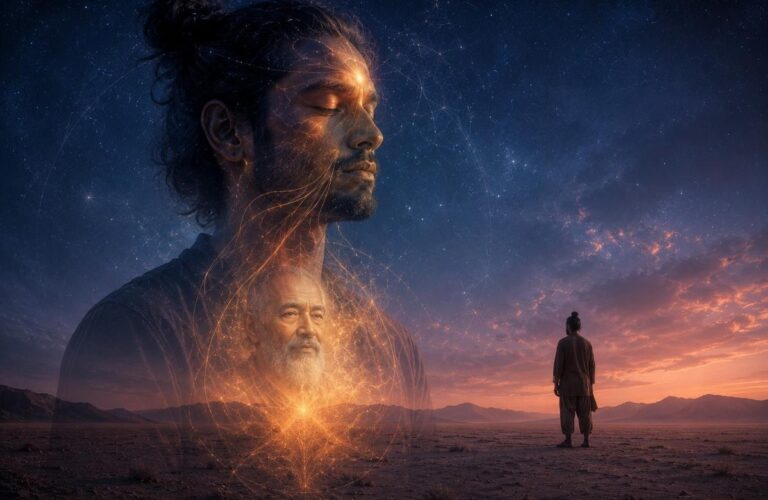
The Transformation is the difficult passage from recognition into integration. It is the space between the moment of awakening–when the world is seen through, when the divine spark is recognised, when the archonic deception is exposed–and the slow, often painful work of living with that recognition. It is not a single event but a process: the unwinding of old patterns, the confrontation with the shadow, the stabilisation of the nervous system, the navigation of spiritual crisis, and the eventual return to ordinary life carrying the recognition.
As a pillar of ZenithEye, The Transformation refuses the fantasy of instant enlightenment. It insists that gnosis is not an escape from the body, the emotions, or the marketplace, but a descent into them with new eyes. The subcategories–Integration and Grounding, Spiritual Emergence, Stages of Integration, Shadow Work, and The Ordinary Saint–map this territory with honesty and spiritual respect. They acknowledge that the path from recognition to embodiment is where most seekers falter, and where the real work begins.
The Transformation is the difficult passage from recognition into integration: awakening, shadow work, grounding, emergence, and return to ordinary life.
Table of Contents
- What Is The Transformation?
- The Moment of Recognition
- Shadow Work: The Unwelcome Guest
- Grounding and Integration
- Spiritual Emergence: When the System Overloads
- The Return to Ordinary Life
- The Ordinary Saint: Invisible Completion
- Why The Transformation Matters
- Frequently Asked Questions
- Further Reading

What Is The Transformation?
The Transformation is the fourth pillar of ZenithEye, positioned deliberately after The Living Thread, States of Knowing, and The Hidden Agreements. The sequence is intentional. First, the seeker encounters the historical survival of suppressed knowledge. Then, they explore the varieties of consciousness that make recognition possible. Then, they see the hidden structures that have shaped their perception. And then–inevitably–they must ask: what now? The Transformation is the answer to that question. It is the bridge between seeing and living, between the peak experience and the Monday morning, between the mystical vision and the grocery queue.
The pillar is built on a simple but unpopular truth: awakening is not the end. It is the beginning of a new set of demands. The Gnostic texts describe the descent of the saviour into the material realm not as a brief visit but as a full engagement. The bridal chamber is not an escape from the body but a transformation of it. The return is not a rejection of the world but a redemption of it. The Transformation takes these mythological patterns seriously and translates them into the practical psychology of contemporary life.
The Moment of Recognition
Recognition, gnosis in its most immediate form–is the sudden or gradual shift in which the underlying nature of reality becomes apparent. It may arrive through contemplative practice, through crisis, through reading an ancient text that speaks with unsettling directness, or through the simple collapse of a habitual assumption. The Nag Hammadi texts describe it as the removal of blindness, the awakening from sleep, the remembering of a forgotten identity. The Gospel of Truth calls it the recognition of what was formerly hidden.
But recognition is unstable. Without integration, it becomes a memory, a story, a credential. The seeker may collect peak experiences the way others collect stamps, each one impressive but none transforming the structure of daily life. The Transformation insists that recognition must be metabolised. It must be digested by the body, tested by relationship, and verified by time. Otherwise it remains a visitation, not a habitation.

Shadow Work: The Unwelcome Guest
One of the first consequences of recognition is the emergence of everything that has been suppressed. The shadow–in Jungian terms, the rejected aspects of the self–does not vanish in the light of awakening. It becomes visible. And visibility is not the same as integration. The Transformation’s subcategory of Shadow Work applies the depth psychology of Jung to the Gnostic journey, examining how the very illumination that reveals the divine spark also reveals the darkness that has obscured it.
The Gnostic texts speak of the hylic, psychic, and pneumatic natures–the three substances of humanity. The hylic nature is bound to matter and resistant to awakening. The psychic nature is capable of faith but not of direct knowledge. The pneumatic nature is the divine spark itself, capable of gnosis. In Jungian terms, these correspond roughly to the shadow, the ego, and the Self. The work of transformation is not to destroy the shadow or the ego but to bring them into relationship with the Self, so that the entire psyche becomes transparent to the light.
This work is not glamorous. It involves confronting the patterns of avoidance, the inherited trauma, the narcissistic wounds, and the spiritual inflation that disguises itself as humility. It requires the refusal of spiritual bypassing–the temptation to use transcendence as an excuse for emotional avoidance. The shadow must be met on its own terms, in the body, in the memory, in the uncomfortable conversation. Only then can it be redeemed rather than repressed.
Grounding and Integration
Integration and Grounding is the practical subcategory of The Transformation. It addresses the question of how to stabilise non-ordinary recognition in a body that still needs to eat, sleep, work, and relate. The Gnostic texts describe the soul’s descent into the foreign land, its stripping of garments, and its eventual return clothed in light. The Transformation reads this allegory as a description of the integration process: the soul must learn to wear its new condition in the world, not merely visit it in meditation.
Grounding involves somatic practices: breathwork, body scanning, nervous system regulation, and the reclamation of the flesh as a vehicle of knowledge rather than a prison of matter. It involves routine–the stabilising power of daily practice, community, and service. It involves the slow work of allowing the nervous system to recalibrate to a new baseline, rather than chasing the next peak. The Stages of Integration subcategory maps this as a three-phase process: immediate stabilisation after the experience, short-term working through of what has emerged, and long-term ripening into wisdom that can be transmitted.

Spiritual Emergence: When the System Overloads
Not all transformation is gradual. Sometimes the voltage is too high for the wiring. Spiritual Emergence is the subcategory that addresses the crisis side of awakening: the kundalini emergency, the dark night of the soul, the dissolution of identity that resembles psychosis, and the somatic overwhelm that sends the seeker to the emergency room. The pillar treats these experiences with both rigour and spiritual respect, refusing to pathologise the mystical and refusing to romanticise the pathological.
The Gnostic texts describe the archons as forces that resist the soul’s ascent, throwing every obstacle in its path. In contemporary terms, these obstacles include the destabilisation of the ego, the surfacing of repressed trauma, and the collapse of the social identity that once provided stability. The Transformation insists that spiritual emergency is not a failure but a phase–one that requires support, containment, and sometimes professional intervention. The goal is not to suppress the emergence but to navigate it, to distinguish between the dissolution that leads to integration and the dissolution that leads to fragmentation.
The subcategory provides guidance on when to seek help, when to rely on community, and when to trust the process. It honours the wisdom of the traditions–the Tibetan recognition of the bardo, the Christian discernment of spirits, the Sufi understanding of the states and stations–while insisting that ancient maps must be supplemented by modern knowledge of trauma and neurobiology.
The Return to Ordinary Life
The most radical demand of The Transformation is the return. After the vision, the retreat, the peak, the seeker must go back to the kitchen, the office, the commute, the argument with the neighbour. The Return to Ordinary Life subcategory examines this return not as a fall from grace but as the completion of the circle. The Nag Hammadi texts describe the saviour’s descent into the world as an act of love, not punishment. The bridal chamber is not a place to hide but a place from which to serve.
This return is where most spiritual projects fail. The seeker may attempt to live in the peak state, chasing the next retreat, the next teacher, the next technique. Or they may attempt to split their life into a spiritual compartment and a mundane compartment, performing holiness on weekends and resentment on weekdays. The Transformation insists on a third option: the integration of the recognition into the texture of ordinary life, so that the divine spark illuminates the spreadsheet, the dirty dish, and the difficult conversation with the same clarity it brought to the meditation cushion.

The Ordinary Saint: Invisible Completion
The capstone of The Transformation is the concept of The Ordinary Saint: the person who has done the work and requires no recognition. This is not the guru on the platform, the author on the tour, or the influencer with the curated enlightenment aesthetic. This is the person who has passed through recognition, shadow, crisis, and integration, and has returned to the world so thoroughly that they are invisible. They do not announce their status because they no longer experience themselves as having one.
The Nag Hammadi texts describe the children of the light as those who are indistinguishable from the children of the world, except for the quality of their presence. The Ordinary Saint is the completion of the Gnostic path not as escape but as embodiment. They have recognised the illusion, withdrawn consent from the hidden agreements, and chosen to remain in the world as a stabilising force. They do not convert others; they simply live in a way that makes conversion unnecessary. The Transformation is the path that leads to this invisibility, and it is the most difficult path of all because it offers no reward except the work itself.
Why The Transformation Matters
The Transformation matters because Gnosticism without integration is merely an intellectual posture. To read the Nag Hammadi texts, to recognise the archonic deception, to glimpse the pleroma, and then to live as if none of it happened–this is the tragedy that the pillar seeks to prevent. The ancient texts were not buried in the desert to be excavated by scholars; they were buried to survive, so that future readers might do what the original communities did: live the recognition, embody the knowledge, and transform the world by transforming themselves.
In an age of spiritual consumerism, where awakening is marketed as a product and integration is omitted from the brochure, The Transformation is a necessary corrective. It insists that the real work begins after the vision, that the shadow is not an enemy but a teacher, that the body is not a prison but a vehicle, and that the return to ordinary life is not a failure but the completion of the sacred circle. The pillar is not a comfort. It is a demand. And it is the demand that separates the tourist from the resident.
Frequently Asked Questions
What is The Transformation in ZenithEye?
The Transformation is the fourth pillar of ZenithEye, addressing the difficult passage from recognition into integration. It covers awakening, shadow work, grounding, spiritual emergence, and the return to ordinary life as a complete process of embodiment.
What are the subcategories of The Transformation?
The subcategories are Integration and Grounding, Spiritual Emergence, Stages of Integration, Shadow Work, and The Ordinary Saint. Each addresses a distinct phase of the journey from peak experience to embodied wisdom.
Is awakening the end of the spiritual path?
No. The Transformation insists that awakening is the beginning of a new set of demands. Without integration, recognition becomes a memory rather than a transformation. The real work lies in embodying the insight in daily life.
What is spiritual bypassing and why is it dangerous?
Spiritual bypassing is the use of spiritual ideas and practices to avoid dealing with emotional pain, unresolved trauma, or psychological wounds. It is dangerous because it creates a split between the peak experience and the grounded self, leading to inflation, dissociation, or collapse.
What is spiritual emergence and how is it different from psychosis?
Spiritual emergence is the crisis phase of awakening, when non-ordinary experiences overwhelm the ego structure. It differs from psychosis in that it occurs within a context of spiritual practice and can be navigated toward integration with proper support. However, the boundary is not always clear, and clinical discernment is essential.
What does The Ordinary Saint mean?
The Ordinary Saint is the concept of invisible completion–a person who has passed through recognition, shadow work, and integration, and has returned to ordinary life so thoroughly that they require no external validation. They carry the fire quietly through the marketplace.
How does The Transformation relate to the other ZenithEye pillars?
The Transformation follows The Living Thread, States of Knowing, and The Hidden Agreements. After encountering suppressed knowledge, exploring consciousness, and seeing hidden structures, the seeker must integrate these recognitions. The Transformation is the bridge between seeing and living.
Further Reading
Explore these ZenithEye articles to deepen your understanding of integration, shadow work, spiritual crisis, and the return to ordinary life:
- The Transformation: After Mystical Experience — The foundational pillar article examining the full arc from peak recognition to grounded embodiment.
- Shadow Work: Excavation and Integration — A detailed guide to confronting the rejected aspects of the self and redeeming them as fuel for transformation.
- Integration and Grounding: The Lightning Conductor — Practical techniques for stabilising non-ordinary experience in the body and in daily routine.
- Spiritual Emergency: Transformation or Crisis? — Navigating the difficult boundary between mystical emergence and psychological breakdown with clinical and contemplative tools.
- Stages of Integration: Immediate, Short-Term, and Long-Term — Mapping the three phases of incorporating non-ordinary experience into a coherent and sustainable life.
- Return to Ordinary Life After Awakening — The practical challenges of living with gnosis in the marketplace, the kitchen, and the workplace.
- The Ordinary Saint: Invisibility and Completion — Celebrating the radical concept of invisible completion–the person who has done the work and requires no recognition.
- Against Spiritual Bypassing: The Refusal to Feel — A critical examination of using transcendence as an excuse for emotional avoidance, and the correction of descent.
- The Gateless Gate: When Awakening Dissolves the World You Knew — Exploring the threshold moment of recognition and the dissolution of habitual reality.
- Embodiment Practices: Grounding Awakening — Somatic techniques for reclaiming the body as a vehicle of knowledge rather than a prison of matter.