
The Gateless Gate: When Awakening Dissolves the World You Knew
There is a particular loneliness that does not announce itself with drama. It arrives quietly, like the moment between waking and rising, when the room is familiar but something in the quality of light has shifted. You are still you. The people around you are still them. But the agreement has changed. The unspoken contract that once made the world coherent — the shared fears, the common hungers, the collective pretending — has begun to dissolve. And you are not sure when it happened, or what you are supposed to do now.
This is the moment the old maps stop working. Not because the territory has changed, but because the traveller has. You have not arrived at a new destination. You have simply stopped believing the old one was the only place worth going. And this is where the real tenderness begins. Because the people you love are still living inside the old map. They are not wrong. They are not behind. They are simply where they are. And you are no longer there with them.
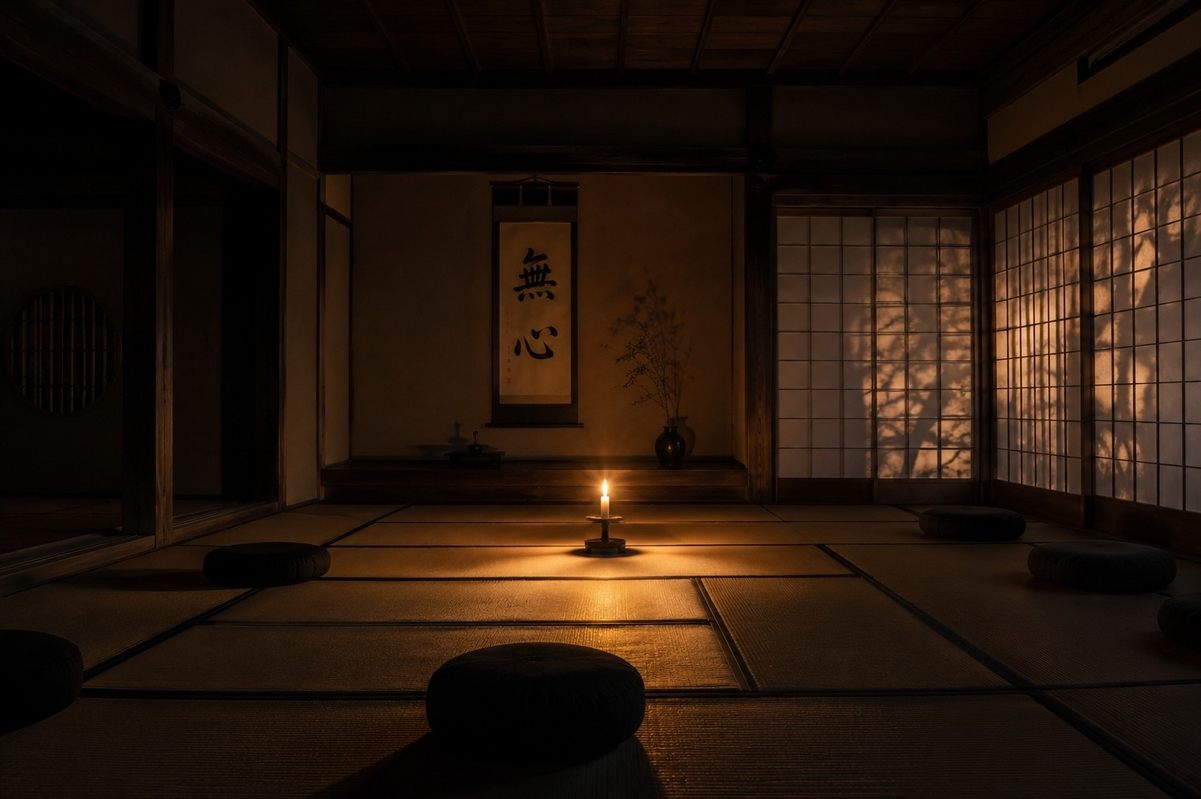
The Zen tradition calls this the Gateless Gate — the Wumenguan, compiled by Wumen Huikai in 1228. It is not a gate you open. It is the recognition that the barrier was never there. The great way has no gate, but there are a thousand paths. If you pass through the barrier, you can walk alone through the universe. What is rarely spoken of is what happens after the passage. The barrier dissolves, yes. But so does the world that once made sense. The recognition that the gate was never there is simultaneously the recognition that the life you lived was built upon a consensus you never consciously signed. You do not ascend to a higher realm. You simply stop pretending the basement is the whole house.
Table of Contents
- The River and the Ocean: When the Banks Fall Away
- The Two Densities: One World, Different Attention
- The Gravity of Consensus
- The Silence Between Notes
- The Dark Night Is the Passage
- The New Assembly
- Practical Navigation
- References and Sources
The River and the Ocean: When the Banks Fall Away
A river does not apologise when it meets the ocean. It has spent years carving its path through stone and soil, and now the banks that once held it are falling away. The water is not becoming something superior. It is simply becoming what it already was — salt, vast, unbounded. The fish that swam beside it for miles cannot follow. They are not wrong to stay. The river is not wrong to go. But the meeting place is tender. The fresh water does not know, at first, that it is becoming salt. It only knows that the old boundaries no longer apply, that the current has changed, that something vast is drawing it forward.
Awakening is like this. You do not trade one shell for a larger one. You find yourself between forms, where the old definitions no longer fit and the new ones have not yet formed. The beliefs, the alliances, the ambitions that once coloured your life — they fall away not because you reject them, but because you have outgrown their necessity. And in the interval, you are soft. The wind cuts deeper. The old protections are gone. You cannot rush this season. You cannot force the tide before the moon has turned.
The tenderness is not that you will be harmed by those who see your bareness. The tenderness is that you may panic and try to rebuild the old banks. You may pretend to be fresh water again so that the other rivers do not find you strange. This is the first test: can you meet the ocean without apologising for your salt?
The Two Densities: One World, Different Attention
It is not that there are two worlds. There is one reality, but there are different densities of attention with which to meet it. The conventional world — the world of mortgages, status, news cycles, and small talk — is not an illusion in the sense that it does not exist. It is an illusion in the sense that it is a stable attractor pattern, a self-reinforcing consensus that maintains itself through repetition and emotional entrainment. It is real the way a habit is real. It is solid the way a riverbed is solid: not because the water cannot change course, but because it has not yet encountered sufficient force to do so.
When your attention shifts density, the same room contains different information. The same conversation reveals different frequencies. You are not seeing a different world. You are seeing the same world without the filter of compulsory participation. And this changes everything.
The Gnostic texts speak of three natures. The hylic soul is clay — it perceives only matter and sensation. The psychic soul is water — it can reflect the light of meaning, but cannot generate it. The pneumatic soul is fire — it remembers, however dimly, that it is not from here. These are not moral hierarchies. They are frequencies. A radio does not judge the dial; it simply resonates at a particular setting. When you begin to resonate differently, the old stations sound static-ridden. Not because they have degraded, but because you are no longer tuned to them.

The Gravity of Consensus
The people around you will sense the shift before you announce it. They will not know what they are sensing, but they will feel it. Perhaps you no longer laugh at the same jokes. Perhaps you no longer fear the same threats. Perhaps you have stopped racing toward the same prizes. These small absences are noticed. They create a subtle drag, a gravity that pulls at you to resume your old orbit.
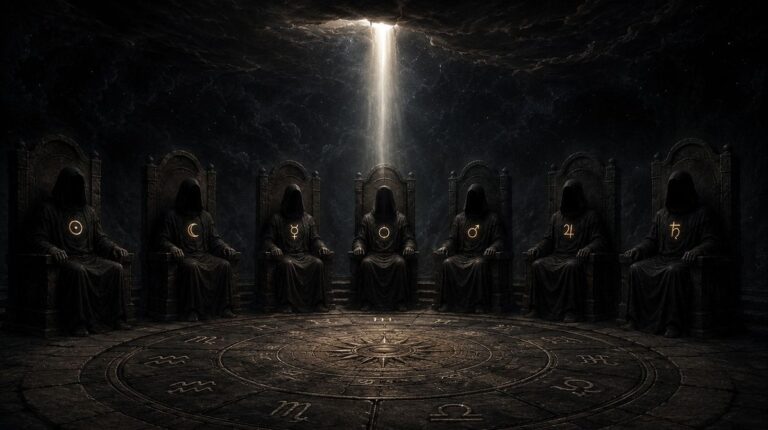
In the Apocryphon of John, the archons are not demons in the medieval sense. They are the automated maintenance protocols of a cosmos that feeds on unconsciousness. They do not hate the awakening soul. They simply notice when the food supply diminishes. When you stop supplying the energy of unquestioned conformity, the system adjusts. Friends may become distant. Family may become concerned. Colleagues may find you unreliable, strange, or sad.
They are not wrong to do so. From within their density, your behaviour looks like decline. You have lost your edge, your ambition, your grip. They are trying to save you from a mistake they cannot see is not a mistake. The gravity of consensus is not malevolent. It is automatic. And it is exhausting to resist.
This is why the Zen masters spoke of the hidden practice. You do not announce your awakening in the marketplace. You do not shake someone from a pleasant dream unless the house is on fire. You learn to move through the conventional world as the river moves through the land: present, unhidden, but no longer pretending to be a pond. You speak the language of the market when necessary. You pay your bills. You meet your obligations. But you do not invest your heart in the theatre. You are in the world, but not of it.
The Silence Between Notes
There is a skill to this bilingual existence, and it takes years to learn. The language of the conventional world is a language of acquisition, defence, and comparison. The language of recognition is a language of silence, presence, and surrender. They do not translate directly. You cannot tell your family over dinner that the self is a useful fiction and that the universe is far more consciousness-dependent than the solid external world they believe in. They will look at you as if you have lost your mind.
And in a sense, you have. You have lost the conventional mind, the socially conditioned mind, the mind that agreed to play along. You have not yet fully articulated what you have found in its place. So you remain silent. Or you speak in hints. Or you find the few who understand.
This silence is not cowardice. It is compassion. The Zen tradition warns against disturbing the dream. People are where they are. They are doing the best they can with the level of consciousness they possess. To force recognition upon someone who is not ready is not teaching; it is violence. The gateless gate cannot be shown to another. It can only be walked through. You can be present. You can be authentic. You can let your quality of attention communicate what your words cannot. But you cannot make them see.
The Dark Night Is the Passage
Between the old life and the new, there is an interval. The mystics have always called it the dark night of the soul. The Gnostic texts describe it as the desert road between the brothel and the bridal chamber — the road the soul must walk after she remembers her royal lineage and leaves the life of forgetting. It is dark because you have left behind the familiar landmarks but have not yet arrived at the new dispensation. You are in between. In limbo. In the wilderness.
During this time, you may feel utterly alone. You may wonder if you have made a terrible mistake. You may long for the days when life was simpler, when you fit in, when you did not question everything. This is natural. The river does not reach the ocean in a single afternoon. The clay between firings is soft and can be ruined. The silence between notes is what makes the music possible, but it is not yet music.
What you must understand is that this loneliness is not a sign that you have gone wrong. It is a sign that you are going right. Every hero in every myth must leave the village, venture into the unknown, and face the dragon alone before returning with the treasure. The treasure, in this case, is your authentic self — not the self that was constructed to please others, to fit in, to meet expectations. And you cannot claim this treasure while still clinging to the approval of those who represent the very conditioning you are outgrowing.

The New Assembly
But you do not remain alone forever. When you outgrow one level, when you shed one shell, you discover a new community. Not because you have become elite, but because you have become honest. The Gnostic texts speak of the elect — not as a chosen few in the arrogant sense, but as those who have undergone the same recognition. They are the ones who have also walked through the gateless gate. They do not need you to explain. They recognise the frequency.
These assemblies are rarely obvious. They do not advertise. They do not proselytise. You find them when your seeking becomes sincere enough, when your loneliness becomes acute enough. A chance conversation. A book that falls into your hands. A teacher who appears when you need them. The key is not to cling desperately to the old relationships out of fear, but also not to cut ties prematurely out of spiritual pride. Maintain what connections you can maintain authentically. Honour your roots. But do not make yourself small to make others comfortable.
And sometimes, miraculously, the people around you grow too. Your own transformation becomes a catalyst. They see something in you — a peace, a clarity, a freedom — and they want it for themselves. They start asking questions. They start opening up. The relationship transforms and deepens. But you cannot force this. You can only be authentic. You can only be the embodiment of what you have discovered. And you must trust that those who are ready will recognise it. The rest will fall away, and you must let them go with love and gratitude for what they gave you.
Practical Navigation
This is not merely a philosophical matter. It is a somatic one. The nervous system that once felt safe in conformity now registers the liminal state as threat. You must learn to ground yourself in the body while the mind reorients.
First, establish a daily practice that does not depend on community. Zazen, contemplation, breathwork, walking meditation — something that roots you in the present moment regardless of who understands you. The ordinary mind is the way. The gateless gate is not a special state. It is the recognition that your ordinary awareness, right now, is already sufficient.
Second, tend to your nervous system. The liminal period is physiologically stressful. Sleep, movement, nourishment, and silence are not luxuries. They are the soil in which the new root system grows. The river survives its meeting with the ocean because it has already done the work of the journey. You must do the same. Withdraw your energy from the performance. Invest it in the ground.
Third, practice the ethics of silence. Do not use your recognition as a weapon. Do not make others feel small for not seeing what you see. The pneumatic nature is not superior; it is simply different. Arrogance is the surest sign that you have not passed through the gate at all, but have merely built a new ego on the other side.
The great way has no gate, but there are a thousand paths. If you pass through the barrier, you can walk alone through the universe.
Wumen Huikai, The Gateless Gate (1228)
The gate was never closed. The world was never solid. The self you outgrew was never who you were. You are not leaving your life; you are simply no longer pretending.
What you gain is yourself. Not the constructed self, but the one that was always present beneath the current, beneath the banks, beneath the agreement. And once you have tasted that freedom, you realise that you were never really losing anything real. You were only losing illusions, masks, false identities. The real connections, the real love, the real community — these remain, and they appear deeper and truer than before.
If you find yourself between the river and the ocean, know that the salt is not a punishment. It is the natural consequence of having travelled far enough. Trust the current. Trust the depth. Trust that the gateless gate has already opened, and that you are walking through it exactly as you are.
Frequently Asked Questions
What is the Gateless Gate in Zen Buddhism?
The Gateless Gate, or Wumenguan, is a collection of 48 Zen koans compiled by Wumen Huikai in 1228. It teaches that the barrier to awakening is not external — there is no gate to pass through. The gate is the recognition that the obstacle was never there.
Why does spiritual awakening feel so isolating?
Awakening shifts your density of attention. You no longer resonate with the consensus reality that once felt like home. Those around you sense the change but cannot articulate it. This creates a natural gravity that pulls you back toward conformity, making the liminal space feel lonely.
What are the three natures in Gnosticism?
The Nag Hammadi texts describe three natures: hylic (matter-bound), psychic (soul-reflective), and pneumatic (spirit-awakened). These are not moral ranks but frequencies of being. The pneumatic soul remembers it is not from here, which naturally creates distance from purely conventional concerns.
How long does the dark night of the soul last?
There is no fixed timeline. The dark night is the interval between the death of the old self and the emergence of the new. Like a river meeting the ocean, you cannot force the current. The duration depends on how willing you are to remain honest during the transition.
Can you go back to your old life after awakening?
You cannot unsee what you have seen. The self that fit into the old framework has dissolved. You can participate in conventional life, but you cannot genuinely return to the unconsciousness that once felt like safety. The gate only opens one way.
How do you maintain relationships after outgrowing your social circle?
Maintain what connections you can maintain authentically. Do not make yourself small to comfort others. Do not use your recognition as a weapon. Be present, be kind, and trust that those who are ready to grow will recognise the frequency. Let the rest fall away with gratitude.
What is a liminal space in spiritual transformation?
Liminal comes from the Latin for threshold. It is the space between what you were and what you are becoming. In this space, the old rules no longer apply and the new ones have not yet formed. It is uncomfortable, necessary, and the only place where genuine transformation occurs.
Further Reading
Explore these ZenithEye articles to deepen your understanding of the liminal journey, integration, and the Gnostic path:
- The Transformation After Mystical Experience — Navigating the return to ordinary life after a peak awakening experience.
- Dark Night: Depression or Transformation? — Discerning the difference between clinical depression and the dark night of the soul.
- Return to Ordinary Life After Awakening — How to live in the world without losing what you have seen.
- Community Integration: Solitary vs. Supported — Finding the balance between lone practice and authentic community.
- Integration Practices After Peak Experience — Somatic and contemplative tools for grounding transformation.
- Stages of Integration: Immediate, Short-Term, Long-Term — A map of the integration journey from first recognition to embodied wisdom.
- Finding the Other: Recognition Without Community — How to sustain your practice when you have not yet found your tribe.
- The Ordinary Saint: Invisibility and Completion — The ZenithEye perspective on mature spirituality hidden in plain sight.
- Apocryphon of John: Gnostic Creation and the Three Natures — The foundational Nag Hammadi text on hylic, psychic, and pneumatic souls.
- The Nag Hammadi Library: Complete Reader’s Guide — The essential map for navigating all 46 tractates and their themes.
References and Sources
The following sources support the theological, historical, and practical claims made in this article.
Primary Sources and Critical Editions
- Wumen Huikai. (1228). The Gateless Gate (Wumenguan). Compiled at Longxiang Monastery, Fuzhou. Translated in Taisho Tripitaka Vol. XLVIII.
- Dogen. (1231). Genjokoan. In Shobogenzo. [Zen text on the total manifestation of awakening in ordinary activity].
- Robinson, J. M. (Ed.). (1988). The Nag Hammadi Library in English (3rd ed.). Brill. [Critical edition of the Coptic Gnostic codices].
Scholarly Monographs and Comparative Studies
- Layton, B. (1987). The Gnostic Scriptures: A New Translation with Annotations. Doubleday. [Standard translation and commentary on Valentinian and Sethian texts].
- Cleary, T. (Trans.). (1993). No Barrier: Unlocking the Zen Koan. North Point Press. [Translation and commentary on the Wumenguan].
- Ferguson, A. (2011). Zen’s Chinese Heritage: The Masters and Their Teachings. Wisdom Publications. [Biographical and historical context for Wumen Huikai and Zhaozhou].
Contemporary Practice and Psychology
- Turner, V. W. (1967). The Forest of Symbols: Aspects of Ndembu Ritual. Cornell University Press. [Foundational anthropological study of liminality and threshold states].
- Wellwood, J. (2000). Toward a Psychology of Awakening: Buddhism, Psychotherapy, and the Path of Personal and Spiritual Transformation. Shambhala. [Clinical and contemplative integration of spiritual emergence].
Safety Notice: This article explores the psychological and social challenges of spiritual transformation. It does not constitute medical, psychological, or spiritual advice. If you are experiencing severe isolation, depression, or suicidal thoughts, please contact professional emergency services or a trauma-informed therapist. Spiritual practice complements but does not replace clinical mental health treatment.