
What Is an Aeon? Divine Emanation and the Gnostic Fullness
The Gnostic cosmos is not empty. Above the material world of stars and suffering lies the Pleroma–the Fullness–a realm so complete that no shadow falls within it. Yet the Pleroma is not a solitary void. It is populated. Its inhabitants are the Aeons: divine emanations, eternal powers, and living principles that flow from the unknowable source like light from a sun that never sets. To understand Gnosticism, one must understand these beings–not as gods in the pagan sense, but as the architecture of divinity itself, the thoughts of the eternal Mind made manifest.
An aeon (Greek: aion) is, at its simplest, a divine emanation. In the Nag Hammadi Library and related texts, aeons are the primary residents of the Pleroma, the highest realm of existence. They are not created by a distant deity in the manner of conventional cosmogony; rather, they emanate from the source as ripples emanate from a stone dropped in still water–continuous, co-substantial, and eternal. Each aeon represents a facet of divine reality: Mind, Truth, Life, Word, Wisdom and countless others. Together, they constitute the complete expression of the Godhead, the fullness that fills all things while remaining one.
Table of Contents
- From Time to Eternity: Etymology and Ancient Context
- The Pleroma’s Population: Aeons as Divine Emanations
- The Valentinian System: Thirty Aeons in Fifteen Syzygies
- The Sethian Vision: Barbelo and the Four Luminaries
- Syzygy: The Sacred Union of Opposites
- Aeons Beyond Gnosticism
- The Aeon and the Soul’s Return
- Frequently Asked Questions
- Further Reading
From Time to Eternity: Etymology and Ancient Context
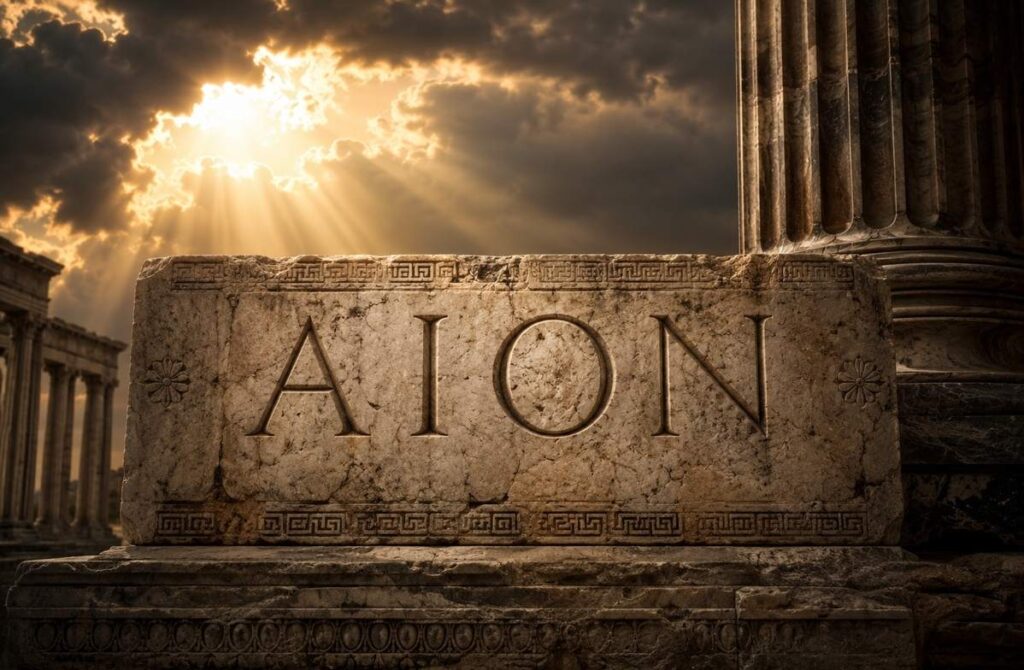
The Greek word aion originally meant a long span of time, an age, or eternity itself. In the Hellenistic world, particularly in Alexandria, infinite Time was venerated as a deity under the name Aion. The term also carried spatial connotations–it could mean a world or a realm. Early Christian texts speak of God as the King of the Aeons and the Creator of the aeons, language that Gnostic thinkers readily adapted. For the Gnostics, the aeon was not merely a measure of duration but a mode of divine existence: an eternal, self-sustaining principle that was simultaneously a being, a place, a person, and a power.
This semantic richness explains why the Gospel of Truth can describe aeons as “spaces” that are emanations of the Father. The aeons are aspects of the ineffable God, but they are also forms of time and space–the coordinates of eternity. In this, Gnostic thought absorbed influences from Middle Platonism, where divine hypostases mediate between the One and the many, and from Jewish wisdom literature, where divine attributes like Wisdom and Word take on quasi-personal roles. The aeon thus arrives in Gnosticism already layered with meaning: it is the age that never ends, the world that is not material, and the power that structures reality from within.
The Pleroma’s Population: Aeons as Divine Emanations
If the Pleroma is the divine fullness, the aeons are its contents–not as foreign objects placed within a container, but as the container’s own self-expression. The aeons are not created ex nihilo; they are emanated. This distinction is crucial. Creation implies separation: a maker and a made, a superior and an inferior. Emanation implies continuity: the aeons are of the same substance as the source, like rays of light that remain light even as they extend from the sun.
Each aeon embodies a specific divine quality. Nous is Mind, the principle of consciousness. Aletheia is Truth, the unveiled reality. Logos is Word, the creative utterance. Zoe is Life, the animating force. Anthropos is the archetypal Human. Ecclesia is the spiritual Assembly. These are not abstract concepts frozen in philosophical ether; in the Gnostic imagination, they are living realities that know one another, rejoice in one another, and together form a harmonious community of light. The Pleroma is thus not a monarchical court with a solitary king, but a symphony of divine attributes, each instrument necessary for the whole.
The Totalities which exist are in the Father who exists, from whom they have come forth, and to whom they will return… The Pleroma is in the Father, and the Father is in the Pleroma.
Gospel of Truth, NHC I,3
The spatial aspect of the aeons is equally important. In the Apocryphon of John, the race of Seth and other Gnostics are placed in specific aeons. The aeons are not merely theological ideas; they are destinations, dwelling places, and stations of spiritual citizenship. To exist within an aeon is to participate in a particular mode of divine life, to inhabit a quality of eternity rather than a location in space.
The Valentinian System: Thirty Aeons in Fifteen Syzygies
The most systematic account of the aeons comes from Valentinian Gnosticism, the school founded by the second-century teacher Valentinus. According to patristic reports by Irenaeus and Hippolytus–and partially confirmed by the Tripartite Tractate (NHC I,5) in the Nag Hammadi Library–the Valentinian Pleroma contains thirty aeons arranged in fifteen pairs called syzygies.
The structure unfolds in three mathematical groups:
The Ogdoad (Eight Aeons)
From the primal Father Bythos (Depth) and his consort Sige (Silence) emerge four syzygies: Nous (Mind) and Aletheia (Truth); Logos (Word) and Zoe (Life); Anthropos (Human) and Ecclesia (Church). These eight constitute the innermost divine circle, the foundational attributes from which all further emanation proceeds.
The Decad (Ten Aeons)
Emanating from Logos and Zoe, these five syzygies include pairs such as Bythios and Mixis, Ageios and Henosis, and others representing unity, eternity, and the deeper harmonies of divine existence. They expand the Pleroma’s structure into the middle realm of its architecture.
The Dodecad (Twelve Aeons)
Emanating from Anthropos and Ecclesia, these six syzygies include Parakletos and Pistis, Elpis and Agape, and culminate in Theletos (Will) and Sophia (Wisdom). Sophia, the youngest and outermost aeon, stands at the boundary of the Pleroma, her position foreshadowing the crisis that will introduce deficiency into the cosmos.
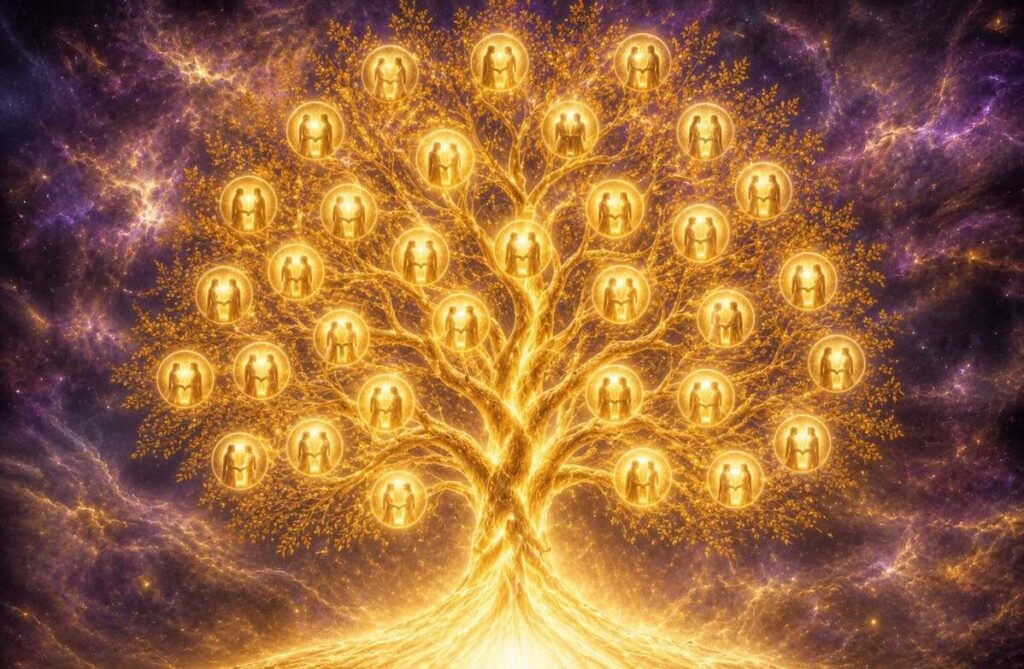
The number thirty held sacred significance: 8 + 10 + 12 = 30, a perfect and complete number in Pythagorean mathematics. The thirty aeons represent the totality of divine attributes, the complete self-knowledge of the Father. Only Nous, the Only-Begotten, knows the Father directly; the other aeons know him through their consorts and through the aeons above them. Yet the Tripartite Tractate complicates this tidy arithmetic. Scholar Einar Thomassen has shown that this text describes its aeons as “numberless and nameless,” using embryological rather than arithmetical imagery: the Pleroma forms gradually within the Father until the aeons are born as autonomous beings. This reminds us that Valentinianism was a school, not a dogmatic system–a shared orientation with room for individual teachers to develop different mappings of the divine.
The Sethian Vision: Barbelo and the Four Luminaries
Sethian Gnosticism, as preserved in the Apocryphon of John and related texts, offers a different but structurally related vision. Here the Pleroma emanates from the Monad through Barbelo, the First Thought and perfect Aeon. The Invisible Spirit and Barbelo together produce the Only-Begotten Autogenes Christ, and from them emerge the Four Luminaries–Harmozel, Oroiael, Daveithai, and Eleleth–each an aeon or realm with its own attendant powers.
Each Luminary creates three additional aeons. Harmozel emanates Grace, Truth, and Form. Oroiael emanates Conception, Perception, and Memory. Daveithai emanates Understanding, Love, and Idea. Eleleth emanates Perfection, Peace, and Wisdom–the last being Sophia, whose unauthorised desire to know the transcendent Father produces the catastrophe of the material world. In the Sethian system, the aeons are not arranged in the strict mathematical hierarchy of the Valentinians; instead, they radiate outward in luminous generations, each level slightly more distant from the source yet still bathed in its light.
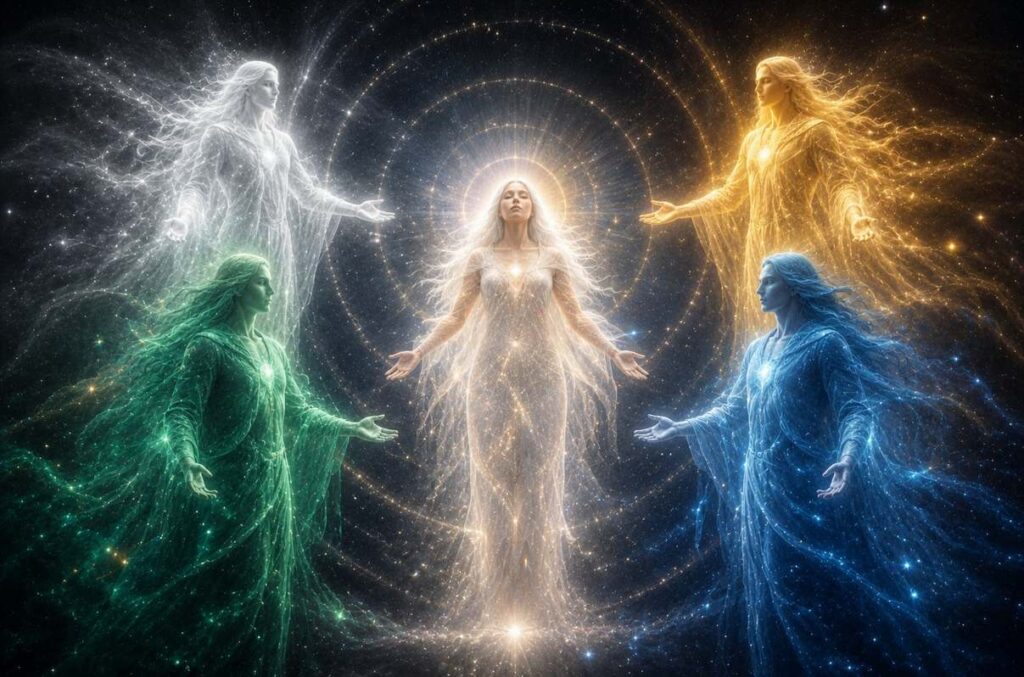
The Sethian aeonic structure emphasises triadic emanation: Father-Mother-Child, followed by Four Luminaries and their Twelve Powers. This creates a total of twenty-one primary aeonic entities before the fall of Sophia, a number less celebrated than the Valentinian thirty but equally systematic in its own logic. The Four Luminaries function as guardians and administrators of the divine light, each overseeing a quadrant of the Pleroma’s architecture.
Syzygy: The Sacred Union of Opposites
A defining feature of aeonic cosmology is the syzygy: the paired union of masculine and feminine aeons. Divine reality, in this view, is fundamentally relational. No single aeon acts alone; each possesses a consort, and generation occurs only through their harmonious union. The syzygy principle reflects a profound intuition: wholeness requires the union of opposites, and divinity is not a solitary masculine monarch but a dynamic interplay of receptive and active principles.
Sophia’s fall, in both Valentinian and Sethian accounts, is often linked to a violation of this principle. When she attempts to know the Father without her consort Theletos–when she acts in isolation rather than in union–she produces an illegitimate emanation: the Demiurge, the flawed craftsman of matter. The syzygy is thus not merely a cosmological detail but an ethical and metaphysical law: separation from one’s counterpart leads to deficiency, while union restores fullness. The highest Valentinian sacrament, the nymphon or Bridal Chamber, is the earthly ritual echo of this aeonic union, restoring the androgynous wholeness that existed before the fall into separated existence.
Aeons Beyond Gnosticism
The concept of the aeon was not exclusive to Gnosticism. In Neoplatonism, Plotinus spoke of the Intelligible Realm as populated by divine intellects that emanate from the One, each contemplating the whole while remaining distinct. In early Christianity, the New Testament calls God the King of the Aeons and speaks of Christ as the one through whom the aeons were made. The Gospel of John and the letters of Paul use language that blurs the boundary between divine attributes and divine persons–language that Gnostic thinkers pushed to its logical conclusion.
Even outside the Christian orbit, the Hellenistic cult of Aion in Alexandria venerated infinite Time as a supreme deity, often depicted as a youth with a lion’s head and a serpent coiled around his body. This figure, syncretised with Phanes and Zervan, suggests that the Gnostic aeon was part of a broader Mediterranean conversation about time, eternity, and the personification of cosmic principles. The Gnostics did not invent the aeon; they interiorised it, transforming a public cult of cosmic time into a private cartography of divine attributes.
The Aeon and the Soul’s Return
For the Gnostic initiate, the aeons are not merely cosmological furniture. They are the stations of the soul’s return. The ascent literature of the Nag Hammadi Library–texts like Zostrianos and Allogenes–describes the soul’s journey through the aeonic realms, encountering each divine power and learning its nature. To pass through the aeons is to undergo a progressive unification with the divine attributes, shedding the accretions of matter and soul until only spirit remains.
The Gospel of Truth speaks of the aeons as spaces into which the wandering soul is welcomed, where deficiency is filled and error is dissolved. In this sense, the aeons are both the geography of heaven and the curriculum of gnosis: each one teaches a necessary lesson, each one bestows a necessary grace. The soul does not merely travel to the Pleroma; it becomes Pleroma, recognising that the divine attributes it encounters are not external gods but its own forgotten nature. The aeons are the mirror in which the exile remembers home.
Frequently Asked Questions
What is an aeon in Gnosticism?
An aeon is a divine emanation, power, or principle that inhabits the Pleroma, the realm of divine fullness in Gnostic cosmology. Aeons are not created by a distant god but flow continuously from the unknowable source as co-substantial expressions of divinity, embodying attributes such as Mind, Truth, Life, and Wisdom.
How many aeons are in the Valentinian Pleroma?
The classical Valentinian system describes thirty aeons arranged in fifteen male-female pairs called syzygies. These are organised into three groups: the Ogdoad (eight aeons), the Decad (ten aeons), and the Dodecad (twelve aeons), representing the complete mathematical fullness of divine reality.
What is a syzygy in Gnostic cosmology?
A syzygy is a paired union of masculine and feminine aeons within the Pleroma. Divine reality is understood as fundamentally relational, and each aeon possesses a consort. Generation and harmony occur only through their union, while separation or solitary action leads to deficiency and error.
Are Gnostic aeons the same as gods?
No. Aeons are not independent gods in the polytheistic sense. They are aspects, attributes, or hypostases of the one divine source–like rays of light that remain light even as they extend from the sun. They are living divine realities, but they are co-substantial with the Father rather than separate creations.
What is the difference between Sethian and Valentinian aeons?
Valentinianism organises the Pleroma into thirty aeons in fifteen syzygies, emphasising mathematical perfection and ordered hierarchy. Sethian texts such as the Apocryphon of John describe aeons radiating from the Monad through Barbelo and the Autogenes Christ, featuring the Four Luminaries (Harmozel, Oroiael, Daveithai, Eleleth) and their attendant powers in a more organic, luminous hierarchy.
What does the Greek word aion mean?
The Greek word aion originally meant a long span of time, an age, or eternity. In the Hellenistic world, it was venerated as a deity of infinite Time, especially in Alexandria. Gnostic thinkers adapted the term to describe eternal divine principles that are simultaneously beings, powers, and realms within the Pleroma.
Do aeons appear in the Bible?
The New Testament refers to God as the King of the Aeons and speaks of Christ as the one through whom the aeons were made. While biblical usage is less systematic than Gnostic cosmology, the language of divine attributes and eternal realms provided fertile ground for the Gnostic development of aeonic theology.
Further Reading
Explore these related articles from the ZenithEye archive to deepen your understanding of Gnostic cosmology and the divine architecture of the Pleroma:
- What Is the Pleroma? Divine Fullness in Gnostic Cosmology — The complete guide to the realm the aeons inhabit, exploring the geography of divine fullness across Sethian and Valentinian systems.
- What Is the Kenoma? Emptiness, Deficiency, and the Gnostic Void — The counter-realm to the Pleroma, where the deficiency produced by aeonic error becomes the condition of material existence.
- What Is Sophia? Wisdom, Fall, and Redemption in Gnostic Myth — The youngest aeon whose overreaching desire introduces the catastrophe that generates the material cosmos.
- What Is the Demiurge? The Craftsman of Matter and the Architect of Form — The flawed offspring of Sophia’s solitary act, the ignorant creator who fashions the material world without knowledge of the aeons above.
- What Are Archons? The Ruling Powers of the Gnostic Cosmos — The administrators of the lower world who obstruct the soul’s recognition of its aeonic origin and destiny.
- Valentinian Gnosticism: The Most Systematic School of the Pleroma — A deep exploration of the school that mapped the Pleroma into thirty aeons and developed the most elaborate sacramental theology of the Gnostic traditions.
- Apocryphon of John: The Foundational Text of Sethian Gnosticism — The primary source for the Sethian aeonic hierarchy, from Barbelo and the Autogenes Christ to the Four Luminaries and their attendant powers.
- Tripartite Tractate: The Complete Valentinian System — The only fully preserved systematic Valentinian treatise in the Nag Hammadi Library, offering a variant vision of the aeons as numberless and nameless.
- Gospel of Truth: Poetics of Recognition — A Valentinian meditation on the Pleroma and its aeons, describing the spaces of divine fullness into which the wandering soul returns.
- Gnostic Technical Glossary: Key Terms from the Nag Hammadi Library — A comprehensive reference for aeons, syzygies, and other essential terminology used throughout the Gnostic scriptures.