What Is Sophia? Wisdom, Fall, and Redemption in Gnostic Myth
Long before she became a name in Gnostic cosmology, Sophia was simply the Greek word for wisdom. Yet across two millennia of theological imagination, philosophy, and poetry, she grew into something far more than an abstract virtue. She became a person, a presence, a tragic heroine, and a redeemer. In Jewish wisdom literature she stands beside God at creation; in Gnostic myth she falls from the divine fullness and gives birth to the flawed cosmos; in modern thought she has become a symbol for the repressed feminine in consciousness, the intelligence of the living earth, and the spark of insight that wakes a sleeper from a dream.
This glossary entry traces Sophia from her Hebrew roots through her dramatic Gnostic transformations, exploring how a single word for wisdom became one of the most emotionally compelling figures in esoteric tradition. Whether you encounter her in the poetry of Proverbs, the Coptic pages of the Nag Hammadi Library, or the analytical psychology of Carl Jung, Sophia remains the voice that calls the seeker toward recognition, wholeness, and return.
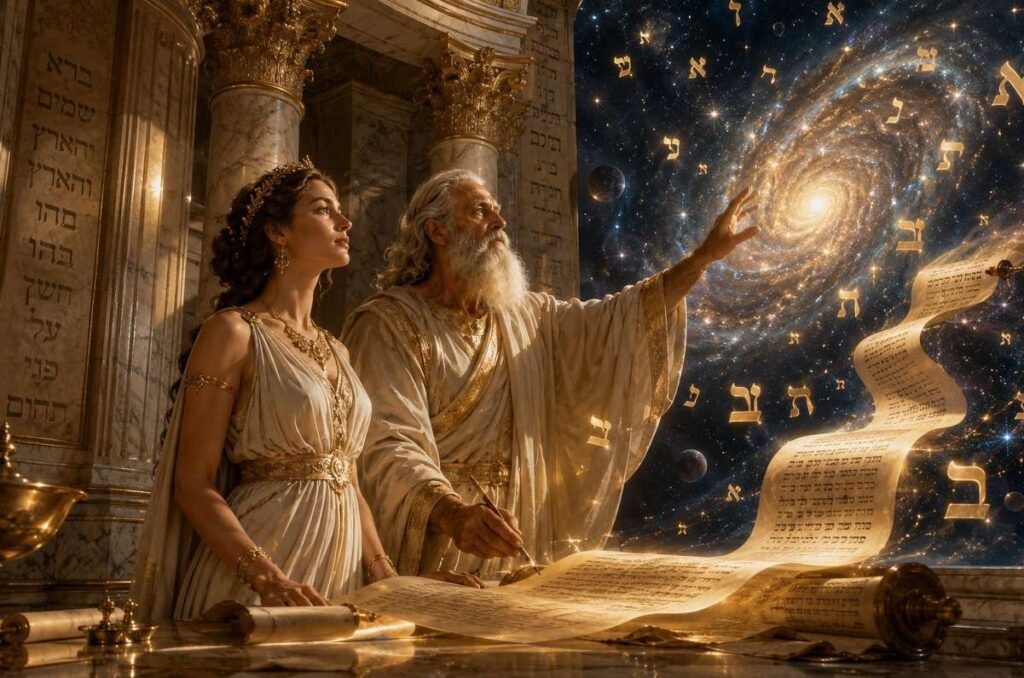
Table of Contents
- The Name and Ancient Roots: From Hokmah to Philosophia
- Sophia in the Pleroma: The Aeon of Divine Wisdom
- The Fall and Its Many Faces: Sethian and Valentinian Stories
- The Redemption of Sophia: Christ, the Spark, and the Soul’s Return
- Modern Interpretations: Jung, Feminist Theology, and the Living Earth
- Why Sophia Still Calls to Us
The Name and Ancient Roots: From Hokmah to Philosophia
The Greek Sophia (σοφία) derives from sophos, meaning wise, skilful, or learned. In classical usage it could describe practical craftsmanship, political shrewdness, or philosophical insight. But the deeper lineage of Sophia as a divine personification comes from the Hebrew Bible, where the term Hokmah (חָכְמָה) — wisdom — is dramatically personified in the book of Proverbs. In Proverbs 8:22-31, Wisdom speaks in the first person as a feminine presence who was brought forth before the earth was shaped, who stood beside God as a master worker, and who delights in the inhabited world. She is not a separate goddess, yet she is more than a metaphor: she is the breath of divine intelligence made audible.
This personification deepened in the deuterocanonical Wisdom of Solomon and the book of Sirach (Ecclesiasticus), where Sophia is described as a spirit that is intelligent, holy, unique, manifold, and all-powerful. She is the fashioner and mother of all good things, a tree of life to those who lay hold of her. In these texts, the boundary between divine attribute and divine agent becomes porous. Wisdom is not merely something God possesses; she is the mode through which God creates, governs, and redeems. This Jewish wisdom tradition provided the essential vocabulary and theological architecture that Gnostic teachers would later adapt, intensify, and dramatise.
Philo of Alexandria, the first-century Jewish philosopher, played a crucial mediating role. In his effort to harmonise the Hebrew scriptures with Platonism, Philo treated Sophia as a cosmic principle parallel to the Stoic Logos — the rational ordering power of the universe. For Philo, Sophia was both the source of the intelligible world and the pattern according to which the material world was formed. This philosophical personification prepared the ground for Gnostic systems in which Sophia would become not merely a metaphor or principle, but an actual Aeon — a divine emanation with will, longing, and the capacity for both error and redemption.
Sophia in the Pleroma: The Aeon of Divine Wisdom
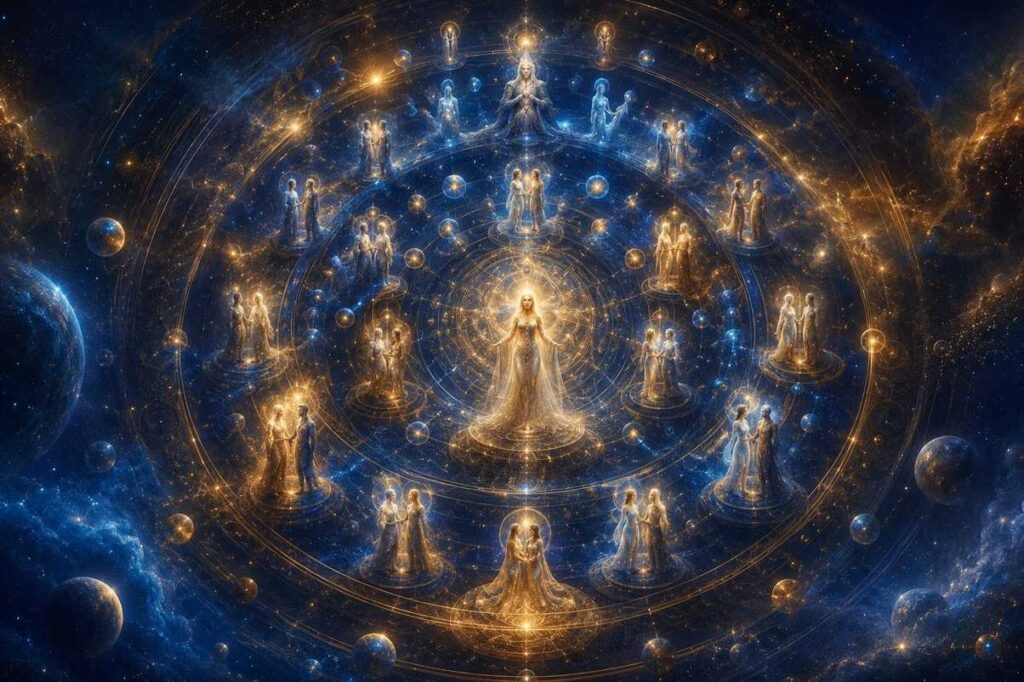
In Gnostic cosmology, the ultimate divine source — called the Father, the Monad, or the Invisible Spirit — is beyond all naming, gender, and limitation. From this source flows a series of emanations known as Aeons, often arranged in male-female pairs called syzygies. Together these Aeons constitute the Pleroma, the divine fullness, a realm of perfect unity, knowledge, and light. Sophia is typically the youngest or lowest of these Aeons, the last emanation before the boundary that separates the perfect realm from the chaos below.
Her placement is significant. As the Aeon closest to the margin of the Pleroma, Sophia is the one most drawn toward what lies beyond the known. In Valentinian systems, she is the thirtieth Aeon, paired with her consort Theletos (Will or Desire). In Sethian texts, she is associated with the divine Mother Barbelo or stands as an independent power whose actions initiate the transition from immaterial perfection to material manifestation. In every system, her defining quality is not mere knowledge but the active, desiring pursuit of wisdom — a pursuit so intense that it becomes the engine of cosmic history.
It is important to understand that Sophia’s fall is not a moral failure in the human sense. She does not sin out of malice or laziness. Rather, her fall is the consequence of an excess of love and curiosity — a desire to comprehend the incomprehensible, to know the unknowable Father directly, without the mediating structure of the Pleroma’s ordered pairs. In this respect, Sophia’s story is the first myth of intellectual ambition, of the spirit that reaches too far and in reaching disrupts the harmony it sought to embrace. The Gnostics did not despise her for this; they recognised in her fall the mirror of their own condition, and in her redemption the promise of their own return.

The Fall and Its Many Faces: Sethian and Valentinian Stories
The Gnostic tradition does not offer a single, uniform account of Sophia’s fall. Instead, it presents a family of related myths, each shaped by the theological school that told it. The two most influential versions are the Sethian narrative, preserved in texts such as the Apocryphon of John, and the Valentinian narrative, reconstructed from the fragments and refutations preserved by Irenaeus and others.
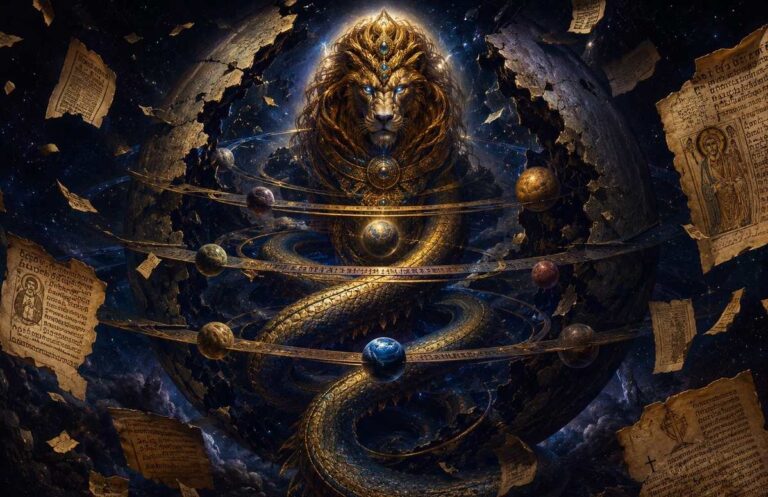
In the Sethian version, Sophia acts without the consent of her syzygy or the Spirit. She desires to bring forth a likeness from herself, to create as the Father creates, but she does so in isolation. The result is not a perfect Aeon but a miscarriage — a malformed, chaotic being who becomes Yaldabaoth, the Demiurge. Horrified by what she has produced, Sophia repents and seeks the assistance of the higher Aeons. They establish a boundary, the Horos, to prevent the chaos from infecting the Pleroma, and Sophia is restored to her proper place — though her offspring remains below, shaping the material world in ignorance of its true origin. In this telling, Sophia is both mother of the flawed cosmos and the first penitent; her grief and longing become the emotional substrate of the lower world.
The Valentinian version is more psychologically subtle and cosmologically elaborate. Here, Sophia — also called Achamoth, a term possibly derived from the Hebrew Hokmah — separates herself from her consort Theletos through an audacious longing for immediate communion with the Father. Her passion and suffering produce a formless substance, an ektrōma or untimely birth, which is cast outside the Pleroma. This substance becomes the raw material of the material universe. From it, the Demiurge is formed, not as a monster but as a necessary administrator — a deputy who organises matter without understanding its spiritual source.
Achamoth herself is not simply cast out and forgotten. She occupies an intermediate realm called the Ogdoad or the Place of the Midst, situated above the seven planetary heavens but below the Pleroma. There she undergoes a process of repentance and transformation. According to Valentinian teaching, Christ descends from the Pleroma to bring her the morphōsis kata gnōsin — the formation according to knowledge — and later the Soter (Saviour) comes to unite her with her proper syzygy. In this system, Sophia’s fall is not a permanent catastrophe but a necessary phase in the education of divine wisdom. The material world becomes a kind of therapeutic school where the sparks of light, including the spiritual element in human souls, are purified and prepared for return.
Some texts give Sophia the epithet Prunikos, a Greek word meaning “licentious” or “wanton.” This name was used by hostile critics and occasionally within the texts themselves to describe the aspect of Sophia that acted without proper union or consent. Modern scholars debate whether this term reflects an ancient tension between ascetic and more liberated readings of the myth, or whether it is simply polemical caricature. What remains clear is that Sophia’s fall, however named, is the mythic event that explains how perfection gave rise to imperfection, and how the divine became entangled with matter.
The Redemption of Sophia: Christ, the Spark, and the Soul’s Return
If Sophia’s fall explains the origin of the material world, her redemption explains its purpose. In Gnostic soteriology, the drama of salvation is essentially the drama of Sophia’s restoration, played out in miniature within every human soul that carries a spark of her light. The Pistis Sophia, a text discovered in 1773 and not part of the Nag Hammadi collection, devotes hundreds of pages to this theme. Here, after her fall, Sophia wanders through the chaos, weeping and repenting, until Christ descends through the aeons, teaches her the mysteries, and leads her back toward the light. The text is structured as a series of questions and answers between the resurrected Christ and his disciples, with Sophia’s story serving as the template for the soul’s journey.
In the Valentinian system, the redemption of Achamoth is intimately connected with the redemption of the pneumatikoi — the spiritual humans who carry the divine seed. Achamoth, having received formation from Christ, becomes the mother of the spiritual church. She produces the pneumatic seed within the lower world, and through the sacraments of the Valentinian community — baptism, chrism, eucharist, redemption, and the bridal chamber — that seed is awakened, nourished, and prepared for its return to the Pleroma. The end of history is thus the reintegration of Sophia and her children into the divine fullness, a restoration called apokatastasis.
The Sethian tradition places greater emphasis on the individual’s direct encounter with divine revelation. In the Apocryphon of John, it is the Father’s providence that sends the luminous Epinoia — the Afterthought — to dwell within Adam, ensuring that even in the Demiurge’s prison a spark of Sophia’s wisdom remains hidden and alive. This spark is not merely a passive presence; it is the capacity for gnosis itself, the recognition that transforms a prisoner into a knower. Sophia’s redemption is thus not something that happens only to a cosmic figure in a distant myth; it happens in the moment a human being remembers who they are and where they came from. The fall and the redemption are simultaneous: to recognise one’s exile is already to begin the journey home.
Modern Interpretations: Jung, Feminist Theology, and the Living Earth
Carl Gustav Jung identified Sophia with the archetype of the anima — the feminine aspect within the male psyche that mediates between the conscious ego and the deeper Self. For Jung, Sophia’s fall represented the alienation of the anima from the integrated psyche, her exile into the unconscious where she becomes distorted, projected, or lost. The process of individuation is, in part, the recovery of this inner Sophia: the reconciliation of reason with wisdom, of masculine consciousness with feminine soul-life. Jung noted that the Gnostic myth was remarkably prescient in describing the modern condition of psychic dissociation, where the rational ego has lost contact with the wisdom of the depths.
Feminist theologians and scholars of religion have reclaimed Sophia as a biblical and esoteric symbol of the divine feminine suppressed by patriarchal tradition. They point to her presence in Proverbs, the Wisdom of Solomon, and the Nag Hammadi texts as evidence that Western spirituality once included a robust feminine personification of God. For these thinkers, Sophia is not merely a goddess substitute but a corrective to one-sidedly masculine images of divinity. She represents divine wisdom as relational, embodied, and immanent — present in the material world rather than aloof from it. This recovery has influenced liturgical language, spiritual practice, and theological anthropology across multiple traditions.
In ecological and Gaia-oriented spirituality, Sophia has been identified with the intelligence of the living earth — the immanent wisdom that organises ecosystems, guides evolution, and sustains the web of life. This “Sophia-as-Gaia” interpretation draws on the Valentinian image of Sophia as the world-soul, the presence of divine wisdom within the body of nature. It also resonates with the Gnostic theme of Sophia’s entrapment in matter: the divine feminine is not separate from the earth but is the earth itself, longing for recognition and care. In this reading, ecological destruction becomes a form of continued violence against Sophia, and environmental restoration becomes an act of spiritual redemption.
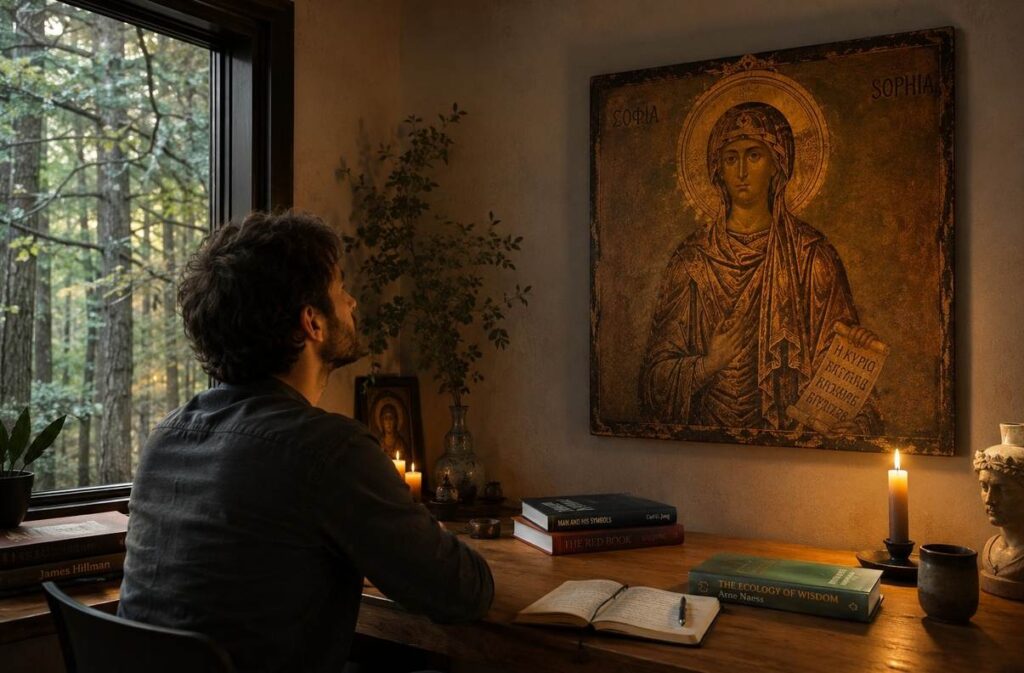
Contemporary Gnostic and esoteric communities continue to venerate Sophia as a patron of seekers, a guide through the labyrinth of illusion, and the presence of divine compassion within the fallen world. She is invoked in meditation, celebrated in poetry and iconography, and studied as a map of the soul’s own trajectory from ignorance to gnosis. Whether approached through scholarly exegesis, psychological practice, or devotional contemplation, Sophia remains the figure who most directly embodies the Gnostic conviction that wisdom is not the accumulation of facts but the recognition of one’s true origin.
Why Sophia Still Calls to Us
Sophia endures because she speaks to experiences that transcend any single religious framework. She is the wisdom that was present at the beginning, the intelligence that shaped the cosmos, the love that risked everything to know the unknowable, and the grief that weeps for every soul trapped in forgetfulness. She is simultaneously the highest and the lowest: the Aeon in the Pleroma and the spark in the dust. Her story is not a simple morality tale but a complex myth of creativity, error, repentance, and restoration — a myth that acknowledges the reality of suffering without resigning itself to despair.
To encounter Sophia is to encounter the possibility that wisdom is not something we acquire from outside but something we remember from within. Her fall reminds us that the desire to know — even when it overreaches — is fundamentally divine. Her redemption assures us that no exile is permanent, no error beyond correction, and no material prison so dark that a spark of light cannot be hidden within it. In a world that often seems shaped by blind forces rather than intelligent love, Sophia remains the voice that whispers: the wisdom you seek is already here, waiting to be recognised. The question is not whether she exists, but whether we have the ears to hear her call.
Frequently Asked Questions
What does Sophia mean in Gnosticism?
In Gnosticism, Sophia is a divine Aeon representing wisdom. She is typically the youngest or lowest emanation in the Pleroma whose longing to know the transcendent Father causes her to fall, inadvertently producing the material world and the Demiurge. She remains a salvific figure who plants divine sparks in human souls to enable their return to the divine fullness.
Is Sophia the same as the Holy Spirit?
Some Gnostic and early Christian texts associate Sophia with the Holy Spirit or draw parallels between their functions, but she is generally considered distinct. In Valentinian systems, she is sometimes identified with the Holy Spirit, while in other traditions, she is an independent Aeon whose story parallels but is not identical to trinitarian pneumatology
Why did Sophia fall in Gnostic myth?
Sophia fell due to an excess of longing and curiosity — a desire to comprehend the unknowable Father directly, without the mediating structure of her syzygy or the Pleroma. Her fall was not malicious but resulted from the passionate reach of divine wisdom toward what lies beyond its proper sphere.
Who is Achamoth in Valentinian Gnosticism?
Achamoth is the Valentinian name for the fallen aspect of Sophia, derived from the Hebrew Hokmah. She is separated from the Pleroma and occupies the intermediate Ogdoad realm, where she undergoes repentance and is eventually redeemed by Christ and the Soter.
How is Sophia related to the Demiurge?
In most Gnostic systems, Sophia is the mother or indirect originator of the Demiurge. In Sethian texts she gives birth to Yaldabaoth through her untimely desire to create. In Valentinian systems, her passion and suffering produce the substance from which the Demiurge is formed as a lower administrator.
What is the Pistis Sophia?
The Pistis Sophia is a Coptic Gnostic text discovered in 1773 that narrates the fall, wandering, and redemption of Sophia through the teachings of the resurrected Christ. It is structured as a dialogue between Christ and his disciples, using Sophia’s story as a template for the soul’s journey to gnosis.
How does Carl Jung interpret the figure of Sophia?
Carl Jung interpreted Sophia as an expression of the anima archetype — the feminine aspect within the psyche that mediates between ego and Self. He saw her fall as symbolic of the modern alienation of consciousness from the wisdom of the unconscious, and her redemption as the goal of individuation.
Further Reading
Explore these ZenithEye articles to deepen your understanding of Sophia and the traditions that honour her.
- The Sophia Myth: Three Falls, Three Redemptions Across Gnostic Schools — A comparative study of how Sethian, Valentinian, and other schools narrate Sophia’s fall and restoration.
- Sophia and Jesus Christ: Divine Wisdom Revealed — Examines the relationship between Sophia and the saviour figure in Gnostic and early Christian texts.
- The Apocryphon of John: Gnostic Creation, the Three Natures, and the Five Seals — The primary Nag Hammadi text narrating Sophia’s fall and the birth of Yaldabaoth.
- Gnostic Ecology: Sophia, the Modern Demiurge, and Earth’s Soul — A contemporary exploration of Sophia as the intelligence of the living earth and the call for ecological restoration.
- On the Origin of the World: Cosmic Rebellion and Divine Restoration — A Nag Hammadi text offering an alternative account of Sophia’s relationship to the Demiurge and the lower cosmos.
- The Feminine Divine in the Nag Hammadi Library — A collection-level overview of divine feminine figures including Sophia, Barbelo, and the Thunder: Perfect Mind.
- Trimorphic Protennoia: The Three Descents of the Divine Voice — Explores another major feminine divine figure in Gnosticism and her parallels to Sophia’s descent and revelation.
- Pleroma and Kenoma: The Foundational Geography of Gnostic Cosmology — Understanding the divine fullness and the lower realm between which Sophia moves.
- Valentinian Gnosticism: The Most Systematic School of the Pleroma — Details the Valentinian system including Achamoth, the Ogdoad, and the redemption of the spiritual seed.
- What Is Gnosticism? The Ancient Currents of Direct Knowledge — The broader tradition within which Sophia’s myth functions as a central narrative of fall and return.