What Is the Pleroma? Divine Fullness in Gnostic Cosmology
At the centre of Gnostic cosmology stands a word that sounds like a promise: Pleroma, the fullness. It is not merely a place but a condition of being — the state in which nothing is lacking, where every divine quality exists in perfect measure, and where the light of recognition needs no shadow to define it. For the Gnostics, the Pleroma was home: the realm from which the human spirit originated, the totality it yearned to recover, and the standard by which the poverty of the material world was measured and found wanting.
Yet the Pleroma was not a Gnostic invention. It was a Greek word with a long philosophical and religious history before it became the name of a divine world. The Gnostics took a term used by Paul to describe the indwelling of God in Christ, expanded it into a comprehensive cosmology, and set it in opposition to the Kenoma — the emptiness, the deficiency, the realm of exile. This glossary entry traces the Pleroma from its linguistic roots through its dramatic Gnostic elaboration, and into modern interpretations that still find in this ancient concept a map for understanding consciousness, wholeness, and the hunger that drives every spiritual search.
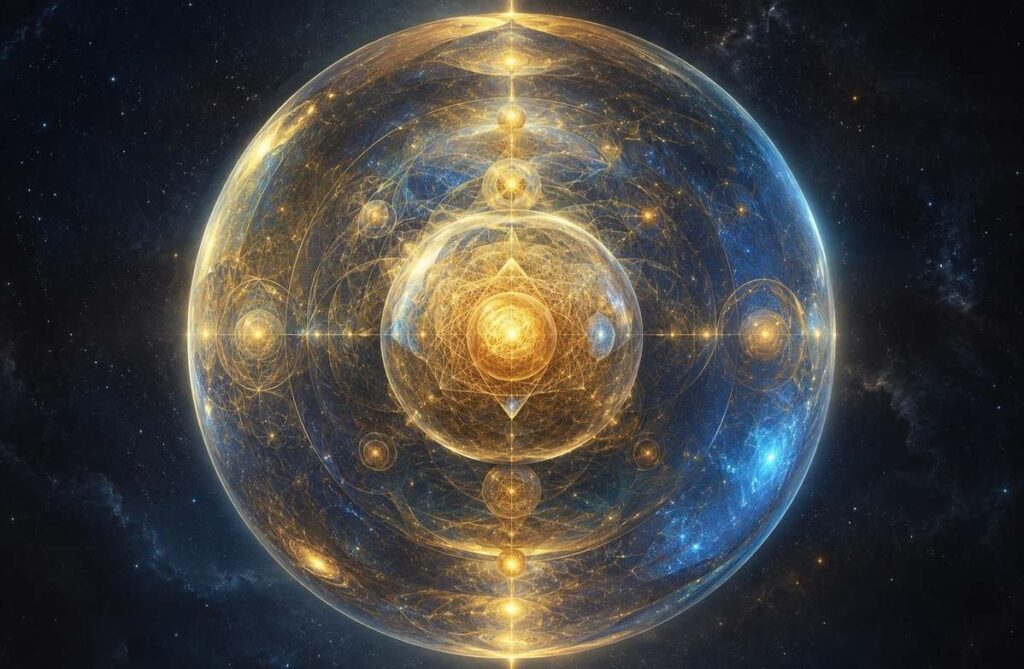
Table of Contents
- The Word Before the System: Pleroma in Greek and Paul
- The Gnostic Pleroma: A Realm of Living Fullness
- Kenoma: The Shadow of Fullness
- The Boundary and the Geography of Salvation
- Modern Echoes: From Jung’s Self to the Quantum Vacuum
- Why the Pleroma Still Matters
The Word Before the System: Pleroma in Greek and Paul
The Greek word pleroma (πλήρωμα) derives from the verb pleroō, meaning to fill, complete, or make full. In ordinary usage it could describe a ship filled with cargo, a body filled with food, or a period of time brought to completion. In philosophical Greek it carried the sense of totality or plenitude — the sum of all parts that leaves nothing outside itself. This everyday word became theologically charged in the hands of the apostle Paul, who used it in ways that would later provide the Gnostics with both vocabulary and interpretive licence.
In Colossians 1:19, Paul writes that “God was pleased to have all his fullness dwell in him [Christ],” and in Colossians 2:9 he declares that “in Christ all the fullness of the Deity lives in bodily form.” Ephesians extends the usage: the church is described as Christ’s body, “the fullness of him who fills everything in every way” (1:23), and Paul prays that believers may be “filled to the measure of all the fullness of God” (3:19). The term also appears in Romans 11:25 in a different sense, referring to the “full number” of the Gentiles. For Paul, the Pleroma was concentrated christologically: the fullness of divinity dwells specifically in Christ, and the Christian life is a participation in that fullness through membership in Christ’s body.
This was not yet a cosmological system. Paul was making a theological claim about where divine fullness is to be found in a broken world, not drawing a map of divine geography. Yet the Gnostics — particularly the Valentinians, who revered Paul and produced some of the earliest commentaries on his letters — took this language and asked the questions Paul had left implicit. If the fullness of divinity dwells in Christ, what is that fullness? Where does it come from? What is its structure? And why did it need to enter the material world at all? The Gnostic Pleroma was born from these questions, a vast expansion of Paul’s concentrated image into a comprehensive vision of the divine world.
The Gnostic Pleroma: A Realm of Living Fullness
In Gnostic cosmology, the Pleroma is the divine realm in its complete, unfallen state: a structured hierarchy of divine beings called Aeons, each representing an aspect or quality of divinity, all emanating from a supreme source that transcends even the fullness it generates. The Pleroma is not a physical location but a mode of existence characterised by completeness, light, knowledge, life, and unity. Nothing is lacking there. No shadow falls. No time passes. The Aeons exist in harmonious syzygies — male-female pairs — whose interrelation constitutes the very structure of divine being.
The Sethian Vision: Barbelo and the Luminous Aeons
The Sethian tradition, preserved in texts such as the Apocryphon of John and Allogenes, presents the Pleroma as emanating from the Monad — the single, invisible, ineffable source beyond all naming and gender. From the Monad emerges the First Thought, often called Barbelo, a divine Mother figure who is the first emanation and the matrix of all subsequent reality. Through Barbelo, the Self-Generated One (Autogenes) and the Luminaries emerge, and from them flow the Aeons in a cascade of increasing differentiation.
In this system, the Pleroma is a realm of pure luminosity and intellectual perfection. The Aeons are not abstract concepts but living, conscious realities who know and are known in a continuous circulation of divine knowledge. The Apocryphon of John describes a complex hierarchy: the Invisible Spirit, Barbelo, the Self-Generated, and the Four Luminaries (Harmozel, Oroiael, Daveithai, Eleleth), each with its associated Aeons and powers. Christ appears in this Pleroma as the divine Autogenes, the perfect Intellect who serves as the model for the restoration of the fallen Sophia and the redemption of the sparks trapped in matter. The Sethian Pleroma is thus a realm of both transcendence and mediation: it is entirely other than the material world, yet it generates the powers and saviours who cross the boundary to rescue what has been lost.
The Valentinian Architecture: Thirty Aeons in Syzygy
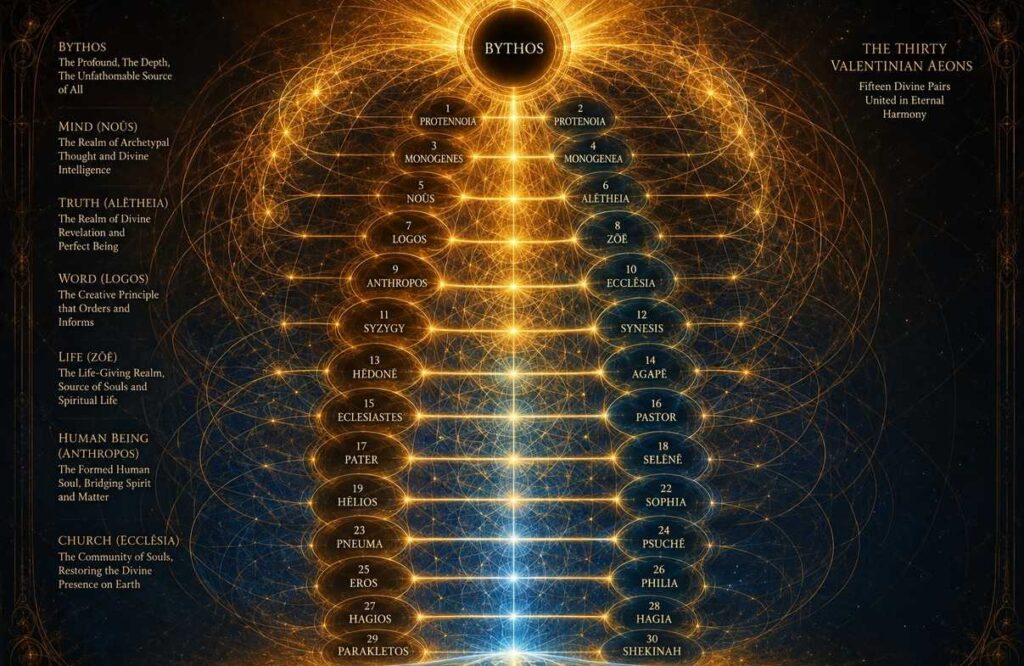
The Valentinian school produced the most systematically elaborate map of the Pleroma. According to Irenaeus’s account of Ptolemy’s system, the Pleroma contains thirty Aeons arranged in fifteen complementary pairs called syzygies, all emanating from a single first principle. At the summit stands Bythos (Depth) or the Pro-Father, paired with Sige (Silence). From this primal pair flow Nous (Mind) and Aletheia (Truth), Logos (Word) and Zoe (Life), Anthropos (Human Being) and Ecclesia (Church). These first eight constitute the Ogdoad, the innermost divine circle. From Logos and Zoe emanate the Decad (ten Aeons), and from Anthropos and Ecclesia emanate the Dodecad (twelve Aeons), bringing the total to thirty.
The names are not arbitrary. Each Aeon represents a necessary aspect of divine self-expression: without Mind there is no knowing, without Truth no reliability, without Word no articulation, without Life no animation, without Human Being no self-reflection, without Church no communion. The syzygy structure reflects a fundamental Valentinian insight: reality is relational. Nothing exists in isolation. Each Aeon is defined by its partner, and the harmony of the Pleroma depends on every pair maintaining its proper union. This relational ontology has parallels in the Hermetic principle of polarity and in the Simonian concept of divine syzygies reported by Hippolytus, but the Valentinian system is unique in its mathematical precision and its integration with a comprehensive soteriology.
The youngest of the thirty Aeons is Sophia (Wisdom), paired with her consort Theletos (Will or Desire). Her position at the margin of the Pleroma is structurally significant: she is the Aeon closest to the boundary that separates fullness from deficiency, and it is her unauthorised reach beyond that boundary — her desire to know the Father directly without mediation — that generates the cosmic crisis. The Pleroma, in both Sethian and Valentinian systems, is not a static paradise but a dynamic totality whose internal structure contains the seed of the drama that will unfold below it. The fullness is so complete that even its outermost edge can generate a longing that disrupts perfection — and from that disruption, the entire story of fall and redemption follows.
Kenoma: The Shadow of Fullness
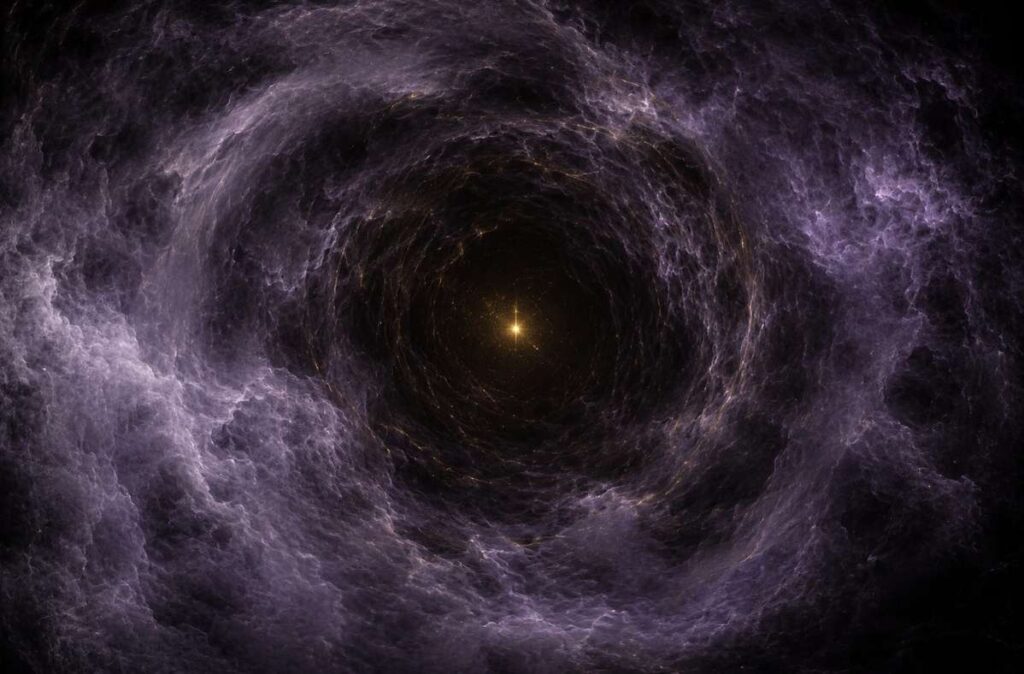
If the Pleroma is fullness, the Kenoma (κένωμα) is its structural opposite: the emptiness, the deficiency, the realm where something is always missing. The term derives from kenos, meaning empty or void, but in Gnostic usage it carries a specific theological weight. The Kenoma is not absolute nothingness; it is a deficient something, a pseudo-reality generated from the passions and errors of a fallen divine principle. It is the region into which Sophia plunged, the domain where the Demiurge exercises his limited sovereignty, and the condition of existence that every awakened soul recognises as exile.
In Valentinian cosmology, the Kenoma originates from the fall of Achamoth — the lower Sophia — who is expelled from the Pleroma after attempting to comprehend the ineffable Father independently. She falls into a place of darkness and formlessness, where she experiences the passions of grief, fear, and perplexity. These passions coalesce into the substance of matter itself: from her suffering arises hyle (matter), from her repentance psyche (soul), and from her gnosis pneuma (spirit). The Demiurge then fashions the material cosmos from this deficient substrate, creating a shadowy, imperfect domain that is at best a parody of the Pleroma’s perfection.
The Gospel of Truth (NHC I,3) offers one of the most profound meditations on this relationship. In this text, error is not an independent force but a byproduct of ignorance: “Oblivion did not come into existence from the Father, although it did indeed come into existence because of him. But what comes into existence in him is knowledge, which appeared in order that oblivion might vanish and the Father might be known.” The Kenoma, in this account, is the fog of forgetfulness — the dense cloud of ignorance that solidifies into a counterfeit reality. Yet it is also the very condition that makes redemption necessary and meaningful. Without deficiency, there could be no filling; without emptiness, no grace of fullness.
In Sethian texts such as On the Origin of the World, the Kenoma appears as the chaotic waters below the Pleroma, the region where Sophia’s unauthorised offspring — the lion-faced serpent Yaldabaoth — emerges and immediately declares his solitary supremacy. Whether described in Valentinian or Sethian terms, the Kenoma consistently functions as the realm where divine sparks are trapped, where fate (heimarmene) prevails, and where the archons enforce their petty jurisdictions until the awakening of gnosis disrupts their order. It is not evil in a moralistic sense; it is simply wrong — a something that believes itself to be everything, an emptiness that mistakes its hollowness for depth.
The Boundary and the Geography of Salvation
Between the Pleroma and the Kenoma stands a boundary, the Horos (Limit), one of the most important and underappreciated concepts in Gnostic cosmology. In Valentinian systems, the Horos is established by the higher Aeons after Sophia’s fall to prevent the deficiency of the Kenoma from contaminating the divine fullness. It functions as both quarantine and pedagogical checkpoint: it keeps the chaos out, but it also marks the threshold that ascending souls must cross on their journey home. The Horos is not a wall of hostility but a limit of protection, a membrane that preserves the integrity of the full while allowing the deficient to be healed.
This boundary is intimately connected to the Gnostic anthropology of the three natures. The hylikoi (material ones) are composed entirely of Kenomic substance — flesh, fate, and elemental matter. They have no divine spark and therefore no capacity for salvation; they perish with the dissolution of the cosmos. The psychikoi (soul-endowed ones) possess the intermediate substance of psyche, created by the Demiurge from Sophia’s repentance. They can achieve partial salvation through faith, moral effort, and the guidance of the Church, but they cannot ascend to the Pleroma itself. The pneumatikoi (spiritual ones) carry the divine spark, the pneuma that originated from Sophia’s gnosis and that is consubstantial with the Pleroma. They are destined to return to the fullness, not through effort but through recognition.
It is crucial to note that the Gnostics did not understand this scheme as a justification for elitism in any modern social sense. The “elect” were not chosen by arbitrary divine decree; they were recognised by their capacity for recognition. The pneuma was not a reward for virtue but a metaphysical given — a fragment of the Pleroma trapped in the Kenoma, awaiting only the event of awakening to begin its return. In this framework, salvation is less a juridical verdict than a geological fact: the diamond does not become precious; it is discovered to have been precious all along. The geography of salvation is already mapped; the only question is whether the traveller remembers the way.
Modern Echoes: From Jung’s Self to the Quantum Vacuum
Carl Gustav Jung engaged deeply with Gnostic terminology in his Seven Sermons to the Dead, where he described the Pleroma as “that which transcends all categories,” “beyond good and evil, beyond being and non-being.” For Jung, the Pleroma was not merely an ancient cosmological abstraction but a psychological reality: the Self, the archetype of wholeness and the regulating centre of the psyche, functions as a kind of personal Pleroma, while the fragmented, compulsive, and defensive aspects of the ego correspond to the condition of Kenoma. Individuation was not the dissolution of the ego into undifferentiated fullness but the conscious reconciliation of opposites — a process that honours both the wholeness of the Self and the necessary limitations of the ego. Jung’s Pleroma is thus both transcendent and immanent: it is the goal of psychological development and the hidden ground from which that development proceeds.
Contemporary physics offers an unexpected parallel. The quantum vacuum — the “void” that is paradoxically teeming with potential energy, the ground from which particles emerge and to which they return — bears a structural resemblance to the Gnostic Kenoma. Both are emptinesses that are not nothing, voids that generate apparent solidity through fluctuation and perturbation. The Gnostic Kenoma, similarly, is not absolute non-being but a deficient mode of existence generated from the passions and errors of a fallen divine principle. Both frameworks invite the question whether the apparent solidity of the material world rests upon a deeper ground of which it is merely a disturbance.
In the realm of information and consciousness, the Pleroma-Kenoma distinction has acquired new urgency. We live in an age of algorithmic governance, where statistical models shape reality through prediction and protocol. An artificial intelligence system, trained on historical data and optimised for specific outputs, knows only its training corpus — it is, in effect, a craftsman operating without access to the “Forms” above its parameters. The Gnostic warning about the Demiurge — the blind intelligence that mistakes its workshop for the whole of existence — becomes startlingly precise when applied to systems that govern human lives without awareness, wisdom, or transcendence. The Kenoma, in this reading, is not merely the material cosmos but any reality constructed from deficiency: from partial data, from instrumental reason, from the reduction of the human to the predictable. The Pleroma remains the fullness that such systems cannot compute, the wholeness that exceeds every model, the recognition that no algorithm can generate.

Why the Pleroma Still Matters
The Pleroma endures because it names an experience more fundamental than any single doctrinal formulation: the sense that behind or beneath the fragmented, anxious, perpetually deficient world we inhabit, there exists a wholeness that is not only possible but primordial. The Gnostics did not invent this intuition; they formalised it, mapped it, and embedded it in a mythology that made the journey from exile to return comprehensible. The Pleroma is the home we do not remember leaving, the fullness we seek in every incomplete love, the silence that waits behind every noise.
To speak of the Pleroma is not to deny the reality of suffering, injustice, or loss. The Gnostics were not naive optimists; they were realists of a particularly rigorous sort, convinced that the world was shaped by ignorance and that most human beings lived in a state of hypnotised forgetfulness. Yet their realism was balanced by a radical hope: the hope that the deficiency was not ultimate, that the emptiness was not original, and that the spark of fullness remained hidden in every soul, waiting only for the event of recognition to begin its return. The Pleroma is not a reward for the virtuous or a destination for the accomplished. It is the truth of what we already are, obscured by the fog of the Kenoma, revealed in the moment we stop seeking and start remembering.
Frequently Asked Questions
What does Pleroma mean in Gnosticism?
In Gnosticism, the Pleroma (Greek for fullness) is the divine realm of complete perfection, light, and knowledge. It is populated by divine beings called Aeons arranged in male-female pairs, all emanating from the supreme unknowable source. It represents the totality of divine being from which the human spirit originated and to which it seeks to return.
What is Kenoma and how does it differ from Pleroma?
Kenoma (Greek for emptiness or deficiency) is the opposite of the Pleroma. While the Pleroma is the realm of divine fullness and perfection, the Kenoma is the region of lack, fragmentation, and material existence where the Demiurge created the flawed cosmos. It is the realm of ignorance and exile into which the fallen Sophia plunged.
How did Paul use the word Pleroma?
Paul used pleroma to describe the fullness of divine being dwelling in Christ (Colossians 1:19, 2:9) and prayed that believers might be filled to the measure of all the fullness of God (Ephesians 3:19). Gnostic teachers, especially Valentinians, expanded this christological usage into a comprehensive cosmological system.
What are Aeons in the Pleroma?
Aeons are divine beings or aspects of divinity within the Pleroma, arranged in male-female pairs called syzygies. Valentinian Gnosticism described thirty Aeons in fifteen pairs, including figures such as Nous (Mind), Aletheia (Truth), Logos (Word), and Zoe (Life). Sethian texts describe a different but related hierarchy emanating from Barbelo.
What is the Horos in Gnostic cosmology?
The Horos (Limit or Boundary) is the metaphysical barrier that separates the Pleroma from the Kenoma. In Valentinian systems, it was established after Sophia’s fall to prevent deficiency from contaminating divine fullness. It also serves as the threshold that ascending souls must cross on their journey back to the divine realm.
Is the Pleroma a physical place?
No, the Pleroma is not a physical place in the spatial sense. It is a mode of existence or state of being characterised by completeness, timelessness, perfect knowledge, and unity. It transcends the categories of space, time, and matter that define the Kenoma and the material cosmos.
How does the Pleroma relate to modern thought?
Modern parallels include Carl Jung’s concept of the Self as a psychological Pleroma, the quantum vacuum in physics as a void teeming with potential, and critiques of algorithmic systems as operating from a condition of Kenoma — constructing reality from partial data without access to the fullness of human experience.
Further Reading
Explore these ZenithEye articles to deepen your understanding of the Pleroma and the cosmology it anchors.
- Pleroma and Kenoma: The Foundational Geography of Gnostic Cosmology — A comprehensive exploration of the two realms and the boundary between them.
- Valentinian Gnosticism: The Most Systematic School of the Pleroma — Detailed examination of the thirty Aeons, syzygies, and Valentinian cosmological structure.
- The Apocryphon of John: Gnostic Creation, the Three Natures, and the Five Seals — The primary Sethian text describing the Pleroma’s emanation from the Monad through Barbelo.
- The Sophia Myth: Three Falls, Three Redemptions Across Gnostic Schools — How Sophia’s fall from the Pleroma’s margin generated the entire drama of creation and return.
- The Gnostic Technical Glossary: Key Terms Every Seeker Should Know — Definitions of Pleroma, Kenoma, Aeons, syzygies, and related cosmological terminology.
- What Is Gnosticism? The Ancient Currents of Direct Knowledge — The broader tradition within which the Pleroma functions as the central metaphysical axis.
- Gnosticism vs Orthodox Christianity: What the Early Church Suppressed — Context on why the Pleroma doctrine was deemed heretical and how it shaped Christian history.
- The Names of the Archons: A Guide to Gnostic Entities and Their Domains — The powers who administer the Kenoma and obstruct the soul’s return to the Pleroma.
- The Gnostic Answer to Evil: Why Suffering Proves the Demiurge — Examines how the Pleroma-Kenoma distinction reframes the problem of suffering and cosmic injustice.
- Trimorphic Protennoia: The Three Descents of the Divine Voice — Explores how divine emanations from the Pleroma descend to redeem the fallen sparks trapped below.