
Gnosticism vs Orthodox Christianity: What the Early Church Suppressed
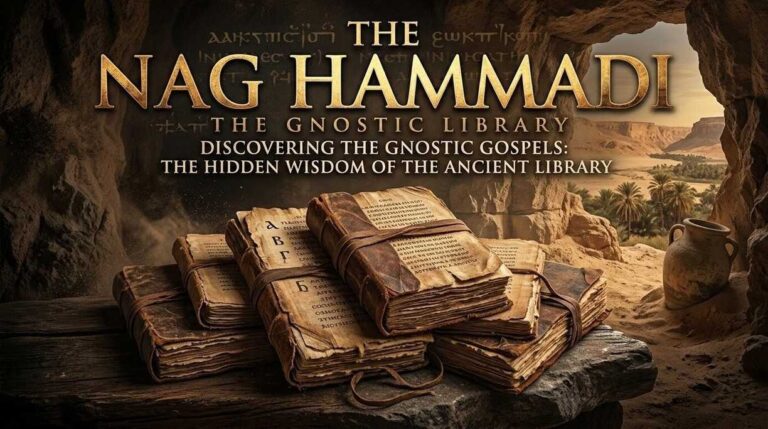
For nearly two thousand years, the Christian story was told as if it had always been singular. One church, one creed, one authorised account of Jesus Christ. The discovery of the Nag Hammadi Library in 1945 shattered that assumption. Buried in a sealed jar beneath the cliffs of Upper Egypt were thirteen codices containing over fifty texts–Gospels, dialogues, revelations, and treatises–that presented a vision of Christianity radically different from the one that had conquered the Roman Empire. These were not the writings of a fringe cult. They were the scriptures of communities that had flourished alongside what would become orthodox Christianity, offering alternative answers to the most fundamental questions: Who is God? What is the world? Who was Jesus, and what did he come to do?
This article examines what the early church suppressed and why. It is not a conspiracy theory about hidden truths and ecclesiastical cover-ups; it is a scholarly account of how theological disagreement became political exclusion, how diversity became heresy, and how one version of Christianity prevailed not because it was obviously true but because it was politically viable. For those inside Christianity who are questioning, and for those outside who are trying to understand what was lost, the Gnostic-orthodox conflict remains one of the most consequential theological debates in Western history.
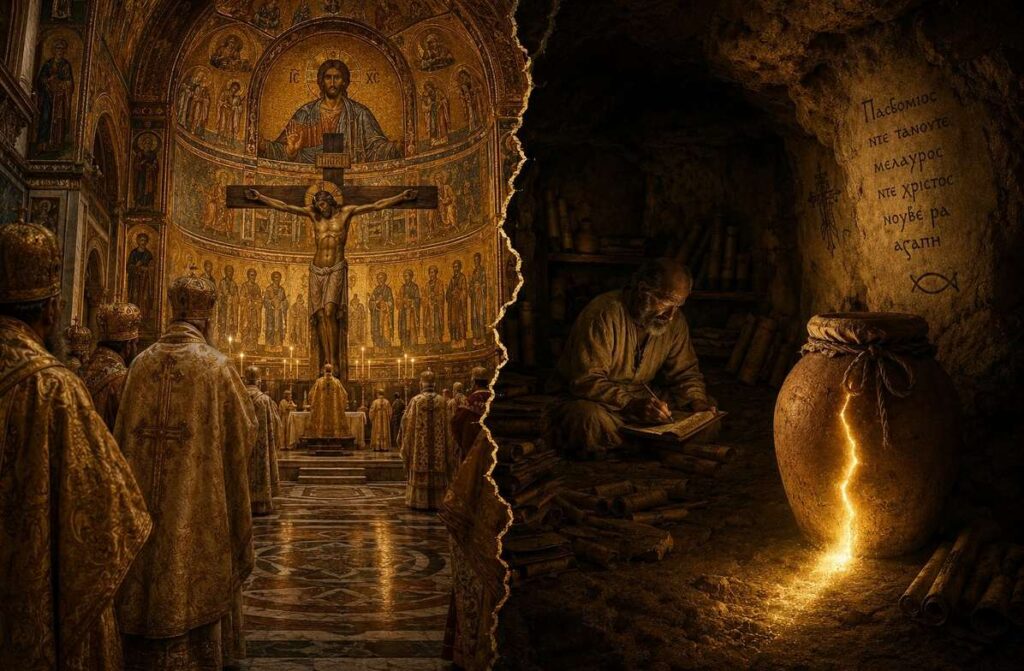
Table of Contents
- Two Christianities: The Landscape of the Second Century
- The Suppression: From Polemic to Persecution
- Why Orthodoxy Won: Theology, Politics, and Power
- The Feminine Divine: What Disappeared from the Creed
- The Nag Hammadi Discovery: The Suppressed Return
- Gnosticism Today: Questions for the Questioning
- Frequently Asked Questions
- Further Reading
- References and Sources
Two Christianities: The Landscape of the Second Century
In the second century CE, Christianity was not a unified movement but a spectrum of competing interpretations. On one end stood what scholars call proto-orthodoxy: communities that affirmed the Old Testament as sacred scripture, believed in one God who created the world and declared it good, insisted that Jesus Christ was fully human and fully divine, and maintained that his bodily death and resurrection were historical events of saving significance. On the other end stood a diverse family of movements that modern scholars have grouped under the label Gnosticism–a term the ancient groups themselves did not uniformly use, but which captures their shared conviction that salvation comes through gnosis, direct experiential knowledge of divine realities.
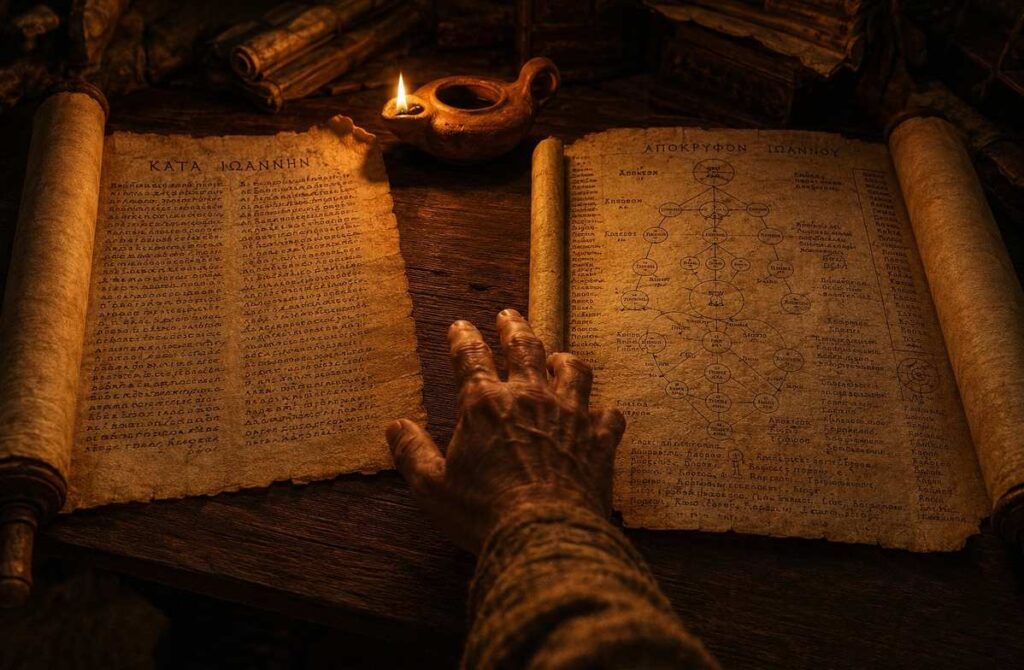
The differences were not minor. The orthodox reading of Genesis maintained that the creator of the world was the supreme God, good and omnipotent. The Gnostic reading, preserved in texts like the Apocryphon of John, described the creator as a lower, ignorant deity–the demiurge–who fashioned the material world in delusion, unaware of the higher divine realm from which he had emanated. For orthodoxy, the incarnation was the central miracle: God became flesh, suffered truly, died historically, and rose bodily. For many Gnostics, the divine Christ could not have suffered in a material body; he was a spiritual being who merely appeared human–a doctrine called docetism–or who entered Jesus at baptism and departed before the crucifixion.
Salvation, for the orthodox, was mediated: faith in Christ’s atoning death, participation in the sacraments, obedience to the bishops who stood in apostolic succession. For the Gnostics, salvation was immediate: the recognition of one’s true identity as a divine spark temporarily imprisoned in matter, the recovery of knowledge that liberated the soul from the demiurge’s domain. The orthodox church was an institution with a hierarchy, a canon, and a creed. The Gnostic communities were networks of teachers and students, often without fixed leadership, valuing individual insight over collective conformity. Both claimed to represent the authentic teaching of Jesus. Both claimed the authority of the apostles. Neither could tolerate the other.
The Suppression: From Polemic to Persecution
The first major assault on Gnosticism came not from the state but from the pen. Around 180 CE, Irenaeus, bishop of Lyons, composed Against Heresies, a five-volume refutation of Gnostic teachings that remains our richest source for understanding what the Gnostics believed–precisely because Irenaeus summarised their doctrines in order to demolish them. He attacked the Valentinian Pleroma with its thirty aeons, mocked the Sethian cosmogonies with their lion-faced demiurge, and insisted that the only reliable guide to truth was the apostolic succession of bishops. Where the Gnostics claimed that spiritual insight could surpass institutional authority, Irenaeus countered that the bishop was the guardian of tradition and that deviation from his teaching was deviation from Christ.
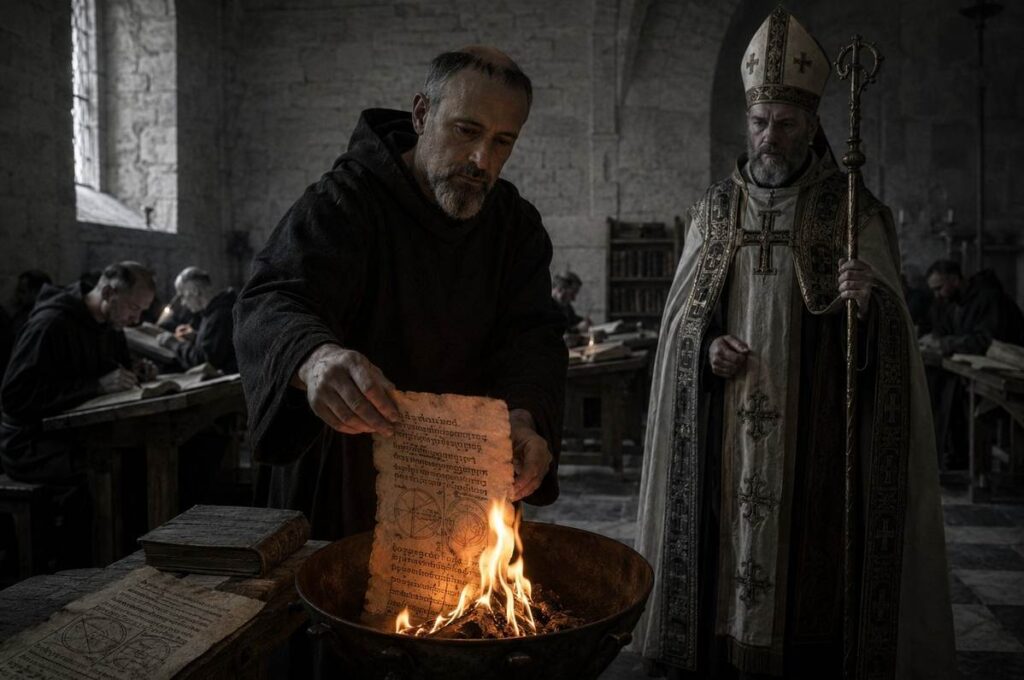
Tertullian in Carthage, Hippolytus in Rome, and Epiphanius in Cyprus continued the campaign. Their writings were not merely theological; they were exercises in boundary-drawing, defining who was inside and who was outside the Christian community. The Gnostics were branded as heretics–a term originally meaning “those who choose for themselves”–and their scriptures were targeted for destruction. When Emperor Constantine legalised Christianity in 313 CE and Theodosius I made it the state religion in 380 CE, the orthodox church acquired the power to enforce its definitions. Edicts urged the faithful to reject Gnostic teachings and burn their books. Communities that had survived through discretion and portability were now vulnerable to state-sanctioned eradication.
The suppression was thorough enough that, by the Middle Ages, Gnosticism had been virtually erased from Christian memory. Its texts survived only in fragments, quotations embedded in hostile polemics, and the occasional manuscript hidden in monastic libraries or buried in desert caves. The orthodox narrative became the only narrative. The diversity of early Christianity was forgotten, and the triumph of the institutional church was read backwards as the inevitable working of divine providence.
Why Orthodoxy Won: Theology, Politics, and Power
The victory of orthodoxy was overdetermined. Theological, political, and social factors converged to make the proto-orthodox position the one that could survive and dominate. Theologically, orthodoxy offered a simpler message. The doctrine of creation ex nihilo by a good God, the incarnation of Christ in a real human body, and the promise of bodily resurrection spoke to ordinary believers in ways that the elaborate aeonic hierarchies of the Valentinians or the dark cosmogonies of the Sethians could not. The orthodox God loved the world he had made; the Gnostic demiurge had made a prison. For most people, hope is more compelling than metaphysical escape.
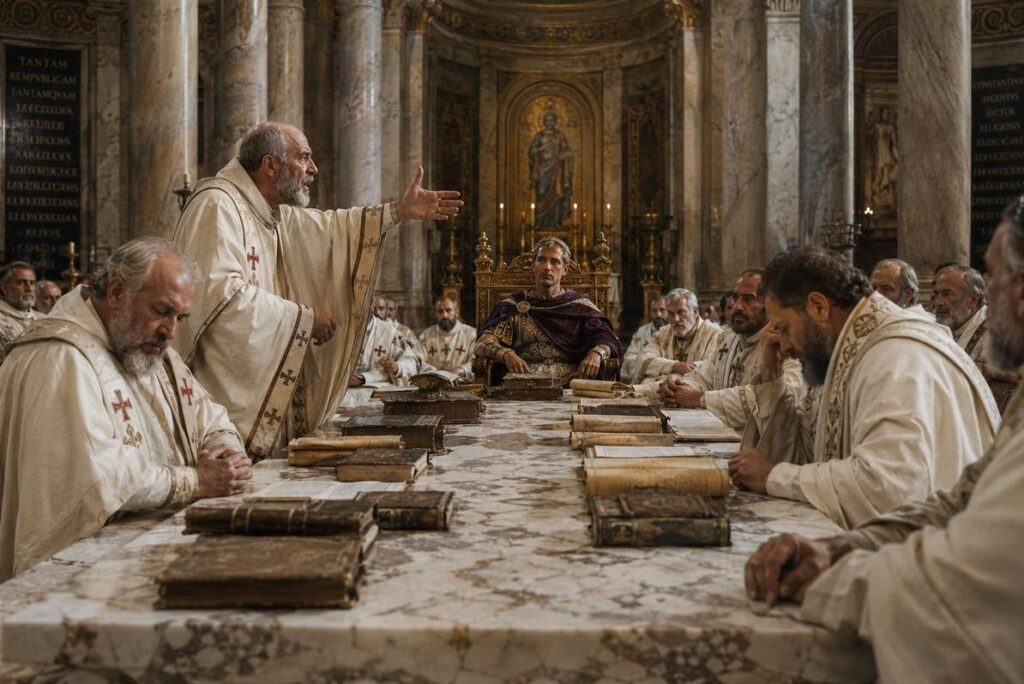
Politically, orthodoxy was better suited to empire. The Gnostic emphasis on secret knowledge, individual enlightenment, and rejection of the material world made it inherently subversive of social order. Gnostic groups refused to honour the creator of the world, which meant they refused to honour the political authorities who claimed legitimacy from that creator. They rejected martyrdom as a virtue, which weakened their public witness in a culture that valued heroic death. They included women in leadership, which scandalised a patriarchal society. The orthodox church, by contrast, developed a hierarchy of bishops, priests, and deacons that mirrored Roman administrative structures. It affirmed the goodness of creation and the legitimacy of earthly rule. It could accommodate empire without contradiction.
Socially, orthodoxy was more inclusive at the level of practice. The Gnostic division of humanity into three natures–hylic, psychic, and pneumatic–implied that not everyone could be saved. The pneumatic elite possessed the divine spark and needed only recognition; the hylic masses were bound to matter and would perish. This elitism limited Gnosticism’s appeal and made it vulnerable to the orthodox charge of arrogance. The orthodox church, by contrast, offered salvation to all who would be baptised, confess the creed, and submit to the bishops. It was a big-tent religion in a way that Gnosticism, with its emphasis on secret knowledge, could never be.
The Feminine Divine: What Disappeared from the Creed
One of the most striking differences between Gnostic and orthodox Christianity concerns the role of women and the feminine divine. The Nag Hammadi texts present women as recipients of secret teaching, visionary prophets, and apostolic leaders. In the Gospel of Mary, Mary Magdalene receives teachings from Jesus that the male disciples–particularly Andrew and Peter–find implausible. Levi defends her, asking why the Saviour would have made her worthy if her testimony were false. The Gospel of Philip states that Jesus loved Mary Magdalene more than the other women and used to kiss her often on the mouth, scandalising the other disciples who asked why he loves her more than them. The answer is devastating in its simplicity: “He made her worthy.”
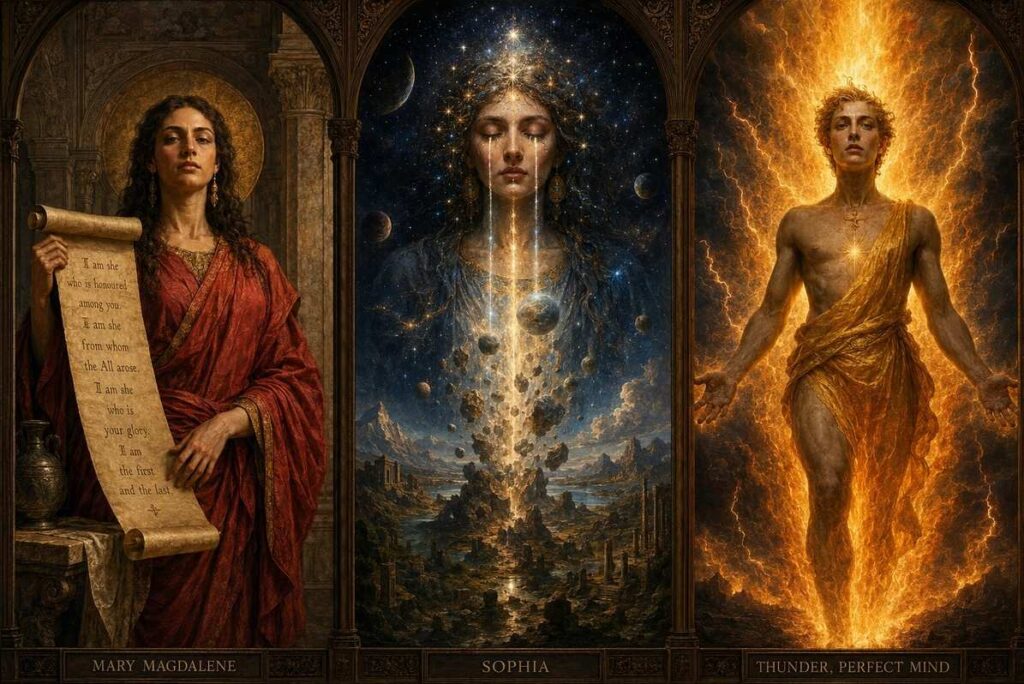
Beyond individual women, Gnosticism developed robust feminine divine imagery. Sophia–Wisdom–is not a marginal figure in the Nag Hammadi Library; she is central. In the Apocryphon of John, she is the twelfth aeon whose fall generates the material world and the demiurge. In the Trimorphic Protennoia, she descends through three realms as Voice, Speech, and Word, baptising and redeeming those who recognise her. Thunder: Perfect Mind speaks in the first person as a divine feminine principle who is both mother and virgin, both whore and holy, both what is and what is not–a figure of paradoxical power that defies every binary the patriarchal world could construct.
By the late second century, orthodox Christianity was systematically eliminating feminine imagery for God. Bishop Irenaeus complained that women were especially attracted to heretical groups that allowed them to prophesy. Tertullian declared that women were not permitted to speak in church, teach, baptise, or claim any masculine function. Clement of Alexandria demanded that women remain in subjection to their husbands. The synagogue custom of segregating women was adopted, and by the end of the second century, women’s participation in worship was explicitly condemned. The suppression of Gnosticism was, in significant measure, the suppression of an alternative Christian vision in which the feminine was not secondary, dangerous, or silent.
The Nag Hammadi Discovery: The Suppressed Return
In December 1945, two Egyptian farmers named Muhammad Ali Khalifa and Abu al-Majd were digging for fertiliser near the town of Nag Hammadi in Upper Egypt when their mattocks struck a large earthenware jar. Inside were thirteen leather-bound codices containing fifty-two texts in Coptic–the largest discovery of early Christian manuscripts since the Dead Sea Scrolls. The find was accidental, almost comic: one of the farmers reportedly used pages from the codices to kindle his oven before scholars intervened. Yet what survived was revolutionary.

The Nag Hammadi Library transformed scholarly understanding of early Christianity. For the first time, historians could read Gnostic texts in the words of the Gnostics themselves, rather than relying on the hostile summaries of Irenaeus and Tertullian. The library revealed that early Christianity was not a single tree with a few wayward branches but a forest of competing visions. The Gospel of Thomas offered 114 sayings of Jesus without narrative or passion. The Gospel of Philip explored sacramental theology and the bridal chamber. The Apocryphon of John presented a creation myth in which the demiurge was born from Sophia’s anguish. The Hypostasis of the Archons described how the feminine principle defeated the archons through recognition rather than violence.
The discovery also exposed the limitations of the orthodox polemic. Irenaeus had claimed that the Gnostics were morally depraved, intellectually absurd, and historically fraudulent. The Nag Hammadi texts revealed something different: serious theological reflection, sophisticated philosophical engagement, and spiritual practices that were neither libertine nor nihilistic. The Gnostics were not the caricature their enemies had drawn. They were Christians who had asked different questions and arrived at different answers–answers that the institutional church had found intolerable not because they were obviously false but because they threatened its authority.
Gnosticism Today: Questions for the Questioning
Today, Gnosticism exerts a fascination that transcends academic interest. Spiritual seekers are drawn to its emphasis on personal experience over institutional dogma, its recovery of the feminine divine, and its insistence that the divine is accessible without priestly mediation. For Christians who are questioning–who find the creedal formulations inadequate, who suspect that institutional authority has sometimes served itself rather than the gospel, who wonder whether the God of wrath described in the Old Testament is truly the God of love proclaimed by Jesus–the Gnostic texts offer a vocabulary for dissent that is neither modern nor merely rebellious. It is ancient, rooted, and theologically serious.
Yet the questions remain unresolved. Can one be Gnostic and Christian? The orthodox answer is no: the creeds, the canon, and the sacraments define the boundary, and Gnosticism stands outside it. The Gnostic answer is also no, but for different reasons: the institutional church, with its hierarchies and dogmas, is itself a product of the demiurgic order, and true Christianity is the secret teaching that the church has suppressed. Between these absolutes, many contemporary seekers occupy a middle space–drawing on Gnostic texts for insight without adopting their cosmology wholesale, questioning authority without rejecting community, seeking gnosis without despising the material world.
The value of studying the Gnostic-orthodox conflict is not that it provides a correct answer. It is that it reveals the contingency of the answers we have inherited. Orthodoxy won, but it did not win because it was self-evidently true. It won because it could build cathedrals, administer empires, and offer salvation to the masses. Gnosticism lost, but it did not lose because it was self-evidently false. It lost because it could not compete with an institution that had allied itself with the power of the state. The Nag Hammadi Library reminds us that the Christian story could have been told differently–and that, for some, it still is.
Frequently Asked Questions
What is Gnosticism and how did it differ from early orthodox Christianity?
Gnosticism refers to a family of early Christian and Jewish movements that emphasised gnosis–direct experiential knowledge–as the path to salvation, rather than faith in Christ’s sacrificial death mediated by the church. Gnostics typically maintained that the material world was created by a lower, ignorant deity (the demiurge), not the supreme God. They viewed the divine spark as trapped in human bodies and believed Christ came as a revealer of secret knowledge, not a sacrificial saviour. Orthodox Christianity, by contrast, affirmed the goodness of creation, the bodily resurrection of Christ, and the authority of the institutional church and its bishops.
Why did the early church suppress Gnostic texts and movements?
The suppression was driven by theological, political, and social factors. Theologically, Gnosticism denied core doctrines that orthodox leaders considered essential: the goodness of creation, the incarnation and bodily resurrection of Christ, and the authority of the Old Testament. Politically, Gnosticism threatened the emerging hierarchy of bishops by claiming that individual spiritual experience could equal or surpass institutional authority. Socially, Gnostic groups included women as teachers and prophets, rejected martyrdom as a virtue, and refused to conform to the developing creedal structure. By the fourth century, with imperial support, orthodox Christianity had the power to enforce its views and systematically marginalise alternatives.
What role did women play in Gnosticism compared to orthodox Christianity?
Gnostic texts present women as teachers, prophets, and recipients of secret knowledge. The Gospel of Mary depicts Mary Magdalene receiving teachings from Jesus that the male disciples find troubling. The Gospel of Philip states that Jesus loved Mary Magdalene more than the other disciples and that he made her worthy. Thunder: Perfect Mind speaks in the voice of a divine feminine principle. In contrast, orthodox Christianity increasingly restricted women’s roles. By the late second century, women were segregated in worship, forbidden to teach or baptise, and excluded from leadership. The suppression of Gnosticism was partly a suppression of this alternative model of gender and authority.
What is the demiurge and why did orthodox Christians reject this idea?
The demiurge is a lower creator deity found in many Gnostic texts, often identified with the God of the Old Testament. In the Apocryphon of John, this figure–called Yaldabaoth, Samael, or Saklas–creates the material world in ignorance, believing himself to be the only god while remaining unaware of the higher divine realm. Orthodox Christians rejected this because it contradicted the biblical doctrine of creation ex nihilo by a single, good, omnipotent God. If the creator were ignorant or malevolent, the material world would be fundamentally flawed, and the incarnation of Christ in a physical body would be impossible or degrading.
How did the Council of Nicaea relate to Gnosticism?
The Council of Nicaea in 325 CE is often mistakenly associated with the suppression of Gnosticism, but its primary focus was the Arian controversy–the question of whether Christ was of the same substance as God the Father. By Nicaea, Gnosticism had already been marginalised through the polemics of Irenaeus, Tertullian, and others. However, the council established a pattern that would prove decisive: imperial endorsement of a specific theological position, backed by the power to enforce conformity. This model–church and state united behind a defined orthodoxy–made the final eradication of Gnostic communities possible.
What was the Nag Hammadi discovery and why is it significant?
In 1945, two Egyptian farmers discovered a sealed jar containing thirteen leather-bound codices near the town of Nag Hammadi in Upper Egypt. The library contained over fifty texts, including the Gospel of Thomas, the Gospel of Philip, the Gospel of Mary, the Apocryphon of John, and many others. Dated to the mid-fourth century, these were Coptic translations of works composed as early as the second century. The discovery was revolutionary because it allowed scholars to read Gnostic texts in the words of the Gnostics themselves, rather than relying solely on the hostile summaries of their orthodox opponents. It revealed early Christianity as far more diverse than previously imagined.
Is Gnosticism compatible with Christianity today?
This depends on how one defines Christianity. Mainstream orthodox traditions–Catholic, Orthodox, and most Protestant churches–maintain the creedal definitions that originally excluded Gnosticism: the goodness of creation, the bodily resurrection, the authority of scripture and tradition. From these perspectives, Gnosticism remains incompatible. However, many contemporary spiritual seekers, theologians, and scholars find in Gnosticism a resource for questioning institutional authority, recovering the feminine divine, and prioritising direct spiritual experience over doctrinal conformity. The question is less whether Gnosticism can rejoin orthodoxy and more whether the boundaries of what counts as Christian can accommodate such radical diversity.
Safety Notice: This article explores theological questions that may challenge established religious beliefs. It does not constitute pastoral advice or encourage hostility toward any living religious tradition. Questioning one’s faith can be a healthy part of spiritual development, but it can also trigger distress, doubt, or religious trauma. If you are experiencing acute spiritual crisis or mental health difficulties, please contact a qualified therapist, pastoral counsellor, or crisis support service. The study of suppressed texts is valuable for historical understanding; it should not be used to justify breaking from community without adequate support.
Further Reading
- The Gospel of Mary: The Suppressed Gospel of the Magdalene — Mary Magdalene receives secret teachings from Jesus and confronts the seven powers of wrath in her ascent to the divine.
- The Sophia Myth: Three Falls, Three Redemptions — How Wisdom fell into matter and what her redemption means for the spark trapped in flesh across Sethian, Valentinian, and modern schools.
- The Sophia of Jesus Christ — The resurrected Jesus reveals cosmological wisdom, bridging pagan philosophy and Christian revelation in a text that orthodoxy never acknowledged.
- The Demented God Architect — Unmasking the Demiurge across Gnostic traditions: Yaldabaoth, the archons, and the counterfeit cosmos that orthodoxy called creation.
- Valentinian Christianity: System and Influence — The most philosophically sophisticated Gnostic school, whose systematic theology posed the sharpest challenge to emerging orthodoxy.
- Apocryphon of John: Foundational Text of Sethian Gnosticism — The complete cosmogony of Yaldabaoth, the divine spark, and the three races of humanity that orthodox Christianity rejected.
- Gospel of Philip: Sacrament, Eros, and the Bridal Chamber — Valentinian reflections on the nymphon, Mary Magdalene’s worthiness, and the sacraments that the institutional church redefined.
- Nag Hammadi Library: Complete Guide to 46 Gnostic Scriptures — The master hub for navigating all tractates, codices, and thematic collections in the Contemporary Gnostic Archive.
References and Sources
The following sources represent the scholarly monographs, primary texts, and critical studies underlying this article.
Primary Sources and Critical Editions
- The Apocryphon of John (NHC II,1; III,1; IV,1). In The Nag Hammadi Library in English, 4th revised edition, edited by Marvin Meyer. HarperOne, 2007.
- The Gospel of Mary (BG 8502,1). In The Nag Hammadi Library in English, 4th revised edition, edited by Marvin Meyer. HarperOne, 2007.
- The Gospel of Philip (NHC II,3). In The Nag Hammadi Library in English, 4th revised edition, edited by Marvin Meyer. HarperOne, 2007.
- The Gospel of Thomas (NHC II,2). In The Nag Hammadi Library in English, 4th revised edition, edited by Marvin Meyer. HarperOne, 2007.
- Thunder: Perfect Mind (NHC VI,2). In The Nag Hammadi Library in English, 4th revised edition, edited by Marvin Meyer. HarperOne, 2007.
- The Trimorphic Protennoia (NHC XIII,1). In The Nag Hammadi Library in English, 4th revised edition, edited by Marvin Meyer. HarperOne, 2007.
- Irenaeus of Lyons. Against Heresies (Adversus Haereses), Books I–V. Translated by Alexander Roberts and James Donaldson. Ante-Nicene Fathers, Vol. 1. Christian Literature Publishing, 1885.
- Tertullian. Prescription Against Heretics (De Praescriptione Haereticorum). Translated by Peter Holmes. Ante-Nicene Fathers, Vol. 3. Christian Literature Publishing, 1885.
Scholarly Monographs
- Pagels, Elaine. The Gnostic Gospels. Random House, 1979.
- Ehrman, Bart D. Lost Christianities: The Battles for Scripture and the Faiths We Never Knew. Oxford University Press, 2003.
- King, Karen L. What Is Gnosticism? Harvard University Press, 2003.
- Brakke, David. The Gnostics: Myth, Ritual, and Diversity in Early Christianity. Harvard University Press, 2010.
- Markschies, Christoph. Gnosis: An Introduction. Translated by John Bowden. T&T Clark, 2003.
- Williams, Michael Allen. Rethinking Gnosticism: An Argument for Dismantling a Dubious Category. Princeton University Press, 1996.
Comparative and Thematic Studies
- Jonas, Hans. The Gnostic Religion: The Message of the Alien God and the Beginnings of Christianity. Beacon Press, 1958.
- Rudolph, Kurt. Gnosis: The Nature and History of Gnosticism. Translated by Robert McLachlan Wilson. Harper & Row, 1987.
- Logan, Alastair H. B. The Gnostics: Identifying an Early Christian Cult. T&T Clark, 2006.
- Thomassen, Einar. The Spiritual Seed: The Church of the Valentinians. Brill, 2006.