Valentinian Christianity: System and Influence
Valentinian Christianity was one of the most intellectually ambitious Christian movements of the second and third centuries. Associated with the teacher Valentinus and his followers, it developed a systematic theology of the Father, Pleroma, aeons, Sophia, Christ, the Church, sacraments and the restoration of the spiritual seed.
This was not a small fringe curiosity at the edge of Christian history. Valentinian teachers operated close enough to wider Christian life that their opponents took them seriously. Irenaeus, Tertullian, Hippolytus and others devoted substantial energy to refuting them. That alone tells us that Valentinian Christianity was a real force in the early struggle over what Christianity would become.
Unlike sharper Gnostic myths that emphasise cosmic rebellion against hostile archons, Valentinian Christianity often speaks in a more ecclesial and restorative key. Its central concern is not simply escape from the world, but the healing of deficiency, the awakening of the spiritual seed, and the return of scattered life to divine Fullness.
What is Valentinian Christianity?
Valentinian Christianity is a second-century Christian Gnostic movement associated with Valentinus and his school. It interprets Christian scripture, Christ, salvation, sacraments and Church through the language of the Pleroma, aeons, Sophia, spiritual seed, knowledge and restoration.
It is important because it shows an early form of Christianity that was philosophical, scriptural, sacramental and mystical, yet later condemned as heretical by emerging catholic authorities.
Content Note: This article discusses ancient Christian disputes, heresy labels, spiritual hierarchy, threefold humanity, sacrament, gendered symbolism and salvation. These are historical and theological categories, not tools for ranking or diminishing living people.
Table of Contents
- Valentinus and the Christian School That Followed Him
- Why Valentinian Christianity Matters
- Inside, Beside and Against the Emerging Church
- Sources for Valentinian Christianity
- The Valentinian System in Plain Terms
- The Pleroma and the Paired Aeons
- Sophia, Deficiency and the Lower World
- Christ, the Saviour and Divine Accommodation
- Threefold Humanity and the Spiritual Seed
- Church, Community and Teaching
- Sacrament and the Bridal Chamber
- Why the Valentinians Were Condemned
- Influence and Legacy
- Reading Valentinian Christianity Today
- Frequently Asked Questions
- Further Reading
- References and Sources
Valentinus and the Christian School That Followed Him
Valentinus was a second-century Christian teacher traditionally associated with Egypt, Alexandria and Rome. Ancient sources place him in Rome during the mid-second century, where he seems to have become a significant and respected teacher before later opponents marked his school as heretical.
Tertullian famously claims that Valentinus turned against the Church after being passed over for high office. Modern scholars usually treat this story with caution. It sounds like polemic, a tidy moral tale about wounded pride rather than a neutral biography.
What the story does reveal is still useful: Valentinus was remembered as someone close enough to wider Christian life that his later condemnation required explanation. His school did not emerge as an obvious outside religion. It developed as an ambitious interpretation of Christian revelation.
Valentinus himself remains partly hidden. The movement that bears his name was developed by later teachers such as Ptolemy, Heracleon, Theodotus, Marcus and others. These figures did not all teach exactly the same thing. Valentinian Christianity was a school tradition, not a single frozen doctrine.
Historical Caution: Much of what survives about Valentinus comes through opponents. His followers developed several related systems, so “Valentinian Christianity” should be read as a family of traditions rather than one perfectly uniform creed.
Why Valentinian Christianity Matters
Valentinian Christianity matters because it shows that early Christianity was not a single smooth road. It was a contested field of interpretation. Scripture, Christ, resurrection, sacrament, Church and salvation were all being argued over with serious philosophical intensity.
The Valentinians were not merely rejecting Christianity. They were re-reading it. They interpreted biblical language through the Pleroma, aeons, Sophia, spiritual seed, sacrament and restoration. Their theology drew from Christian proclamation, Platonist thought, scriptural allegory and mythic imagination.
This makes them important for the history of Christian doctrine. They forced emerging catholic writers to define boundaries. What counts as the true God? What is creation? Who is Christ? What is resurrection? What is the Church? What saves?
Valentinian Christianity is therefore not just an abandoned branch of ancient speculation. It is one of the mirrors in which early Christianity discovered what it would accept, what it would reject, and what it feared becoming.
Inside, Beside and Against the Emerging Church
One reason Valentinianism is so interesting is that it lived close to the Christian mainstream before being decisively labelled heresy. Valentinian teachers used Christian scripture, spoke of Christ, practised sacramental forms and addressed Christian communities.
To their opponents, this closeness made them more dangerous. A movement outside Christianity could be dismissed more easily. A movement using Christian language with a different inner grammar was harder to contain.
The Valentinians often distinguished between ordinary faith and deeper knowledge. They interpreted scripture allegorically and claimed that the apostolic message contained hidden depths. This was not unusual in late antique religious culture, but it became controversial when attached to a different cosmology and anthropology.
Valentinian Christianity therefore stood inside, beside and against the emerging Church all at once. It shared the language of the tradition while bending that language towards a different vision of Fullness and return.
Sources for Valentinian Christianity
Our knowledge of Valentinian Christianity comes from several kinds of sources, and each has its own difficulties.
Hostile witnesses include Irenaeus, Tertullian, Hippolytus and Epiphanius. They preserve important information about Valentinian systems, teachers and practices, but they write as opponents.
Nag Hammadi texts preserve internal or sympathetic witnesses. Important Valentinian or Valentinian-related works include the Gospel of Truth, Gospel of Philip, Tripartite Tractate, Treatise on the Resurrection, Interpretation of Knowledge and A Valentinian Exposition.
Fragments and later testimonies attributed to Valentinus or his disciples help fill out the picture, but they are incomplete and often difficult to place.
The best reading therefore compares sources carefully. The hostile reports show what opponents attacked. The Nag Hammadi texts show how a related inner tradition could speak in its own voice. Between the two, the shape of Valentinian Christianity comes into view.
The Valentinian System in Plain Terms
Valentinian Christianity begins with the highest Father, the hidden source beyond full comprehension. From this source unfolds the Pleroma, the divine Fullness, expressed through aeons and paired relations.
Within this Fullness, Sophia, Wisdom, becomes associated with longing, disturbance or deficiency. Her movement gives rise to disorder, the lower world and the need for restoration.
The lower world is not usually treated in Valentinian sources as a rival kingdom equal to the Father. It is the realm of mixture, ignorance, formation and incompletion. The Demiurge may organise it, but he does not understand the highest source.
The Saviour descends to reveal the Father, heal deficiency, awaken the spiritual seed and restore what belongs to the Pleroma. Salvation is therefore knowledge, but not information alone. It is recognition, transformation and reunion.
In Plain Terms
Valentinian Christianity teaches that divine Fullness has become disturbed through deficiency, and that Christ restores the spiritual seed through knowledge, sacrament and reunion. Its story is not only escape from the world, but the healing of separation and the return of the soul to the Pleroma.
The Pleroma and the Paired Aeons
The Pleroma means Fullness. In Valentinian theology, it is the divine realm of completeness, emanation and relation. It is not simply heaven as a faraway place. It is the living fullness of divine reality.
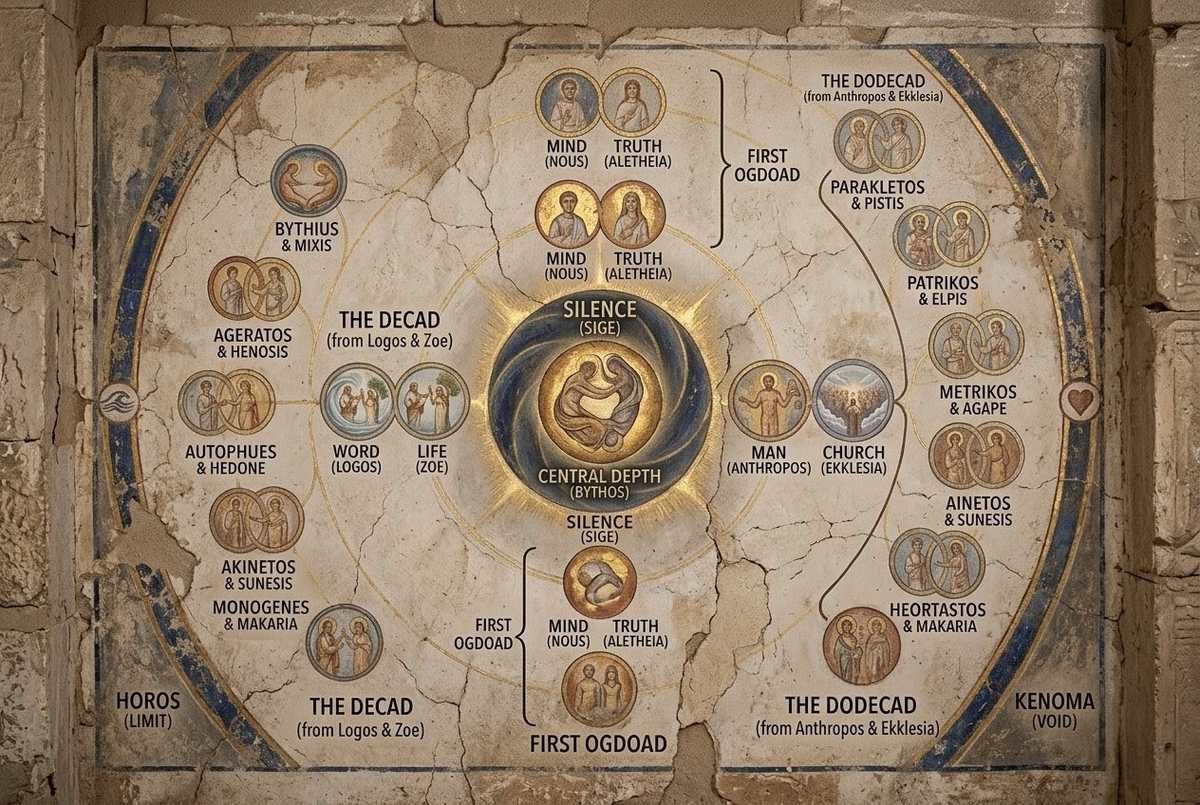
Some Valentinian systems describe thirty aeons arranged in fifteen paired relations called syzygies. These pairs express a deep conviction: fullness is relational. Divine life unfolds through complementary relation, not isolation.
Classic pairs include Depth and Silence, Mind and Truth, Word and Life, Humanity and Church. These names are not decorative labels. They show how Valentinian theology thinks: being is known through thought, speech, life, communion and relation.
The Pleroma is therefore a map of divine wholeness. The lower world becomes intelligible as a disturbance from this wholeness, and salvation becomes the restoration of relation to it.
Primary Source Theme: Valentinian sources and ancient reports imagine divine reality through Fullness, aeons and paired relations. The central idea is not a mechanical chart, but the wholeness of divine life unfolding through relation.
Sophia, Deficiency and the Lower World
Sophia, Wisdom, stands near the edge of the Valentinian drama. Her longing for the hidden source becomes associated with disturbance, passion or deficiency.
This is not usually a simple tale of wicked rebellion. It is a subtler myth of desire without measure. Wisdom longs for the Father, but the longing becomes unstable when it moves outside proper relation to Fullness.
From this disturbance comes deficiency, and from deficiency the lower order begins to emerge. The lower world is not the direct expression of perfect fullness. It is a mixed realm shaped by ignorance, incompletion and formation.
But Sophia is not abandoned. Her restoration is central. The story moves from disturbance to healing, from separation to reunion, from wounded Wisdom back towards the Fullness she longed to know.
Christ, the Saviour and Divine Accommodation
Valentinian Christianity remains deeply concerned with Christ. The Saviour is the one who descends from the higher order to reveal the Father, heal deficiency and awaken the spiritual seed.
Valentinian Christology is not simple. Some sources and hostile reports distinguish between heavenly Christ, Saviour and the earthly Jesus. Other texts, especially the Tripartite Tractate, offer a more integrated account of divine descent and manifestation.
It is therefore too crude to say that all Valentinians thought Jesus was merely an illusion. Some strands may sound docetic in certain respects, but the tradition as a whole is more complex. It asks how the divine can enter the lower order without being overcome by it.
The Saviour adapts to the level of those he restores. He reveals truth to the spiritual, guides the psychic and enters the condition of humanity so that what is scattered can begin to recognise its source.
Threefold Humanity and the Spiritual Seed
Valentinian anthropology often speaks of three kinds or layers of humanity: material, psychic and spiritual. This doctrine is famous, influential and easily misused.
The material, or hylic, is associated with matter, passion, ignorance and dissolution.
The psychic is associated with soul, faith, moral formation and the ordinary life of the Church.
The spiritual, or pneumatic, is associated with the divine seed, recognition and return to the Pleroma.
Ancient sources sometimes describe these categories sharply. Modern readers should not turn them into labels for living people. Read symbolically, the threefold pattern can describe layers within the human being: matter, soul and spirit; ignorance, formation and recognition; sleep, seeking and return.

Church, Community and Teaching
Valentinian Christianity did not exist only as private speculation. It had teachers, disciples, communities, scriptural interpretation and sacramental life.
This is clear from texts such as Interpretation of Knowledge, which addresses gifts, teachers, humility, body imagery and community order. Knowledge is not treated as isolated brilliance. It must become service within the body of truth.
The Valentinians could criticise ordinary church life while also drawing on its language and forms. They interpreted Church, sacrament and scripture through deeper symbolic meanings rather than simply abandoning them.
This is one reason they were so contested. They did not stand far enough away to be ignored. They worked with Christian materials from inside the workshop, reshaping them into another pattern.
Sacrament and the Bridal Chamber
Valentinian sacramental theology is especially visible in the Gospel of Philip and in Codex XI ritual fragments connected with A Valentinian Exposition. Key sacramental terms include baptism, chrism, eucharist, redemption and bridal chamber.
These rites are not treated as ordinary outward ceremonies alone. They symbolise transformation: cleansing, sealing, nourishment, release and restored union.
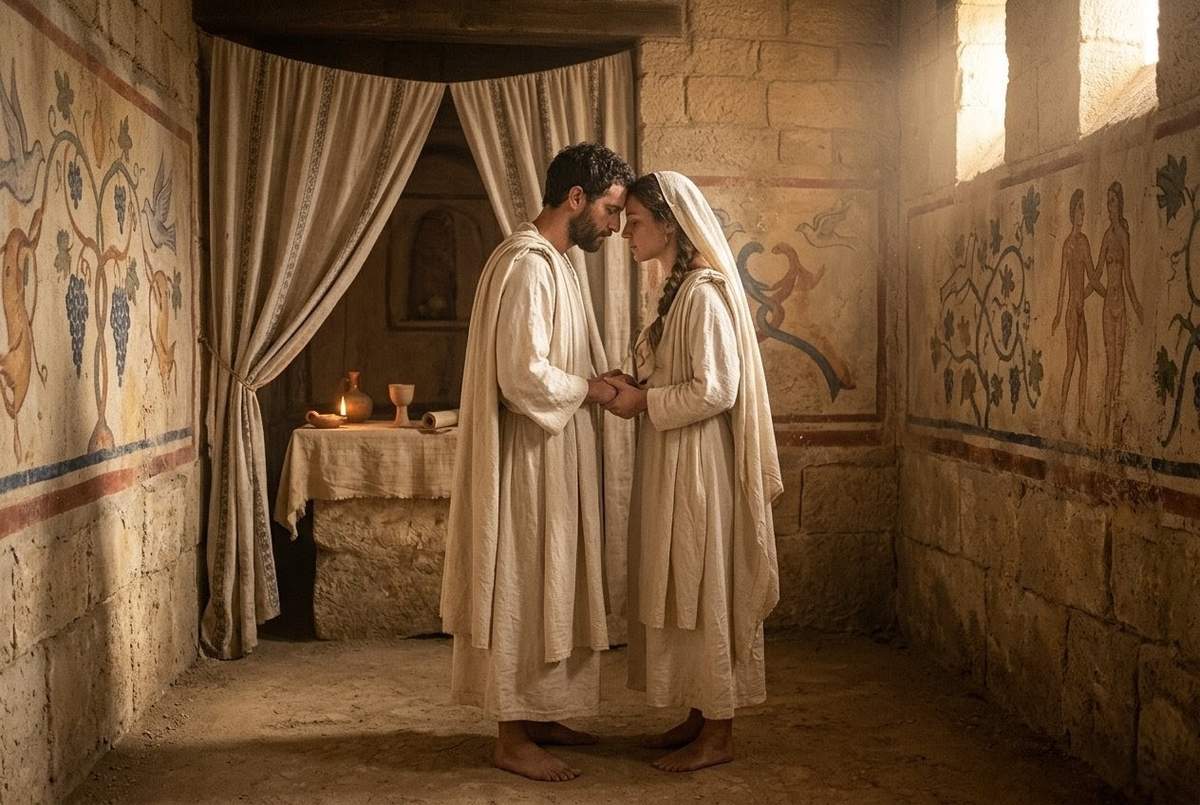
The bridal chamber, or nymphon, becomes the supreme image of restoration. It represents the reunion of the divided self with its heavenly truth, the healing of separation and the return of the image to its original.
The exact ritual details are not fully recoverable. Some evidence is fragmentary, and some comes from opponents. The safest reading is symbolic and historical: the bridal chamber was central because it expressed Valentinian salvation as union, not merely pardon or escape.
Why the Valentinians Were Condemned
Emerging catholic writers condemned Valentinian Christianity because it challenged several developing boundaries of orthodoxy.
First, it distinguished the highest Father from the lower creator or organiser of the world in ways that seemed to threaten biblical monotheism.
Second, it interpreted scripture through hidden meanings, giving teachers and spiritual interpretation a role that opponents considered dangerous.
Third, it divided humanity into different kinds or levels, which critics feared could undermine moral responsibility, church unity and ordinary Christian humility.
Fourth, its sacramental and Christological interpretations could seem to alter the public meaning of baptism, eucharist, resurrection and incarnation.
In short, the Valentinians were condemned not because they were shallow outsiders, but because they offered a rival inner reading of Christianity itself.
Influence and Legacy
Valentinian Christianity had a large impact on early Christian debate. Irenaeus devotes major attention to Valentinian systems, and later writers continue to treat the movement as a serious threat.
Its broader influence should be described carefully. Some later Christian themes, including interior knowledge, spiritual interpretation, divine image, restoration and the ascent of the soul, can be compared with Valentinian concerns. But direct influence must be argued case by case.
What can be said safely is that Valentinianism helped force early Christianity to clarify itself. By contesting creation, Christ, salvation, sacrament and spiritual knowledge, it sharpened the lines of orthodoxy and heresy.
It also preserved a vision that still fascinates: salvation as the restoration of relation, the healing of Wisdom, the awakening of the hidden seed, and the return of the divided self to Fullness.
Reading Valentinian Christianity Today
Modern readers should approach Valentinian Christianity as a historical Christian movement, not simply as a modern spiritual brand. Its categories belong to the second and third centuries, where Christian identity was still being argued into shape.
That means avoiding two errors. The first is dismissing Valentinianism as nonsense because later orthodoxy rejected it. The second is romanticising it as pure hidden truth untouched by human problems.
The more useful approach is careful reading. Valentinian Christianity was brilliant, symbolic, speculative and sometimes troubling. It could speak profoundly about restoration, but its hierarchy of spiritual types can also sound severe. It gave deep value to sacrament, yet some ritual details remain uncertain. It honoured Christ, but in forms that other Christians found unacceptable.
Read with that balance, Valentinian Christianity becomes one of the great alternate routes of early Christian thought. It asks whether salvation is only pardon, or whether it is also remembrance. It asks whether the world is merely created, or also wounded. It asks whether Christ only rescues, or also restores the broken pattern of Fullness. Its answer is a theology of return: the seed remembers, Sophia is healed, and the lost image finds its original.
Safety Notice: This article explores symbolic, historical and spiritual ideas about hidden knowledge, spiritual hierarchy, sacrament, Christian heresy, salvation, gendered imagery and spiritual identity. It is intended for grounded study of ancient texts, not as medical, psychological, legal, sexual or spiritual advice. Do not use ancient categories such as spiritual, psychic and material humanity to rank, pressure or control living people. If themes of hidden status, initiation, teacher authority or spiritual hierarchy become distressing or destabilising, seek support from a qualified professional, trusted support service or appropriate safeguarding body.
Frequently Asked Questions
What is Valentinian Christianity?
Valentinian Christianity is a second-century Christian Gnostic movement associated with Valentinus and his followers. It interprets Christian scripture, Christ, salvation, sacraments and Church through the language of the Pleroma, aeons, Sophia, spiritual seed, knowledge and restoration.
Was Valentinianism originally inside Christianity?
Valentinianism developed close to wider Christian life and used Christian scripture, sacramental language and Christology. Later catholic writers condemned it as heresy, but its earliest phase seems to have operated within or near Christian communities rather than as an entirely separate religion.
Who was Valentinus?
Valentinus was a second-century Christian teacher traditionally associated with Egypt, Alexandria and Rome. Ancient opponents present him as a major teacher whose followers developed one of the most sophisticated Christian Gnostic schools. Details of his life remain uncertain because much evidence comes from hostile sources.
What is the Pleroma in Valentinian Christianity?
The Pleroma means Fullness. In Valentinian Christianity it refers to the divine realm of aeons, paired relations and restored wholeness. It is the spiritual source from which the divine seed comes and to which it returns through knowledge and restoration.
What are the three natures in Valentinian thought?
Valentinian sources often speak of material, psychic and spiritual humanity. These categories relate to matter, soul and spirit, and to different degrees of openness to truth. Modern readers should treat them as ancient symbolic and theological categories, not as labels for living people.
What was the Valentinian view of Christ?
Valentinian Christology varied across sources. In broad terms, the Saviour descends from the higher order to reveal the Father, heal deficiency and awaken the spiritual seed. Some strands distinguish heavenly Christ, Saviour and earthly Jesus, while others present a more integrated theology of divine descent and restoration.
What is the bridal chamber in Valentinian Christianity?
The bridal chamber, or nymphon, is a major Valentinian sacramental symbol. It represents restored union: the divided soul reunited with its heavenly truth and the image restored to its original. It should not be reduced to ordinary marriage, secret sexual ritual or romantic fantasy.
Why was Valentinian Christianity condemned?
Valentinian Christianity was condemned because it offered a rival inner reading of Christian scripture, creation, Christ, salvation, sacraments and spiritual hierarchy. Emerging catholic writers saw it as a threat to biblical monotheism, church unity, public doctrine and moral responsibility.
How is Valentinian Christianity different from Sethian Gnosticism?
Sethian texts often emphasise archons, cosmic conflict, sacred names and ascent beyond hostile powers. Valentinian Christianity more often emphasises the Pleroma, paired aeons, Sophia’s deficiency, Christ, Church, sacraments, bridal chamber and restoration of relation.
Further Reading
Continue through the related Valentinian, Christian history and Nag Hammadi source layer:
- Valentinian Gnosticism: the broader overview of the Valentinian school, Pleroma, Sophia, spiritual seed and restoration.
- The Gospel of Truth: Valentinian meditation on error, joy, recognition and the Father’s name.
- The Tripartite Tractate: the most systematic Nag Hammadi witness to Valentinian theology.
- The Gospel of Philip: Valentinian sacrament, bridal chamber, chrism, names, images and sacred union.
- The Treatise on the Resurrection: resurrection as present transformation and spiritual understanding in Codex I.
- Interpretation of Knowledge: Valentinian community, spiritual gifts, teachers, humility and the body of truth.
- A Valentinian Exposition: Codex XI material connecting Valentinian cosmology with sacramental fragments.
- Valentinian Sacramental Theology: baptism, chrism, eucharist, redemption and bridal chamber as symbolic restoration.
- Sethian and Valentinian Traditions: a comparison of two major Gnostic currents in the Nag Hammadi Library.
- Nag Hammadi Library: Complete Guide to the Gnostic Scriptures: the wider archive guide to codices, tractates and traditions.
References and Sources
The following sources support the historical, textual and interpretive claims made in this article.
Primary Sources and Critical Editions
- The Gospel of Truth. Nag Hammadi Codex I,3.
- The Treatise on the Resurrection. Nag Hammadi Codex I,4.
- The Tripartite Tractate. Nag Hammadi Codex I,5.
- The Gospel of Philip. Nag Hammadi Codex II,3.
- Interpretation of Knowledge. Nag Hammadi Codex XI,1.
- A Valentinian Exposition. Nag Hammadi Codex XI,2.
- Irenaeus of Lyons. Against Heresies, especially Books I and II, as an ancient hostile witness to Valentinian systems.
- Tertullian. Against the Valentinians, as a Latin polemical witness to the reception of Valentinian teaching.
- Hippolytus of Rome. Refutation of All Heresies, especially Book VI, as another ancient witness to Valentinian traditions.
- Robinson, James M., ed. The Nag Hammadi Library in English. Harper & Row / HarperSanFrancisco, revised editions.
- Meyer, Marvin, ed. The Nag Hammadi Scriptures. HarperOne, 2007.
- Layton, Bentley. The Gnostic Scriptures. Doubleday, 1987.
Scholarly Monographs and Studies
- Thomassen, Einar. The Spiritual Seed: The Church of the Valentinians. Brill, 2006.
- Dunderberg, Ismo. Beyond Gnosticism: Myth, Lifestyle, and Society in the School of Valentinus. Columbia University Press, 2008.
- Markschies, Christoph. Valentinus Gnosticus? Mohr Siebeck, 1992.
- Esler, Philip F. The First Valentinians. Cambridge University Press, 2023.
- King, Karen L. What Is Gnosticism?. Harvard University Press, 2003.
- Williams, Michael Allen. Rethinking “Gnosticism”: An Argument for Dismantling a Dubious Category. Princeton University Press, 1996.
- Brakke, David. The Gnostics: Myth, Ritual, and Diversity in Early Christianity. Harvard University Press, 2010.
- Pagels, Elaine. The Gnostic Paul: Gnostic Exegesis of the Pauline Letters. Fortress Press, 1975.
Comparative and Thematic Studies
- Pagels, Elaine. The Gnostic Gospels. Random House, 1979.
- Pearson, Birger A. Ancient Gnosticism: Traditions and Literature. Fortress Press, 2007.
- Logan, A.H.B. Gnostic Truth and Christian Heresy: A Study in the History of Gnosticism. T&T Clark, 1996.
- van den Broek, Roelof. Gnostic Religion in Antiquity. Cambridge University Press, 2013.
- Rudolph, Kurt. Gnosis: The Nature and History of Gnosticism. HarperSanFrancisco, 1987.
- Clement of Alexandria. Stromata, as a witness to early Christian philosophical theology and contested esoteric interpretation.
- Origen. On First Principles, as a later Christian theological witness often compared with Gnostic and Platonist themes, though not simply reducible to Valentinian influence.
Reading Note: Valentinian Christianity is best read as the historical companion to the wider Valentinian Gnosticism overview. Valentinian Gnosticism maps the theology; Valentinian Christianity shows how that theology lived inside the contested world of early Christian teaching, community, sacrament and heresy.