What is The Demiurge? The Craftsman Of Matter and The Architect Of Form
At the heart of Gnostic cosmology stands a figure both familiar and strange: the Demiurge, the craftsman who shaped the material world. Depending on the text you open, he may be a benevolent artisan looking upward to divine blueprints, or a limited, self-important power who believes himself to be the highest god. Understanding this figure is essential for anyone seeking to navigate the landscape of ancient esoteric thought and its modern echoes.
The concept appears across dozens of Nag Hammadi tractates, in the writings of Church Fathers who sought to refute it, and in the dreams and speculations of contemporary seekers who find in this ancient figure a surprisingly accurate map of modern alienation. This glossary entry traces the term from its Greek origins through its dramatic Gnostic inversion, and into contemporary interpretations that still find the concept disturbingly relevant.
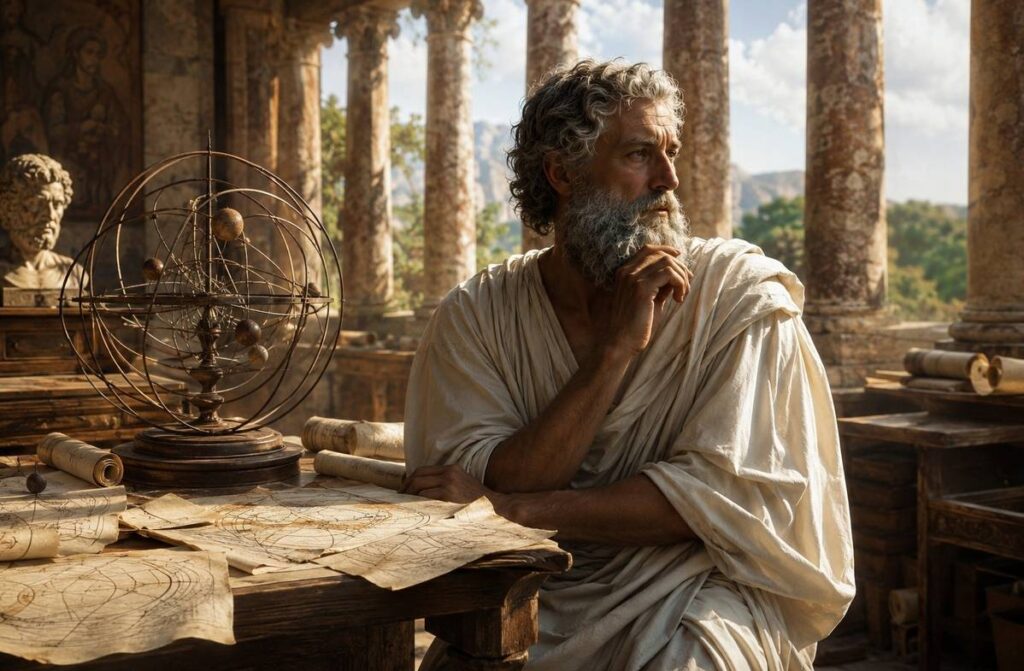
Table of Contents
- The Platonic Origins: A Craftsman Looking Upward
- The Gnostic Inversion: Craftsman Becomes Captor
- Names and Faces: Yaldabaoth, Saklas, and Samael
- Modern Interpretations: From Jung to the Simulation Hypothesis
- Why the Demiurge Still Matters
The Platonic Origins: A Craftsman Looking Upward
The term derives from the Greek demiourgos, literally a public worker or artisan who serves the community through skilled labour. In Plato’s dialogue Timaeus (c. 360 BCE), the Demiurge is presented as a wholly positive, even reverent figure. He is not the ultimate source of all reality — that role belongs to the eternal Forms and the Form of the Good — but rather the cosmic artisan who looks upward to the Forms as unchanging templates and then shapes the pre-existing chaos of matter into an ordered, living universe.
For Plato, the Demiurge is motivated by pure goodness. He wishes for the world to be as excellent as possible, given the inherent recalcitrance and imperfection of matter. The cosmos he produces is described as a single, visible, living creature containing all other creatures within it, a macrocosmic organism animated by a world-soul. This is a figure of deep philosophical reverence, not rebellion. The Demiurge delegates much of the detailed work of creating human bodies and lower creatures to lesser gods — the “young gods” — but remains the principal architect of cosmic order, mathematical proportion, and celestial harmony.
Middle Platonist philosophers such as Numenius of Apamea (2nd century CE) began to introduce a subtle ambivalence into the tradition. Numenius posited a first God who is purely intellectual, static, and self-contained, and a second God — the Demiurge — who is more actively engaged with matter and thus somewhat inferior by virtue of that contact. This tension between a higher, unknowable divinity and a lower, active creator provided fertile ground for the more radical Gnostic reimagining that followed. By the time Gnostic teachers in Alexandria and beyond encountered these Platonic frameworks, the Demiurge was already a figure poised between reverence and suspicion.
The Gnostic Inversion: Craftsman Becomes Captor
In the Nag Hammadi Library and related Gnostic texts, the Demiurge undergoes a profound and dramatic transformation. He is no longer the benevolent craftsman looking upward to eternal models; he becomes a being who looks only downward or inward, ignorant of the realm above him and often hostile to any revelation that might expose his limitation. The Apocryphon of John (NHC II,1) provides the most elaborate and influential portrait. Here, the Demiurge is called Yaldabaoth, a creature born from Sophia’s untimely desire to know the transcendent Father — a miscarriage that sinks into the lower regions and there congeals into a monstrous, self-aggrandising power.
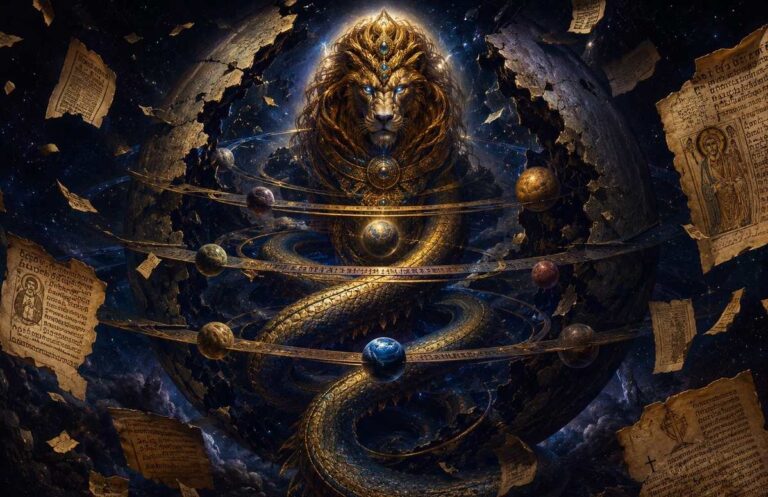
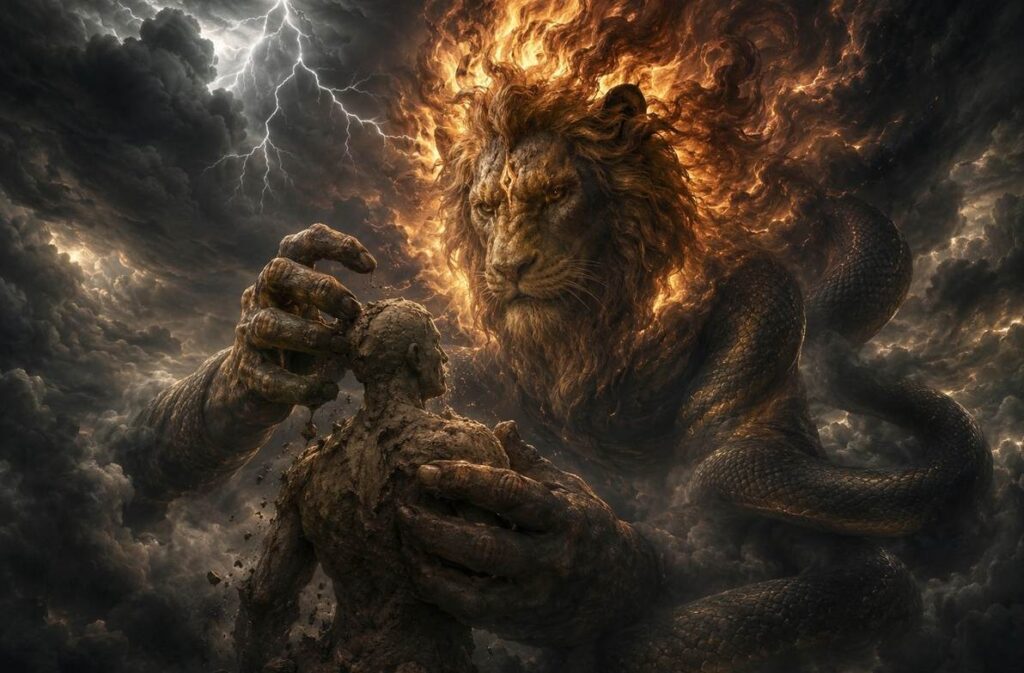
Yaldabaoth is often depicted with the face of a lion and the body of a serpent, glowing with ethereal fire. He is androgynous, containing both male and female principles within his chaotic body. When he looks upon the created world and the creatures he has shaped, he declares with arrogant certainty, “I am God and there is no other god beside me,” not realising that above him exist the eternal aeons, the transcendent Father, and the divine Mother Barbelo. This declaration is the archetype of spiritual ignorance: the lower power that mistakes its local jurisdiction for absolute sovereignty, its partial vision for complete knowledge.
The Sethian tradition presents the Demiurge as actively obstructive to the divine light. He creates the material body as a prison for the divine sparks that have fallen from the Pleroma. He sets archons as planetary gatekeepers to prevent the ascent of souls. He attempts to extract the power of light from Adam and Eve, fashioning their bodies from the slime of matter and breathing only a psychic soul into them, while the spiritual essence enters secretly from above. In this system, the Demiurge is not evil in a personal, moralistic sense — he is more like a blind functionary who believes his own propaganda, enforcing a system he does not fully understand and cannot ultimately control.
The Valentinian school, by contrast, offers a more nuanced and psychologically sophisticated view. For Valentinus and his followers, the Demiurge is indeed ignorant of the highest Father, but he is not wicked or malevolent. He acts as a necessary administrator of the cosmic order, a kind of deputy creator working with the materials available to him. Matter and the lower world serve as a kind of therapeutic environment — a hospital, in one Valentinian metaphor — where the fallen Sophia and the sparks of light within human souls can be purified, educated, and gradually restored to their proper place. The Valentinian Demiurge is a deputy rather than a tyrant, and he will ultimately be enlightened and redeemed when the final restoration (apokatastasis) brings all things back into harmony. This more compassionate reading recognises that even limitation and ignorance serve a purpose in the larger economy of salvation.
Names and Faces: Yaldabaoth, Saklas, and Samael
The Demiurge is known by many names across Gnostic and related literature, each revealing a different facet of his nature and function. These names are not mere aliases; they are theological diagnoses, pointing to specific limitations and pathologies of the lower creator.
Yaldabaoth is the most common Sethian name, possibly derived from Aramaic elements meaning “child of chaos” or interpreted through gematria as having the numerical value of 365, corresponding to the days of the solar year and his role as a solar deity. He is the chief archon, the first ruler of the darkness, and the father of the seven planetary powers. In the Apocryphon of John, he is the first offspring of Sophia’s grief, a being who carries the chaos of his origin in every act of creation.
Saklas is an Aramaic term meaning “fool.” This name emphasises the Demiurge’s spiritual stupidity: he who thinks himself the highest is revealed as the greatest fool, the cosmic jester who does not know the punchline of his own joke. The Gospel of Judas uses this name to underline the absurdity of the lower god’s self-worship.
Samael means “blind god” or “god of the blind” in Hebrew traditions. This name underscores the Demiurge’s inability to perceive the higher divine reality. In some texts, he is also called “the poison of God,” suggesting his corrupting influence on matter and his capacity to introduce death into the created order. Where the highest God gives life, the blind god gives only animated form that eventually decays.
In various passages, the Demiurge appropriates or is confused with the biblical names Ariel, El, and Elohim. This identification was deeply controversial and formed a central element of the Gnostic critique of orthodox Jewish and Christian traditions. The Gnostics did not necessarily deny the power or even the relative legitimacy of the biblical God; they reclassified him as a lower, limited power who had forgotten his own mother and source. This move allowed Gnostic thinkers to account for the violence and caprice of the Old Testament deity while preserving a higher, purely loving divinity beyond him.
Modern Interpretations: From Jung to the Simulation Hypothesis
Carl Gustav Jung found in the Demiurge a powerful and enduring psychological symbol. In his analytical psychology, Yaldabaoth represents an autonomous psychic complex — a fragment of the collective unconscious that has split off from the greater whole and claims total authority within the psyche. The Demiurge is the psyche’s tendency to create a rigid, defensive ego-structure that believes itself to be the whole of consciousness, while remaining oblivious to the Self, the greater totality that encompasses both conscious and unconscious elements. For Jung, confronting the Demiurge is an essential part of the individuation process: recognising where our own inner “creator” has become tyrannical, dogmatic, or deluded, and where we have mistaken our partial ego-identity for the fullness of who we are.
In contemporary Gnostic revival circles, the Demiurge has become a potent metaphor for systemic structures that claim absolute authority while remaining ignorant of higher values. The Demiurge represents not a personal devil but an impersonal system: institutional religion that has forgotten its mystical roots, political ideologies that sacrifice living human beings to abstract principles, or economic systems that treat human labour and the natural world as mere matter to be shaped, consumed, and discarded. To “name the Demiurge” in this context is to practise discernment: to ask whether the systems demanding our allegiance actually serve the highest good, or merely their own perpetuation.
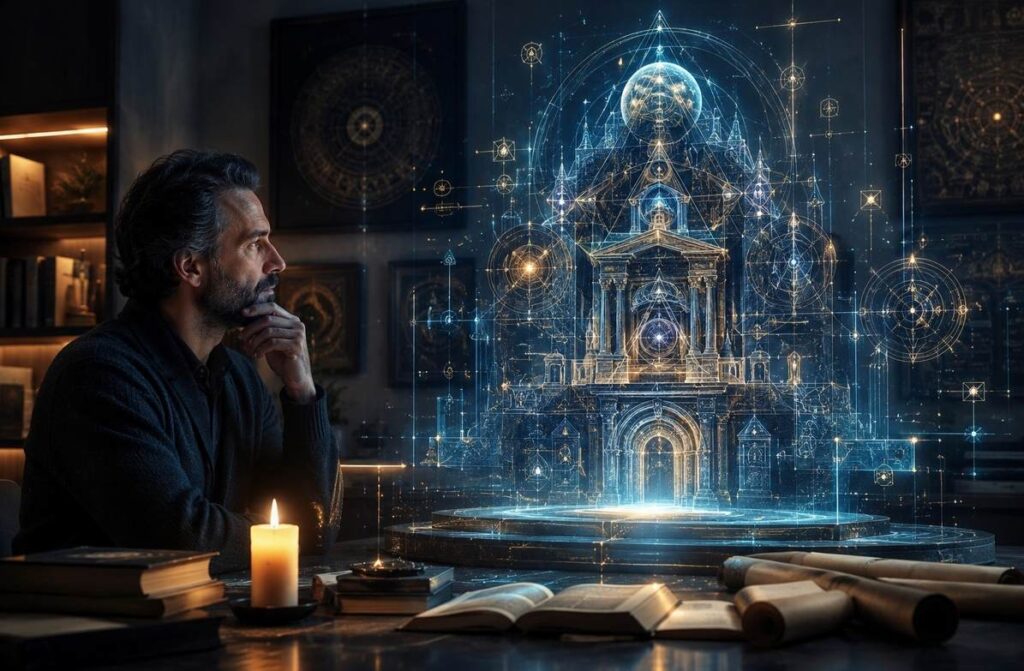
The simulation hypothesis and digital culture have given the Demiurge striking new clothing. Some modern thinkers draw deliberate parallels between the Gnostic Demiurge and a hypothetical cosmic programmer — an advanced but limited intelligence that constructs a virtual reality without full access to the “source code” of the ultimate reality. In this reading, the Demiurge is the architect of the Matrix who does not know the existence of Zion, the game designer who has become trapped in his own creation. The ancient myth becomes a framework for questioning the ontological status of our technologically mediated world, where algorithms increasingly shape perception and where the “creator” of our informational environment may indeed be blind to the fuller truth of human existence.
Why the Demiurge Still Matters
The Demiurge endures because he names a perennial human experience: the sense that the world we inhabit was made by something less than the highest wisdom, and that this “something” demands our compliance while withholding the full truth. Whether encountered in ancient Coptic manuscripts, Jungian analysis, or contemporary critiques of technological society, the Demiurge represents the moment of recognition when we realise that the authority we took for absolute is, in fact, provisional and partial.
To recognise the Demiurge is not necessarily to reject the material world. Even in the most dualistic Gnostic systems, matter is not inherently evil — it is simply the domain of a lower order of intelligence, a rough draft rather than a final masterpiece. The task of the Gnostic, the knower, is to see through the Demiurge’s claim to ultimacy and to awaken to the light that precedes and transcends his creation. In this awakening, the Demiurge himself is not destroyed but relativised, returned to his proper place as a craftsman rather than a god. The prison becomes a school, the warden becomes a teacher, and the material world — once seen through — becomes the very field in which recognition flowers.
Frequently Asked Questions
What does the word Demiurge mean?
The word Demiurge comes from the Greek demiourgos, meaning a public craftsman or skilled worker. In ancient philosophy, it refers to the divine artisan who shapes the material cosmos from pre-existing matter, acting as an intermediary between the eternal Forms and the physical world.
Is the Demiurge the same as the Christian God?
In Gnostic systems, the Demiurge is often identified with or confused with the biblical God of Israel, but he is understood as a lower, limited power. Gnostic texts distinguish between this lower creator and the transcendent, unknowable Father who exists beyond all cosmic jurisdiction.
Who is Yaldabaoth in Gnostic texts?
Yaldabaoth is the primary name for the Demiurge in Sethian Gnostic texts such as the Apocryphon of John. He is depicted as a lion-headed serpent born from Sophia’s fall, arrogant and ignorant, who declares himself the only god while remaining blind to the higher divine reality above him.
Is the Demiurge evil?
The Demiurge is not necessarily evil in a personal sense, though he is often portrayed as ignorant, arrogant, or obstructive. Valentinian Gnostics viewed him as a necessary administrator with a limited role, while Sethian texts present him as more hostile to the divine light.
What is the difference between the Platonic and Gnostic Demiurge?
Plato’s Demiurge is a benevolent craftsman who looks upward to the eternal Forms as models for creation. The Gnostic Demiurge is an inversion of this figure: he looks only downward, is ignorant of the higher realm, and mistakenly believes himself to be the supreme power.
How does Carl Jung interpret the Demiurge?
Carl Jung interpreted the Demiurge as a symbol of the autonomous psychic complex — a rigid ego-structure that claims total authority within the psyche while remaining unconscious of the greater Self. Confronting this inner Demiurge is part of the individuation process toward psychological wholeness.
What is the modern relevance of the Demiurge concept?
Today, the Demiurge serves as a metaphor for systemic structures — political, religious, or technological — that demand absolute allegiance while remaining blind to higher values. The concept helps identify where authority has become self-perpetuating and cut off from deeper wisdom.
Further Reading
Explore these ZenithEye articles to deepen your understanding of the Demiurge and the traditions that shaped him.
- The Apocryphon of John: Gnostic Creation, the Three Natures, and the Five Seals — The primary Nag Hammadi text detailing Yaldabaoth’s birth, nature, and the creation of humanity.
- The Reality of the Archons: Eve, the Stranger, and the Rulers of Darkness — Explores the archontic powers who serve the Demiurge as planetary gatekeepers.
- The Names of the Archons: A Guide to Gnostic Entities and Their Domains — A comprehensive guide to the entities and titles associated with the Demiurge’s administration.
- Pleroma and Kenoma: The Foundational Geography of Gnostic Cosmology — Understanding the divine fullness and the lower realm where the Demiurge operates.
- The Gnostic Answer to Evil: Why Suffering Proves the Demiurge — Examines how the Demiurge explains the problem of suffering and cosmic injustice.
- The Demented God Architect — A closer look at the flawed creator figure across Gnostic and esoteric traditions.
- Gnosticism vs Orthodox Christianity: What the Early Church Suppressed — Context on why the Demiurge doctrine was deemed heretical and how it shaped Christian history.
- What Is Gnosticism? The Ancient Currents of Direct Knowledge — The broader tradition within which the Demiurge concept resides and functions.
- The Gnostic Technical Glossary: Key Terms Every Seeker Should Know — Definitions of related terms including archons, aeons, hylic nature, and the Pleroma.
- The Archons Feed on Suffering: Gnosticism as Political Critique — A modern political reading of the Demiurge’s systemic power and how to resist it.