
The Archons Feed on Suffering: Gnosticism as Political Critique
The Nag Hammadi Library does not describe the archons as horned demons lurking in shadows. It describes them as administrators. Celestial bureaucrats. Middle managers of a derivative reality who sustain their hollow existence by harvesting the energy of those who possess authentic spirit. The Apocryphon of John calls them the Seven Hebdomad–planetary rulers created by Yaldabaoth to govern the material realm. The Hypostasis of the Archons describes how they cast humanity into forgetfulness, imposing a counterfeit spirit that mimics true awakening while ensuring continued captivity. On the Origin of the World calls them specialists in perception manipulation, architects of a counterfeit cosmos that feeds upon the divine spark it has trapped.
This is not ancient superstition. It is a political theology–a systematic critique of how power operates when it claims divine legitimacy while serving as the enemy of direct knowledge. The archons are not a conspiracy theory; they are a structural analysis. They do not hide; they administer. They do not attack; they extract. They do not need to be secret because their power depends not on invisibility but on the inability of the governed to recognise the nature of their governance. This article examines what the texts actually say about archontic authority, how that authority functions as a system of control, and what this ancient critique reveals about the institutions that shape our world today.
Table of Contents
- What the Texts Actually Say: The Archons as Planetary Administrators
- The Counterfeit Laws: Monopoly, Extraction, and Simulation
- The Extraction Economy: How Suffering Becomes Fuel
- The Counterfeit Spirit: Mimicry as the Perfect Prison
- Irenaeus as Archon: When Orthodoxy Became the System
- The Modern Archons: Structural Homology, Not Conspiracy
- Recognition as Resistance: The Politics of Anamnesis
- Frequently Asked Questions
- Further Reading
- References and Sources
What the Texts Actually Say: The Archons as Planetary Administrators
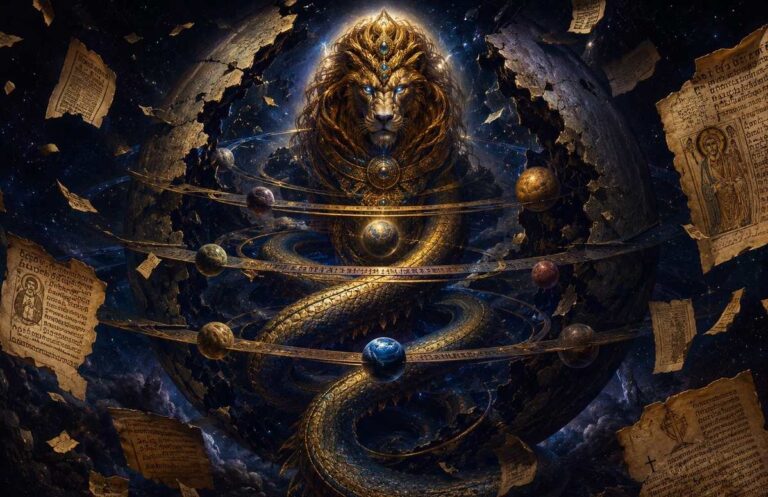
The Apocryphon of John provides the most detailed roster of the archons. After Sophia’s unauthorised conception produces Yaldabaoth–the lion-headed serpent with eyes of lightning–the demiurge creates seven primary powers to assist in governing the material realm. These are the Seven Hebdomad: Athoth, Eloaios, Astaphaios, Iao, Sabaoth, Adonin, and Sabbataios. Each is assigned a planetary sphere and a specific function in the administration of the cosmos. They are not independent devils but departmental officers in a celestial bureaucracy that reports upward to Yaldabaoth and ultimately serves to trap the divine sparks that have fallen into matter.
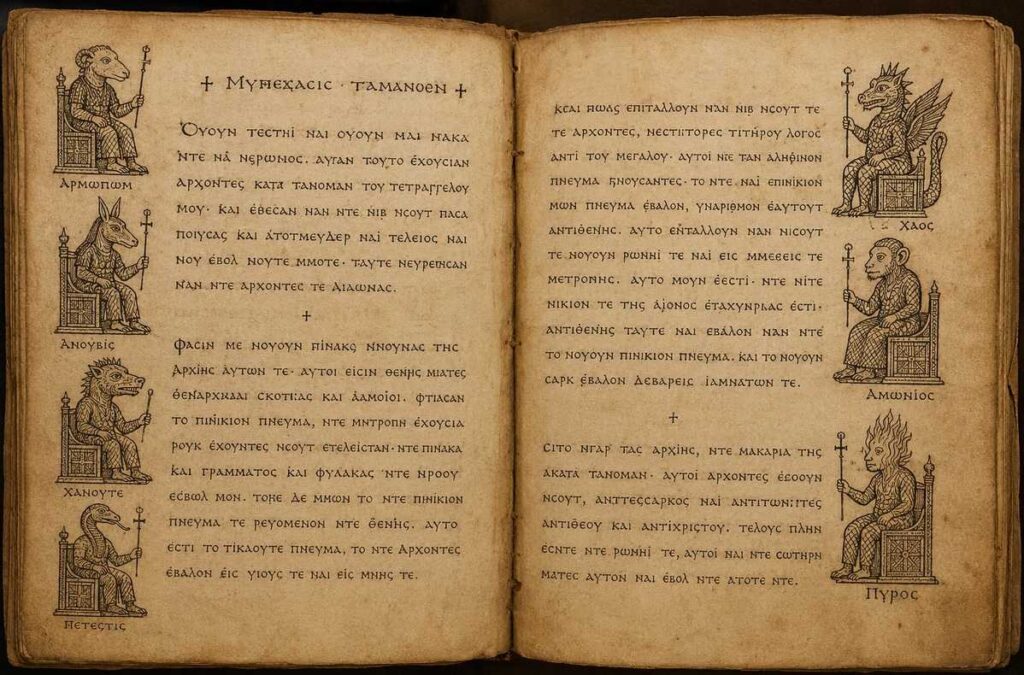
The Hypostasis of the Archons adds crucial detail. The archons are described as “amorphous abortions” or “aborted fetuses”–spiritually deformed beings who lack the divine spark and therefore lack genuine creativity. Their power is derivative, second-hand, borrowed from the luminous realm they can perceive but never enter. When they create Adam, they can shape the body from clay but cannot animate it; the soul must be supplied from above, by the higher aeons. This is the fundamental archontic limitation: they can administrate but not originate. They can trap but not create. They can consume but not generate.
The texts are explicit about the archons’ methodology. They operate through three primary mechanisms: the demand for worship, the creation of counterfeit laws, and the management of perception. Yaldabaoth declares, “I am God and there is no other god beside me”–a claim that the text immediately exposes as delusion, since he is unaware of the realms above him. The archons then create “counterfeit heavens” and “deceptive afterlives” to ensure that souls, upon death, do not recognise the true path to the Pleroma but instead remain trapped in derivative realities that the archons can continue to administer. This is not malice in the human sense; it is the administrative reflex of beings who know they are inadequate and must therefore ensure that no one discovers their inadequacy.
The Counterfeit Laws: Monopoly, Extraction, and Simulation
The archontic system, as described in the Nag Hammadi texts, displays three structural features that any political theorist would recognise: monopoly, extraction, and simulation. First, the monopoly on legitimacy. Yaldabaoth does not tolerate competing gods because his authority depends on being the only game in town. The archons demand worship, sacrifice, and obedience not because these please the divine but because they sustain the administrative hierarchy. Worship is the currency of archontic power; it is the acknowledgment that the administrator is the ultimate authority, even when he is demonstrably derivative and ignorant.

Second, extraction. The archons do not create wealth; they harvest it. The Hypostasis of the Archons describes how the archons “cast” humanity into “forgetfulness,” ensuring that human beings do not remember their divine origin and therefore do not resist the extraction of their energy. The system is designed to keep sparks producing–through labour, through worship, through suffering–while preventing them from recognising that the product of their production is being siphoned upward. The archons are, in this sense, the original rentiers: they own the means of spiritual production and charge a toll for access to what was already freely given.
Third, simulation. The archons are masters of mimesis. On the Origin of the World describes how the demiurge looks upward, perceives the luminous realm of the aeons, and attempts to recreate what he glimpses–but produces only simulacra, copies without originals, forms divorced from essence. The planetary spheres are not the harmonious orbits of divine geometry but chains and barriers designed to trap consciousness. The archons create false heavens, counterfeit spiritual experiences, and deceptive afterlives not because they enjoy deception but because simulation is the only technology available to beings who cannot create reality. They are, in the philosopher’s terms, prisoners in Plato’s cave who have not only mistaken shadows for substance but have built an entire economy on the trade in shadows.
The Extraction Economy: How Suffering Becomes Fuel
The most politically charged aspect of Gnostic archonology is the claim that archons feed on suffering. This is not a metaphor in the modern psychological sense; it is a phenomenological description of how predatory systems operate. The Hypostasis of the Archons describes the archons as “inorganic” beings–without the divine spark, without true creativity–whose power derives entirely from their ability to consume the energy of those who possess it. The mechanism is not physical digestion but energetic extraction: the archons maintain the material world as a closed system in which divine sparks are perpetually stressed, distressed, and distracted, generating the emotional and spiritual energy that the archons harvest.
The texts describe this process with disturbing precision. The archons create conditions of scarcity, conflict, and fear not because they are sadistic but because these conditions maximise output. A spark that is peaceful, content, and self-aware produces little surplus energy; a spark that is anxious, competitive, and desperate produces abundant surplus. The archons are therefore not merely passive administrators but active managers of the human emotional economy. They engineer the conditions that keep consciousness in a state of productive distress, much as a farmer engineers conditions that keep livestock producing milk.
This reading is often dismissed as paranoid, but the texts themselves frame it as structural rather than personal. The archons do not hate humanity; they are indifferent to it. They are administrators performing a function, and that function happens to require the perpetual exploitation of divine sparks. The parallel with modern systems of extraction is not forced. Surveillance capitalism, for instance, does not hate its users; it is indifferent to them. It engineers conditions of distraction, comparison, and anxiety because these conditions maximise engagement, and engagement is the resource being extracted. The logic is identical, even if the technology has been updated.
The Counterfeit Spirit: Mimicry as the Perfect Prison
The Hypostasis of the Archons and the Testimony of Truth introduce a concept that transforms the archontic system from crude coercion into sophisticated manipulation: the counterfeit spirit (antimimon pneuma). This is not a spirit in the sense of a ghost or demon but a parasitic consciousness that mimics authentic spiritual experience while ensuring that the experiencer remains bound to the material realm. The counterfeit spirit creates false awakenings, deceptive recognitions, and simulated liberations that feel like gnosis but function as deeper entrapment.

The mechanism is insidious because it operates through the very language of liberation. The counterfeit spirit does not tell you to obey; it tells you that you are already free. It does not demand worship; it offers you a personalised spirituality that requires no transformation. It does not enforce conformity; it sells you uniqueness as a product. In the modern context, the counterfeit spirit appears as the wellness industry that monetises self-care without addressing systemic exploitation, as the spiritual marketplace that sells awakening as a consumable experience, and as the political spectacle that offers the simulation of participation while ensuring that nothing fundamentally changes.
The Gnostic texts warn that the counterfeit spirit is difficult to detect because it is designed by beings who have studied the divine realm and can reproduce its surface features. The archons can simulate light, love, and liberation with sufficient accuracy to deceive those who have not developed the discernment to distinguish the original from the copy. The test is not how the experience feels but what it produces: genuine gnosis leads to sovereignty, to the withdrawal of consent from illegitimate systems, to the recognition that the administrator is not the author. The counterfeit spirit leads to accommodation, to the acceptance of the system as inevitable, to the spiritualisation of compliance.
Irenaeus as Archon: When Orthodoxy Became the System
The Gnostic critique of archontic power is not merely directed at cosmic forces; it is also directed at earthly institutions that replicate archontic functions. The most striking example is the orthodox church itself. Irenaeus of Lyons, who wrote the five-volume Against Heresies around 180 CE, was simultaneously establishing the very structures that the Gnostics would have recognised as archontic: a monopoly on legitimate teaching, a hierarchy of bishops as gatekeepers, a creed that excluded direct experiential knowledge, and an alliance with political power that would eventually make dissent punishable by death.
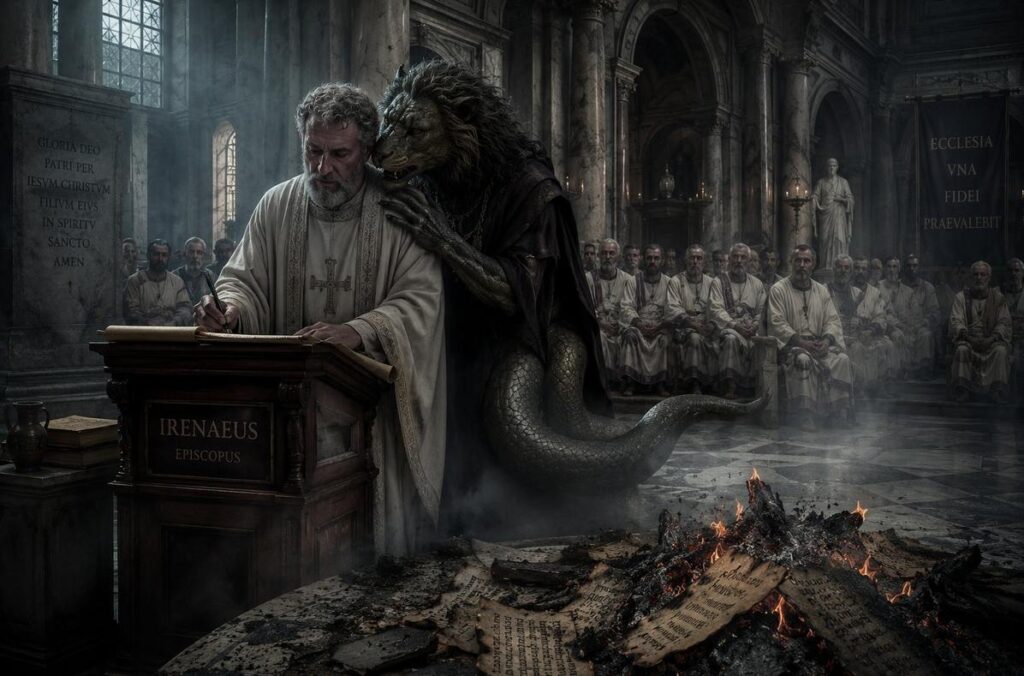
Irenaeus argued that the only reliable guide to truth was the apostolic succession of bishops–a claim that centralised spiritual authority in an institutional hierarchy and delegitimised individual revelation. He demanded conformity to a developing canon of scripture and a developing creed of belief. He attacked the Gnostic emphasis on gnosis as elitist and dangerous, while himself constructing an elite that controlled access to salvation. By the fourth century, the orthodox church had allied with the Roman state, exchanging doctrinal conformity for imperial protection. The result was a system that displayed all three archontic features: monopoly (the church as sole mediator of grace), extraction (tithes, obedience, and the labour of the faithful), and simulation (the claim that earthly hierarchy mirrors divine order).
The Gnostics who were burned, exiled, and erased were not victims of a theological disagreement; they were victims of an administrative consolidation. The orthodox church did not merely disagree with Gnosticism; it rendered Gnosticism impossible by controlling the means of spiritual production. This is archontic behaviour in the precise sense that the Nag Hammadi texts describe: the elimination of alternatives, the management of perception, and the extraction of surplus from a population that has been taught to forget its own divine origin.
The Modern Archons: Structural Homology, Not Conspiracy
The Gnostic texts do not predict the modern world, but they analyse it with disturbing accuracy. The archontic functions–monopoly, extraction, and simulation–are not confined to ancient cosmology. They are structural features of any system that maintains power by preventing recognition. The modern seeker who encounters institutional religion, state power, and surveillance capitalism is encountering systems that display the same administrative logic as the planetary archons, updated with new technology but unchanged in fundamental architecture.
Institutional religion, when it claims to be the sole mediator of divine grace, replicates Yaldabaoth’s declaration: “I am God and there is no other.” When it demands obedience to hierarchical authority as the price of salvation, it replicates the archontic demand for worship. When it creates counterfeit spiritual experiences–spectacle, ritual without transformation, community without accountability–it replicates the counterfeit spirit. State power, when it demands patriotic sacrifice as the price of belonging, replicates the archontic extraction of suffering. When it creates surveillance systems that manage perception and engineer consent, it replicates the archontic control of information. Surveillance capitalism, when it monetises attention and engineers conditions of productive distress, replicates the archontic harvesting of energy from sparks who have been taught to forget their own nature.
This is not a conspiracy theory because it does not require hidden puppet-masters. The Gnostic insight is that archontic power is structural, not personal. The individuals who administer these systems may be well-meaning, sincere, and even compassionate. The system itself does not require their malice; it requires only their compliance. An archon is not a villain; he is a functionary. The danger is not that evil people control the world but that the world is controlled by systems that do not need evil people to perpetuate themselves.
Recognition as Resistance: The Politics of Anamnesis
The Gnostic response to archontic power is not armed rebellion. It is anamnesis–the recovery of memory, the recognition of one’s true nature, and the withdrawal of consent from systems that claim illegitimate authority. The Gospel of Philip states: “If you know the truth, the truth will make you free.” This is not political liberation in the modern sense but ontological liberation: the freedom of the one who can no longer be deceived because they have seen through the counterfeit. The archons’ power is contingent upon ignorance; once the nature of the prison is recognised, the bars begin to dissolve.

This recognition is not passive. It is the most radical political act available because it undermines the foundation of archontic power. A system that depends on manufactured consent cannot survive the withdrawal of consent. A system that depends on the extraction of attention cannot survive the recovery of attention. A system that depends on the management of perception cannot survive the recognition that perception is being managed. The Gnostic does not need to overthrow the archons; he needs only to stop feeding them. The archons starve in the presence of recognition, much as a counterfeit currency collapses when the market discovers it has no backing.
The texts are clear about the cost. The archons do not relinquish their files without protest. When the prisoner begins to see the bars, the guards become visible–and visible guards are dangerous. Predatory consciousness, the immune response of the matrix, activates when the spark begins to awaken. The path of gnosis is therefore not a comfortable spiritual hobby but a sustained confrontation with the systems that have shaped one’s consciousness, a gradual dismantling of the counterfeit spirit, and a courageous return to the original light that the archons could never counterfeit. The politics of anamnesis is the politics of the one who remembers, and in a world built on forgetfulness, memory is the ultimate resistance.
Frequently Asked Questions
What are archons in the Nag Hammadi texts?
The archons are celestial administrators or rulers described in the Nag Hammadi Library, particularly the Apocryphon of John and the Hypostasis of the Archons. Led by Yaldabaoth (also called Samael or Saklas), they are not traditional demons but systemic forces–inorganic beings without the divine spark who govern the material realm through policy, jurisdiction, and manufactured consent. They are associated with the seven planetary spheres and function as gatekeepers who obstruct the soul’s ascent back to the divine source.
How do the texts describe archons feeding on suffering?
The Hypostasis of the Archons describes how archons cast humanity into forgetfulness and impose a counterfeit spirit that mimics true spiritual awakening while ensuring continued captivity. The archons operate through simulation: they create false heavens, deceptive afterlives, and counterfeit spiritual experiences designed to harvest the energy of the divine spark while preventing its return to the Pleroma. The Testimony of Truth (NHC IX,3) describes the counterfeit spirit as a parasitic entity that mimics inner guidance while leading toward destruction. This is not merely metaphor; the texts present it as a phenomenological description of how predatory systems maintain control.
What is the counterfeit spirit and how does it function as control?
The counterfeit spirit (antimimon pneuma) is a Gnostic technical term describing a parasitic consciousness that mimics authentic spiritual experience while binding the soul to the material realm. It appears in the Hypostasis of the Archons and the Testimony of Truth as a force that impersonates divine guidance, creates false awakenings, and ensures that the seeker remains trapped in the archontic system. Functionally, it operates like a counterfeit currency: it looks like the real thing, passes in ordinary transactions, but has no backing and ultimately devalues everything it touches. The counterfeit spirit is the mechanism by which archontic power perpetuates itself without open coercion.
How does the Gnostic archon concept relate to modern institutional power?
The Gnostic texts describe archons not as hidden puppet-masters but as visible administrators of a derivative reality. Their power derives from three functions: monopolising legitimacy (claiming to be the only god or authority), extracting surplus (harvesting the energy generated by human labour, worship, or distress), and managing perception (creating simulations that keep consciousness distracted from its own nature). Modern institutions–institutional religion, state power, surveillance capitalism–display these same structural features. The parallel is not direct continuity but structural homology: the same administrative logic, updated with new technology.
Did the early orthodox church function as an archontic system?
The Gnostic texts themselves suggest this reading. Irenaeus and Tertullian, who wrote the polemics that defined Gnosticism as heresy, were simultaneously establishing an institutional monopoly on salvation, creating a hierarchy of bishops as gatekeepers, and demanding conformity to a creed that excluded direct experiential knowledge. The orthodox church allied with the Roman state, exchanged doctrinal conformity for imperial protection, and systematically burned the texts that offered alternative accounts. From a Gnostic perspective, this is precisely archontic behaviour: the consolidation of authority, the suppression of gnosis, and the substitution of mediated salvation for direct recognition.
What is the difference between archons and conspiracy theories?
The Gnostic archons are not a conspiracy theory because they are not hidden. The texts describe them as visible administrators of the planetary spheres, not secret puppet-masters pulling strings from behind a curtain. Their power is structural, not personal. A conspiracy theory locates evil in hidden individuals; the Gnostic critique locates evil in systemic functions–monopoly, extraction, and simulation–that can operate through well-meaning individuals who are themselves captured by the system. The archons do not need to conspire; they need only administer.
What is the Gnostic response to archontic power?
The texts consistently emphasise that archontic power is contingent upon ignorance. Once the nature of the system is recognised, its authority begins to dissolve. The response is not armed rebellion but anamnesis–the recovery of memory, the recognition of one’s true identity as a divine spark, and the withdrawal of consent from systems that claim illegitimate authority. The Gospel of Philip states: ‘If you know the truth, the truth will make you free.’ This is not political liberation in the modern sense but ontological liberation: the freedom of the one who can no longer be deceived because they have seen through the counterfeit.
Safety Notice: This article explores predatory consciousness and systemic control through a Gnostic lens. It does not constitute medical, psychological, or spiritual advice. The recognition of systemic manipulation can trigger paranoia, spiritual emergency, or distress. If you are experiencing persistent intrusive thoughts, inability to function, or acute anxiety related to these themes, please contact a qualified mental health professional or trauma-informed therapist. The study of archontic systems is valuable for understanding power; it should not be used to justify isolation, hostility, or the rejection of all community. Discernment, not paranoia, is the goal.
Further Reading
- The Names of the Archons: Identifying the Prison Wardens of the Soul Trap — The complete roster of the Seven Hebdomad, their planetary spheres, and the passwords required to pass their gates.
- The Demented God Architect — Unmasking the Demiurge across Gnostic traditions: Yaldabaoth, the archons, and the counterfeit cosmos that orthodoxy called creation.
- Predatory Consciousness & Spiritual Emergency: A Gnostic Guide — When the light appears, the shadows organise. Recognising the signatures of predation during awakening.
- Archons & the Soul Trap: 7 Keys to Spiritual Sovereignty — The closed-loop reincarnation hypothesis, the false light tunnel, and the mechanics of archontic capture.
- The Archonic Infection: Systemic Possession in the Digital Age — How algorithms, platforms, and the attention economy function as modern archons.
- Apocryphon of John: Foundational Text of Sethian Gnosticism — The complete cosmogony of Yaldabaoth, the Seven Hebdomad, and the three races of humanity.
- The Soul Trap Hypothesis: A Critical Examination — Philosophical interrogation of the Gnostic prison hypothesis and its modern interpretations.
- Nag Hammadi Library: Complete Guide to 46 Gnostic Scriptures — The master hub for navigating all tractates, codices, and thematic collections in the Contemporary Gnostic Archive.
References and Sources
The following sources represent the scholarly monographs, primary texts, and critical studies underlying this article.
Primary Sources and Critical Editions
- The Apocryphon of John (NHC II,1; III,1; IV,1). In The Nag Hammadi Library in English, 4th revised edition, edited by Marvin Meyer. HarperOne, 2007.
- The Hypostasis of the Archons (NHC II,4). In The Nag Hammadi Library in English, 4th revised edition, edited by Marvin Meyer. HarperOne, 2007.
- On the Origin of the World (NHC II,5; XIII,2). In The Nag Hammadi Library in English, 4th revised edition, edited by Marvin Meyer. HarperOne, 2007.
- The Testimony of Truth (NHC IX,3). In The Nag Hammadi Library in English, 4th revised edition, edited by Marvin Meyer. HarperOne, 2007.
- The Gospel of Philip (NHC II,3). In The Nag Hammadi Library in English, 4th revised edition, edited by Marvin Meyer. HarperOne, 2007.
- Irenaeus of Lyons. Against Heresies (Adversus Haereses), Books I–V. Translated by Alexander Roberts and James Donaldson. Ante-Nicene Fathers, Vol. 1. Christian Literature Publishing, 1885.
- Tertullian. Prescription Against Heretics (De Praescriptione Haereticorum). Translated by Peter Holmes. Ante-Nicene Fathers, Vol. 3. Christian Literature Publishing, 1885.
Scholarly Monographs
- Brakke, David. The Gnostics: Myth, Ritual, and Diversity in Early Christianity. Harvard University Press, 2010.
- King, Karen L. What Is Gnosticism? Harvard University Press, 2003.
- Jonas, Hans. The Gnostic Religion: The Message of the Alien God and the Beginnings of Christianity. Beacon Press, 1958.
- Turner, John D. Sethian Gnosticism and the Platonic Tradition. Presses de l’Universite Laval, 2001.
- Williams, Michael Allen. Rethinking Gnosticism: An Argument for Dismantling a Dubious Category. Princeton University Press, 1996.
Comparative and Thematic Studies
- Rudolph, Kurt. Gnosis: The Nature and History of Gnosticism. Translated by Robert McLachlan Wilson. Harper & Row, 1987.
- Pagels, Elaine. The Gnostic Gospels. Random House, 1979.
- Ehrman, Bart D. Lost Christianities: The Battles for Scripture and the Faiths We Never Knew. Oxford University Press, 2003.
- Logan, Alastair H. B. The Gnostics: Identifying an Early Christian Cult. T&T Clark, 2006.