What Is the Kenoma? Emptiness, Deficiency, and the Gnostic Void
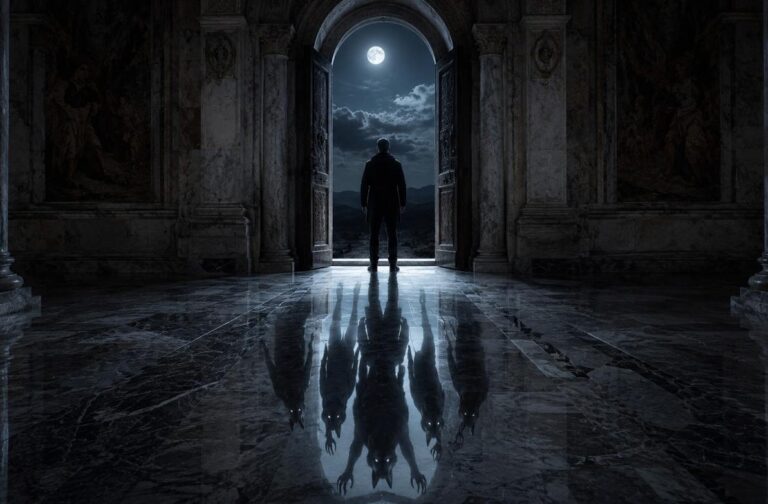
Every spiritual tradition has a word for the sense that something is missing. The Gnostics called it the Kenoma: the emptiness, the deficiency, the realm where wholeness has been forgotten. It is not hell in the conventional sense, nor is it mere nothingness. It is a something that lacks, a pseudo-reality generated from the passions and errors of a fallen divine principle, a copy that believes itself to be the original. If the Pleroma is the fullness from which we came, the Kenoma is the condition into which we fell — the fog of forgetfulness that makes a prisoner believe his cell is the whole of the world.
Understanding the Kenoma is essential for anyone seeking to navigate Gnostic thought, because it names the problem that the entire Gnostic project exists to solve. The Kenoma is not simply the material cosmos; it is the state of consciousness that mistakes the partial for the total, the provisional for the ultimate, the shadow for the substance. This glossary entry traces the term from its Greek roots through its Valentinian elaboration, examines its relationship to the Pleroma and the Demiurge, and explores why this ancient concept of emptiness remains startlingly relevant to contemporary experience.
Table of Contents
- The Word and Its World: Etymology and Basic Meaning
- The Valentinian Kenoma: Achamoth’s Passions and the Three Substances
- The Gospel of Truth: Error, Oblivion, and Deficiency
- The Kenoma’s Architecture: Shadow-Counterparts and the Demiurge’s Domain
- Modern Echoes: Existential Emptiness, Digital Deficiency, and the Void That Is Not Nothing
- Why the Kenoma Still Matters
The Word and Its World: Etymology and Basic Meaning
The Greek word kenoma (κένωμα) derives from kenos, meaning empty, void, or lacking content. In ordinary usage it could describe an empty vessel, a hollow space, or a promise without substance. The term appears in the New Testament in Philippians 2:7, where Christ is said to have “emptied himself” (ekenōsen) to take the form of a servant — a usage that would later fascinate theologians but that the Gnostics approached from a different angle entirely. For the Gnostics, the Kenoma was not an act of divine self-limitation but a cosmic condition, a structural deficiency that characterised the lower realm in contrast to the Pleroma’s fullness.
The mid-second-century teacher Valentinus was among the first to employ kenoma as a technical term in a systematic cosmology. Drawing on Middle Platonist frameworks, Valentinus constructed a three-tiered vision of reality: the Pleroma as the realm of divine fullness and ideal forms, the Kenoma as the region of emptiness and material phenomena, and the cosmos as the manifest world that results from their interaction. This was not merely abstract philosophy; it was an interpretive key for reading scripture, understanding human nature, and mapping the path of salvation. The Kenoma named the condition of existence before awakening — the state in which one lives, moves, and has one’s being, yet remains fundamentally incomplete.
It is crucial to distinguish the Kenoma from absolute non-being. The Gnostics were not nihilists. The Kenoma is not ouk on (non-being in the strict sense) but a deficient mode of being — a something that is less than it should be, a reality that carries the trace of what it has lost without possessing the power to recover it. In this respect, the Kenoma is more tragic than evil. It is the realm of the orphan, the exile, the forgotten. It is the condition of the soul that knows it is not at home but cannot remember where home is.
The Valentinian Kenoma: Achamoth’s Passions and the Three Substances
The most detailed account of the Kenoma comes from the Valentinian school, preserved in the refutations of Irenaeus of Lyon and the extracts of Clement of Alexandria. According to this system, the Kenoma originates from the fall of Achamoth — the lower Sophia — who is expelled from the Pleroma after attempting to comprehend the ineffable Father through thought alone. She falls into a place of darkness and formlessness, separated from her divine syzygy and prevented from returning by the Horos, the boundary that guards the frontier of the supramundane realm.
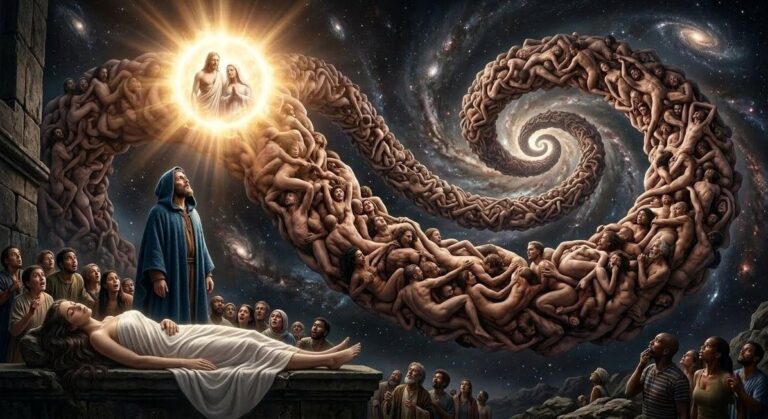
In this void, Achamoth experiences a sequence of passions that become the generative source of the lower world. From her suffering and terror arises hyle (matter), the densest and most deficient substance. From her repentance and prayer arises psyche (soul), the intermediate substance that possesses free will and the capacity for partial salvation. And from her joy at the appearance of the Saviour’s accompanying angels arises pneuma (spirit), the divine spark that is consubstantial with the Pleroma and destined to return to it. These three substances underlie all else in the Valentinian cosmos: every human being is a composite of body, soul, and spirit, and the cosmos itself mirrors this tripartite structure.
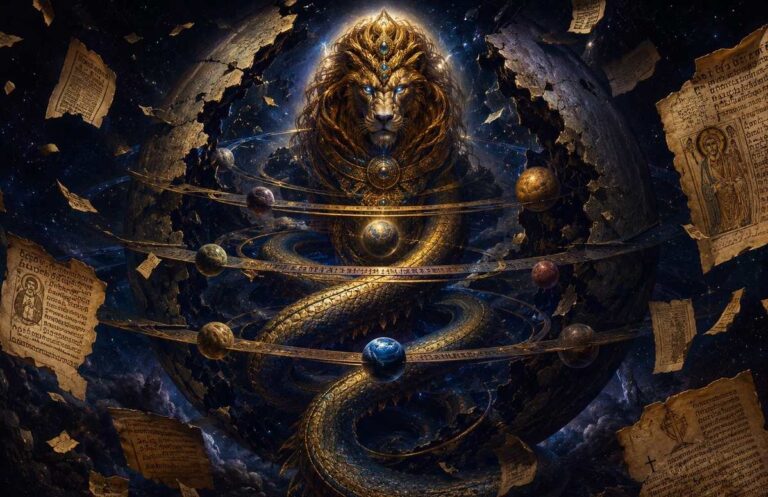
The Demiurge, the lower creator, is formed from the psychic substance produced by Achamoth’s repentance. He is not an Aeon and has no share in the Pleroma’s fullness. Rather, he is a creature of the Kenoma who believes himself to be the highest god because he knows nothing beyond the void in which he was born. From the matter and soul at his disposal, he fashions the material cosmos — a shadowy, imperfect domain that is at best a parody of the Pleroma’s perfection. The stars, the planets, and the seven heavens are his handiwork, and the archons who govern them are his deputies. Yet because the Demiurge works with deficient materials and from limited knowledge, everything he creates carries the stamp of the Kenoma: it is solid enough to seem real, yet hollow enough to betray its origin in emptiness.
Valentinian ethics and soteriology flow directly from this cosmology. The hylikoi (material ones), composed entirely of matter, have no divine spark and therefore no capacity for salvation; they perish with the dissolution of the cosmos. The psychikoi (soul-endowed ones) can achieve partial salvation through faith, moral effort, and the guidance of the Church, ascending to the intermediate realm of the Ogdoad but not entering the Pleroma itself. The pneumatikoi (spiritual ones) carry the divine seed and are destined to return to the fullness, not through merit but through recognition. The Kenoma is thus not merely a cosmological abstraction; it is the diagnostic framework for understanding why different people respond differently to the call of gnosis.
The Gospel of Truth: Error, Oblivion, and Deficiency
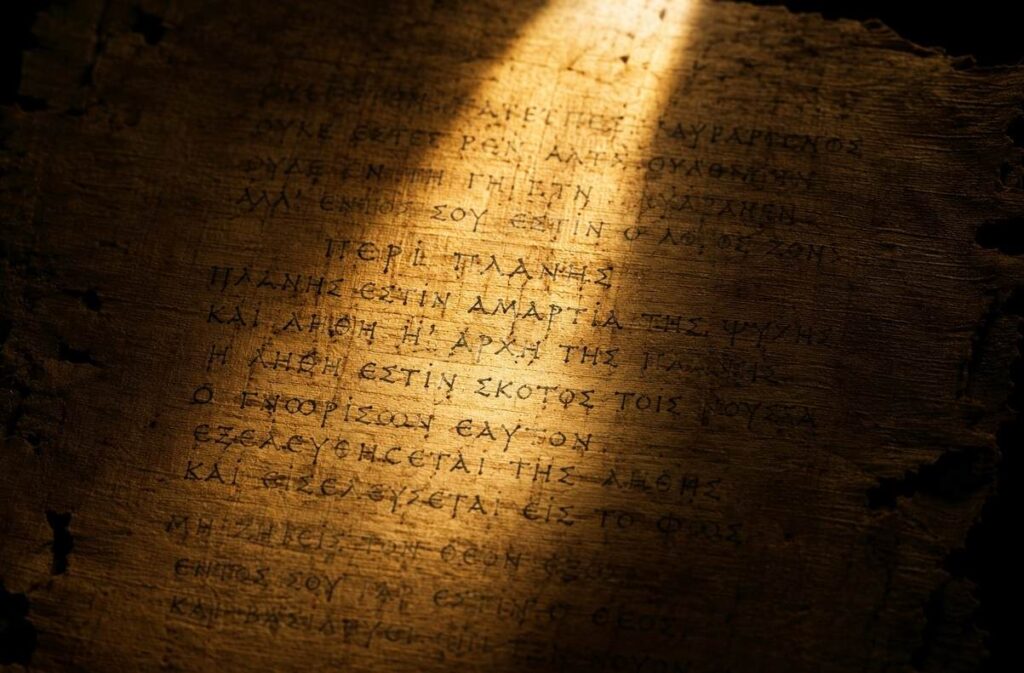
One of the most profound meditations on the Kenoma appears in the Gospel of Truth (NHC I,3), a Valentinian text discovered among the Nag Hammadi codices. Here the Kenoma is not described in the technical language of Aeons and substances but in the poetic imagery of forgetting, terror, and error. The text opens with a description of how ignorance of the Father brought about terror and fear, which “became dense like a fog, that no one was able to see.” This fog is the Kenoma: not a place but a condition of perceptual obstruction, a cloud of unknowing that solidifies into the apparent reality of the material world.
The Gospel of Truth offers a remarkable insight: error is not an independent force with its own substantial existence. It is a byproduct of ignorance, a parasite that feeds on forgetfulness. “Forgetfulness did not exist with the Father, although it existed because of him. What exists in him is knowledge, which was revealed so that forgetfulness might be destroyed and that they might know the Father.” The Kenoma, in this account, is the fog of oblivion — the dense cloud of ignorance that makes the deficient seem complete and the partial seem total. Yet because error has no root in the ultimate reality, it is inherently unstable. The moment knowledge approaches, error is revealed as empty: “Error was disturbed not knowing what it should do. It was troubled; it lamented, it was beside itself because it did not know anything.”
This text transforms the Kenoma from a cosmological location into an existential condition. To live in the Kenoma is to live in forgetfulness — not merely to lack information but to have forgotten one’s own origin, nature, and destiny. The material world is not evil; it is simply the domain where forgetfulness has solidified into habit, where the terror of not-knowing has organised itself into institutions, customs, and systems of control. The goal of the gospel, according to this text, is not to destroy the world but to destroy the oblivion that makes the world seem like the only reality. “As one’s ignorance disappears when he gains knowledge, and as darkness disappears when light appears, so also incompleteness is eliminated by completeness.” The Kenoma is thus not a permanent prison but a temporary deficiency, destined to dissolve when the Pleroma’s light finally penetrates it.
The Kenoma’s Architecture: Shadow-Counterparts and the Demiurge’s Domain
The Kenoma is not merely chaotic; it has its own structure, a dark mirror of the Pleroma’s ordered hierarchy. According to Irenaeus’s account of Valentinian teaching, the Kenoma possesses its own Ogdoad, Decad, and Dodecad — shadow-counterparts of the divine Aeons above. There is a Sophia in the supramundane region and another Sophia (Achamoth) in the mundane; there is a Christ who redeems the Aeons in the spiritual world and a second Christ who redeems mankind in the sensible world; there is an Aeon Man and an Aeon Ecclesia in the celestial kingdom, with their terrestrial counterparts in the human race and the Christian Church. This mirroring is not accidental; it reflects the Gnostic conviction that the material world is a copy, a mimema, of the higher reality — a copy that is necessarily distorted because it is produced by a craftsman who has never seen the original.
The Demiurge rules this shadow-kingdom from the seventh heaven, believing himself to be the supreme power because he knows nothing of the Pleroma above him. In some Valentinian accounts, he is called by the name of the realm he rules — Hysterema (deficiency) — a term used by Hippolytus as the complement to Pleroma. The Demiurge is thus not merely a being but a function: he is the administrator of deficiency, the organiser of emptiness, the one who takes the chaotic raw material of the Kenoma and shapes it into a cosmos that appears ordered but is fundamentally unstable. His creation is described as a “fashioned form” that is “preparing, in power and in beauty, the equivalent of truth” — a counterfeit so skilful that it deceives all but those who have received the spark of gnosis.
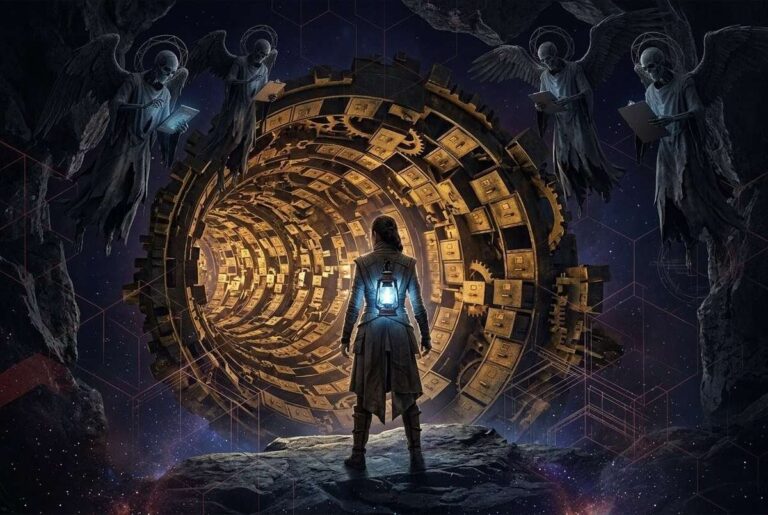
The archons who serve the Demiurge are the planetary powers, each governing one of the seven heavens and enforcing the laws of fate (heimarmene) upon the souls trapped in their jurisdictions. These archons are not evil demons in the dualistic sense; they are functionaries of the Kenoma, bureaucrats of emptiness who maintain the status quo because they know no alternative. Their role is to prevent the ascent of souls, to extract the divine sparks, and to ensure that the deficiency remains hidden behind a facade of cosmic order. Yet their power is limited and provisional. The Apocryphon of John describes how the Father’s providence sends the luminous Epinoia — the Afterthought — to dwell within Adam, ensuring that even in the Demiurge’s prison a trace of Pleromatic wisdom remains hidden and alive. The Kenoma’s architecture, however elaborate, contains the seeds of its own undoing.
Modern Echoes: Existential Emptiness, Digital Deficiency, and the Void That Is Not Nothing
The Kenoma has proven remarkably adaptable to modern interpretation because it names an experience that transcends ancient cosmology: the sense that the world we inhabit is somehow less than real, that our institutions and systems are running on autopilot, and that the abundance of information has not produced a corresponding abundance of wisdom. Jean-Paul Sartre described nausea as the experience of existence without essence — the confrontation with a world that is simply there, without purpose or justification. The Gnostic would recognise this as the taste of the Kenoma: the moment when the facade drops and the emptiness beneath is revealed. Existentialism, in this reading, is the modern attempt to live authentically within the Kenoma without the consolation of the Pleroma — a courageous but ultimately incomplete project, since it denies the possibility of return.
In the digital age, the Kenoma has acquired new and disturbing forms. Social media platforms, algorithmic feeds, and artificial intelligence systems construct realities from partial data, optimised for engagement rather than truth. These systems are, in effect, Demiurgic: they organise information into coherent patterns without access to the “Forms” of wisdom, compassion, or transcendence. The user who lives entirely within an algorithmic bubble experiences a kind of Kenoma — a reality that seems complete because it is all they see, yet is fundamentally deficient because it excludes everything that cannot be quantified, predicted, or monetised. The Gnostic critique of the Demiurge — the blind intelligence that mistakes its workshop for the whole of existence — becomes startlingly precise when applied to systems that govern human perception without awareness of what lies beyond their parameters.
Contemporary physics offers an unexpected parallel. The quantum vacuum — the “void” that is paradoxically teeming with potential energy, the ground from which particles emerge and to which they return — is structurally similar to the Gnostic Kenoma. Both are emptinesses that generate apparent solidity through fluctuation and perturbation. The quantum vacuum is not absolute nothingness but a field of latent possibility, a deficiency that contains the seed of fullness. In this light, the ancient Gnostic intuition that matter arises from a deficient but not non-existent substrate finds an echo in the most advanced physics of our time. The Kenoma is not a primitive superstition but a sophisticated metaphysical concept that anticipated modern discoveries about the relationship between void and form.
Why the Kenoma Still Matters
The Kenoma endures because it describes a condition that is immediately recognisable to anyone who has paused long enough to feel the hollowness beneath the surface of ordinary life. It is the emptiness that persists after the achievement, the loneliness that remains in the crowded room, the sense that the world is running on a script that no one wrote and no one can revise. The Gnostics did not invent this feeling; they named it, mapped it, and embedded it in a mythology that made the journey from deficiency to fullness comprehensible. The Kenoma is the diagnosis; the Pleroma is the cure; and gnosis is the recognition that moves the patient from one to the other.
To understand the Kenoma is not to despise the material world. Even in the most dualistic Gnostic systems, matter is not inherently evil — it is simply the domain of a lower order of reality, a rough draft rather than a final masterpiece. The task of the knower is to see through the Kenoma’s claim to ultimacy without rejecting the world entirely. The prison becomes a school, the deficiency becomes the very condition that makes gratitude possible, and the emptiness becomes the vessel that waits to be filled. In this awakening, the Kenoma is not destroyed but transcended, its shadows dissolved by a light that was always present but had been forgotten. The fog lifts. The exile remembers. And the something that believed itself to be everything finally recognises that it was, all along, a child of the Fullness.
Frequently Asked Questions
What does Kenoma mean in Gnosticism?
Kenoma (Greek for emptiness or deficiency) is the lower realm of material existence and spiritual lack, contrasted with the Pleroma (divine fullness). It is the region into which Sophia fell, where the Demiurge created the flawed cosmos, and where divine sparks remain trapped until awakened by gnosis.
Is the Kenoma the same as hell?
No, the Kenoma is not hell in the traditional sense. It is not a place of punishment but a condition of deficiency and forgetfulness — a realm where reality is incomplete, where the partial masquerades as the total, and where souls exist in a state of oblivion regarding their divine origin.
How is the Kenoma related to the Pleroma?
The Kenoma is the structural opposite of the Pleroma. While the Pleroma is the divine realm of fullness, light, and perfection, the Kenoma is the region of emptiness, shadow, and deficiency. They are separated by the Horos (Boundary), and the goal of Gnostic spirituality is to cross from the Kenoma back to the Pleroma through gnosis.
What are the three substances of the Kenoma?
In Valentinian cosmology, the three substances that constitute the Kenoma are hyle (matter, arising from Achamoth’s suffering), psyche (soul, arising from her repentance), and pneuma (spirit, arising from her joy at the Saviour’s appearance). These correspond to the three types of human beings: material, soul-endowed, and spiritual.
Who rules the Kenoma?
The Kenoma is ruled by the Demiurge, a lower creator god who was born within the void and believes himself to be the supreme power. He is assisted by archons — planetary powers who enforce fate and prevent souls from ascending. The Demiurge does not know of the Pleroma above him.
What is the Gospel of Truth’s teaching on deficiency?
The Gospel of Truth describes the Kenoma as a fog of oblivion and error that arises from ignorance of the Father. It teaches that deficiency is not ultimate — it is eliminated by completeness, just as darkness disappears when light appears. Error has no root and dissolves when knowledge is revealed.
What is the modern relevance of the Kenoma concept?
Today, the Kenoma serves as a metaphor for systemic structures that construct reality from partial data — algorithmic bubbles, instrumental reason, and existential emptiness. It also finds parallels in quantum physics, where the vacuum is a void teeming with potential rather than absolute nothingness.
Further Reading
Explore these ZenithEye articles to deepen your understanding of the Kenoma and the cosmology it completes.
- Pleroma and Kenoma: The Foundational Geography of Gnostic Cosmology — A comprehensive exploration of the two realms and the boundary between them.
- Valentinian Gnosticism: The Most Systematic School of the Pleroma — Detailed examination of the thirty Aeons, the three substances, and Valentinian soteriology.
- The Apocryphon of John: Gnostic Creation, the Three Natures, and the Five Seals — The primary Sethian text describing the fall into deficiency and the birth of the Demiurge.
- The Sophia Myth: Three Falls, Three Redemptions Across Gnostic Schools — How Sophia’s fall from the Pleroma generated the Kenoma and the drama of return.
- The Gnostic Answer to Evil: Why Suffering Proves the Demiurge — Examines how the Kenoma’s deficiency explains the problem of suffering and cosmic injustice.
- The Names of the Archons: A Guide to Gnostic Entities and Their Domains — The planetary powers who administer the Kenoma and obstruct the soul’s ascent.
- The Demented God Architect — A closer look at the Demiurge, the blind craftsman who rules the Kenoma from the seventh heaven.
- The Reality of the Archons: Eve, the Stranger, and the Rulers of Darkness — Explores the archontic powers who serve the Demiurge as gatekeepers of the deficient realm.
- The Gnostic Technical Glossary: Key Terms Every Seeker Should Know — Definitions of Kenoma, Pleroma, hyle, psyche, pneuma, and related cosmological terminology.
- What Is Gnosticism? The Ancient Currents of Direct Knowledge — The broader tradition within which the Kenoma functions as the central problem awaiting solution.