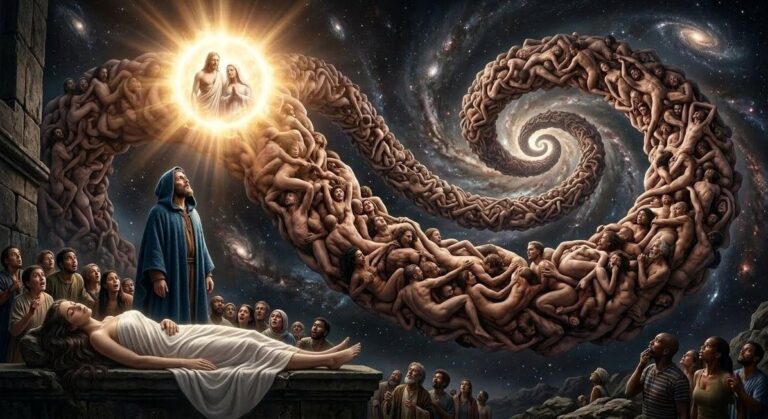

What is a Tractate? The Individual Text and The Nag Hammadi
A tractate is an individual text or treatise–a self-contained literary work bound within a larger collection. The word describes a single composition, complete in itself, that occupies its own place inside a codex. Where a codex is the vessel, the tractate is the voice that speaks from within it.
For scholars of Gnosticism, the tractate is the fundamental unit of the Nag Hammadi Library. Thirteen codices contain fifty-two separate tractates. Six of these are duplicates, leaving forty-six unique texts. Each tractate is a distinct world: a gospel, an apocalypse, a treatise on resurrection, a hymn, or a letter. Some run to more than a hundred pages; others survive in fragments of only a few lines. Together they form the most significant collection of Gnostic and early Christian writings ever recovered from antiquity.
A tractate is an individual text or treatise–a self-contained literary work that occupies its own place within a codex, distinct from the manuscript that contains it.
Table of Contents
- What Is a Tractate? Etymology and Definition
- The Nag Hammadi Library: Fifty-Two Tractates, Forty-Six Unique Texts
- Titles, Incipits, and Scholarly Names
- The Tractate as a Literary Unit
- Frequently Asked Questions
- Further Reading
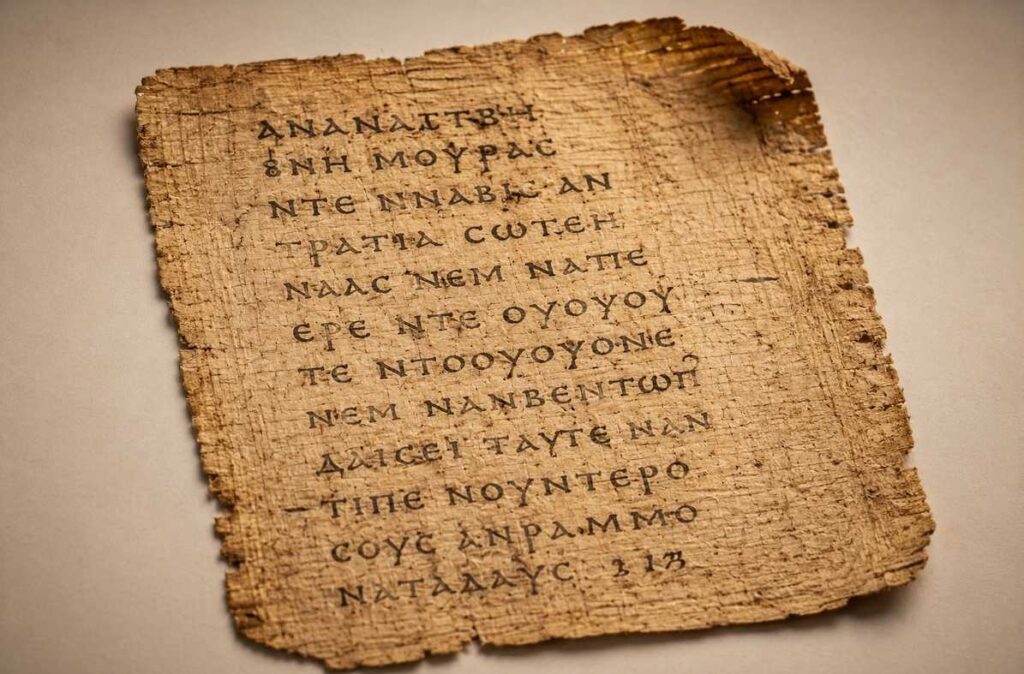
What Is a Tractate? Etymology and Definition
From Latin to Library
The term tractate derives from the Medieval Latin tractatus, itself from the Latin verb tractare, meaning to handle, treat, or draw out. In its earliest English usage during the fifteenth century, the word simply meant a treatise or formal written work that explored a subject systematically. It carries the sense of something drawn out at length, examined thoroughly, and laid open for consideration.
In modern scholarly usage, particularly in religious and codicological studies, tractate has acquired a more specific meaning. It refers to an individual composition within a collected manuscript–a single text that stands on its own, with its own beginning, argument, and conclusion, even when bound alongside other works. The tractate is not a chapter or a section. It is a complete work, a book within a book.
A Parallel in Jewish Tradition
The word also resonates in Jewish scholarship, where the Hebrew masekhet (plural masekhtot) is rendered into English as tractate. The Mishnah and both Talmuds are divided into tractates–systematic examinations of specific legal, ethical, or ritual topics. Pirkei Avot, the Ethics of the Fathers, is formally the tractate Avot. This parallel is useful: in both Jewish and Gnostic contexts, a tractate is a discrete unit of teaching, a bounded exploration of a particular theme, compiled into a larger corpus. The format crosses traditions.
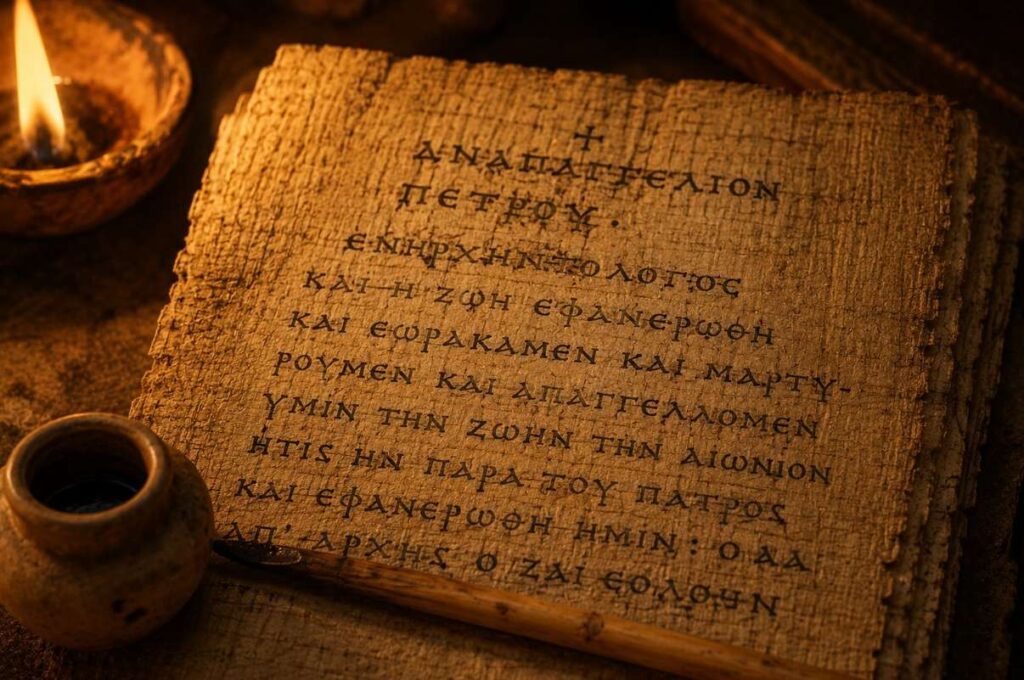
The Nag Hammadi Library: Fifty-Two Tractates, Forty-Six Unique Texts
The Arithmetic of Discovery
The Nag Hammadi Library contains fifty-two tractates distributed across thirteen codices. However, six of these tractates are duplicates–the same text copied into more than one codex. When duplicates are accounted for, the library yields forty-six unique texts. Some scholars speak of forty-five distinct titles, depending on how fragmentary survivals are classified, but the consensus figure remains forty-six unique tractates.
These numbers matter because they reveal the library’s nature as an anthology rather than a unified composition. The codices were assembled from smaller collections. No single codex contains two copies of the same tractate, and the same scribe rarely copied the same text twice. The duplicates suggest that the thirteen codices represent a secondary merging of at least three smaller libraries, each with its own copies of favoured texts.
The Apocryphon of John: A Tractate in Triplicate
The most striking example of duplication is the Apocryphon of John. This foundational Sethian text–a revelation dialogue in which the risen Christ teaches John the secrets of the divine realm, the fall of Sophia, and the creation of humanity–appears in three separate codices: II, III, and IV. Codex II contains the longest version; Codex III preserves a shorter recension with additional material; Codex IV offers another copy of the longer version. Each copy is a distinct tractate, with its own scribal hand, its own pagination, and its own textual variants. The duplication tells us that this text was considered essential, worth copying even when the community already possessed it.
Hidden Tractates: Codex XIII
Not every tractate was bound in its own codex. Codex XIII survives only as eight leaves removed from their original volume in antiquity and concealed inside the front cover of Codex VI. These leaves contain two tractates: Trimorphic Protennoia (Three Forms of First Thought) and a second copy of On the Origin of the World. The fact that one tractate was hidden inside another suggests deliberate preservation–perhaps protection from those who might destroy non-canonical texts. A tractate, in this case, was valuable enough to smuggle inside a neighbour’s covers.
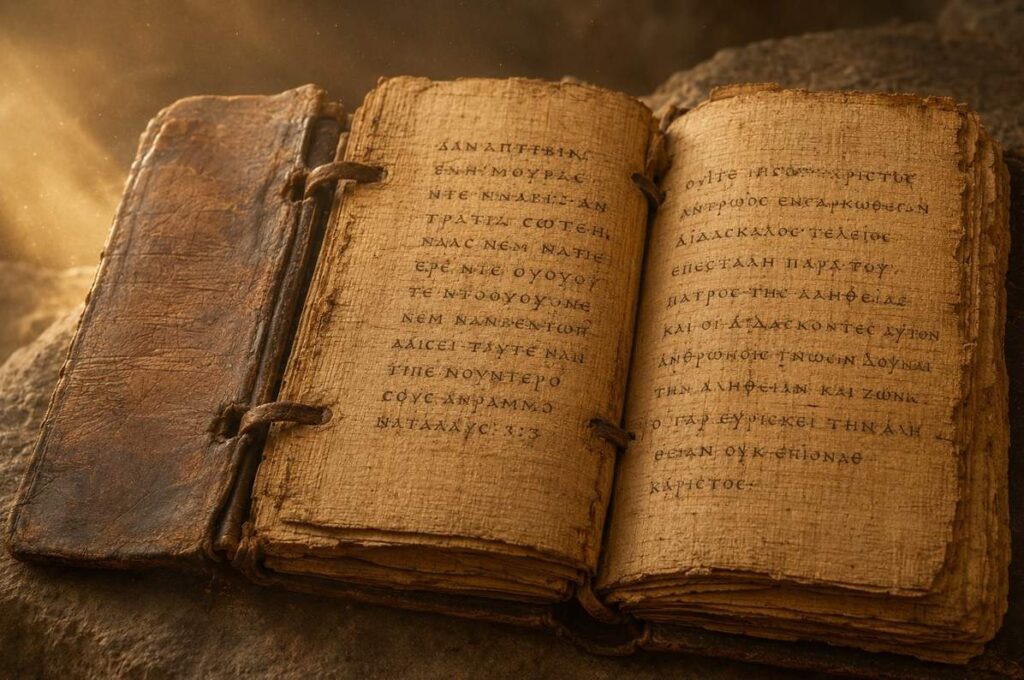
Titles, Incipits, and Scholarly Names
How Tractates Are Named
Unlike modern books, ancient tractates did not always arrive with title pages. Scholars identify Nag Hammadi texts through three methods: preserved titles, incipits, and conventional names.
Some tractates carry their titles within the text itself. The Gospel of Thomas is named at its opening. The Gospel of Philip identifies itself in the first lines. The Apocryphon of James announces its genre and protagonist. These are straightforward cases: the ancient scribe provided the label, and modern scholarship has retained it.
Other tractates lack titles and are known by their incipit–the opening words of the text. The Gospel of Truth takes its name from its first line: “The gospel of truth is joy for those who have received from the Father of truth the grace of knowing him.” The title is not a separate label; it is woven into the opening sentence. Similarly, The Thought of Norea derives its name from a phrase near the end of the text, where the heroine is identified.
Scholarly Conventions
When neither title nor incipit provides a usable name, scholars assign a conventional title. On the Origin of the World is a modern description of the text’s contents. The Tripartite Tractate is a scholarly coinage reflecting the three-part structure of the work. The Teachings of Silvanus is named for its attributed author, though the historical Silvanus remains unknown. These names are tools for reference, not ancient designations. They remind us that every tractate had a life before the label, and that some arrived at the present day nameless, rescued only by the content they carried.
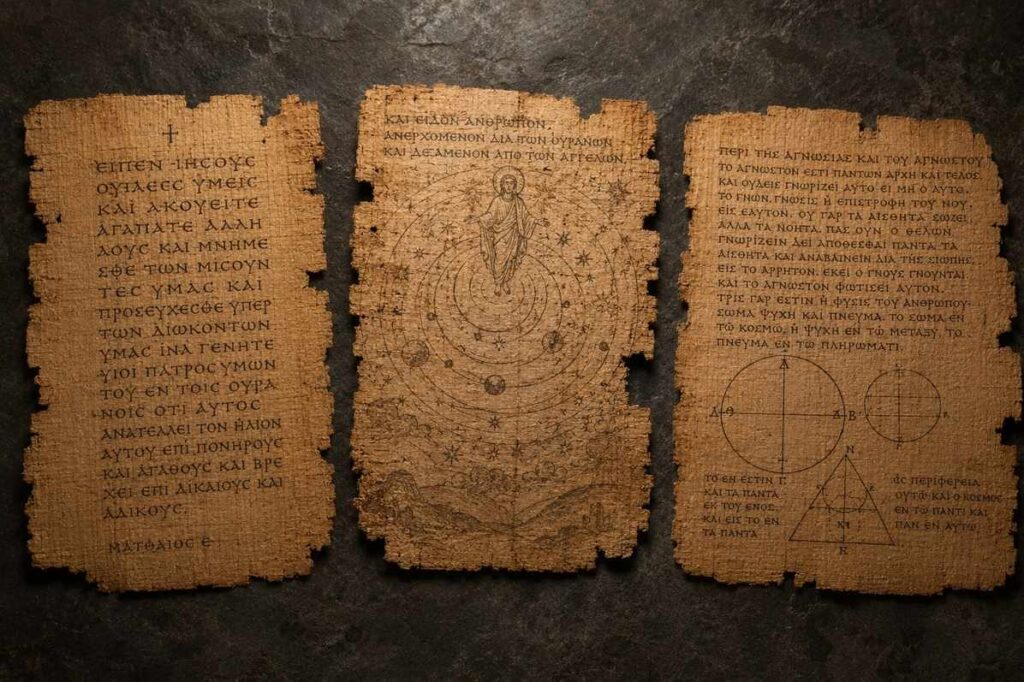
The Tractate as a Literary Unit
Genres and Forms
The Nag Hammadi tractates display remarkable literary diversity. They include sayings gospels such as the Gospel of Thomas, which collects 114 logia without narrative framework. They include revelation dialogues such as the Apocryphon of John, where a divine figure answers questions posed by a disciple. They include ascension apocalypses such as Zostrianos, which narrates a visionary journey through thirteen celestial realms. They include liturgical hymns such as the Three Steles of Seth, designed for communal recitation. They include letters such as the Treatise on Resurrection, addressed to a student named Rheginos. They include philosophical treatises such as Marsanes, which explores Neoplatonic metaphysics in Gnostic terms.
This variety means that the tractate is not defined by genre. It is defined by boundaries. A tractate begins at a specific point–an invocation, a title, an incipit–and ends at a specific point, often marked by a closing formula, a doxology, or a scribal colophon. Within those boundaries, anything is possible.
Scale and Scope
The length of Nag Hammadi tractates varies enormously. The Tripartite Tractate spans nearly ninety pages in Codex I and represents one of the most extensive surviving expositions of Valentinian theology. At the other extreme, The Thought of Norea occupies only two and a half pages in Codex IX. Some tractates are so fragmentary that only a few lines remain, their arguments lost to the damage of centuries. The tractate is thus a flexible container: it can hold a world-system or a whisper.
Scribal Hands and Compilation
Palaeographers study the scribal hands within each codex to determine whether one or multiple copyists produced the volume. In many Nag Hammadi codices, a single scribe copied all the tractates, suggesting a planned anthology. In others, different hands appear, indicating successive copying or collaborative production. The tractate, in these cases, was the unit of labour: a scribe might complete one tractate and pass the codex to another, or a community might commission the copying of a specific text without reproducing the entire collection.
The physical boundaries of the tractate are sometimes visible in the manuscript itself. A new tractate might begin on a new page, or a scribal note might mark the transition. These material cues remind us that the ancient readers recognised the tractate as a distinct entity, even when bound in sequence with others.
Frequently Asked Questions
What is a tractate?
A tractate is an individual text or treatise–a self-contained literary work that occupies its own place within a larger manuscript or codex. The term derives from the Latin tractatus, meaning a formal written handling of a subject.
How many tractates are in the Nag Hammadi Library?
The Nag Hammadi Library contains fifty-two tractates across thirteen codices. Six of these are duplicates, leaving forty-six unique texts. Some scholars count forty-five distinct titles depending on how fragmentary texts are classified.
What is the difference between a tractate and a codex?
A codex is the physical book–the bound collection of pages. A tractate is an individual text contained within that codex. A single codex may hold multiple tractates, each a complete literary work with its own title, argument, and conclusion.
Why are some Nag Hammadi tractates found in more than one codex?
Six tractates appear in duplicate across the library. The Apocryphon of John, for example, survives in Codex II, III, and IV. This suggests the thirteen codices were assembled from smaller collections, each copying texts considered essential to their community.
How do scholars name tractates that have no ancient title?
When a tractate lacks a preserved title, scholars identify it by its incipit–the opening words of the text–or assign a conventional descriptive name based on content. Examples include On the Origin of the World and the Tripartite Tractate.
What genres do Nag Hammadi tractates cover?
The tractates span multiple genres: sayings gospels, revelation dialogues, apocalypses, philosophical treatises, liturgical hymns, letters, and polemical essays. This diversity reflects the broad theological and literary creativity of Gnostic and early Christian communities.
Is the word tractate used outside Gnostic studies?
Yes. In Jewish scholarship, the Hebrew masekhet is rendered as tractate, referring to sections of the Mishnah and Talmud. In general academic usage, tractate simply means a formal treatise or systematic written exploration of a subject.
Further Reading
Explore these ZenithEye articles to deepen your understanding of the Nag Hammadi Library, its individual texts, and the world that produced them:
- The Complete Guide to the Nag Hammadi Library — A definitive introduction to all 13 codices, 46 tractates, and the history of the 1945 discovery.
- Nag Hammadi Library: Complete Reader’s Guide — Navigate the library by codex, theme, or reading level with this comprehensive map.
- The Apocryphon of John: Gnostic Creation Myth — A deep dive into the tractate that appears in three separate codices, exploring the fall of Sophia and the birth of the demiurge.
- The Gospel of Thomas: 114 Keys — Explore the most famous sayings gospel in the Nag Hammadi Library, a tractate that changed how scholars read early Christianity.
- The Tripartite Tractate: Valentinian System — A detailed study of one of the longest and most systematic tractates in the library, covering Valentinian cosmology and soteriology.
- Trimorphic Protennoia: The Three Descents — The hidden tractate found inside Codex VI, examining the divine voice that descends to awaken the soul.
- The Gospel of Philip: Sacrament and Eros — A Valentinian tractate on the bridal chamber, anointing, and the mystical union of male and female principles.
- On the Origin of the World — A Sethian tractate on cosmology, archons, and the restoration of the divine light, surviving in two copies within the library.
- Codicology and Conservation of the Nag Hammadi Library — Learn how papyrus was manufactured, how codices were bound, and how scholars preserved the tractates within them.
- Gnostic Technical Glossary: Key Terms — Master essential terminology including archons, aeons, pleroma, demiurge, and gnosis.