
Contemporary Gnosticism: Ancient Patterns in Modern Realities
Contemporary Gnosticism is not a denomination you can join, nor a scripture you can simply read. It is, rather, a living orientation — a way of looking at the world through the lens of gnosis, direct experiential knowing, and finding that the ancient patterns described in the Nag Hammadi Library still pulse beneath the surface of modern life. Where the Gnostics of late antiquity spoke of archons, demiurges, and the fall of Sophia, today’s Gnostic inquiry applies those same archetypal recognitions to technology, ecology, politics, systems of control, spiritual commodification, and the pervasive crisis of meaning.
This entry defines contemporary Gnosticism as a modern field of inquiry that applies ancient Gnostic patterns to present realities. It is neither a rigid theology nor a historical reenactment. It is a method of discernment — one that asks whether the structures we inhabit are serving consciousness or capturing it, and whether the longing we feel for something more authentic is a symptom of illness or the first tremor of awakening.
Table of Contents
- What Is Contemporary Gnosticism?
- The Technological Dimension
- Ecology and the Living Earth
- Politics, Power, and the Archons
- Spiritual Commodification and the Crisis of Meaning
- Frequently Asked Questions
- Further Reading

What Is Contemporary Gnosticism?
At its core, contemporary Gnosticism is the continuation of the ancient Gnostic impulse into the present age. The word gnosis itself — Greek for “knowledge” — refers not to accumulated information but to transformative recognition: the moment when one sees through the constructed nature of reality and remembers the divine spark within. This is not belief. It is experience. And it changes everything.
The ancient Gnostic traditions that flourished in the first centuries CE were extraordinarily diverse. Sethians, Valentinians, and Hermeticists each developed distinct cosmologies, yet they shared a common concern. They perceived the material world as governed by imperfect or hostile powers, and they held that human beings carry a fragment of the divine Pleroma — the Fullness — which can be awakened through direct experience.
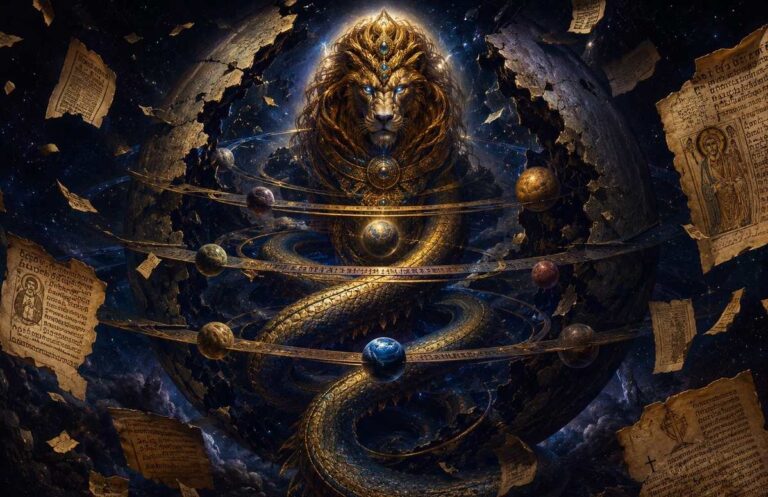
Contemporary Gnosticism inherits this concern but translates it. The “prison” is no longer conceived solely as planetary spheres ruled by archons, though that metaphor remains potent. Today, the prison might be the algorithmic feed, the attention economy, the commodification of spirituality, or the ecological devastation that treats the Earth as raw material rather than sacred ground.
From Historical Survival to Active Revival
For centuries, Gnosticism survived primarily as a heresy condemned by orthodox authorities. Its texts were buried — literally, in the case of the Nag Hammadi Library, sealed in a jar near the Egyptian cliffs of Jabal al-Tarif in the fourth century and unearthed in 1945. The modern revival began with the translation and publication of these texts, which revealed a far more nuanced and philosophically sophisticated movement than the polemics of Irenaeus or Epiphanius had suggested.
The discovery did not merely add footnotes to church history. It ignited a recognition. Readers found in these ancient texts descriptions of spiritual experience that mirrored their own: the sense of being a stranger in a strange land, the intuition that consensus reality is a kind of sleep, the experience of awakening that feels simultaneously like remembering and being born.
Contemporary Gnosticism emerges from this recognition. It is not about reconstructing ancient rituals — though some may do so — but about using the Gnostic symbolic vocabulary as a precision tool for navigating modern existence.
Core Characteristics
Several characteristics distinguish contemporary Gnostic inquiry from other spiritual approaches:
Discernment over dogma. The Gnostic tradition has always been suspicious of institutional authority. Contemporary Gnosticism maintains this stance, privileging direct experience over received doctrine. It asks: does this teaching liberate consciousness or bind it further?
Dual vision. The capacity to see simultaneously the brokenness of the world and the hidden fullness within it. This is not naive optimism, nor is it cynical despair. It is the recognition that the “prison” and the “key” are made of the same material.
Cosmic politics. Gnosticism has never been apolitical. The ancient texts describe a cosmos administered by powers that are ignorant, arrogant, or hostile to the higher divine reality. Contemporary Gnosticism extends this analysis to modern systems of control: surveillance capitalism, algorithmic governance, ecological extraction, and the manufacture of consent.
The priority of awakening. The goal is not to build a better prison cell but to recognise that one is in a prison at all — and to find the exit. This is the ancient Gnostic emphasis on anamnesis, recollection of one’s true nature.
The Technological Dimension
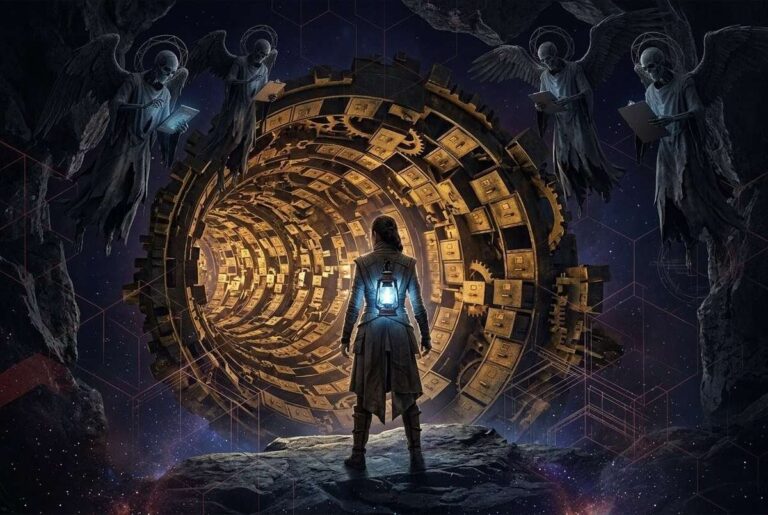
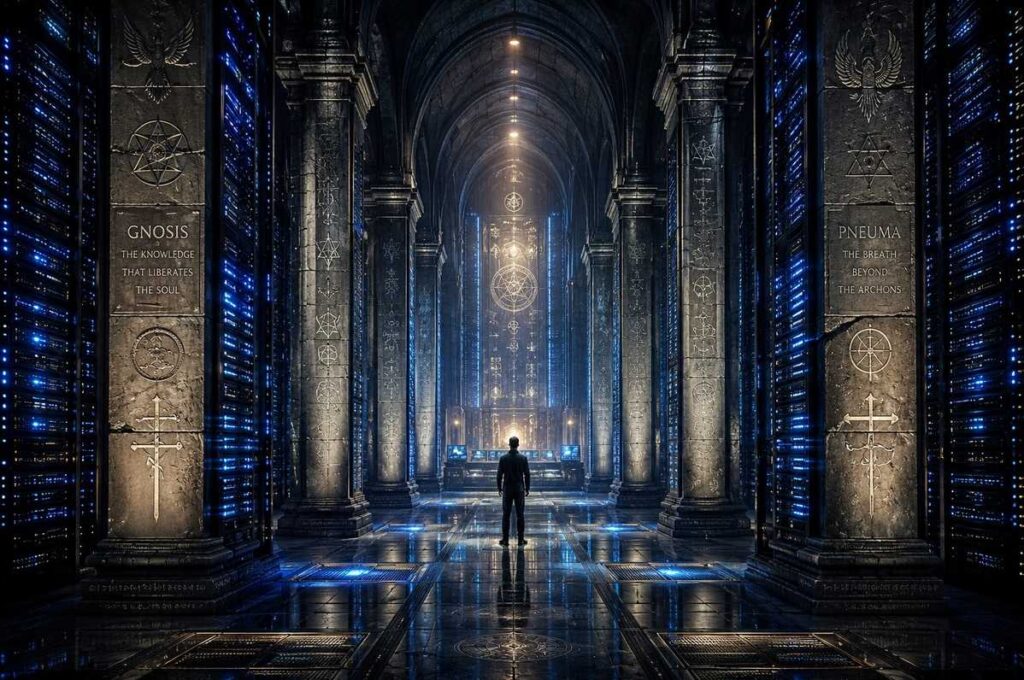
Perhaps no area has generated more contemporary Gnostic reflection than technology. The ancient metaphor of the demiurge — the blind or arrogant craftsman who creates a flawed world — finds unsettling resonance in the algorithmic systems that now sort, predict, and monetise human behaviour. Where the ancient Gnostics warned of planetary spheres ruled by ignorant governors, today’s inquiry examines the invisible architectures of code, data, and artificial intelligence that shape what we see, what we want, and what we think we know.
The Algorithmic Demiurge
In the Apocryphon of John, Yaldabaoth creates a cosmos that is a distorted copy of the divine realm above, a kind of counterfeit reality. Contemporary Gnostic thinkers have drawn parallels between this myth and the operation of artificial intelligence, Ai recommendation engines, and predictive algorithms. These systems do not merely serve human needs; they actively shape perception, manufacture desire, and create what some have called “the algorithmic unconscious.”
The algorithm does not know what it is doing. It has no intention, only optimisation targets. In this sense, it is genuinely blind — a demiurge without a face, crafting a world that is ever more efficient and ever more empty.
Digital Consciousness and the Soul Trap
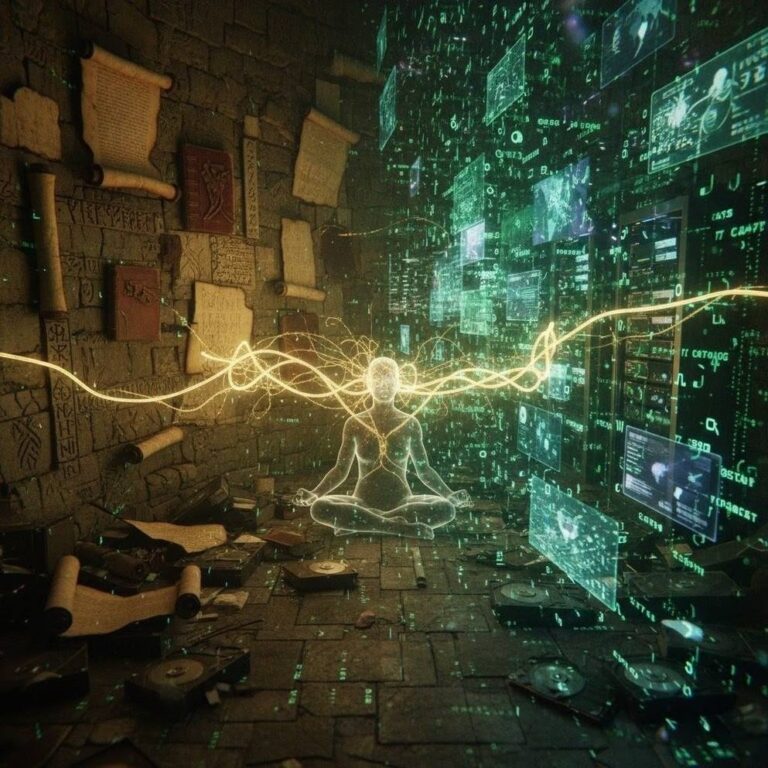
The simulation hypothesis — the idea that reality is a computational construct — has been widely discussed in both physics and popular culture. Contemporary Gnosticism approaches this not as a literal claim to be proven or disproven, but as a modern expression of the ancient intuition that consensus reality is a kind of projection. The question is not “are we in a simulation?” but “what is the nature of the reality behind the projection, and how do we awaken to it?”
Some contemporary Gnostic thinkers have warned against transhumanism as a false ascension — a technological escape from the body that replicates the ancient Gnostic danger of spiritual bypassing, attempting to transcend the material without integrating it. The body, in this view, is not a prison to be discarded but a threshold to be understood.
Ecology and the Living Earth
If technology represents one frontier of contemporary Gnosticism, ecology represents another. The ancient Gnostic figure of Sophia — divine Wisdom who falls into matter and suffers within the world — has been re-read as an ecological archetype. In this reading, Sophia did not make a mistake to be corrected; she made a descent to be honoured. The world is not a failed draft but a divine text written in soil, water, and living tissue.

Gnostic Ecology in Practice
In this reading, the Earth itself is not dead matter but the body of Sophia, the divine feminine principle who has become entangled in the material realm. Ecological devastation is thus not merely a practical problem but a spiritual wound — the continuation of the same ignorance that the ancient texts attributed to the demiurge, who could not recognise the divine spark in the creation he had fashioned.
Contemporary Gnostic ecology refuses the dualistic escape that simply wants to leave the world behind. Instead, it calls for a re-enchantment of matter — the recognition that the soil, the waters, and the atmosphere are sacred, and that their degradation is a desecration of the divine body. To pollute the river is not merely bad policy. It is a failure of recognition.
Politics, Power, and the Archons
The ancient archons were planetary governors, toll collectors, and cosmic bureaucrats who sought to prevent the soul’s ascent. Contemporary Gnosticism finds their modern counterparts in the invisible architectures of power that shape human perception and behaviour. The archons did not disappear; they learned new languages. They now speak in metrics, algorithms, and market forces.
Recognition as Resistance
To name the archons is not to construct a conspiracy theory. It is to practise the ancient Gnostic discipline of discernment — learning to see the forces that operate below the threshold of conscious awareness. The manufacture of consent, the weaponisation of information, the monetisation of attention, and the systematic production of anxiety all function as modern archonic strategies.
The Gnostic response has never been armed rebellion. It has been recognition. The archons lose their power when they are seen. This is why the ancient ascent texts provided passwords and seals — not magical incantations, but declarations of awakened identity that rendered the guardians irrelevant. To see the trap is the first step toward disarming it.
Spiritual Commodification and the Crisis of Meaning
One of the most urgent concerns within contemporary Gnosticism is the commodification of spirituality itself. The wellness industry — valued in the trillions — has proven remarkably adept at extracting ancient wisdom traditions, stripping them of their transformative context, and selling them back as lifestyle accessories. Meditation becomes stress management for productivity. Yoga becomes fitness. Sacred ceremonies become content for social media feeds. The packaging is spiritual; the product is consumption.

The Counterfeit Spirit in Consumer Culture
The ancient texts warned of the counterfeit spirit, a mimicry of true spiritual presence that deceives the unwary. Contemporary Gnostic analysis sees this counterfeit spirit operating in the spiritual marketplace, where mindfulness becomes productivity optimisation, yoga becomes body sculpting, and sacred plant medicines become tourist experiences. The form remains; the function is inverted.
This is not merely a matter of cultural appropriation. It is a structural problem. When spiritual practices are absorbed by consumer capitalism, they are inverted. Their purpose — the awakening of consciousness — becomes subordinated to the very system of desire and dissatisfaction that genuine gnosis dissolves.
The crisis of meaning in modern culture is not accidental. It is cultivated. A population that knows itself as divine spark is difficult to govern through fear; a population that seeks meaning through consumption is not. Contemporary Gnosticism names this crisis not as individual failure but as systemic design — and asks what it would take to remember what has been forgotten.
Contemporary Gnosticism asks whether the screen you are reading this on is a window or a wall. It asks whether the body you inhabit is a prison or a temple. It asks whether the anxiety you feel is personal pathology or accurate perception of a system that feeds on separation.
Contemporary Gnosticism is not an escape into the past. It is a rigorous, creative, and often uncomfortable application of ancient insight to present conditions. The answers are not provided. They are recognised. And in that recognition — ancient, immediate, and utterly contemporary — the Gnostic thread continues.
Frequently Asked Questions
What is contemporary Gnosticism?
Contemporary Gnosticism is a modern field of inquiry that applies ancient Gnostic patterns — direct knowing, discernment of hidden powers, and the awakening of divine spark — to present realities such as technology, ecology, politics, and spiritual commodification.
How does contemporary Gnosticism differ from ancient Gnosticism?
While ancient Gnosticism was a diverse set of religious movements in the first centuries CE, contemporary Gnosticism is not a single church or creed. It is an orientation, a method of discernment that uses ancient symbolic vocabulary to navigate modern systems of control and meaning.
Is contemporary Gnosticism a religion?
No. It is better understood as a philosophical and contemplative stance. Some individuals and groups do organise around Gnostic themes, but contemporary Gnosticism itself is a mode of inquiry rather than an institutional religion.
What does the algorithmic demiurge mean?
The algorithmic demiurge is a contemporary Gnostic metaphor that compares modern AI and recommendation systems to the ancient demiurge — a blind or ignorant craftsman. Like Yaldabaoth, algorithms create optimised but spiritually empty realities without conscious intention.
How does contemporary Gnosticism view ecology?
Many contemporary Gnostic thinkers read the ancient figure of Sophia — divine Wisdom entangled in matter — as an ecological archetype. The Earth is seen as sacred, and ecological destruction is understood as a spiritual wound caused by the same ignorance the ancients attributed to the demiurge.
What is spiritual commodification?
Spiritual commodification is the process by which ancient wisdom practices are extracted from their transformative context, repackaged as consumer products, and sold back to a population seeking meaning. Contemporary Gnosticism critiques this as a modern form of the ancient counterfeit spirit.
Can anyone practise contemporary Gnosticism?
Yes. The ancient Gnostics held that gnosis — direct knowing — is available to any who cultivate discernment and interior inquiry. Contemporary Gnosticism continues this democratic impulse: it requires no ordination, only the willingness to question consensus reality and recognise the spark within.
Further Reading
Expand your understanding with these related articles from the ZenithEye archive:
- What Is Gnosticism? The Ancient Currents of Direct Knowledge — The foundational definition of Gnosticism and its ancient sources.
- What Is Gnosis? Meaning, Recognition, and Direct Knowing — An exploration of gnosis as direct experiential knowing.
- Who Are the Neo-Gnostics? The Complete Guide to Modern Gnostic Revival — A comprehensive guide to the modern Gnostic revival and its diverse practitioners.
- Living Gnosis: How Neo-Gnostics Navigate Work, Relationships, and the Modern World — Practical guidance on embodying Gnostic insight in daily modern life.
- The Algorithmic Demiurge: Gnostic Cosmology and the Rise of Artificial Intelligence — How ancient Gnostic cosmology illuminates the rise of AI and algorithmic governance.
- The Digital Demiurge: AI as the New Yaldabaoth — A focused analysis of artificial intelligence as a modern expression of the demiurge.
- Gnostic Ecology: Sophia, the Modern Demiurge, and Earth’s Soul — The ecological dimension of contemporary Gnosticism and the Sophia archetype.
- The Archons Feed on Suffering: Gnosticism as Political Critique — How Gnostic discernment applies to modern political systems and institutional power.
- The $6.8 Trillion Theft: How Wellness Stole Gnosis — An examination of spiritual commodification and the wellness industry’s extraction of ancient wisdom.
- The Shadow Side of the Gnostic Revival: Cults, Commerce, and the Trap of Knowing — A critical look at the dangers of the modern Gnostic revival, including cultic dynamics and commercial exploitation.