
What Is a Codex? The Ancient Book and the Gnostic Library
A codex is an ancient book-form manuscript composed of individual pages–called leaves–fastened together along one edge and protected by covers. Unlike the continuous roll of the scroll, the codex opens like a modern book, allowing random access to any passage with a single hand. This seemingly simple innovation revolutionised how knowledge was stored, consulted, and preserved across centuries.
For students of Gnosticism, the word codex carries extraordinary weight. The Nag Hammadi Library–the most significant collection of Gnostic scriptures ever recovered–consists of thirteen papyrus codices containing forty-six separate tractates. Buried in a sealed jar near Nag Hammadi, Egypt, in December 1945, these ancient books survived nearly sixteen centuries because the codex format offered protection and portability that the older scroll could not match. To understand the Nag Hammadi texts is, in part, to understand the physical object that carried them through time.
A codex is an ancient book composed of leaves fastened together along one edge, distinct from a scroll, permitting random access to any passage with a single hand.
Table of Contents
- From Scroll to Codex: A Revolution in Format
- The Nag Hammadi Library: Thirteen Codices, Forty-Six Tractates
- Codicology: The Archaeology of the Book
- The Codex in Gnostic and Esoteric Tradition
- Frequently Asked Questions
- Further Reading
From Scroll to Codex: A Revolution in Format
Etymology and Origins
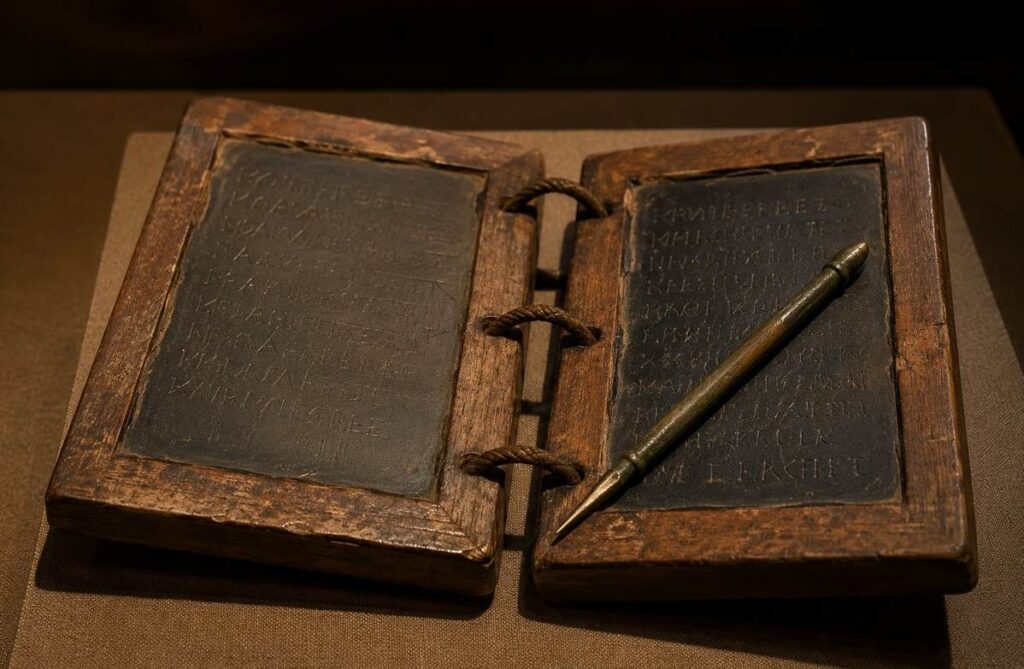
The term codex derives from the Latin caudex, meaning tree trunk or block of wood. In its earliest usage, the word referred to sets of wooden tablets coated with wax, which Romans used for temporary notes, accounts, and drafts. Multiple tablets could be hinged or bound together, creating a rudimentary book that opened and closed. By the first century CE, the term had migrated to describe books made from papyrus or parchment leaves, bound along one edge–the direct ancestor of every book on your shelf today.
Horace mentions using such tablets for drafting poetry, while Martial, writing in the first century CE, advertised the codex as a convenient format for published works. Yet the codex remained somewhat disreputable in elite Roman circles. The jurist Ulpian ruled that the Latin word liber–book–referred only to scrolls, not codices. A bequest of libri would not include codices. The format carried the stigma of the notebook: useful, perhaps, but not dignified.
Why the Codex Replaced the Scroll
Despite this prejudice, the codex offered practical advantages that the scroll–or volumen–could not match. A scroll demands two hands and sequential reading; finding a specific passage requires unwinding and rewinding the entire roll. The codex permits random access: the reader flips directly to any page. A codex can be held in one hand, leaving the other free for writing or annotation. Its covers protect the text from damage, and additional leaves can be inserted before binding, allowing texts to grow and adapt.
The decisive shift came during the early centuries of Christianity. The early Church adopted the codex as its preferred format, perhaps to distinguish Christian writings from Jewish scripture, which remained scroll-bound, and from pagan literature. By containing the four Gospels in a single volume, the codex enabled a new kind of textual unity. By the fourth century CE, the codex had triumphed across the Mediterranean, and the scroll receded into specialised liturgical use.
The Nag Hammadi Library: Thirteen Codices, Forty-Six Tractates
What Is Inside a Nag Hammadi Codex?
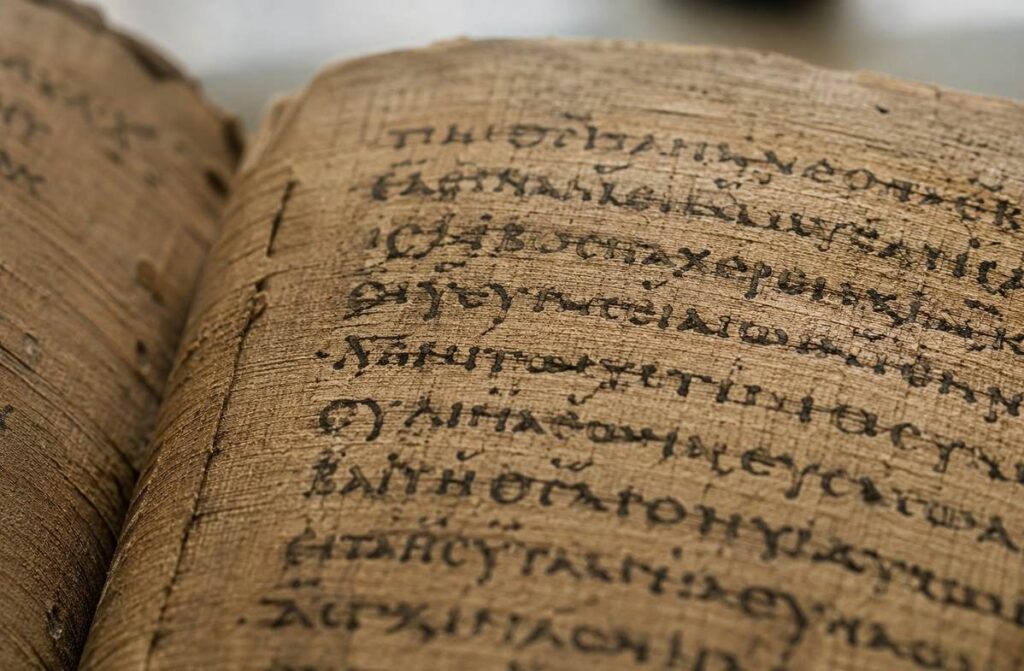
Each Nag Hammadi codex is a collection of papyrus leaves folded into gatherings and bound between leather covers. The scribes wrote in Sahidic Coptic, the literary dialect of Upper Egypt, using reed pens and ink made from soot and gum. The pages were numbered, and many codices contain multiple tractates–independent texts–copied by the same scribal hand. Codex II, for instance, holds seven texts including the Apocryphon of John, the Gospel of Thomas, and the Gospel of Philip. Codex VII contains five tractates ranging from the Paraphrase of Shem to the Teachings of Silvanus.
The diversity within a single codex suggests that these were not random compilations but deliberate anthologies, organised by theological affinity or ritual purpose. A Sethian codex might gather creation myths, ascent texts, and liturgical hymns. A Valentinian codex might collect doctrinal treatises, letters, and expositions of sacramental theology. The codex format allowed such thematic grouping in a single portable object.
Codex I: The Jung Codex
Nag Hammadi Codex I holds a special place in the library’s history. Discovered in 1945 along with the other codices, it was smuggled out of Egypt and purchased by the C. G. Jung Institute in Zurich through the mediation of Professor Gilles Quispel. For two decades it remained in Switzerland, known as the Jung Codex, while scholars worked to publish its contents: the Prayer of the Apostle Paul, the Apocryphon of James, the Gospel of Truth, the Treatise on Resurrection, and the Tripartite Tractate.
After publication, the codex was reunited with the other twelve in the Coptic Museum in Cairo. The scholarly community agreed on an international numbering system: the Jung Codex became NHC I, and the remaining codices were numbered II through XIII. This episode illustrates both the vulnerability and the resilience of ancient books–how easily they can be separated from their context, and how scholarly persistence can restore them.
The Hidden Codex: Codex XIII Inside Codex VI
The numbering of the Nag Hammadi Library conceals a fascinating codicological secret. Codex XIII is not a complete codex in the usual sense. It consists of only eight surviving leaves, removed from their original volume in antiquity and carefully tucked inside the front cover of Codex VI. When the peasants discovered the jar in 1945, these leaves were hidden within another book, invisible to anyone who did not open the cover.
Scholars identified the leaves as belonging to Trimorphic Protennoia and a second copy of On the Origin of the World. The discovery of a fragment from Codex XIII still attached to the inside of Codex VI’s front cover confirmed the relationship. This ancient act of preservation–hiding one text inside another–may have been deliberate, a way of protecting particularly sensitive material from destruction. The codex, in this instance, became a sanctuary within a sanctuary.

Codicology: The Archaeology of the Book
Materials and Construction
The study of ancient books as physical objects is called codicology. For the Nag Hammadi codices, codicology reveals a world of practical craftsmanship. The papyrus was manufactured in the Nile Delta, cut into sheets, and folded to form gatherings. The scribes arranged the leaves so that the horizontal fibres of one page faced the horizontal fibres of the next–a technique that reduced stress on the material. Leather covers, some with flaps, protected the pages from dust and moisture.
The bindings were not merely functional. They shaped how the texts were read, stored, and transmitted. A codex with a leather flap could be sealed, keeping its contents private. The durability of the format meant that a single codex could be copied, transported, and hidden–as the Nag Hammadi Library was–without disintegrating.
Scribal Hands and Colophons
Each codex bears the traces of its makers. Palaeographers identify scribal hands by the distinctive shapes of letters, the spacing of lines, and the pressure of the pen. Some Nag Hammadi codices were copied by a single scribe; others show multiple hands, suggesting collaborative scriptoria or successive copying over time.
Colophons–closing notes at the end of a text–sometimes record the scribe’s name, a prayer, or a warning against tampering. These marginal voices remind us that codices were not neutral containers. They were charged objects, produced by specific individuals in specific circumstances, often under conditions of secrecy or persecution. The codex preserved not only the text but the labour and intention of its makers.
The Codex in Gnostic and Esoteric Tradition
The Book as Sacred Vessel
For Gnostic communities, the book was more than a storage device. It was a ritual object, a vessel of revelation. The Apocryphon of John opens with a heavenly voice commanding the text to be written down and hidden. The Gospel of Thomas claims that its reader will find the interpretive keys to the living Jesus. The codex format–closed, portable, secret–lent itself to esoteric transmission. A closed book could be sealed; an opened book could be read aloud in a gathered community.
The very materiality of the codex reinforced Gnostic cosmology. Just as the divine spark was hidden within the material body, so the sacred text was hidden within the leather cover. Opening the codex became a metaphor for gnosis itself: the revelation of what is concealed.
From Ancient Archive to Digital Library
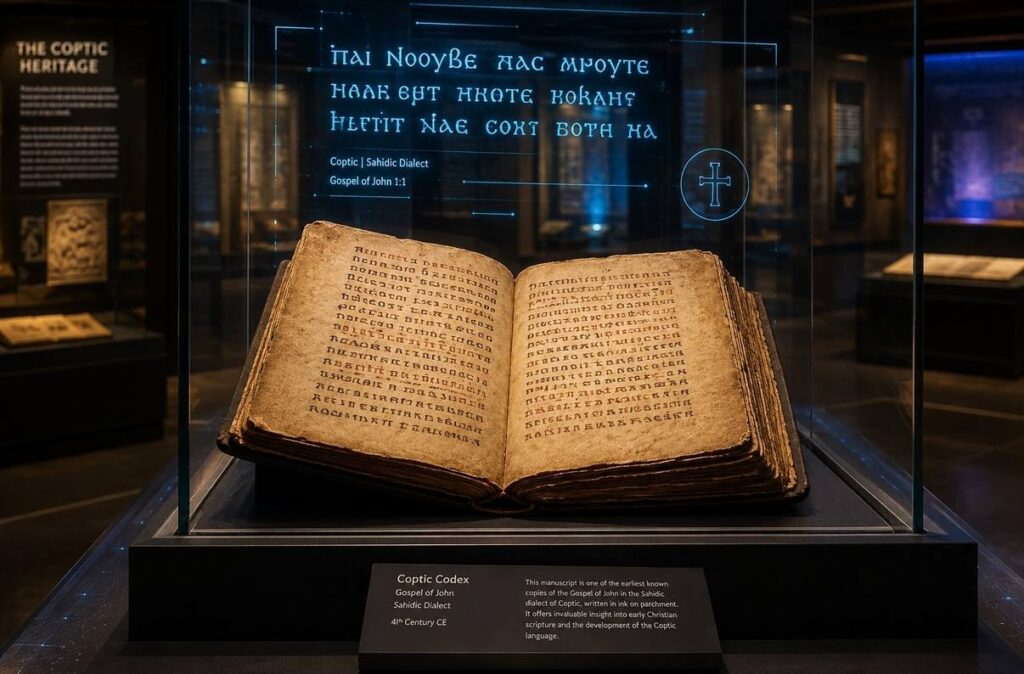
Today, the Nag Hammadi codices reside in the Coptic Museum in Cairo, their papyrus stabilised behind glass, their pages digitised and made available online. The transition from ancient codex to digital text is not merely technological. It raises questions about how the format shapes meaning. The codex demanded physical encounter–the weight of the book, the turn of the page, the smell of leather and papyrus. The screen offers access but removes embodiment.
Yet the fundamental logic of the codex persists. We still speak of web “pages” and digital “documents.” The random access that the codex introduced remains the organising principle of information retrieval, from the medieval codex to the search engine. The ancient book, in this sense, never died. It simply changed its covers.
Frequently Asked Questions
What is the difference between a codex and a scroll?
A scroll is a continuous roll of papyrus or parchment that must be read sequentially from beginning to end, requiring two hands to manage. A codex consists of individual leaves bound along one edge, opening like a modern book. This allows random access to any page, one-handed reading, and better protection for the text.
How many codices make up the Nag Hammadi Library?
The Nag Hammadi Library comprises thirteen papyrus codices containing forty-six separate tractates. They were discovered in a sealed jar near Nag Hammadi, Egypt, in December 1945.
What is codicology and why does it matter?
Codicology is the study of ancient books as physical objects. It examines materials, construction, binding, scribal hands, and colophons. For the Nag Hammadi Library, codicology reveals how the texts were produced, organised, and preserved, offering insights that the words alone cannot provide.
Why did early Christians prefer the codex format?
Early Christians adopted the codex to distinguish their writings from Jewish scripture, which remained in scroll form, and from pagan literature. The codex also allowed longer texts–such as the four Gospels–to be contained in a single volume, enabling easier reference and a sense of textual unity.
What is the Jung Codex and why is it important?
The Jung Codex is Nag Hammadi Codex I. It was purchased by the C. G. Jung Institute in Zurich after the 1945 discovery and remained there for two decades before being reunited with the other codices in Cairo. It contains five important texts including the Gospel of Truth and the Tripartite Tractate.
What materials were used to make ancient codices?
Ancient codices were made from papyrus, parchment, or vellum leaves, bound between wooden boards or leather covers. The Nag Hammadi codices use papyrus leaves folded into gatherings, with leather covers that often included protective flaps.
Can I visit the Nag Hammadi codices today?
The Nag Hammadi codices are housed in the Coptic Museum in Cairo, Egypt. Some leaves and fragments have been digitised and are accessible through academic databases and the Facsimile Edition published by Brill.
Further Reading
Explore these ZenithEye articles to deepen your understanding of the Nag Hammadi Library, its discovery, and the ancient world that produced it:
- The Complete Guide to the Nag Hammadi Library — A definitive introduction to all 13 codices, 46 tractates, and the history of the 1945 discovery.
- Nag Hammadi Library: Complete Reader’s Guide — Navigate the library by codex, theme, or reading level with this comprehensive map.
- How the Nag Hammadi Library Was Discovered — The story of Muhammad Ali al-Samman, the sealed jar, and the moment that changed Gnostic studies forever.
- Codicology and Conservation of the Nag Hammadi Library — Learn how papyrus was manufactured, how the codices were bound, and how scholars preserved them.
- Codex I: The Jung Codex — A detailed overview of the codex that spent two decades in Zurich before returning to Cairo.
- Codex II: The Crown Jewels — Explore the codex containing the Apocryphon of John, the Gospel of Thomas, and the Gospel of Philip.
- Codex XIII: Trimorphic Protennoia — The hidden codex found inside Codex VI, containing the Three Forms of First Thought.
- Gnostic Technical Glossary: Key Terms — Master essential terminology including archons, aeons, pleroma, demiurge, and gnosis.
- Reading Coptic Texts: A Guide for Non-Specialists — An accessible introduction to the Sahidic Coptic language used in the Nag Hammadi codices.
- Trimorphic Protennoia: The Three Descents — A deep dive into the text hidden inside Codex VI, exploring the divine voice that descends to awaken the soul.