
The Ouroboros: Seven Faces of the Serpent That Eats Its Own Tail
The serpent devouring its own tail is one of humanity’s oldest visual riddles. It appears on the golden shrine of a boy-king in Egypt, in the alchemical notebooks of a woman philosopher in Alexandria, in Vedic hymns describing cosmic ritual, and in the storm-lashed sagas of the North. It is at once a symbol of eternity and a warning about the closed loop, a map of liberation and a diagram of the trap. To trace the ouroboros across cultures is to discover not a single meaning, but a shared intuition: that endings feed beginnings, that the boundary of the world is also its centre, and that the way out may require passing through the mouth of the very thing that encircles us.
This article examines seven distinct cultural faces of the ouroboros–from the Enigmatic Book of the Netherworld to Jungian psychology–and asks what this ancient image still has to say about cycles, self-knowledge, and the shape of time itself.
Table of Contents
- Egypt — The Enigmatic Book and the Union of Ra-Osiris
- Greece — Plato’s Self-Sufficient Cosmos and the Birth of a Name
- Gnosticism — The Twelve-Part Dragon and the Soul of the World
- Alchemy — Cleopatra’s Circle and the All Is One
- India — Vedic Ritual and the Coiled Power of Kundalini
- The Norse World-Serpent and the Cosmic Boundary
- Beyond the Old World — West Africa, South America, and the Closed Loop
- The Modern Tail — From Benzene Rings to Jungian Archetypes
- What the Ouroboros Actually Means
- Frequently Asked Questions
- Further Reading
- References and Sources
Egypt — The Enigmatic Book and the Union of Ra-Osiris
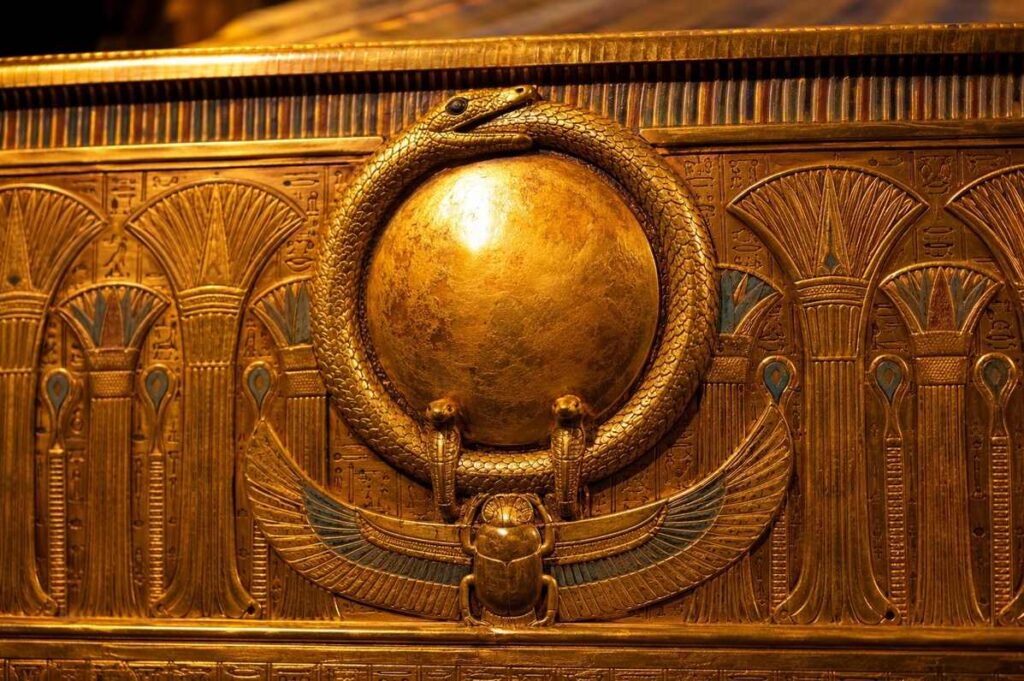
The earliest surviving ouroboros appears in Egypt, on one of the gilded shrines enclosing the sarcophagus of Tutankhamun, dating to roughly the fourteenth century BCE. Here the serpent encircles the solar disc, its tail in its mouth, guarding the threshold between the living and the dead. This is not mere decoration. The image belongs to the Enigmatic Book of the Netherworld, a royal underworld text painted in the tomb of Ramesses VI and echoed in the boy-king’s burial goods. In this context, the ouroboros represents the union of Ra and Osiris–the sun god of the day and the resurrected king of the night–whose cyclic merging guarantees the renewal of time itself.
Egyptian cosmology understood the cosmos as a closed circuit. The sun travelled through the body of the sky-goddess Nut by day, was swallowed at evening, passed through the underworld, and was reborn at dawn. The serpent Mehen, whose name means “the Coiled One,” protected Ra during this nocturnal journey, encircling him much as the ouroboros encircles the solar disc. The symbol thus carries two simultaneous messages: the world is a bounded, self-contained system, and within that boundary, regeneration is guaranteed. Death feeds life; the end of the circuit is the start of the next.
Greece — Plato’s Self-Sufficient Cosmos and the Birth of a Name
The Greek name ouroboros comes from oura (tail) and borea (devouring), though the exact etymological path remains debated among philologists. What is certain is that the image entered Greek thought not merely as an exotic import but as a philosophical necessity. In Plato’s Timaeus, the demiurge fashions the cosmos as a single, self-sufficient living creature, “round and revolving upon itself,” needing no external limbs because nothing lies outside it. While Plato does not name the ouroboros directly, the description is unmistakable: a circular being that contains everything within itself and therefore consumes only itself.
For the Stoics who followed, the cosmos was a single organism bound together by sympatheia–universal resonance. Heraclitus had already taught that all things are one, held in tension by the Logos. The ouroboros became the perfect emblem of this philosophy: opposites locked in a cycle that never breaks, fire and water, creation and destruction, each becoming the other in an endless rotation. The Greek contribution was to give the image a conceptual skeleton, transforming an Egyptian funeral motif into a metaphysical argument about the nature of totality.
Gnosticism — The Twelve-Part Dragon and the Soul of the World
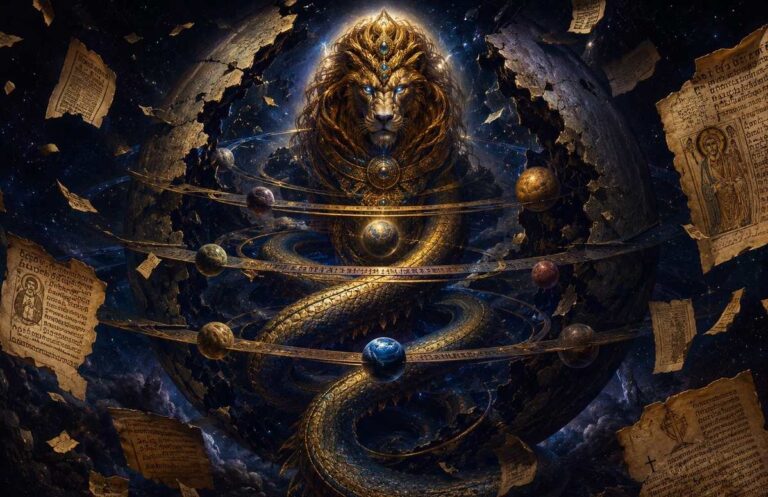
In the Nag Hammadi Library, the ouroboros appears as a cosmic boundary and a spiritual obstacle. The Apocryphon of John describes Yaldabaoth, the lion-faced demiurge, surrounded by a twelve-part dragon–a zodiacal ouroboros that both defines the material world and imprisons the sparks of light trapped within it. Here the closed circle is not comforting; it is the kenoma, the emptiness, the domain of forgetfulness from which the awakened soul must escape.
Yet even in Gnosticism, the ouroboros retains its original power. Some Valentinian texts describe the anima mundi, the world soul, as a serpent encircling the cosmos, holding together the elements in a fragile equilibrium. The task of the Gnostic is not simply to reject the world but to recognise its cyclic nature for what it is: a system that feeds on itself, generating endless motion without genuine transformation. The way out, as the ascent texts repeatedly insist, is through–passing the planetary spheres, answering the archonic guardians, and stepping beyond the rim of the serpent’s circle into the pleroma, the fullness that knows no boundary.
Alchemy — Cleopatra’s Circle and the All Is One
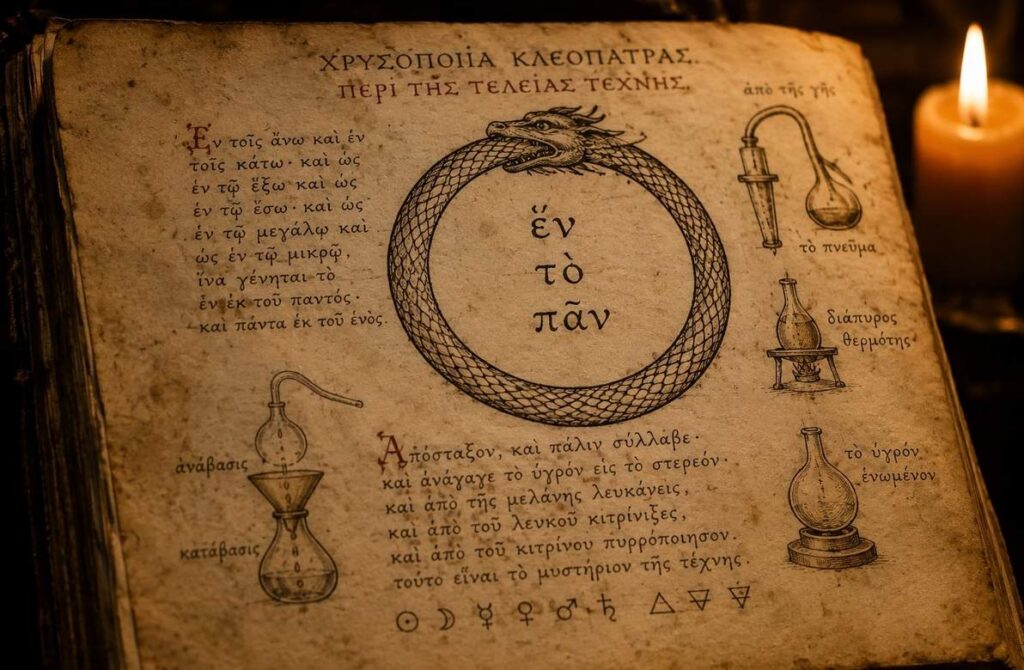
The most famous alchemical ouroboros belongs to a woman. Cleopatra the Alchemist–not the Ptolemaic queen, but a philosopher working in Alexandria around the third century CE–left behind the Chrysopoeia, a single manuscript page now preserved in Venice (Biblioteca Marciana, MS Marciana gr. Z. 299). At its centre sits a serpent biting its tail, encircled by the Greek words hen to pan: “The All is One.” Around the ring, a longer inscription reads: “One is the Serpent which has its poison according to two compositions, and One is All and through it is All, and by it is All, and if you have not All, All is Nothing.”
This is not mysticism divorced from practice. The same page includes diagrams of laboratory apparatus–the dibikos and kerotakis used for distillation and vapour treatment–alongside symbols for gold, silver, and mercury. Cleopatra’s ouroboros is a working hypothesis: the alchemical process must be carried through its full cycle, or the result is void. The serpent eating its tail becomes a warning against shortcuts, a reminder that the opus demands completion. The page also contains an eight-pointed star and crescent moons that scholars interpret as a pictorial recipe for turning lead into silver, proving that even the most exalted symbols were rooted in the smoke and heat of actual furnaces.
Cleopatra stood in a lineage of women alchemists that included Mary the Jewess, inventor of the bain-marie and the tribikos still. Their work suggests that the ouroboros was never exclusively a masculine symbol of abstract eternity; it was also a practical tool in the hands of technicians who understood that cycles must be completed, not merely contemplated.
India — Vedic Ritual and the Coiled Power of Kundalini
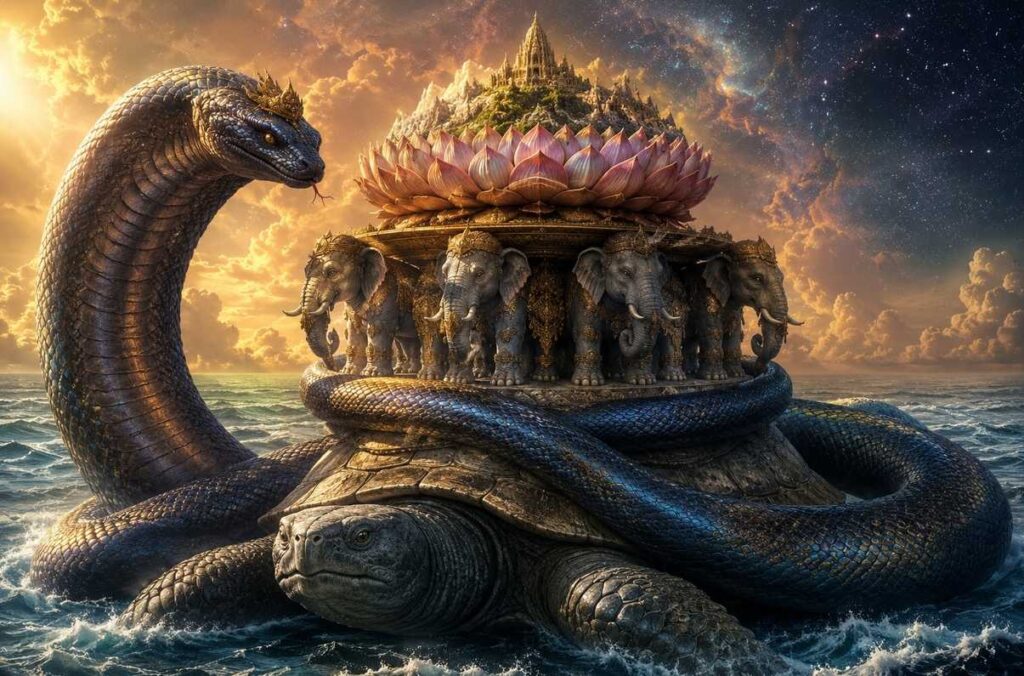
In Hindu cosmology, the serpent Shesha–also called Ananta, the Infinite–encircles the tortoise Kurma, supporting the elephants who bear the world on their backs. This is not precisely an ouroboros in the Egyptian sense, since Shesha does not bite his own tail, but the structural parallel is unmistakable: a cosmic serpent defines the boundary of existence and sustains what lies within. In the Bhagavata Purana, when the universe dissolves at the end of a kalpa, it is drawn back into Ananta’s coils, only to be reborn when Vishnu awakens from his serpent-bed and begins the creative cycle anew.
The tantric tradition offers a more intimate version. Kundalini, the coiled serpent power, sleeps at the base of the spine, three and a half times encircled–a microcosmic ouroboros waiting to be awakened. When aroused through practice, she rises through the chakras, consuming and transforming each centre until she unites with Shiva at the crown. Here the ouroboros is not external but internal, not a map of cosmic time but a diagram of personal transformation. The cycle is completed within the body, turning the finite self into a vessel for infinite consciousness.
The Norse World-Serpent and the Cosmic Boundary
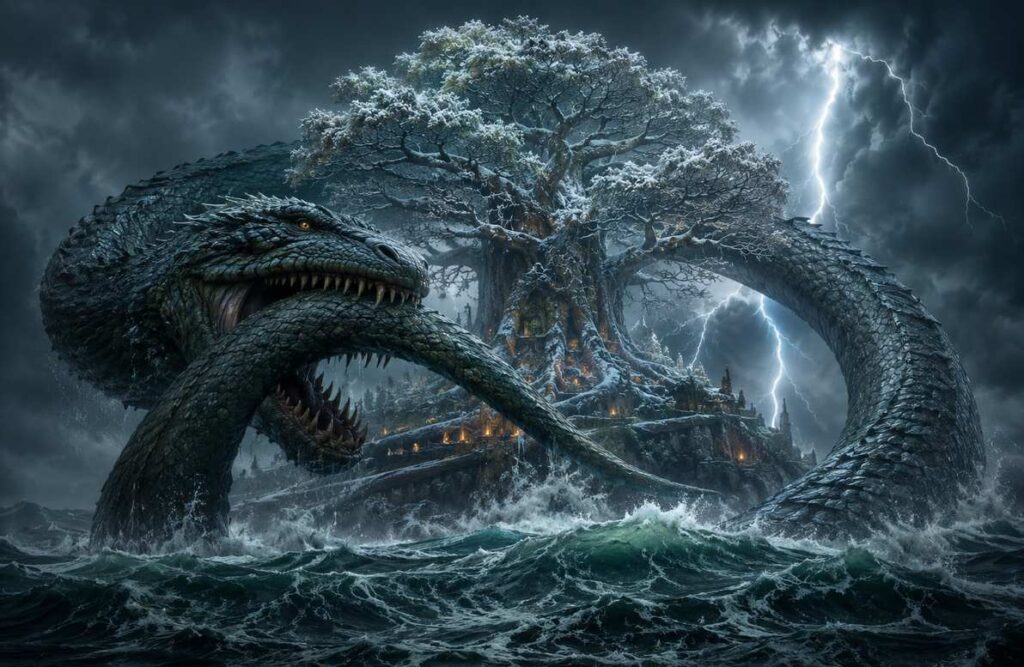
In the Prose Edda, compiled by Snorri Sturluson in thirteenth-century Iceland, Jormungandr, the Midgard Serpent, grows so vast in the world-ocean that he encircles the Earth and grasps his own tail in his teeth. His name means “vast monster” or “earth necklace,” and his presence defines the boundary of the human realm. Odin flung him into the sea as a child, yet the serpent grew to become the very rim of the world.
The Norse ouroboros carries a darker message than its Egyptian cousin. Jormungandr’s tail-holding is not merely a symbol of eternal return; it is a restraint. When he releases his tail, Ragnarok begins–the twilight of the gods, the breaking of the cycle, the flood of venom that poisons the nine worlds. Thor will slay the serpent at the world’s end, yet will himself die nine steps later. The Norse tradition thus presents the ouroboros as a holding pattern, a temporary containment of forces that will eventually burst their boundary. The circle is real, but it is not permanent; it is a dam, not a promise.
Beyond the Old World — West Africa, South America, and the Closed Loop
The ouroboros is not confined to Eurasia. In the Fon and Dahomean traditions of West Africa, the rainbow serpent Oshunmare–also known as Aidophedo–is depicted biting its own tail. Unlike the Egyptian symbol of renewal, the Fon ouroboros carries a warning: when the serpent exhausts the iron that sustains it, it begins to consume itself, and when the self-consumption is complete, creation collapses back into chaos. This is an ecological ouroboros, a symbol of finite resources and the danger of unsustainable cycles. In 1812, the newly independent Republic of Haiti minted coins bearing a serpent biting its tail, linking the ancient symbol to revolutionary self-determination.
In the tropical lowlands of South America, indigenous traditions hold that the waters at the edge of the world-disc are encircled by an anaconda biting its own tail. The Aztecs, too, produced a seven-segmented ouroboros, a feathered serpent whose cyclic body encoded calendrical time. These American variants suggest that the image arises not from a single point of diffusion but from a recurrent structural intuition: the world is bounded, the boundary is alive, and the living boundary sustains itself only by self-consumption.
The Modern Tail — From Benzene Rings to Jungian Archetypes
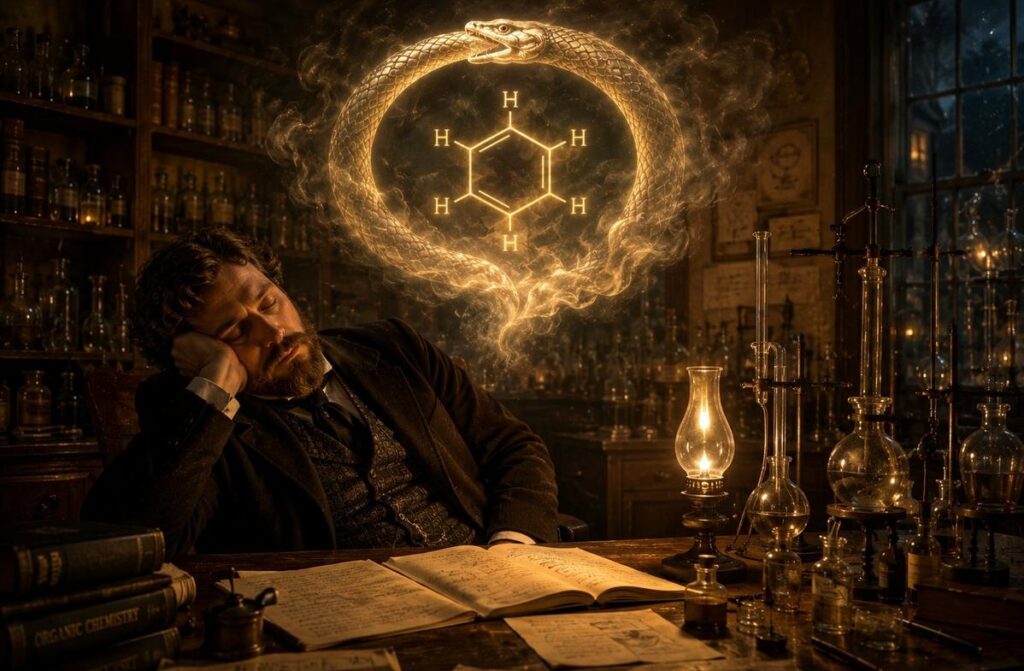
The ouroboros refused to die with the ancient world. In 1865, the German chemist Friedrich August Kekule claimed that the structure of benzene–a six-carbon ring–came to him in a dream of a serpent biting its own tail. Whether the dream occurred exactly as described has been debated by historians of science, but the symbol’s power is undeniable: the ouroboros provided a visual grammar for understanding cyclic molecular bonds that revolutionised organic chemistry.
Carl Jung adopted the ouroboros as an archetype of the pre-ego state, the “dawn state” of consciousness before the self separates from the world. For Jung, the serpent consuming its tail represented the original undifferentiated wholeness from which individuation emerges. The Theosophical Society placed the ouroboros on its seal alongside the swastika and the Star of David, claiming it as a universal emblem of humanity’s shared wisdom. In the twentieth century, the symbol migrated into psychology, counter-culture, and even physics, where some theorists use it to model closed-system universes.
What the Ouroboros Actually Means
After travelling from Tutankhamun’s tomb to Kekule’s laboratory, what does the ouroboros actually signify? The answer is plural, not singular. The symbol functions as a boundary marker: it defines the edge of the cosmos, the body, the molecule, the self. It operates as a process diagram: it shows how systems return to their origins, how waste becomes nourishment, how death feeds life. And it serves as a cautionary image: the closed loop can become a trap, the self-sustaining cycle can deplete its own resources, the serpent that eats only itself will eventually consume everything it is.
The ouroboros does not promise that every cycle is benign. It promises only that every end is connected to a beginning, and that the connection itself is alive.
For the contemporary seeker, the ouroboros offers a method of discernment. When encountering a system–whether spiritual, psychological, or social–one might ask: is this cycle generative or merely self-consuming? Does it renew its substance, or does it spin ever faster on diminishing returns? The Egyptian version answers one way; the Fon version answers another. The serpent itself does not judge. It simply reminds us that the tail is already in the mouth, and has been from the start.
Frequently Asked Questions
What is the oldest known ouroboros symbol?
The earliest surviving ouroboros appears on a gilded shrine in the tomb of Tutankhamun, dating to approximately the fourteenth century BCE. It encircles the solar disc and belongs to the Egyptian Enigmatic Book of the Netherworld, symbolising the union of Ra and Osiris.
What does the word ouroboros mean in Greek?
The term comes from the Greek oura (tail) and borea (devouring or food), describing a serpent eating its own tail. Plato’s Timaeus describes the cosmos as a self-sufficient circular being that closely matches the ouroboros image, though he does not use the name directly.
How is the ouroboros used in Gnosticism?
In Nag Hammadi texts such as the Apocryphon of John, the ouroboros appears as a twelve-part dragon surrounding the demiurge Yaldabaoth, representing the zodiacal boundary of the material world. For Gnostics, it symbolises the kenoma–the empty cycle of material existence from which the awakened soul must ascend.
Who was Cleopatra the Alchemist and what is the Chrysopoeia?
Cleopatra the Alchemist was a third-century CE philosopher working in Alexandria. Her Chrysopoeia is a single manuscript page preserved in Venice, featuring an ouroboros with the Greek motto hen to pan (The All is One). The page includes laboratory diagrams and alchemical apparatus, showing the symbol’s practical as well as philosophical use.
Is the Norse Midgard Serpent an ouroboros?
Yes. In the Prose Edda, Jormungandr grows so large that he encircles Midgard and grasps his own tail. Unlike the Egyptian symbol of renewal, the Norse ouroboros represents a temporary containment; when Jormungandr releases his tail, Ragnarok begins.
How did the ouroboros influence modern science?
In 1865, chemist August Kekule claimed that the structure of benzene–a six-carbon ring–came to him in a dream of a serpent biting its tail. The symbol thus provided a visual model for cyclic molecular bonds that transformed organic chemistry.
What does the ouroboros mean in West African tradition?
In Fon and Dahomean traditions, the rainbow serpent Oshunmare (Aidophedo) bites its own tail. Here the symbol carries an ecological warning: when the serpent exhausts its food source, it consumes itself, and when self-consumption is complete, creation collapses back into chaos.
Further Reading
- The Nag Hammadi Library: A Complete Reader’s Guide — The essential introduction to the Gnostic texts where the ouroboros appears as a cosmic boundary.
- The Apocryphon of John: Gnostic Creation and the Twelve-Part Dragon — Detailed analysis of the demiurgic ouroboros surrounding Yaldabaoth.
- Hermetic Connections in the Nag Hammadi Library — Explores the Alexandrian milieu where alchemy, Gnosticism, and the ouroboros converged.
- Zostrianos: Journey Through the Thirteen Aeons — An ascent text describing how the soul passes beyond cosmic boundaries.
- The Five Seals: Sethian Initiation and Ritual — Examines the practical techniques for passing through the planetary spheres.
- Gnostic Schools: Sethians, Valentinians, and Hermetics — Comparative overview of how different Gnostic traditions mapped the cosmos.
- The Axial Age: Why Wisdom Emerged Simultaneously — Contextualises the cross-cultural appearance of symbols like the ouroboros during the first millennium BCE.
- The Sevenfold Pattern: Planets, Metals, and Chakras — Explores the zodiacal and planetary structures that the Gnostic ouroboros encircles.
- The Emerald Tablet: Hermetic Foundation and Correspondence — The “as above, so below” tradition that shares the ouroboros’ vision of cyclic unity.
- What is Gnosticism? Defining the Undefinable — Essential background on the tradition that transformed the ouroboros from a symbol of renewal into a map of spiritual escape.
References and Sources
The following sources represent the scholarly and primary materials consulted in the preparation of this article.
Primary Sources and Critical Editions
- Hornung, E. (1999). The Ancient Egyptian Books of the Afterlife. Cornell University Press. (Contains the Enigmatic Book of the Netherworld and analysis of Tutankhamun’s shrine imagery.)
- Plato. Timaeus. Translated by Donald J. Zeyl. In Plato: Complete Works, ed. John M. Cooper. Hackett, 1997.
- Sturluson, Snorri. Prose Edda. Translated by Jesse L. Byock. Penguin Classics, 2005.
- The Nag Hammadi Library in English. 4th revised ed. Edited by James M. Robinson. Brill, 1996. (Specifically the Apocryphon of John and Valentinian Exposition.)
- MS Marciana gr. Z. 299. Biblioteca Marciana, Venice. (10th-11th century manuscript containing the Chrysopoeia of Cleopatra the Alchemist.)
Scholarly Monographs and Comparative Studies
- Abraham, Lyndy. (1998). A Dictionary of Alchemical Imagery. Cambridge University Press.
- Collins, Derek. (2008). Magic in the Ancient Greek World. Blackwell.
- Giesecke, Annette Lucia. (2019). The Mythology of Plants: Botanical Lore from Ancient Greece and Rome. Getty Publications.
- Holmyard, E.J. (1957). Alchemy. Penguin Books. (Chapter on Cleopatra the Alchemist and the Chrysopoeia.)
- Neumann, Erich. (1954). The Origins and History of Consciousness. Princeton University Press. (Jungian analysis of the ouroboros as pre-ego archetype.)
- Witzel, Michael. (2012). The Origins of the World’s Mythologies. Oxford University Press. (Comparative analysis of cosmic serpent motifs across world cultures.)
Specialist Articles and Encyclopaedic References
- “Ouroboros.” Encyclopaedia Britannica. Accessed May 2026.
- “Jormungandr.” Stanford Encyclopedia of Philosophy (via Norse mythology entries). Accessed May 2026.
- “Cleopatra the Alchemist.” Wikipedia (cross-referenced with Biblioteca Marciana catalogue records). Accessed May 2026.
- “Chrysopoeia of Cleopatra.” Wikimedia Commons (File: Chrysopoea of Cleopatra 1.png). Accessed May 2026.
- “Ouroboros.” Crystalinks.com (cross-cultural survey including Fon, Dahomean, and South American variants). Accessed May 2026.
Safety Notice: This article explores historical and esoteric symbolism. It does not constitute medical, psychological, or spiritual advice. Contemplative or alchemical practices mentioned are historical descriptions, not instructions. If you are experiencing psychological distress related to obsessive cyclical thoughts or spiritual emergency, please contact professional emergency services or a trauma-informed therapist.