
Lucid Dreaming as Practice Platform: The Tibetan Milam and Western Methods
You dream. The narrative unfolds–absurd, yet accepted without question. Then, something shifts. You realise: this is a dream. The realisation, stable, produces lucidity. The dream, now known as a dream, becomes a platform–a laboratory for transformation, a preparation for death, and an extension of practice into the third of life usually spent in darkness. For a moment, the prisoner notices the cell bars are painted on.
The phenomenon is universal. A 2016 quality-effects meta-analysis by Saunders et al., synthesising data from 34 studies spanning fifty years of research, found that approximately 55% of people have experienced lucidity at least once in their lifetime (95% confidence interval: 49% to 62%). For most, it is rare–a glitch in the system, a momentary rupture in the consensual hallucination of the dream state. For practitioners, it becomes regular, even nightly. The cultivation requires technique, persistence, and the systematic application of attention to the sleep state.

Table of Contents
- The Tibetan Milam: Dream Yoga as Spiritual Technology
- Western Methods: The Mechanics of Lucidity
- Neuroscience of Lucidity: The Brain Awake in Sleep
- Advanced Practice: Beyond the Novelty
- The Realities of Risk: Clinical Boundaries
- The Thread Extended
- Frequently Asked Questions
- Further Reading
- References and Sources
The Tibetan Milam: Dream Yoga as Spiritual Technology
The Tibetan tradition calls it milam–dream yoga. This advanced practice, one of the Six Dharmas (or Six Yogas) of Naropa in the Kagyu school of Tibetan Buddhism, produces not merely lucidity but control: the capacity to transform dream content, travel to pure lands, and receive teachings from non-physical guides. The six yogas are tummo (inner heat), osel (clear light), milam (dream), gyulu (illusory body), bardo (intermediate state), and phowa (consciousness transference). Crucially, milam serves as a training ground for the bardo–the “between-state” encountered after death, where the soul navigates the hallucinatory projections of its own psyche. To master the dream is to prepare for the ultimate transition.
While Western methods focus on induction mechanics, the Tibetan milam offers a comprehensive spiritual technology for utilising the dream state. It is not merely about becoming lucid, but about what one does with that lucidity–transforming the night from rest into practice. Contemporary teachers often present the system through five progressive stages, a pedagogical framework that maps the journey from initial recognition to full integration:
The Five Stages of Dream Yoga
Stage 1: Recognition (Tib. namshe): Developing the capacity to recognise the dream as dream. This corresponds to Western lucidity but is approached as a spiritual discipline rather than a psychological curiosity. The recognition is not merely “I am dreaming” but “This is the nature of all experience–unreal, projected, empty of inherent existence.” The practitioner learns to question the solidity of both dream and waking phenomena, recognising their shared dependence upon mind.
Stage 2: Control (wang): Learning to stabilise the dream and manipulate its content. The practitioner learns to fly, change environments, or summon guides–not for entertainment, but to train the mind’s capacity to shape reality through intention. This prepares the practitioner for the bardo, where thoughts manifest instantaneously and uncontrolled mentation produces terrifying apparitions. In the bardo, as in the dream, fear creates what is feared.
Stage 3: Dissolution of Fear: Confronting terrifying dream figures–demons, wild animals, or threatening scenarios–and recognising them as projections of one’s own mind. The practitioner dissolves these figures through compassion or insight, training for the wrathful deities encountered in the bardo. What appears as nightmare becomes teaching. The Bardo Thodol (Tibetan Book of the Dead) explicitly instructs the deceased to recognise all bardo visions as their own mind’s projections; dream yoga provides the rehearsal.
Stage 4: The Clear Light (osel): The most advanced practice–maintaining awareness not merely through the dream, but into deep, dreamless sleep. Here, the practitioner encounters the “clear light of sleep,” the substrate consciousness underlying all experience. This is preparation for the moment of death, when the clear light of the dharmakaya manifests. To recognise it is liberation; to miss it is continued wandering in the six realms. The Buddha himself, before parinibbana, passed through all eight jhanas in ascending and descending order, demonstrating that even the highest conditioned states must be transcended for final liberation.
Stage 5: Integration: Bringing the realisation of the dream’s emptiness into waking life. The yogi recognises that waking reality is also “dream-like”–empty of inherent existence, dependently arisen, mind-made. This is the raison d’etre of dream yoga: not escape into fantasy, but the awakening that transcends both sleep and waking. The distinction between the two states dissolves, revealing a single continuum of mind.
Western Methods: The Mechanics of Lucidity
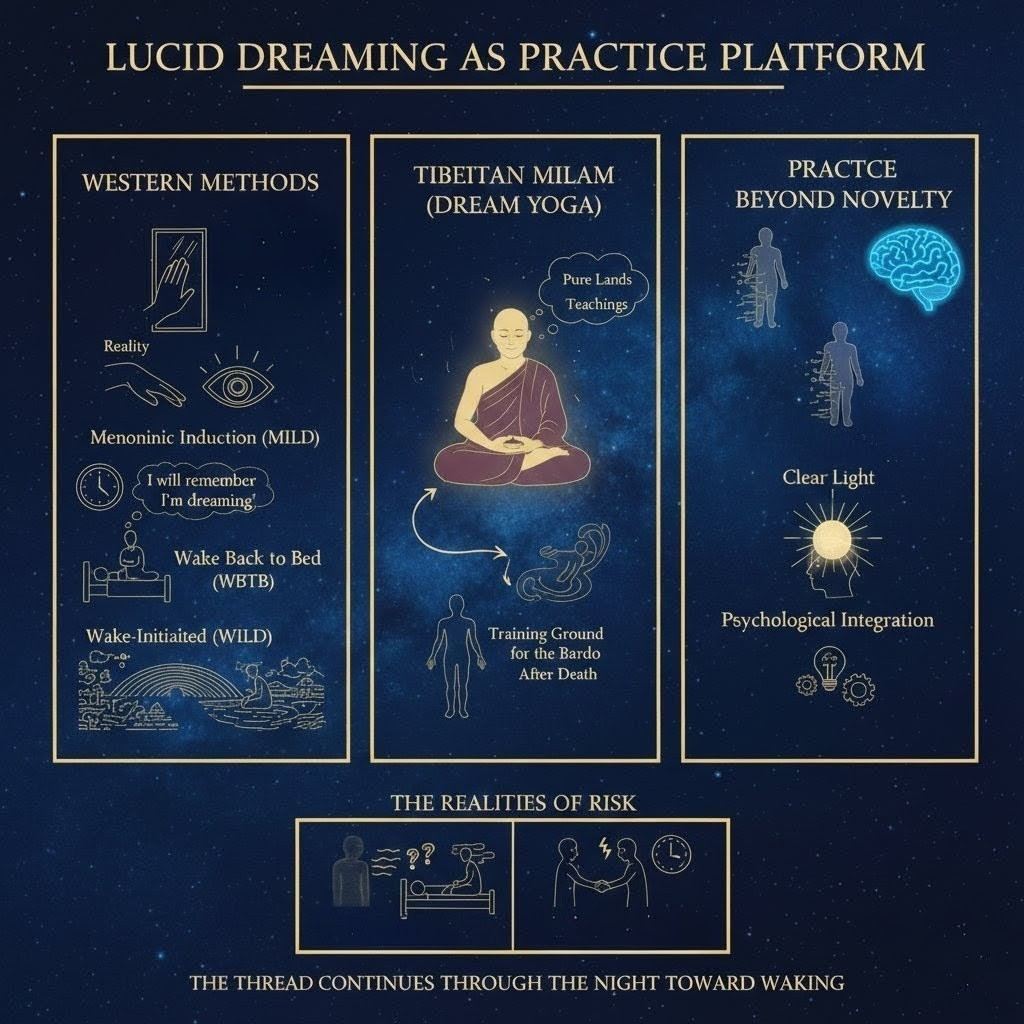
The cultivation of lucidity, when secularised, produces reliable results through specific induction techniques. These are not mystical abstractions but replicable protocols–software patches for the sleeping mind:
Reality Testing
The habitual questioning of the waking state (“Am I dreaming?”) which eventually triggers the same question within a dream. The practitioner performs “state checks” throughout the day–attempting to push a finger through the palm, checking digital clocks (which rarely remain stable in dreams), or observing whether text remains constant when looked at twice. The goal is to install a subroutine that runs automatically during sleep. Research by Stumbrys et al. (2012) confirmed that reality testing, when performed consistently, significantly increases lucid dream frequency.
Mnemonic Induction of Lucid Dreams (MILD)
Developed by Dr. Stephen LaBerge at Stanford University in 1980, this technique involves setting a firm intention at sleep onset, often repeated as a mantra: “Next time I’m dreaming, I will remember I’m dreaming.” It combines prospective memory (remembering to do something in the future) with meta-cognitive awareness. The practitioner visualises themselves becoming lucid while repeating the affirmation, effectively programming the subconscious to trigger recognition. A 2017 study by Aspy et al. published in Consciousness and Cognition demonstrated that when MILD was combined with Wake Back to Bed (WBTB), participants achieved lucidity in 54% of attempts–making it one of the most scientifically validated induction methods available.
Wake Back to Bed (WBTB)
Waking after approximately five hours of sleep (after several REM cycles), staying awake briefly (15-30 minutes), and returning to bed with focused intent. This exploits the extended REM periods of the morning, when dreams are longest and most vivid. The method is effective but requires sacrificing sleep architecture–potentially problematic for those with anxiety or insomnia. LaBerge’s original research found that wakefulness interjected during sleep significantly improved lucidity rates.
Wake-Initiated Lucid Dream (WILD)
The most direct but technically demanding method–maintaining awareness through the hypnagogic threshold. The practitioner enters the dream directly from wakefulness without loss of consciousness, often experiencing sleep paralysis as the body falls asleep while the mind remains alert. This produces the most vivid lucid dreams but requires navigating the “presence” phenomena and hypnagogic hallucinations that accompany the transition. Success rates for beginners are low (70%+ failure rate), but the resulting experiences are often the most intense and stable.
Safety Note: WILD techniques can trigger intense hypnagogic hallucinations and sleep paralysis. While physiologically harmless, these experiences can be terrifying for the unprepared. Those with trauma histories, dissociative tendencies, or psychotic spectrum disorders should approach WILD cautiously, preferably with guidance. The “presence” often reported during sleep paralysis is a neurological artifact, but the fear response is real.
Neuroscience of Lucidity: The Brain Awake in Sleep
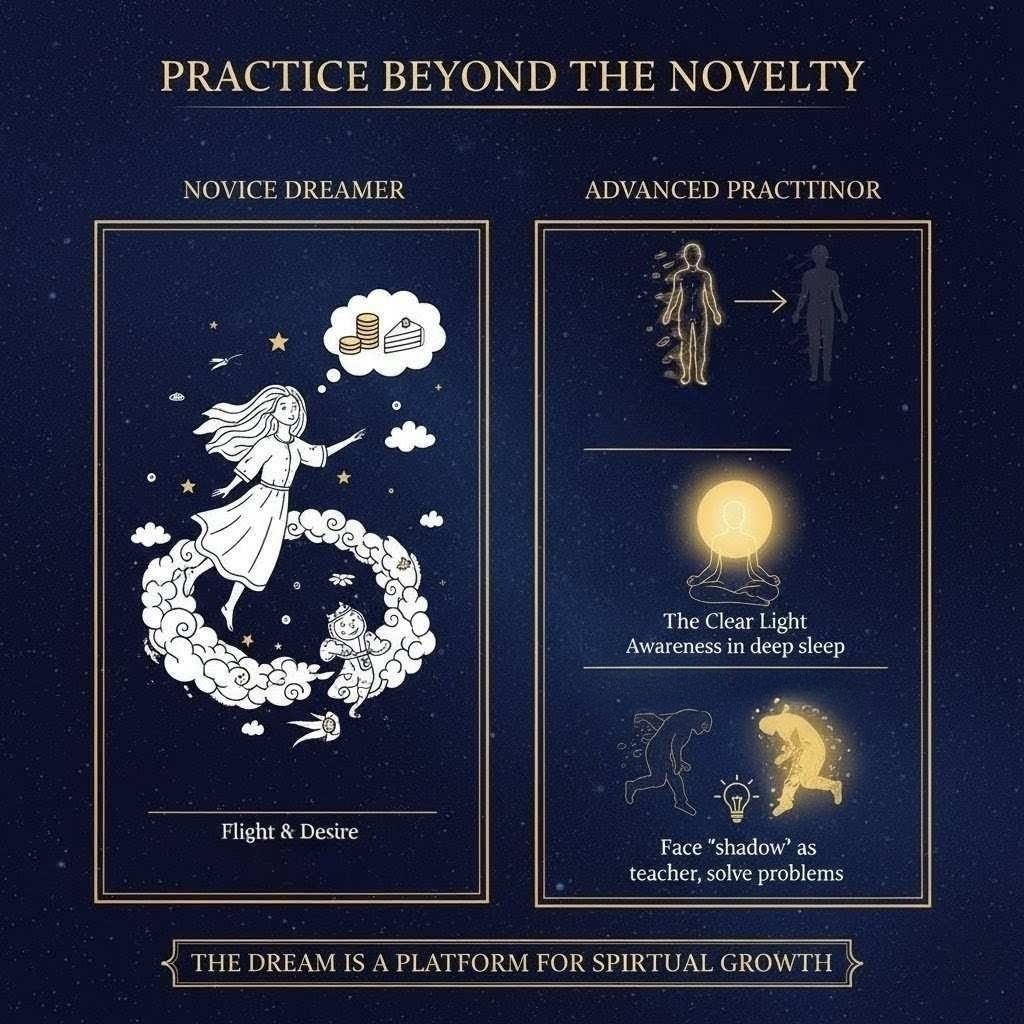
Neuroimaging confirms that lucid dreaming is not mere metaphor but a distinct neurophysiological state. During ordinary REM sleep, the prefrontal cortex–the seat of executive function, self-awareness, and logical reasoning–is largely offline. This explains the dream’s bizarre acceptance of impossible scenarios: the “reality-testing” department has closed for the night.
In lucid dreams, however, fMRI and EEG studies show prefrontal cortex reactivation–specifically in the dorsolateral prefrontal cortex associated with metacognition (thinking about thinking). In a landmark 2009 study published in Sleep, Ursula Voss and colleagues demonstrated that lucid dreaming constitutes a hybrid state with REM-like power in delta and theta frequency bands, but significantly higher-than-REM activity in the gamma band (25-100 Hz), with the between-states difference peaking around 40 Hz. Power in the 40 Hz band was strongest in the frontal and frontolateral regions, and overall coherence levels were similar to waking consciousness–significantly higher than in ordinary REM sleep.
The gamma wave coherence observed during lucid dreams is particularly significant. Gamma synchronisation (30-100 Hz) is associated with conscious awareness, attention, and moments of insight (the “aha!” moment). That it appears in lucid dreams suggests that lucidity is not merely the presence of consciousness, but of a specific quality of consciousness–awake, integrated, and self-reflective.
Technological Induction: tACS and the Gamma Band
This research has led to attempts to induce lucidity through transcranial alternating current stimulation (tACS) at gamma frequencies. In a 2014 Nature Neuroscience study, Voss and colleagues applied fronto-temporal tACS at 2, 6, 12, 25, 40, 70, and 100 Hz during REM sleep. Only stimulation at 25 Hz and 40 Hz produced significant increases in lucid dream-like self-awareness, suggesting that gamma oscillations are not merely correlates but potentially causal factors in the emergence of lucidity. The implications are profound: if 40 Hz gamma activity is a signature of lucid awareness, then technological modulation of this frequency may offer a pathway to induced lucidity for those who struggle with conventional techniques.
However, the technology raises important questions. Is artificially induced lucidity the same as naturally cultivated awareness? Does the shortcut bypass the developmental benefits of the practice itself? The pragmatic view is that tACS may serve as a training wheel–demonstrating to the novice what lucidity feels like, thereby accelerating the learning of natural induction. But the deeper transformation that Tibetan dream yoga seeks–the recognition of emptiness in all phenomena–requires more than a stimulated brain state. It requires a transformed understanding.
Advanced Practice: Beyond the Novelty
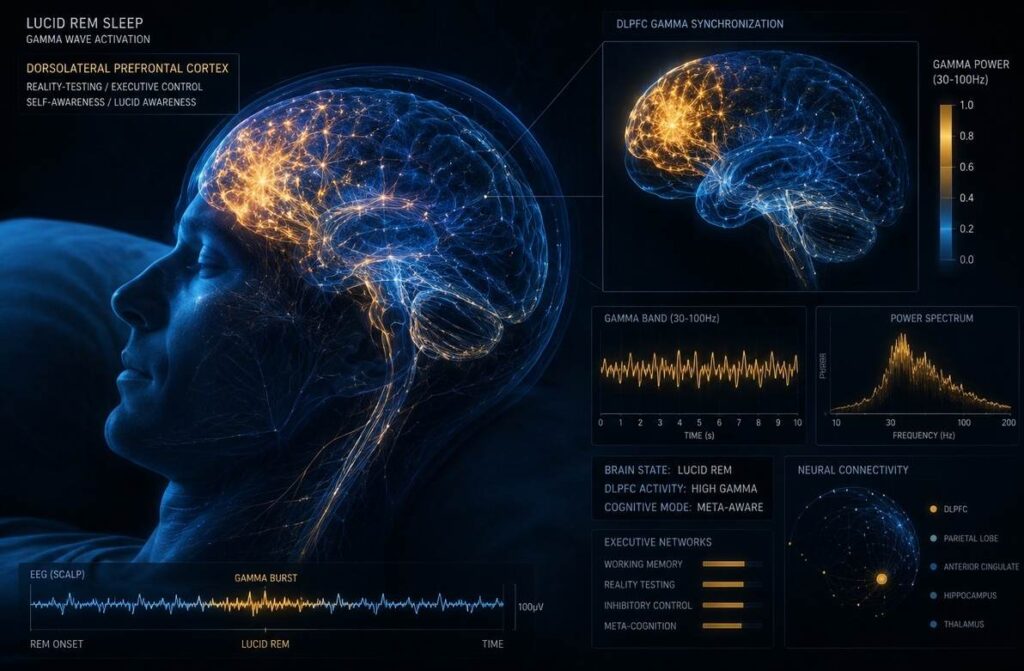
The novice lucid dreamer often uses the state for flight, sexual fulfilment, or the satisfaction of desires denied in waking life. This is natural–the ego, suddenly granted god-like powers in a consequence-free environment, indulges its fantasies. But the advanced practitioner recognises the dream as a platform for transformation–not escapism, but deep work.
The Illusory Body
Recognising the dream body as insubstantial–lacking solidity, birth, or death–prepares the practitioner to see the waking body and “self” as similarly constructed and non-permanent. This is not nihilism but liberation: if the self is a story, one need not be imprisoned by it. The gyulu (illusory body) yoga of Naropa extends this recognition into waking life, training the practitioner to perceive all form as mind-made.
Psychological Integration
Western practitioners use the state to resolve nightmares, face “shadow” figures as teachers, and solve creative problems. The dream becomes a continuity of waking growth–a safe container for encountering repressed material. Carl Jung’s “active imagination” technique finds its natural home here: the unconscious, made visible, becomes dialogical. Imagery Rehearsal Therapy (IRT), now recognised by the American Academy of Sleep Medicine as the treatment of choice (Level A) for PTSD-associated nightmares and nightmare disorder, leverages this capacity by having patients rescript disturbing dreams while awake. When combined with lucidity training, the results are even more dramatic: a recent UK study found that 85% of participants with PTSD showed such significant symptom reduction after lucid dreaming training that they no longer met diagnostic criteria, with effects persisting at one-month follow-up.
Motor Skill Rehearsal
Research has confirmed that skills practised in lucid dreams transfer to waking performance. A 2016 study by Stumbrys et al. published in the Journal of Sports Sciences compared lucid dream practice (LDP) with physical practice and mental practice (visualisation while awake) using a finger-tapping task. All three practice groups showed significant improvement from pre-test to post-test, while the control group did not. Lucid dream practice was roughly as effective as physical and mental practice–and subjective sleep quality was not negatively affected by night practice. Athletes, musicians, and public speakers increasingly use lucid dreams for rehearsal, essentially “hacking” the brain’s simulation capabilities for training purposes.
Transpersonal Encounters
Many advanced practitioners report meetings with deceased relatives, spiritual guides, or archetypal figures in lucid dreams. Whether these are “real” encounters with non-physical entities or projections of the collective unconscious remains an open question. The pragmatic approach is to treat such figures as “real enough”–honouring the encounter while maintaining discernment. The dream yogi consults with dakinis and dharmapalas; the Western practitioner dialogues with anima or higher self. The architecture differs; the function is similar.
Preparation for Death
The Tibetan emphasis on dream yoga as bardo training is not superstition. The phenomenology of death–particularly the dissolution of the elements and the appearance of the clear light–closely resembles the transition from waking to sleep. To learn to maintain awareness during the hypnagogic drop is to practice for the final drop. Those who master lucidity find the transition less terrifying, more familiar–a threshold crossed many times before. The Bardo Thodol does not ask the deceased to do anything they have not already practised; it asks them to recognise what they have already seen.
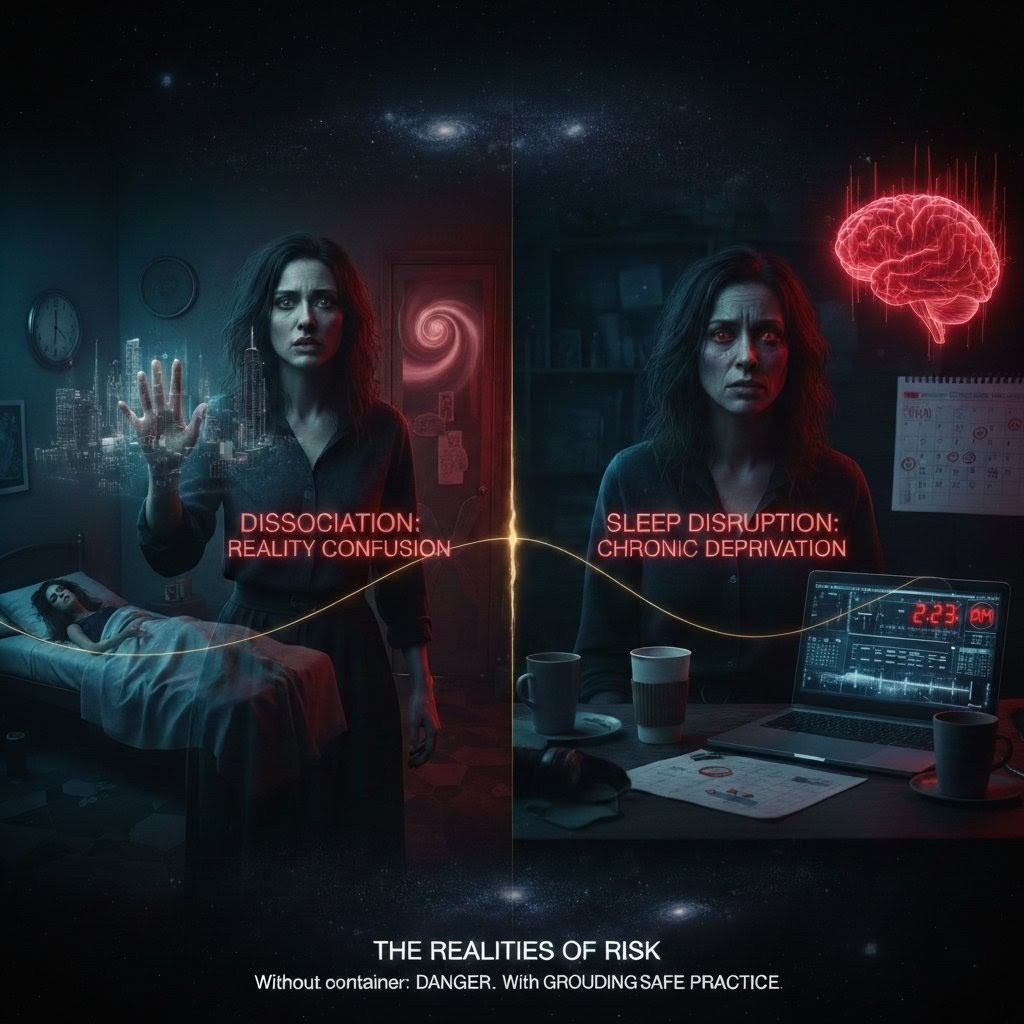
The Realities of Risk: Clinical Boundaries
Intensive practice is not without its dangers. Without a proper “container”–grounding in ethics, psychological stability, and somatic awareness–lucid dreaming can produce dissociation: a blurring of the boundary between waking and dreaming that leads to reality confusion. The practitioner begins to doubt the reality of the waking world or, conversely, believes dream figures have objective existence.
Sleep Disruption
Methods like WBTB intentionally fragment sleep architecture. While this increases lucidity rates, chronic sleep deprivation produces cognitive impairment, emotional dysregulation, and immune suppression. The practitioner must balance nightwork with biological necessity. Traditional monastic settings mitigated these risks through supervised, integrated systems–afternoon naps, specific dietary restrictions, and daytime practices that anchored the nightwork. The secular practitioner must exercise self-regulation. The rule is simple: if daytime functioning declines, the practice is too aggressive.
Spiritual Emergency
Intensive dream work can trigger overwhelming experiences: encounters with terrifying entities, false awakenings (dreaming one has woken, repeatedly), or the dissolution of the body boundary that persists into waking. These phenomena, while generally benign, can precipitate anxiety or existential crisis in the unprepared. The rule is simple: ground the nightwork in the day. Embodiment practices, journaling, and community support provide the container that prevents fragmentation. Those with pre-existing psychiatric conditions should approach advanced techniques with appropriate clinical support.
Predatory Interference
Some traditions warn that the lucid dream state, particularly when entered through WILD, can attract non-physical entities–parasitic consciousness that feeds on the energy of the unprotected sleeper. Whether interpreted literally or as psychological projection, the recommendation is consistent: maintain clear intention, cultivate protective visualisations (light, mantra, or deity yoga), and avoid lucidity practices when emotionally depleted or intoxicated. The night has its hunters.

The Thread Extended
Lucid dreaming reclaims the third of your life for transformation. The continuity from waking to dreaming produces a seamless practice, turning the night into a sanctuary of recognition. The filing cabinets are locked; the bureaucrats have gone home; and for a few hours, you may rearrange the furniture.
You sleep. The dream awaits. The recognition, applied, makes it a platform–a temporary autonomous zone where the constraints of matter are suspended and the mind can rehearse its freedom. The thread continues through the night toward waking, and the practitioner learns that neither state is more “real” than the other; both are rendered, both are code, both are opportunities for gnosis.
The question is not whether you will lucid dream tonight. The question is whether you will recognise the dream-like nature of the day.
Read With Discernment
This article touches material where experience, interpretation and symbolic language can easily blur. Read slowly, compare sources, and keep your own discernment intact.
- Editorial Principles — how ZenithEye separates source, interpretation and lived experience.
- Start Here — the reader guide for the wider archive.
- States of Knowing — altered states, dreams, consciousness, perception and direct experience.
- The Transformation — integration, grounding, spiritual emergence and return to ordinary life.
Frequently Asked Questions
Is lucid dreaming safe, or can it cause mental illness?
Lucid dreaming is generally safe for psychologically stable individuals. However, intensive practice–particularly WILD techniques–can trigger dissociation, sleep paralysis anxiety, or reality confusion in susceptible individuals. Those with schizophrenia, bipolar disorder, or dissociative disorders should consult a clinician before attempting advanced techniques. The key safety factor is grounding: maintaining robust daytime embodiment practices and not allowing the nightwork to bleed into functional impairment.
How long does it take to learn lucid dreaming?
With consistent practice (reality testing + dream journaling), most people experience their first lucid dream within 2-4 weeks. Regular lucidity (2-3 times weekly) typically develops within 3-6 months. Tibetan dream yoga practitioners traditionally commit years to stabilising the practice. The timeline depends on sleep quality, motivation, and individual neurophysiology–some brains are simply more lucidity-prone than others.
Can lucid dreaming be used to treat nightmares or PTSD?
Yes. Imagery Rehearsal Therapy (IRT) combined with lucidity training is highly effective for nightmare disorder and PTSD-related sleep disturbance. The lucid dreamer can confront nightmare figures, transform the dream narrative, or simply wake themselves up. However, for severe trauma, this work should be undertaken with therapeutic support–unsupervised trauma processing in dreams can retraumatise if the container is insufficient.
What is sleep paralysis, and is it dangerous?
Sleep paralysis is a normal neurological mechanism (REM atonia) that prevents you from acting out dreams. During WILD attempts, awareness persists while the body remains paralysed, producing the sensation of being trapped. Hallucinations (visual, auditory, or tactile) are common. While terrifying, it is physiologically harmless and lasts only seconds to minutes. The key is to recognise it as a transition state rather than an attack. Fighting it prolongs the experience; relaxing into it facilitates entry into the lucid dream.
Can you die in a lucid dream or get stuck in one?
No. The dream body is insubstantial; damage to it produces either waking or a scene shift. The getting stuck myth confuses lucid dreaming with coma or the fictional inception scenario. However, false awakenings–dreaming you have woken up while still dreaming–can occur multiple times, creating a Russian doll effect that is disorienting but ultimately harmless. Reality testing upon waking prevents prolonged confusion.
What is the difference between lucid dreaming and astral projection?
Phenomenologically, both involve awareness separated from the physical body. However, lucid dreaming recognises the experience as internal (a simulation generated by the mind), while astral projection interprets it as external (actual travel to non-physical realms). The Tibetan milam occupies a middle position–the dream is empty (internal) yet provides access to valid teachings (functional externalism). For practical purposes, the distinction matters less than the quality of awareness brought to the experience.
Can I use lucid dreaming to improve real-world skills?
Yes. Studies show that motor skills practiced in lucid dreams improve waking performance (though less efficiently than physical practice). The effect is strongest for cognitive skills–muscle memory, spatial navigation, and decision-making under pressure. Athletes, musicians, and public speakers use lucid dreams for rehearsal. The mechanism may involve neural rehearsal in the motor cortex during REM sleep, essentially hacking the brain’s simulation capabilities for training purposes.
Further Reading
- Sleep Paralysis as Threshold State — The territory before lucidity, where the body sleeps but the mind wakes.
- Hypnagogia: The Threshold State Between Waking and Sleep — The platform for lucid dream induction and the hypnagogic gateway.
- States of Knowing: What Happens When Consciousness Unravels — The broader context of non-ordinary states and the dream as valid epistemology.
- Extended Solitude: The Gateway to Self-Recognition — The conditions that enable spontaneous dream practice and hypnagogic phenomena.
- The 5 Gateways to Direct Knowing: A Complete Map — Lucid dreaming as the fifth gateway, integration in action.
- The Collapse of the Witness: When Observation Becomes Participation — Understanding the observer effect in consciousness and the dangers of losing the witness.
- Predatory Consciousness and Spiritual Emergency — Clinical boundaries and diagnostic criteria for distinguishing mystical experience from pathology.
References and Sources
This article draws upon peer-reviewed sleep science, clinical psychology, and primary Tibetan Buddhist source material. Sources are grouped by discipline for clarity.
Sleep Science and Lucid Dreaming Research
- Saunders, D. T., Roe, C. A., Smith, G., & Clegg, H. (2016). “Lucid dreaming incidence: A quality effects meta-analysis of 50 years of research.” Consciousness and Cognition, 43, 197-215. — Meta-analysis of 34 studies finding 55% lifetime prevalence (95% CI: 49%-62%) and 23% monthly frequency (95% CI: 20%-25%).
- LaBerge, S. (1980). Lucid Dreaming: An Exploratory Study of Consciousness During Sleep. PhD dissertation, Stanford University. — Original documentation of the MILD technique and physiological correlates of lucidity.
- Aspy, D. J., Delfabbro, P., Proeve, M., & Mohr, P. (2017). “Reality testing and the mnemonic induction of lucid dreams: Findings from the national Australian lucid dream induction study.” Consciousness and Cognition, 55, 53-59. — Study demonstrating 54% lucidity success rate with MILD + WBTB.
- Voss, U., Holzmann, R., Tuin, I., & Hobson, J. A. (2009). “Lucid dreaming: A state of consciousness with features of both waking and non-lucid dreaming.” Sleep, 32(9), 1191-1200. — EEG study identifying gamma band (40 Hz) activation and frontal coherence as signatures of lucidity.
- Voss, U., Holzmann, R., Hobson, A., Paulus, W., Koppehele-Gossel, J., Klimke, A., & Nitsche, M. A. (2014). “Induction of self awareness in dreams through frontal low current stimulation of gamma activity.” Nature Neuroscience, 17(6), 810-812. — tACS at 40 Hz and 25 Hz induced lucid dream-like self-awareness during REM sleep.
- Stumbrys, T., Erlacher, D., & Schredl, M. (2016). “Effectiveness of motor practice in lucid dreams: A comparison with physical and mental practice.” Journal of Sports Sciences, 34(1), 27-34. — Lucid dream practice improved motor performance similarly to physical and mental practice.
- Stumbrys, T., Erlacher, D., Schadlich, M., & Schredl, M. (2012). “Induction of lucid dreams: A systematic review of evidence.” Consciousness and Cognition, 21(3), 1456-1475. — Systematic review validating reality testing and MILD as effective induction techniques.
Clinical Psychology and Nightmare Treatment
- So, C. J., et al. (2025). “Status of Imagery Rehearsal Therapy and Other Interventions for Nightmare Treatment in PTSD.” Current Psychiatry Reports, 27(11), 671-678. — IRT and prazosin remain most supported treatments; AASM Level A recommendation for nightmare disorder.
- Krakow, B., et al. (2001). “Imagery rehearsal therapy for chronic nightmares in sexual assault survivors with PTSD.” JAMA, 286(5), 537-545. — Randomised controlled trial demonstrating IRT efficacy for PTSD-related nightmares.
- PTSD UK Lucid Dreaming Study (2024/2025). — 85% of participants no longer met PTSD criteria after lucid dreaming training; effects persisted at one-month follow-up.
Tibetan Buddhist Sources
- The Six Yogas of Naropa. Traditional Kagyu teachings compiled from Tilopa and Naropa (11th century). Translated and commented upon by Mullin, G. H. (1997). The Practice of the Six Yogas of Naropa. Snow Lion Publications.
- The Tibetan Book of the Dead (Bardo Thodol). Traditional; rediscovered by Karma Lingpa (14th century). Evans-Wentz, W. Y. (ed.) (1927). Oxford University Press.
- Wangyal, T. (1998). The Tibetan Yogas of Dream and Sleep. Snow Lion Publications. — Contemporary teaching on milam and the five stages of dream yoga practice.
- Digha Nikaya (DN 16). In: Walshe, M. (trans.). (1995). The Long Discourses of the Buddha. Wisdom Publications. — Contains the Buddha’s final passage through the jhanas before parinibbana.
Comparative and Psychological Studies
- Jung, C. G. (1961). Memories, Dreams, Reflections. Vintage Books. — Jung’s autobiographical account of active imagination and the dialogical unconscious.
- Hobson, J. A. (2009). “REM sleep and dreaming: Towards a theory of protoconsciousness.” Nature Reviews Neuroscience, 10(11), 803-813. — Theoretical framework for understanding REM sleep as a virtual reality generator.
Safety Notice: This article explores advanced contemplative and sleep-related practices involving altered states of consciousness, sleep disruption, and potential psychological destabilisation. It does not constitute medical, psychological, or spiritual advice. Those with schizophrenia, bipolar disorder, dissociative disorders, or trauma histories should consult a qualified mental health professional before attempting WILD, intensive dream work, or sleep-cycle manipulation. If you experience suicidal ideation, psychosis, or inability to distinguish dream from waking reality, seek emergency services immediately. Lucid dreaming practice complements but does not replace clinical mental health treatment.