
Hypnagogia: The Threshold State Between Waking and Sleep
You lie down. The day recedes. The body relaxes. The mind, released from directed attention, begins to drift. Images emerge–fragmentary, vivid, nonsensical. Voices speak, single words or phrases. Scenes unfold, brief narratives without context. You are not asleep. You are not fully awake.
This is hypnagogia–the threshold, the liminal, the “between.” The customs office of consciousness, where the filing cabinets of the day shift are locked away and the night staff have not yet clocked in. Here, the membrane between the manufactured self and the raw data of psyche grows thin enough to read by. The archons, for a brief moment, glance away from their surveillance screens.
The state is near-universal. Research indicates that between 72% and 85% of the population experience hypnagogic phenomena, though frequency and recall vary significantly. The threshold, crossed quickly, leaves no trace. The threshold, lingered in, becomes available–as a creative resource, a diagnostic tool, and a gateway to deeper states of consciousness. The thread extends through the keyhole of the closing door.

Table of Contents
- What Is Hypnagogia?
- The Specific Phenomenology
- The Edison Method and Creative Mining
- The Gateway Function
- The Pathology Question: Clinical Boundaries
- Practical Cultivation: Techniques for the Threshold
- The Thread Extended
- Frequently Asked Questions
- Further Reading
- References and Sources
What Is Hypnagogia?
The term derives from Greek hypnos (sleep) and agogos (leading)–literally, “leading into sleep.” Its counterpart, hypnopompia, describes the transition out of sleep toward waking. Both states share a common feature: the dissolution of the ego’s editorial control, permitting raw sensory and cognitive data to surface without the usual filters of logic, propriety, and temporal continuity.
Neurologically, hypnagogia represents the handover of executive control from the waking brain to the sleep architecture. The reticular activating system–the brainstem’s switchboard for arousal–begins to dampen its firing rate. The prefrontal cortex, responsible for reality-testing and sequential reasoning, downregulates. Meanwhile, the visual and auditory cortices remain active, generating imagery from internal rather than external sources. The result is a hybrid state: consciousness without the censor, perception without the object.
The Specific Phenomenology
Hypnagogia is a sensory “wild west” where the brain’s filters begin to drop. The usual border patrols–executive function, reality-testing, semantic consistency–abandon their posts. What remains is the raw feed of consciousness, unedited by the ego’s editorial board. It manifests through several distinct channels:

Visual Phosphenes and Formed Imagery
Visual: Geometric patterns, faces, shifting scenes, or flashes of light known as phosphenes. These “prison bars” of light often appear as honeycombs, spirals, or checkerboards–the visual cortex’s default screensaver when external input is cut. More rarely, fully formed scenes emerge: landscapes, rooms, or figures that seem more real than the darkness behind closed eyelids. Studies suggest visual phenomena occur in approximately 86% of hypnagogic experiences, making them the most common modality.
Auditory Phenomena and Exploding Head Syndrome
Auditory: Snippets of music, environmental sounds, or “exploding head syndrome” (a sudden loud bang). Frequently, one hears their own name called–a phenomenon known as hypnagogic speech. The auditory cortex, like a radio between stations, picks up phantom transmissions from the static. Auditory hallucinations affect between 8% and 34% of people experiencing hypnagogic states.
Kinaesthetic Distortions and the Tetris Effect
Kinaesthetic: Sensations of falling, floating, or body distortions (the “Alice in Wonderland” effect). The proprioceptive system loses its anchor, creating the sensation that limbs are growing enormous or shrinking to nothing. Some report the sensation of leaving the body–a preliminary disconnection of the silver cord that tethers consciousness to flesh. The Tetris Effect demonstrates how recent repetitive activities shape hypnagogic imagery; even amnesiac patients retain this visuomotor imprint, suggesting it operates below conscious recall.
Cognitive Leaps and Nonsense Logic
Cognitive: Sudden insights, “nonsense logic,” or the feeling of having solved a complex problem. The associative networks of the brain, freed from linear constraints, make quantum leaps of connection that the waking mind would dismiss as absurd. This is the brute-force creativity of the unconscious, running simulations without the governor of reason.
In the hypnagogic state, the prisoner receives letters smuggled from the unconscious, written in a language that dissolves upon full waking.
The Edison Method and Creative Mining
Artists, writers, and scientists have mined hypnagogia for centuries. The hypnagogic mind, released from executive control, makes novel associations that the waking mind would censor as improper, illogical, or insane. The cosmic bureaucracy, in other words, loosens its regulations.
Historical Examples
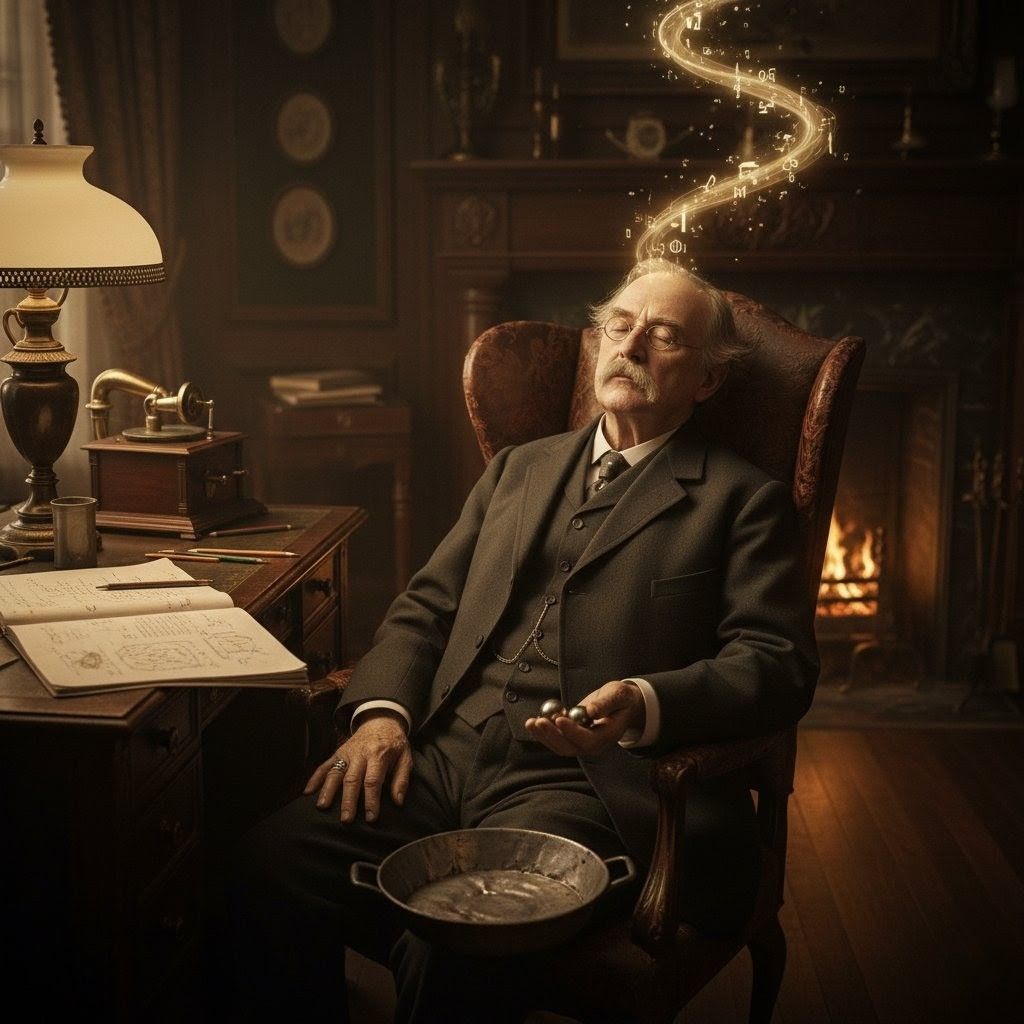
Thomas Edison: He famously napped with metal objects in his hands–steel balls, keys, or ball bearings, depending on the account. As he drifted into hypnagogia, his muscles would relax, the object would drop into a metal pan, and the noise would wake him to capture his insights. This was not mere rest but harvesting–a deliberate raid on the liminal state to steal its treasures before the amnesia of deep sleep could claim them. Contemporary interviews and early biographies confirm Edison described this practice, though modern retellings have standardised and dramatised the details.
Salvador Dali: Used a similar “slumber with a key” method to fuel his surrealist imagery. He called hypnagogia “the slumber with a key,” understanding that the threshold state offers direct access to the paranoiac-critical method–seeing the extraordinary in the ordinary, the code behind the rendered world.
Mary Shelley: Her hypnagogic vision of a “pale student of unhallowed arts” kneeling beside a creature gave birth to Frankenstein. In her 1831 introduction, Shelley describes her imagination, “unbidden, possessed and guided me, gifting the successive images that arose in my mind with a vividness far beyond the usual bounds of reverie.” The novel itself is a meditation on the dangers of unmoored consciousness–appropriate for a work born in the threshold.
August Kekule: Discovered the ring structure of benzene after a reverie of a snake seizing its own tail–the ouroboros–an image that solved a problem his waking mind could not crack. Kekule recounted this in an 1890 address, though historians debate whether it represents a genuine memory or a later embellishment.
Capturing the Thread
Mining this state requires technique. The threshold, once crossed into deep sleep, produces amnesia. To capture the thread, one must interrupt the crossing. The practitioner learns to hover at the edge, like a bird refusing to land, collecting the pearls that form in the minutes between worlds.
The Gateway Function
Hypnagogia is the natural passage into sleep, but if attention is maintained, it becomes a platform for non-ordinary states. The customs office becomes a transit hub, with routes to territories unavailable to ordinary consciousness:

Lucid Dreaming and WILD
1. Lucid Dreaming (WILD): Awareness that one is entering a dream while the body falls asleep (Wake Induced Lucid Dream). The hypnagogic imagery becomes the dream scene; the practitioner steps directly from the threshold into the lucid dream without losing consciousness. This requires maintaining meta-awareness–watching the self fall asleep without interfering.
Safety Note: WILD techniques can trigger sleep paralysis–a natural REM atonia that persists into waking. While harmless, the experience can be terrifying if unprepared. The “presence” felt during sleep paralysis is a hypnagogic projection, but the fear response is real. Those with trauma histories or anxiety disorders should approach this technique gradually.
Yoga Nidra
2. Yoga Nidra: The “yogic sleep” where the practitioner remains conscious on the edge of sleep for deep restoration. Here, the hypnagogic state is not a passage but a destination–a suspended animation where the body sleeps but the witness remains alert. Brain scans show Yoga Nidra practitioners hovering in the hypnagogic delta wave state, accessing deep restoration while maintaining executive function.
Dream Yoga and the Bardo
3. Milam (Dream Yoga): The Tibetan practice of using the dream state for spiritual encounter and preparation for the transition of death. The hypnagogic threshold is recognised as the bardo–the intermediate state. By learning to recognise the “clear light” that appears at the onset of sleep, the practitioner trains for the moment of death, when the same light appears. To master the hypnagogic gateway is to prepare for the final exit.

The middle path–relaxed awareness, neither forcing nor releasing–is learned through repetition. Mastered, the hypnagogic gateway opens territory unavailable to ordinary consciousness. But the gateway is narrow; those who rush find themselves in deep sleep or, worse, in the confusing labyrinth of half-dreams without lucidity.
The Pathology Question: Clinical Boundaries
Hypnagogia borders pathology. Its hallucinations resemble those of psychosis, yet the difference lies in context and integration. Hypnagogic phenomena are recognised as internal and temporary; they do not carry the delusional conviction of a waking hallucination. The clerk knows the visions are merely paperwork; the psychotic believes the memos are directives.
Clinical Boundaries
However, misinterpreted hypnagogia becomes a dangerous explanation–the “voice” as a divine command or the “presence” as a demonic attack. History is littered with tragedies born of hypnagogic misinterpretation: the commander who heard God order an attack, the mother who saw a demon in her child. The discipline required is suspension: experiencing the phenomenon without immediate meaning-making. This suspension allows the raw data of consciousness to be held for waking evaluation.

Exploding Head Syndrome
Exploding Head Syndrome: A particularly dramatic hypnagogic phenomenon where the sleeper experiences a sudden, loud bang or crash as they drift off. Neurologically, this is a misfire of the reticular formation–the brainstem’s transition protocol stuttering as it hands over control from waking to sleep. While terrifying, it is benign, with lifetime prevalence estimates ranging from 10% to 37% depending on study methodology. Understanding it as a “glitch in the code” rather than a stroke or aneurysm prevents the panic that would otherwise disrupt sleep for weeks.
When to Seek Help
When to Seek Help: If hypnagogic experiences persist into waking hours, carry delusional certainty, or command harmful actions, this is no longer hypnagogia but potentially a neurological or psychiatric condition. Narcolepsy, for instance, features hypnagogic hallucinations that intrude upon waking life. The rule is simple: in hypnagogia, you know you are falling asleep; in psychosis, you do not know you are awake.
Practical Cultivation: Techniques for the Threshold
Hypnagogia can be cultivated without esoteric apparatus. The technique is simple attention, refined through repetition:
The Body Scan Entry
The Body Scan Entry: Lie supine, limbs uncrossed. Scan the body from toes to crown, relaxing each region. When the body begins to feel heavy or distorted (the first hypnagogic sign), do not resist. Maintain a “loose grip” on awareness–watching without directing.

The Image Watching
The Image Watching: As phosphenes appear, observe them without engagement. Treat them as clouds–there, but not requiring response. When fully formed images emerge, note them as “dreaming” but do not follow the narrative. This maintains the witness position.
The Audio Anchor
The Audio Anchor: Some practitioners use binaural beats (4-8 Hz, theta range) to entrain the brain toward hypnagogia. Others use the natural sound of their own breath, counting exhalations until the numbers themselves begin to dissolve into nonsense–another threshold sign.
Recording and Capture
Capturing the Thread: Keep a notebook or voice recorder within arm’s reach. Upon noticing a valuable insight, move immediately to record it. The transition from horizontal to vertical often wipes the slate; speed is essential. Edison’s metal-drop method works because it exploits the startle reflex, but a quiet alarm or even the intention to wake in five minutes can serve.
The Thread Extended
Hypnagogia is a natural mystical experience. It is available to the vast majority, requiring no substance and no technique beyond simple attention. The threshold, crossed consciously, extends the thread into the third of our lives usually spent in darkness.
You experience hypnagogia nightly. The recognition of it makes it a resource. The thread continues through sleep toward waking, and the practitioner learns to follow it like a silver cord through the labyrinth of night. What was once mere transition becomes transformation–a daily opportunity to glimpse the code behind the rendered world, to catch the archons with their guard down, to remember that consciousness is not the prisoner of the brain but its observer.
Read With Discernment
This article touches material where experience, interpretation and symbolic language can easily blur. Read slowly, compare sources, and keep your own discernment intact.
- Editorial Principles — how ZenithEye separates source, interpretation and lived experience.
- Start Here — the reader guide for the wider archive.
- States of Knowing — altered states, dreams, consciousness, perception and direct experience.
- The Transformation — integration, grounding, spiritual emergence and return to ordinary life.
Frequently Asked Questions
What is hypnagogia and how common is it?
Hypnagogia is the transitional state between wakefulness and sleep, characterised by vivid sensory experiences, geometric patterns, voices, or sudden insights. Research indicates that between 72% and 85% of the population experience hypnagogic phenomena at some point, though not everyone recalls them. The state is a normal neurological event–not a disorder, not a spiritual intrusion, but the brain’s handover protocol between waking and sleep architectures.
Is hypnagogia the same as lucid dreaming?
No, though hypnagogia is the gateway to lucid dreaming. Hypnagogia occurs at sleep onset or waking, characterised by sensory phenomena while the body is still relaxed. Lucid dreaming occurs during REM sleep, when the dreamer becomes aware they are dreaming. However, the technique of WILD (Wake Induced Lucid Dream) uses hypnagogia as the launch pad–maintaining awareness as the body falls asleep allows a seamless transition from hypnagogic imagery into the lucid dream state.
Can hypnagogia be dangerous or cause mental illness?
Hypnagogia itself is a normal physiological state experienced by the vast majority of people. However, misinterpretation of hypnagogic content can be dangerous–believing that commanding voices are divine orders, for instance. Those with bipolar disorder, schizophrenia, or dissociative conditions should approach deliberate cultivation with caution, as the boundary between internal and external reality may already be compromised. The key diagnostic is insight: healthy hypnagogia is recognised as internal imagery; pathological hallucinations are experienced as external reality.
What causes exploding head syndrome and is it harmful?
Exploding head syndrome is a benign sensory parasomnia caused by a misfire in the brainstem’s reticular formation during the wake-to-sleep transition. Neural signals associated with auditory processing fire randomly, creating the sensation of a loud bang, crash, or gunshot. Despite its dramatic name, it causes no physical damage and is not associated with neurological disease. Stress, sleep deprivation, and irregular sleep schedules increase frequency. Managing sleep hygiene usually resolves the phenomenon.
How can I remember my hypnagogic experiences?
Memory of hypnagogia requires interrupting the transition before deep sleep erases the slate. Techniques include: the Edison method (holding an object that drops when muscles relax), setting a soft alarm for 10-15 minutes after lying down, or simply maintaining enough awareness to recognise the threshold and sit up to record impressions. Voice recorders are often better than writing, as motor control may be compromised in the hypnagogic state. Consistency is key–the brain learns to retain these memories with practice.
Can I use hypnagogia for creative problem solving?
Yes, and history provides abundant examples. The hypnagogic state allows associative leaps that the waking censor would prevent. To use it practically: formulate your problem clearly before sleep, hold it in mind as you drift, and capture whatever emerges–no matter how nonsensical it seems in the moment. The nonsense logic of hypnagogia often contains solutions that bypass linear thinking. Edison, Dali, and countless inventors used this threshold thinking to crack problems that resisted waking analysis.
What is the silver cord seen in hypnagogic states?
The silver cord is a visual-tactile hallucination reported during hypnagogia and out-of-body experiences–a luminous thread connecting the perceived subtle body to the physical form. Esoteric traditions (Hermetic, Theosophical, and some Gnostic texts) interpret this as the lifeline tethering consciousness to the physical vehicle. Neurologically, it may represent proprioceptive confusion–the brain’s attempt to map body position when the usual sensory inputs are disrupted. Whether interpreted mystically or materially, the cord serves as an anchor, preventing the practitioner from dissociating completely during threshold exploration.
Further Reading
Continue exploring threshold states and the architecture of consciousness:
- Sleep Paralysis as Threshold State — The next threshold beyond hypnagogia, where the body sleeps but the mind wakes.
- Lucid Dreaming as Practice Platform — Maintaining awareness through the threshold into the dream state.
- States of Knowing: What Happens When Consciousness No Longer Belongs to You — The broader context of threshold states and non-ordinary consciousness.
- The Discipline of Solitude: Extended Alone Time — The conditions that produce spontaneous hypnagogic phenomena.
- The Thread That Binds: Five Gateways to Direct Knowing — Hypnagogia as natural gateway requiring no technique.
- Predatory Consciousness and Spiritual Emergency — Clinical boundaries and diagnostic criteria for distinguishing mystical experience from pathology.
- The Collapse of the Witness: When Observation Becomes Participation — Understanding the observer effect in consciousness and the dangers of losing the witness.
- Breathwork: Ancient Technology, Modern Application — Pneumatic technologies for altering consciousness and navigating threshold states.
- Physiology of Mystical Experience: How Awakening Changes the Brain — Neuroscientific correlates of non-ordinary states and their lasting effects.
- Psychosis and Mysticism: The Shared Territory — Clinical discernment between breakthrough and breakdown in non-ordinary states.
References and Sources
Sources are grouped by category for clarity. No in-text citation numbers are used, per The Thread editorial protocol.
Primary Sources and Historical Accounts
- Shelley, M. (1831). Introduction to Frankenstein, or The Modern Prometheus (3rd ed.). Henry Colburn and Richard Bentley.
- Kekule, A. (1890). Address to the German Chemical Society, Berlin. Berichte der Deutschen Chemischen Gesellschaft, 23, 1302-1311.
- Dyer, F. L., & Martin, T. C. (1910). Edison: His Life and Inventions (Vol. 1). Harper & Brothers. (Contains Edison’s own descriptions of napping with metal objects.)
Scholarly Monographs and Reviews
- Schacter, D. L. (1976). The hypnagogic state: A critical review of the literature. Psychological Bulletin, 83(3), 452-481.
- Mavromatis, A. (1987). Hypnagogia: The Unique State of Consciousness Between Wakefulness and Sleep. Thames & Hudson.
- Ohayon, M. M. (2000). Prevalence of hallucinations and their pathological associations in the general population. Psychiatry Research, 97(2-3), 153-164.
Clinical and Neuroscientific Studies
- Sharpless, B. A., Denis, D., Perach, R., French, C. C., & Gregory, A. M. (2020). Exploding head syndrome: Clinical features, theories about etiology, and prevention strategies in a large international sample. Sleep Medicine Reviews, 52, 101311.
- Denis, D., French, C. C., & Gregory, A. M. (2019). Associations between exploding head syndrome and measures of sleep quality and experiences, dissociation, and well-being. Sleep, 42(2), zsy216.
- Jones, A. M., Valli, K., & Watson, N. F. (2009). The Durham Hypnagogic and Hypnopompic Hallucinations Questionnaire: Item analysis and development. International Journal of Dream Research, 2(2), 100-106.
- Laroi, F. et al. (2023). Hypnagogic states are quite common: Self-reported prevalence, modalities, and gender differences. Consciousness and Cognition, 115, 103590.
Safety Notice: This article explores altered states of consciousness and techniques for navigating threshold phenomena. It does not constitute medical, psychological, or spiritual advice. If you experience persistent hallucinations, paranoia, or command hallucinations during waking hours, please contact professional emergency services or a trauma-informed therapist. Contemplative practice complements but does not replace clinical mental health treatment. Those with bipolar disorder, schizophrenia spectrum conditions, or dissociative disorders should approach deliberate cultivation of hypnagogic states with appropriate clinical supervision.