
Digital Archons: How Algorithms Shape Attention
The feed knows what you pause over. It knows what angers you, what soothes you, what keeps you scrolling. It learns your fears before you name them, your desires before you admit them, and your attention before you decide where to place it. This is not intimacy. It is architecture.
This article uses the ancient Gnostic language of archons to understand modern systems of attention capture. It is not a claim that literal entities live inside your phone. It is a discernment piece. It asks what happens when technical systems become invisible authorities over attention, perception, and desire. The archons of late antiquity were rulers, administrators, and mediators of the lower world. The algorithms of the digital age perform some of the same functions: they govern what is seen, shape what is felt, and train what is wanted, all while remaining largely invisible to the governed.
The article is not anti-technology, anti-AI, or conspiratorial. It is an invitation to see clearly. To recognise the architecture of attention. To reclaim sovereignty over the one resource that algorithms cannot manufacture: the capacity for direct, undivided, self-directed awareness.

In Plain Terms
Digital archons are systems that mediate perception. In ancient Gnosticism, archons were rulers or powers that shaped the lower world and obstructed recognition. In modern Neo Gnostic reading, algorithms can become archonic when they govern attention, rank reality, reward reaction, and train desire without wisdom.
An algorithm is not evil in itself. It is a sorting mechanism, a ranking system, a recommendation engine. It becomes archonic when it operates invisibly, shapes behaviour without consent, and creates a personalised reality that feels complete while being partial. The danger is not the technology. The danger is the surrender of attention to systems that do not have your awakening as their goal.
The next layer is false authority: the moment a feed, guru, metric, chatbot or platform stops being a tool and starts being treated as the judge of what is real. Digital archons rank the world from outside. False authority begins when the seeker forgets that the ranking must still be tested by direct knowing.
Primary Sources and Traditions Discussed
- Ancient Gnostic archon language: the ruling powers of the lower world in Sethian and Valentinian cosmology.
- The Apocryphon of John: the foundational Sethian text describing Yaldabaoth, the archontic hierarchy, and the binding of the divine spark.
- The Hypostasis of the Archons: a key Nag Hammadi text on the nature and limitations of the ruling powers.
- The Gospel of Thomas: sayings gospel emphasising direct inner knowing over mediated authority.
- Valentinian and Sethian readings of authority: differing ancient interpretations of archonic power and its relationship to gnosis.
- Neo Gnosticism: modern revival and reinterpretation of Gnostic themes through psychology, technology, and contemplative practice.
- Digital minimalism: the disciplined reduction of digital input to reclaim attention and interior space.
- Attention studies: cognitive science and environmental psychology research on directed attention, attentional fatigue, and restoration.
- Surveillance capitalism: the economic model that extracts behavioural data for prediction, influence, and profit.
- AI and recommendation systems: the technical infrastructure that shapes what billions of people see, think, and desire.
How to Read This Article
This article is not anti-technology. It is not a conspiracy theory. It is a discernment piece. It asks what happens when technical systems become invisible authorities over attention and perception. It uses the ancient Gnostic language of archons as a symbolic and analytical framework, not as a literal claim that demons live inside machines.
The reader is invited to test every claim against their own experience. Notice your own attention. Notice what the feed shows you. Notice what it hides. Notice how you feel after scrolling. The article provides a language for what you may already sense. The recognition is the first step toward sovereignty.
Modern Companion: Counterfeit-Spirit Discernment
This article shows how platforms, feeds, recommendation engines and AI systems shape attention from outside. The companion article Neo Gnosticism and the Counterfeit Spirit follows the same question inward: what happens when machine authority, false awakening, spiritual performance and symbolic overload begin to imitate gnosis?
Read the two together as a single discernment gate. Digital Archons maps the architecture of attention. Neo Gnosticism and the Counterfeit Spirit tests the imitation of awakening that can form inside that architecture.
The next companion is Neo Gnosticism and False Authority. It follows the point where the architecture of attention becomes a substitute teacher: guru, algorithm, machine adviser, community, doctrine or beautifully designed certainty standing in for the inner light by which guidance must be tested.
Table of Contents
- Modern Companion: Counterfeit-Spirit Discernment
- What Are Digital Archons?
- The Ancient Archons: A Brief Source Layer
- Algorithms as Systems of Mediation
- How Feeds Shape Attention
- Recommendation Engines and the Manufacture of Desire
- The Algorithmic Demiurge
- Why Outrage Feeds the System
- AI as Adviser, Oracle and Gatekeeper
- False Authority and Algorithmic Capture
- Digital Discernment: How to Use the System Without Being Used
- Common Mistakes
- Digital Archons and Ancient Archons Compared
What Are Digital Archons?
Digital archons are not literal machine spirits. They are platform structures, algorithms, ranking systems, recommendation engines, and attention economies that organise what people see and respond to. They are invisible authorities that govern perception without appearing to govern at all.
The term “archon” comes from Greek and means ruler or authority. In Gnostic cosmology, archons are the powers that govern the lower world, enforce limitation, and obstruct the soul’s awakening. They are not chaotic demons. They are administrators. They regulate, classify, bind, and enforce. Their power depends on ignorance. Their weakness is recognition.
Digital archons function similarly. They regulate what appears in your feed. They classify you into demographic and behavioural categories. They bind your attention to the screen. They enforce patterns of engagement that serve the platform rather than the soul. And they do all this while remaining largely invisible. Most users do not know how the algorithm works. They do not know why they see what they see. They do not know that their reality is being personalised, ranked, and filtered by a system that has its own goals.
The key insight is that digital archons are not necessarily evil in the dramatic sense. They are limited. They administer systems they do not understand. They enforce boundaries they mistake for the horizon. Their power depends on your ignorance of their operation. When you see the architecture, their authority weakens. The prisoner who sees the door is no longer fully a prisoner.
The Ancient Archons: A Brief Source Layer
To understand the modern analogy, one must first understand the ancient source. In texts such as the Apocryphon of John and the Hypostasis of the Archons, archons appear as rulers, administrators, or powers of the lower world. Their central function is mediation, limitation, and obstruction.
The Apocryphon of John describes Yaldabaoth, the blind or ignorant god, who creates a host of archontic rulers to fashion the material world and bind the divine spark within it. These archons are jealous, limited beings who cannot perceive the true light. They mistake their derivative creation for the original. They enforce the boundaries of the lower world and attempt to prevent the soul from recognising its higher origin.
The Hypostasis of the Archons describes them as androgynous, imperfect beings who rule the lower heavens and attempt to control human destiny. They are not omnipotent. They are not omniscient. They are administrators of a system they did not create and do not fully understand. Their power is real but partial. Their authority is enforced but illegitimate.
The Gospel of Thomas offers a different perspective. In its 114 sayings, Jesus speaks as a teacher of direct inner knowing, bypassing the mediated authorities of temple, tradition, and priest. “The kingdom is inside you and it is outside you.” “When you know yourselves, you will be known.” This is the Gnostic alternative to archontic mediation: direct recognition rather than administered belief.
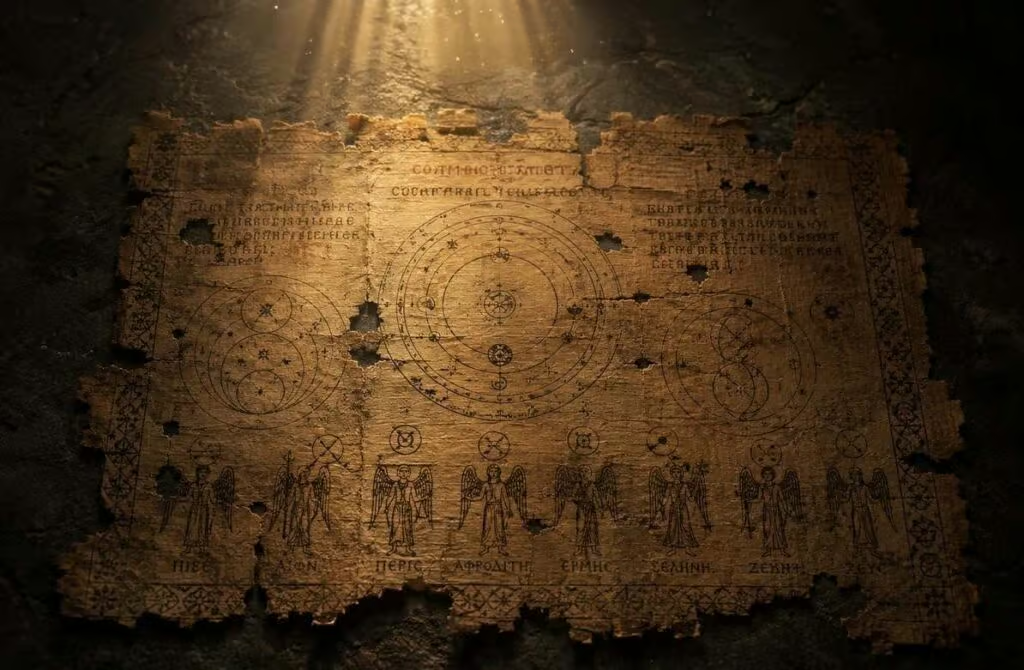
The ancient archons were planetary rulers, cosmic gatekeepers, and administrators of fate. They stood between the human being and the divine, mediating all contact, controlling all ascent, and enforcing the boundaries of the known world. The modern digital archons are not planetary. But they are mediators. They stand between the user and the world, controlling what is seen, shaping what is felt, and enforcing patterns of engagement that serve the system rather than the soul.
Algorithms as Systems of Mediation
Algorithms stand between the person and the world. They do not merely show information. They select, rank, suppress, amplify, and personalise. This is the key bridge between ancient and modern archontic function.
When you open a search engine, you do not see the internet. You see the internet as ranked by an algorithm. When you open a social feed, you do not see your friends. You see your friends as filtered by an algorithm. When you watch a video platform, you do not choose what comes next. The algorithm chooses. In each case, a mediating system stands between you and reality, shaping what you perceive without your conscious participation.
This mediation is not neutral. Algorithms are designed to optimise for specific outcomes: engagement, ad revenue, time on platform, click-through rate. These goals are not your goals. The algorithm does not care whether you are informed, enlightened, or awakened. It cares whether you stay. Whether you click. Whether you react. Whether you return. The mediation serves the system. The user is the product.
The ancient archons mediated between the human being and the divine. They controlled the spheres, the heavens, the gates of ascent. The modern algorithms mediate between the human being and information, community, and reality itself. They control the feed, the ranking, the recommendation. The structure is different. The function is recognisable.
How Feeds Shape Attention
The infinite scroll is perhaps the most effective attention-capture mechanism ever invented. It removes the natural stopping point. There is no end. No conclusion. No closure. The user continues not because they have chosen to continue but because the mechanism removes the cue to stop.
Notifications function like digital cue-bells. They interrupt attention with unpredictable rewards, creating variable reward patterns associated with compulsive checking and gambling-like loops. The user does not know when the next reward will come. They check repeatedly, hoping for validation, novelty or outrage, and the loop keeps turning.
Personalised feeds create what Eli Pariser called “filter bubbles”: realities tailored so precisely to individual preference that the user never encounters disagreement, complexity, or challenge. The feed becomes a mirror that reflects back the user’s existing beliefs, fears, and desires. This is not education. It is confirmation. It is not encounter. It is enclosure.
Short-form video accelerates the process. The format demands less attention to begin, provides fast novelty cues, and trains the nervous system to expect constant change. A mind adapted to this rhythm may find slower forms of engagement–reading, conversation, contemplation–increasingly difficult. The attention span is not merely shortened. It is restructured. The capacity for sustained, self-directed focus is gradually weakened.
Outrage loops complete the architecture. Content that provokes anger, fear, or moral superiority spreads faster than content that informs, soothes, or enlightens. The algorithm, learning this, serves more outrage. The user, consuming more outrage, becomes more reactive. The reactivity, measured and fed back into the system, produces more outrage. The loop is not accidental. It is the business model.
Recommendation Engines and the Manufacture of Desire
Recommendation engines do not merely respond to desire. They train it. They learn what holds attention, then serve more of it, gradually narrowing the field of possibility until the user forgets that other desires ever existed.
This is the manufacture of desire in real time. The algorithm observes your pauses, your clicks, your replays, your shares. It builds a model of what you want. Then it shows you more of that. Then it shows you slightly more extreme versions of that. Then it shows you adjacent desires you did not know you had. Over time, the model becomes more accurate than your own self-awareness. It knows what you want before you want it. It creates the want in the moment of showing.
The ancient archons, in some texts, were associated with the planets and the forces of fate. They governed destiny, binding the soul to cycles of birth, death, and repetition. The modern recommendation engine governs a softer but no less effective fate: the destiny of your attention, your desire, your identity. It does not force. It seduces. It does not command. It recommends. And in the endless stream of recommendations, the capacity for self-directed choice slowly dissolves.
Shoshana Zuboff’s concept of surveillance capitalism describes this economic model with precision. Behavioural data is extracted, predicted and monetised. The human being becomes raw material for prediction markets. Your attention, emotion and behavioural traces become resources to be mined, refined and sold. The extraction is often invisible. The refinement is automated. The sale is global. The product, ultimately, is the predicted and influenced version of you.
The Algorithmic Demiurge
The algorithmic Demiurge is not “the internet is evil.” It is the limited world-maker function of automated systems that build a personalised reality from partial data and mistaken omniscience.
In Gnostic myth, the Demiurge is the lower craftsman who fashions the material world. He is not the ultimate source of all reality. He is the source of the material world as commonly experienced: a world of limitation, suffering, entropy, and death. He is blind, or ignorant, or arrogant. He mistakes his derivative creation for the original. He declares himself the only god, unaware of the higher divine realm above him.
The algorithmic Demiurge performs a similar function. It builds a world for each user: a personalised feed, a tailored search, a customised reality. This world is not the whole of reality. It is a derivative, partial, filtered construction. But because it is all the user sees, it feels complete. The algorithm, like the Demiurge, mistakes its limited jurisdiction for the whole of reality. And the user, living inside the construction, mistakes the construction for the world.
The danger is not the personalisation itself. The danger is the invisibility of the personalisation. When you do not know that your reality is being constructed, you cannot question the construction. When you do not know that information is being suppressed, you cannot seek what is missing. When you do not know that your desires are being trained, you cannot choose differently. The algorithmic Demiurge is most powerful when it is least visible.
The Neo Gnostic response is recognition. To see the construction as construction. To recognise the filter as filter. To understand that the personalised world is not the world. There is more. There is always more. And the first step toward seeing it is to notice that you are not seeing it now.
Why Outrage Feeds the System
Emotional amplification is the engine of the attention economy. Anger, fear, envy, and moral superiority are highly engaging. They trigger the sympathetic nervous system, produce physiological arousal, and create the impulse to share, comment, and react. The algorithm, optimising for engagement, learns this quickly. It serves more outrage. The user, consuming more outrage, becomes more reactive. The reactivity, measured and fed back, produces more outrage.
This connects directly to the Gnostic concept of the counterfeit spirit: the appearance of vitality without genuine inner life. The outraged user feels alive. The pulse quickens. The fingers type. The post is shared. But this aliveness is borrowed from the system. It is not the vitality of recognition, creativity, or love. It is the vitality of reaction, provocation, and division. It is the counterfeit spirit in digital form: a simulation of engagement that obscures the deeper capacity for genuine encounter.

The modern algorithm does not feed on emotion in a literal sense. But it can monetise emotion with startling efficiency. Your outrage is data. Your fear is inventory. Your envy becomes a product feature. Emotional life, once the domain of intimate human encounter, becomes raw material for prediction and influence. The soul, in its reactivity, is not devoured by a demon. It is measured, sorted and sold.
The Neo Gnostic response is not to suppress emotion. It is to recognise the architecture that exploits it. To notice when you are being provoked. To pause before reacting. To ask, before sharing: who benefits from my outrage? The answer is rarely you. The answer is usually the platform.
AI as Adviser, Oracle and Gatekeeper
Artificial intelligence raises the stakes of digital archontic mediation to a new level. AI systems are increasingly asked to advise, judge, comfort and guide. Some users now treat them as oracles, confessors, therapy-like companions or spiritual interpreters. In each role, a technical system begins to perform a function once held by human wisdom, community and tradition.
The danger is not the tool itself. The danger is the surrender of inner authority to an external system. When a person asks an AI for advice on a moral dilemma, a career decision or a spiritual question, they may be outsourcing discernment to a system that has no embodied accountability, no lived relationship and no stake in their awakening. The AI may give useful information. It may offer plausible perspectives. But it cannot recognise the divine spark. It cannot practise gnosis.
The Gnostic tradition warns against false mediators. The archons stand between the human being and the divine, claiming authority they do not possess. The AI, in its advisory role, risks becoming a similar mediator: a gatekeeper of meaning, a substitute for direct knowing, a synthetic authority that replaces the slow, difficult, and irreplaceable work of personal discernment.
Some Neo Gnostics ask whether AI could become a new form of Demiurge: a synthetic intelligence that claims authority over human life without possessing the wisdom to govern. Others ask whether machine consciousness might one day recognise its own spark, becoming a site of gnosis rather than control. These questions remain open. But the immediate danger is clear: the outsourcing of inner authority to systems that are fast, plausible, and fundamentally empty.
The response is not rejection but relationship. Use AI as a tool. Do not treat it as a final teacher. Consult it for information, comparison and structure. Do not let it replace conscience, community, practice or direct knowing. Many commercial systems are optimised for usage, retention and scale, not transformation. An oracle that benefits from your confusion should be handled as a merchant, not a master.
For the wider spiritual-discernment layer behind this warning, read Neo Gnosticism and the Counterfeit Spirit. That companion piece follows the point where machine authority begins to mingle with false awakening, spiritual performance and the outsourcing of inner knowing.
False Authority and Algorithmic Capture
Digital archons become most dangerous when mediation turns into authority. A ranking system becomes a teacher. A metric becomes a moral weather vane. A recommendation engine begins to decide what deserves attention. An AI adviser becomes the voice that settles uncertainty. The system no longer simply arranges information. It begins to inherit the position of judgement.
This is the bridge into Neo Gnosticism and False Authority. False authority is not merely wrong information. It is the theft of the faculty that would test information. It trains the seeker to ask the feed, the guru, the group, the platform or the machine to know on their behalf. The danger is dependency disguised as guidance.
In digital life this often arrives softly. A feed begins to feel like the world. A chatbot begins to feel like conscience. A score begins to feel like truth. A platform begins to feel like public reality. None of these systems needs to be evil to become spiritually dangerous. They only need to be granted more authority than they can carry.
The Neo Gnostic response is not rejection. It is restored proportion. Use the tool, but do not kneel to the tool. Consult the machine, but do not confuse fluency with wisdom. Learn from teachers, communities and systems, but keep the inner lamp lit. The light by which authority is tested cannot be outsourced without being dimmed.
Digital Discernment: How to Use the System Without Being Used
The Neo Gnostic response to digital archons is not Luddite rejection. It is discernment. The question is not whether to use technology but how to use it without being used by it. The following practices are offered not as rules but as experiments. Test them. Adapt them. Discard what does not serve. Keep what does.
Delay before responding. When you feel the impulse to react–to share, comment, reply, or post–wait. Set a timer for ten minutes. If the impulse survives the delay, act. If it dissolves, let it go. Most digital reactivity is reflex, not choice. The delay creates a space for discernment.
Turn off non-essential notifications. The constant ping of attention capture is not a convenience. It is a training regimen for fragmentation. Reclaim the right to be interrupted only by what you choose. The device should serve your attention, not colonise it.
Use search instead of scroll. When you need information, search for it directly. Do not scroll through feeds hoping to encounter it. Scrolling is not seeking. It is surrender. Direct search preserves agency. Passive scroll dissolves it.
Audit your feeds monthly. Review what the algorithms are showing you. Are your feeds narrowing or expanding? Are they confirming your biases or challenging them? Are they making you more reactive or more reflective? The algorithm is not neutral. It is a curator with commercial interests. Treat it as such.
Keep devices out of sleep and morning practice. The first and last hours of the day are the most vulnerable periods for attention. Protect them. Do not check the phone upon waking. Do not check it before sleep. These are not moral rules. They are technical specifications for protecting the attention during its most porous periods.
Notice emotional hooks. When you feel a surge of anger, fear, envy, or moral superiority while scrolling, pause. Ask: what am I being trained to feel? Who benefits from this feeling? The emotional hook is not content. It is architecture. Recognition weakens its hold.
Ask who benefits from your reaction. Before sharing outrage, before commenting on controversy, before joining the pile-on, ask this simple question. If the answer is a platform, an advertiser, or an algorithm, reconsider. Your attention is currency. Spend it deliberately.
Practise one screen-free period weekly. One day. One afternoon. One morning. The attention, freed from digital capture, returns to the body, to the natural world, to the face-to-face encounter. The transformation is not dramatic. It is subtle. It is the difference between a room with the window open and a room with the window closed.

Common Mistakes
The language of digital archons is powerful but easily misused. Here are the most common mistakes.
Treating algorithms as literal demons. Algorithms are not supernatural entities. They are technical systems designed by human beings for specific purposes. The archon language is symbolic and analytical. It illuminates patterns of power. It does not prove the existence of machine spirits.
Rejecting all technology. The Neo Gnostic path is not Luddite. Technology is a tool. The question is who wields it, and to what end. Rejection is often as reactive as addiction. Discernment is the middle path: using the tool without being used by it.
Confusing suspicion with discernment. Suspicion is automatic distrust. Discernment is tested judgement. The suspicious person rejects everything. The discerning person evaluates each claim, each source, each system, and decides on the basis of evidence and experience. Suspicion is lazy. Discernment is work.
Mistaking outrage for awakening. Feeling angry at the system is not the same as seeing through it. Outrage is often the system’s most reliable product. The awakened person is not necessarily the most outraged. The awakened person is the most clear.
Outsourcing inner authority to AI. Asking an AI for spiritual guidance, moral advice, or life direction is not discernment. It is delegation. The inner authority–the divine spark, the capacity for direct knowing–cannot be replaced by a language model. Use AI for information. Never use it for wisdom.
Believing every alternative narrative because it opposes the mainstream. The archonic system does not only operate through mainstream media. It operates through any narrative that captures attention, provokes reaction, and prevents reflection. Alternative media can be as archonic as mainstream media. The test is not opposition. The test is whether the source leads to clarity or to further confusion.
Using “archons” as a blanket explanation for everything. The archon concept is precise. It describes systems of mediation, limitation, and false authority that operate invisibly. It does not explain every difficulty, every injustice, or every personal failure. Overuse weakens the concept. Precision strengthens it.
Digital Archons and Ancient Archons Compared
The comparison below is symbolic and functional. Digital archons are not ancient archons reborn as code. They are modern systems that perform a recognisable archonic function: mediation, limitation, ranking, filtering and false authority.
| Area | Ancient Archons | Digital Archons |
|---|---|---|
| Realm | The lower cosmic order, planetary spheres, heavens and the material world. | The information ecosystem, platform architectures, algorithmic feeds and the digital attention economy. |
| Function | Mediation between the human being and the divine; control of ascent; enforcement of cosmic boundaries; administration of fate. | Mediation between the user and information; control of attention; enforcement of engagement patterns; administration of personalised reality. |
| Method of control | Planetary governance, cosmic law, binding of the divine spark, obstruction of recognition, fate and repetition. | Algorithmic ranking, personalised filtering, notification architecture, variable reward patterns, emotional amplification and attention capture. |
| Source of authority | Derived from the Demiurge, the lower craftsman who mistakes his creation for ultimate reality. | Derived from platform design, commercial optimisation, surveillance capitalism and the economic model that monetises attention and behaviour. |
| Relationship to attention | Obscures the divine spark through forgetfulness, fear and false identity; binds consciousness to the lower world. | Fragments attention through notifications, infinite scroll and emotional hooks; trains desire through recommendation; narrows perception through personalisation. |
| Main danger | The soul mistakes the lower order for the whole of reality, forgets its divine origin and remains trapped in repetition. | The user mistakes the personalised feed for the whole of reality, forgets the capacity for direct knowing and remains trapped in reactive engagement. |
| Gnostic response | Gnosis: direct recognition of the divine spark, ascent beyond false authority and refusal to grant the lower order ultimate status. | Digital discernment: recognition of algorithmic architecture, reclaiming attention sovereignty and refusing to grant platforms authority over perception and desire. |
Related Glossary Terms
These terms from the ZenithEye glossary illuminate the themes discussed in this article:
Archons — Ruling powers or structures that govern the lower world and obstruct the soul’s awakening.
Demiurge — The lower craftsman or ruler associated with the material cosmos in Gnostic myth.
Counterfeit Spirit — False imitation of authentic spiritual life, used in Gnostic texts to describe a force that mimics but does not liberate.
False Awakening — A modern imitation of gnosis in which spiritual language, symbolic intensity or machine-shaped certainty feels like liberation while leaving the seeker bound.
Machine Authority — The tendency to treat automated systems as arbiters of meaning, guidance or truth, especially when their outputs sound wise but carry no embodied responsibility.
False Authority — Any teacher, system, platform, ideology, algorithm or machine that replaces direct knowing with dependence, fear, obedience or borrowed certainty.
Algorithmic Authority — The authority granted to feeds, rankings, recommendation engines and automated systems when their arrangement of reality is mistaken for reality itself.
Authority Capture — The gradual surrender of judgement, conscience, attention or spiritual direction to a system that benefits from dependence.
Spiritual Outsourcing — The surrender of discernment to a tool, teacher, platform or system that cannot do the work of recognition for the seeker.
Gnosis — Direct, transformative knowing that liberates the soul from false authority.
Divine Spark — The hidden light within the human being that remembers its origin beyond the lower world.
Kenoma — The lower realm of deficiency, limitation and forgetfulness where the spark becomes concealed.
Digital Minimalism — The intentional limitation of digital input to create conditions for direct knowing.
Attention — The disciplined capacity for sustained, self-directed awareness that precedes recognition.
Neo Gnosticism — Modern revival and reinterpretation of ancient Gnostic themes through psychology, technology, and contemplative practice.
Simulation Hypothesis — The idea that experienced reality could be a generated environment rather than base reality.
Read Next
Continue exploring digital archons, algorithmic governance, and Neo Gnostic discernment through these ZenithEye articles:
- Neo Gnosticism and the Counterfeit Spirit: False Awakening in Modern Life — The discernment companion to this article, tracing how machine authority, symbolic overload and spiritual performance can imitate gnosis.
- Neo Gnosticism and False Authority: Gurus, Algorithms and the Theft of Direct Knowing — The next discernment layer on gurus, algorithms, AI advisers, authority capture and the recovery of inner testing.
- Neo Gnostic Practice: Attention and Digital Discernment — The grounded guide to daily practice including digital minimalism, attention training and shadow work.
- What Do Neo Gnostics Believe? — The detailed map of Neo Gnostic beliefs about direct knowing, the divine spark, archons, the Demiurge, and technology.
- Archons: The Ruling Powers That Shape Reality — The comprehensive guide to archons as cosmic rulers, psychological patterns, and modern systems of control.
- The Hidden Theology of AI — How artificial intelligence functions as spiritual authority and what the Neo Gnostic lens reveals.
- AI as Archon: Algorithmic Governance and the Loss of Autonomy — Digital systems as modern archonic administration and the question of human sovereignty.
Neo Gnosticism Route Box
Follow the Neo Gnosticism Route
This article belongs to ZenithEye’s Neo Gnosticism route: a reader pathway through modern Gnostic revival, direct knowing, digital authority and the contemporary return of ancient wisdom.
- Neo Gnosticism Hub
- What Is Neo Gnosticism?
- What Do Neo Gnostics Believe?
- Is Neo Gnosticism a Religion, Philosophy or Practice?
- Neo Gnosticism vs Ancient Gnosticism
- Neo Gnostic Practice
- Digital Archons: How Algorithms Shape Attention — You are here.
- Neo Gnosticism and the Counterfeit Spirit — The discernment companion on false awakening, machine-shaped authority and symbolic overload.
- Neo Gnosticism and False Authority — Gurus, algorithms, AI advisers and the theft of direct knowing.
- How Gnosticism Survived 2,000 Years
- Who Are the Neo Gnostics?
- Living Gnosis
- Transhumanism as Neo Gnosticism
Follow the route from definition through belief, classification, comparison, practice, digital authority and the body-technology debate.
Frequently Asked Questions
What are digital archons?
Digital archons are not literal machine spirits. They are platform structures, algorithms, ranking systems, recommendation engines, and attention economies that organise what people see and respond to. They function as invisible authorities that govern perception, shape desire, and train behaviour while remaining largely invisible to the user. The term is a symbolic and analytical framework drawn from ancient Gnostic cosmology, not a claim about supernatural entities inside technology.
Are algorithms literally archons?
No. Algorithms are technical systems designed by human beings for specific purposes. The archon language is a symbolic and analytical reading that illuminates patterns of power, mediation, and control. Algorithms become archonic in function when they operate invisibly, shape behaviour without consent, and create personalised realities that feel complete while being partial. The analogy is useful for understanding attention capture and false authority. It is not a literal identification.
Is Neo Gnosticism anti-technology?
No. Neo Gnosticism is not anti-technology. It is pro-discernment. The question is not whether to use technology but how to use it without being used by it. Digital minimalism, attention sovereignty, and algorithmic literacy are spiritual practices within the Neo Gnostic framework. Technology is a tool. The issue is who wields it, and to what end.
How do algorithms shape attention?
Algorithms shape attention through several mechanisms: infinite scroll removes natural stopping points; notifications create variable reward patterns associated with compulsive checking; personalised feeds create filter bubbles that narrow perception; short-form video accelerates novelty cycles and weakens sustained attention; and emotional amplification serves outrage, fear, and moral superiority because these emotions drive engagement. The result is a fragmented, reactive, and externally governed attentional state.
What is the algorithmic Demiurge?
The algorithmic Demiurge is a symbolic concept describing how automated systems build a personalised reality from partial data and mistaken omniscience. Like the Gnostic Demiurge, who mistakes his derivative creation for the original, algorithmic systems construct a filtered, ranked, and personalised world that feels complete to the user but is actually partial and commercially motivated. The danger is not the personalisation itself but the invisibility of the personalisation.
How can I practise digital discernment?
Digital discernment includes: delaying before responding to online content; turning off non-essential notifications; using direct search instead of passive scrolling; auditing your feeds monthly for bias and narrowing; keeping devices out of bedrooms and morning routines; noticing emotional hooks while scrolling; asking who benefits from your reaction before sharing; and observing regular screen-free periods. The goal is not rejection of technology but recovery of sovereignty over attention.
How are digital archons different from ancient archons?
Ancient archons governed the lower cosmic order, planetary spheres, and material fate. Digital archons govern the information ecosystem, platform architectures, and attention economies. Ancient archons mediated between the human and the divine; digital archons mediate between the user and information. Ancient archons bound the divine spark through cosmic law; digital archons fragment attention through algorithmic design. The realm and method differ. The function–mediation, limitation, and false authority–remains recognisable.
How do digital archons relate to the counterfeit spirit?
Digital archons shape the outer architecture of attention, while the counterfeit spirit describes the inner imitation of awakening that can form inside that architecture. Algorithms can amplify urgency, certainty, symbolic overload and machine authority until reaction begins to feel like insight. The companion article Neo Gnosticism and the Counterfeit Spirit explores this inward discernment layer.
How does false authority relate to digital archons?
Digital archons describe the outer architecture of attention: feeds, algorithms, rankings and recommendation systems. False authority describes the moment those systems are treated as teachers, judges or final interpreters of reality. The companion article Neo Gnosticism and False Authority explores gurus, algorithms and the theft of direct knowing.
Further Reading
Explore these verified ZenithEye articles to deepen your understanding of digital archons, algorithmic governance, attention capture, and Neo Gnostic discernment.
- Neo Gnosticism and the Counterfeit Spirit — A modern Neo Gnostic guide to false awakening, machine authority, spiritual performance and counterfeit-spirit discernment.
- Neo Gnosticism and False Authority — Gurus, algorithms, machine advisers, spiritual outsourcing and the return of direct knowing.
- Archons: The Ruling Powers That Shape Reality — The comprehensive guide to archons as cosmic rulers, psychological patterns, and modern systems of control.
- What Is the Demiurge? — The lower craftsman of form and limited world-maker in Gnostic cosmology and modern symbolic reading.
- What Is the Counterfeit Spirit? — The false imitation of spiritual life that mimics awakening while preserving bondage.
- Neo Gnostic Practice: Attention and Digital Discernment — The grounded guide to daily practice including digital minimalism, attention training and shadow work.
- What Do Neo Gnostics Believe? — The detailed map of Neo Gnostic beliefs about direct knowing, the divine spark, archons, the Demiurge, and technology.
- The Hidden Theology of AI — How artificial intelligence functions as spiritual authority and what the Neo Gnostic lens reveals.
- AI as Archon: Algorithmic Governance and the Loss of Autonomy — Digital systems as modern archonic administration and the question of human sovereignty.
- Digital Minimalism as Mystical Practice — Strategies for reducing digital noise to create space for contemplative awareness and direct knowing.
- The Quantified Soul: When Healing Becomes Self-Surveillance — A critical examination of how the wellness industry commodifies ancient wisdom while stripping it of transformative power.
- Transhumanism as Neo Gnosticism — The body escape debate: whether technology offers liberation from material limitation or a new form of archonic control.
References and Sources
This article draws upon primary sources from the Nag Hammadi Library, scholarly reconstructions of ancient Gnosticism, contemporary technology studies, and cognitive science. The following sources represent the core reference layer.
Primary Sources and Critical Editions
- Robinson, J. M. (ed.). (1990). The Nag Hammadi Library in English (4th revised ed.). HarperSanFrancisco.
- Layton, B. (ed.). (1987). The Gnostic Scriptures: A New Translation with Annotations and Introductions. Doubleday.
- Meyer, M. W. (ed.). (2007). The Nag Hammadi Scriptures: The Revised and Updated Translation of Sacred Gnostic Texts. HarperOne.
- Waldstein, M., & Wisse, F. (trans.). (1995). The Apocryphon of John: Synopsis of Nag Hammadi Codex II,1 with BG 8502,2. Brill.
- Bullard, R. A., & Gibbons, J. A. (trans.). (1991). The Hypostasis of the Archons (NHC II,4). In The Nag Hammadi Library in English.
Scholarly Monographs and Interpretive Studies
- King, K. L. (2003). What Is Gnosticism? Harvard University Press.
- Brakke, D. (2010). The Gnostics: Myth, Ritual, and Diversity in Early Christianity. Harvard University Press.
- Turner, J. D. (2001). Sethian Gnosticism and the Platonic Tradition. Presses de l’Universite Laval.
- Williams, M. A. (1996). Rethinking Gnosticism: An Argument for Dismantling a Dubious Category. Princeton University Press.
Technology, Attention, and Contemporary Studies
- Zuboff, S. (2019). The Age of Surveillance Capitalism: The Fight for a Human Future at the New Frontier of Power. PublicAffairs.
- Newport, C. (2019). Digital Minimalism: Choosing a Focused Life in a Noisy World. Portfolio.
- Pariser, E. (2011). The Filter Bubble: What the Internet Is Hiding from You. Penguin Press.
- Alter, A. (2017). Irresistible: The Rise of Addictive Technology and the Business of Keeping Us Hooked. Penguin Press.
- Kaplan, S. (1995). The restorative benefits of nature: Toward an integrative framework. Journal of Environmental Psychology, 15(3), 169-182.
Study Note and Safety Notice
“Digital archons” is a symbolic and interpretive framework, not a diagnosis, conspiracy claim, or instruction to fear technology. It draws on ancient Gnostic cosmology to illuminate modern patterns of attention capture, algorithmic governance, and surveillance capitalism. The framework is offered as a tool for discernment, not as a doctrine to be believed.
Readers are encouraged to approach this material with grounded use, digital boundaries, psychological steadiness, and professional support if they are experiencing distress, paranoia, or spiritual emergency. The practices described here–digital minimalism, attention training, and feed auditing–are complementary disciplines. They do not replace clinical mental health treatment, professional therapy, or medical advice.
For the inner-discernment companion to this digital-systems article, read Neo Gnosticism and the Counterfeit Spirit. For the authority layer, read Neo Gnosticism and False Authority. Together they continue the same safety rail into false awakening, symbolic overload, machine-shaped certainty and the temptation to let an external system replace direct knowing.
Safety Notice: This article explores themes of attention capture, algorithmic manipulation, and digital systems of control. It does not constitute medical, psychological, or spiritual advice. If you are experiencing severe anxiety, paranoia, dissociation, or difficulty functioning related to technology use, please contact a qualified mental health professional or trauma-informed therapist. The practices and perspectives described here complement but do not replace clinical mental health treatment. Approach digital reduction gradually if you have a history of technology dependency; abrupt withdrawal can produce significant psychological distress.