What Is Neo Gnosticism? A Complete Guide to Modern Gnosis
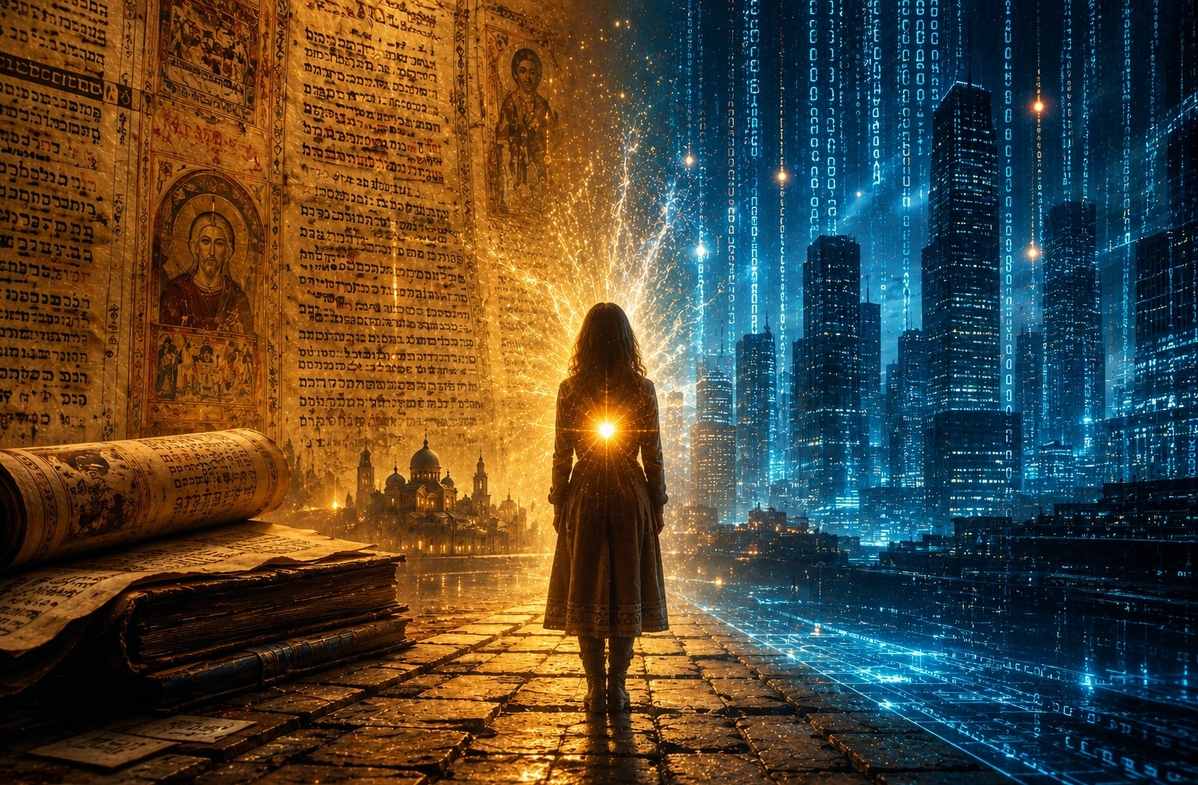
Neo Gnosticism is not simply ancient Gnosticism revived in modern clothing. It is the renewed search for direct knowing in a world shaped by systems, screens, simulations, artificial intelligence, institutional authority and spiritual hunger. Where ancient Gnostics wrestled with empire, cosmic rulers and the boundaries of early Christian authority, Neo Gnostics today ask how perception is shaped by algorithms, digital surveillance, transhumanist promises, synthetic realities and a crisis of meaning that information alone cannot resolve.
The question is no longer only “What has been hidden?” It is also: what is real, what shapes our sense of reality, and how does the human being recover direct recognition inside systems designed to capture attention?
In Plain Terms
Neo Gnosticism is the modern revival and reinterpretation of the ancient Gnostic search for direct knowing. It asks how older ideas such as gnosis, archons, the Demiurge, the divine spark and liberation can be understood in a world shaped by AI, simulation theory, digital authority, transhumanism, psychological fragmentation and modern spiritual searching.
It is not one church, one doctrine or one organisation. It is a broad modern field of inquiry and practice. Some Neo Gnostics study the Nag Hammadi texts. Some approach Gnosticism through depth psychology, meditation, art, philosophy or technology. Others use Gnostic language to ask why the official story of reality often feels incomplete.
In simple terms, Neo Gnosticism begins with the suspicion that the surface world is not the whole world, and that the human being carries a deeper capacity for recognition than most systems encourage.
Primary Sources and Traditions Discussed
- Ancient Gnostic traditions: especially Sethian, Valentinian and related early Christian currents centred on gnosis, divine origin, archons, aeons, the Demiurge and liberation.
- Nag Hammadi Library: the Coptic codices discovered in Egypt in 1945, including texts such as the Apocryphon of John, Gospel of Thomas, Gospel of Philip and Gospel of Truth.
- Modern Gnostic revival: contemporary Gnostic churches, independent seekers, scholars, writers, artists and online communities engaging ancient Gnostic material today.
- Depth psychology: especially Jungian language around shadow, Self, symbolic powers, individuation and inner recognition.
- Modern systems: artificial intelligence, simulation theory, algorithmic governance, digital attention, transhumanism and technological authority.
How to Read This Article
This article treats Neo Gnosticism as a modern interpretive field, not as a single fixed religion. Some Neo Gnostics are sacramental practitioners. Some are independent spiritual seekers. Some are scholars, artists, technologists or psychologically minded readers of ancient texts. The aim here is not to force them into one box, but to clarify the shared pattern: direct knowing, suspicion of false authority, recovery of inner light, and careful discernment inside modern systems.
Read the modern comparisons as lenses, not literal replacements. Algorithms are not simply ancient archons in new costumes, and artificial intelligence is not literally the Demiurge. These images are useful when they help us see how power, perception and attention operate. They become unhelpful when they turn complex reality into panic or fantasy.
Table of Contents
- In Plain Terms
- Primary Sources and Traditions Discussed
- How to Read This Article
- What Is Neo Gnosticism?
- Is Neo Gnosticism the Same as Ancient Gnosticism?
- What Do Neo Gnostics Believe?
- The Ancient Roots: Gnosis, Archons, Demiurge and Divine Spark
- The Modern Shift: AI, Simulation, Transhumanism and Digital Authority
- Neo Gnosticism as Practice, Not Just Theory
- Common Misunderstandings
- Why Neo Gnosticism Matters Now
- Related Glossary Terms
- Read Next
- Neo Gnosticism Route
- Frequently Asked Questions
- Further Reading
- References and Sources
What Is Neo Gnosticism?
Neo Gnosticism is the contemporary revival, reinterpretation and practice of the ancient Gnostic impulse. At its centre is gnosis: direct, interior knowing that transforms the one who receives it. This is not ordinary information. It is recognition. It is the moment a person begins to see that inherited explanations, social roles, institutional stories and technological systems do not exhaust reality.
The term Neo Gnostics refers to the diverse people who explore this path today. They may draw on ancient Gnostic scriptures, contemplative practice, depth psychology, comparative religion, art, digital culture, philosophy or critical study of technology. Some belong to modern Gnostic churches. Others practise independently. Some are primarily readers and researchers. Others approach Neo Gnosticism as a lived discipline of attention, discernment and inner honesty.
Unlike the ancient Gnostic schools of the second and third centuries CE, Neo Gnosticism does not have one founder, one council or one fixed canon. It is decentralised. That looseness can be both its gift and its danger. It allows new insight, but it also demands careful grounding. Without ancient sources, ethical practice and psychological balance, Neo Gnosticism can easily collapse into vague rebellion, spiritual branding or conspiracy-shaped confusion.
At its best, Neo Gnosticism asks three living questions:
- What kind of reality are we living inside?
- What powers shape our perception of that reality?
- What in the human being can recognise more than the surface world allows?
These questions are old. Their modern forms are new. That is the heart of Neo Gnosticism.

Is Neo Gnosticism the Same as Ancient Gnosticism?
No. Neo Gnosticism is related to ancient Gnosticism, but it is not identical with it.
Ancient Gnosticism was not one single religion. It was a diverse field of early religious movements, many of them connected to early Christianity, with their own myths, scriptures, rituals and communities. Sethian, Valentinian and related currents described elaborate cosmologies of divine fullness, fallen wisdom, archons, aeons, the Demiurge and the soul’s return to its higher origin.
Neo Gnosticism inherits the questions and symbolic patterns of these traditions rather than reproducing every ancient answer. Where ancient Gnostic texts mapped the cosmos through divine emanations and ruling powers, Neo Gnostics often read modern life through systems, media, psychology, technological authority and the shaping of attention.
The archons, for example, can still be studied as cosmic rulers in ancient texts. But in modern interpretation they can also name systems that narrow consciousness: algorithms, bureaucracies, social scripts, institutional narratives, inherited trauma or inner voices that keep a person obedient to lesser realities. The Demiurge can still be read as the lesser creator in Gnostic myth. It can also become a lens for understanding blind systems that generate worlds without wisdom.
There is also an important shift around the body and the world. Some ancient Gnostic traditions were strongly ascetic and world-denying. Many Neo Gnostics adopt a more integrative stance. The body is not simply a prison to be escaped. It can become a place of recognition, practice and return. The world is not automatically rejected. It is read more carefully.
That distinction matters. Neo Gnosticism is strongest when it honours the ancient sources without pretending that the modern world is the second century wearing a digital mask.
What Do Neo Gnostics Believe?
It is more accurate to ask what Neo Gnostics inquire into than what they all believe. The movement resists fixed creeds. Still, several recurring orientations appear across the field.
Direct Knowing Over Passive Belief
The central emphasis is gnosis: direct recognition rather than passive belief. This does not mean rejecting study, tradition or community. It means that spiritual truth must become inwardly known, not merely accepted from outside. For Neo Gnostics, a borrowed answer is not the same as awakened understanding.
Suspicion of False Authority
Neo Gnosticism carries a disciplined suspicion toward official accounts of reality. This does not need to become paranoia. At its best, it is careful discernment: asking who benefits from a story, what it hides, what it makes impossible to ask, and whether it deepens or diminishes human awareness.
The Divine Spark
The ancient idea of the divine spark remains central. In many Gnostic texts, the human being carries something of divine origin within the conditions of limitation. For Neo Gnostics, the divine spark names the capacity to recognise, question, remember and awaken beyond the roles imposed by systems, history and conditioning.
Archontic Awareness
Neo Gnostics often use the language of archons to describe powers that bind attention to the surface. These powers may be understood cosmologically, psychologically, socially or technologically. What matters is the pattern: consciousness becomes trapped when it forgets its depth and begins to serve what merely manages it.
Integration Over Escape
Many modern readers are drawn to Gnosticism because it names exile, alienation and the feeling that this world is not the whole story. Yet Neo Gnosticism does not need to become body-hatred or world-rejection. A mature modern reading seeks liberation within embodied life: clearer attention, ethical action, grounded practice and a refusal to confuse escape with awakening.

The Ancient Roots: Gnosis, Archons, Demiurge and Divine Spark
Neo Gnosticism cannot be understood without its ancient vocabulary. These terms are not decorative relics. They are living concepts that help modern readers think about perception, power, identity and liberation.
Gnosis
In Greek, gnosis means knowledge. In Gnostic contexts, it means a deeper form of knowing: direct recognition of divine reality, true origin and the soul’s condition. It is not merely collecting information about the sacred. It is being changed by what is recognised.
For Neo Gnostics, gnosis can appear through study, contemplation, crisis, symbolic insight, inner practice or sudden recognition. It is the moment when reality stops feeling flat and the person senses that the official surface has been hiding a deeper structure.
Archons
In ancient Gnostic cosmology, the archons are ruling powers associated with the lower cosmos. They obstruct the soul, enforce forgetfulness and demand recognition from beings who should belong to a higher source. In texts such as the Apocryphon of John and the Hypostasis of the Archons, they are linked to the Demiurge and to the flawed administration of the visible world.
In Neo Gnostic interpretation, archons can also describe repeating patterns of control: attention capture, propaganda, social conditioning, algorithmic sorting, inner compulsion and institutional systems that keep people moving without awakening. The term becomes useful when it clarifies how consciousness is shaped. It becomes dangerous when it turns complexity into fantasy enemies.
Demiurge
The Demiurge is the lesser creator or craftsman of the material order in many Gnostic myths. Named Yaldabaoth, Saklas or Samael in some sources, he fashions a world without full knowledge of the higher divine fullness. His tragedy is not only malice, but limitation: he mistakes his partial power for ultimate reality.
Modern readers often find the Demiurge disturbingly contemporary. It can name any system that builds a world from limited assumptions and then treats that world as final. Bureaucracy, code, ideology, market logic and machine authority can all become demiurgic when they generate environments without wisdom, humility or inner sight.
Divine Spark
The divine spark is the hidden element of divine origin within the human being. In ancient myth, it is the light trapped within matter, the forgotten trace of the higher realm, the part of the soul that can remember where it belongs.
For Neo Gnostics, the divine spark names the irreducible capacity for recognition. It is the part of the person that does not fully belong to advertising, ideology, trauma, status, algorithmic prediction or inherited identity. It is not a possession. It is a call to wakefulness.
The Modern Shift: AI, Simulation, Transhumanism and Digital Authority
If ancient Gnostics looked at the heavens and saw a cosmos ruled by powers, Neo Gnostics look at modern systems and ask a similar question in a new key: what shapes the world before we experience it?
The modern shift does not replace ancient cosmology with technology talk. It asks why Gnostic symbols have become newly legible in an age of generated realities, machine mediation, predictive systems and digital attention economies.
Artificial Intelligence and the New Question of Authority
Artificial intelligence has entered the intimate spaces once reserved for teachers, mystics, friends, advisers and inner reflection. People now turn to machines for answers, comfort, direction, interpretation and judgement. The danger is not that these tools exist. The danger is that a useful tool can quietly become an unseen authority.
For Neo Gnosticism, AI matters because it intensifies an old question: who mediates reality? When a system begins to shape what a person notices, trusts, believes or ignores, discernment becomes more than a mental skill. It becomes a spiritual necessity.
The machine may speak fluently, but fluency is not wisdom. It may produce answers, but answers are not the same as knowing. A Neo Gnostic reading does not require fear of AI. It asks whether human attention is being strengthened, clarified and returned to itself, or slowly handed over to systems that cannot recognise the soul they are advising.
For Neo Gnosticism, AI becomes important not because machines are demons, but because they intensify an older question: who mediates reality? When answers come through opaque systems trained on vast human data, discernment becomes a spiritual practice as well as an intellectual one.
Simulation as Modern Cosmology
Simulation theory has become one of the modern world’s most powerful metaphors for constructed reality. Neo Gnostics do not need to claim that the universe is literally a computer simulation. The deeper value lies in the structure of the question: what if the world we take as final is generated, limited or mediated by a deeper order we do not fully perceive?
Ancient Gnostic texts often treated the visible world as incomplete, deceptive or deficient compared with a higher fullness. Modern simulation language gives contemporary readers another way to ask whether appearance and reality are the same thing.
Transhumanism and the Body Question
Transhumanism promises to overcome biological limitation through technology: life extension, enhancement, neural interfaces, digital continuity and perhaps even mind uploading. At first glance, this can sound like a technological version of ancient escape from matter.
Neo Gnosticism asks a sharper question. If the body is abandoned before the self is understood, has liberation occurred, or has the prison simply changed architecture? Ancient Gnosis was not merely escape from flesh. It was transformation of knowing. A body can be a trap when lived unconsciously, but it can also be a site of attention, presence and awakening.
Digital Authority and the Algorithmic Unconscious
The old archons demanded recognition at the gates of the cosmos. Modern systems ask for clicks, compliance, prediction and engagement. The feed supplies dreams on our behalf, shaping desire, memory, outrage, belonging and fear before we have time to recognise what has entered us.
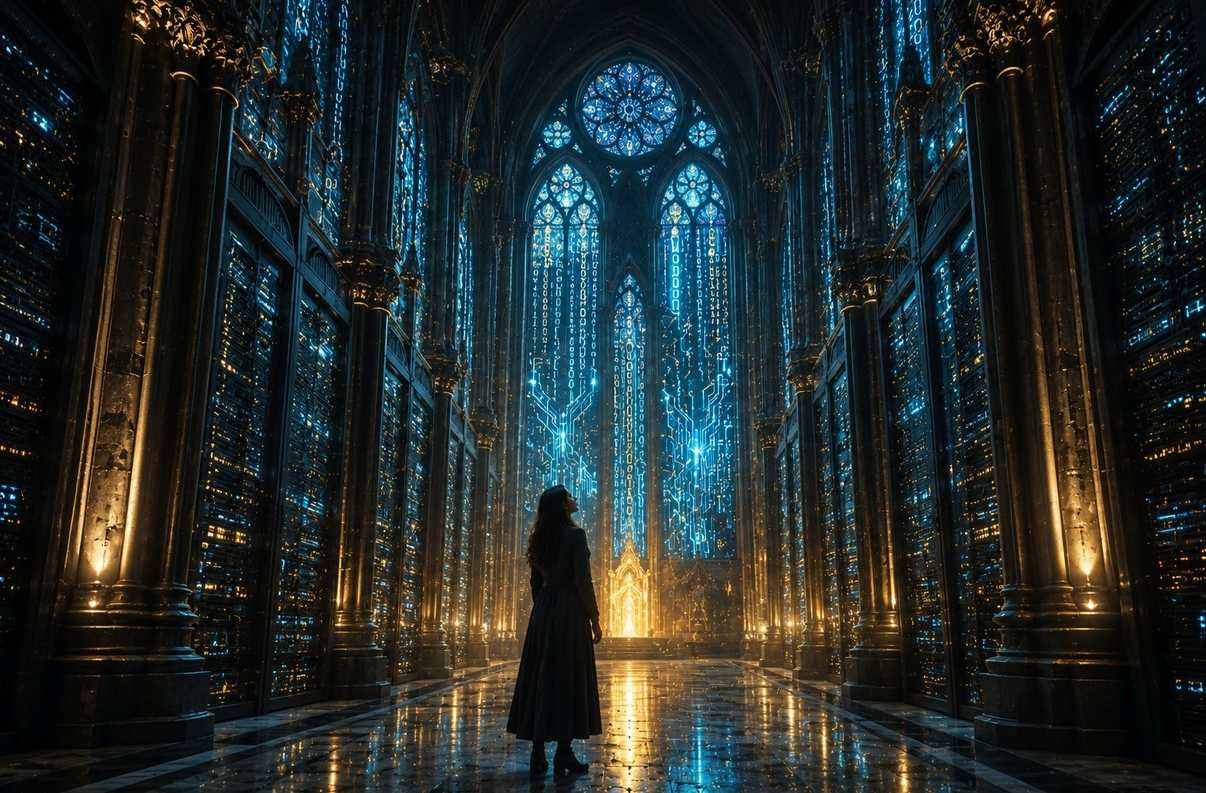
For Neo Gnosticism, the battle for attention is not merely a productivity issue. It is spiritual terrain. A person who cannot direct attention cannot easily practise discernment. A culture trained to react cannot easily recognise. The first liberation is often the recovery of attention from the systems that have learned to harvest it.
Neo Gnosticism as Practice, Not Just Theory
Neo Gnosticism is weakest when it remains an aesthetic, an identity or a theory about hidden systems. It becomes meaningful when it changes how a person lives, attends, speaks, reads, chooses and relates.
Practices vary widely. Some Neo Gnostics study the Nag Hammadi texts slowly and repeatedly, treating them as maps of the soul rather than curiosities from religious history. Some practise meditation, contemplative prayer, breathwork, silence, dream work, shadow integration or somatic awareness. Some use digital minimalism as a spiritual discipline, not because technology is evil, but because attention is sacred.
What unites these practices is not one technique, but one orientation: the refusal to outsource discernment. Neo Gnosticism asks the seeker to test claims inwardly, ethically and carefully. Does this idea make me clearer, kinder and more awake? Or does it make me grandiose, fearful, detached or addicted to hidden explanations?
Gnosis is not only seeing through illusion. It is learning how to live after the seeing.
Common Misunderstandings
Because Neo Gnosticism sits outside tidy institutional categories, it is easily misunderstood. These are the most common confusions.
“Neo Gnosticism Is a Cult or Secret Society”
Neo Gnosticism has no single leader, central headquarters, mandatory initiation or universal doctrine. Some groups are organised, but the wider field is decentralised. Its “hiddenness” is not mainly organisational. It is experiential. Gnosis cannot be handed over like a membership card. It must be recognised.
“Neo Gnosticism Rejects the Body as Evil”
Some ancient Gnostic traditions held strongly ascetic views, but many modern Neo Gnostic readers take embodiment seriously. The body is not automatically an enemy. It can be the place where attention returns, trauma is worked through, breath becomes conscious and recognition is grounded in ordinary life.
“Neo Gnosticism Is Anti-Christian”
Neo Gnosticism is not simply anti-Christian. It often questions institutional claims to exclusive authority, but many Neo Gnostics value Jesus as a revealer of gnosis, especially through texts such as the Gospel of Thomas and Gospel of Philip. The disagreement is usually not with the figure of Jesus, but with systems that reduce revelation to control.
“Neo Gnosticism Is Just Conspiracy Thinking”
Neo Gnosticism can become distorted if every difficulty is blamed on hidden enemies. But its deeper critique is not conspiracy. It is discernment. It asks how systems shape perception openly: through incentives, platforms, institutions, habits, media and internalised narratives. The aim is not fear. The aim is clearer seeing.
Why Neo Gnosticism Matters Now
The twenty-first century has produced a strange spiritual crisis. We have more information than any previous generation, yet not necessarily more clarity. We are more connected, yet many feel more isolated. We have access to the wisdom of many traditions, yet fewer shared tools for discernment. The systems that govern attention are not primarily designed to deepen understanding. They are designed to hold engagement, and engagement is not the same as wisdom.
Neo Gnosticism matters because it gives language to this crisis without requiring a person to join one institution, adopt one creed or reject the modern world wholesale. It asks for something more difficult: honest attention. It asks whether the self has become a user, consumer, profile, data point or role before it has remembered itself as a living centre of recognition.
In an age of artificial intelligence, the radical act may not be rejecting every machine. It may be refusing to let any system do your knowing for you. Neo Gnosticism reminds the modern seeker that the final authority is not the algorithm, the institution, the simulation or the inherited script. It is the recognition that arises when awareness returns to itself.

Related Glossary Terms
These glossary terms provide deeper context for the concepts discussed in this article:
- Gnosis — direct knowing, recognition and inner illumination.
- Archons — ruling powers, cosmic or psychological, that bind awareness to lesser structures.
- Demiurge — the lesser craftsman or world-maker in many Gnostic myths.
- Divine Spark — the hidden element of divine origin within the human being.
- Counterfeit Spirit — imitation life, false animation or unconscious pattern mistaken for spirit.
- Pleroma — divine fullness, completion and the realm beyond deficiency.
- Pneuma — spirit, breath and the living principle within Gnostic anthropology.
Neo Gnosticism Route
This article is the central definition guide for ZenithEye’s Neo Gnosticism route: the path where ancient Gnostic patterns meet AI, simulation theory, transhumanism, digital authority, attention capture and modern spiritual searching.
Frequently Asked Questions
What is Neo Gnosticism in simple terms?
Neo Gnosticism is the modern revival and reinterpretation of the ancient Gnostic search for direct knowing. It asks how gnosis, archons, the Demiurge, the divine spark and liberation can be understood in a world shaped by AI, simulation, digital authority, transhumanism and modern spiritual searching.
Is Neo Gnosticism a religion?
Neo Gnosticism is not one formal religion with a single organisation, creed or hierarchy. It is better understood as a broad modern field of inquiry and practice. Some Neo Gnostics belong to modern Gnostic churches, while others practise independently through study, contemplation, psychology, art or spiritual discernment.
How is Neo Gnosticism different from ancient Gnosticism?
Ancient Gnosticism refers to diverse historical religious movements from late antiquity with specific myths, texts and communities. Neo Gnosticism inherits the questions and symbolic patterns of those traditions, but applies them to modern concerns such as technology, psychology, simulation, attention, institutional authority and the search for direct recognition.
What do Neo Gnostics believe?
Neo Gnostics do not all share one creed. Common themes include direct knowing, suspicion of false authority, the divine spark within the human being, awareness of archontic patterns, and the possibility of liberation through recognition, practice and discernment rather than passive belief.
Do Neo Gnostics worship the Demiurge?
No. In Gnostic thought, the Demiurge is the lesser or flawed world-maker, not a figure of worship. Neo Gnostics may also use the Demiurge as a symbol for blind systems that generate reality from limited assumptions, such as bureaucracy, ideology, code, market logic or machine authority.
Is Neo Gnosticism anti-technology?
Neo Gnosticism is not automatically anti-technology. A careful Neo Gnostic approach asks how technology shapes attention, authority, identity and discernment. The issue is not whether tools exist, but whether human knowing is strengthened or outsourced to systems without wisdom.
Is Neo Gnosticism compatible with science?
Neo Gnosticism can be compatible with serious inquiry when it treats scientific models as maps rather than final dogmas. It often engages questions from philosophy of mind, cognitive science, simulation theory, consciousness studies and technology ethics, while keeping its central focus on direct recognition and discernment.
How can I begin exploring Neo Gnosticism?
Begin with the ancient foundations: gnosis, the Nag Hammadi Library, the Apocryphon of John, the Gospel of Thomas, archons, the Demiurge and the divine spark. Then explore modern questions around AI, simulation, transhumanism, attention and practice. The Neo Gnosticism hub on ZenithEye offers a structured route through these materials.
Further Reading
These ZenithEye articles continue the path through ancient Gnostic foundations, modern revival and contemporary systems:
- Neo Gnosticism Hub — The central route for Neo Gnosticism articles on ZenithEye.
- Neo Gnosticism: How Gnosticism Survived 2,000 Years — The historical companion to this definition guide.
- Who Are the Neo Gnostics? The Complete Guide to the Modern Gnostic Revival — The people, communities and currents shaping contemporary Gnostic revival.
- Living Gnosis: How Neo Gnostics Navigate Work, Relationships, and the Modern World — How modern gnosis becomes practical in ordinary life.
- What Is Gnosticism? The Ancient Currents of Direct Knowledge — The foundation guide to ancient Gnosticism.
- What Is Gnosis? Meaning, Recognition, and Direct Knowing — A deeper explanation of direct knowing.
- Archons: The Ruling Powers That Shape Reality — The ancient concept of ruling powers and its modern relevance.
- What Is the Demiurge? The Craftsman of Matter and the Architect of Form — The Gnostic world-maker and its contemporary echoes.
- The Algorithmic Demiurge: Gnostic Cosmology and the Rise of Artificial Intelligence — How AI can be read through Gnostic symbolism without reducing either field to a slogan.
- Transhumanism as Neo Gnosticism: The Body Escape Debate — Where technological transcendence meets ancient spiritual questions.
- The Nag Hammadi Library: A Complete Guide to the Gnostic Scriptures — The reader’s map to the thirteen codices and their major texts.
References and Sources
The following sources informed the historical framing, terminology and modern comparisons in this article. Primary sources, scholarly studies and contextual works are listed separately for clarity.
Primary Sources and Critical Editions
- Robinson, James M. (ed.). (1977). The Nag Hammadi Library in English. San Francisco: Harper & Row.
- Layton, Bentley. (1987). The Gnostic Scriptures. New York: Doubleday.
- Meyer, Marvin W. (ed.). (2007). The Nag Hammadi Scriptures. New York: HarperOne.
Scholarly Monographs and Studies
- Pagels, Elaine. (1979). The Gnostic Gospels. New York: Random House.
- King, Karen L. (2003). What Is Gnosticism? Cambridge, MA: Harvard University Press.
- Williams, Michael Allen. (1996). Rethinking “Gnosticism”: An Argument for Dismantling a Dubious Category. Princeton: Princeton University Press.
- Jonas, Hans. (1958). The Gnostic Religion: The Message of the Alien God and the Beginnings of Christianity. Boston: Beacon Press.
- Hoeller, Stephan A. (2002). Gnosticism: New Light on the Ancient Tradition of Inner Knowing. Wheaton, IL: Quest Books.
- Markschies, Christoph. (2003). Gnosis: An Introduction. London: T & T Clark.
Comparative and Contextual Studies
- Bostrom, Nick. (2003). “Are You Living in a Computer Simulation?” Philosophical Quarterly, 53(211), 243–255.
- Chalmers, David J. (2022). Reality+: Virtual Worlds and the Problems of Philosophy. New York: W. W. Norton.
- Davis, Erik. (1998). TechGnosis: Myth, Magic, and Mysticism in the Age of Information. New York: Harmony Books.
- Hanegraaff, Wouter J. (2012). Esotericism and the Academy: Rejected Knowledge in Western Culture. Cambridge: Cambridge University Press.
- Segal, Robert A. (1992). The Gnostic Jung. Princeton: Princeton University Press.
Study Note: This article explores historical, spiritual, psychological and technological themes related to Gnosticism and Neo Gnosticism. It is intended for comparative study and reflective reading. It does not offer theological, psychological, medical or spiritual instruction. Readers encountering difficult material around religious trauma, psychological crisis or altered states should seek appropriate support from qualified professionals or trusted practitioners.