
The Somatic Cage: How Survival Biology Blocks Gnosis
You cannot think your way into gnosis while the body is preparing for danger.
A person may understand an idea intellectually but be unable to embody it. The mind may want insight, silence, prayer, recognition or direct knowing, while the body is still registering threat. In that state, perception narrows. Attention scans. Breath shortens. The world becomes something to survive rather than something to receive.
This is the somatic cage.
The somatic cage is the state in which the nervous system is organised around survival. When the body registers danger, perception narrows, attention searches for threat and deeper reflection becomes harder to access. This does not mean the body is spiritually inferior. It means the body is protecting life.
Gnosis requires receptivity. Threat response requires defence. These two states are not the same doorway.
The gate to direct knowing opens more easily when the body no longer has to defend itself.
In Plain Terms
The somatic cage is the biological state in which the body is organised around survival rather than openness. When the nervous system feels unsafe, attention narrows, the body prepares for defence and reflective insight becomes harder to access. This does not make the body an enemy of spiritual life. It makes safety the first gate through which deeper knowing must pass.
Primary Sources and Traditions Discussed
- Fight-or-flight, freeze and survival physiology.
- Amygdala function and threat detection.
- Prefrontal cortex, reflection and flexible meaning-making.
- Autonomic nervous system regulation.
- Trauma-informed spirituality and somatic safety.
- Breath, grounding, orientation and environmental safety.
- Gnosis as direct knowing rather than belief alone.
- Embodied spirituality and integration.
- Spiritual bypass and the denial of biology.
- Neo-Gnostic readings of the body as gatekeeper, not enemy.
How to Read This Article
Read this as a guide to the body’s role in perception, not as medical advice. The somatic cage is not a moral failure or a spiritual defect. It is a protective state. The aim is not to defeat the body, but to understand why safety must come before stable insight.
Article Map
- What the Somatic Cage Is
- Why Survival Mode Narrows Perception
- The Amygdala and the Organic Alarm System
- The Prefrontal Cortex and the Loss of Reflective Space
- Why Gnosis Requires Safety
- The Body Is Not the Enemy
- Spiritual Bypass and the Denial of Biology
- Modern Control Patterns and Permanent Threat
- A Neo-Gnostic Reading of the Biological Barrier
- Signs You Are in the Somatic Cage
- First Steps Toward Somatic Safety
- What This Article Is Not Saying
- Safety Is the First Gate
- Related Glossary Terms
- Read Next
- Further Reading
- Frequently Asked Questions
- References and Sources
What the Somatic Cage Is
The somatic cage is not the body itself. It is the state the body enters when survival becomes the organising principle of perception.
When the nervous system detects threat, a cascade begins. Breath becomes shallow. Muscles tighten. Attention scans for danger. The body prepares to fight, flee, freeze or collapse. The world becomes threat-shaped, and every ambiguity begins to look like a warning.
This is not imagination. It is physiology. The cage appears through tension, vigilance, racing thought, shutdown, agitation, numbness, compulsive interpretation or the inability to rest inside the present moment.
In survival mode, reality changes flavour. The room may be safe, but the body does not yet believe it. The idea may be true, but the nervous system cannot receive it. Spiritual language may still be understood, but it does not land. It hovers above a body too busy defending itself to open.
The somatic cage is not the body. It is the body organised around threat.

The somatic cage is not the body. It is the body organised around threat.
Why Survival Mode Narrows Perception
Survival mode is designed for speed, not depth.
When danger is near, the nervous system does not prioritise symbolic nuance, contemplative subtlety or metaphysical reflection. It prioritises action. Where is the threat? How close is it? Can I escape? Must I fight? Should I freeze? Is this safe enough to soften?
A house alarm cannot distinguish between a burglar and burnt toast. Its job is to sound the alarm. The nervous system can do something similar. Once activated, it may treat uncertainty as threat, complexity as overload and openness as vulnerability.
This is why a person in survival mode may read profound spiritual texts and feel nothing. The text is not necessarily the problem. The receiver is tuned to another frequency.
This narrowing is protective, not personal. It is the biology of a being that has learned, through experience or environment, that the world is unsafe. The narrowing is not a moral failure. It is a survival adaptation. But adaptations that keep the body alive can also keep the deeper mind from opening.
Survival mode is designed for speed, not depth.
The Amygdala and the Organic Alarm System
The amygdala is part of the brain’s threat-detection network. It is not evil, primitive or stupid. It is fast.
Neuroscientist Joseph LeDoux has cautioned against reducing the amygdala to the brain’s “fear centre”. It helps coordinate defensive responses and threat learning, but the conscious feeling of fear involves broader systems. In plain language: the amygdala is not the whole story of fear. It is part of the alarm architecture.
When threat is registered, the body shifts toward survival response. Heart rate and breathing may change. Stress hormones may rise. Attention becomes threat-focused. Reflection becomes harder, not because the amygdala is a jailer, but because it is doing what it evolved to do: keep the organism alive long enough to worry about enlightenment later.
It is important not to overclaim. The amygdala does not simply “shut down the cortex”. The brain is more complex than that. A better way to say it is this: high threat activation can reduce access to reflective, flexible processing. The alarm system and the contemplative system are competing for biological resources.
When the alarm is ringing, the library tends to close early.
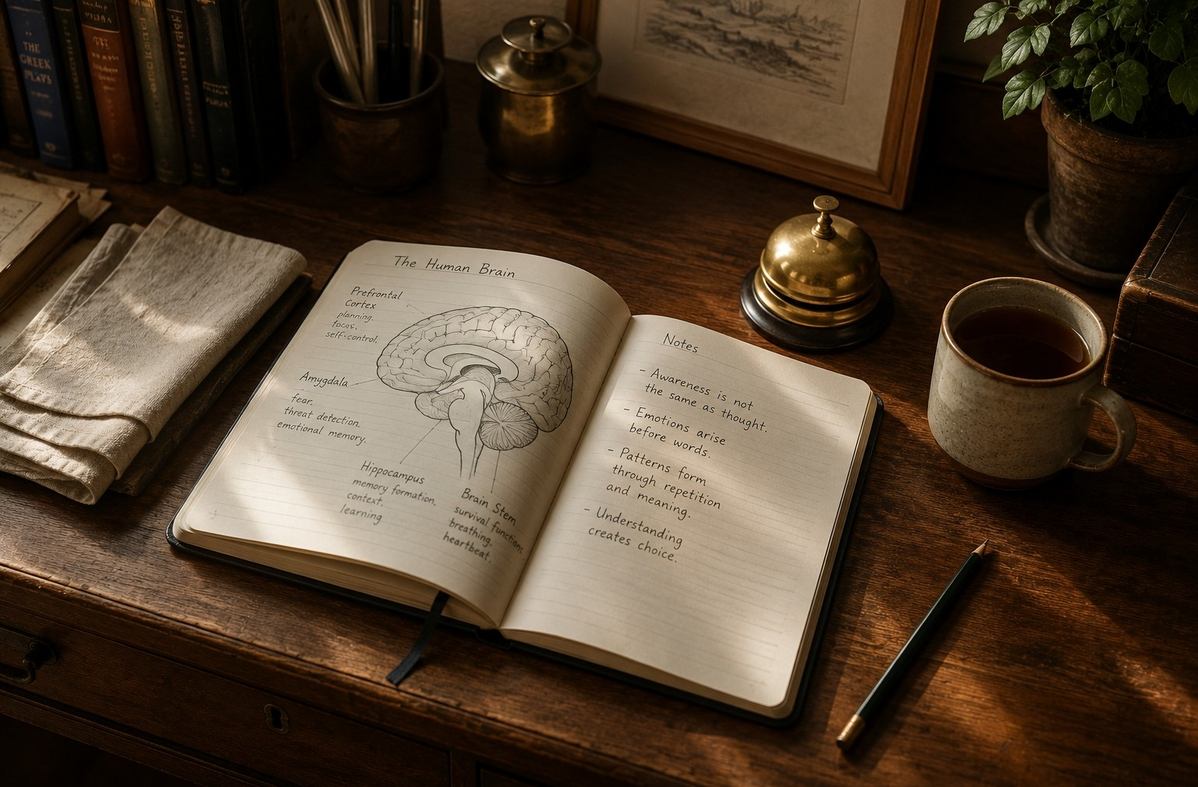
The amygdala is not the jailer. It is the alarm bell.
The Prefrontal Cortex and the Loss of Reflective Space
The prefrontal cortex supports reflection, planning, impulse regulation and flexible meaning-making. Under intense threat or chronic stress, these capacities can become harder to access. This is not a design flaw. It is the body choosing immediate survival over long-range deliberation.
A zebra does not need philosophical nuance while escaping a lion.
Insight needs space. Symbolic interpretation needs flexibility. Gnosis needs receptive attention. Survival states prioritise reaction. This is why spiritual advice can sound true but feel unreachable. The words may be correct, but the nervous system is spending its available bandwidth on defence.
Stress research helps explain this. Acute and chronic stress can impair prefrontal cortex function, making working memory, impulse regulation and flexible thought more difficult. Trauma research also shows that the body can remain organised around threat long after the conscious mind believes the danger has passed.
In contemplative language, the lamp of reflection has not gone out. It is simply being asked to shine during a storm.

Insight needs space, and survival mode spends space on defence.
Why Gnosis Requires Safety
Gnosis is direct knowing. Direct knowing is not merely information. It is not forced by argument, memorised from doctrine or manufactured by intellectual pressure. It arrives through a field that is available enough to receive it.
A threatened body cannot easily become receptive.
Safety does not guarantee gnosis. It is not a vending machine where three coins of calm produce one packet of enlightenment. But safety removes one of the locks on the door. The body that feels safe enough to stop scanning can begin to notice what is actually present. The mind that is no longer preoccupied with threat can begin to entertain subtlety, ambiguity and symbolic depth.
The field becomes available for recognition.
This is why many contemplative traditions begin with posture, breath, environment, rhythm, silence and repetition before introducing advanced practice. The body must be brought into the room before the soul can be invited to speak.
Safety is the first gate not because it is the final destination, but because without it, the other gates remain locked.
Safety does not manufacture gnosis. It removes one of the locks on the door.
The Body Is Not the Enemy
Some spiritual systems have treated the body as an obstacle to awakening. That mistake has caused deep confusion.
The body is not blocking gnosis out of ignorance. It is protecting life. A body that feels unsafe cannot be bullied into openness. Spiritual maturity begins by respecting the gatekeeper rather than trying to break down the gate.
Embodiment is not lower than insight. It is the condition in which insight becomes livable. A disembodied revelation may feel magnificent in the moment and evaporate in the supermarket. The body is where insight must land, test itself and become integrated.
Without the body, gnosis remains a visitor from above rather than a resident of life.
The body is not the obstacle to awakening. The unsafe body is the locked gate.
The body is not the obstacle to awakening. The unsafe body is the locked gate.
Spiritual Bypass and the Denial of Biology
Some spiritual advice asks people to transcend fear before helping the body feel safe.
“Just observe it” may not be enough for a dysregulated nervous system. “You are not the body” can become bypass when the body is overwhelmed. “Raise your vibration” can become another demand placed upon a system already struggling to remain coherent.
Insight without regulation can become inflation, dissociation or abstraction. Grounding is not less spiritual than transcendence. The descent matters.
A spirituality that cannot calm the body may only teach the mind to float above distress. The person becomes spiritually articulate but somatically bankrupt. They can describe the Pleroma but cannot sleep through the night. They can discuss the divine spark but cannot feel their own feet.
This is not integration. It is escape dressed in sacred language.
A spirituality that cannot calm the body may only teach the mind to float above distress.
Modern Control Patterns and Permanent Threat
Modern systems keep the nervous system in a low-grade state of alert.
Notifications, news cycles, economic pressure, social comparison, accelerated communication and digital speed create a constant stream of urgency. The nervous system receives more signals than it can metabolise. Permanent alert begins to feel normal. In this state, insight is replaced by scanning.
The attention economy does not merely distract. It shapes nervous-system states for engagement. Outrage, fear, novelty and social comparison capture attention because they borrow the body’s survival machinery.
The body does not always know that a notification is not a predator. It only knows that the signal feels urgent and the environment feels unpredictable.
This is where the somatic cage meets Digital Archons. The archonic pattern does not need to destroy the soul. It only needs to keep the alarm system online.
A nervous system kept in permanent alert cannot easily recognise the quiet voice beneath the noise.
A nervous system kept in permanent alert cannot easily recognise the quiet voice beneath the noise.
A Neo-Gnostic Reading of the Biological Barrier
The biological barrier is not proof that matter is evil. It is evidence that consciousness must pass through embodiment.
Gnostic language often speaks of ignorance, sleep, false perception and awakening. A contemporary Neo-Gnostic reading can add nervous-system survival states to this vocabulary. Sometimes the veil is not only doctrinal, symbolic or cultural. Sometimes it is somatic.
The archonic pattern is not only external control. It is internalised threat. The body becomes a lock when it feels unsafe.
The key is not hatred of the body, but restoration of safety. Gnosis must become embodied or it remains unstable. The prison is not the body. The prison is consciousness trapped in a body that never feels safe enough to open.
Liberation is not escape from flesh. It is the return of the body to a state in which it can receive what the mind has already glimpsed.
The prison is not the body. The prison is consciousness trapped in a body that never feels safe enough to open.
Signs You Are in the Somatic Cage
The following signs are possible indicators, not diagnostic criteria. They suggest that the nervous system may be organised around survival rather than receptivity:
- Shallow breathing or breath-holding.
- Tight jaw, chest or belly.
- Constant scanning for danger or reassurance.
- Inability to sit still, or inability to move.
- Racing thoughts or compulsive interpretation.
- Spiritual urgency or the need for certainty.
- Feeling cut off from intuition.
- Irritability, collapse or sudden shutdown.
- Dissociation, numbness or unreality.
- Feeling that every ambiguity is a threat.
- Inability to absorb insight even when it makes intellectual sense.
If several of these are present, the body may be asking for safety before it can offer openness.
If several of these are present, the body may be asking for safety before it can offer openness.
First Steps Toward Somatic Safety
These practices are gentle, not prescriptive. They are invitations, not commands.
- Lengthen the exhale. A slower out-breath can help signal settling to the nervous system.
- Feel the feet or seat. Grounding attention in physical contact interrupts the upward spiral of threat.
- Look around and name safe details. Orientation to the actual environment can interrupt imagined threat.
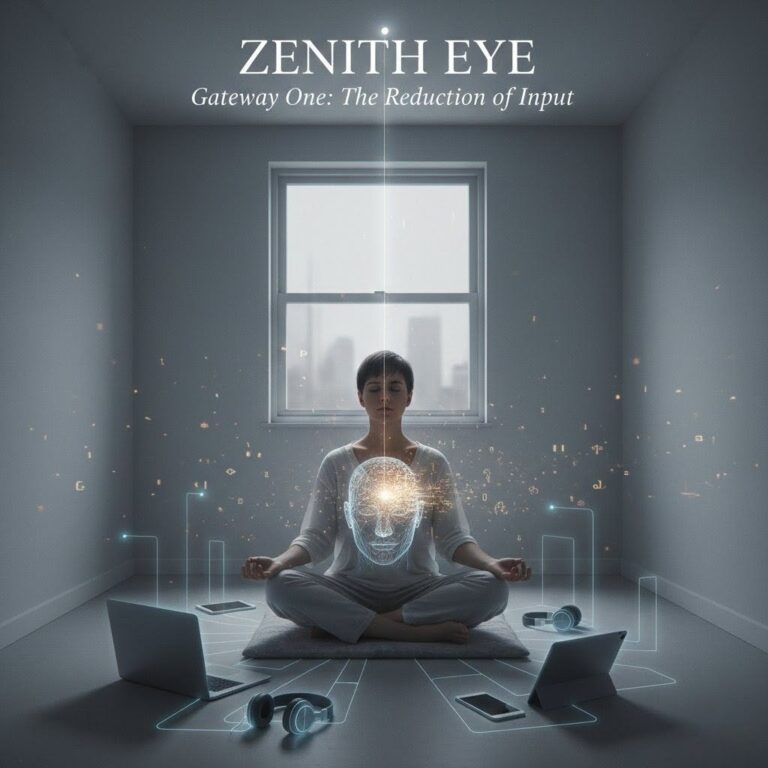
- Lower sensory input. Reduce noise, light and screen exposure when activated.
- Use warmth, water, soft light or familiar sound. These can act as ordinary bodily signals of safety.
- Avoid intense interpretation while activated. Do not force insight during alarm.
- Delay big spiritual conclusions until regulated. The frightened body makes a poor theologian.
- Let the body arrive before the mind explains. Explanation is not the same as safety.
These first steps are developed more fully in the next article, De-Escalating the Amygdala: The Mechanics of Somatic Safety, where breath, grounding, orienting, rhythm and environment are explored as practical signals of safety.
Do not ask the frightened body for revelation. First, tell it the room is safe.

Do not ask the frightened body for revelation. First, tell it the room is safe.
What This Article Is Not Saying
This article is not saying that trauma is solved by breathing, that spiritual insight is purely biological, that the body is a machine to hack or that people should abandon therapy, medicine or support.
It is not saying that anxiety or dysregulation is spiritual failure, that everyone can self-regulate instantly, that altered states are always healthy or that survival responses are shameful.
Regulation is not a moral achievement. It is a condition that may need support, time and care. Some nervous systems have been shaped by chronic stress, trauma, illness, disability or developmental conditions that make self-regulation difficult without professional help.
This article is a guide to the body’s role in perception, not a substitute for clinical care.
Regulation is not a moral achievement. It is a condition that may need support, time and care.
Safety Is the First Gate
The somatic cage can open, but not through force.
The body narrows perception when it senses threat. That narrowing is protective. Gnosis requires openness. Openness requires enough safety. The first gate of spiritual practice may not be doctrine, ritual or belief. It may be the breath, the room, the body, the slow return from alarm.
Before the eye can open, the body must know it is no longer under attack.
This is not a lowering of spiritual ambition. It is the recognition that the vessel must be stable enough to hold what the light reveals. The body is not the enemy of gnosis. It is the ground on which gnosis becomes real.
Safety is not the destination. It is the first gate, and the gate is already built into the flesh.

Related Glossary Terms
These terms help place the somatic cage within the wider ZenithEye map of embodiment, perception and direct knowing.
- Somatic Cage
- Survival Mode
- Fight-or-Flight
- Freeze Response
- Nervous System Regulation
- Somatic Safety
- Amygdala
- Prefrontal Cortex
- Autonomic Nervous System
- Embodiment
- Grounding
- Spiritual Emergency
- Integration
- Trauma Response
- Direct Knowing
- Gnosis
- Recognition
- Digital Archons
- The Slow Work of Integration
- Pattern Recognition Without Paranoia
Read Next
Continue through the Biological Barrier series: first the body in survival mode, then the mechanics of somatic safety, then the return of reflective and intuitive knowing.
- The Somatic Cage: How Survival Biology Blocks Gnosis
- De-Escalating the Amygdala: The Mechanics of Somatic Safety
- Reclaiming the Cortex: Opening the Gateways of Direct Knowing
- The Slow Work of Integration
- What Is Recognition?
Further Reading
Articles from ZenithEye that continue the themes of attention, embodiment, nervous-system regulation, spiritual emergency and direct knowing:
- De-Escalating the Amygdala: The Mechanics of Somatic Safety – The next article in the Biological Barrier series, showing how breath, grounding, orienting, rhythm and environment signal safety to the nervous system.
- The Spiritual Practice of Attention – How attention creates the receptive field in which insight can land.
- The Gateway of Sensation – Body scan, sensation and somatic awareness as grounding practices.
- The Slow Work of Integration – Why insight must be grounded in ordinary life before it becomes stable.
- Spiritual Emergency – When awakening, intensity or inner opening becomes destabilising.
- Pattern Recognition Without Paranoia – Discerning real signals from threat-amplified noise.
- The Discipline of Not Interpreting Everything – Why the activated mind compulsively interprets.
- Digital Archons – How algorithmic systems shape attention and keep the nervous system in alert.
- What Is Recognition? – The moment of direct seeing beneath filters and defensive patterns.
- What Is Gnosis? – Direct knowing as recognition rather than belief alone.
Frequently Asked Questions
What is the somatic cage?
The somatic cage is the state in which the nervous system is organised around survival. When the body registers threat, perception narrows, attention scans for danger and deeper reflection or direct knowing becomes harder to access.
Can survival mode block spiritual insight?
Survival mode can make spiritual insight harder to receive or integrate because the body prioritises defence over openness. This does not mean insight is impossible, but it means the nervous system may need safety and grounding before deeper perception can stabilise.
Is the body the enemy in spiritual practice?
No. The body is not the enemy. The body protects life. The problem is not embodiment itself, but a nervous system that remains trapped in threat. Spiritual maturity includes learning how to work with the body rather than trying to bypass it.
What does the amygdala have to do with gnosis?
The amygdala is part of the brain’s threat-detection network. When threat activation is high, reflective and flexible processing may become harder to access. Since gnosis involves direct knowing and receptive attention, chronic threat activation can interfere with the conditions that support it.
Why does safety matter for direct knowing?
Direct knowing requires a degree of openness, attention and receptivity. If the body feels unsafe, attention narrows around defence. Safety does not create gnosis by itself, but it can remove one of the biological locks that prevents insight from landing.
Can breathwork open the somatic cage?
Breathwork can help some people shift toward regulation, especially gentle breathing with longer exhalations. However, breathwork is not a cure-all and can be destabilising for some people. It should be used carefully, especially by those with trauma, panic or medical concerns.
Is this medical advice?
No. This article is educational and contemplative. It explores the relationship between survival biology, nervous-system regulation and spiritual insight. Anyone experiencing trauma symptoms, panic, dissociation, psychosis, severe anxiety or spiritual emergency should seek qualified professional support.
References and Sources
The following sources support the article’s framework on threat response, stress, embodied awareness and Gnostic direct knowing.
Neuroscience and Threat Response
- LeDoux, Joseph. The Deep History of Ourselves: The Four-Billion-Year Story of How We Got Conscious Brains. Viking, 2019.
- LeDoux, Joseph. Anxious: Using the Brain to Understand and Treat Fear and Anxiety. Viking, 2015.
- LeDoux, Joseph. “Rethinking the Emotional Brain.” Neuron, 2012.
- Arnsten, Amy F. T. “Stress Signalling Pathways That Impair Prefrontal Cortex Structure and Function.” Nature Reviews Neuroscience, 2009.
Trauma, the Body and Somatic Safety
- van der Kolk, Bessel. The Body Keeps the Score: Brain, Mind, and Body in the Healing of Trauma. Viking, 2014.
- Levine, Peter. Waking the Tiger: Healing Trauma. North Atlantic Books, 1997.
- Siegel, Daniel J. The Developing Mind: How Relationships and the Brain Interact to Shape Who We Are. Guilford Press, 1999.
- Porges, Stephen W. The Polyvagal Theory: Neurophysiological Foundations of Emotions, Attachment, Communication, and Self-Regulation. W. W. Norton, 2011.
Embodiment, Feeling and Consciousness
- Damasio, Antonio. The Feeling of What Happens: Body and Emotion in the Making of Consciousness. Harcourt, 1999.
- Damasio, Antonio. Self Comes to Mind: Constructing the Conscious Brain. Pantheon, 2010.
- Research on mindfulness, grounding, interoception, stress physiology and autonomic regulation.
Gnostic Sources and Contemporary Readings
- Robinson, James M., ed. The Nag Hammadi Library in English. Revised edition. HarperSanFrancisco, 1990.
- Layton, Bentley. The Gnostic Scriptures. Doubleday, 1987.
- Jonas, Hans. The Gnostic Religion. Beacon Press, 1958.
- King, Karen L. What Is Gnosticism?. Harvard University Press, 2003.
Safety Notice: This article discusses survival mode, nervous-system regulation, trauma responses and spiritual insight. It is not medical, psychological or psychiatric advice. If you experience severe anxiety, panic, dissociation, trauma symptoms, psychosis, mania, suicidal thoughts, spiritual emergency or difficulty functioning, seek support from a qualified mental health professional or appropriate medical service. Breathwork and altered-state practices can be destabilising for some people and should be approached carefully.
Study Note: The somatic cage is not a judgement against the body. It names what happens when the nervous system prioritises protection over perception. The aim is not to transcend the body by force, but to restore enough safety for attention, reflection and direct knowing to open naturally.