De-Escalating the Amygdala: The Mechanics of Somatic Safety
The body is rarely persuaded by reassurance alone. It looks for signals.
Telling a frightened person that they are safe does not always reach the place where fear is being organised. The thinking mind may understand the sentence, but the body is reading another language: breath rate, posture, muscle tension, temperature, sound, rhythm, light, distance, movement and the felt absence or presence of threat.
If the cues say danger, the body remains mobilised. If the cues say safety, the body may begin to stand down. The shift is not merely symbolic. It is physiological, somatic and environmental.
This article is about the mechanics of that shift.
It is about how breath, grounding, orienting, rhythm, warmth and physical space tell the nervous system that the danger has passed. These are not spiritual techniques in the theatrical sense. They are somatic tools: grounded, non-dogmatic methods that work with the body rather than against it.
The goal is not transcendence. It is regulation. And regulation is the condition in which deeper perception becomes possible.
In Plain Terms
De-escalating the amygdala means helping the body move out of threat activation by giving it reliable signals of safety. Gentle breathing, sensory grounding, slow orienting, rhythmic movement, warmth, water and a calm environment can help the nervous system recognise that it no longer needs to defend itself. This does not force awakening. It creates the bodily ground where attention, reflection and direct knowing can return.
Primary Sources and Traditions Discussed
- Somatic safety and nervous-system regulation.
- Extended exhalation and gentle breath regulation.
- Grounding techniques and sensory orientation.
- Orienting to safety in Somatic Experiencing.
- Rhythm, movement and completion of stress responses.
- Warmth, water and mammalian cues of comfort.
- Environment as co-regulator.
- Window of tolerance and trauma-informed practice.
- Breathwork safety and limits of self-regulation.
- Embodied spirituality, direct knowing and gnosis.
How to Read This Article
Read this as a practical and contemplative guide, not as medical advice. The methods described here are gentle invitations, not commands. Breathwork, grounding and somatic practices can help many people, but they can also be destabilising for some. The aim is not to force calm, hack the body or bypass distress. The aim is to learn the body’s language of safety slowly and respectfully.
Article Map
- The Language of the Body
- The Extended Exhale
- Sensory Grounding
- Orienting to Safety
- Rhythm and Movement
- Warmth, Water and Mammalian Recovery
- The Safe Physical Space
- When These Methods Are Not Enough
- From Somatic Safety to Contemplative Depth
- Conclusion: The Body Learns Slowly
- Related Glossary Terms
- Read Next
- Further Reading
- Frequently Asked Questions
- References and Sources
The Language of the Body
The nervous system does not speak in arguments. It speaks in cues.
It listens to the rate of the heart, the depth of the breath, the tone of the muscles, the stability of the room, the softness or sharpness of sound, the nearness of others, the quality of light and the predictability of the environment.
This is why cognitive reassurance often fails. A person can know intellectually that they are safe while their body continues to register danger. The cortex may understand the explanation, but the survival system is waiting for a different kind of message.
De-escalation requires speaking the body’s native language: sensation, rhythm, orientation and environment.
The methods in this article are not about forcing calm. They are about creating conditions in which calm can emerge. The body is not a machine to hack. It is a sensitive living system that responds to genuine signals of safety. The practitioner’s work is to provide those signals consistently, patiently and without demand.
The nervous system does not speak in arguments. It speaks in cues.
The Extended Exhale
Breath is one of the few bodily processes that moves between voluntary and involuntary control. It belongs to both the conscious person and the autonomic body. This makes it a useful bridge between intention and regulation.
When someone is frightened, breath often becomes shallow, rapid or held. The body prepares for action. A longer, gentler exhale can support parasympathetic settling for many people, especially when it is not forced.
The practice is simple: inhale gently through the nose for a comfortable count, then exhale a little longer than the inhale. For some people this may be four in and six out. For others, it may be three in and five out. The exact number matters less than the quality: slow, soft, unforced and sustainable.
The exhale should not become a performance. The aim is not to empty the lungs heroically or dominate the body with technique. The aim is to send a repeated signal: there is enough safety here to soften.
Breathwork is not universally safe. For some people, especially those with trauma, panic, dissociation or certain medical conditions, focused breathing can become destabilising. If breathing practice produces distress, stop. The body is not failing. It is communicating that this particular lever is not available right now.

The breath is not a weapon to deploy against anxiety. It is a signal to send to the nervous system that the danger has passed.
Sensory Grounding
When the nervous system is activated, attention narrows around threat. The mind may spin with catastrophic prediction, or it may dissociate and float away from the body. Grounding techniques interrupt these patterns by redirecting attention to the actual present environment: the one that exists outside the internal alarm theatre.
The 5-4-3-2-1 technique is a widely used method: name five things you can see, four things you can touch, three things you can hear, two things you can smell and one thing you can taste. This can help shift attention from threat rehearsal back into present sensory contact.
Physical grounding can be even simpler. Feel the feet on the floor. Notice the weight of the body in the chair. Press the hands together. Run cool water over the fingers. Touch the texture of fabric, wood, stone or earth.
The body often returns to the room before the mind does.
Grounding works best when paired with awareness of safety. It is not enough to feel the feet. The nervous system also needs to register where those feet are. A quiet room, a familiar chair, a stable floor and a softened sensory field all help the body update its map.

The body often returns to the room before the mind does.
Orienting to Safety
Orienting is one of the oldest nervous-system responses. When a mammal enters a new environment, it looks around. The head turns. The eyes move. The ears adjust. The body asks simple questions before the mind has words for them: where am I, what is near me, what can move, what is safe, where is the exit?
In Somatic Experiencing, orienting to safety becomes a deliberate practice. The person slowly looks around the room, noticing colour, shape, texture, distance, light and stable objects. They allow the eyes to rest on something neutral or pleasant. The aim is not distraction. It is nervous-system updating.
When the orienting response is interrupted, the body can remain in unresolved vigilance. The alarm system never receives the all-clear because the environment was never fully scanned. Deliberate orienting completes the cycle gently. It tells the body: the danger is not here. The room can be seen. The body can stand down.
Slowness matters. Rapid scanning can increase arousal. Slow, deliberate head movement gives the body time to process the environment without increasing mobilisation. The body reads slowness as a possible sign of safety.

The room must be seen before the body believes it is safe.
Rhythm and Movement
Animals often shake after stress. A gazelle escaping a predator may tremble, twitch and then return to grazing. The shaking is not weakness. It is discharge: the body completing a survival response that was mobilised and then released.
Humans often suppress this completion. We are taught to hold still, stay composed, not make a scene. The result can be unfinished survival energy: chronic tension, agitation, hypervigilance or collapse.
Somatic approaches sometimes allow small movements, trembling or shaking to emerge gently, without forcing. This should be approached carefully, especially for people with trauma histories. The principle is not dramatic catharsis. It is completion at a pace the body can tolerate.
Rhythmic movement can also support regulation. Walking, rocking, gentle swaying, stretching or slow repetitive movement gives the nervous system a predictable pattern. The rhythm becomes a metronome for presence. Each step or sway reminds the system: here, now, here, now.
The body does not need to be calmed by force. It needs to be allowed, slowly and safely, to finish what the alarm started.

The body does not need to be calmed by force. It needs to be allowed to finish what the alarm started.
Warmth, Water and Mammalian Recovery
Mammals seek warmth when safe.
A warm cup held in both hands, a heated blanket, a bath, a bowl of soup, sunlight on the skin or a quiet room with soft temperature can all act as ordinary cues of comfort, containment and reduced environmental demand.
Warmth is not magic. It does not erase trauma or solve the nervous system by itself. But it speaks in an old bodily language. Cold often asks the body to guard its resources. Warmth may tell it that some of those defences can soften.
Water carries a similar intimacy. Washing the hands, drinking slowly, bathing, listening to rain or sitting near a river can help some bodies recognise continuity and containment. These actions are simple, but simple is not shallow. The nervous system was regulating through warmth, water, weight, rhythm and touch long before it had spiritual vocabulary.
These are not exotic practices. They are mammalian recovery signals. The body already knows the grammar. The practitioner provides the conditions and listens for the response.

Simple is not shallow. The nervous system was regulating before it had spiritual vocabulary.
The Safe Physical Space
The nervous system does not exist in isolation. It co-regulates with the environment.
A cluttered, noisy or unpredictable space can keep the alarm system online. A quiet, ordered and familiar space may allow the body to rest. The physical environment is not merely a backdrop for practice. It is part of the nervous system’s conversation.
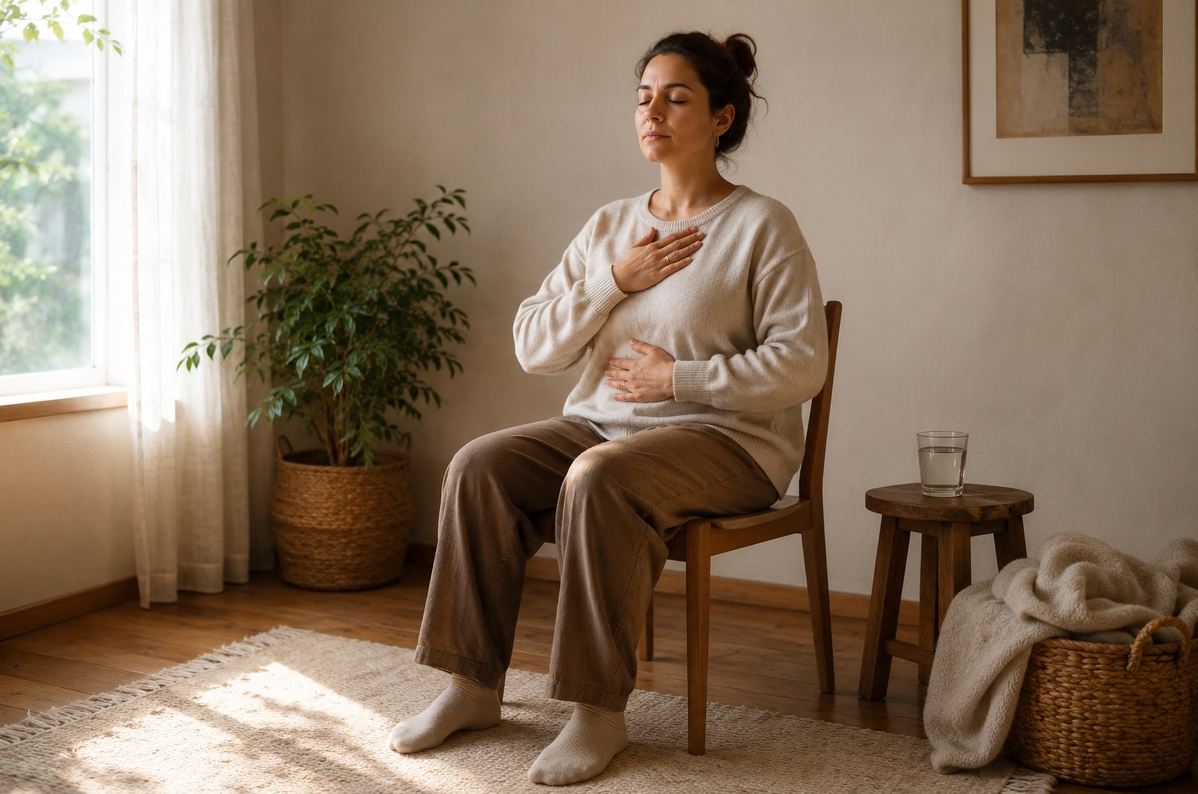
Creating a safe physical space does not require a dedicated meditation room. It requires attention to the cues the body reads. Lower the lights. Reduce noise. Remove unnecessary visual clutter. Adjust the temperature. Keep water nearby. Add a blanket, cushion or familiar object. Create a place where the body does not have to keep asking what comes next.
In polyvagal language, these conditions may support a shift toward social engagement and restoration, though polyvagal theory should be used carefully and not treated as settled doctrine. The practical point is simpler: the body settles more easily in an environment that feels predictable, warm, quiet and secure.
Consistency is a safety signal. The body learns that this place is reliable, and reliability is the foundation of regulation.
Consistency is a safety signal.
When These Methods Are Not Enough
These methods are useful, but they are not universal. Some nervous systems have been shaped by chronic stress, developmental trauma, acute trauma, disability, illness or medical conditions that make self-regulation difficult or impossible without professional support.
Breathwork can trigger panic. Grounding can feel futile. Warmth can feel suffocating. Silence can feel threatening. Stillness can intensify dissociation. These responses are not failures. They are information.
If somatic practices consistently produce distress, dissociation, panic, worsening symptoms or destabilisation, the nervous system may need support beyond self-practice. A trauma-informed therapist, somatic practitioner or medical professional can offer a container that solitary practice cannot always provide.
It is also important to distinguish between normal discomfort and harmful overwhelm. Some emotion, trembling or temporary unease may arise during somatic work. But if a practice leaves you destabilised for hours or days, it is too much. The window of tolerance must be respected.
Pushing beyond capacity is not spiritual courage. It can be retraumatisation wearing a heroic mask.
These responses are not failures. They are information.
From Somatic Safety to Contemplative Depth
The goal of somatic safety is not safety as a final destination. It is the opening of a window where deeper perception can occur.
A regulated nervous system is not the end of the path. It is the platform. From this platform, contemplative practice becomes more possible. Attention becomes steadier. Insight becomes more receivable. Gnosis becomes less abstract and more embodied.
This is the sequence: safety first, then depth. The body must know it is no longer under attack before it can become receptive to subtle perception. The breath must soften before the mind can quiet. The environment must stabilise before attention can expand.
The somatic practices in this article are not lesser than meditation or prayer. They are the foundation. A house built on a shaking foundation will not stand, no matter how beautiful its architecture. The body is the foundation. Regulation is the ground. Everything else is built upon it.
This is why this article follows The Somatic Cage. Once we recognise how survival biology blocks gnosis, the next question is practical: how does the body learn that the danger has passed?
Safety first, then depth.
The Body Learns Slowly
The nervous system does not change overnight. It learns through repetition, consistency and patience.
A single long exhale will not undo years of chronic stress. But repeated, gentle signals of safety can slowly reshape the baseline. The body learns slowly, but it learns.
De-escalating the amygdala is not a technique to master once and display like a certificate. It is a relationship to cultivate. The practitioner learns to speak the body’s language: breath, grounding, orientation, rhythm, warmth and environment. The body, gradually, learns to trust those signals.
The alarm recedes. The window opens. Through that window, something deeper becomes visible.
The body is not the enemy of awakening. It is the ground on which awakening must land. Safety is the first gate, and the gate is built into the flesh. The key is not force. It is patience, presence and the slow return of the body to itself.
The body stands down when it believes the room is safe.
Related Glossary Terms
These terms help place somatic safety within the wider ZenithEye map of embodiment, perception and direct knowing.
- Somatic Safety
- Amygdala
- Nervous System Regulation
- Extended Exhale
- Breathwork
- Grounding
- Orienting
- Window of Tolerance
- Fight-or-Flight
- Freeze Response
- Embodiment
- Spiritual Grounding
- Trauma-Informed Spirituality
- Direct Knowing
- Gnosis
- Recognition
- The Somatic Cage
- Spiritual Emergency
Read Next
Continue through the Biological Barrier series: from the body in survival mode, through somatic safety, into the return of reflective and intuitive knowing.
- The Somatic Cage: How Survival Biology Blocks Gnosis
- De-Escalating the Amygdala: The Mechanics of Somatic Safety
- Reclaiming the Cortex: Opening the Gateways of Direct Knowing
Further Reading
Articles from ZenithEye that continue the themes of breath, somatic grounding, spiritual emergency, embodiment and direct knowing:
- The Somatic Cage: How Survival Biology Blocks Gnosis – The first article in this series, establishing why the body must feel safe before insight can land.
- Breathwork: Ancient Technology, Modern Application for Altered States – A deeper exploration of respiratory physiology and breath as consciousness technology.
- The Gateway of Sensation – Body scan, sensation and somatic awareness as grounding practices.
- Nervous System Regulation – Embodied spirituality, autonomic regulation and the body as the ground of practice.
- Embodiment Practices – Grounding awakened experience through body, earth, movement and ordinary life.
- The Gateway of Movement – Walking meditation, circulation and rhythmic movement as embodied practice.
- Spiritual Emergency – When awakening becomes crisis and the nervous system needs containment.
- What Is Gnosis? – Direct knowing as recognition rather than belief alone.
Frequently Asked Questions
What does de-escalating the amygdala mean?
De-escalating the amygdala means helping the body move out of threat activation through signals of safety such as slower breathing, grounding, orienting, rhythm, warmth and a stable environment. It does not mean forcing calm or controlling the brain by willpower.
Why does reassurance not always calm the body?
Reassurance often fails because the nervous system is not persuaded by language alone. It also reads bodily and environmental cues: breath, muscle tension, temperature, sound, posture, light and whether the surroundings feel safe. If those cues still suggest danger, the body may remain on alert.
How does the extended exhale support nervous-system regulation?
A longer, gentle exhale can support parasympathetic settling for many people by slowing the breath and encouraging the body to stand down from immediate threat. It should not be forced, and it is not suitable for everyone.
What is sensory grounding?
Sensory grounding is the practice of returning attention to present sensory contact: feet on the floor, weight in the chair, objects in the room, sound, texture, light, temperature and breath. It helps attention return from threat rehearsal to the actual environment.
What is orienting to safety?
Orienting to safety means slowly looking around and allowing the nervous system to register where it actually is. Noticing exits, light, familiar objects and calm details can help the body update its threat map and recognise that the immediate environment may be safe.
Are breathwork and somatic practices safe for everyone?
No. Breathwork and somatic practices can be destabilising for some people, especially those with trauma, panic, dissociation, cardiovascular issues or spiritual emergency. The approach should be gentle, and anyone who becomes distressed should stop and seek appropriate support.
How does somatic safety support spiritual practice?
Somatic safety creates the bodily conditions in which deeper attention, reflection and direct knowing can become more available. It does not create gnosis by itself, but it helps remove the survival activation that can block receptive awareness.
References and Sources
The following sources support the neuroscientific, psychological and somatic framework used in this article.
Respiratory Physiology and Vagus Nerve
- Gerritsen, Roderik J. S., and Guido P. H. Band. “Breath of Life: The Respiratory Vagal Stimulation Model of Contemplative Activity.” Frontiers in Human Neuroscience, 2018.
- Zaccaro, Andrea, et al. “How Breath-Control Can Change Your Life: A Systematic Review on Psycho-Physiological Correlates of Slow Breathing.” Frontiers in Human Neuroscience, 2018.
- Grossman, Paul, and Edwin W. Taylor. “Toward Understanding Respiratory Sinus Arrhythmia: Relations to Cardiac Vagal Tone, Evolution and Biobehavioral Functions.” Biological Psychology, 2007.
Somatic Experiencing and Trauma
- Levine, Peter. Waking the Tiger: Healing Trauma. North Atlantic Books, 1997.
- Levine, Peter. In an Unspoken Voice: How the Body Releases Trauma and Restores Goodness. North Atlantic Books, 2010.
- van der Kolk, Bessel. The Body Keeps the Score: Brain, Mind, and Body in the Healing of Trauma. Viking, 2014.
- Siegel, Daniel J. The Developing Mind: How Relationships and the Brain Interact to Shape Who We Are. Guilford Press, 1999.
Autonomic Regulation and Embodiment
- Porges, Stephen W. The Polyvagal Theory: Neurophysiological Foundations of Emotions, Attachment, Communication, and Self-Regulation. W. W. Norton, 2011.
- Dana, Deb. The Polyvagal Theory in Therapy: Engaging the Rhythm of Regulation. W. W. Norton, 2018.
- Damasio, Antonio. The Feeling of What Happens: Body and Emotion in the Making of Consciousness. Harcourt, 1999.
- Research on grounding, sensory integration, interoception, thermoregulation, slow breathing and trauma-informed practice.
Safety Notice: This article discusses breathwork, somatic grounding, trauma responses and nervous-system regulation. It is not medical, psychological or psychiatric advice. If you experience severe anxiety, panic, dissociation, trauma symptoms, psychosis, mania, suicidal thoughts, spiritual emergency or difficulty functioning, seek support from a qualified mental health professional or appropriate medical service. Breathwork and altered-state practices can be destabilising for some people and should be approached carefully. Never practise breathwork while driving, in water or anywhere loss of awareness could be dangerous.
Study Note: Somatic safety is not the conquest of the body. It is the patient restoration of trust. Breath, grounding, warmth, rhythm and environment are not tricks for forcing transcendence. They are ordinary signals that help the nervous system recognise that the danger has passed, making deeper perception possible without bypassing the body.