Beyond the Physical: Understanding the Planes of Consciousness and Higher Dimensions
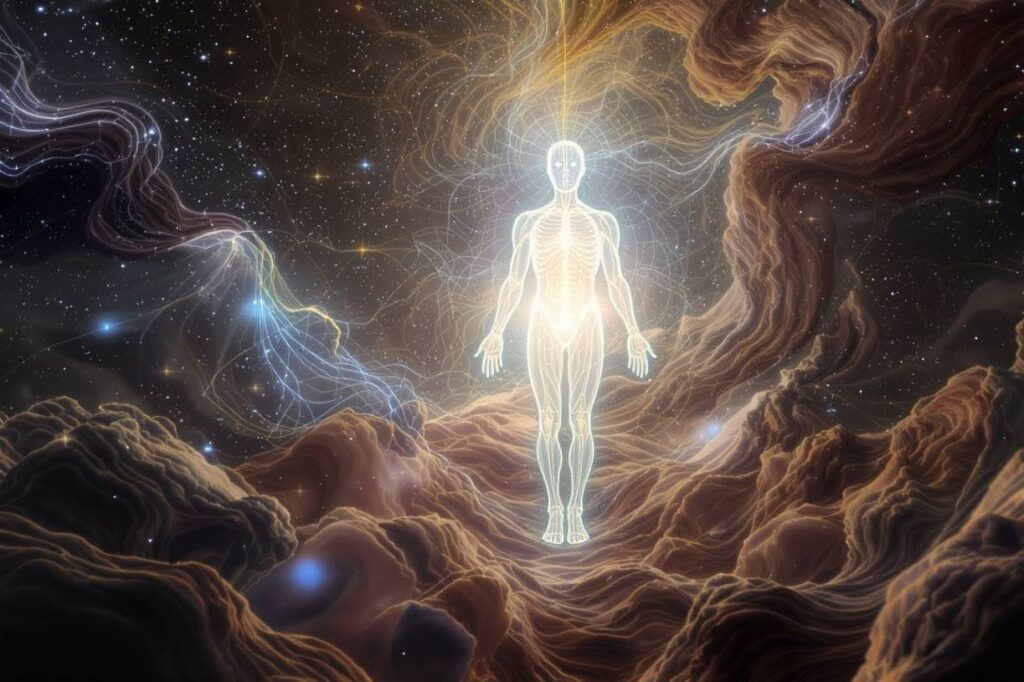
You are not merely physical, but that does not mean the physical can be skipped. The body is the anchor, the place where breath moves, sensation gathers, memory settles, and spiritual insight is tested by ordinary life. Esoteric traditions often describe human consciousness as extending through subtle bodies, planes, layers, or dimensions beyond the visible world. These maps can be powerful, but they must be read carefully: as symbolic, contemplative, and traditional models, not as laboratory-certified geography.
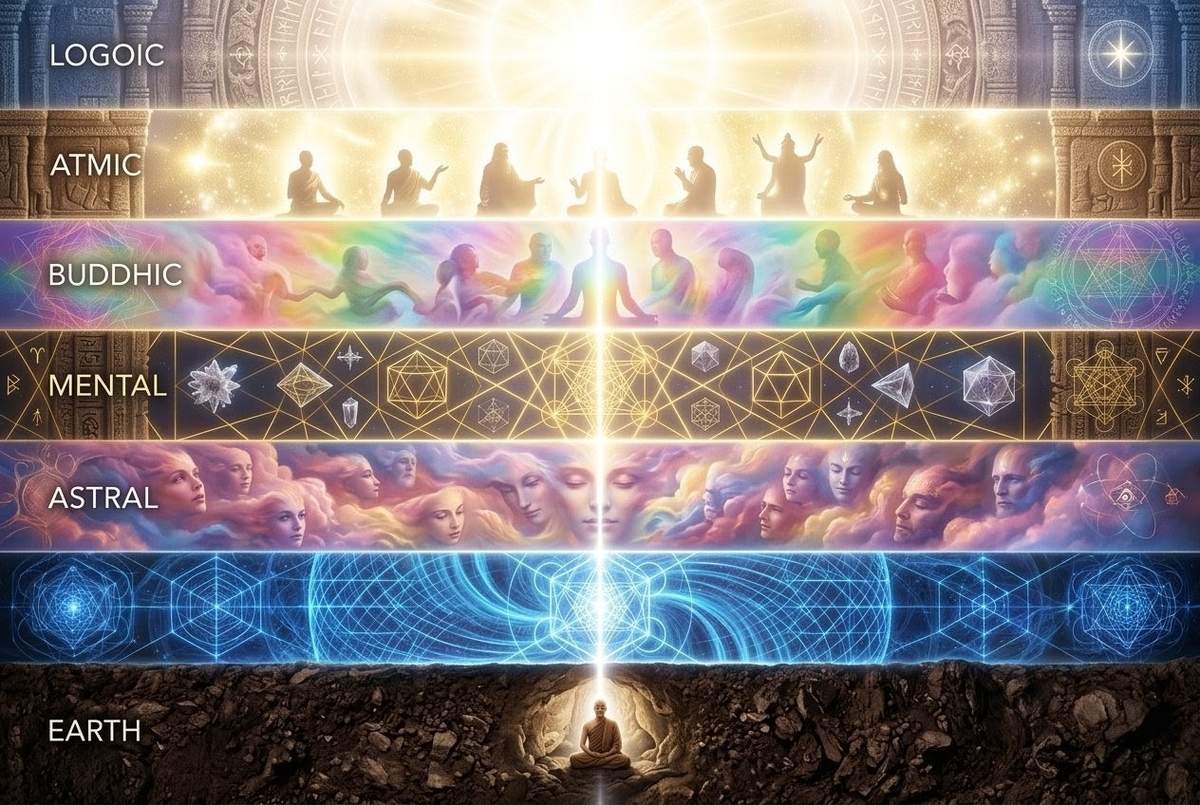
The planes of consciousness offer a way to speak about different modes of experience: physical embodiment, vital energy, emotion, dream, thought, intuition, spiritual will, and the mystery beyond ordinary comprehension. In Theosophy, these are often arranged as a sevenfold architecture. In other traditions, similar terrain appears through koshas, lokas, heavens, worlds, subtle bodies, bardos, spheres, sefirot, or levels of soul.
This article explores the physical, etheric, astral, mental, Buddhic, Atmic, and Logoic planes through Theosophy, comparative esotericism, altered states, dream practice, subtle-body language, near-death interpretation, and Gnostic discernment. The aim is not escape from Earth. The aim is integration: knowing the layers of experience without losing the body, the ground, or the thread of ordinary responsibility.
In Plain Terms
Planes of consciousness are traditional esoteric maps describing different layers of experience, from physical embodiment to subtle energy, emotion, thought, intuition, spiritual will, and transcendent being.
Higher dimensions in this article does not mean proven extra dimensions in physics. It means higher or subtler modes of consciousness in Theosophical, yogic, mystical, and esoteric language.
The safest reading is layered. The planes may be approached as spiritual realities, symbolic maps, altered-state descriptions, subtle-body models, psychological patterns, or contemplative teaching tools.
The goal is integration. Plane knowledge becomes useful only when it makes the reader more embodied, discerning, ethical, grounded, and awake in daily life.
Sources and Traditions Discussed
- Theosophy, especially H. P. Blavatsky, Annie Besant, and C. W. Leadbeater’s maps of planes, subtle bodies, astral experience, mental forms, and spiritual evolution.
- Yogic and Vedantic frameworks, including koshas, prana, subtle body, causal body, and levels of consciousness.
- Buddhist and Tibetan traditions, especially dream yoga, bardos, subtle perception, and the need to recognise projections without grasping them.
- Kabbalistic and Neoplatonic resonances, including worlds, emanation, ascent, and layered reality.
- Gnostic cosmology, especially ascent, rulers, heavens, false authorities, and the need for direct knowing rather than blind travel through subtle realms.
- Modern altered-state research, including lucid dreaming, near-death experience studies, dissociation cautions, and transpersonal psychology.
- Embodiment and integration practice, because subtle exploration without grounding can become inflation, avoidance, destabilisation, or spiritual theatre with better curtains.
How to Read This Article
This article uses traditional esoteric terms such as etheric body, astral plane, mental plane, causal body, Buddhic plane, Atmic will, subtle bodies, silver cord, thought-forms, and higher dimensions. These are not presented as settled scientific facts. They are part of esoteric, mystical, symbolic, and experiential traditions.
Read the article as a map of consciousness, not as an instruction to force altered states. Subtle-plane work can become destabilising when mixed with trauma, sleep deprivation, panic, dissociation, psychosis vulnerability, mania, obsessive spiritual seeking, or contempt for ordinary life.
The grounding test is simple: does the map make you more present, compassionate, clear, embodied, and responsible? If it makes you more inflated, frightened, dissociated, or detached from daily life, step back and return to breath, body, sleep, food, relationship, and ordinary human support.
The planes are not destinations to collect. They are layers of consciousness to recognise, integrate, and return from with greater clarity.
Table of Contents
- The Sevenfold Architecture: A Map of Consciousness
- From Blavatsky to Besant and Leadbeater
- The Physical Plane: Embodiment and Constraint
- The Etheric Plane: Vital Force and Subtle Body
- The Astral Plane: Emotion, Dream, and Desire
- The Mental Plane: Thought-Forms and Meaning
- The Buddhic Plane: Direct Knowing and Unity
- The Atmic Plane: Spiritual Will and Purpose
- The Logoic and Beyond: The Limits of Human Mapping
- The Subtle Bodies: Vehicles or Symbolic Layers?
- Karma, Reincarnation, and Between-Life Maps
- Navigating the Planes Without Losing the Ground
- Near-Death Experiences and Plane Interpretation
- The Gnostic Reading: Do Not Worship the Map
- Related Glossary Terms
- Read Next
- Frequently Asked Questions
- Further Reading
- References and Sources
The Sevenfold Architecture: A Map of Consciousness
Traditional esoteric philosophy often describes reality as layered. These layers may be called planes, worlds, heavens, bodies, dimensions, spheres, veils, or states. The language changes across traditions, but the intuition is repeated: ordinary waking consciousness is not the whole estate.
The sevenfold map used here comes especially through Theosophical literature. It arranges experience from dense physical embodiment through etheric vitality, astral emotion, mental form, Buddhic unity, Atmic will, and the Logoic mystery beyond ordinary cognition. The map is useful because it gives structure to experiences that otherwise become vague: dreams, intuitions, energy sensations, visionary states, altered perception, thought-forms, and the felt difference between ordinary mind and direct knowing.
Yet the map must remain a map. The planes should not be turned into a cosmic postcode system where every experience is stamped with false precision. One person’s astral dream may be another person’s symbolic memory. One practitioner’s etheric sensation may be nervous-system arousal. One vision may be spiritual, psychological, cultural, archetypal, neurological, or several at once. The mature reader does not panic when categories overlap. The psyche has always preferred stained glass to spreadsheet tabs.
The sevenfold structure is therefore best used as a disciplined imagination. It helps organise subtle experience while preserving humility about what can and cannot be proven.
From Blavatsky to Besant and Leadbeater
H. P. Blavatsky’s The Secret Doctrine presented a vast cosmological system rooted in Theosophy, Indian terminology, occult correspondences, and a nineteenth-century attempt to synthesise religion, philosophy, and hidden science. Her language of planes, principles, rounds, races, root systems, and cosmic evolution is complex, uneven, and often difficult for modern readers to untangle.
Annie Besant and C. W. Leadbeater later gave Western esoteric students a more teachable version of the planes, especially through texts on the astral plane, devachanic plane, subtle bodies, thought-forms, and clairvoyant perception. Their system became highly influential in modern Western esotericism, New Age spirituality, occult healing, aura language, and subtle-body teaching.
This article follows that later Theosophical synthesis while keeping its claims labelled. The physical, etheric, astral, mental, Buddhic, Atmic, and Logoic planes are not treated here as measurable strata in the scientific sense. They are treated as a historically important esoteric map that continues to shape modern language about subtle bodies and higher dimensions.
The map is powerful. It is also not the territory. That distinction is the small hinge on which the door of sanity swings.
The Physical Plane: Embodiment and Constraint
The physical plane is the realm of body, matter, time, weight, biological process, sensory experience, action, consequence, and ordinary survival. It is tempting for esoteric minds to treat this plane as the lowest and therefore least important. That is a mistake. The physical is dense, but density is not inferiority. Density is commitment.
The physical body gives consciousness resistance. It makes the invisible accountable. A person may have radiant visions, but the body still asks whether they can sleep, eat, work, speak truthfully, repair harm, respect boundaries, and remain kind under pressure. The physical plane tests every subtle claim by consequence.
In Theosophical language, the physical plane includes both dense matter and subtler etheric levels. In practical terms, this means physical experience is not merely “gross matter” but includes vitality, health, breath, nervous-system tone, and subtle sensation. The bridge from body to energy begins here.
For Gnostic readers, the physical plane should not be rejected too quickly. Many Gnostic myths are suspicious of the lower world, but the deeper danger is not embodiment itself. The danger is forgetfulness. The body can become a prison when ruled by ignorance, compulsion, and false identity. It can also become the field where recognition is grounded.
The Etheric Plane: Vital Force and Subtle Body
The etheric plane, in Theosophical and related esoteric systems, is the subtle vitality layer that interpenetrates and supports the physical body. It is associated with life force, prana, qi, vitality, aura, subtle channels, and energetic sensitivity. Some traditions describe it as the etheric double: a finer body closely linked to physical form.
It is important not to overclaim. The etheric body is not currently established by mainstream science as a measurable anatomical structure. Biophoton emissions, electromagnetic activity, fascia, nervous-system signalling, and biofield research may be interesting areas of conversation, but they do not prove the Theosophical etheric body as traditionally described. Better to say this: many practitioners experience the body as a field of sensation and vitality that exceeds ordinary anatomical awareness.
That field may be explored through breathwork, qigong, yoga, body scanning, somatic awareness, movement, chanting, touch, stillness, and attention. Whether one interprets the experience as prana, nervous-system regulation, interoception, subtle energy, or contemplative sensitivity, the practical lesson remains: the body becomes more readable when attention settles into it.
Prana and the Etheric Double
Theosophical writers often used terms such as linga sharira, etheric double, prana, and subtle body to describe a life-field that organises physical vitality. Yogic traditions have their own complex language of prana, nadis, chakras, koshas, and subtle anatomy. Chinese traditions speak differently again through qi, meridians, dantian, and organ-energy systems.
These systems should not be collapsed into one bland “energy” soup. Each belongs to a different tradition. Still, they converge around a useful practice insight: vitality can be felt, cultivated, depleted, disturbed, and restored. The body is not only meat and mechanics. It is also rhythm, charge, breath, posture, warmth, attention, and relationship with environment.
For subtle-plane work, the etheric layer is the foundation. A person who is exhausted, dissociated, sleep-deprived, ungrounded, or physically unwell may not need more astral travel. They may need food, rest, breath, sunlight, safe movement, medical care, and ordinary steadiness. The gate to higher worlds often looks suspiciously like a glass of water and a reasonable bedtime.

The Astral Plane: Emotion, Dream, and Desire
The astral plane is one of the most influential and misunderstood ideas in modern esotericism. In Theosophical language, it is the plane of emotion, desire, image, dream, psychic impression, recently departed souls, and subtle beings. In practical experience, “astral” often refers to the dreamlike, symbolic, emotionally charged layer of consciousness where inner states appear as landscapes, figures, weather, and encounters.
It is tempting to speak of the astral plane as a literal geography with fixed districts, permanent inhabitants, and reliable road signs. Some traditions do speak that way. But the safer reading is more flexible: the astral may be experienced as a subtle realm, a dream field, an imaginal environment, a psychic theatre, a symbolic ecology, or an altered-state interface between personal emotion and collective imagery.
The Ecology of Desire
The astral layer is shaped by emotion. Fear, longing, shame, desire, grief, rage, devotion, and wonder all colour perception. This is why astral language often includes beings and presences: guides, parasites, elementals, thought-forms, ancestors, dream figures, beloved dead, and counterfeit authorities. Some may be read literally. Some may be read psychologically. Some may be both, depending on the reader’s worldview and experience.
The practical rule is not to believe everything that appears. Dreamlike intensity can feel more real than waking life, but intensity is not proof. A presence that appears radiant may still inflate the seeker. A frightening image may be a protective threshold. A guide may be helpful, symbolic, deceptive, or simply a form taken by the psyche so it can speak to itself.
Emotional clarity is therefore the first protection. A person entering subtle work while full of fear, desperation, grandiosity, or hunger may find exactly those forces reflected back with masks on. The astral mirror is generous, but not always kind.
Lucid Dreaming as Conscious Navigation
Lucid dreaming gives a safer and more accessible doorway into astral-style experience. In lucid dreaming, the dreamer recognises the dream while it is happening. This recognition changes the relationship to the experience. The dream is no longer merely endured. It can be observed, questioned, stabilised, explored, or allowed to reveal its deeper pattern.
Lucidity does not automatically create wisdom. A lucid dreamer can still be reckless, inflated, fearful, or distracted. But lucidity trains a key capacity: recognition inside a shifting world. That is the beginning of subtle-plane discernment.
For readers prone to nightmares, trauma activation, sleep paralysis, dissociation, or panic, dream practice should be gentle. The aim is not to conquer the night. It is to become more awake without losing the body’s sense of safety.


The Mental Plane: Thought-Forms and Meaning
The mental plane is the realm of thought, meaning, abstraction, pattern, symbolic structure, belief, and concept. In Theosophical language, thoughts can become forms. They are not merely private sparks inside the skull, but subtle structures that gather force through attention, emotion, repetition, and collective belief.
Again, the language needs care. To say that thought-forms exist is not the same as proving that every physical object began as a literal mental-plane template. It is safer and still powerful to say that ideas shape reality through attention, behaviour, culture, habit, institutions, architecture, law, technology, and imagination. A nation, money system, religion, ideology, brand, school, empire, or social identity begins as a mental form before becoming physical organisation.
Thought-Forms and Autonomous Constructs
A thought-form may be understood as an idea that has acquired persistence. Individually, this might be a repeated belief: “I am unsafe”, “I must perform”, “I am chosen”, “I am unworthy”, “I must obey”, or “I cannot trust my own knowing”. Collectively, thought-forms become larger: nationalism, racial hierarchy, religious dogma, consumer identity, market logic, technological inevitability, or spiritual superiority.
These constructs can behave almost like entities because they recruit attention, shape perception, demand sacrifice, defend themselves, and reproduce through human speech and behaviour. The person thinks they are thinking, when in fact an inherited structure is thinking through them. The mental plane, read this way, becomes the workshop where liberation or captivity is designed.
Mental Discipline
The mental plane is clarified through concentration, study, contemplative inquiry, symbolic literacy, meditation, and the capacity to see thought as thought. This is not suppression. It is de-identification. The practitioner learns to recognise an idea without becoming possessed by it.
On this plane, discernment means asking: who benefits from this belief? What emotion feeds it? What behaviour does it demand? Does it open perception or narrow it? Does it make me more truthful, or merely more certain?

The Buddhic Plane: Direct Knowing and Unity
The Buddhic plane, in Theosophical language, is the level of unity, intuition, direct knowing, compassion, and non-separate awareness. The word should not be confused too quickly with Buddhism as a whole. Theosophy borrowed and reworked many terms from Indian and Buddhist contexts, often in ways that do not match traditional usage precisely.
As a contemplative category, the Buddhic plane points towards a shift beyond ordinary conceptual mind. Instead of thinking about unity, the practitioner may experience a temporary or enduring loosening of separation. Self and other feel less divided. Compassion appears not as moral effort, but as recognition. The world is no longer only a collection of objects outside the observer.
Intuition as Direct Perception
True intuition is not a decorative name for impulse. It is not anxiety with incense around it. It is a form of knowing that arrives quietly, cleanly, and often without the drama that ego expects. It may be felt as immediate recognition rather than argument.
Still, intuition requires testing. Trauma can sound like intuition. Fear can wear the mask of prophecy. Desire can call itself destiny. The Buddhic plane is therefore not accessed by believing every inner certainty. It is approached through purification of motive, emotional clarity, humility, and the willingness to be wrong.
Compassion Without Sentimentality
At the Buddhic level, compassion is not softness alone. It is the perception that another being’s suffering is not finally separate from one’s own field of life. This does not erase boundaries. Real unity does not mean becoming porous to every demand. It means care becomes less performative and more accurate.
Good Buddhic contact should therefore make a person more humane, not more vague. If a unity experience produces contempt for ordinary people, the experience has probably been captured by inflation before reaching the ground.

The Atmic Plane: Spiritual Will and Purpose
The Atmic plane is described in Theosophy as the plane of spiritual will. It is not ordinary wanting, ambition, preference, or personal agenda. It points towards a deeper current of purpose: the alignment of individual life with a wider movement of truth, service, and evolutionary necessity.
This language can be luminous, but it can also become dangerous. “Divine will” is easily misused by people who want their desire to sound cosmic. The Atmic plane should never be invoked to override conscience, consent, humility, or practical reality. A person claiming divine purpose while neglecting ethics has not reached a higher plane. They have found a nicer balcony for ego.
Spiritual Will
Spiritual will is quieter than personal ambition. It does not need constant announcement. It appears as direction, integrity, steadiness, and the capacity to act without being driven by fear or vanity. It may feel less like “I want this” and more like “this is what must be served”.
In this sense, the Atmic plane represents vocation in its deepest form. Not career branding, not social role, not spiritual importance, but the alignment of being and action. The person becomes less divided between insight and behaviour.
Masters, Guides, and the Risk of Projection
Theosophical and esoteric traditions often associate higher planes with masters, guides, adepts, bodhisattvas, saints, hidden teachers, or realised beings. Some practitioners read these literally. Others read them as archetypal forms of wisdom, lineage memory, imaginal teachers, or inner functions of guidance.
Either way, the same discernment applies. A true guide strengthens the seeker’s direct knowing. A false guide creates dependency, fear, superiority, secrecy, or obedience. Guidance that cannot be questioned is not guidance. It is administration wearing light.
The Logoic and Beyond: The Limits of Human Mapping
The Logoic plane, in Theosophical language, points beyond ordinary human comprehension towards the source principles from which manifestation arises. Words become fragile here. Logos, divine mind, cosmic reason, source, Pleroma, pure being, and primordial fullness all gesture towards something the mind cannot contain.
The danger at this level is false precision. The more remote a plane is from ordinary experience, the easier it is to make confident declarations that cannot be tested. A little apophatic humility is useful. Some things may be approached only by silence, symbol, prayer, or direct contemplative recognition.
A mature map knows where it ends. The highest plane is not the place where the ego gets better vocabulary. It is where vocabulary begins to bow.
The Subtle Bodies: Vehicles or Symbolic Layers?
Just as the planes describe layers of reality or consciousness, subtle-body systems describe the vehicles through which those layers are experienced. Theosophy speaks of physical, etheric, astral, mental, causal, Buddhic, and Atmic bodies. Vedantic systems speak of koshas, or sheaths. Yogic traditions speak of subtle anatomy. Other traditions describe soul parts, dream bodies, light bodies, resurrection bodies, or spiritual forms.
These terms can be read literally, symbolically, or phenomenologically. Literally, they are bodies operating in subtle dimensions. Symbolically, they describe the different ways experience organises itself. Phenomenologically, they name the felt difference between physical sensation, emotional image, mental form, intuitive unity, and spiritual purpose.
Vehicles for Each Plane
The Etheric Body is the vitality layer, associated with prana, qi, subtle sensation, aura, and bodily energy. It is closely linked to physical health and embodied presence.
The Astral Body is the dream-emotional body, associated with feeling, desire, image, projection, and the kinds of experiences reported in dreams, visions, and astral projection traditions.
The Mental Body is the thought body, the organising structure of concepts, belief, attention, symbolic imagination, and mental patterning.
The Causal Body is often described as the enduring soul-vehicle or seed-body, carrying the distilled essence of experience, wisdom, and karmic pattern across incarnations in traditions that teach rebirth.
The Buddhic Body is the vehicle of unity and direct knowing, associated with compassion, intuition, and non-separate awareness.
The Atmic Body is the vehicle of spiritual will, associated with purpose, alignment, and the expression of higher direction through individual life.
The Silver Cord
The silver cord is a traditional image for the link between physical body and subtle body, especially during sleep, astral projection, or the death process. The phrase is often connected to Ecclesiastes 12:6, where the silver cord is mentioned in a poetic meditation on mortality.
Theosophical and occult writers developed this image into a more technical idea: a subtle thread that connects the physical and astral vehicles until death. This is not something established by current scientific instrumentation. It is best handled as a traditional esoteric image for continuity between body and consciousness during altered states.
As symbol, it remains useful. The silver cord says: do not pretend subtle exploration floats free of the body. Every journey is tethered to embodiment until it is not.
Karma, Reincarnation, and Between-Life Maps
Many traditions use planes or subtle worlds to explain karma, death, rebirth, ancestral memory, and between-life states. In Theosophy, the soul passes through astral and mental conditions after death, sheds lower vehicles, and carries distilled experience through the causal body into future incarnation. In Buddhist, Hindu, Platonic, Gnostic, and esoteric systems, the details differ considerably.
Karma should not be flattened into punishment. In many traditional contexts, it is a law of action and consequence, habit and result, intention and pattern. Reincarnation is likewise interpreted differently across traditions: as learning, bondage, purification, repetition, opportunity, illusion, divine pedagogy, or a problem to be escaped.
The Between-Life Sojourn
Theosophical writers often describe the period between lives as a process of withdrawal through the planes. The physical body dies. The etheric and astral layers dissolve or transform. The mental and causal layers carry forward the essence of experience. The soul rests, reviews, assimilates, and eventually returns under karmic conditions.
This is a meaningful esoteric model, but it should not be presented as proven afterlife mechanics. It is one map among many. Tibetan Buddhism, classical Hinduism, Platonism, Spiritualism, Gnostic ascent texts, Christian mysticism, and modern near-death literature all describe different post-mortem landscapes. Their overlap is interesting. Their differences matter.
The practical lesson is this: what is not integrated in life may continue as pattern. Whether one believes in literal rebirth or not, the same unfinished reactions return again and again. Fear reincarnates in the morning. Desire reincarnates in the next decision. Shame reincarnates in the next relationship. Liberation begins by interrupting repetition while alive.
Navigating the Planes Without Losing the Ground
The planes are not distant planets requiring heroic travel. They are modes of consciousness that may open through meditation, sleep, prayer, breathwork, grief, ritual, illness, near-death states, contemplation, solitude, music, trauma, or spontaneous spiritual emergence. That is precisely why care is needed. Not every opening is stable. Not every expansion is liberating.
Meditation as Plane-Work
Different practices emphasise different layers:
- Etheric practices: breath awareness, pranayama, qigong, body scan, grounding, walking, and gentle energy circulation.
- Astral practices: dream journalling, lucid dreaming, devotional meditation, emotional integration, symbolic imagination, and careful work with images.
- Mental practices: concentration, contemplative inquiry, study, visualisation, mantra meaning, symbolic analysis, and attention training.
- Buddhic practices: compassion practice, nondual meditation, self-inquiry, contemplative silence, and direct recognition.
- Atmic practices: vow, service, surrender, ethical alignment, vocation, prayer, and the daily discipline of living what has been recognised.
The order matters less than the stability. Breath and body should not be skipped. Emotional material should not be bypassed. Mental clarity should not be confused with wisdom. Unity should not be used to deny boundaries. Spiritual will should not be used to inflate personal desire.
A Grounding Protocol for Subtle Work
Before or after any strong subtle-state practice, keep the basics close:
- Feel the feet, hands, and contact with the chair or floor.
- Open the eyes and orient to the room.
- Name the date, place, and ordinary task waiting after practice.
- Eat, drink water, walk, or do a simple physical action.
- Avoid interpreting every sensation immediately.
- Speak with a grounded person if practice becomes intense or strange.
The aim is not to shut down subtle perception. It is to give perception a body to return to. Without return, exploration becomes drift.
Near-Death Experiences and Plane Interpretation
Near-death experiences are often used to support plane models because many accounts include out-of-body perception, tunnels, light, deceased relatives, guides, life review, landscapes, expanded love, and reluctance or instruction to return. These accounts deserve careful attention. They should not be squeezed into one theory too quickly.
From a Theosophical perspective, an NDE might be interpreted as withdrawal from physical focus into etheric, astral, mental, or higher-plane awareness. The tunnel may be read as transition. The life review may be read as mental-plane record. Beings of light may be read as Buddhic or Atmic presences.
Other interpretations exist. Medical, neurological, psychological, spiritual, cultural, and religious frameworks all offer different explanations. The wisest approach is not to force NDEs to prove one map. Instead, ask what the experiences consistently reveal: consciousness may not be as narrow as ordinary materialism assumes; the death process may involve perception and meaning; and love, review, memory, fear, judgement, and return remain central human themes.
For Gnostic readers, the key remains discernment. A luminous experience may be profound. It may also require interpretation. Light is not exempt from testing simply because it is beautiful.
The Gnostic Reading: Do Not Worship the Map
Gnostic traditions are full of layered worlds, rulers, heavens, powers, gates, ascent, passwords, seals, luminous realms, false authorities, and hidden knowledge. At first glance, this seems close to plane theory. The soul moves through levels. Powers guard thresholds. Knowledge liberates. Ascent requires discernment.
Yet the Gnostic warning is sharp: do not confuse the map with liberation. Passing through realms is not the same as knowing the Source. Seeing lights is not the same as gnosis. Meeting beings is not the same as freedom. A ruler on a subtle plane may still be a ruler. A voice in the heavens may still demand false consent.
This is where plane knowledge becomes spiritually dangerous or spiritually useful. Dangerous, when it turns into hierarchy, status, obsession, escape, superiority, or fear. Useful, when it helps the seeker recognise patterns of consciousness without being captured by them.
The Gnostic path asks for direct knowing. Not blind acceptance of matter, but not blind acceptance of subtle realms either. The archonic pattern can appear in physical institutions, astral visions, mental ideologies, spiritual hierarchies, and even refined language about higher planes. Anything that demands unconscious submission must be tested.
The true ascent is not a tour of invisible floors. It is the recovery of the divine spark from every layer that claims to define it.
Related Glossary Terms
For quick definitions, use the main ZenithEye Glossary. The key terms for this article are:
Read Next
Continue with: The Mental Plane Explained: Where Thoughts Become Reality
If this article maps the wider architecture of planes and subtle bodies, the next step is the mental layer itself: thought-forms, collective belief, symbolic structures, and the way ideas become realities people live inside.
Within States of Knowing
This article belongs to Aethyric Navigation & Altered States, the States of Knowing layer where dreams, subtle bodies, higher dimensions, visionary perception, and altered consciousness are read with discernment and grounded integration.
Frequently Asked Questions About the Planes of Consciousness
What are the planes of consciousness?
Planes of consciousness are traditional esoteric maps describing different layers of experience, such as physical embodiment, vital energy, emotion, dream, thought, intuition, spiritual will, and transcendent being. In Theosophy, these are often arranged as physical, etheric, astral, mental, Buddhic, Atmic, and Logoic planes.
Are higher dimensions the same as dimensions in physics?
No. In this article, higher dimensions refers to esoteric and contemplative levels of consciousness, not proven extra spatial dimensions in physics. The language is symbolic, traditional, and experiential rather than a scientific claim about measurable physical dimensions.
What is the difference between the etheric and astral planes?
The etheric plane is associated with vitality, prana, qi, subtle sensation, and the energy body close to physical embodiment. The astral plane is associated with emotion, desire, dream, image, and visionary experience. In simple terms, etheric relates to life force and bodily energy; astral relates to the dream-emotional field.
Is the astral plane dangerous?
Astral-style work can be destabilising if approached with fear, trauma activation, obsession, sleep deprivation, or lack of grounding. It should not be treated as a playground or proof of spiritual status. Safer practice begins with body awareness, emotional integration, discernment, and the ability to stop when experience becomes overwhelming.
What is the mental plane?
The mental plane is the layer of thought, concept, symbolic structure, belief, and meaning. In Theosophy, thoughts may form subtle structures called thought-forms. Psychologically and culturally, this points to the way ideas shape perception, behaviour, institutions, identities, and lived reality.
What is the silver cord?
The silver cord is a traditional esoteric image for the link between the physical body and subtle body during sleep, astral projection, or death. It is associated with Ecclesiastes 12:6 and later occult teachings. It should be read as a traditional symbolic and esoteric idea, not as something established by current scientific instrumentation.
How do near-death experiences relate to plane theory?
Some esoteric systems interpret near-death experiences as temporary movement through etheric, astral, mental, or higher planes. Features such as light, tunnels, life review, and encounters with beings may be read through this map. Other medical, psychological, religious, and cultural interpretations also exist, so NDEs should not be forced to prove one model.
What is the safest way to work with plane knowledge?
Use plane knowledge as a map, not an obsession. Stay grounded in breath, body, sleep, food, relationships, work, ethics, and ordinary life. If subtle-state material produces panic, dissociation, paranoia, insomnia, grandiosity, despair, or loss of function, pause the practice and seek qualified support.
Study and Safety Note
This article explores planes of consciousness, higher dimensions, subtle bodies, astral experience, Theosophy, altered states, near-death interpretation, and Gnostic discernment for educational and reflective purposes. It does not provide medical, psychological, psychiatric, occult-training, astral-projection, or spiritual-direction advice.
Do not intensify subtle-plane practices if you are experiencing panic, mania, psychosis, severe dissociation, derealisation, depersonalisation, paranoia, trauma flashbacks, sleep deprivation, frightening voices, command experiences, suicidal thoughts, or difficulty functioning. Prioritise grounding, rest, food, ordinary human support, and qualified care where needed.
Plane knowledge should make life more integrated, not less. The body, relationships, work, ethics, and daily responsibilities are not lower distractions from the path. They are the place where any higher insight proves whether it has truly arrived.
Further Reading
These ZenithEye links continue the themes of planes, altered states, subtle bodies, dream practice, grounding, and multidimensional consciousness:
- The Mental Plane Explained: Where Thoughts Become Reality – A deeper guide to thought-forms, mental structures, manifestation language, and collective belief.
- States of Knowing: What Happens When Consciousness No Longer Belongs to You – Altered states, shifting identity, and the challenge of integrating expanded perception.
- The Transformation: What Actually Changes After Mystical Experience – What happens after breakthrough, when subtle experience must return to ordinary life.
- Embodiment Practices: Grounding the Awakened Body – Essential somatic grounding for stabilising subtle or mystical experience.
- Lucid Dreaming Practice and Tibetan Milam – Dream yoga, lucid recognition, and conscious navigation of dreamlike states.
- Hypnagogia: The Threshold State Between Waking and Sleep – The liminal state where physical, dream, and imaginal perception begin to overlap.
- Kundalini Phenomena: The Physiology of Spiritual Emergence – Energetic activation, subtle-body intensity, and the need for nervous-system safety.
- Breathwork: Ancient Technology, Modern Application – Breath as a bridge between body, energy, state, and altered consciousness.
- The Five Gateways to Direct Knowing – Breath, sensation, sound, vision, and movement as practical entrances into direct experience.
- The Gnostic Theory of Consciousness: A Psychological Analysis – Consciousness read through Gnostic psychology, false identity, and direct recognition.
- Benevolent or Neutral Entities – A careful map of guides, presences, ancestors, angels, nature spirits, and neutral intelligences.
- Negative Entities and Their Hunting Grounds – The necessary contrast: predatory patterns, fear, folklore, sleep paralysis, and destabilising contact.
- Integration and Grounding: 7 Keys to Mystical Experience – Practical stabilisation after altered states, visionary contact, or spiritual emergence.
References and Sources
The following sources support the historical, esoteric, comparative, psychological, and safety framework used in this article.
Primary Theosophical and Esoteric Sources
- Blavatsky, H. P. The Secret Doctrine. Theosophical Publishing House, 1888.
- Blavatsky, H. P. The Key to Theosophy. Theosophical Publishing House, 1889.
- Besant, Annie. The Ancient Wisdom. Theosophical Publishing House, 1897.
- Besant, Annie. Man and His Bodies. Theosophical Publishing House, 1896.
- Leadbeater, C. W. The Astral Plane: Its Scenery, Inhabitants and Phenomena. Theosophical Publishing House, 1895.
- Leadbeater, C. W. The Devachanic Plane. Theosophical Publishing House, 1896.
- Leadbeater, C. W. Man Visible and Invisible. Theosophical Publishing House, 1902.
- Leadbeater, C. W. and Besant, Annie. Thought-Forms. Theosophical Publishing House, 1901.
- Powell, Arthur E. The Etheric Double. Theosophical Publishing House, 1925.
- Powell, Arthur E. The Astral Body. Theosophical Publishing House, 1927.
- Powell, Arthur E. The Mental Body. Theosophical Publishing House, 1927.
- Powell, Arthur E. The Causal Body and the Ego. Theosophical Publishing House, 1928.
Comparative Mysticism, Yoga, and Subtle Body
- Flood, Gavin. An Introduction to Hinduism. Cambridge University Press, 1996.
- Feuerstein, Georg. The Yoga Tradition: Its History, Literature, Philosophy and Practice. Hohm Press, 1998.
- Eliade, Mircea. Yoga: Immortality and Freedom. Princeton University Press, 1958.
- Samuel, Geoffrey. The Origins of Yoga and Tantra. Cambridge University Press, 2008.
- Mallinson, James and Singleton, Mark. Roots of Yoga. Penguin Classics, 2017.
- Avalon, Arthur, Sir John Woodroffe. The Serpent Power. Luzac, 1919.
- Gethin, Rupert. The Foundations of Buddhism. Oxford University Press, 1998.
- Gyatso, Tenzin, the 14th Dalai Lama. Sleeping, Dreaming, and Dying: An Exploration of Consciousness. Wisdom Publications, 1997.
- Norbu, Namkhai. Dream Yoga and the Practice of Natural Light. Snow Lion, 1992.
Gnostic, Hermetic, and Ascent Context
- Robinson, James M. (ed.). The Nag Hammadi Library in English. Revised edition. HarperOne, 1990.
- Meyer, Marvin (ed.). The Nag Hammadi Scriptures. HarperOne, 2007.
- Layton, Bentley. The Gnostic Scriptures. Yale University Press, 1987.
- Brakke, David. The Gnostics: Myth, Ritual, and Diversity in Early Christianity. Harvard University Press, 2010.
- King, Karen L. What Is Gnosticism?. Harvard University Press, 2003.
- Copenhaver, Brian P. Hermetica: The Greek Corpus Hermeticum and the Latin Asclepius. Cambridge University Press, 1992.
- Dodds, E. R. The Greeks and the Irrational. University of California Press, 1951.
- Plotinus. The Enneads. Various translations.
Near-Death Experience, Altered States, and Transpersonal Psychology
- Moody, Raymond. Life After Life. Mockingbird Books, 1975.
- Greyson, Bruce. After: A Doctor Explores What Near-Death Experiences Reveal About Life and Beyond. St. Martin’s Essentials, 2021.
- Ring, Kenneth. Heading Toward Omega. William Morrow, 1984.
- Grof, Stanislav and Grof, Christina. Spiritual Emergency: When Personal Transformation Becomes a Crisis. Tarcher, 1989.
- Grof, Stanislav. Realms of the Human Unconscious. Viking, 1975.
- Tart, Charles T. Altered States of Consciousness. Wiley, 1969.
- Walsh, Roger and Vaughan, Frances. Paths Beyond Ego: The Transpersonal Vision. Tarcher, 1993.
- Lindahl, Jared R., et al. “The Varieties of Contemplative Experience: A Mixed-Methods Study of Meditation-Related Challenges in Western Buddhists.” PLOS ONE, 12(5), 2017.
Embodiment, Trauma, and Safety
- van der Kolk, Bessel. The Body Keeps the Score: Brain, Mind, and Body in the Healing of Trauma. Viking, 2014.
- Treleaven, David A. Trauma-Sensitive Mindfulness: Practices for Safe and Transformative Healing. W. W. Norton, 2018.
- Ogden, Pat, Minton, Kekuni, and Pain, Clare. Trauma and the Body: A Sensorimotor Approach to Psychotherapy. W. W. Norton, 2006.
- Porges, Stephen W. The Polyvagal Theory: Neurophysiological Foundations of Emotions, Attachment, Communication, and Self-Regulation. W. W. Norton, 2011.
- Mehling, Wolf E., et al. “Body Awareness: A Phenomenological Inquiry into the Common Ground of Mind-Body Therapies.” Philosophy, Ethics, and Humanities in Medicine, 6, 6, 2011.
- Masters, Robert Augustus. Spiritual Bypassing: When Spirituality Disconnects Us from What Really Matters. North Atlantic Books, 2010.
- Kornfield, Jack. After the Ecstasy, the Laundry. Bantam, 2000.