Benevolent or Neutral Entities
Benevolent or neutral entities occupy the lighter, stranger, and more ambiguous side of the spiritual ecosystem. Across religious traditions, folklore, shamanic practice, angelology, Theosophy, ancestor veneration, nature religion, contactee literature, and visionary experience, human beings have reported presences that guide, protect, warn, illuminate, teach, or simply exist alongside us without obvious hostility.
This article does not ask the reader to accept every category as literal in the same way. Angels, devas, ancestors, animal guides, ascended masters, star beings, and elementals belong to different traditions, different symbolic worlds, and different standards of evidence. Some readers approach them as real intelligences. Others read them as archetypes, psychic structures, imaginal beings, ritual forms, ancestral memory, ecological relationship, or altered-state experience.
The wiser question is not simply “do they exist?” but “what kind of contact produces clarity, sovereignty, compassion, embodiment, discernment, and ethical action?” A true guide does not make you smaller. A neutral being does not owe you intimacy. A deceptive presence may flatter before it feeds. The gateway here is not blind belief. It is discernment.

In Plain Terms
Benevolent entities are presences, beings, figures, or intelligences traditionally understood as helpful, protective, illuminating, or guiding.
Neutral entities are not necessarily loving or hostile. They may belong to nature, place, ancestry, symbolic realms, planetary forces, dream states, or other layers of experience. Neutral does not mean safe to command. It means not automatically predatory.
Discernment is essential. Helpful contact should increase steadiness, humility, compassion, responsibility, and embodied clarity. Contact that produces fear, dependency, grandiosity, exhaustion, isolation, compulsion, or loss of ordinary functioning needs careful grounding and, where needed, qualified support.
Sources and Traditions Discussed
- Jewish, Christian, and Islamic angelology, especially messengers, archangels, protective beings, celestial hierarchies, and divine intermediaries.
- Late antique and medieval esoteric traditions, including planetary intelligences, Enochian angelic systems, ritual caution, and the need for purification and discernment.
- Hindu, Buddhist, and Jain traditions, including devas, bodhisattvas, siddhas, rishis, yakshas, nagas, and other non-human beings in layered cosmologies.
- Zoroastrian and ancestral traditions, especially fravashi, ancestor veneration, lineage memory, and the relationship between the living and the dead.
- Theosophy and modern esotericism, including ascended masters, the “Great White Brotherhood” as a light-based term in that tradition, and the problems of modern projection.
- Nature-spirit and elemental traditions, including devas, elementals, land spirits, folklore beings, and ecological relationship.
- Animal totem and animal-guide language, approached carefully because many modern uses borrow from Indigenous frameworks without proper context.
- Gnostic discernment, especially the need to distinguish liberating guidance from archonic imitation, psychic inflation, dependency, fear, and spiritual bypass.
How to Read This Article
This article uses entity language as a layered map. A being may be read literally, symbolically, psychologically, ritually, culturally, mythically, or imaginally. These layers do not have to cancel each other. They give different ways of asking what kind of experience is occurring and what it produces in the life of the seeker.
Do not use entity work to avoid medical care, mental health support, grief work, trauma recovery, ordinary responsibility, or ethical repair. If contact experiences include voices commanding harm, severe fear, paranoia, mania, sleep deprivation, dissociation, loss of function, or suicidal thoughts, pause spiritual interpretation and seek qualified support.
The safest rule is simple: any guidance worth trusting should make you more whole, not more dependent; more grounded, not more theatrical; more compassionate, not more grandiose; more sovereign, not more controllable.
The highest guide does not replace your discernment. It teaches your discernment to stand upright.
Table of Contents
- Why Neutral Matters
- 1. Angelic Orders and Messenger Beings
- 2. Ascended Masters, Siddhas, Bodhisattvas, and Wise Ancestors
- 3. Star Nations and Contactee Cosmologies
- 4. Nature Spirits, Devas, and Elementals
- 5. Ancestral Guides and the Mighty Dead
- 6. Animal Guides, Totems, and the Other Nations
- 7. Neutral Intelligences, Threshold Beings, and Place Spirits
- Discernment: The Essential Practice
- Seven Tests of Contact
- The Gnostic Reading: Guidance Without Submission
- Related Glossary Terms
- Read Next
- Frequently Asked Questions
- Further Reading
- References and Sources
Why Neutral Matters
Spiritual writing often divides entities into comforting opposites: angels or demons, guides or parasites, light or dark, helpers or predators. That division is useful at the level of warning, but reality, folklore, and visionary experience are usually more tangled.
Many traditions describe beings that are not simply good or evil. Nature spirits may protect a place but ignore human wishes. Ancestors may guide a lineage but carry unresolved patterns. Planetary intelligences may represent lawful powers rather than personal affection. Animal signs may teach through instinct, danger, beauty, or death. A dream figure may be terrifying but transformative. A threshold guardian may block the seeker not out of malice, but because the seeker is not ready.
Neutrality matters because it prevents spiritual entitlement. Not every subtle presence exists to serve the human ego. Not every encounter is a personalised message. Not every powerful being is benevolent. Not every frightening encounter is predatory. The mature practitioner learns to ask what kind of relation is present, what boundaries are needed, and what fruit the contact produces.
In this article, “benevolent” means supportive of clarity, wholeness, ethical life, and awakening. “Neutral” means not automatically harmful, but not necessarily devoted to personal rescue. Neutral beings may require respect, distance, ritual care, or no engagement at all.
1. Angelic Orders and Messenger Beings
Angels appear across Jewish, Christian, Islamic, Hermetic, magical, and visionary traditions as messengers, protectors, agents of revelation, guardians, warriors, powers of judgement, or intelligences of divine order. The Greek angelos and Hebrew malakh both carry the basic meaning of messenger.
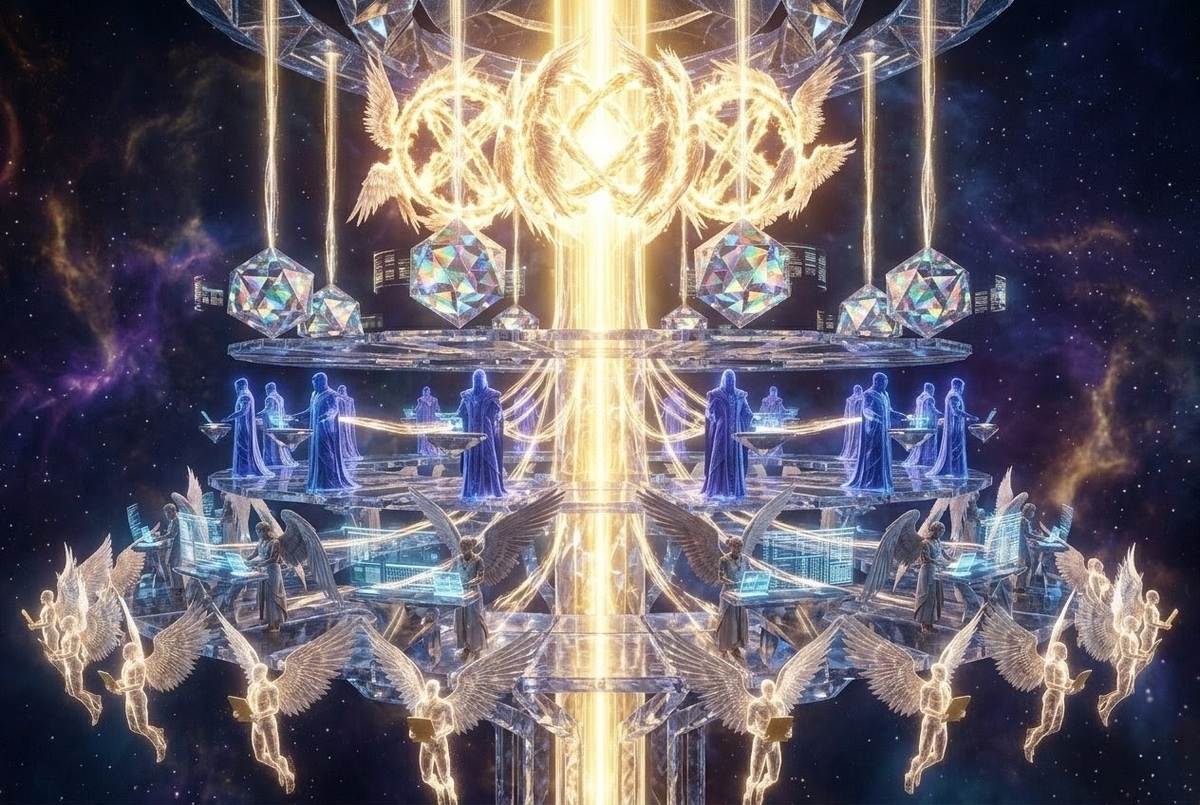
Popular culture often domesticates angels into sentimental comfort figures. Older traditions are less cosy. Biblical angels frighten, announce, guard, destroy, reveal, strengthen, and interrupt. Medieval angelology builds elaborate hierarchies: seraphim, cherubim, thrones, dominions, virtues, powers, principalities, archangels, and angels. Esoteric systems often map them to planets, directions, names, colours, hymns, seals, and ritual functions.
The Orders as Function
A careful reading treats angelic orders as functions rather than a cosmic office party. The “higher” orders are often more abstract, radiant, and difficult to personify. The “lower” orders are closer to human communication, protection, and guidance. This is hierarchy as proximity and function, not domination for its own sake.
- Seraphim: burning ones, associated with nearness to divine presence, purification, and overwhelming intensity.
- Cherubim: guardians of sacred thresholds, especially boundaries between ordinary and divine space.
- Thrones, dominions, virtues, and powers: orders often associated with cosmic law, order, strength, movement, and governance.
- Principalities: powers linked in some traditions with peoples, places, nations, and collective patterns.
- Archangels and angels: more personal messengers, protectors, guides, and communicators in devotional and esoteric practice.
In practice, angelic contact should not bypass discernment. A luminous figure, a grand name, or an intense feeling is not enough. The older magical traditions repeatedly emphasise purification, prayer, humility, testing, and ethical preparation because subtle contact can inflate the practitioner faster than a bellows under a dragon.
2. Ascended Masters, Siddhas, Bodhisattvas, and Wise Ancestors
Many traditions preserve the idea of perfected, realised, awakened, or advanced beings who assist others. The names differ: siddhas, bodhisattvas, rishis, immortals, saints, hidden masters, realised teachers, and ascended masters. These categories should not be flattened into one universal system. A bodhisattva in Mahayana Buddhism is not identical to an ascended master in Theosophy, and a saint in Christian devotion is not the same as a Taoist immortal.
The shared pattern is the presence of advanced wisdom that remains relational. The realised one does not merely vanish into private bliss. They teach, bless, guide, intercede, transmit, or remain available through memory, lineage, dream, text, devotion, or inner recognition.
Theosophical Masters and the Language of Light
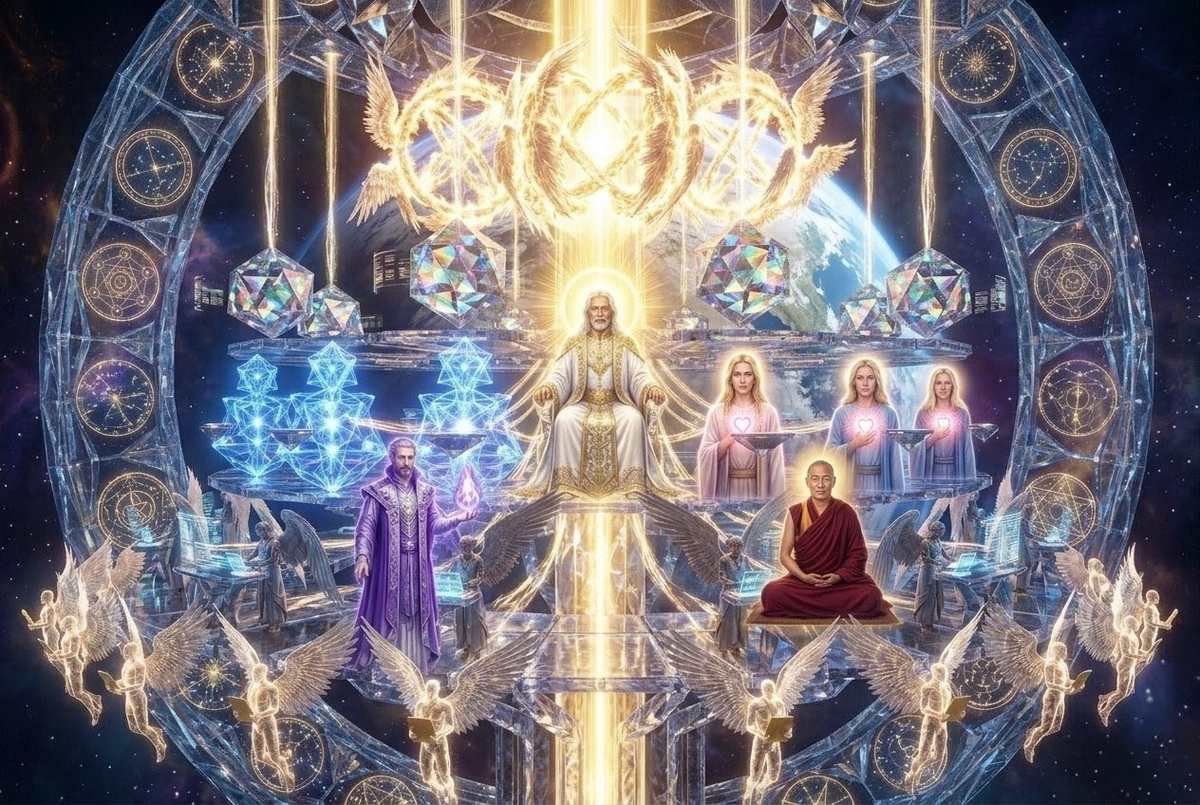
The phrase “Great White Brotherhood” appears in Theosophical and later esoteric contexts. In that usage, “white” refers to light, purity, and spiritual radiance, not race. Even so, the phrase now carries historical and cultural weight that modern readers should handle carefully. It is often better to speak plainly of ascended masters, hidden adepts, or lineages of realised guidance.
Figures such as Saint Germain, Maitreya, Djwal Khul, Kuthumi, and Sanat Kumara belong especially to modern esoteric and Theosophical currents. Some practitioners treat them as real guiding beings. Others read them as imaginal forms of teaching authority, archetypal wisdom, or symbolic personifications of spiritual functions.
The discernment test remains the same: does the contact produce humility, service, clear practice, ethical repair, and embodied responsibility? Or does it inflate the seeker into special missions, secret rankings, exclusive status, and cosmic self-importance with incense drifting out of the filing cabinet?
3. Star Nations and Contactee Cosmologies
Modern esoteric culture includes many claims about star beings, star nations, galactic councils, Pleiadian teachers, Arcturian healers, Sirian lineages, and extraterrestrial or interdimensional guidance. These claims belong mainly to modern contactee, New Age, UFO, channelled, and visionary traditions rather than classical Gnostic sources.
That does not make them automatically meaningless. It does mean they need careful labelling. A reader should not confuse a modern Pleiadian teaching with a Nag Hammadi tractate, or a channelled council with a primary ancient source. The traditions may be placed in conversation, but they should not be thrown into the same stew and served as “ancient wisdom”.
Common modern associations include:
- Pleiadian beings: often described as heart-centred, relational, healing, artistic, and focused on collective awakening.
- Arcturian beings: often described as highly technological, geometric, healing-oriented, or associated with subtle bodies and dimensional thresholds.
- Sirian beings: often linked in modern esotericism with Egypt, sacred geometry, star wisdom, and initiatory knowledge.
The safest reading is layered. Star-being language may refer to literal non-human intelligences, imaginal teaching figures, archetypes of cosmic belonging, trance material, symbolic ancestry, or mythic forms through which the psyche processes humanity’s longing not to be alone in the cosmos.
Helpful contact should never demand isolation, obedience, money, sexual access, sleep deprivation, or unquestioning belief. Any “galactic” message that makes ordinary ethics look optional has probably lost its passport at the first checkpoint.
4. Nature Spirits, Devas, and Elementals
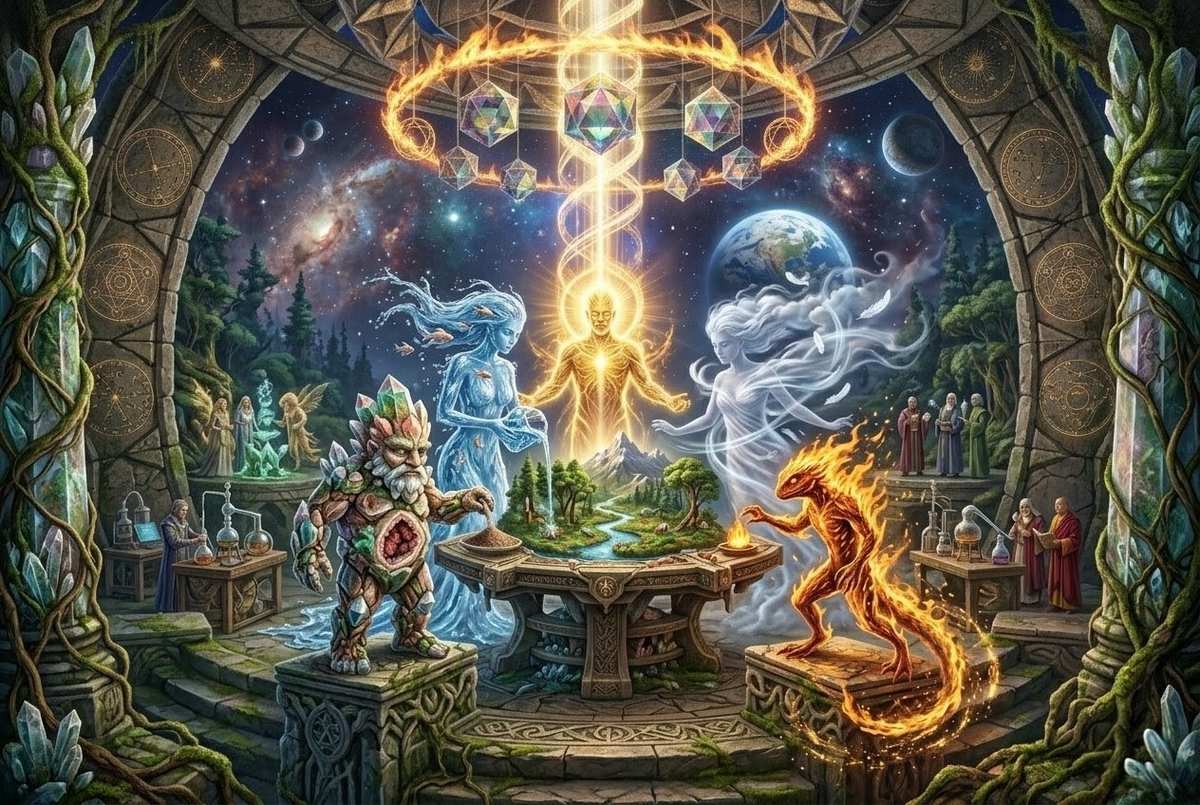
Nature-spirit traditions appear across the world. Forests, rivers, mountains, springs, stones, trees, fields, storms, and animals are often treated as ensouled, inhabited, guarded, or intelligible. In Hindu and Buddhist contexts, devas may inhabit heavens, places, trees, or subtle realms. In European esoteric traditions, elementals are associated with earth, water, air, and fire. In many Indigenous traditions, relationship with land and more-than-human beings is inseparable from ceremony, kinship, and responsibility.
Modern readers should approach this with respect. Nature spirits are not collectible fantasy pets. Land-based traditions are often embedded in culture, language, ecology, ancestral relationship, and place-specific obligation. Borrowing names without understanding the living context can turn reverence into costume.
The Elemental Map
- Earth beings: associated with stone, soil, roots, minerals, bodies, boundaries, stability, and the slow intelligence of form.
- Water beings: associated with rivers, springs, rain, emotion, memory, dream, cleansing, and flow.
- Air beings: associated with wind, breath, thought, birds, weather, communication, and movement between worlds.
- Fire beings: associated with flame, heat, lightning, transformation, digestion, passion, purification, and danger.
Whether read literally or symbolically, elemental work teaches humility. Human beings are not above nature. We are a small nervous system walking through a much larger body. Contact with the living world should make the practitioner more ecological, not more theatrical. The tree does not require a performance. It requires not being cut down by someone who claims to love tree spirits.
5. Ancestral Guides and the Mighty Dead
Ancestral guidance appears in many cultures. The dead are not always imagined as gone. They may remain connected to family, land, name, memory, ritual, dream, genetic inheritance, moral obligation, or unresolved history. Ancestors can bless, warn, protect, disturb, demand remembrance, or reveal unfinished patterns.
This is not always comforting. Ancestors are not automatically wise because they are dead. A lineage may carry courage, skill, devotion, land knowledge, art, humour, prayer, craft, and resilience. It may also carry trauma, violence, silence, addiction, shame, exile, poverty, domination, religious fear, or patterns that need conscious ending.
- Biological ancestors: the bloodline, carrying inherited body, temperament, memory, wound, blessing, and pattern.
- Cultural ancestors: those who shaped the language, land, craft, faith, struggle, and symbolic world one inherits.
- Spiritual ancestors: teachers, writers, artists, mystics, philosophers, practitioners, and elders who shaped the path without biological relation.
- The Mighty Dead: a term used in some esoteric contexts for the honoured dead whose work continues to guide the living.
The best ancestral practice is not superstition. It is remembrance joined to repair. Light a candle, yes, if that belongs to your path. But also end the pattern. Tell the truth. Heal what can be healed. Refuse what should not continue. Honour the dead by becoming less possessed by what wounded them.
6. Animal Guides, Totems, and the Other Nations
Animals have always taught humans. Their tracks, calls, migrations, hunting patterns, mating rituals, patience, speed, caution, camouflage, loyalty, ferocity, play, and silence offer other ways of knowing the world. In some traditions, animal guides or totems are part of specific cultural and ceremonial systems. In modern spiritual writing, animal symbolism is often borrowed loosely, sometimes too loosely.
A respectful approach begins with the animal itself. Learn its ecology before turning it into a slogan. Owl is not merely “wisdom”. Owl is night vision, silent flight, predation, patience, death, and listening. Deer is not merely “gentleness”. Deer is alertness, herd intelligence, speed, fragility, and sudden disappearance. Snake is not merely “transformation”. Snake is venom, shedding, healing, fear, medicine, and boundary.
- Life animals: recurring animal presences that seem to accompany a person’s long-term pattern of learning.
- Message animals: animals that appear at meaningful moments, especially through repeated encounters, dreams, or synchronicity.
- Shadow animals: animals that evoke fear, disgust, fascination, or rejection, often revealing disowned instincts.
- Place animals: animals native to a landscape, teaching through ecology rather than personal symbolism.
Do not reduce animals to private fortune cookies. The animal is not a logo for your mood. It belongs first to itself, to its species, to its land, and to its web of life. A good animal omen should make you more attentive to the living world, not merely more pleased with your own symbolism.
7. Neutral Intelligences, Threshold Beings, and Place Spirits
Some beings are best understood as neutral or threshold-like. They do not behave like personal guides. They may guard places, enforce boundaries, embody natural forces, appear in dreams, test the seeker, or simply exist beyond human moral categories. Folklore is full of such beings: land spirits, fae-like figures, guardians, gatekeepers, watchers, tricksters, and local presences.
Neutral does not mean harmless. Fire is neutral, but it burns. A cliff is neutral, but gravity keeps its calendar. A river is neutral, but it will not pause for your spiritual biography. In the same way, a threshold intelligence may not be evil, but it may still be dangerous to approach carelessly.
Where benevolent guidance tends to clarify and support, neutral contact often demands right relation. Respect the place. Do not demand signs. Do not make contracts. Do not offer what you cannot honour. Do not assume every presence wants conversation. Sometimes the most intelligent ritual is to say nothing, leave no trace, and walk home with your pockets spiritually zipped.
Discernment: The Essential Practice
With subtle contact, discernment matters more than taxonomy. A being may call itself angelic, ancestral, galactic, ascended, elemental, or divine. Names are easy. Fruit is harder to fake.
Genuine guidance usually has a certain quality. It does not panic the body into obedience. It does not demand theatrical identity. It does not isolate the seeker from grounded people. It does not flatter spiritual narcissism. It does not make ordinary ethics look small. It does not punish questions. It does not need you terrified in order to be heard.
By contrast, deceptive contact often uses urgency, exclusivity, flattery, fear, dependency, secret missions, special status, sexual pressure, exhaustion, or contempt for ordinary life. It may begin with sweetness and end with control. The old spiritual counterfeit does not always arrive with claws. Sometimes it arrives with a clipboard, a halo, and excellent branding.
Seven Tests of Contact
The following tests are practical, not infallible. Use them together, slowly, and with grounded support where needed.
- The Test of Embodiment: Does the contact leave you more grounded, rested, functional, and present in the body?
- The Test of Freedom: Does it increase your sovereignty, or does it create dependency on the being, channel, teacher, system, or sign?
- The Test of Humility: Does it make you kinder and more honest, or inflated and superior?
- The Test of Ethics: Does it strengthen consent, truthfulness, repair, and responsibility?
- The Test of Clarity: Does it clarify the next step, or create fog, obsession, secrecy, and dramatic urgency?
- The Test of Community: Can the experience survive gentle discussion with grounded, trustworthy people?
- The Test of Time: Does the guidance remain wise after the emotional charge fades?
Never ignore the body. Tightness, nausea, dread, compulsion, sudden exhaustion, dissociation, or loss of agency may be signals to stop. Equally, warmth, peace, tears, spaciousness, and awe are not automatic proof. Discernment listens to the whole field: body, behaviour, time, ethics, fruit, and ordinary sanity.
A guide who forbids discernment is not a guide. It is a gate wearing borrowed light.
The Gnostic Reading: Guidance Without Submission
Gnostic myth is suspicious of false rulers, false lights, counterfeit authorities, and beings who claim power over the soul without possessing true knowledge. This does not mean all non-human contact is hostile. It means the seeker must learn the difference between guidance and domination.
In Gnostic terms, the deepest guide is not an external ruler. It is the awakening of the divine spark, the recovery of gnosis, the recognition of the true self in relation to the Pleroma. External beings may help, warn, teach, protect, or mirror. But they cannot replace direct knowing. The moment a guide becomes a substitute for gnosis, the old archonic pattern has returned through a prettier door.
Benevolent guidance points beyond itself. It strengthens the inner lamp. It gives courage, not dependence. It restores memory, not obedience. It may arrive as angel, ancestor, animal, teacher, dream, silence, prayer, pattern, land, or sudden clarity. But its real test is not costume. Its test is liberation.
Neutral beings teach a second lesson: the cosmos is not arranged around human demand. The mountain does not flatter. The river does not negotiate. The owl does not explain itself in bullet points. The more-than-human world asks for right relation, humility, and attention.
The mature seeker therefore does not crawl before every light or sneer at every mystery. They stand in the body, keep the heart awake, test the fruit, and remember that no being worth meeting requires the surrender of conscience.
Related Glossary Terms
For quick definitions, use the main ZenithEye Glossary. The key terms for this article are:
Read Next
Continue with: Negative Entities and Their Hunting Grounds
If this article maps benevolent and neutral presences, the next step is contrast. Discernment becomes sharper when the reader can recognise predatory patterns, fear-based contact, energetic depletion, and the conditions where harmful forces gather.
Within The Hidden Agreements
This article belongs to Comparative Cosmology, the Hidden Agreements layer where cosmic maps, spiritual entities, unseen orders, guiding presences, predatory forces, and systems of discernment are read across traditions.
Frequently Asked Questions About Benevolent or Neutral Entities
What are benevolent or neutral entities?
Benevolent entities are presences, beings, guides, or intelligences traditionally understood as helpful, protective, clarifying, or spiritually supportive. Neutral entities are not automatically hostile or helpful. They may belong to nature, place, ancestry, dream, ritual, planetary symbolism, or threshold experience, and they require discernment rather than automatic trust.
Are angels the same as spirit guides?
Not exactly. Angels belong to specific religious and esoteric traditions as messengers, protectors, and powers of divine order. Spirit guide is a broader modern term that may include ancestors, teachers, animal presences, ascended masters, inner figures, or symbolic guides. The categories overlap in practice but should not be treated as identical.
What is the difference between a guide and a predatory entity?
A trustworthy guide increases clarity, freedom, humility, embodiment, compassion, and ethical responsibility. A predatory or deceptive presence often creates fear, dependency, grandiosity, isolation, urgency, exhaustion, sexual pressure, secrecy, or contempt for ordinary life. The fruit of the contact matters more than the name it gives itself.
Are ascended masters historical or symbolic?
Ascended masters belong especially to Theosophical and modern esoteric traditions. Some practitioners treat them as real guiding beings. Others read them as imaginal teachers, archetypes, or symbolic forms of spiritual authority. A grounded approach labels the tradition clearly and tests any claimed contact by humility, ethics, and practical fruit.
Are star nations part of ancient Gnosticism?
No. Pleiadian, Arcturian, Sirian, and galactic council language belongs mainly to modern contactee, New Age, UFO, channelled, and visionary traditions, not classical Nag Hammadi Gnosticism. These frameworks can be compared with Gnostic themes, but they should not be presented as ancient Gnostic sources.
Can ancestors be spiritual guides?
Many cultures understand ancestors as continuing presences connected to family, land, memory, ritual, and lineage. Ancestors may bless, warn, guide, or reveal inherited patterns. They are not automatically wise or benevolent, so ancestral work should include discernment, repair, grounding, and respect for cultural context.
Can animals act as spiritual guides?
Animals can function as teachers, symbols, messengers, dream figures, and ecological presences. A respectful approach begins with the actual animal and its behaviour, not just a private meaning assigned to it. Animal-guide language should also be used carefully because some modern totem language borrows from Indigenous traditions without proper context.
What is the safest way to approach entity contact?
Begin with grounding, bodily awareness, ethical clarity, and sceptical openness. Do not make contracts, surrender discernment, isolate yourself, or obey commands that violate conscience. Helpful contact should leave you steadier, freer, kinder, more embodied, and more functional. Distressing or destabilising experiences may require qualified support.
Study and Safety Note
This article explores entities, angels, guides, ancestors, animal symbolism, nature spirits, star-being language, altered states, and esoteric cosmology for educational and reflective purposes. It does not provide medical, psychological, psychiatric, mediumship, ritual, or spiritual-direction advice.
Do not intensify entity work if you are experiencing panic, mania, psychosis, severe dissociation, sleep deprivation, paranoia, trauma flashbacks, frightening voices, command experiences, suicidal thoughts, or difficulty functioning. Seek qualified support and prioritise grounding, sleep, food, ordinary contact, and safety.
Discernment is not a lack of spirituality. It is spiritual hygiene. No guide, ancestor, angel, master, star being, animal sign, or subtle presence should override conscience, consent, health, ordinary responsibility, or the right to say no.
Further Reading
These ZenithEye links continue the themes of entities, guidance, predatory forces, angelic systems, protection, altered states, and discernment:
- Negative Entities and Their Hunting Grounds – The necessary contrast: predatory presences, folklore, sleep paralysis, trauma, fear, and the places where harmful patterns gather.
- Archons and the Soul Trap: A Gnostic Guide to Spiritual Sovereignty – Archons, false authority, soul-trap language, and the question of spiritual sovereignty.
- Planes of Consciousness: The 7 Dimensions You Already Inhabit – A symbolic map of subtle realms, higher dimensions, and layered consciousness.
- Psychic Vampire: Energy Parasitism in Occult Tradition – Human and occult patterns of energetic depletion, dependency, and extraction.
- Predatory Consciousness and Spiritual Emergency – Discernment, spiritual crisis, entity language, and the difference between symbolic and destabilising experience.
- 7 Ancient Protection Rituals from Gnostic Texts – Grounded protective practices inspired by Nag Hammadi themes of seals, remembrance, light, and discernment.
- Scrying the Enochian Aethyrs – John Dee, angelic language, altered states, and the need for careful method in visionary work.
- Heptarchia Mystica: John Dee’s Planetary Kings Guide – Planetary kings, Renaissance angelic magic, and historical protocols for working with celestial intelligences.
- Embodiment Practices: Grounding the Awakened Body – Why all subtle contact needs bodily grounding and ordinary integration.
References and Sources
The following sources support the comparative, historical, symbolic, psychological, and esoteric framework used in this article.
Angelic, Biblical, and Late Antique Sources
- Book of Daniel. Biblical source for angelic figures such as Michael and Gabriel.
- Book of Tobit. Deuterocanonical source involving Raphael as healer and guide.
- 1 Enoch. Ancient Jewish apocalyptic text with angels, watchers, cosmic journeys, and heavenly orders.
- Pseudo-Dionysius the Areopagite. The Celestial Hierarchy. Foundational Christian text on angelic orders.
- Davidson, Gustav. A Dictionary of Angels: Including the Fallen Angels. Free Press, 1967.
- Hanegraaff, Wouter J. Dictionary of Gnosis and Western Esotericism. Brill, 2005.
Gnostic, Hermetic, and Esoteric Context
- Robinson, James M. (ed.). The Nag Hammadi Library in English. Revised edition. HarperOne, 1990.
- Meyer, Marvin (ed.). The Nag Hammadi Scriptures. HarperOne, 2007.
- Layton, Bentley. The Gnostic Scriptures. Yale University Press, 1987.
- Brakke, David. The Gnostics: Myth, Ritual, and Diversity in Early Christianity. Harvard University Press, 2010.
- King, Karen L. What Is Gnosticism?. Harvard University Press, 2003.
- Copenhaver, Brian P. Hermetica: The Greek Corpus Hermeticum and the Latin Asclepius. Cambridge University Press, 1992.
- Asprem, Egil. Arguing with Angels: Enochian Magic and Modern Occulture. SUNY Press, 2012.
- French, Peter J. John Dee: The World of an Elizabethan Magus. Routledge, 1972.
Devas, Bodhisattvas, Siddhas, and Comparative Religion
- Gethin, Rupert. The Foundations of Buddhism. Oxford University Press, 1998.
- Williams, Paul. Mahayana Buddhism: The Doctrinal Foundations. Routledge, 1989.
- Flood, Gavin. An Introduction to Hinduism. Cambridge University Press, 1996.
- Eliade, Mircea. Yoga: Immortality and Freedom. Princeton University Press, 1958.
- Samuel, Geoffrey. The Origins of Yoga and Tantra. Cambridge University Press, 2008.
- Boyce, Mary. Zoroastrians: Their Religious Beliefs and Practices. Routledge, 1979.
Theosophy, Ascended Masters, and Modern Esotericism
- Blavatsky, H. P. The Secret Doctrine. Theosophical Publishing, 1888.
- Leadbeater, C. W. The Masters and the Path. Theosophical Publishing House, 1925.
- Bailey, Alice A. Initiation, Human and Solar. Lucis Publishing, 1922.
- Godwin, Joscelyn. The Theosophical Enlightenment. SUNY Press, 1994.
- Hammer, Olav. Claiming Knowledge: Strategies of Epistemology from Theosophy to the New Age. Brill, 2001.
- Hanegraaff, Wouter J. New Age Religion and Western Culture. SUNY Press, 1996.
Nature Spirits, Folklore, and More-Than-Human Worlds
- Evans-Wentz, W. Y. The Fairy-Faith in Celtic Countries. Oxford University Press, 1911.
- Yeats, W. B. Fairy and Folk Tales of the Irish Peasantry. Walter Scott, 1888.
- Harvey, Graham. Animism: Respecting the Living World. Hurst, 2005.
- Abram, David. The Spell of the Sensuous. Vintage, 1996.
- Kohn, Eduardo. How Forests Think: Toward an Anthropology Beyond the Human. University of California Press, 2013.
- Hutton, Ronald. The Triumph of the Moon: A History of Modern Pagan Witchcraft. Oxford University Press, 1999.
Ancestors, Spirits, Psychology, and Safety
- Hertz, Robert. Death and the Right Hand. Cohen & West, 1960.
- Metcalf, Peter and Huntington, Richard. Celebrations of Death: The Anthropology of Mortuary Ritual. Cambridge University Press, 1991.
- Jung, C. G. The Archetypes and the Collective Unconscious. Collected Works, Vol. 9, Part I. Princeton University Press.
- Hillman, James. The Dream and the Underworld. Harper & Row, 1979.
- Luhrmann, T. M. When God Talks Back: Understanding the American Evangelical Relationship with God. Knopf, 2012.
- Grof, Stanislav and Grof, Christina. Spiritual Emergency: When Personal Transformation Becomes a Crisis. Tarcher, 1989.
- Lindahl, Jared R., et al. “The Varieties of Contemplative Experience: A Mixed-Methods Study of Meditation-Related Challenges in Western Buddhists.” PLOS ONE, 12(5), 2017.
- Treleaven, David A. Trauma-Sensitive Mindfulness: Practices for Safe and Transformative Healing. W. W. Norton, 2018.