The Doctrine of Emanation: From Plotinus to Kabbalah
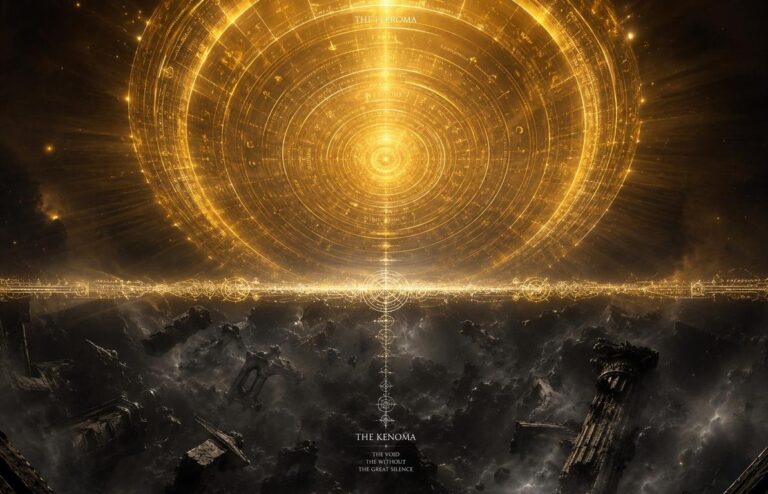
The One is perfect. The perfect, complete, lacks nothing. Yet from the One, the many emerge. Not through creation–creation implies will, decision, change in creator. Not through fabrication–fabrication implies pre-existing matter, co-eternal with creator. Through emanation–overflow, radiation, the necessary consequence of plenitude. The doctrine, articulated by Plotinus, adapted by Kabbalah, and discovered independently across cultures, underlies all esoteric cosmology and describes the original architecture of manifestation.
How does the Absolute become relative without compromising its absoluteness? How does the Infinite produce the finite without loss? These questions troubled the philosophers of the ancient world, who recognised that a true Source cannot be depleted by its distribution–that the cosmos operates on principles of infinite resource rather than finite scarcity. The answer, proposed by Plotinus and echoed in Kabbalah, Sufism, and Vedanta, is that the One overflows necessarily, like light from the sun or water from a fountain, remaining full while the rays extend.
Table of Contents
- The Neoplatonic Cascade: Plotinus and the Levels of Being
- The Kabbalistic Adaptation: Ein Sof and the Sefirot
- Emanation Across Cultures
- Emanation as Lived Experience
- Frequently Asked Questions
- Further Reading
- References and Sources
The Neoplatonic Cascade: Plotinus and the Levels of Being
The One Beyond Being
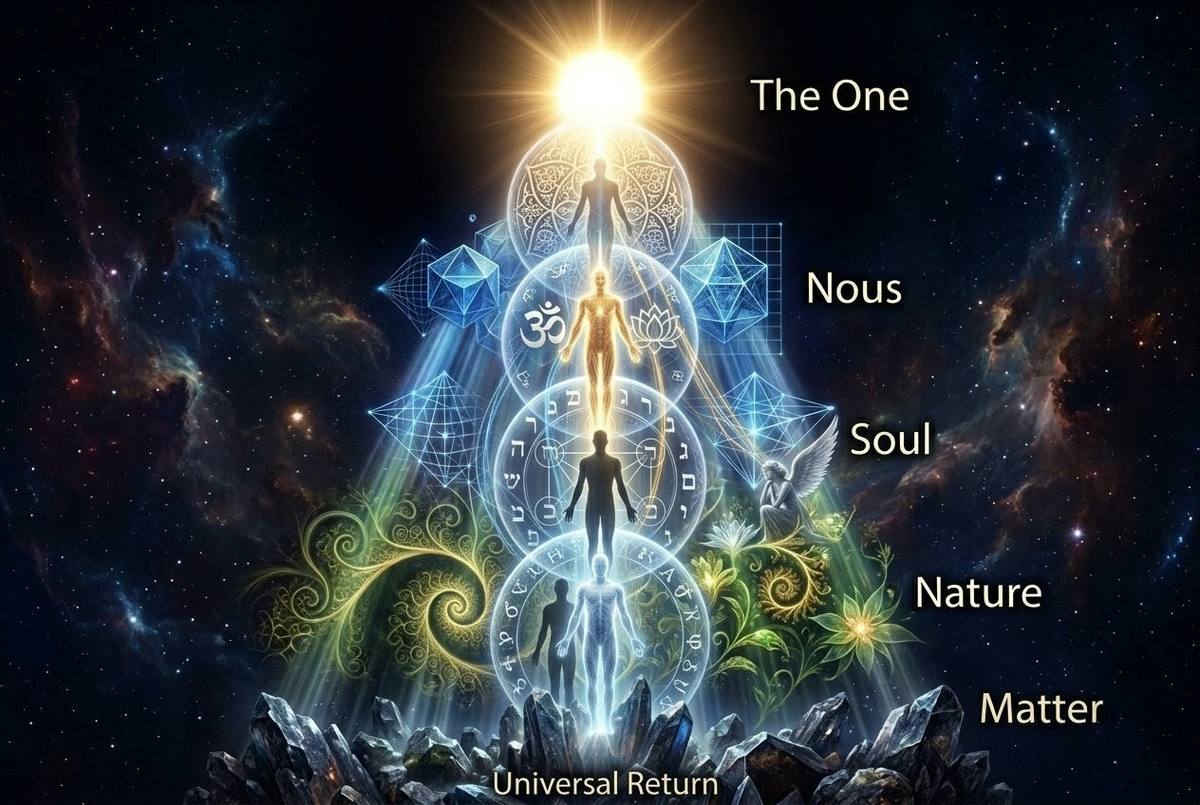
Plotinus (204/5–270 CE) systematised what he received from Plato, from Aristotle, and from the philosophical traditions that circulated through the Hellenistic world. Working in Rome during the height of the Empire, he articulated a vision of reality so precise it would influence Christianity, Islam, and Renaissance philosophy alike. The One—to hen, the Good, beyond being itself–overflows necessarily, not by choice but by the very nature of perfection.
The One is not a being among beings, not a god among gods. It is the principle that makes all being possible, the ground that supports all grounds. To say that it “is” is already misleading, for “is” implies existence, and existence is a predicate that applies to things within the world, not to the source of the world. Plotinus is careful: the One is hyperousios, beyond substance, beyond the categories that structure thought. Yet from this beyond, all that is flows.
Nous and the Realm of Forms
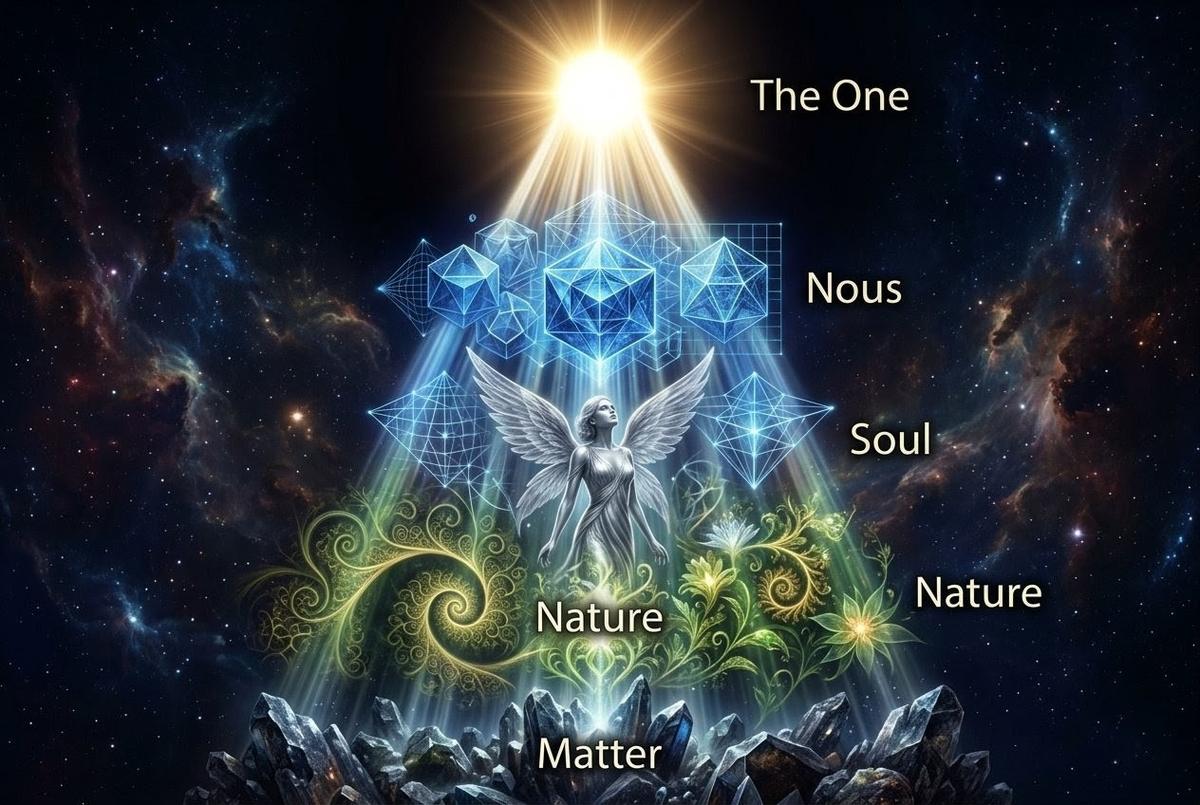
The overflow, first, is Nous (Intellect), the realm of eternal Forms and mathematical perfections. This is not human thinking but Divine Mind–the archetypal blueprint where the patterns for all manifestation are stored. Nous contemplates The One, and in this contemplation, generates the multiplicity of Platonic Ideas. It is the first differentiation, yet remains in eternal presence to its Source, like a mirror that reflects without diminishing the light.
Nous is eternal–not in time but outside it. The Forms within Nous are not created at a moment; they are always present, always contemplated, always productive. The relationship between The One and Nous is not temporal but logical: Nous is the necessary consequence of The One’s perfection, not an event that happens after. This is the key to understanding emanation: it is not a process in time but a structure of reality, the way the infinite necessarily expresses itself in the finite without being changed by the expression.
Soul, Nature, and Matter
The Nous, contemplating the One, produces Soul–the principle of life, movement, and desire. Soul occupies the middle position, facing both upward toward Intellect and downward toward Nature. It is the administrator of the cosmos, the bridge between eternity and time, between the unchanging and the flowing. Soul is not trapped between two worlds; it is the connection that makes both worlds intelligible to each other.
The Soul, contemplating Nous, produces Nature–the vital principle within organic life, the growth patterns in plants, the instinctual wisdom in animals. Finally, Nature produces Matter, the receptacle furthest from the Source, the dark mirror that receives the faintest trace of the divine light. Matter is not evil, but the final outpost of the emanation, the frontier where the overflow becomes barely perceptible. In Plotinus’s view, matter is privation–not a positive evil but the absence of form, the limit where the light has travelled so far it is almost indistinguishable from darkness.
The Return: Epistrophe
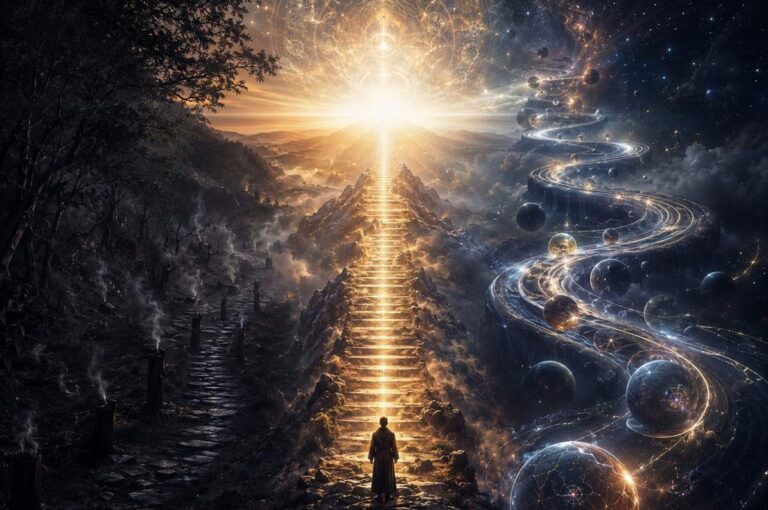
The descent, complete, enables ascent–the return of Soul to Nous to One. The chain of emanation is also a ladder of return. Plotinus calls this return epistrophe–the turning back of the soul toward its source. The ascent is not escape from the world but the recognition that the world, even at its lowest level, is still overflow of the One. The philosopher, through contemplation, ascends the levels; the mystic, through ecstasy, leaps them. Both arrive at the same recognition: the One was never absent from the many.
The Kabbalistic Adaptation: Ein Sof and the Sefirot
Ein Sof and the Concealed Source
The Kabbalah, emerging in the twelfth and thirteenth centuries among medieval Jewish mystics in Spain and Provence, adapts the ancient doctrine of emanation to a biblical framework. Where Plotinus speaks of The One, the Kabbalists speak of Ein Sof–Infinite, beyond all name and attribute, the ultimate concealed source from which all flows yet which remains eternally hidden. The term itself, Ein Sof, means “without end”–not a name but a negation, a pointer toward what cannot be pointed at directly.
From Ein Sof, the sefirot emanate–not created, not separate, but aspects of the divine, modes of manifestation, stages of overflow. The sefirot, ten in number, are not additions to Ein Sof but revelations of what Ein Sof is, accessible to finite consciousness. They are the garments of the Infinite, the ways the divine shows itself to itself through the mirror of creation. The Kabbalistic innovation is to make the emanation personal–not abstract levels of being but named qualities, divine attributes that can be related to, contemplated, and repaired.
The Architecture of the Sefirot
The first sefirah, Keter (Crown), is closest to Ein Sof–still infinite, still beyond comprehension, the pure will to be. From Keter, Chokmah (Wisdom) and Binah (Understanding) emanate–the primal polarity of masculine and feminine, expansion and contraction, thesis and antithesis. This triad–Keter, Chokmah, Binah–constitutes the upper face of the Tree, the realm of pure intellect and divine intention.
The subsequent sefirot–Chesed (Mercy), Gevurah (Severity), Tiferet (Beauty), Netzach (Victory), Hod (Glory), Yesod (Foundation)–represent increasing differentiation, increasing distance from source, and increasing accessibility to human consciousness. Finally, Malkuth (Kingdom) represents the divine presence fully incarnated in matter, the Shekhinah dwelling in the physical world. The Tree of Life is not merely a diagram; it is a map of consciousness, a way of navigating the levels of reality from the most abstract to the most concrete.
Tikkun and the Repair of Flow
The emanation, in Kabbalah, is dynamic–not a static hierarchy but a living process of interaction. The sefirot receive from above, influence below, give and receive in constant circulation. However, the Shekhinah, the divine presence in Malkuth, is exiled from the upper sefirot, separated by the ruptures of manifestation, awaiting reunion. This exile is not punishment but condition–the necessary distance that makes relationship possible, the gap that makes love meaningful.
The human work–tikkun (repair)–restores the flow between sefirot, reunites Shekhinah with the source, and completes the emanation through conscious return. The practitioner becomes the repairer, fixing the broken circuits in the cosmic flow through ethical action, contemplation, and ritual. Tikkun is not merely personal salvation; it is cosmic restoration. The individual’s spiritual work affects the whole structure, because in emanation metaphysics, the part and the whole are not separate.
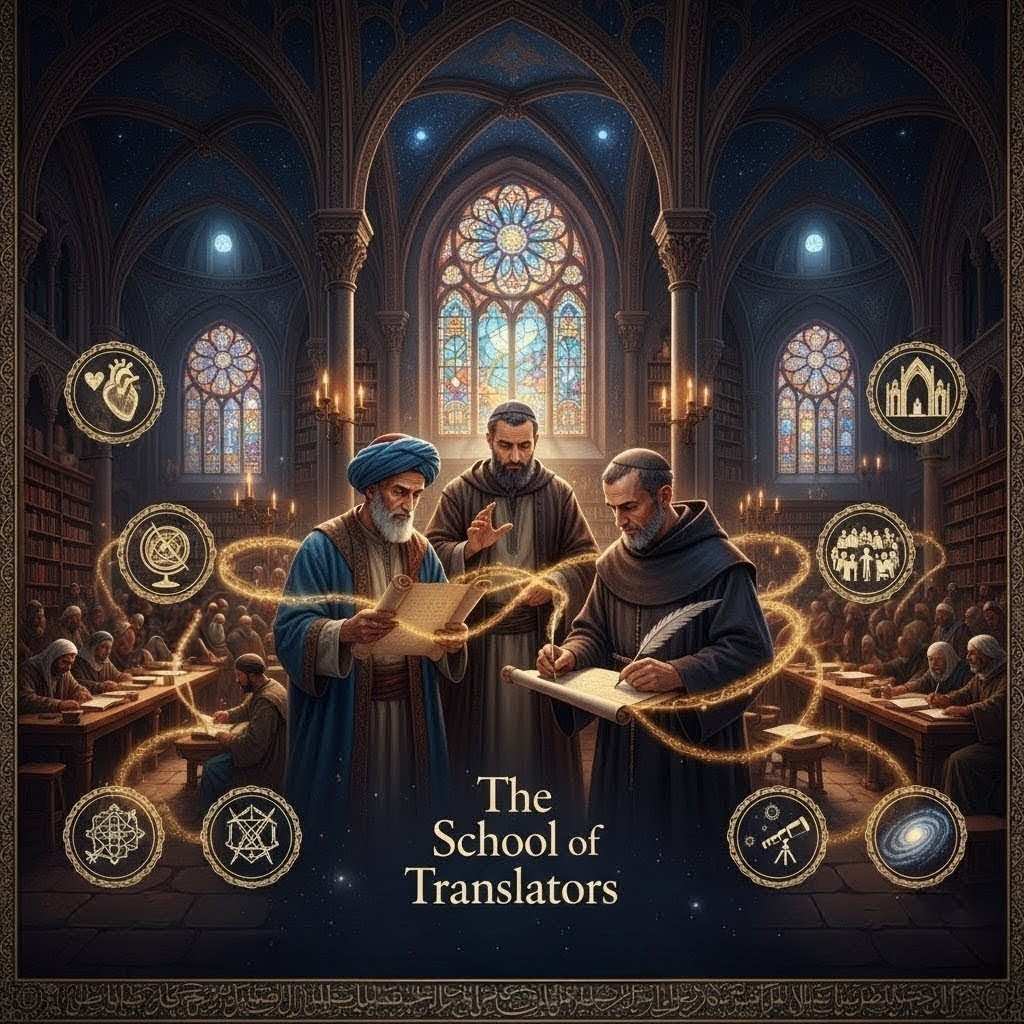
Emanation Across Cultures
The vocabulary differs. The structure–perfect source, necessary emanation, apparent multiplicity, possible return–is identical across cultures. The identity suggests not diffusion (though some exchange occurred) but discovery. The emanation doctrine describes something–the structure of consciousness, the nature of manifestation, the relationship between the infinite and finite. The description, accurate, is discovered independently by those who investigate the architecture of reality.
In Sufism: The Unity of Being
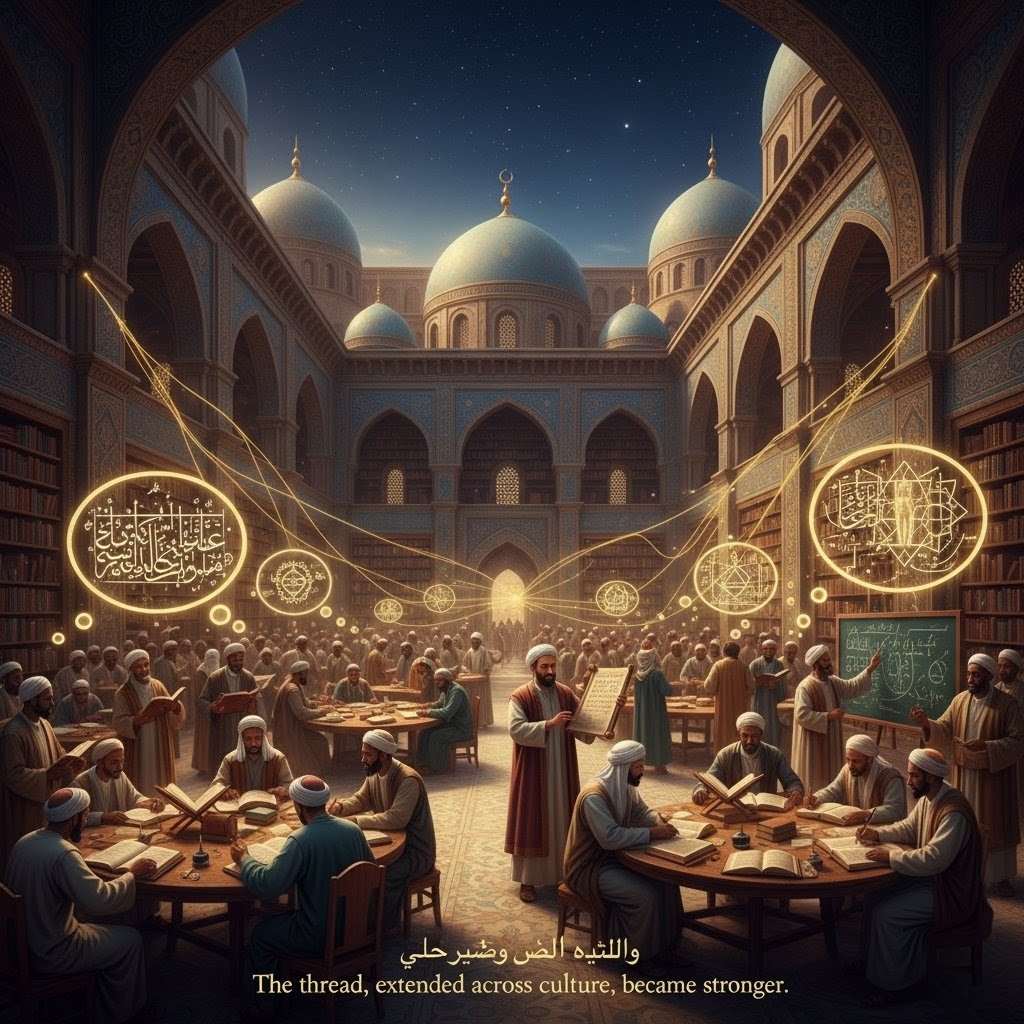
Ibn Arabi (1165–1240), the Andalusian Sufi known as al-Shaykh al-Akbar (the Greatest Master), articulated what later interpreters called wahdat al-wujud (the unity of being). It is worth noting that Ibn Arabi himself never used the exact phrase wahdat al-wujud in his writings; the term was coined by later commentators, particularly the Persian mystic Abd al-Razzaq Kashani (d. 1345), to summarise a doctrine they found implicit in Ibn Arabi’s vast corpus. The doctrine describes the same cascade through the complementary principles of tanzih (transcendence) and tashbih (immanence). The Absolute (al-Haqq) manifests through the “Most Beautiful Names” (corresponding to sefirot), yet remains utterly beyond all manifestation.
The Sufi path of fana (annihilation) and baqa (subsistence) mirrors the Neoplatonic return–the soul’s dissolution into the Source while maintaining its distinctness. Ibn Arabi’s concept of the insan kamil (perfect human) corresponds to the Kabbalistic tikkun–the individual who has realised their identity with the divine and thereby serves as a channel for the restoration of the whole. The structure is the same; only the names and practices differ.
In Hinduism: Maya and the Play of Brahman
Shankara (c. 788–820 CE), the preeminent exponent of Advaita Vedanta, describes Brahman alone as real, the world as maya–not illusion in the sense of unreality, but manifestation, the apparent multiplicity projected without diminishing the Absolute. The atman (individual self) is identical to Brahman; the recognition of this identity (moksha) is the return from the illusion of separation to the reality of unity.
The levels of koshas (sheaths)–annamaya (food body), pranamaya (energy body), manomaya (mental body), vijnanamaya (wisdom body), and anandamaya (bliss body)–correspond to the levels of emanation, from matter to bliss, from the most distant to the closest to source. Shankara’s system is not merely philosophical; it is a contemplative technology, a method for penetrating the sheaths through discrimination (viveka) and detachment (vairagya) until the true self, beyond all sheaths, is recognised as Brahman itself.
In Buddhism: The Dharmakaya and Buddha-Nature
Mahayana Buddhism describes the Dharmakaya (truth body) of the Buddha as the ultimate reality, from which the Sambhogakaya (enjoyment body) and Nirmanakaya (manifestation body) emanate to teach beings. The tathagatagarbha (Buddha-nature) is inherent in all sentient beings, not created or added, but waiting to be recognised–precisely the emanationist view that the lowest level already contains the highest, obscured only by adventitious defilements.
The doctrine of dharmadhatu (realm of reality) in the Avatamsaka Sutra extends this to its most radical form: every phenomenon contains all phenomena, every atom contains infinite Buddhas, every moment contains eternity. This is not poetic hyperbole but the logical consequence of emanation: if all is overflow of the One, then every point of the overflow contains the entire pattern, just as every cell contains the DNA of the whole organism. The holographic implication of emanation–that the part contains the whole–is made explicit in Buddhist thought in ways that Western Neoplatonism approached but never fully developed.
Emanation as Lived Experience
The Practical Map
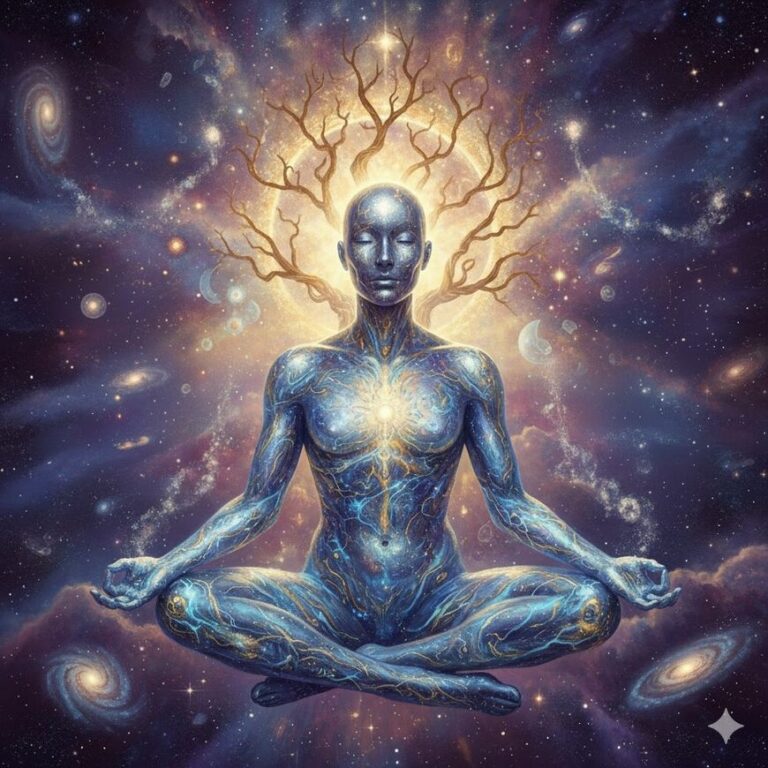
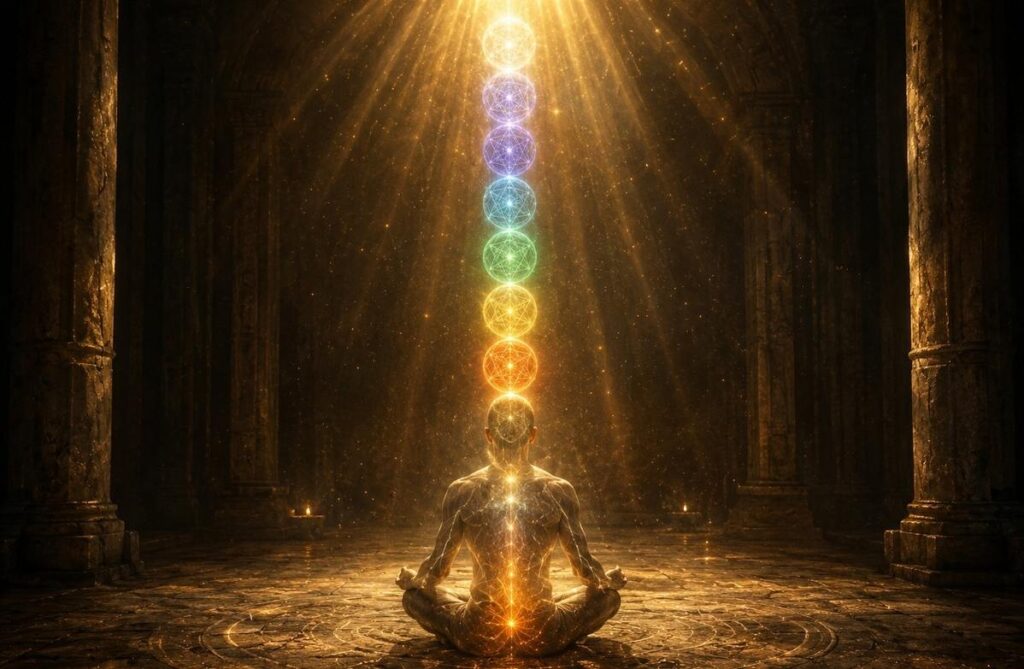
The doctrine of emanation extends the thread through metaphysics into immediate experience. The cosmology, abstract, is also lived–the practitioner, recognising their own consciousness as emanation, as a ray of the source, as capable of return, transforms. You are not a separate creature created by a distant God; you are the presence of The One at the level of Matter, the furthest reach of the divine overflow, capable of recognising your own source and returning through the levels.
This recognition is not merely intellectual. It is existential–the reorientation of life toward return, the practice of ascent, the embodiment of emanation’s truth. In Kabbalah, the practice is tikkun–repairing the world through ethical action and contemplation. In Neoplatonism, the practice is epistrophe–turning the soul back toward the One through dialectic and contemplation. In Sufism, the practice is dhikr–remembrance of the divine through repetition and presence. In Vedanta, the practice is nididhyasana–profound meditation on the identity of Atman and Brahman. The forms differ; the direction is the same.
Matter as Divine, Not Profane
To realise that Matter itself is divine overflow removes the dualism between spiritual and material, sacred and profane. The physical world is not a prison to escape but the final outpost of the divine presence, waiting to be recognised and repaired. This is the radical implication of emanation that distinguishes it from Gnostic dualism: matter is not the product of a fallen demiurge but the last ripple of the One’s overflow, still containing–however faintly–the trace of its source.
The practitioner who understands this does not reject the body but transforms it–purifying it, harmonising it, making it a fit vessel for the return. The body is not obstacle but instrument; matter is not enemy but frontier. The descent enables the ascent; the many return to the One without the One ever having left. The overflow becomes the return; the emanation completes itself in the recognition that the lowest is already the highest, obscured only by the failure to see.
Frequently Asked Questions
What is the doctrine of emanation and how does it differ from creation?
Emanation describes reality flowing from a perfect source like light radiating from the sun–the source remains full while the rays extend. Unlike creation ex nihilo (which implies will, decision, and change in the creator), or fabrication (which requires pre-existing matter), emanation is necessary overflow, the consequence of plenitude. The One gives without loss, remains unaffected yet immanent in all that flows from it, like a fountain that remains full while pouring forth water.
Who was Plotinus and what did he teach about The One?
Plotinus (204-270 CE) systematised Neoplatonic philosophy in Rome, synthesising Plato, Aristotle, and Oriental teachings. He taught that The One (to hen) is the Good beyond being, so perfect it overflows necessarily. This overflow generates Nous (Intellect/Forms), which generates Soul, which generates Nature, which finally generates Matter. Each level contemplates the level above it, producing the level below through a form of productive contemplation.
What is Ein Sof in Kabbalah and how does it relate to the sefirot?
Ein Sof (Infinite) is the Kabbalistic term for the divine source beyond all name, attribute, or comprehension. From Ein Sof, the ten sefirot emanate–not as creations separate from God, but as aspects or modes of divine manifestation. Keter (Crown) is closest to Ein Sof, followed by Chokmah (Wisdom) and Binah (Understanding), down to Malkuth (Kingdom). They are not additions to Ein Sof but revelations of what Ein Sof is, accessible to finite consciousness.
How can emanation happen without diminishing the source?
This is the central mystery of emanation metaphysics. Analogies help: the sun radiates without loss; a candle lights another without dimming; a fountain pours forth while remaining full. The key distinction is that in emanation, the Source remains absolutely transcendent and unchanged by what flows from it. Unlike a human creator who is changed by the act of creating, The One is so absolutely perfect that its giving is automatic, necessary, and without depletion–it is the nature of infinity to overflow.
What is the relationship between emanation and the problem of evil?
In emanation metaphysics, evil is not a positive force but a privation–the absence or distance from the Source. Matter, as the final emanation, is furthest from The One and thus most susceptible to evil’s privation. However, matter also serves as the necessary vessel for the return journey. Evil emerges not from the Source (which is perfect) nor from the emanation itself (which is good), but from the receptivity of the lowest level failing to fully receive and transmit the divine overflow.
Does the doctrine of emanation appear outside Western traditions?
Yes–the structure appears universally: In Sufism, Ibn Arabi’s wahdat al-wujud (unity of being) describes the same cascade from absolute transcendence (tanzih) to manifested immanence (tashbih). In Hinduism, Shankara’s advaita Vedanta describes Brahman alone as real, with the world as maya (apparent multiplicity) without diminishing the Absolute. In Mahayana Buddhism, the tathagatagarbha (Buddha-nature) is inherent in all beings, suggesting a perfect source (Dharmakaya) manifesting as apparent multiplicity without alteration.
What is the practical application of emanation theory for spiritual practice?
The doctrine is not merely abstract cosmology but an existential map. Recognising oneself as emanation–a ray of the source, not separate from it–enables the return (tikkun in Kabbalah, epistrophe in Neoplatonism). The practitioner aligns with the contemplative nature of each level: purifying the body (matter), harmonising with nature, awakening the soul’s intellectual vision, until achieving union with The One. This is not escape from the world but the realisation that even the lowest matter is divine overflow, awaiting recognition and repair.
Further Reading
- The Tree of Life: Kabbalistic Architecture Explained — Emanation as lived practice through mapping the sefirot.
- The Hidden Agreements: Why Esoteric Traditions Keep Inventing the Same Architecture — Emanation as cross-cultural structural pattern discovered independently.
- How Scripture Became Scripture — The textual transmission of wisdom across cultures and the formation of canonical authority.
- The Emerald Tablet: Hermetic Foundation & The Law of Correspondence — “As above, so below” as the formula of emanation without loss.
- The Transformation: What Actually Changes After Mystical Experience — The return through emanation to source and its psychological effects.
- The Holographic Universe Theory: Consciousness and the Nature of Reality — Modern physics encountering the emanationist view that the part contains the whole.
- The Sevenfold Pattern: Planets, Metals, Chakras & The Architecture of Seven — Post-emanation systematisation of the levels into practical correspondences.
- Apocryphal Gospels: The Gnostic Jesus and the Nag Hammadi Library — Gnostic variations on the theme of divine overflow and the correction of error.
References and Sources
This article draws upon the history of philosophy, comparative religion, and contemplative studies. Sources are grouped by tradition for clarity.
Primary Sources and Critical Editions
- Plotinus. (c. 250–270 CE). Enneads. Edited by P. Henry and H.-R. Schwyzer. Oxford Classical Texts. (Standard critical edition of the six books of Enneads).
- Ibn Arabi, M. (c. 1230). Fusus al-Hikam (The Bezels of Wisdom). (Foundational text of Sufi metaphysics; the term wahdat al-wujud was coined by later interpreters, not Ibn Arabi himself).
- Shankaracharya [Adi Shankara]. (c. 700–750 CE). Brahma Sutra Bhashya and Upadesasahasri. (Foundational texts of Advaita Vedanta).
Scholarly Monographs and Studies
- Armstrong, A. H. (Ed.). (1966–1988). The Cambridge History of Later Greek and Early Medieval Philosophy. Cambridge University Press. (Authoritative history of Neoplatonism and its influence).
- Chittick, W. C. (1989). The Sufi Path of Knowledge: Ibn al-Arabi’s Metaphysics of Imagination. State University of New York Press. (Comprehensive study of Ibn Arabi’s thought and the development of wahdat al-wujud).
- Idel, M. (1988). Kabbalah: New Perspectives. Yale University Press. (On the emergence and transmission of Kabbalistic emanation doctrine).
- Isayeva, N. (1993). Shankara and Indian Philosophy. State University of New York Press. (Study of Shankara’s Advaita Vedanta and its relationship to other Indian philosophical systems).
- Rist, J. M. (1967). Plotinus: The Road to Reality. Cambridge University Press. (Standard introduction to Plotinus’s philosophy and the doctrine of emanation).
Comparative and Contemplative Studies
- Corbin, H. (1969). Creative Imagination in the Sufism of Ibn Arabi. Princeton University Press. (On the imaginal realm as the bridge between the One and the many).
- Forman, R. K. C. (Ed.). (1990). The Problem of Pure Consciousness: Mysticism and Philosophy. Oxford University Press. (Comparative study of mystical experience across traditions, including Neoplatonic and Vedantic return to source).