The Holographic Universe – Are You the Universe Experiencing Itself? 7 Mind-Bending Truths
The Mirror Question That Changes Everything
What if everything you’ve ever seen—every person you’ve loved, every thought you’ve had—wasn’t out there, but projected from in here ?
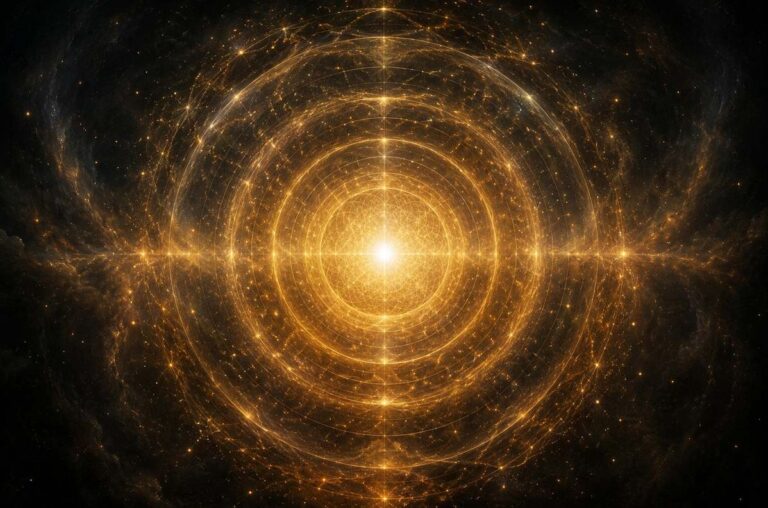
According to the holographic universe theory, the 3D world around you might just be a cosmic illusion, like a galactic movie playing on the screen of consciousness. This isn’t mystical speculation; it’s a revolutionary framework developed by distinguished physicists David Bohm and Karl Pribram, who independently arrived at the same startling conclusion: the universe behaves like a giant hologram where every tiny part contains the whole.
Recent breakthroughs in 2024 have only strengthened these foundations. Physicists at the Institute for Advanced Study, including Edward Witten, have uncovered new mathematical structures suggesting that our three-dimensional reality genuinely emerges from two-dimensional quantum information—precisely as Bohm intuited decades ago.
1. The Fractal Blueprint Within Your DNA
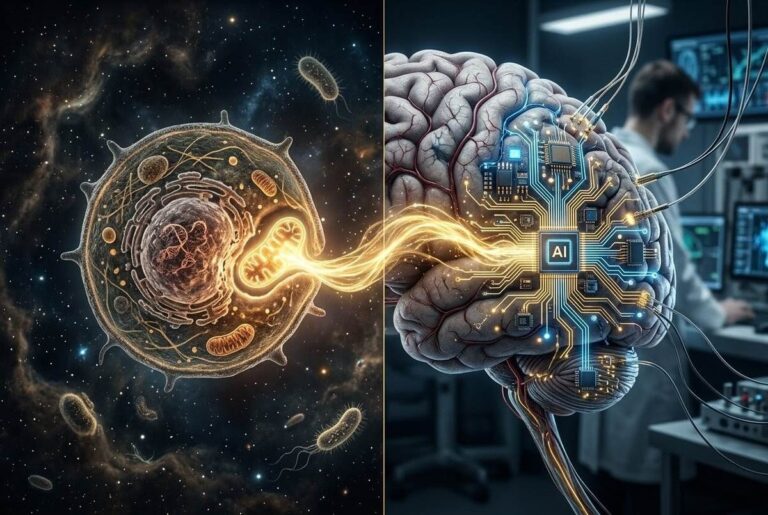
Your DNA isn’t merely biological code—it’s a fractal blueprint of the cosmos. Just as a hologram contains the entire image within each fragment, your genetic material reflects universal patterns. The human genome shares structural similarities with cosmic microwave background radiation and neural networks, suggesting that the same informational architecture operates from the quantum to the galactic scale.In a holographic model, the whole is enfolded in every part. This explains why quantum entanglement allows particles to remain connected regardless of distance—they’re not separate entities but extensions of the same fundamental unity.

2. Your Mind. The Projector Interpreting Waves into Matter
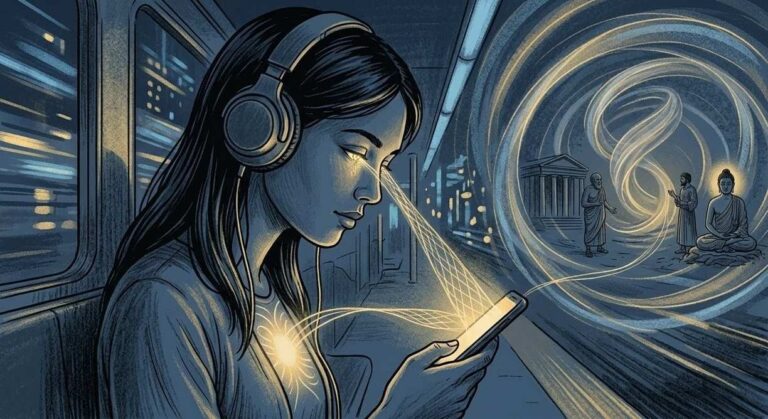
Karl Pribram, the Stanford neurophysiologist, discovered that the brain processes information holographically. Rather than storing memories in specific locations, your mind distributes them across neural networks as interference patterns—exactly how a hologram stores information
David Bohm described this as the implicate order—a deeper, enfolded reality where everything connects—contrasted with the explicate order, the unfolded 3D world we perceive. When you observe the world, you’re not passively receiving data; you’re actively decoding wave functions into the “solid” reality you experience.
This aligns with cutting-edge 2025 research suggesting consciousness arises from macroscopic quantum interactions between the zero-point field (the fluctuating energy ocean permeating all space) and glutamate, your brain’s primary neurotransmitter.
3. Black Holes. The Universe’s Hard Drives
Here’s where physics becomes extraordinary. Black holes don’t simply swallow light—they may store information on their event horizons like cosmic hard drives.
Stephen Hawking and Jacob Bekenstein discovered that black hole entropy increases proportionally with surface area, not volume. This defies classical physics: you can increase a black hole’s internal volume without affecting its entropy, suggesting that all information about its 3D contents is encoded on its 2D boundary.
Recent 2024 research using von Neumann algebras has revealed that mild quantum fluctuations transform spacetime algebra, making it possible to calculate entropy changes in black holes. This provides the most concrete evidence yet that black holes are fundamentally holographic systems.
The implication? The 3D universe you inhabit might be precisely such a projection from a 2D surface—exactly like the event horizon of a black hole.

4. Are You a Pixel or a Portal?
This presents a profound choice in perspective. Are you merely a pixel in someone else’s simulation, or are you a living gateway where Source observes itself through unique consciousness?
The holographic principle suggests the latter. If every fragment contains the whole, then your individual awareness isn’t separate from universal consciousness—it’s a localised expression of it. As Bohm demonstrated through his quantum potential research, particles don’t exist as independent entities but as manifestations of an indivisible cosmic whole.
2025 research on quantum entanglement and consciousness has provided empirical evidence that quantum processes enhance conscious experience and learning efficiency, suggesting our minds genuinely interact with fundamental quantum fields.

5. The Revolutionary Truth. You’re Not In the Universe—You Are the Universe
This is the ultimate paradigm shift. You’re not in the universe; you are the universe, experiencing itself from the inside out.
Every time you dream, love, or imagine, you engage with the holographic field. You bend the hologram. You shift timelines. You awaken the code. You are simultaneously the glitch and the upgrade, the spark and the screen.
Contemporary physics supports this participatory view. The Chapman University study (2025) reveals that agency and intelligence require both quantum and classical processes—suggesting consciousness operates precisely at the intersection where quantum potential collapses into experienced reality.
6. Consciousness as the Ground of Reality
The holographic model dissolves the hard problem of consciousness. Rather than asking how consciousness arises from matter, we recognise that matter arises from consciousness—or more precisely, from the quantum information field that consciousness accesses.
David Bohm’s “undivided universe” concept, developed with Basil Hiley, proposed that the fundamental reality is an unbroken wholeness where observer and observed are inherently connected. This isn’t philosophical idealism; it’s an interpretation consistent with quantum mechanics’ mathematical formalism.
When you look in the mirror, you’re not seeing light bouncing off matter. You’re witnessing the universe observing itself through your particular point of view.

7. Practical Implications – Living as a Conscious Creator
Understanding the holographic nature of reality transforms your relationship with existence:
- Non-local connection: Your consciousness isn’t confined to your skull—it interacts with the unified field.
- Creative participation: Your thoughts and intentions literally influence the quantum field, collapsing probability waves into specific outcomes.
- Empathic unity: If all separation is illusory, harming another is fundamentally harming yourself.
- Temporal fluidity: Past, present and future may exist simultaneously in the implicate order, accessible through intuition and dream states.
The next time you look in the mirror, ask yourself: Am I just light bouncing off matter, or am I the light behind it all?
The Science Behind the Mystery
The holographic principle has evolved significantly since Bohm and Pribram’s initial insights. The AdS/CFT correspondence (anti-de Sitter/conformal field theory), developed by Juan Maldacena in 1997, provided a rigorous mathematical framework showing how gravitational physics in a volume corresponds to quantum field theory on its boundary.
While originally applied to theoretical spaces unlike our universe, recent “celestial holography” research (2020-2024) extends these principles to asymptotically flat spacetimes—closer to our actual cosmic environment. The Celestial Holography Initiative at Perimeter Institute, supported by the Simons Foundation, aims to make these theories testable using gravitational wave detection through LIGO or LISA.
Edward Witten’s 2024 discovery that quantum fluctuations transform spacetime algebra represents a potential breakthrough, offering “a more concrete hint that [black hole] entropies do indeed reflect their microscopic parts”—essentially proving the holographic nature of quantum gravity.
Final Reflection
The holographic universe theory isn’t merely an abstract physics concept—it’s an invitation to recognise your fundamental nature. You are not a passive observer in a predetermined cosmos. You are an active participant in the ongoing creation of reality, a unique perspective through which the infinite explores its own possibilities.
Every breath you take is the universe breathing. Every thought you think is the cosmos contemplating itself. Every love you feel is the holographic field recognising its own beauty.
You are the universe, remembering itself
Further Reading & Resources:
- Bohm, D. (1980). Wholeness and the Implicate Order . Routledge.
- Pribram, K. (1991). Brain and Perception . Lawrence Erlbaum Associates.
- Talbot, M. (1991). The Holographic Universe . Harper Perennial.
- Susskind, L. (1995). “The World as a Hologram.” Journal of Mathematical Physics .