The Quantum Mind: 2026 Evidence That Consciousness Is Fundamental
The quantum mind is one of the most fascinating and most easily abused frontiers in consciousness studies. It asks whether mind is only a by-product of ordinary brain computation, or whether quantum processes, integrated information, field models, and the strange structure of reality itself may force us to think more deeply. The evidence does not prove that consciousness is fundamental. It does, however, keep the question open in ways that matter for science, philosophy, and Gnostic reflection.
In Plain Terms
The hard problem of consciousness asks why there is subjective experience at all. Why is there something it is like to see red, feel grief, hear music, taste honey, or know oneself from the inside? Neuroscience can map brain activity, but the leap from activity to experience remains unresolved.
The quantum mind hypothesis is not one single theory. It is a family of proposals suggesting that consciousness may involve quantum processes, non-classical information, microtubules, field effects, or deep features of physical reality not captured by ordinary neural-computation models.
Some research is genuinely intriguing. Microtubules may play a role in anaesthetic action. Quantum biology has shown that living systems can exploit quantum effects in certain contexts. Integrated Information Theory offers a formal account of consciousness as irreducible causal structure. Field theories ask whether mind is better understood as distributed, relational, or fundamental.
But none of this proves that consciousness survives death, that the soul has been scientifically measured, or that human observation collapses the wave function into reality. The useful position is more careful and more powerful: consciousness remains unexplained, and several serious research frontiers are challenging the old assumption that mind is merely a late accident of matter.
Primary Sources and Traditions Discussed
- The hard problem of consciousness: the philosophical problem of why physical processes are accompanied by subjective experience.
- Orch-OR theory: Stuart Hameroff and Roger Penrose’s proposal that orchestrated quantum processes in microtubules may contribute to consciousness.
- Microtubule and anaesthesia research: studies asking whether anaesthetics affect microtubule dynamics and whether this matters for consciousness.
- Integrated Information Theory: a mathematical theory proposing that consciousness corresponds to irreducible causal structure or integrated information.
- Global Neuronal Workspace Theory: a major competing theory that links consciousness to widespread availability of information across brain networks.
- Quantum field and panpsychist models: speculative frameworks exploring whether consciousness is fundamental, field-like, or present at basic levels of reality.
- Gnostic anthropology: the ancient distinction between body, soul, and spirit, including the image of the divine spark as not reducible to material identity.
- Contemplative practice: attention, witness consciousness, embodiment, and direct recognition as practical ways of investigating experience.
How to Read This Article
This article uses quantum consciousness research as a frontier, not as a trophy cabinet. It does not claim that science has confirmed Gnosticism, proven the soul, verified immortality, or demonstrated that meditation edits the universe like a cosmic spreadsheet.
The stronger claim is subtler. The scientific study of consciousness is not closed. Materialist explanations remain powerful but incomplete. Quantum biology, anaesthesia studies, IIT, field theories, and philosophical models all show that the relation between mind and matter is still deeply contested.
The Gnostic resonance matters because ancient Gnostic texts also refused to reduce the human being to flesh alone. They spoke of a spark, a deeper identity, a knowing that wakes from the lower order. That does not make quantum mechanics a Gnostic doctrine. It means the old symbolic map and the modern scientific question touch the same abyss from different sides.
The quantum mind is not proof that mysticism was right. It is a reminder that consciousness remains the locked room at the centre of the scientific house.
Table of Contents
- When the Hard Problem Refuses to Crack
- The Evidence Landscape: Three Converging Frontiers
- Frontier 1: Quantum Biology and Microtubules
- Frontier 2: Integrated Information Theory and Consciousness Testing
- Frontier 3: Field Theories and Consciousness as Fundamental
- The Gnostic Resonance: Ancient Spark, Modern Question
- The Observer Effect: What Quantum Physics Does and Does Not Say
- Living the Recognition: Practice Without Quantum Inflation
- The Science of the Spark: From Proof Claims to Serious Mystery
- Related Glossary Terms
- Read Next
- Frequently Asked Questions
- Further Reading
- References and Sources
When the Hard Problem Refuses to Crack
The hard problem of consciousness is not the problem of how the brain processes information, controls attention, stores memory, or coordinates behaviour. Those are difficult problems, but they are at least tractable within ordinary neuroscience. The hard problem asks why any of that processing should feel like anything from the inside.
A camera can register colour. A brain can respond to colour. But why is there redness? A nervous system can process pain. But why does pain hurt? A model can classify emotion. But why is grief lived as a world-darkening interior weather?
This is where consciousness resists reduction. The brain is clearly involved in conscious experience. Damage the brain, alter the brain, sedate the brain, stimulate the brain, and experience changes. But correlation does not automatically solve ontology. A radio is involved in receiving a broadcast, but that does not prove the broadcast is manufactured entirely by the radio. The analogy is imperfect, but the caution remains useful.
Quantum mind theories enter this gap. They ask whether ordinary neural computation is enough, or whether deeper physical processes are required. Some proposals are speculative. Some are controversial. Some are easy to abuse with mystical glitter. But the question is legitimate: is consciousness classical, quantum, informational, field-like, fundamental, emergent, or something our current categories do not yet hold?
The Evidence Landscape: Three Converging Frontiers
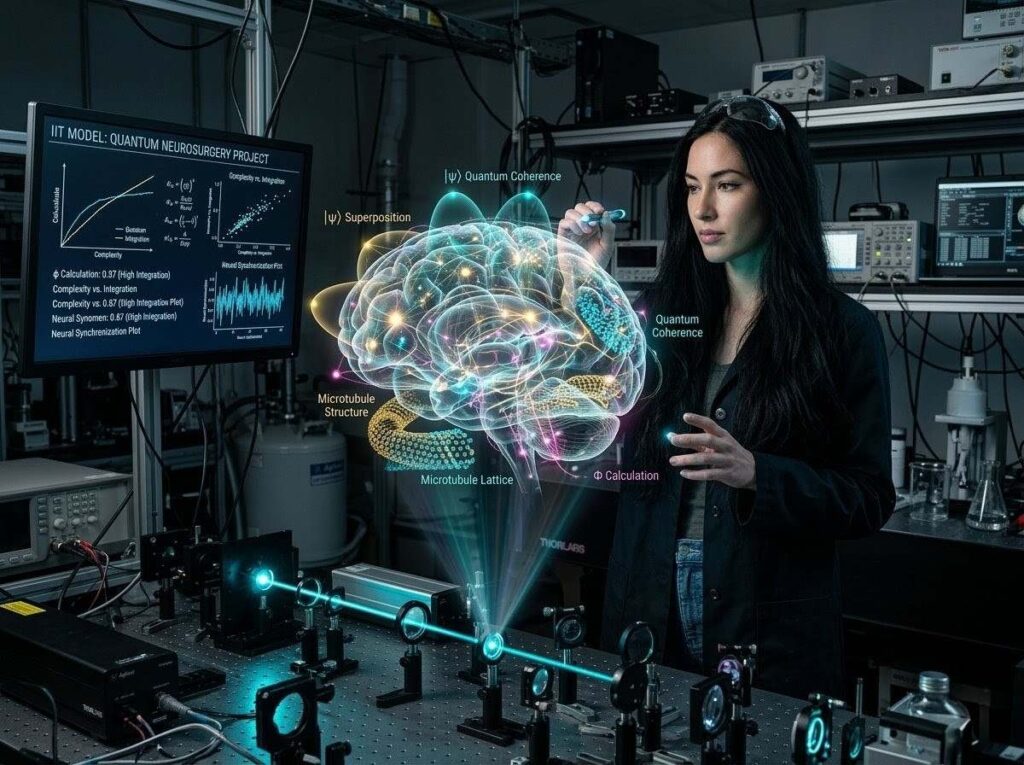
Three research frontiers matter most for a careful discussion of the quantum mind: quantum biology and microtubules, formal theories such as Integrated Information Theory, and broader field or fundamental-consciousness models. They do not all say the same thing, and they should not be collapsed into one grand certainty.
What they share is pressure on a simple materialist story. Consciousness may not be easily explained as “neurons firing until experience appears”. The real picture may involve organisation, integration, information, field dynamics, biological quantum effects, or properties of reality that current neuroscience has only begun to describe.
Frontier 1: Quantum Biology and Microtubules
Quantum biology has already shown that living systems can make use of quantum effects in some contexts, including photosynthesis, enzyme behaviour, magnetoreception, and molecular dynamics. This does not mean the whole brain is a magic quantum computer. It means the old assumption that warm, wet biology automatically destroys all meaningful quantum effects was too simple.
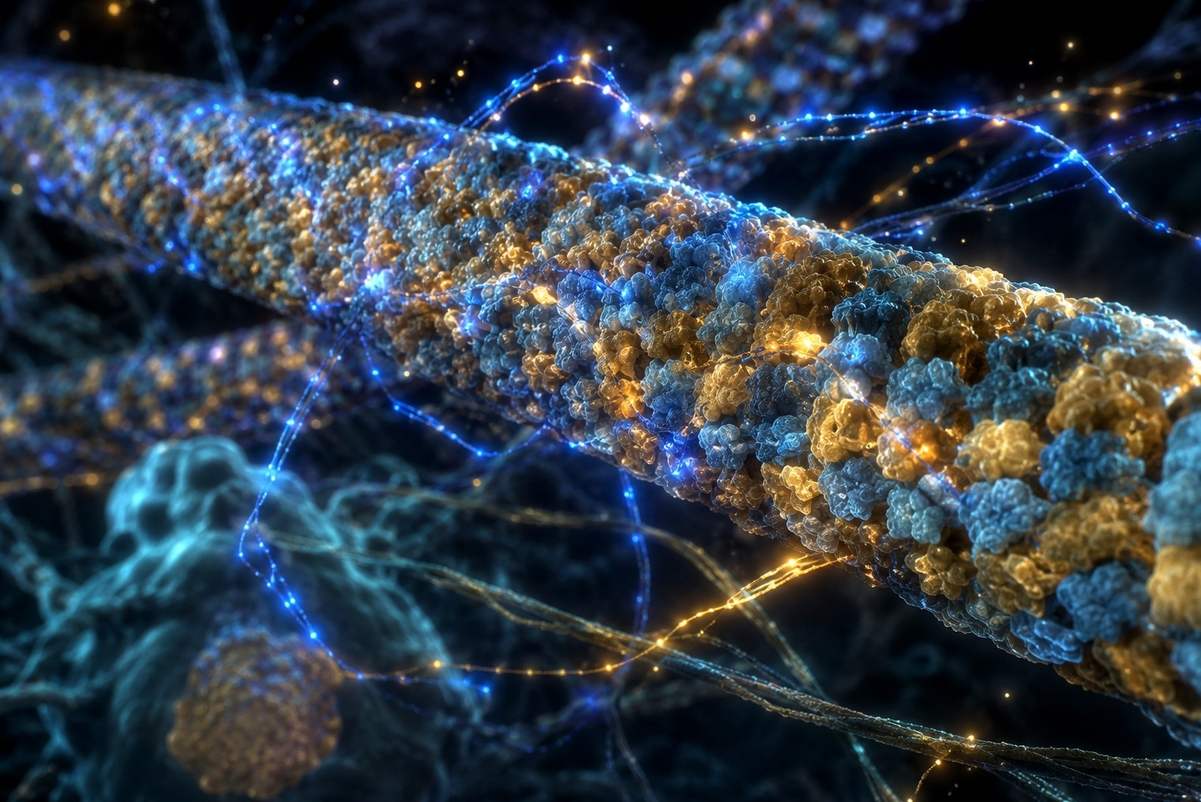
The microtubule question sits inside this wider shift. Microtubules are cytoskeletal structures found inside cells, including neurons. They help organise cell shape, transport, division, and intracellular dynamics. Hameroff and Penrose’s Orch-OR theory proposes that microtubules may support orchestrated quantum processes related to moments of consciousness.
Orch-OR remains controversial. Many neuroscientists and physicists doubt that microtubules can sustain the relevant quantum states in the brain long enough, or that the theory explains subjective experience better than competing models. Yet recent anaesthesia-related research has kept the theory alive enough to discuss carefully.
- Microtubules and anaesthesia: some studies suggest anaesthetics may interact with tubulin or microtubule dynamics in ways relevant to loss of consciousness.
- Terahertz oscillations: research has explored whether anaesthetic effects on tubulin oscillations correlate with anaesthetic potency.
- Microtubule stabilisation: animal research has reported that a microtubule-stabilising agent delayed anaesthetic-induced unconsciousness in rats.
- Interpretive caution: these findings suggest microtubules may matter for anaesthesia and consciousness mechanisms, but they do not prove quantum consciousness or Orch-OR.
The strongest version of the claim is not “microtubules prove the soul”. It is this: consciousness may depend on intracellular and molecular processes more deeply than older neuron-only models assumed. The brain may be less like a simple electrical switchboard and more like a layered biological instrument, with computation, chemistry, rhythm, structure, and perhaps quantum-sensitive dynamics all participating.
That is already enough to matter. The Gnostic reader does not need to turn tubulin into scripture. The real resonance is that consciousness may not be reducible to surface-level mechanism. There may be depth beneath the neural surface, a hidden architecture in the cell’s own cathedral.
Frontier 2: Integrated Information Theory and Consciousness Testing
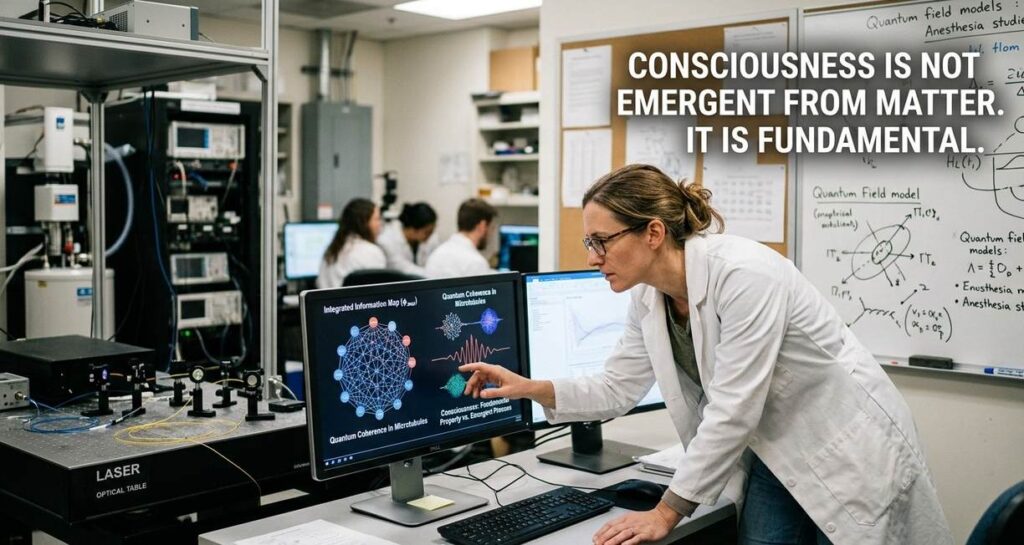
Integrated Information Theory, or IIT, takes a different route. It does not depend on microtubules or quantum collapse. Instead, IIT begins from the structure of experience itself and asks what kind of physical substrate could account for it.
IIT proposes that consciousness corresponds to a system’s intrinsic causal power: the degree to which it is both differentiated and integrated. A conscious experience is unified, but also structured. It contains many distinctions within one field. IIT tries to express that unity and differentiation mathematically.
IIT 4.0 strengthened and revised the theory’s formal framework. It attempts to translate properties of experience into operational and mathematical terms. In principle, IIT can be applied beyond biological brains, which is why it often enters discussions of artificial intelligence, panpsychism, and substrate independence.
But IIT is also controversial. Critics argue that it can imply consciousness in systems that many people would not intuitively regard as conscious. Others dispute its assumptions about causality, exclusion, or physical substrate. Some scientists have strongly criticised it. The debate remains alive, and that matters.
The major adversarial collaboration comparing IIT with Global Neuronal Workspace Theory was important because it tested competing predictions rather than letting rival camps build castles in separate fog banks. The results challenged both theories and did not crown a simple winner. That is not failure. That is science doing something useful: making theories risk contact with evidence.
For Gnostic reflection, IIT is interesting because it treats consciousness as something that must be understood from the inside as well as measured from the outside. It does not simply say: find the behaviour and consciousness follows. It asks what kind of structure could be identical with experience itself.
That does not make IIT Gnostic. But it does resonate with a Gnostic instinct: consciousness is not an accidental decoration on matter. It is central to what reality is like when known from within.
Frontier 3: Field Theories and Consciousness as Fundamental
A third frontier includes quantum field theories of consciousness, electromagnetic field theories, panpsychism, neutral monism, cosmopsychism, and other models that treat consciousness as more fundamental than standard materialism allows.
These theories vary widely. Some argue that consciousness is a basic feature of reality. Some propose that matter and mind are two aspects of a deeper neutral substrate. Some suggest that consciousness belongs not only to brains but to integrated physical systems. Others remain speculative attempts to connect quantum fields, information, and subjective experience.
The temptation is to leap too quickly: quantum fields exist everywhere; therefore consciousness exists everywhere; therefore the universe is a mind; therefore ancient mystics were scientifically correct. That leap is too easy. It turns mystery into slogan.
The more disciplined version is this: if consciousness cannot be explained by current physicalist models, then serious alternatives deserve philosophical and scientific attention. Panpsychist and field-like theories are not proven, but they are no longer dismissible merely because they sound strange. The hard problem has made strange company respectable.
For the Gnostic imagination, these models echo the Pleroma: fullness, field, depth, source, and living ground. But echo is not identity. Physics and myth speak different languages. The skill is to let them illuminate one another without forcing either into costume.
The Gnostic Resonance: Ancient Spark, Modern Question
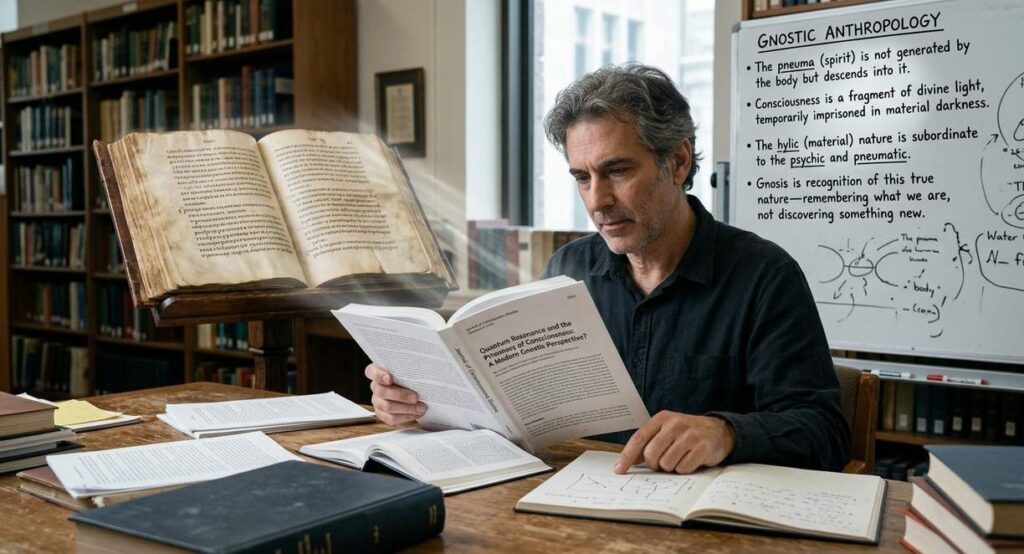
Ancient Gnostic traditions often describe the human being as layered. There is body, psyche, and pneuma. There is ordinary identity and deeper origin. There is the world of appearances and the Fullness beyond it. There is forgetfulness and recognition. The divine spark is not manufactured by the lower world; it is hidden within it.
Modern quantum mind theories should not be used as crude confirmation of that symbolic map. The ancient Gnostics were not writing papers on microtubules, integrated information, or quantum fields. But the resonance is real because both ask whether consciousness is secondary or primary.
The Gnostic question is not simply “what is the brain doing?” It is “who is aware of the brain, the world, the self, and the system?” That question does not replace neuroscience. It cuts beneath it like a hidden river.
The Divine Spark
In Gnostic language, the divine spark is the hidden light within the human being, the element that remembers its source beyond the lower order. It is not the ego, personality, social identity, or biological appetite. It is the depth-dimension of awareness that can recognise itself as more than the system that contains it.
The quantum mind does not prove the spark. It gives modern readers another way to question the assumption that consciousness is merely a by-product of local matter. It opens a conceptual door: what if awareness is not only generated from below, but also discloses something fundamental about reality?
Descent into Matter
Gnostic myth often speaks of descent: spirit enters the lower world, becomes entangled with body and fate, and forgets its origin. Quantum language should not be forced onto that myth too literally. Decoherence is not the Fall of Sophia in a laboratory coat.
Still, the symbolic parallel is useful. Quantum possibilities become definite in interaction with an environment. The open becomes constrained. The many becomes one realised outcome. In contemplative life, the same movement appears psychologically: identity collapses around roles, fears, habits, memories, and social scripts.
The myth says: you are more than the collapsed version of yourself.
Archonic Constraint
The Archons represent powers that limit, administer, and define reality from below. In a modern symbolic reading, they include the forces that collapse awareness into narrow identity: fear, habit, ideology, algorithmic capture, social conditioning, trauma, compulsive thought, and the tyranny of the measurable.
Quantum mechanics does not need Archons. But the Gnostic symbol helps interpret the psychological and cultural problem: the deeper field of awareness is constantly reduced to what can be named, tracked, scored, feared, sold, or controlled.
Gnosis and Liberation
Gnosis is not the acquisition of exotic information. It is direct recognition. In this context, gnosis is the recognition that consciousness is not exhausted by thought, identity, data, or bodily process. The body matters. The brain matters. The nervous system matters. But awareness cannot be fully captured by the descriptions made within awareness.
This is why contemplative practice remains central. The quantum mind may be interesting, but direct inquiry into awareness is where the question becomes lived rather than merely discussed.
The Observer Effect: What Quantum Physics Does and Does Not Say
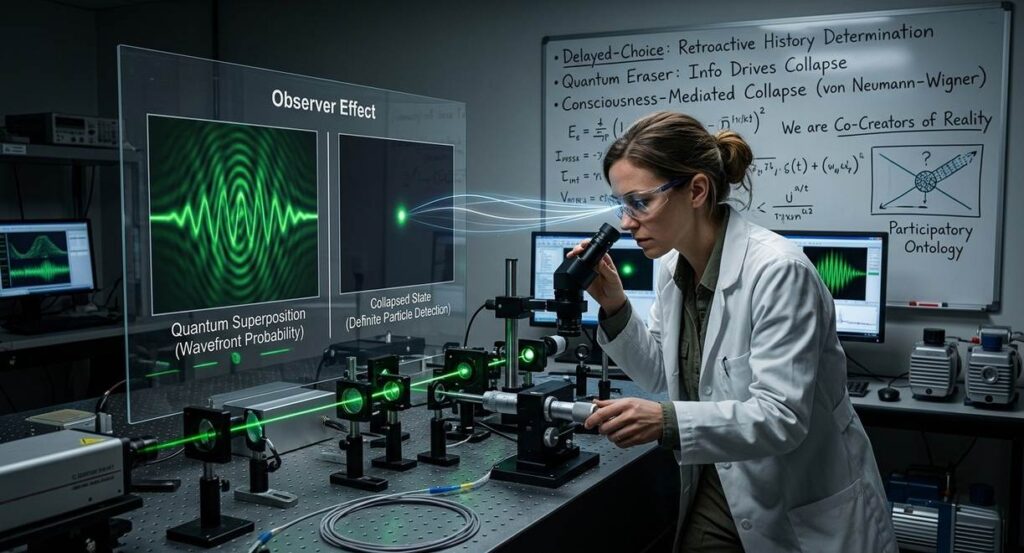
The observer effect is one of the most misused ideas in popular spirituality. In quantum mechanics, measurement matters. The way a system is measured affects what can be known and what outcomes appear. But “observer” does not necessarily mean a conscious human mind looking at something. It usually means a physical interaction, measurement apparatus, or information-producing process.
Delayed-choice experiments and quantum-eraser experiments are genuinely strange. They challenge naïve ideas of particles as tiny billiard balls moving through pre-existing paths. But they do not prove that human consciousness retroactively changes history, nor that attention alone creates external reality.
This matters because bad quantum mysticism can inflate the ego. “I create reality with my mind” is often less enlightenment than metaphysical narcissism wearing a lab badge. The deeper insight is humbler: reality is not as simple, solid, or observer-independent as ordinary perception suggests. Participation matters, but not in the cartoon sense that thought magically commands the cosmos.
A more careful spiritual reading is this: attention changes the world we inhabit psychologically, relationally, and behaviourally. It shapes perception, choice, emotion, memory, and meaning. It may also participate in deeper mysteries of reality we do not yet understand. But honest practice does not pretend to know more than the evidence allows.
Living the Recognition: Practice Without Quantum Inflation
If consciousness may be more fundamental than conventional materialism assumes, how should we live? The answer is not to become grandiose. It is to become more attentive, embodied, humble, and precise.
Attention as Participation
Attention is not passive. Even without quantum speculation, attention changes experience. What you attend to becomes more vivid. What you repeatedly attend to becomes part of character. Attention trains emotion, desire, identity, memory, and the nervous system.
In practice, attention is the lamp of the temple. Point it carelessly, and the inner world becomes cluttered with shadows. Point it steadily, and hidden architecture begins to appear.
Non-Locality as Symbolic Humility
Quantum entanglement does not prove telepathy, cosmic unity, or instant soul-communication. But it does undermine a crude picture of reality as separate objects with only local, mechanical relationships. At minimum, it teaches humility: the world is stranger than everyday perception suggests.
Spiritually, that humility can deepen compassion. The self is not sealed marble. It is relational, porous, shaped by others, language, attention, memory, ecology, and the unseen networks of life. Whether or not consciousness is quantum, separateness is already less final than it feels.
The Body as Instrument, Not Prison
Some Gnostic language can sound hostile to the body, but a mature reading is more careful. The body is not merely a prison. It is also the instrument through which recognition becomes lived. Breath, posture, sleep, diet, movement, touch, and nervous-system regulation all affect awareness.
If consciousness is deeper than the body, that does not make the body disposable. It makes embodiment sacred: the local instrument through which non-local mystery learns to speak in hands, eyes, grief, love, and action.
Death as Mystery, Not Slogan
Quantum mind theories do not prove survival after death. They may be compatible with some models of consciousness beyond ordinary biological life, but compatibility is not confirmation. Near-death experiences, afterlife traditions, and Gnostic return myths remain important human testimony and symbolic material, but they are not settled by microtubule research.
The wise position is neither denial nor certainty. Death remains the great threshold. Gnosis does not require pretending to possess a map of every corridor beyond it. It asks us to live now with the seriousness of beings whose awareness may be deeper than the story told by matter alone.
The Science of the Spark: From Proof Claims to Serious Mystery
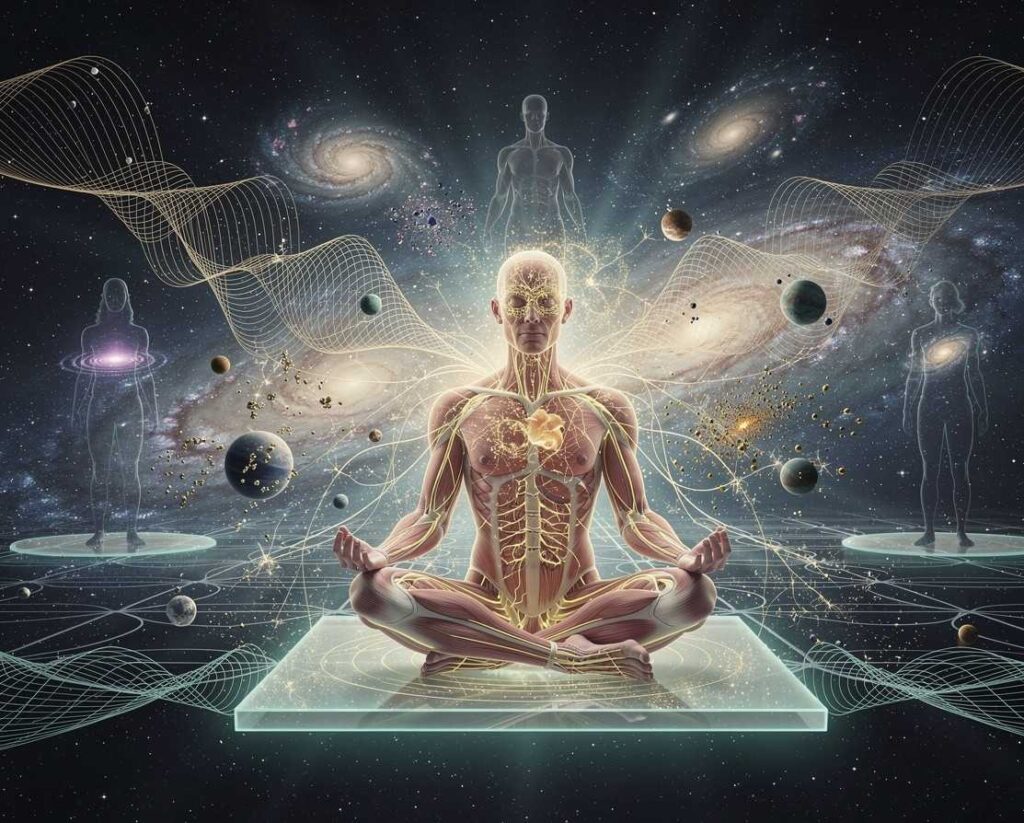
The quantum mind hypothesis remains unproven. That sentence is not a defeat. It is the floor beneath honest exploration. Science advances by testing, criticising, refining, and sometimes abandoning beautiful ideas. A theory that cannot survive correction is not a theory; it is incense with footnotes.
What can be said responsibly?
- The hard problem of consciousness remains unresolved.
- Quantum biology shows that living systems can involve non-classical effects in some contexts.
- Microtubules may be relevant to anaesthesia and consciousness mechanisms, but this remains debated.
- IIT offers a serious mathematical framework, but it is controversial and not proven.
- Field and fundamental-consciousness theories are philosophically important, but mostly speculative.
- Quantum mechanics does not prove that human consciousness creates physical reality by observation alone.
- Gnostic symbolism remains powerful as a map of recognition, not as a substitute for empirical evidence.
That is enough. The mystery does not need exaggeration. Consciousness is already astonishing without making every quantum experiment carry a crystal crown.
The question is not whether quantum theory proves the divine spark. The question is why the spark of awareness remains so difficult to fit inside any theory that treats matter as the whole story.
The contemporary Gnostic does not reject science. The contemporary Gnostic also does not bow before reduction. Between denial and inflation lies the living path: study carefully, practise deeply, speak honestly, and keep the mystery bright without pretending it has been solved.
Related Glossary Terms
These terms help clarify the consciousness, quantum, Gnostic, and philosophical framework behind this article:
- Hard problem of consciousness: the question of why physical processes are accompanied by subjective experience.
- Quantum mind: umbrella term for theories suggesting that quantum processes may contribute to consciousness.
- Orch-OR: Orchestrated Objective Reduction, Hameroff and Penrose’s theory linking consciousness to quantum processes in microtubules.
- Microtubules: cellular structures involved in shape, transport, division, and intracellular organisation; proposed by Orch-OR as relevant to consciousness.
- Integrated Information Theory: theory proposing that consciousness corresponds to irreducible integrated causal structure.
- Global Neuronal Workspace Theory: theory linking consciousness to information becoming globally available across brain networks.
- Panpsychism: philosophical view that consciousness or proto-consciousness may be a basic feature of reality.
- Neutral monism: view that mind and matter may be two aspects of a deeper neutral reality.
- Observer effect: in quantum mechanics, the fact that measurement interactions affect the system being measured; not necessarily conscious observation.
- Decoherence: the process by which quantum systems lose interference-like behaviour through interaction with the environment.
- Divine spark: Gnostic image of the hidden light or spiritual element within the human being.
- Pleroma: the divine fullness in Gnostic cosmology, symbolising source, completeness, and the reality beyond deficiency.
- Gnosis: direct liberating recognition, not merely belief, theory, or information.
Read Next
For the strongest next step, continue into the related article on consciousness as interface:
Consciousness as Interface: The User Experience of Being
This companion article explores whether ordinary perception is less a transparent window onto reality and more a rendered interface through which awareness navigates a structured world.
Frequently Asked Questions About Quantum Consciousness
What is the quantum mind hypothesis?
The quantum mind hypothesis is an umbrella term for theories suggesting that quantum processes may play a role in consciousness. The best-known version is Orch-OR, proposed by Stuart Hameroff and Roger Penrose, which links consciousness to possible quantum processes in neuronal microtubules. The hypothesis remains controversial and unproven, but ongoing research into microtubules, anaesthesia, and quantum biology keeps the debate active.
Does quantum consciousness prove that the soul exists?
No. Quantum consciousness theories do not prove the soul in theological or Gnostic terms. They may be compatible with some spiritual ideas about consciousness being deeper than brain computation, but compatibility is not proof. The divine spark remains a symbolic and spiritual concept, while quantum mind theories remain scientific and philosophical hypotheses under debate.
Does the observer effect mean consciousness creates reality?
Not in the simple popular sense. In quantum physics, measurement affects what can be known and which outcomes appear, but observer usually means a physical measuring interaction, not necessarily a conscious human mind. Delayed-choice and quantum-eraser experiments are strange, but they do not prove that personal thoughts or attention magically create external reality.
What is Orch-OR theory?
Orch-OR, or Orchestrated Objective Reduction, is a theory developed by Stuart Hameroff and Roger Penrose. It proposes that moments of consciousness may involve orchestrated quantum processes in microtubules inside neurons. Some anaesthesia and microtubule studies are compatible with parts of the theory, but Orch-OR remains controversial and is not accepted as established neuroscience.
What is Integrated Information Theory?
Integrated Information Theory, or IIT, proposes that consciousness corresponds to irreducible integrated causal structure. It attempts to describe consciousness mathematically by asking how unified and differentiated a system is from its own intrinsic perspective. IIT 4.0 refined the theory, but IIT remains debated and has not been proven as the final explanation of consciousness.
Is consciousness fundamental according to science?
Science has not proven that consciousness is fundamental. Some theories, including panpsychism, neutral monism, field theories, and certain interpretations of IIT or quantum consciousness, explore that possibility. Other major theories treat consciousness as emerging from brain activity. The honest position is that consciousness remains unresolved, and multiple competing frameworks are still being tested.
How does the quantum mind relate to Gnosticism?
The relationship is symbolic and philosophical, not literal proof. Gnosticism teaches that the human being contains a divine spark not reducible to material identity. Quantum mind theories challenge simple materialist assumptions about consciousness. Both raise the possibility that awareness is deeper than ordinary physical description, but modern physics should not be treated as automatic confirmation of ancient Gnostic doctrine.
Study Note: This article explores consciousness studies, quantum mind theories, Gnostic symbolism, microtubules, IIT, field theories, and contemplative practice for educational and reflective purposes. It does not provide medical, psychological, psychiatric, neurological, spiritual-direction, or scientific advice. Quantum consciousness theories remain debated and should not be used to avoid healthcare, therapy, medication, grief support, or practical responsibility. If contemplation of consciousness, death, reality, or metaphysics increases anxiety, derealisation, dissociation, insomnia, panic, grandiosity, or inability to function, pause the material and seek qualified support.
Follow the Consciousness Route
This article belongs to the route through consciousness, perception, altered states, science, symbolism, and direct recognition.
- Consciousness & Cognition – the wider layer for mind, brain, awareness, and knowing.
- Phenomenology – direct experience, perception, selfhood, and the structure of awareness.
- Simulation Hypothesis – digital physics, rendered reality, code, and interface theories.
- The Thread – the main route through ZenithEye’s symbolic, historical, and contemporary architecture.
Further Reading
The following live ZenithEye links continue the themes of consciousness, quantum reality, perception, direct knowing, mystical experience, and Gnostic recognition:
- Consciousness as Interface: The User Experience of Being – Phenomenology of awareness, perception as rendered interface, and the question of whether experience shows reality directly.
- States of Knowing: What Happens When Consciousness No Longer Belongs to You – Non-ordinary states, altered perception, and the destabilising power of direct experience.
- Simulation Hypothesis: 7 Clues That Reality Might Be Code – Digital physics, informational reality, and the possibility that the world behaves like rendered structure.
- Gnosis: Direct Knowing Beyond Belief and Reason – The foundational concept of transformative recognition that changes the knower rather than merely adding information.
- The Transformation: What Actually Changes After Mystical Experience – How direct knowing restructures perception, identity, embodiment, and ordinary life.
- The Gnostic Theory of Consciousness: A Psychological Analysis – Ancient Gnostic models of mind, identity, and awakening read through psychological lenses.
- Planes of Consciousness: The 7 Dimensions You Already Inhabit – A symbolic map of layered awareness and states beyond ordinary waking identity.
- The Physiology of Mystical Experience: What Changes in the Brain – Neuroscientific correlates of mystical states, altered perception, and lasting transformation.
- The Neuroscience of Ego Dissolution: DMN and the Gnostic Spark – How self-referential networks quieten during profound mystical, meditative, and psychedelic states.
References and Sources
The following sources support the consciousness-studies, quantum-mind, Gnostic, philosophical, and contemplative framework used in this article.
Consciousness Studies and Philosophy of Mind
- Chalmers, David J. (1996). The Conscious Mind: In Search of a Fundamental Theory. Oxford: Oxford University Press.
- Nagel, Thomas. (1974). “What Is It Like to Be a Bat?” The Philosophical Review, 83(4), 435-450.
- Strawson, Galen. (2006). Consciousness and Its Place in Nature. Exeter: Imprint Academic.
- Goff, Philip. (2019). Galileo’s Error: Foundations for a New Science of Consciousness. New York: Pantheon.
- Seth, Anil. (2021). Being You: A New Science of Consciousness. London: Faber & Faber.
- Dehaene, Stanislas. (2014). Consciousness and the Brain: Deciphering How the Brain Codes Our Thoughts. New York: Viking.
Integrated Information Theory and Adversarial Testing
- Albantakis, Larissa, et al. (2023). “Integrated Information Theory (IIT) 4.0: Formulating the Properties of Phenomenal Existence in Physical Terms.” PLOS Computational Biology, 19(10), e1011465.
- Mediano, Pedro A. M., et al. (2022). “Integrated Information Theory: The Good, the Bad and the Misunderstood.” arXiv preprint.
- Cogitate Consortium. (2025). “Adversarial Testing of Global Neuronal Workspace and Integrated Information Theories of Consciousness.” Nature, 642, 133-142.
- Tononi, Giulio. (2004). “An Information Integration Theory of Consciousness.” BMC Neuroscience, 5, 42.
- Oizumi, Masafumi, Albantakis, Larissa, and Tononi, Giulio. (2014). “From the Phenomenology to the Mechanisms of Consciousness: Integrated Information Theory 3.0.” PLOS Computational Biology, 10(5), e1003588.
Quantum Mind, Microtubules, and Anaesthesia
- Hameroff, Stuart, and Penrose, Roger. (1996). “Orchestrated Reduction of Quantum Coherence in Brain Microtubules: A Model for Consciousness.” Mathematics and Computers in Simulation, 40, 453-480.
- Hameroff, Stuart, and Penrose, Roger. (2014). “Consciousness in the Universe: A Review of the ‘Orch OR’ Theory.” Physics of Life Reviews, 11(1), 39-78.
- Craddock, Travis J. A., Kurian, P., Preto, J., et al. (2017). “Anesthetic Alterations of Collective Terahertz Oscillations in Tubulin Correlate with Clinical Potency.” Scientific Reports, 7, 9877.
- Khan, Sana, et al. (2024). “Microtubule-Stabilizer Epothilone B Delays Anesthetic-Induced Unconsciousness in Rats.” eNeuro, 11(8).
- Wiest, Michael C. (2025). “A Quantum Microtubule Substrate of Consciousness Is Supported by Recent Evidence.” Neuroscience of Consciousness.
- Tegmark, Max. (2000). “Importance of Quantum Decoherence in Brain Processes.” Physical Review E, 61(4), 4194-4206.
- Koch, Christof, and Hepp, Klaus. (2006). “Quantum Mechanics in the Brain.” Nature, 440, 611-612.
Quantum Measurement and Observer Caution
- Wheeler, John Archibald, and Zurek, Wojciech Hubert, eds. (1983). Quantum Theory and Measurement. Princeton: Princeton University Press.
- Zurek, Wojciech H. (2003). “Decoherence, Einselection, and the Quantum Origins of the Classical.” Reviews of Modern Physics, 75, 715-775.
- Kastner, Ruth E. (2019). “The ‘Delayed Choice Quantum Eraser’ Neither Erases Nor Delays.” arXiv preprint.
- Fearn, H. (2015). “A Delayed Choice Quantum Eraser Explained by the Transactional Interpretation of Quantum Mechanics.” arXiv preprint.
- de Barros, J. Acacio, and Oas, Gary. (2016). “Can We Falsify the Consciousness-Causes-Collapse Hypothesis in Quantum Mechanics?” arXiv preprint.
Gnostic and Comparative Sources
- Apocryphon of John. Nag Hammadi Codex II,1; III,1; IV,1; Berlin Codex 8502,2.
- Gospel of Thomas. Nag Hammadi Codex II,2.
- Gospel of Philip. Nag Hammadi Codex II,3.
- Robinson, James M., ed. (1990). The Nag Hammadi Library in English. Revised edition. San Francisco: HarperOne.
- Meyer, Marvin, ed. (2007). The Nag Hammadi Scriptures. New York: HarperOne.
- Jonas, Hans. (1958). The Gnostic Religion. Boston: Beacon Press.
- King, Karen L. (2003). What Is Gnosticism? Cambridge: Harvard University Press.
- Williams, Michael Allen. (1996). Rethinking “Gnosticism”: An Argument for Dismantling a Dubious Category. Princeton: Princeton University Press.
Meditation, Mystical Experience, and the Brain
- Goleman, Daniel, and Davidson, Richard J. (2017). Altered Traits: Science Reveals How Meditation Changes Your Mind, Brain, and Body. New York: Avery.
- Hölzel, Britta K., et al. (2011). “Mindfulness Practice Leads to Increases in Regional Brain Gray Matter Density.” Psychiatry Research: Neuroimaging, 191(1), 36-43.
- Brewer, Judson A., et al. (2011). “Meditation Experience Is Associated with Differences in Default Mode Network Activity and Connectivity.” Proceedings of the National Academy of Sciences, 108(50), 20254-20259.
- Newberg, Andrew, and Waldman, Mark Robert. (2009). How God Changes Your Brain. New York: Ballantine Books.