
Syncretism vs. Synthesis: The Difference That Preserves the Thread
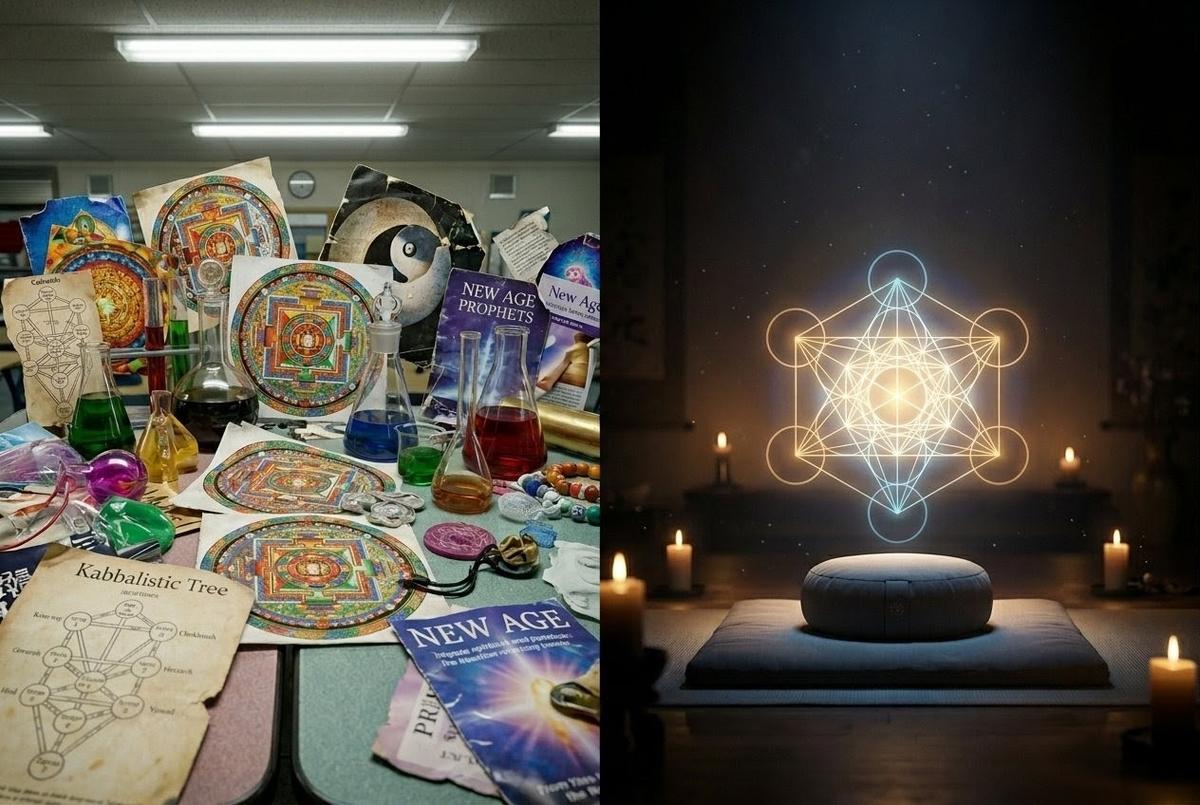
You have walked the aisles of the spiritual supermarket. Shelves stocked with Sanskrit mantras beside Egyptian hieroglyphs, Celtic knots tangled with Buddhist mudras, the I Ching sitting atop tarot decks. The modern seeker faces an embarrassment of riches–and a poverty of depth. The temptation is immediate: take a little from each, combine them, create your own bespoke path. This is the age of the spiritual buffet, where traditions are sampled but rarely mastered.
But the universe is not a pick-and-mix sweet shop. The thread that connects genuine esoteric transmission requires more than aesthetic appreciation. It demands structural integrity. And here lies the distinction that separates the tourist from the initiate: syncretism versus synthesis. The difference is not academic. It is the difference between accumulation and transformation, between spiritual entertainment and the genuine article.
Table of Contents
- The Mechanism of Collapse: Why Syncretism Fails
- The Discipline of Deep Fluency
- The Architecture Beneath
- The Operational Test
- The Thread Extended
- Frequently Asked Questions
- Further Reading
- References and Sources
The Mechanism of Collapse: Why Syncretism Fails
The Confusion of Symbol with Structure
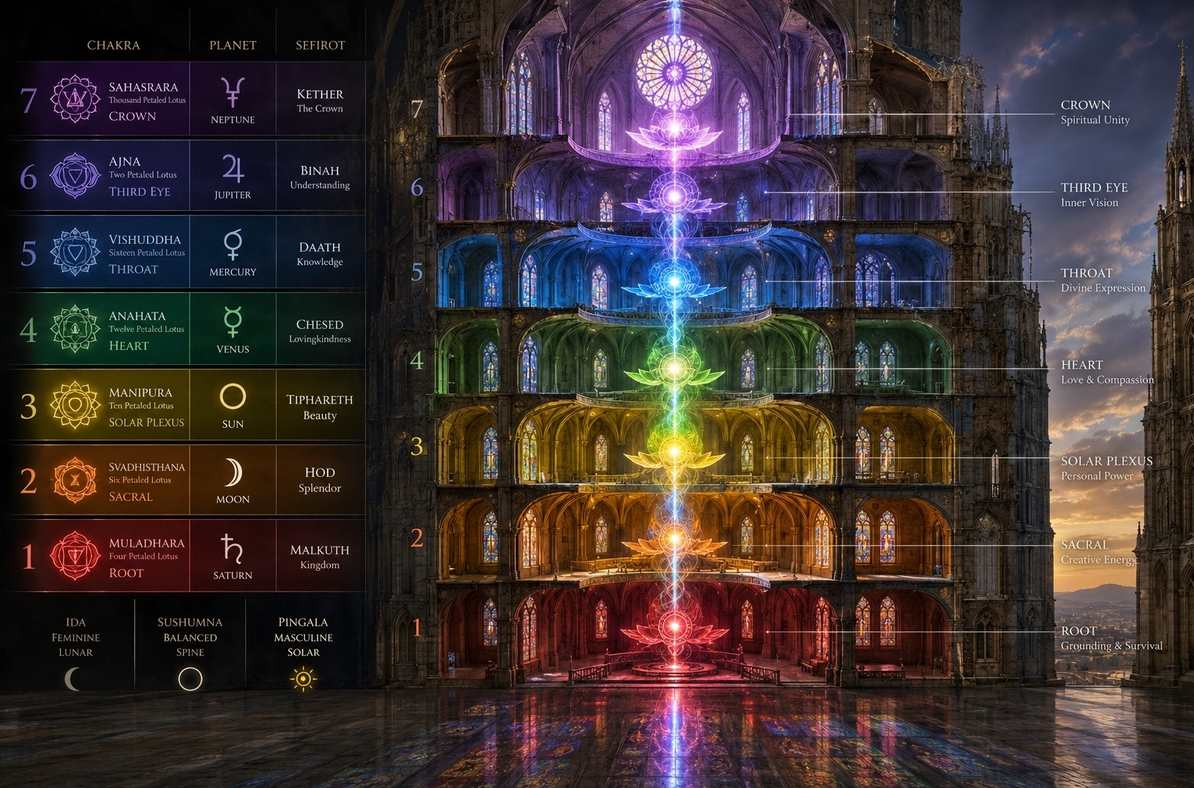
The syncretist confuses symbol with structure. The Tree of Life and the chakra system both present seven levels; the syncretist superimposes them impatiently, creating a diagram that satisfies the eye but confuses the internal navigation. The synthesist, however, recognises that both describe the same architecture–the scale of density to radiance, the graduated transformation from unconsciousness to consciousness. The description differs in vocabulary; the function is identical. The synthesist does not combine. The synthesist translates.
This confusion extends beyond mere cartography. When the practitioner encounters the Buddhist doctrine of anatta (no-self) and the Kabbalistic development of the neshamah (soul), they face not complementary approaches to identical territory but different cartographies with conflicting topographical features. To overlay them without understanding their respective foundations is to create a map that leads nowhere, or worse, into active delusion. The syncretist sees resemblance and declares unity. The synthesist sees function and recognises identity.
Epistemological Damage and the Loss of Discernment
When traditions are combined superficially, the practitioner risks what might be termed epistemological damage–not merely confusion, but a corruption of the cognitive faculties that distinguish genuine recognition from its simulation. The loss is invisible to the collector, who experiences something and attributes it to the tradition. The experience, however, is projection–expectation mapped onto neutral sensation.
The syncretist, combining without comprehension, loses depth through dilution. The Kabbalah, reduced to a decorative diagram, loses its specific operation–the disciplined work of pathworking, the precise transformation of each sefirah through specific contemplative and ethical labour. The yoga, reduced to posture, loses its interiority–the specific movement of prana, the awakening of each centre through particular bandhas and breath. The alchemy, reduced to psychological metaphor, loses its materiality–the specific work with substance, the chymical wedding of matter and spirit. Each tradition, when skimmed rather than mastered, becomes a hollow signifier pointing to nothing.

The Discipline of Deep Fluency
Immersion Before Translation
The synthesist does not begin with combination. The synthesist begins with immersion–the complete submission to a single tradition, the mastery of its vocabulary, the practice of its method, the transformation it specifically produces. This is not a weekend workshop; it is a years-long occupation, a colonisation of the psyche by a particular symbolic order. The immersion, prolonged, produces fluency–the capacity to think in the tradition’s terms, to recognise its territory from minimal description, to navigate without the map because the territory has become internal.
Fluency is not familiarity. One may be familiar with multiple cities without knowing any intimately. The synthesist seeks citizenship, not tourism. They learn not merely the vocabulary but the grammar–the rules that govern how concepts combine, the logic that determines what questions may be asked, the silence that indicates where language fails. This depth of inhabitation is prerequisite to any genuine comparison. Without it, the practitioner compares translations of translations, never suspecting that the original text contains dimensions inaccessible to the casual reader.
Sequential Mastery and the Architecture of Recognition
Only when fluency is achieved–when the tradition has become a native language rather than a clumsily translated one–does the synthesist approach a second system. And not simultaneously. Sequentially. The Kabbalah, mastered. Then the yoga, mastered. Then the alchemy, mastered. Each mastery produces recognition. The recognitions, compared, reveal identity–the same territory, described differently according to the available technology and cultural context of the time. The identity, recognised, enables translation.
The synthesist does not create a new system. The synthesist speaks multiple languages. The Tree, described to the Kabbalist. The chakras, described to the yogi. The same territory, accessible through different entry points. The accessibility, provided, extends the thread to those who would not otherwise find it. This is the secret function of the synthesist: not to invent, but to interpret; not to combine, but to clarify.

The Architecture Beneath
Identity of Function, Not Similarity of Form
What the synthesist recognises is not similarity of symbol but identity of function. The sevenfold pattern that appears in the planets, metals, chakras and sefirot is not a coincidence of numerology but the signature of a specific structural reality: the scale of density to radiance, the graduated transformation from unconsciousness to consciousness. The syncretist sees “seven” and superimposes eagerly. The synthesist sees the function of seven–the specific operations that occur at each density–and translates accordingly.
This requires penetrating the aesthetic surface to the operational core. The alchemical nigredo is not “like” the dark night of the soul; both describe the necessary dissolution of the imaginary self before the emergence of the real. The Taoist wu wei is not “similar to” the Sufi fana; both describe the cessation of egoic interference in the flow of divine action. The vocabulary differs. The territory is identical. The synthesist moves between descriptions with the ease of a diplomat who knows that different nations refer to the same mountain by different names.
The Sevenfold Pattern as Universal Signature
The sevenfold pattern serves as perhaps the clearest example of structural correspondence. In the Kabbalistic Tree of Life, the seven lower sefirot form the psychological and ethical architecture through which the human soul ascends from material conditioning to conscious union. In the yogic chakra system, the seven centres mark specific transformations of pranic intelligence from survival instinct to transcendent awareness. In alchemical tradition, the seven metals correspond to seven planetary intelligences governing seven stages of material and spiritual purification.
These are not analogous systems. They are the same system, expressed through the available symbolic vocabulary of three distinct cultures. The synthesist recognises that Malkuth and Muladhara both describe the foundation of embodied consciousness; that Tiferet and Anahata both mark the integration of opposites into radiant equilibrium; that Kether and Sahasrara both point to the non-dual ground from which all differentiation emerges. The symbols differ; the operations are identical.
The Operational Test
Experience Versus Function
The distinction is testable, verifiable, and mercilessly democratic. A practice either produces reliable function or it does not. The universe does not grade on effort.
The syncretist’s combined practice produces experience–intense, perhaps, memorable, certainly. But it lacks clear trajectory. The experiences do not build; they accumulate. Like a museum of sensations, each peak experience is catalogued but not integrated. The transformation, if it comes, is unstable, unreliable, subject to the mood of the moment and the continued availability of novel combinations.
The synthesist’s practice produces function–the capacity, developed and tested, to navigate consciousness with precision, to recognise interference, to maintain continuity of awareness through altered states. The navigation, tested under pressure, holds steady. The transformation, produced, is stable because it is structural, not decorative. The thread, extended, is strong.
The Temporal Dimension of Practice
The test is also temporal. The syncretist, bored by the exhaustion of their own combinations, moves on to new spiritual fashions, ever seeking the next aesthetic hit. The synthesist, committed to the inexhaustible depth of a single current, finds that mastery yields continuing revelation. The well does not run dry; it deepens. The yield, prolonged, produces wisdom rather than entertainment.
Time reveals what novelty conceals. A practice tested across years exposes its true nature: whether it produces stable transformation or merely recurrent experience. The synthesist trusts this temporal dimension, knowing that genuine integration requires not months but decades. The syncretist, impatient, abandons each tradition before it has yielded its secret, mistaking the map for the territory and the collection for the journey.

The Thread Extended
From Collection to Integration
The syncretist collects. The synthesist integrates. The collection, displayed, impresses the gallery but leaves the collector unchanged at the core. The integration, invisible to the observer, transforms the artist fundamentally. The thread does not require novelty to survive; it requires depth–the continued excavation of single territory until the bedrock is reached, until the recognition dawns that all genuine traditions point to the same ground, described in the only languages available to their specific times and places.
You encounter multiple traditions. The temptation is combination. The discipline is translation. The thread continues regardless of your choice–but whether you grasp it firmly or let it slip through fingers cluttered with souvenirs depends on whether you choose to add or to integrate.

Frequently Asked Questions
What is the difference between syncretism and synthesis?
Syncretism is the superficial addition of symbols and practices from different traditions without understanding their operational foundations, creating aesthetic collage. Synthesis is the deep integration that recognises identical functional structures beneath different vocabularies, enabling translation between systems without losing the integrity of either.
Is it wrong to combine spiritual practices from different traditions?
It is not ‘wrong’ but potentially ineffective or confusing. Without deep fluency in each tradition, combination risks contradiction and epistemological damage–the loss of capacity to distinguish genuine recognition from its simulation. Mastery must precede integration.
How do I know if I am practicing syncretism or synthesis?
Test for operational function. Syncretism produces accumulated experiences without stable transformation. Synthesis produces reliable navigational capacity–consistent results under pressure, deepening insight over time, and the ability to translate between symbolic languages without distortion.
Can syncretism ever be useful?
Syncretism may serve as an introductory phase, exposing the seeker to multiple paths. However, it cannot produce the stable transformation that genuine practice requires. It remains spiritual entertainment–engaging, but ultimately a distraction from the discipline required for synthesis.
How long does it take to achieve synthesis?
Synthesis requires sequential mastery of each tradition–typically years of immersion in one system before approaching another. There is no shortcut. The translator must speak both languages fluently before bridging them; the architect must understand both structures before recognising their identity.
What are examples of genuine structural correspondence?
The sevenfold pattern appearing in Kabbalah’s Tree of Life, Yoga’s chakra system, and alchemy’s planetary metals describes the same graduated scale of consciousness density. Similarly, the nigredo, albedo, and rubedo correspond to specific stages of psychological dissolution and reconstitution found in contemplative Christianity and Buddhist jhana practice.
Why do traditions oppose each other if they point to the same truth?
Traditions oppose each other at the level of doctrine and cosmology–their specific maps of reality. However, at the level of operational practice and transformed consciousness, they often describe identical territories. The synthesist navigates these contradictions by distinguishing between cultural packaging and essential function.
Further Reading
- The Sevenfold Pattern: Planets, Metals, Chakras & The Architecture of Seven — An example of genuine structural correspondence beneath different symbolic systems.
- The Kabbalistic Tree of Life: A Complete Guide to the Esoteric Architecture — The necessity of mastering a single tradition before attempting translation.
- The Chakra System: Origins, Development, and Misconceptions — What happens when systems are combined carelessly without operational understanding.
- The Living Thread: How Forbidden Knowing Survives the Fire — The integrity of transmission through time and the dangers of dilution.
- Practice & Method: Five Gateways to Direct Knowing — Selecting and combining techniques with discernment and proper sequence.
- The Emerald Tablet: Hermetic Foundation & the Law of Correspondence — The ancient philosophical basis for understanding unified principles across traditions.
- The Axial Age: Why Wisdom Emerged Simultaneously Across the World — Historical evidence for the independent discovery of identical spiritual structures.
- The Doctrine of Emanation: From Plotinus to Kabbalah — How Neoplatonic metaphysics underpin both Western and Eastern hierarchical cosmologies.
- Hidden Agreements: The Esoteric Architecture Behind All Traditions — The shared structural grammar that genuine synthesists recognise beneath cultural variation.
References and Sources
The following sources inform the distinctions drawn between syncretism and synthesis in contemporary and historical esoteric studies.
Primary Sources and Classical Texts
- The Emerald Tablet (Hermetic tradition) — foundational text on the law of correspondence and the unity of material and spiritual operations.
- Patanjali. The Yoga Sutras — classical formulation of the eight-limbed path and the specific interior operations of consciousness.
- Sefer Yetzirah and Zohar (Kabbalistic tradition) — primary sources for the sefirotic architecture and the doctrine of emanation.
Scholarly Monographs
- Faivre, Antoine. (1994). Access to Western Esotericism. SUNY Press. — Definitive typology of esoteric currents and the criteria distinguishing genuine transmission from popular appropriation.
- Hanegraaff, Wouter J. (1996). New Age Religion and Western Culture: Esotericism in the Mirror of Secular Thought. Brill. — Critical examination of how contemporary spirituality dilutes traditional structures through uncritical combination.
- Schimmel, Annemarie. (1975). Mystical Dimensions of Islam. University of North Carolina Press. — Authoritative study of Sufi technical vocabulary and the specificity of mystical language within its tradition.
Comparative Studies
- Huxley, Aldous. (1945). The Perennial Philosophy. Harper & Brothers. — Philosophical argument for the identity of essential teachings beneath diverse religious formulations.
- Zaehner, R.C. (1957). Mysticism Sacred and Profane. Oxford University Press. — Rigorous distinction between naturalistic and theistic mystical experiences, with implications for cross-tradition comparison.