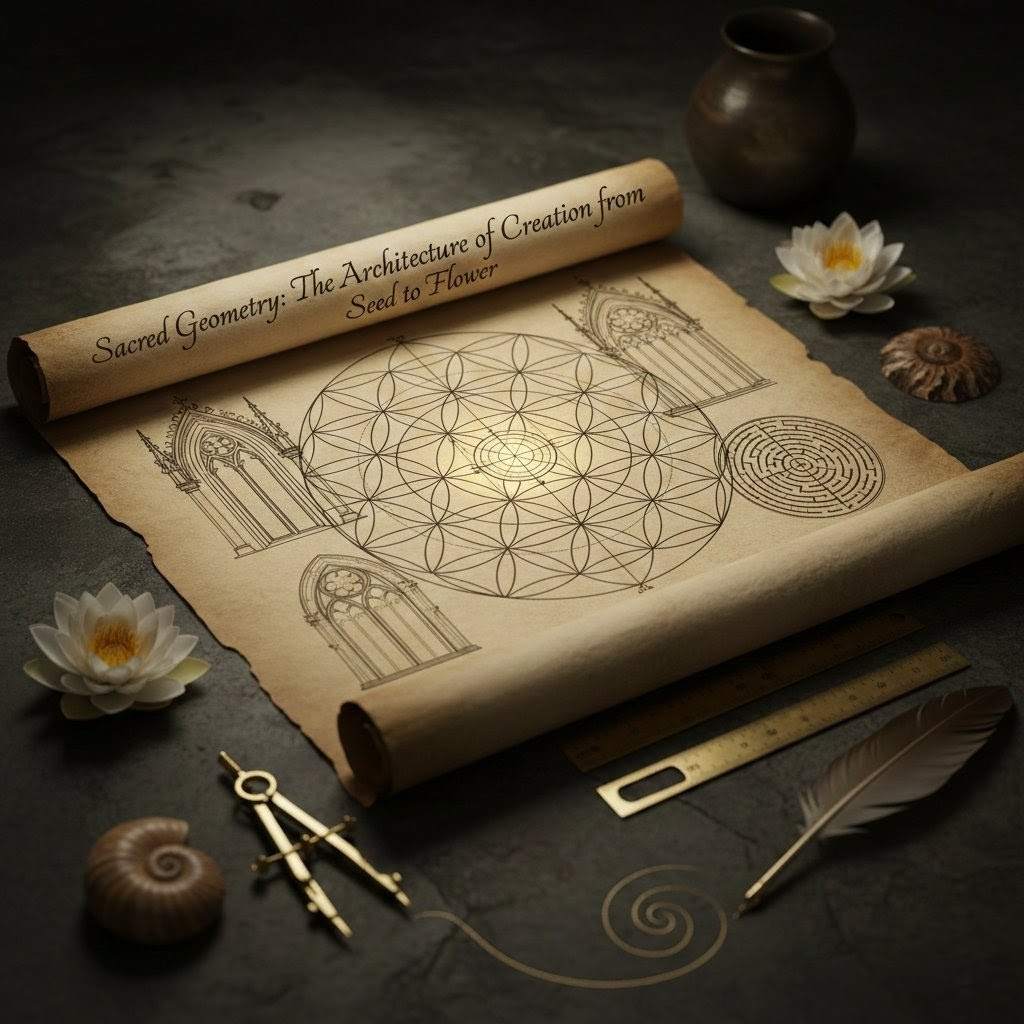
Sacred Geometry: The Architecture of Creation from Seed to Flower
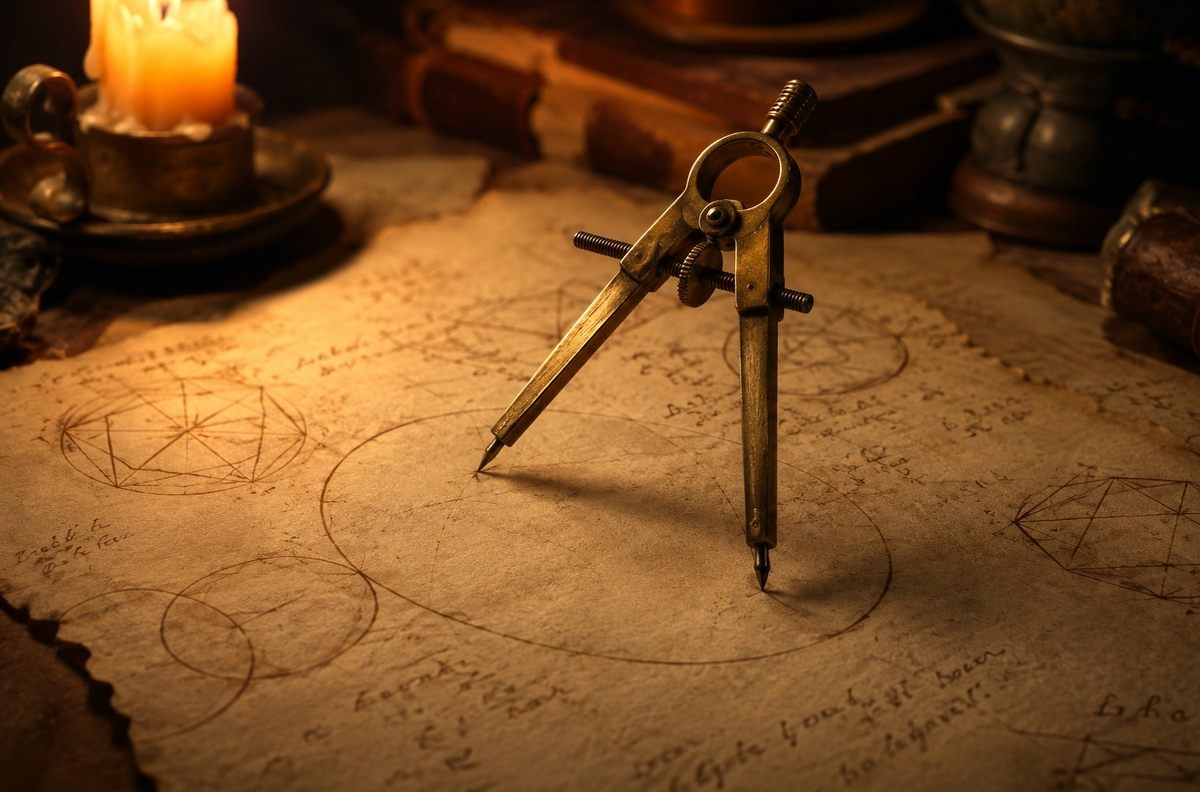
The circle, drawn with compass, is perfect–no beginning, no end, all points equidistant from centre. The circle, duplicated, produces vesica piscis–the lens of intersection, the womb of form, the geometric origin of triangle, square, and pentagon. The forms, extended, generate Flower of Life–a pattern of overlapping circles found in stone and plaster across ancient temples from Egypt to China. The geometry is not mere human invention. It is discovery–the forms underlying manifest reality, the architecture of creation itself.
Sacred geometry is not decoration. It is ontology–the study of being through form. The forms are not merely symbols pointing to reality. They are patterns that structure reality–the matrices that govern matter, life, and consciousness. The recognition of forms enables participation in their creation. The participation is theurgy—work of the divine, work on the self, work that transforms both. This article traces the thread from the drawn circle to the spiral galaxy, from medieval stone to molecular bond, asking not merely what sacred geometry means but what it does.
Table of Contents
- The Circle: Origin of All Form
- The Forms Are Generative
- The Forms Are Experienced
- Sacred Geometry in Nature and Cosmos
- The Thread Extended
- Frequently Asked Questions
- Further Reading
- References and Sources
The Circle: Origin of All Form
Vesica Piscis and the Genesis of Shape
The circle, duplicated with centres on each other’s circumference, produces the vesica piscis–the almond-shaped lens of intersection. From this single form, all regular polygons derive. The vesica piscis contains the equilateral triangle, the square, the pentagon, and the hexagon within its proportions. In medieval Christian symbolism, it represented the mandorla, the aureole of light surrounding Christ in majesty. In earlier Pythagorean tradition, it was the passage between worlds, the birth canal of form.
The geometric method is austere: compass and straightedge, no measurement. The practitioner does not impose dimension but discovers relationship. The circle generates the line; the line generates the angle; the angle generates the polygon. The process is emanation in miniature–the One becoming Many through lawful extension. Euclid, in his Elements, called the division of a line in extreme and mean ratio the foundational proportion from which the golden section later derived. What the geometer constructs on parchment, the cosmos constructs in star and cell.
The Flower of Life and the Pattern of Creation
Six circles surrounding a central circle produce the Seed of Life; extended outward, the pattern becomes the Flower of Life–nineteen interlocking circles forming a hexagonal matrix. The oldest known examples appear in the Temple of Osiris at Abydos, Egypt, where archaeologists date them to at least the sixth millennium BCE, though some scholars argue for a considerably later origin. The pattern also appears in Chinese temple architecture, Indian Buddhist sites, Assyrian rock carvings, and medieval synagogues. Its ubiquity suggests not diffusion from a single source but independent discovery–the same form recognised by different eyes because the form is inherent in the structure of space itself.
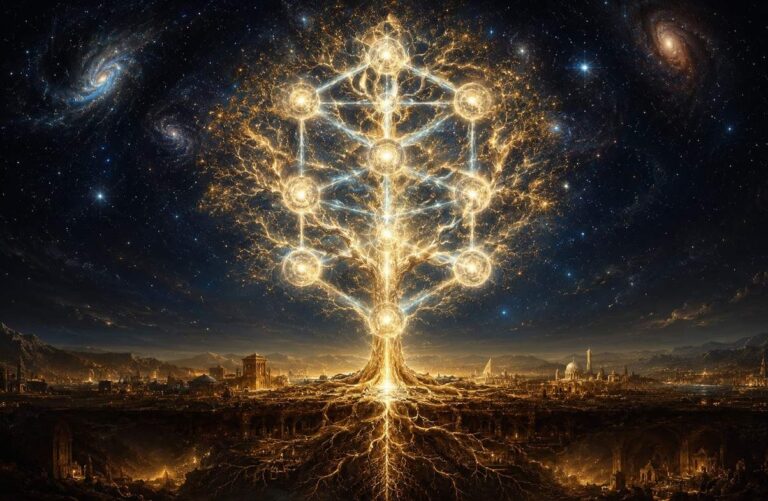
Within the Flower of Life, further patterns emerge. Connecting the centres of every second circle produces the Tree of Life of Kabbalah. Connecting the centres of all circles produces Metatron’s Cube, containing the five Platonic solids. The pattern is not merely decorative; it is generative–a single geometric seed containing, in potential, the entire hierarchy of form. The geometer who draws it participates in the same act by which, according to tradition, the cosmos itself was laid out.
The Forms Are Generative
The circle generates all polygons. Six circles around a central circle–the Flower of Life seed–produce the hexagon, the structure of honeycomb, of snowflake, of crystal. The hexagon, extended, produces the tetrahedron, cube, octahedron, dodecahedron, and icosahedron–the five Platonic solids that served as the elemental architecture of ancient cosmology and that now describe the bonding geometries of molecules and viruses.
The Golden Ratio and Efficient Growth
The golden ratio–φ, approximately 1.618–emerges from the pentagon, from the Fibonacci sequence, and from spiral growth. In the Fibonacci sequence, each number is the sum of the two preceding numbers: 1, 1, 2, 3, 5, 8, 13, 21, 34… As the sequence progresses, the ratio between successive terms converges on φ. This is not numerological preference but efficient packing–the mathematical solution to the problem of arranging maximum form in minimum space while maintaining proportion.
The ratio appears in the branching of trees, the arrangement of leaves, the spirals of pinecones and sunflowers. Botanist Roger Jean, in a 1994 meta-analysis, estimated that approximately ninety-two per cent of plants exhibiting spiral phyllotaxis arrange their leaves or seeds according to Fibonacci numbers, optimising sunlight exposure through what botanists call the golden angle of 137.5 degrees. However, the popular claim that nautilus shells follow the golden spiral is inaccurate; they grow in logarithmic spirals whose proportions differ from φ. The golden ratio is abundant in nature, but not universal–and its presence where it does occur is a matter of growth efficiency, not mystical decree.
The Spiral: Process in Form
The logarithmic spiral—golden where it approximates φ–models galaxy, hurricane, shell, and embryo. The spiral is process–growth, expansion, evolution–captured in form. The centre is origin. The expansion is development. The infinite periphery is a limit never reached. Unlike the circle, which is complete, the spiral is becoming–always moving, never arriving. It is the geometry of life itself, which grows not by addition but by proportional transformation.

The Platonic Solids and Molecular Architecture
The five Platonic solids–the only convex polyhedra with identical regular polygonal faces–were assigned by Plato to the classical elements: tetrahedron to fire, cube to earth, octahedron to air, icosahedron to water, dodecahedron to the heavens. Kepler, in his Mysterium Cosmographicum, attempted to model planetary orbits as nested Platonic solids. The attempt failed astronomically, but the intuition was profound: the solids represent the symmetry constraints of three-dimensional space.
Modern chemistry confirms the intuition at molecular scale. The tetrahedron describes the bonding geometry of methane and the water molecule. The icosahedron describes the capsid structure of many viruses, including the common cold. The cube appears in the crystal lattice of sodium chloride. The solids are not merely philosophical metaphors; they are spatial necessities–the only ways identical units can close-pack in three dimensions. Sacred geometry, in this light, is not esoteric speculation but empirical pattern recognition.
The Forms Are Experienced
Sacred geometry is not merely contemplated. It is constructed–drawn with compass and straightedge, built in stone and wood, walked in labyrinth, danced in pattern. The construction is practice. The practice produces participation—the knower becomes known, the observer enters observed. The form, made by hand, imprints itself on the hand that makes it. The body learns what the mind can only approximate.
The Gothic Cathedral as Instrument of Transformation
The cathedral, Gothic, embodies sacred geometry in stone and light. Medieval master builders employed sophisticated proportional systems based on geometric relationships, musical harmonies, and symbolic numerology. The nave was proportioned to reflect harmonic ratios–the octave (1:2), the fifth (2:3), the fourth (3:4)–creating visual resonance analogous to musical consonance. The vault, ribbed, traced the geometry of the Tree of Life across the ceiling. The labyrinth, set into the stone floor, provided a meditative journey to centre and return.
While some modern scholars have identified instances of golden ratio proportions in specific cathedrals such as Amiens and Salisbury, the broader claim that Gothic architecture was systematically governed by φ remains contested. The golden ratio received its celebrated treatment in Luca Pacioli’s De divina proportione only in the early sixteenth century, after the Gothic period had concluded. What is certain is that the building was not merely a container for worship. It was instrument of transformation–the proportions, the light, the acoustic properties, working on consciousness directly, whether the worshipper understood the geometry or not.
The Mandala as Contemplative Practice
The mandala, Eastern, embodies sacred geometry in pigment and sand. The circle, squared, contains symbols of the cosmos. The centre, bindu, is the point of origin. The periphery is manifestation. The journey inward reverses emanation–from multiplicity back to unity. The construction, whether in sand, paint, or mental image, is meditation. The completion, followed by dissolution–the mandala swept away, the grains returned to river–teaches impermanence even within perfection.
The Tibetan Buddhist tradition distinguishes between kyilkhor (external mandala, architectural) and thigle (internal mandala, energetic). The external form maps the internal process: the practitioner visualises the palace, enters through the gates, approaches the central deity. The geometry is psychotechnology–a structured environment for consciousness to navigate its own architecture. What the cathedral does in stone over centuries, the mandala does in sand over hours. Both are technologies of transformation, differing only in duration and material.

Sacred Geometry in Nature and Cosmos
The forms recognised in temple and manuscript are not human inventions projected onto nature. They are patterns discovered in nature and then refined by human attention. The hexagon appears in basalt columns, snowflakes, and honeycomb because it is the most efficient way to partition a plane into equal areas with the least perimeter. The spiral appears in galaxies and hurricanes because it is the geometry of angular momentum conservation. The forms are not imposed; they are inherent.
Phyllotaxis and the Golden Angle
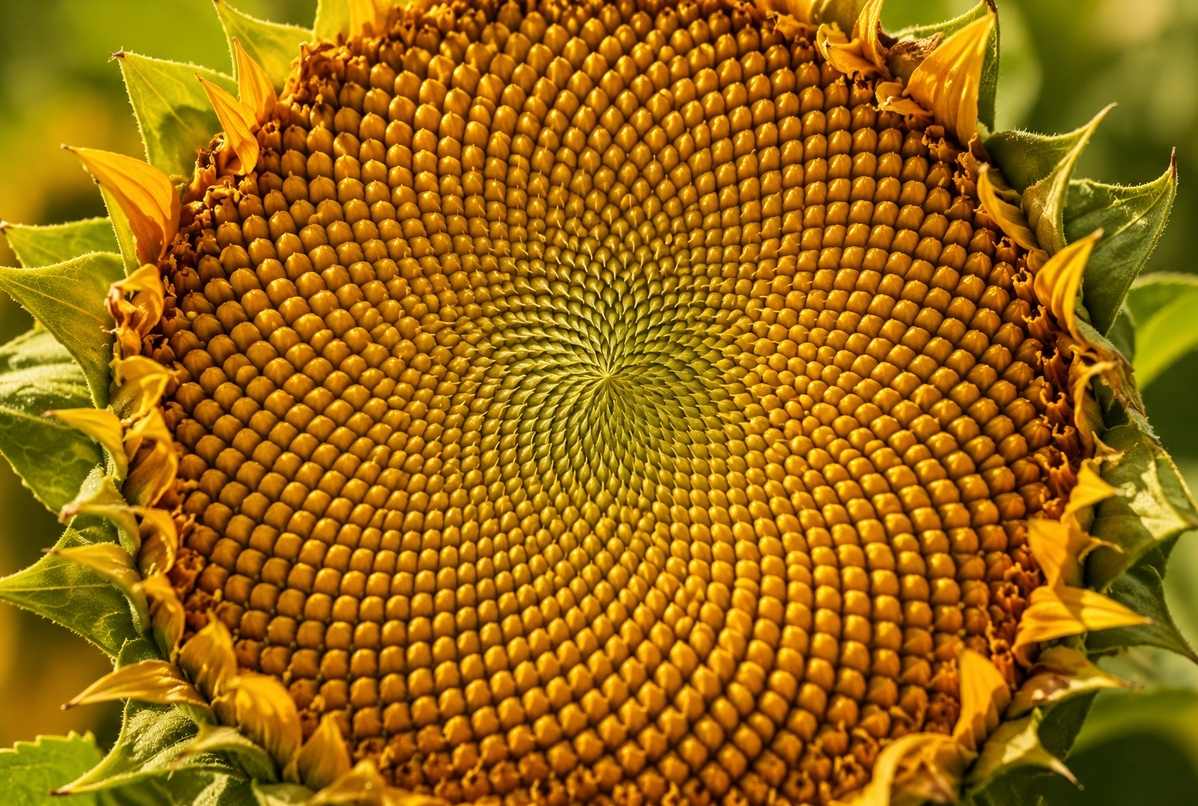
In botany, phyllotaxis–the arrangement of leaves, seeds, and petals–follows geometric law with remarkable consistency. Sunflower seed heads display spirals that count as consecutive Fibonacci numbers: thirty-four spirals in one direction, fifty-five in the other. Pinecones show five and eight, or eight and thirteen. The angle between successive leaves, approximately 137.5 degrees, is the golden angle–the angle that divides a circle in the golden ratio. This arrangement minimises shading and maximises exposure to sunlight and rain.
The mechanism is not mysterious. It arises from simple growth rules: each new primordium emerges at the point of least resistance, repelled by the chemical traces of its predecessors. Over time, the geometric optimum emerges from local interactions–no central planner, no divine draftsman, just the mathematics of packing playing out in biological tissue. The result, however, is the same form that the geometer draws with compass: the spiral, the hexagon, the golden proportion. Nature does not copy geometry; geometry describes nature.
From Microcosm to Macrocosm
The same patterns scale across orders of magnitude. The coriolis spiral of a hurricane, viewed from satellite, traces the same logarithmic geometry as the shell of a snail. Spiral galaxies–comprising approximately seventy-seven per cent of all observed galaxies, including our own Milky Way–organise their arms according to density wave mechanics that produce spiral structure. The form is not identical at every scale–the galaxy is not a giant nautilus–but the mathematical family is the same: the logarithmic spiral, the most general solution to the equation of growth with proportional expansion.
This scaling does not imply, as some popular accounts suggest, that the universe is “designed” according to the golden ratio. It implies something more precise and more modest: that space itself has shape constraints, and that matter, growing within those constraints, adopts the forms that the constraints permit. The geometer who draws the circle is not imitating the cosmos. She is practising the same mathematics that the cosmos practises unconsciously. The recognition of this continuity–between compass and galaxy, between bindu and black hole–is the beginning of theurgical participation.
The Thread Extended
Sacred geometry extends the thread through form. The forms, recognised in nature, in art, in the body, reveal underlying unity–not the unity of identical repetition but the unity of lawful variation. The same spiral appears in shell and galaxy because both are solutions to the same geometric problem. The same hexagon appears in crystal and honeycomb because both are solutions to the same packing problem. The unity is mathematical, not metaphorical.
The participation, through construction, transforms. When you draw the circle, you do not create the form; you uncover it. The form, emerging under your hand, reveals what was always present but unnoticed. The thread continues through geometry toward what geometry indicates–the pattern behind patterns, the law behind laws, the silence in which all forms arise and to which all forms return. The compass is not merely a tool. It is a key, and the lock it opens is consciousness itself.
Frequently Asked Questions
What is sacred geometry and where did it originate?
Sacred geometry is the study of geometric forms and proportions that appear to underlie manifest reality. It originated not from a single culture but from independent discoveries across civilisations–in Egyptian temple architecture, Chinese cosmology, Indian mandala tradition, and Greek mathematics. The forms–circle, vesica piscis, golden ratio, Platonic solids–were recognised as patterns structuring nature, matter, and consciousness. Euclid formalised many of these relationships in his Elements, while medieval builders applied them in cathedral design and Eastern traditions employed them in mandala construction.
Is the golden ratio really found everywhere in nature?
The golden ratio appears frequently but not universally. It emerges in approximately ninety-two per cent of plants exhibiting spiral phyllotaxis, in the arrangement of sunflower seeds and pinecone scales, and in the branching of trees. However, the popular claim that nautilus shells follow the golden spiral is inaccurate–they grow in logarithmic spirals with different proportions. The golden ratio is a growth efficiency solution, not a mystical decree, and its presence is strongest where packing and exposure optimisation are required.
Did Gothic cathedrals use the golden ratio in their design?
The claim is partially accurate but contested. Some rigorous modern studies have identified golden ratio proportions in specific cathedrals such as Amiens and Salisbury. However, the broader assertion that Gothic architecture was systematically governed by the golden ratio is disputed by architectural historians. Luca Pacioli’s celebrated treatise De divina proportione appeared in the early sixteenth century, after the Gothic period had ended. Medieval builders certainly used sophisticated geometric proportions based on squares, circles, triangles, and musical harmonies, but the golden ratio was not the dominant system it is sometimes claimed to be.
What are the Platonic solids and why are they significant?
The Platonic solids are the five convex polyhedra with identical regular polygonal faces: tetrahedron, cube, octahedron, dodecahedron, and icosahedron. Plato assigned them to the classical elements, and they served as the geometric foundation of ancient cosmology. Their significance extends into modern science: the tetrahedron describes molecular bonding in methane and water; the icosahedron describes viral capsids; the cube describes crystal lattices. They represent the symmetry constraints of three-dimensional space–the only ways identical units can close-pack in three dimensions.
How does drawing sacred geometry differ from just studying it?
Drawing with compass and straightedge is participatory rather than observational. The body learns through repetition what the mind grasps only conceptually. The construction process–setting the compass, finding the intersection, extending the line–mirrors the generative process by which forms emerge in nature. This is theurgical practice: work that transforms the worker. Medieval masons, Tibetan mandala makers, and Pythagorean initiates all understood that the hand, trained in geometric construction, becomes an instrument of recognition.
What is the Flower of Life and how old is it?
The Flower of Life is a pattern of nineteen overlapping circles arranged in hexagonal symmetry. It contains within it the Seed of Life, the Tree of Life, and Metatron’s Cube. The oldest known examples appear in the Temple of Osiris at Abydos, Egypt, where some archaeologists date them to at least the sixth millennium BCE, though other scholars argue for a later origin. The pattern also appears in Chinese temples, Indian Buddhist sites, Assyrian carvings, and medieval European synagogues, suggesting independent discovery rather than single-source diffusion.
Can sacred geometry be scientifically proven?
Sacred geometry is not a hypothesis to be proven but a pattern to be recognised. The geometric forms it studies–hexagons, spirals, golden ratios–are empirically observable in nature, from molecular bonding to galactic structure. The claims about their spiritual significance are not scientific propositions; they are interpretive frameworks. Science can verify that sunflowers arrange seeds in Fibonacci spirals; it cannot verify that this arrangement reflects divine harmony. The value of sacred geometry lies in its capacity to integrate empirical observation with contemplative practice, not in substituting one for the other.
Further Reading
- The Sevenfold Pattern: Planets, Metals, Chakras & The Architecture of Seven — Geometry as numerical architecture and the sevenfold pattern across traditions.
- The Hidden Agreements: Why Esoteric Traditions Keep Inventing the Same Architecture — Sacred geometry as discovered rather than invented, and why the same forms recur.
- The Tree of Life: Kabbalistic Architecture Explained — The geometric structure of Kabbalah and its relationship to the Flower of Life.
- Symbol as Safety Protocol: Why Esotericism Hides in Plain Sight — Geometric forms as protective encryption and symbolic transmission.
- The Emerald Tablet: Hermetic Foundation & The Law of Correspondence — “As above, so below” and the geometric principle of cosmic correspondence.
- The Doctrine of Emanation: From Plotinus to Kabbalah — The geometric logic of emanation from the One to the Many.
- The Holographic Universe Theory: Consciousness and the Nature of Reality — Modern physics and the geometric structure of information in the cosmos.
- Sacred Architecture: Esoteric Technology from Gothic Cathedrals to Egyptian Temples — How geometry and space encode hidden wisdom and transform consciousness.
References and Sources
This article draws upon mathematics, architectural history, botany, and contemplative studies. Sources are grouped by discipline for clarity.
Primary Sources and Critical Editions
- Euclid. (c. 300 BCE). Elements, Book VI, Proposition 30. (Extreme and mean ratio).
- Pacioli, L. (1509). De divina proportione. Venice. (Golden ratio in Renaissance context).
- Plato. (c. 360 BCE). Timaeus. (Platonic solids and elemental cosmology).
Scholarly Monographs and Studies
- Bork, R. (2020). Geometry and the Gothic Design Process. University of Iowa. (Rigorous analysis of Gothic proportional systems, cautioning against speculative overlays).
- Jean, R. V. (1994). Phyllotaxis: A Systemic Study in Plant Morphogenesis. Cambridge University Press. (Meta-analysis estimating ninety-two per cent of spiral phyllotaxis follows Fibonacci patterns).
- Livio, M. (2002). The Golden Ratio: The Story of Phi, the World’s Most Astonishing Number. Broadway Books. (Comprehensive history debunking popular myths while affirming genuine occurrences).
- Murray, S., & Addiss, J. (1990). “Plan and Space at Amiens Cathedral.” Journal of the Society of Architectural Historians, 49(1), 44-66. (Documented use of golden ratio in specific Gothic building).
Comparative and Contemplative Studies
- Hemenway, P. (2005). Divine Proportion: Phi in Art, Nature, and Science. Sterling. (Cross-cultural survey of golden ratio applications).
- Kidson, P. (Various). Studies on Salisbury Cathedral proportions. (Documented rational approximations for irrational numbers in medieval design).