The Ptolemaic Acquisition System: How the Library of Alexandria Was Built
The Library of Alexandria did not accumulate by accident. It was built–through policy, through aggression, through the systematic application of royal power to the collection of knowledge. The Ptolemies, Macedonian Greek rulers of Egypt, created the ancient world’s first knowledge empire. Their methods instruct those who would preserve or extend the thread.
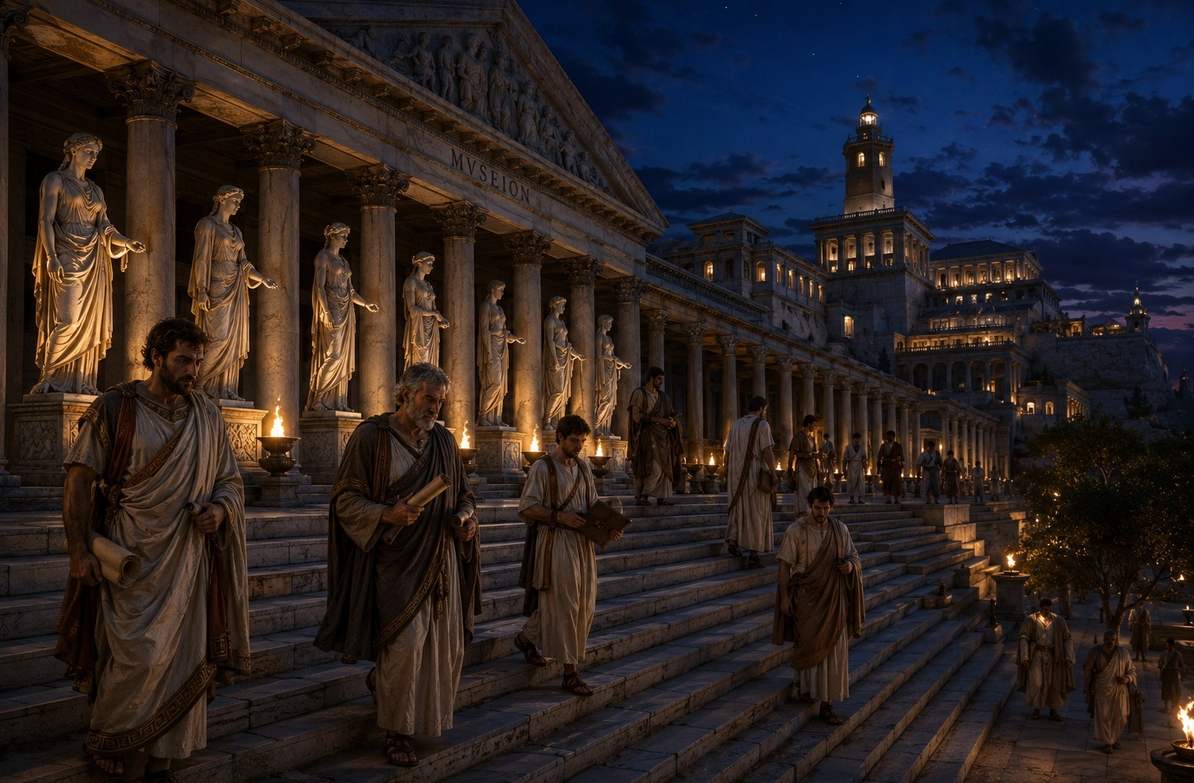
Ptolemy I Soter, founder of the dynasty, established the Musaeum–the Temple of the Muses–as a centre of learning attached to the royal court around 295 BCE. The project was advised by Demetrius of Phalerum, an exiled Athenian statesman and Peripatetic philosopher who had curated texts during his regency in Athens. His proposal drew directly from the model of Aristotle’s Lyceum: a research institution where scholars lived, dined, and worked collectively under royal patronage. The ambition was explicit from the outset: to collect all the books of the world.
His son, Ptolemy II Philadelphus, expanded the Musaeum into the Library proper and dedicated the Mouseion around 283 BCE as part of the royal palace complex in Alexandria’s Bruchion district. Under his reign, the institution acquired its reputation as the preeminent intellectual centre of the Mediterranean, drawing scholars from across the Greek world with stipends, tax exemptions, communal dining, and lodgings. This was not merely a repository; it was an engine of cultural production–a state-funded research laboratory where the textual inheritance of Greece was edited, standardised, and augmented.
This was not metaphor. It was operational policy–and it operated with the ruthlessness of an empire.
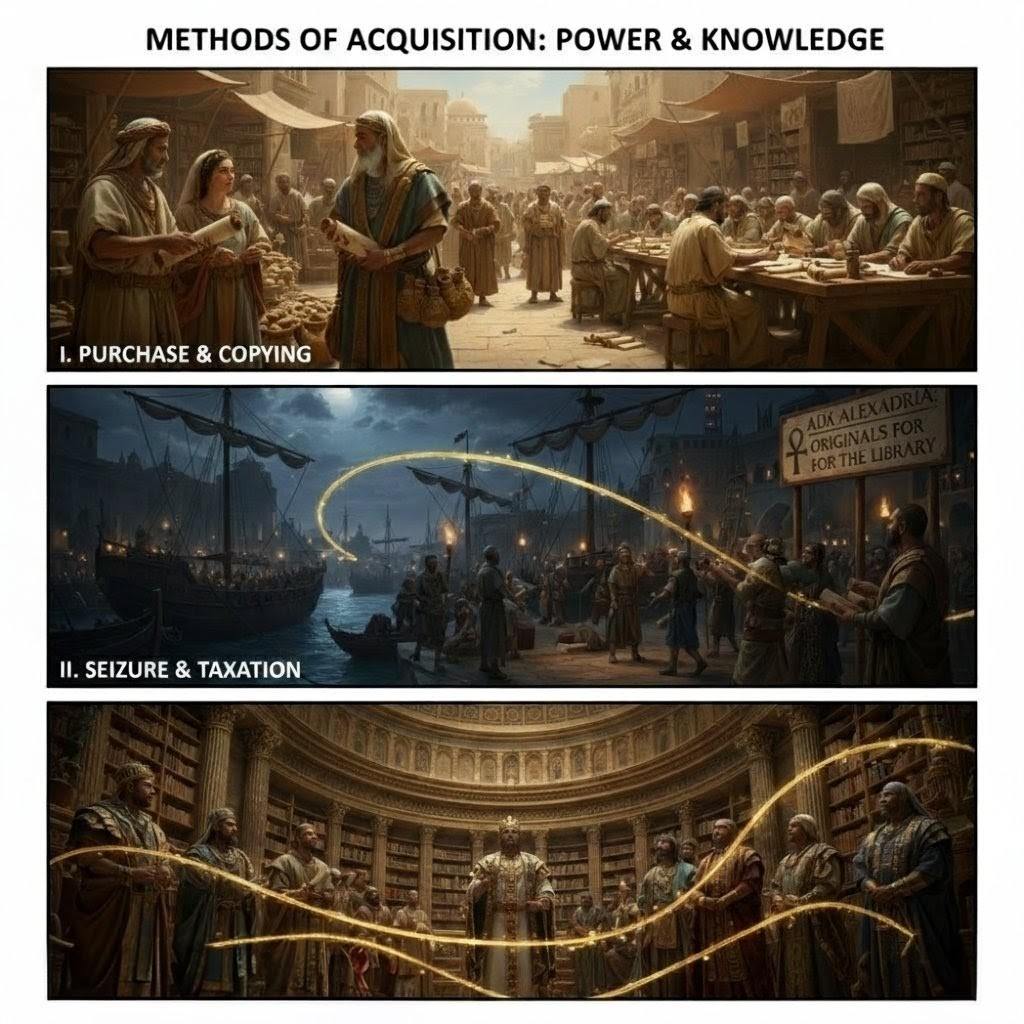
Table of Contents
- What Is the Ptolemaic Acquisition System?
- The Methods Were Aggressive
- The Catalogue Was the Innovation
- The Cost of Power
- The Decline Was Inevitable
- The Lesson
- Frequently Asked Questions
- Further Reading
- References and Sources
What Is the Ptolemaic Acquisition System?
The Ptolemaic acquisition system was the bureaucratic and coercive infrastructure that transformed the Library of Alexandria from a royal vanity project into the ancient world’s most formidable concentration of textual knowledge. It combined economic power (purchasing scrolls at inflated prices), legal authority (confiscating books under customs pretences), diplomatic subterfuge (borrowing official state copies and retaining the originals), and institutional inducement (attracting scholars whose personal collections became part of the royal holdings).
The system was administered through the Mouseion, a temple-research complex dedicated to the Muses that functioned as a state-sponsored think tank. Scholars resident in the Mouseion received salaries, lodging, and communal meals–but they also surrendered their intellectual output to the crown. The library was not a public institution in the modern sense. It was a royal archive, accessible primarily to those with patronage, and its contents served the ideological project of demonstrating Ptolemaic cultural supremacy over the older civilisations of Egypt and the Greek mainland.
Modern estimates of the collection’s size vary dramatically. Ancient sources claim figures as high as 700,000 scrolls, but scholars such as Luciano Canfora have demonstrated that this number is almost certainly hyperbolic–a product of rhetorical inflation and circular reporting. More reliable estimates place the holdings between 40,000 and 400,000 scrolls depending on whether one counts multi-volume works individually or collectively. Even at the conservative end, this represented the largest assemblage of Greek literature ever concentrated in a single location.
The Methods Were Aggressive
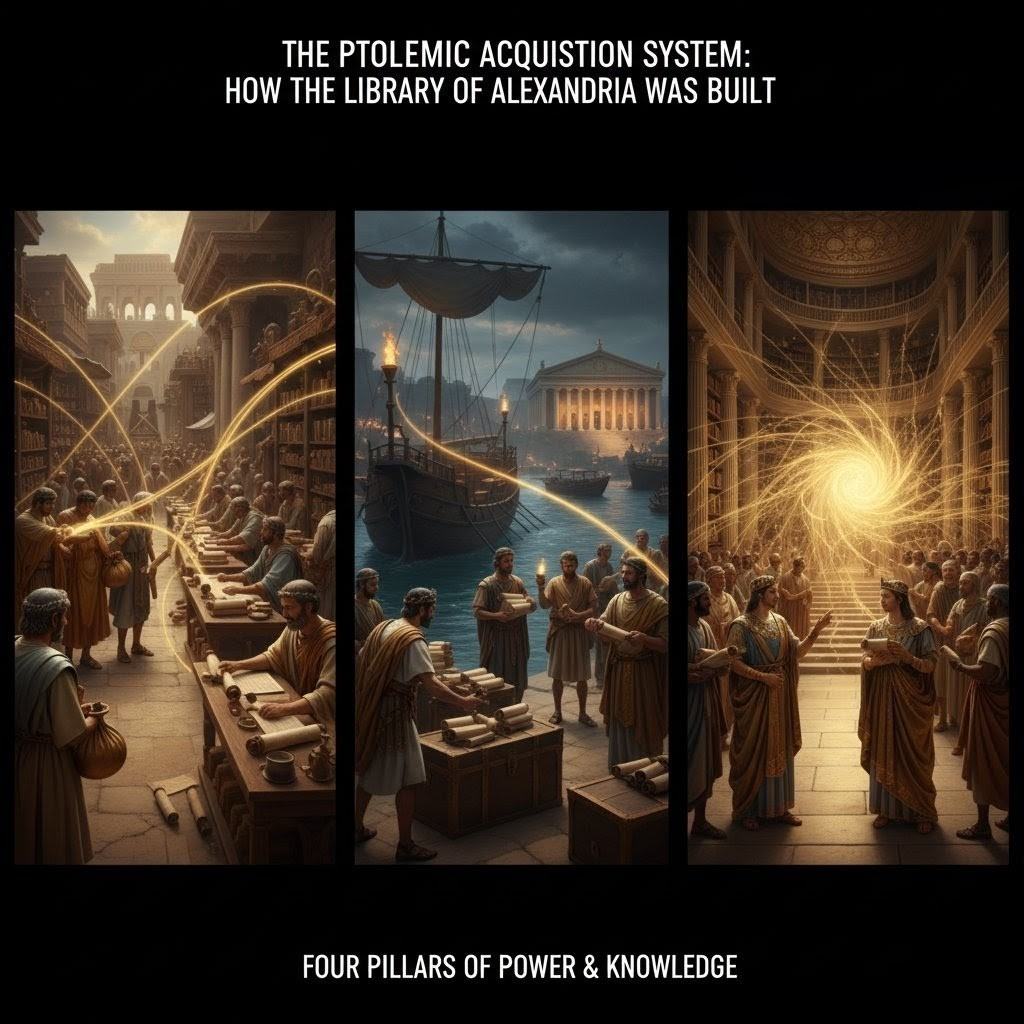
The growth of the collection relied on four pillars of acquisition, ranging from the economic to the coercive. Ancient sources–particularly Galen, writing in the second century CE–preserve detailed accounts of these methods, though modern historians caution that some stories may belong to the “mythos” of Alexandrian bibliomania rather than documented administrative history.
Purchase and the Inflation of the Book Trade
Purchase: The Ptolemies sent agents throughout the Mediterranean, buying scrolls from dealers, collectors, and families in financial distress. This royal demand created a competitive market that drove prices to historic highs. Athens and Rhodes, the largest book marts of the era, became primary targets. The crown’s purchasing power was virtually unlimited–annual revenues exceeded 14,800 talents of silver–and the Ptolemies used this advantage to outbid private collectors and rival institutions.
The market distortion was deliberate. By making books prohibitively expensive for ordinary buyers, the Ptolemies ensured that scarce texts flowed toward Alexandria. Different versions of the same work were acquired to establish critical editions–Homeric texts “from Chios,” “from Sinope,” and “from Massalia” were all represented in the collection, allowing the Alexandrian scholars to compare variants and establish standard texts.
Copying and the Retention of Originals
Copying: The Library employed hundreds of scribes in a royal scriptorium. Often, acquired texts were copied; the copies were returned to the sellers, while the originals were retained in Alexandria. This practice, while economically rational from the crown’s perspective, created a secondary market of inferior duplicates. The scriptorium also produced standardised editions with critical annotations–the Alexandrian scholars Zenodotus and Aristarchus produced corrected texts of Homer that became the basis for nearly all subsequent transmission.
The copying operation served a dual function. It preserved the physical text while simultaneously improving it–or at least standardising it. The Ptolemies understood that control of the text meant control of the tradition. By establishing the “correct” version of Homer or Euripides, they positioned Alexandria as the arbiter of Greek cultural identity.
Seizure: The Customs Office of Knowledge
Seizure: Ships arriving in Alexandria’s harbour were searched. Books found were confiscated under “customs procedure”–a tax on knowledge entering Egypt. Owners received a copy; the Library kept the original. Galen records that books acquired through this method were tagged ek ploion–“from the ships”–for identification. The practice transformed Alexandria’s commercial advantage as a port into an intellectual advantage as a library.
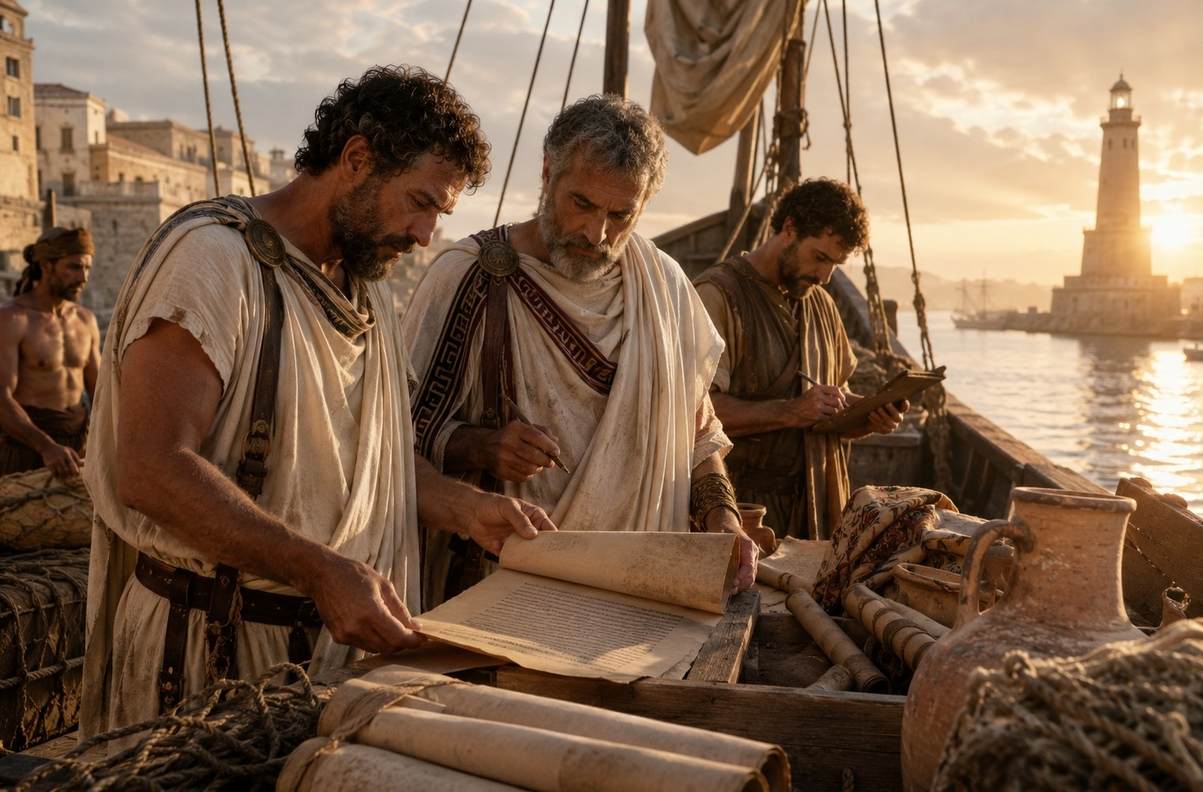
While the harbour confiscation is attested in ancient sources, historians note that the story may have been embellished as part of the Library’s legendary reputation. Whether every ship was searched or merely those suspected of carrying valuable texts, the principle remains: the Ptolemies treated knowledge as a strategic resource subject to state control.
Coercion and the Concentration of Scholars
Coercion: Scholars were invited–and sometimes compelled–to reside in Alexandria. Their presence brought their own collections, students, and expertise, concentrating intellectual capital in a single geographic point. The grammarian Sosibius reportedly negotiated his salary directly with Ptolemy II, illustrating the king’s personal involvement in recruiting. The poet Theocritus composed encomia praising the royal couple; the scholar Callimachus organised the collection; the engineer Ktesibios experimented with pneumatic devices. Each resident scholar was simultaneously a researcher and a trophy.
The most notorious example of coercive acquisition occurred under Ptolemy III Euergetes, who borrowed the official Athenian state copies of tragedies by Aeschylus, Sophocles, and Euripides. He deposited fifteen talents of silver as a pledge for their safe return, copied the texts, and then sent the copies back to Athens–forfeiting the bond but retaining the authoritative originals. The Athenians had no recourse; the Ptolemaic treasury could absorb the loss, and the diplomatic relationship was too valuable to rupture over books.
The Ptolemies did not merely collect books. They collected the people who wrote, copied, and interpreted them–turning the Mediterranean intellectual economy into a royal monopoly.
The Catalogue Was the Innovation
The Library’s true innovation was not collection but organisation. A hoard, no matter how vast, is merely a heap. The Ptolemies transformed their heap into a resource–searchable, navigable, and intellectually productive.
Callimachus and the Pinakes
Callimachus of Cyrene, poet and scholar, created the Pinakes (Tables)–a monumental catalogue of Greek literature. The full title, Tables of Persons Eminent in Every Branch of Learning Together with a List of Their Writings, suggests the scope. The work extended to 120 papyrus rolls–five times the length of Homer’s Iliad–and organised authors alphabetically within genre classifications: drama, rhetoric, law, epic, lyric, history, medicine, mathematics, natural science, and miscellanies.
Each entry included biographical data, a list of the author’s works grouped by type, the opening words of each text, and its extent in lines. This was not merely an inventory; it was a bibliographic survey of the entire Greek literary tradition. The Pinakes enabled scholars to locate related works, trace intellectual genealogies, and identify gaps in the collection. It also, crucially, recorded what was missing–and these gaps became the new targets for acquisition.
The collection was an asymptote–something the Ptolemies constantly approached but could never fully achieve. The Pinakes made this pursuit systematic rather than haphazard.
The First Critical Editions
Before the Library, texts circulated in multiple, often contradictory versions. The Alexandrian scholars–beginning with Zenodotus of Ephesus, the first superintendent–established the practice of diorthosis, or textual correction. By collating manuscripts, eliminating interpolations, and annotating variants, they produced standard editions that became the basis for nearly all subsequent copying. The text of Homer you read today descends from choices made in Alexandria.
This editorial work had political implications. By establishing the “correct” text of the foundational poems of Greek identity, Alexandria asserted itself as the cultural capital of the Hellenistic world–more authoritative than Athens, more comprehensive than Pergamon. The Library was not merely preserving Greek culture; it was redefining it.
The Cost of Power
The Ptolemies spent fortunes on the Library. The scribes, the scholars, the buildings, the papyrus, and the conservation required continuous funding. However, the cost was not merely financial; the acquisition system created dependency.
The knowledge, concentrated and stipended, was controlled. The Library was an instrument of power–a tool for demonstrating cultural superiority and legitimising the Hellenistic imperial project. The thread, while extended, became entangled with the state. When the state faltered, the thread frayed.
The rivalry with the Library of Pergamon illustrates the political dimension. When the Ptolemies prohibited the export of papyrus–the essential writing material–to undercut their competitor, the Pergamenes responded by developing parchment. The “paper war” was a proxy for cultural dominance. The Ptolemies won the battle but set a precedent: knowledge policy could be weaponised.
By the later Ptolemaic period, scholars had begun hiding their private libraries to prevent seizure. The acquisition system, once a magnet, had become a threat. The very success of the Ptolemies in concentrating knowledge had created the conditions for its dispersal.
The Decline Was Inevitable
The fate of the Library was sealed not by fire but by the withdrawal of the system that built it. As the Ptolemaic dynasty declined, the funding became intermittent and the aggressive acquisitions stopped. The most probable explanation for the Library’s fall is not a single catastrophic destruction but a long decline driven by loss of patronage.
The Expulsion of 145 BCE
The turning point came under Ptolemy VIII Euergetes II. After a power struggle with his brother Ptolemy VI, he withdrew his support from the institution and, in 145 BCE, banished all foreign scholars from Alexandria. Among the exiles was Aristarchus of Samothrace, the most eminent critic of his generation, who fled to Cyprus and died soon after. The position of head librarian, once reserved for scholars of international reputation, was awarded to political cronies.
When the scholars dispersed, they carried books with them. Even if they did not, the texts had been standardised and copied by this time, and would have existed in private libraries and other intellectual centres. The concentration had ended; the dispersal had begun.
Roman Patronage and the Long Fade
During the Roman period, patronage was uneven at best. The emperor Claudius supported the library; so did Hadrian. But other rulers neglected it. In 272 CE, Aurelian’s war with Zenobia destroyed the library’s district; in 297 CE, Diocletian levelled that section of Alexandria. By then, however, Alexandrian scholarship was already a memory. Whatever great work had gone on in the city had been taking place elsewhere since sometime after 145 BCE.
The famous fire of 48 BCE–Caesar’s civil war–did damage, but the Library survived. The daughter library, the Serapeum, certainly survived. The Christian destruction of the Serapeum in 391 CE finished a process of decay, not initiated it. The Arab conquest of 642 CE found little remaining to burn. The thread, in this place, was eventually cut–not by a single sword-stroke, but by slow starvation.
The Lesson
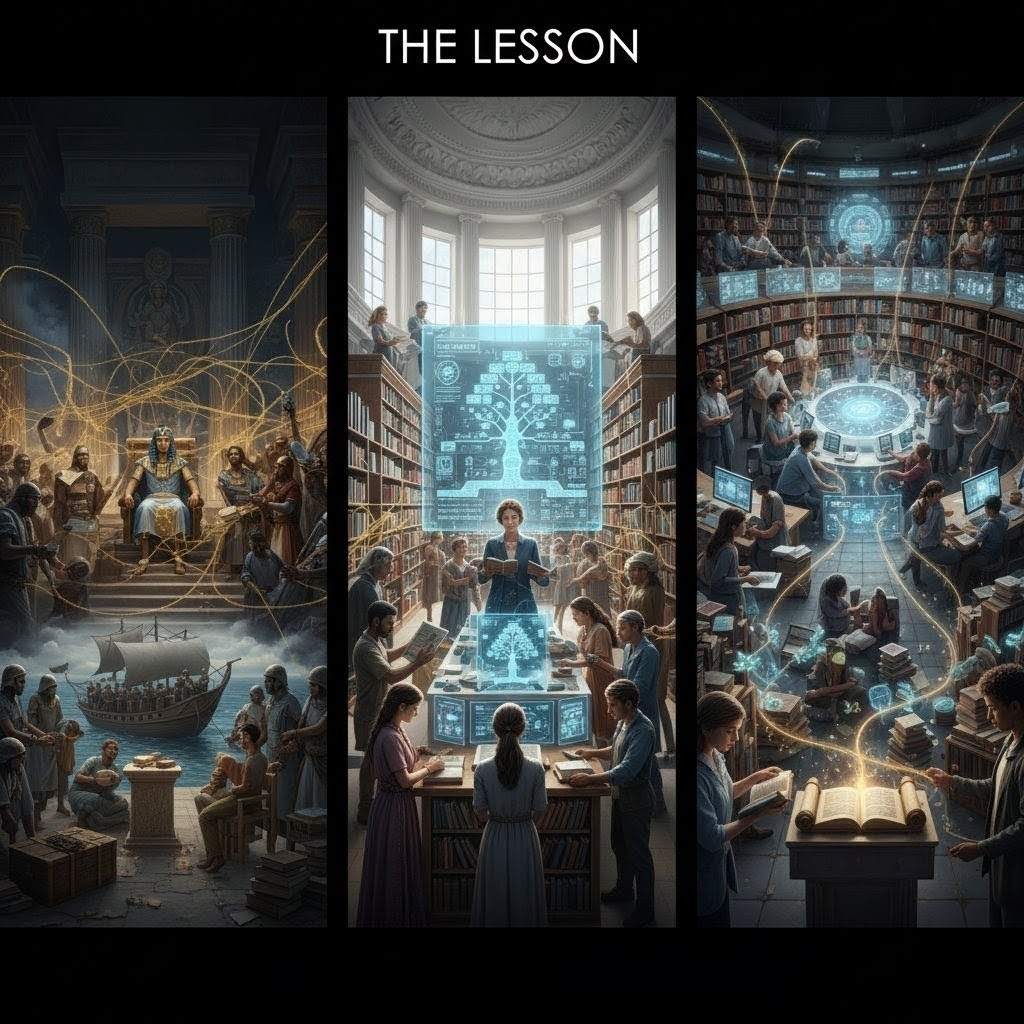
The methods of the Ptolemies–seizure and coercion–are relics of the past. But the principle remains: knowledge requires systematic collection, organisation, and continuous maintenance. The Library demonstrates both the possibilities and the perils of concentration. When knowledge is hoarded by the powerful, it becomes vulnerable to the power’s decline. When it is distributed, it becomes resilient.
The thread extended elsewhere–through monasteries, Islamic courts, and Byzantine schools. These new centres adopted methods that were perhaps less aggressive but more sustainable, ensuring the thread continued through adaptation. The House of Wisdom in Baghdad, the Toledo School of Translators, the scriptoria of medieval Europe–each was a daughter library, learning from the mother’s mistakes.
You maintain the thread today through your own institutions, however small. The Ptolemies built for centuries; you build for the future. The thread continues regardless–not because libraries survive, but because someone recognises what they contain, someone copies, someone carries, someone reads. The someone is you.
Frequently Asked Questions
Who actually built the Library of Alexandria?
The Library was conceived under Ptolemy I Soter (r. 323-282 BCE), who established the Musaeum around 295 BCE with advice from Demetrius of Phalerum. It was expanded into a major research institution under his son, Ptolemy II Philadelphus (r. 282-246 BCE), who dedicated the Mouseion around 283 BCE and funded the aggressive acquisition policies that filled its shelves. While later Ptolemies continued to add to the collection, the foundational architecture–both physical and bureaucratic–was established by the first two kings of the dynasty.
How many books did the Library of Alexandria actually hold?
Ancient sources claim up to 700,000 scrolls, but modern scholars consider this figure hyperbolic–a product of rhetorical inflation and circular reporting. More reliable estimates place the collection between 40,000 and 400,000 scrolls, depending on whether multi-volume works are counted individually or collectively. Even at the conservative end, this represented the largest concentration of Greek literature in the ancient world. The exact number remains unknown because the catalogue itself, Callimachus’ Pinakes, has not survived.
What were the Pinakes and why do they matter?
The Pinakes (Tables) was a 120-volume bibliographic catalogue compiled by Callimachus of Cyrene around 200 BCE. It organised Greek literature by genre and author alphabetically, including biographical data, lists of works, opening words, and line counts. Considered the first systematic library catalogue in Western history, it transformed the collection from an unsearchable hoard into a navigable resource. The Pinakes also recorded gaps in the collection, directing future acquisition efforts. Its organisational principles influenced library science for centuries, including Ibn al-Nadim’s medieval Kitab al-Fihrist.
Did the Ptolemies really confiscate books from ships?
Ancient sources, particularly the physician Galen writing in the second century CE, report that ships arriving in Alexandria’s harbour were searched for books, which were confiscated under customs procedures while copies were returned to the owners. Books acquired this way were tagged ‘from the ships’ (ek ploion). However, modern historians caution that some of these stories may belong to the ‘mythos’ of Alexandrian bibliomania–legendary embellishments that grew around the Library’s reputation. Whether every ship was searched or merely those carrying valuable texts, the principle reflects the Ptolemaic treatment of knowledge as a strategic resource subject to state control.
Why did the Library of Alexandria really fall?
The most probable explanation is not a single catastrophic fire but a long decline driven by loss of patronage. The turning point came in 145 BCE when Ptolemy VIII expelled foreign scholars from Alexandria. During the Roman period, patronage was uneven. By the time of Diocletian’s destruction of the district in 297 CE, and the Christian demolition of the Serapeum in 391 CE, the institution had already decayed through administrative neglect and political instability. The famous fire of 48 BCE during Caesar’s civil war did damage, but the Library survived it. The thread was starved, not severed.
What is the difference between the Great Library and the Serapeum?
The Great Library was the main royal collection attached to the Mouseion in Alexandria’s Bruchion district, restricted to scholars with royal patronage. The Serapeum was a ‘daughter library’ established by Ptolemy III Euergetes in a different quarter of the city, attached to the temple of Serapis. It was public, accessible to citizens and students, and housed popular works and religious texts. The Serapeum outlived the main library by centuries, surviving until its destruction by Christian mobs in 391 CE. Its survival demonstrates that accessibility and distributed storage are more resilient than elite concentration.
How did the Ptolemaic acquisition system influence later libraries?
The Ptolemaic model of systematic collection, critical editing, and bibliographic organisation established paradigms that persisted for millennia. The Pinakes influenced medieval cataloguing, including the Islamic Kitab al-Fihrist. The practice of textual criticism–collating manuscripts to establish standard editions–became the foundation of modern philology. However, the Ptolemies also demonstrated the vulnerability of centralised, state-dependent institutions. Later transmission centres–monastic scriptoria, the House of Wisdom in Baghdad, the Toledo School of Translators–adopted more distributed and sustainable models, ensuring that the thread could survive the fall of any single empire.
Further Reading
Continue exploring the history of knowledge preservation and the thread that extends through institutional collapse:
- The Library of Alexandria: What Was Lost, What Survived & Why It Matters — The mother library and the specific texts that vanished or persisted.
- The Burning of the Library of Alexandria — Separating Caesar’s fire from the long decline that followed.
- The Serapeum: Alexandria’s Daughter Library — How the public daughter outlived the elite mother through adaptation.
- The House of Wisdom: Baghdad’s Translation Movement — Where the scholars dispersed and the thread extended into the Islamic Golden Age.
- The Living Thread: How Forbidden Knowing Survives the Fire — The pattern of suppression and survival across history.
- The Role of Jewish Scholars in Knowledge Transmission — The invisible hands that carried Greek and Arabic learning into medieval Europe.
- Nag Hammadi: The Burial and Resurrection of Gnostic Texts — The 1945 discovery that changed everything, and the pattern of deliberate concealment.
- The Cathars: A Clean Church Without Property — Medieval suppression of direct knowing and the thread’s survival through heresy.
- The Transformation After Mystical Experience — Integration and the return to ordinary life after non-ordinary states.
- States of Knowing: What Happens When Consciousness No Longer Belongs to You — The broader context of threshold states and the architecture of perception.
References and Sources
Sources are grouped by category for clarity. No in-text citation numbers are used, per The Thread editorial protocol.
Primary Ancient Sources
- Galen. Commentary on Hippocrates’ Epidemics (III). (References the ship confiscation and the “from the ships” designation, ek ploion.)
- Strabo. Geography, 13.1.54. (On Aristotle’s library and its relationship to the Ptolemies.)
- Athenaeus. Deipnosophistae, I.10. (On the acquisition of Aristotle’s books and the book trade.)
Scholarly Monographs
- Canfora, L. (1987). The Vanished Library: A Wonder of the Ancient World. University of California Press.
- Casson, L. (2001). Libraries in the Ancient World. Yale University Press.
- Blum, R. (1991). Kallimachos: The Alexandrian Library and the Origins of Bibliography. University of Wisconsin Press.
- Parsons, E. A. (1952). The Alexandrian Library: Glory of the Hellenistic World. Elsevier.
Critical Studies and Reviews
- Johnson, J. C. (2013). Myth and History: Galen and the Alexandrian Library. In Ancient Libraries (pp. 364-376). Cambridge University Press.
- World History Encyclopedia. (2023). Library of Alexandria. (On decline through loss of patronage and Ptolemy VIII’s expulsion of scholars.)