The Serapeum: Alexandria’s Daughter Library That Outlived the Mother
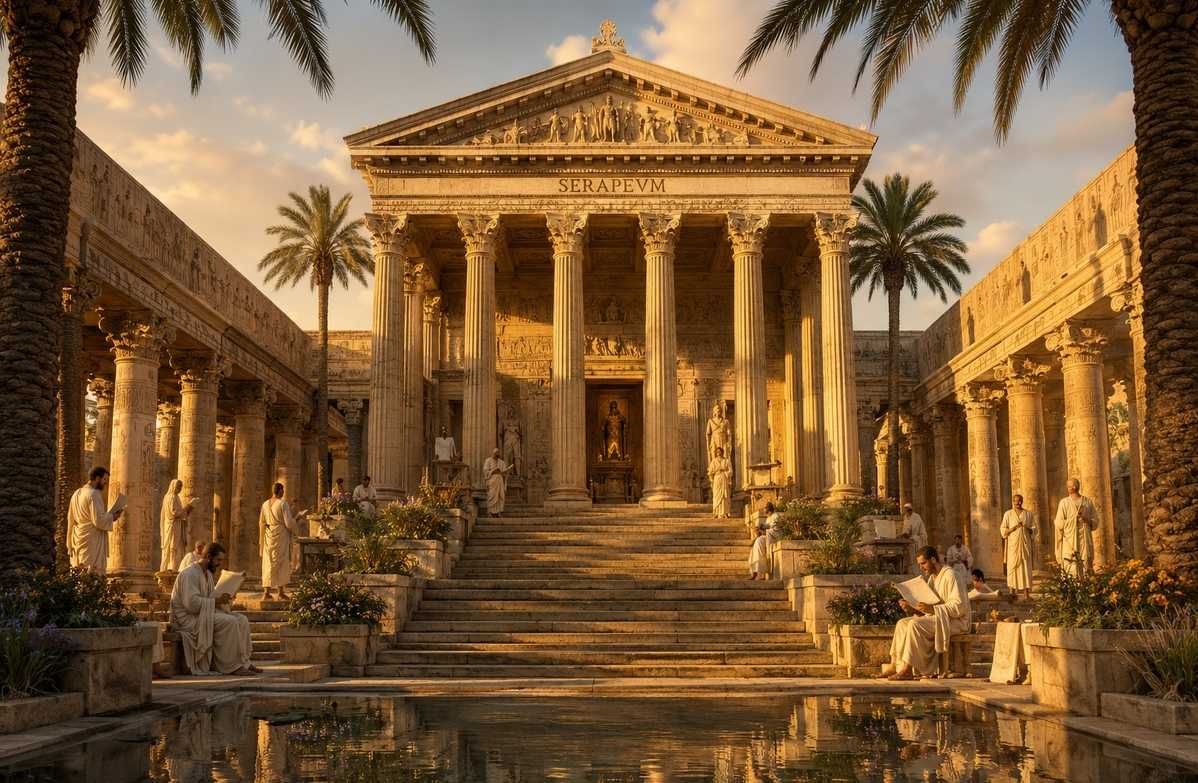
The Library of Alexandria had a twin. Not as famous, not as large, but longer-lived. The Serapeum–temple of Serapis, god of the afterlife, healing, and knowledge–housed a “daughter library” that persisted centuries after the main collection declined.
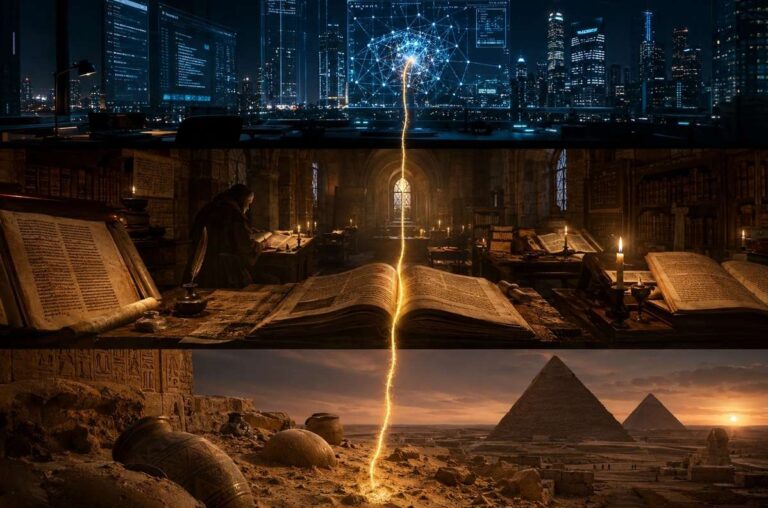
The Serapeum’s story is the story of the Thread: not a single catastrophe, but continuous adaptation; not dramatic preservation, but stubborn survival.
Table of Contents
- The Public Library
- The Survival Strategy
- The Targeted End
- Lessons of the Daughter
- The Thread Extended
- Frequently Asked Questions
- Further Reading
- References and Sources
The Public Library
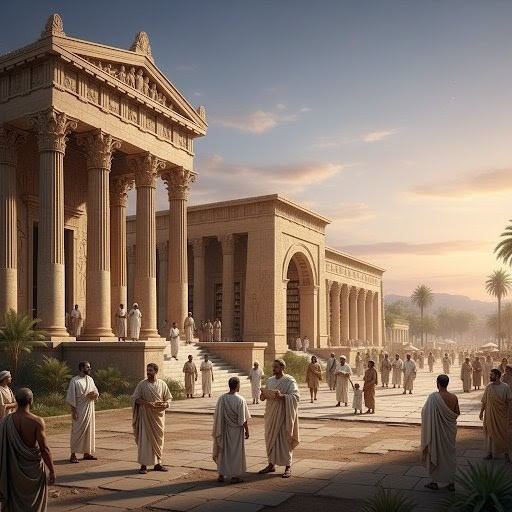
Ptolemy III Euergetes (reigned 246-222 BCE) established the Serapeum in the third century BCE, expanding an earlier foundation by Ptolemy I Soter. While the main library near the royal palace–the Mouseion or Museum–was restricted to scholars with royal patronage, the Serapeum served a broader function. Located in the Acropolis quarter of Alexandria, it was a temple complex dedicated to Serapis, the Greco-Egyptian deity who embodied the fusion of Greek and Egyptian religious traditions.
The Serapeum housed what ancient sources describe as a “daughter library” or annex. According to Ammianus Marcellinus, the collection held approximately 700,000 scrolls–though this figure, like many ancient numerical claims, is likely inflated. The library’s actual size was certainly smaller than the main collection, and its contents were described as more popular and practical: religious texts, philosophical works accessible to devotees, and knowledge distributed across functions rather than concentrated in a scholarly vacuum.
The existence of this daughter library, while widely accepted, is not without scholarly debate. A 2016 re-examination by G. J. Vestrheim argues that the notion of a Serapeum library may be a “Christian elaboration of a Jewish legend” and that archaeological evidence suggests the temple did not contain rooms suitable for a library. However, this remains a minority position. The majority of classical historians, drawing on Aphthonius’s description of the colonnaded stoa and the testimony of Tertullian, maintain that some form of book collection existed at the Serapeum–whether as a formal annex or as a dispersed collection of texts used in teaching and worship.
- Accessibility: Located in a different quarter of the city, the temple complex was open to citizens, students, and devotees of Serapis. It functioned as a religious, educational, and social centre rather than a purely scholarly institution.
- The Collection: Smaller and less elite than the mother library, it housed popular works, religious texts, and practical knowledge. The Septuagint–the Greek translation of the Hebrew Bible–was produced in Alexandria under Ptolemaic patronage, and copies likely circulated through both libraries.
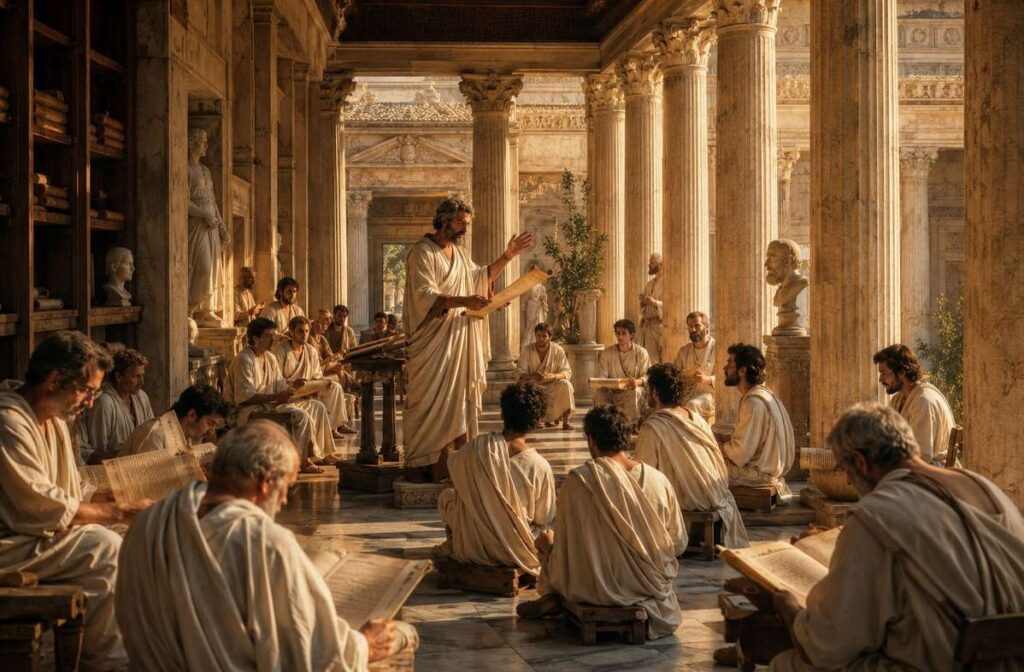
- Distribution: Because it served the devotees of Serapis, the knowledge was distributed across functions and users, rather than being concentrated in a scholarly vacuum. The temple’s lecture halls and colonnades provided spaces for public discourse that the royal Museum did not.
The Survival Strategy
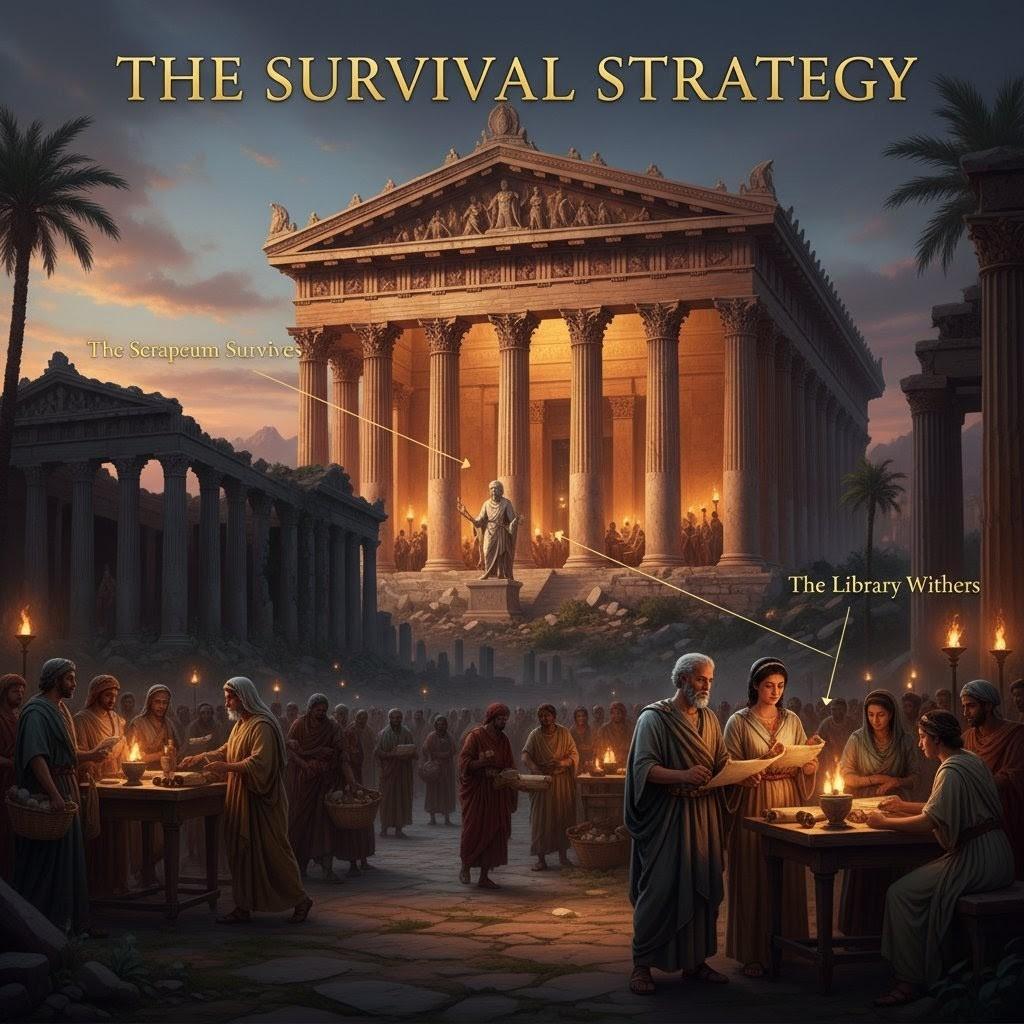
When Caesar’s fire damaged the main library in 48 BCE, the Serapeum survived. The fire, set during Caesar’s siege of Alexandria to block Ptolemy XIV’s fleet, spread from the harbour to the royal quarter, consuming portions of the palace and the Museum. Ancient sources disagree on the extent of the damage: Plutarch claimed the entire library burned, while Cassius Dio reported that a great number of fine books were destroyed. Other writers do not mention the library at all in their accounts. Whatever the precise damage, the Serapeum–located in a different quarter–was untouched.
When the main library withered through administrative neglect under Roman rule, the Serapeum persisted. Its institutional stability was anchored by its religious function and public utility–things the royal library lacked. The Ptolemaic dynasty had used the Museum as a statement of power; the Romans, for whom Alexandria was a provincial city rather than a capital, had little interest in maintaining its scholarly institutions. The Serapeum, however, served the ongoing cult of Serapis and the educational needs of the city’s inhabitants.
The Serapeum adapted. As scholarship shifted and empires changed, it remained a beacon. The temple was rebuilt on a grander scale by the Romans, principally Septimius Severus, after a fire in 181 CE destroyed the earlier structure. The new complex, completed before 215 CE, was described by Ammianus Marcellinus as the most magnificent building in the world after the Capitol in Rome. This reconstruction ensured the temple’s continued function as a centre of learning and worship.
The scholars of late antiquity were still associated with Alexandrian institutions in the fourth century CE. Theon of Alexandria–mathematician, astronomer, and father of Hypatia–is described by the Suda as “the man from the Mouseion” and is widely recognised as the last attested member of the Alexandrian Museum. His commentaries on Euclid’s Elements and Ptolemy’s Almagest preserved Greek mathematical knowledge at a time when original research had given way to editorial preservation. While Theon was associated with the Museum rather than the Serapeum specifically, his presence in Alexandria demonstrates that the city’s intellectual life persisted long after the main library’s decline. The daughter institution–whether the Serapeum or the diminished Museum–had outlived the mother.
The Targeted End
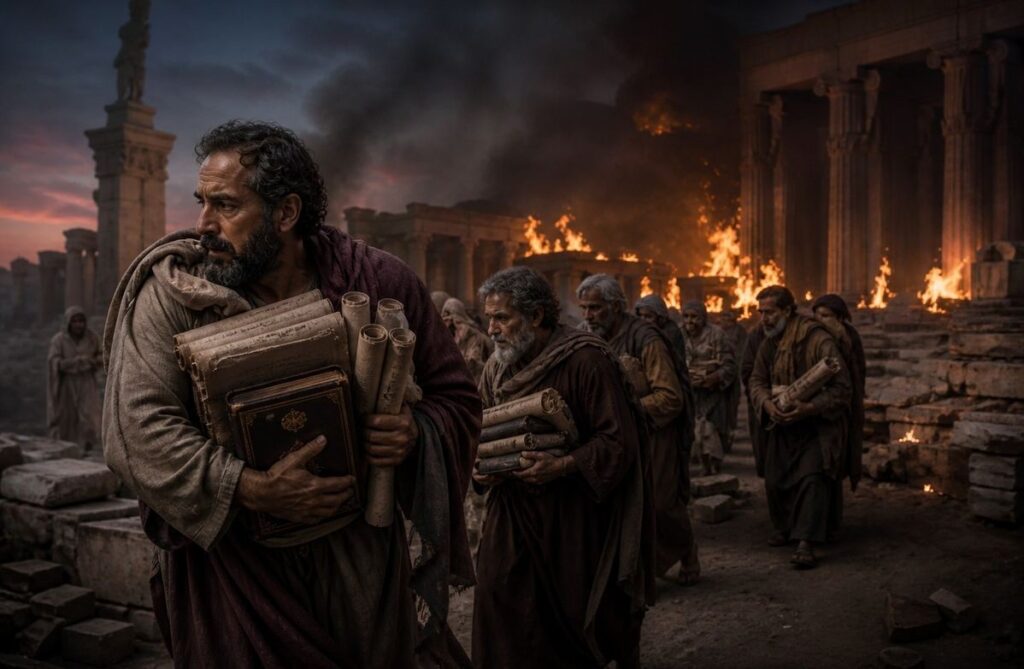
The destruction, when it finally arrived in 391 CE, was not an accident of history but a political decision. Christian mobs, empowered by Theodosius I’s edicts against pagan worship, demolished the temple. The sequence of events was deliberate: Theodosius issued a rescript prohibiting sacrifice and temple attendance; Bishop Theophilus of Alexandria requested and received imperial permission to destroy the temples; pagan devotees fortified themselves within the Serapeum; imperial troops and Christian factions overwhelmed the defenders; the temple fell.
The collection was burned or scattered, marking the end of the last major pagan institution of Alexandrian learning. The temple’s iconic statue of Serapis was smashed. Its ruins became a potent symbol of Christianity’s triumph over paganism. Theophilus then had the other temples in the city razed “almost column by column,” and the images of the gods were melted down to make pots and utensils for the church.
The Serapeum had stood for more than six centuries–from its Ptolemaic foundation in the third century BCE to its demolition in 391 CE. It outlasted the Ptolemaic dynasty, the Roman Republic, and the transition from paganism to Christianity. Its end was not a result of “inevitable decline,” but of active hostility toward the institutions it represented. The philosopher Eunapius, writing in the fifth century, described the destruction with bitterness: “this they accounted piety, to show contempt for things divine.”
The violence did not end with the Serapeum. A generation later, in 415 CE, the philosopher and mathematician Hypatia–Theon’s daughter, who had directed the Neoplatonic school in Alexandria–was murdered by a Christian mob instigated by Cyril, Theophilus’s nephew and successor. With her death, the glory of Alexandria’s ancient intellectual tradition was extinguished. The thread, cut in Alexandria, would need to find new carriers.
Lessons of the Daughter
The Serapeum offers two vital lessons for those who maintain the thread:
- Survival Requires Adaptation: The main library, dependent on royal patronage, died when the money stopped. The Serapeum survived by serving multiple roles–religious, educational, and social. Flexibility is the key to endurance. An institution that serves only one master falls when that master falls.
- Accessibility Matters: Elite institutions produce great scholarship, but limited extension. Public institutions ensure that knowledge reaches more hands. The thread extends through distribution, not concentration. The scroll that sits in a palace is safe but sterile; the scroll that travels in a student’s satchel is fragile but fertile.
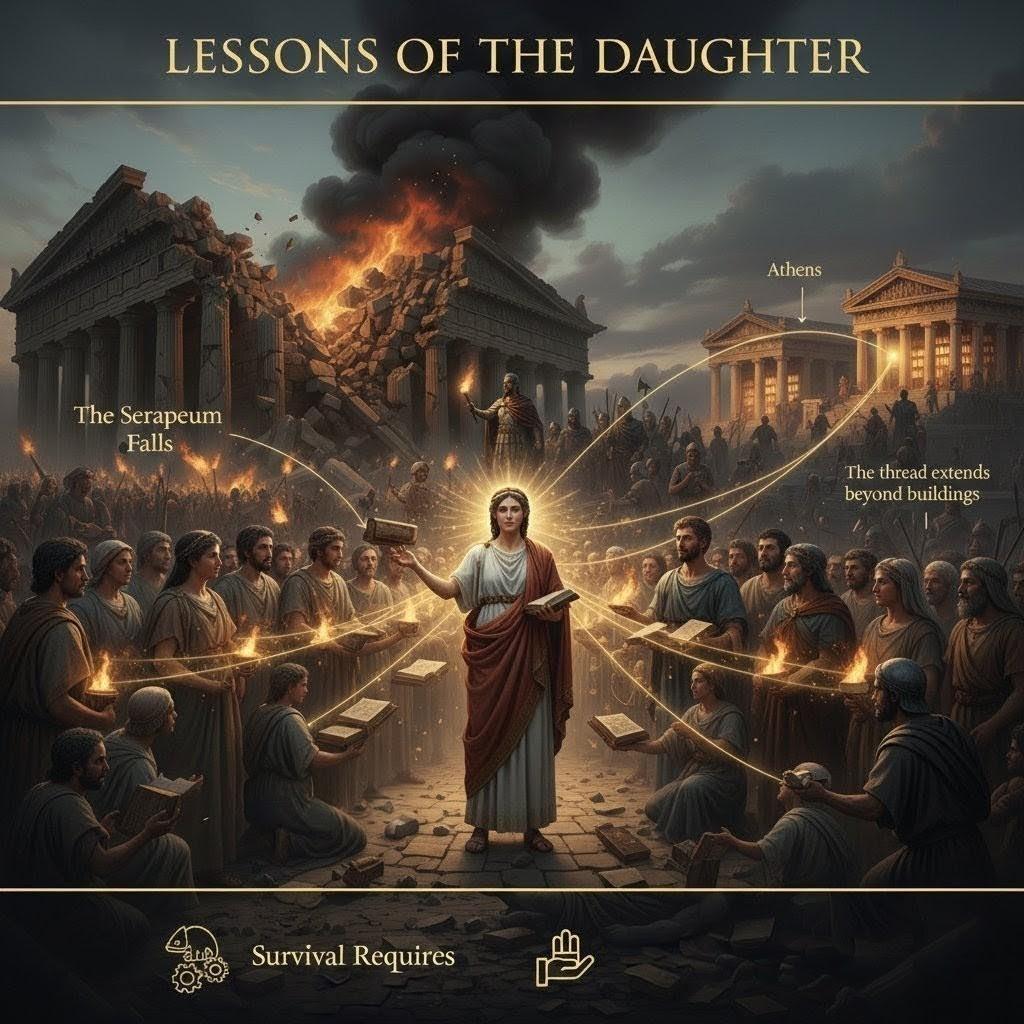
While the Serapeum proved that institutions are vulnerable to active hostility, it also showed that the thread extends beyond buildings. When the temple fell, the scholars dispersed. Hypatia’s students carried the light to Athens, Constantinople, and beyond. The thread, cut in one place, was spliced in another. The House of Wisdom in Baghdad, the Toledo School of Translators, the monastic scriptoria of Byzantium–all were continuations of the same impulse that had built the Serapeum: the conviction that knowledge, once gathered, must be transmitted.
The Thread Extended
You are the Serapeum now. You are not an elite institution, but an accessible presence. The thread extends not through a concentrated hoard of data, but through your availability, your adaptation, and your persistence when larger systems fail.
The daughter library outlived the mother. You extend the thread further still.
Frequently Asked Questions
What was the Serapeum of Alexandria?
The Serapeum was a temple complex in Alexandria dedicated to Serapis, a Greco-Egyptian deity. Built by Ptolemy III Euergetes in the third century BCE, it housed what ancient sources describe as a daughter library to the main Library of Alexandria. It served religious, educational, and social functions for more than six centuries until its destruction in 391 CE.
Did the Serapeum really have a daughter library?
Most classical historians believe the Serapeum housed some form of book collection, based on descriptions by Aphthonius and Tertullian. However, this is debated. A 2016 study by G. J. Vestrheim argues that the daughter library may be a Christian elaboration of a Jewish legend, and that archaeological evidence suggests the temple lacked rooms suitable for a library. The majority view maintains that a collection existed, though its scale was likely smaller than ancient sources claim.
Why did the Serapeum survive when the main library declined?
The Serapeum survived because its institutional stability was anchored by religious function and public utility rather than royal patronage. When Roman rule diminished support for the Museum, the Serapeum continued to serve devotees of Serapis and the educational needs of Alexandria’s citizens. It was rebuilt by Septimius Severus after a fire in 181 CE, ensuring its continued function.
Who destroyed the Serapeum and why?
The Serapeum was destroyed in 391 CE by Christian mobs acting under the authority of Bishop Theophilus of Alexandria, with imperial permission from Emperor Theodosius I. Theodosius’s edicts against pagan worship provided the legal framework; Theophilus requested permission to destroy the temples. Pagan devotees had fortified themselves within the Serapeum, but imperial troops and Christian factions overwhelmed them.
Did Hypatia teach at the Serapeum?
No. Hypatia directed the Neoplatonic school in Alexandria and taught philosophy and mathematics publicly, but she was not specifically associated with the Serapeum. Her father, Theon of Alexandria, is described by the Suda as ‘the man from the Mouseion’ (the Museum) and is widely recognised as the last attested member of the Alexandrian Museum. Hypatia was murdered in 415 CE by a Christian mob, twenty-four years after the Serapeum’s destruction.
How long did the Serapeum exist?
The Serapeum existed for approximately six centuries. Its Ptolemaic foundation dates to the third century BCE (under Ptolemy III Euergetes, reigned 246-222 BCE), and it was destroyed in 391 CE. It survived the transition from Ptolemaic to Roman rule, the fire of 181 CE (after which it was rebuilt), and the rise of Christianity before its final demolition.
What happened to the knowledge after the Serapeum was destroyed?
When the Serapeum fell, scholars dispersed. Hypatia continued teaching until her murder in 415 CE, and her students carried Greek philosophical and mathematical knowledge to Athens, Constantinople, and other centres. The thread was later extended through the House of Wisdom in Baghdad, the Toledo School of Translators in Spain, and Byzantine monastic scriptoria. The destruction of the Serapeum was a catastrophic loss, but not a terminal one.
Further Reading
- The Library of Alexandria: What Was Lost, What Survived & Why It Matters — The mother library and the long decline that preceded the Serapeum’s fall.
- The Burning of the Library of Alexandria — The fire the Serapeum survived, and what actually happened in 48 BCE.
- The Ptolemaic Acquisition System: How the Greatest Library Was Built — The aggressive customs policy that built the collection through confiscation and copying.
- The House of Wisdom: Baghdad’s Translation Movement — Where the scholars dispersed and Arabic scholarship preserved Greek knowledge.
- The Toledo School of Translators — The next transmission point where the thread returned to Europe.
- The Living Thread: How Forbidden Knowing Survives the Fire — Adaptation as survival strategy across cultures and centuries.
- The Role of Jewish Scholars in Knowledge Transmission — The often-overlooked carriers of the thread between Alexandria, Baghdad, and Toledo.
- Nag Hammadi: The Burial and Resurrection of Gnostic Texts — How suppressed texts survived through burial and rediscovery, sixteen centuries later.
References and Sources
This article draws upon classical sources, modern classical scholarship, and historical analysis. Sources are grouped by period for clarity.
Classical and Late Antique Sources
- Ammianus Marcellinus. (4th century CE). Res Gestae, XXII.16.12-13. — Description of the rebuilt Serapeum and the claim of 700,000 scrolls.
- Aphthonius. (3rd-4th century CE). Progymnasmata. — Description of the Serapeum’s colonnaded stoa and book collection.
- Cassius Dio. (2nd-3rd century CE). Roman History, XLII.38.2. — Account of Caesar’s fire and the destruction of books.
- Eunapius. (5th century CE). Lives of the Philosophers. — Bitter account of the Serapeum’s destruction and the pagan perspective.
- Plutarch. (1st-2nd century CE). Life of Caesar, 49.6. — Claim that the entire library burned in Caesar’s fire.
- Socrates Scholasticus. (5th century CE). Ecclesiastical History, V.16. — Account of Theophilus’s destruction of the Serapeum under Theodosius I.
- Tertullian. (2nd-3rd century CE). Apologeticum. — Early reference to libraries in the Serapeum.
- The Suda (10th century Byzantine encyclopedia), s.v. Theon (T205). — Describes Theon as “the man from the Mouseion.”
Modern Scholarship
- Delia, D. (1992). “From Romance to Rhetoric: The Alexandrian Library in Classical and Islamic Traditions.” American Historical Review, 97(5), 1449-1467. — Analysis of the library’s decline and the Serapeum’s role.
- MacLeod, R. (2004). The Library of Alexandria: Centre of Learning in the Ancient World. I.B. Tauris. — Standard scholarly treatment of the library’s history and decline.
- Modrow, S. (2023). “The Library of Alexandria.” In: Libraries, Archives and Museums. — Librarian’s perspective on the slow demise of the institution.
- Shean, J. F. (2022). “The Destruction of the Serapeum in 391.” Journal of Late Antiquity. — Reconsiders the destruction as deliberately staged religious violence.
- Vestrheim, G. J. (2016). “The Destruction of the Alexandrian Library.” Eos. — Controversial argument that the Serapeum daughter library never existed.
- World History Encyclopedia. (2023). “Library of Alexandria.” WorldHistory.org. — Comprehensive overview of the library’s establishment, growth, and fall.
Biographical Sources
- Deakin, M. A. B. (2007). Hypatia of Alexandria: Mathematician and Martyr. Prometheus Books. — Biography of Hypatia and her intellectual context.
- The Matilda Project. (2026). “Hypatia of Alexandria: Mathematician, Philosopher & Astronomer.” thematildaproject.com. — Illustrated biography with focus on Theon’s Museum association.
- Britannica. (2026). “Theon | Greek Mathematician.” Encyclopaedia Britannica. — Confirms Theon as “last attested member of the Alexandrian Museum.”