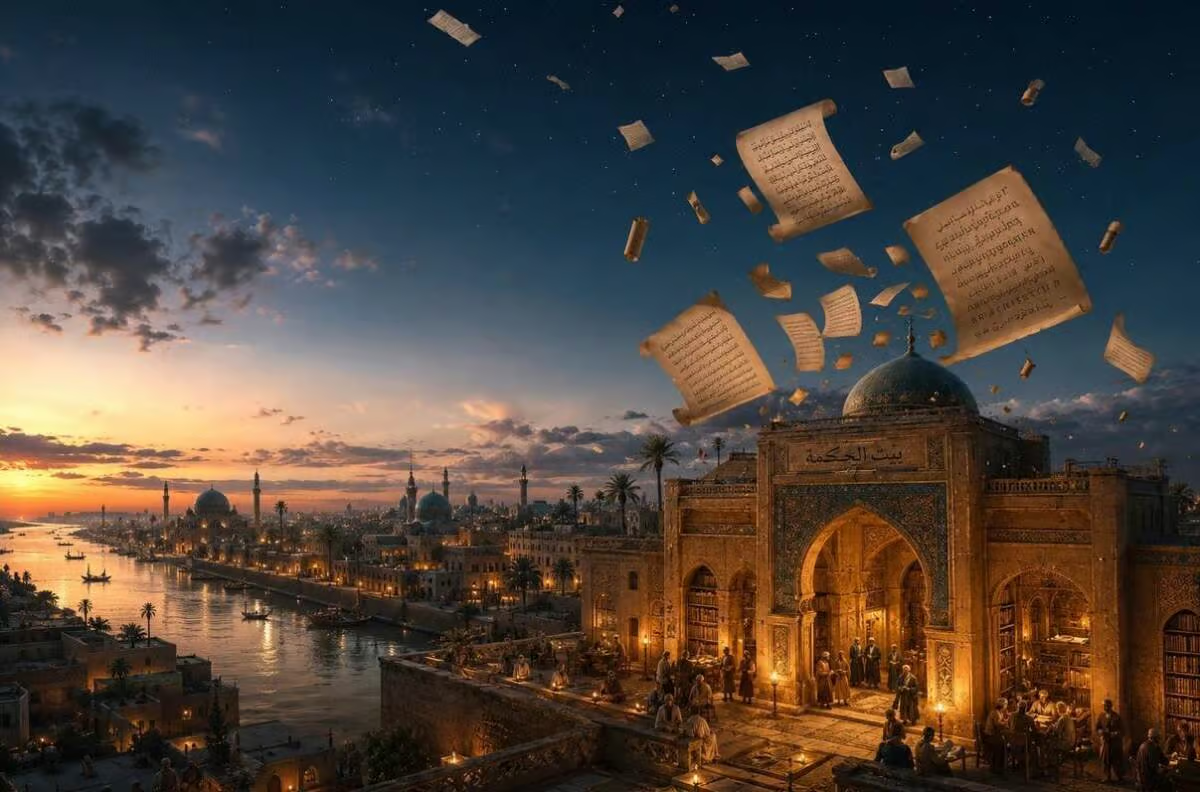
The House of Wisdom: Baghdad’s Translation Movement That Saved Greek Knowledge
The thread, cut in Alexandria, extended to Baghdad. The House of Wisdom—Bayt al-Hikma–associated with the Abbasid court from the late eighth century onward, became the new centre of ancient learning. Greek texts, lost in the West, were preserved in Arabic. The knowledge, translated, was transformed. The thread, extended across culture, became stronger.
The Abbasid Caliphate, ruling from Baghdad, pursued knowledge systematically. The second Abbasid caliph, al-Mansur (r. 754–775), sponsored translations of Sanskrit astronomical texts and laid the groundwork for what would become the translation movement. His grandson, al-Ma’mun (r. 813–833), is traditionally credited with establishing the House of Wisdom as a formal institution, though modern scholars debate whether it was a single building or a network of scholars supported by royal patronage. The translation movement, already active, became state policy–and state policy, sustained across generations, changed the intellectual map of the world.
Table of Contents
- The Abbasid Context: Why Baghdad?
- The Translators Were the Thread
- The Translation Was Not Neutral
- Original Work and Advancement
- Decline and Dispersal
- The Thread Extended Across Culture
- Frequently Asked Questions
- Further Reading
- References and Sources
The Abbasid Context: Why Baghdad?
Al-Mansur and the Foundation
The Abbasid revolution of 750 CE displaced the Umayyad Caliphate and moved the capital from Damascus to Baghdad, a new city built on the Tigris River. The move was strategic: Baghdad sat at the crossroads of trade routes connecting China, India, Persia, and the Mediterranean. It was also symbolic: the Abbasids claimed descent from Muhammad’s uncle al-Abbas and sought to distinguish themselves from their predecessors by embracing Persian administrative models and intellectual traditions.
Al-Mansur, the second Abbasid caliph, laid the groundwork for the translation movement. He sponsored the translation of Sanskrit astronomical texts–particularly the Siddhanta–into Arabic, recognising that Indian mathematics and astronomy offered techniques superior to those available in the Islamic world. This was not disinterested scholarship; it was statecraft. The caliph needed accurate calendars for tax collection, reliable astronomical predictions for agriculture, and advanced medicine for his court. Knowledge was power, and the past was a mine.
Al-Ma’mun and State Patronage
Al-Ma’mun (r. 813–833), the seventh Abbasid caliph, is traditionally credited with transforming the House of Wisdom from an informal circle of scholars into a state-sponsored institution. According to later sources, al-Ma’mun was inspired by a dream in which Aristotle appeared to him, promising that the pursuit of philosophy would lead to divine truth. Whether legendary or not, the dream captures the spirit of the age: the conviction that Greek philosophy and Islamic revelation were not enemies but allies in the search for wisdom.
Al-Ma’mun’s patronage was systematic and generous. He sent emissaries to Byzantium to acquire Greek manuscripts, funded the salaries of translators, and established the Bayt al-Hikma as a centre where scholars could work without the distractions of commerce or politics. The motivation was practical: astronomy for astrology and navigation, medicine for healing, mathematics for taxation and engineering. But the effect was far broader than the motive. The House of Wisdom became the intellectual capital of the world, drawing scholars from across the Islamic empire and beyond.
The Translators Were the Thread
The effect of the translation movement was preservation. Texts that survived only in fragments in Greek were translated whole into Arabic. Works lost in the original were preserved in translation. The thread was not merely maintained; it was renewed. The individuals who accomplished this were not lone geniuses working in isolation but members of collective networks–families, schools, and patronage systems that sustained the work across generations.
Hunayn ibn Ishaq and the Ishaq Family
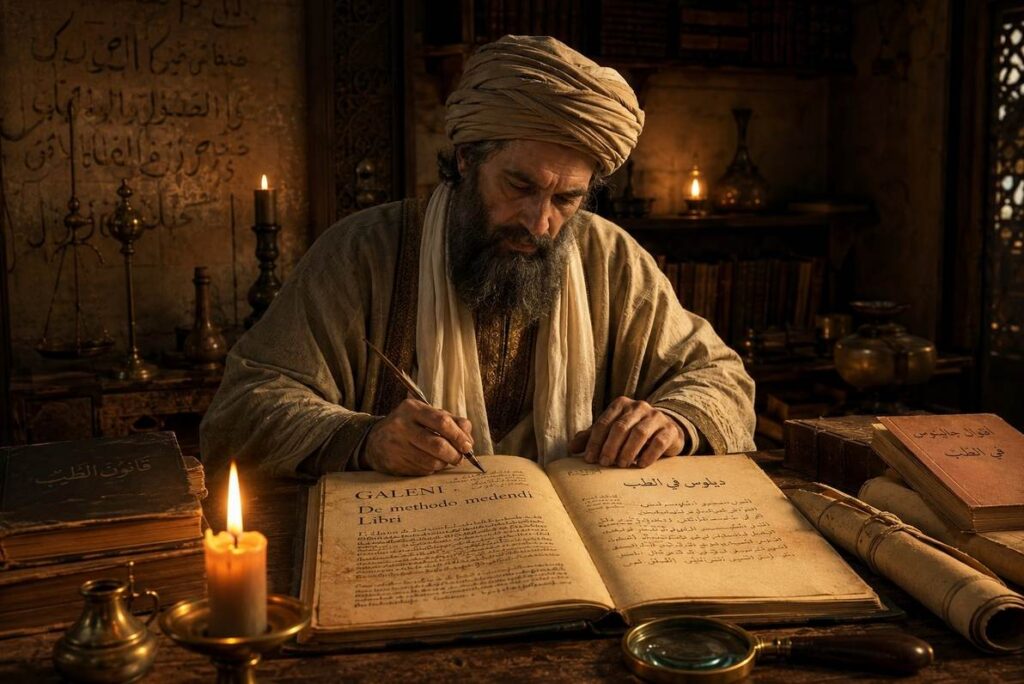
Hunayn ibn Ishaq (c. 809–873), a Christian Arab from al-Hira, was the most prolific and precise of the Baghdad translators. Working under the patronage of the Banu Musa brothers–three wealthy and influential scholars who sponsored the translation movement–Hunayn produced translations of Galen’s medical works that set the standard for accuracy. The exact number of his translations is debated, but scholarly estimates range from approximately eighty-six to over one hundred treatises, encompassing not only Galen but also Hippocrates, Dioscorides, and numerous Greek philosophical texts.
Hunayn did not work alone. His son Ishaq ibn Hunayn and his nephew Hubaysh ibn al-Hasan continued the family tradition, translating Aristotle’s Metaphysics and Physics into Arabic. The Ishaq family, across three generations, extended the thread through language with a precision that later Latin translators would strive to match. Their method was rigorous: they compared multiple Greek manuscripts, consulted with Greek-speaking scholars, and produced Arabic versions that were then checked against the originals. The result was not merely transmission but refinement–the text, translated, was often clearer than the original.
Al-Kindi: The Philosopher of the Arabs
Al-Kindi (c. 801–873), known as Ya’qub al-Kindi or “the Philosopher of the Arabs,” was the first systematic philosopher in the Islamic world. Unlike the translators who rendered Greek texts into Arabic, al-Kindi synthesised them–making Aristotle and Plato compatible with Quranic revelation, developing arguments for the eternity of the world that could be reconciled with creation, and writing treatises on everything from optics to music to the nature of the soul. His output was vast: approximately 270 treatises, of which only a fraction survive.
Al-Kindi’s significance lies in his method. He did not merely translate Greek philosophy; he transposed it–adapting its concepts to an Islamic framework while preserving its logical rigour. His treatise On First Philosophy begins with the declaration that “the truth is one,” whether sought by Greeks or Arabs, philosophers or prophets. This ecumenical approach, though controversial in some quarters, established the precedent that would be followed by al-Farabi, Avicenna, and Averroes: the Greek philosophical tradition was not foreign to Islam but a preparation for it, a rational foundation upon which revelation could build.
Al-Khwarizmi and the Mathematical Revolution
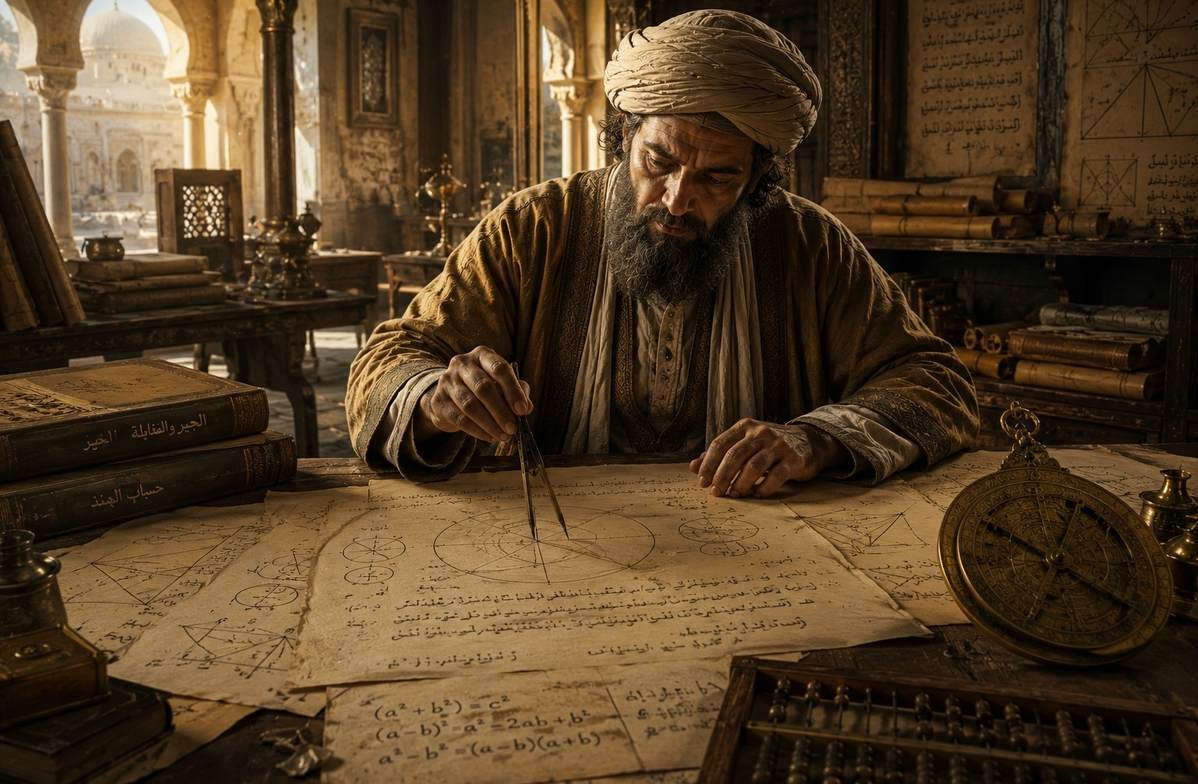
Muhammad ibn Musa al-Khwarizmi (c. 780–850), a scholar at the House of Wisdom, produced works that would transform mathematics forever. His Kitab al-Jabr wa-l-Muqabala (Book of Restoration and Balancing) introduced systematic methods for solving linear and quadratic equations–the foundation of algebra. The word “algebra” itself derives from al-jabr, the operation of restoring equality by transferring negative terms to the other side of the equation.
Al-Khwarizmi also introduced the decimal positional system–the Hindu-Arabic numerals, including the revolutionary zero–to the Islamic world and, through Latin translations, to Europe. His name, Latinised as Algoritmi, gave us the word algorithm. The practical impact was immense: the decimal system replaced the cumbersome Roman numerals, making complex calculations accessible to merchants, engineers, and astronomers. The thread, here, was not merely philosophical but operational–it changed how people counted, built, and thought about quantity.
The Unnamed Majority
These individuals represent hundreds unnamed: the scribes who copied manuscripts by hand, the students who assisted with research, the patrons who funded the work, and the scholars whose names were lost because they did not produce original treatises but only translations. The thread extends through collective labour, not lone genius. The House of Wisdom was a collaborative institution in an age when most scholarship was solitary. The translators worked in teams, debated interpretations, and built upon each other’s work in a manner that resembles modern scientific collaboration more than medieval monastic study.
The Translation Was Not Neutral
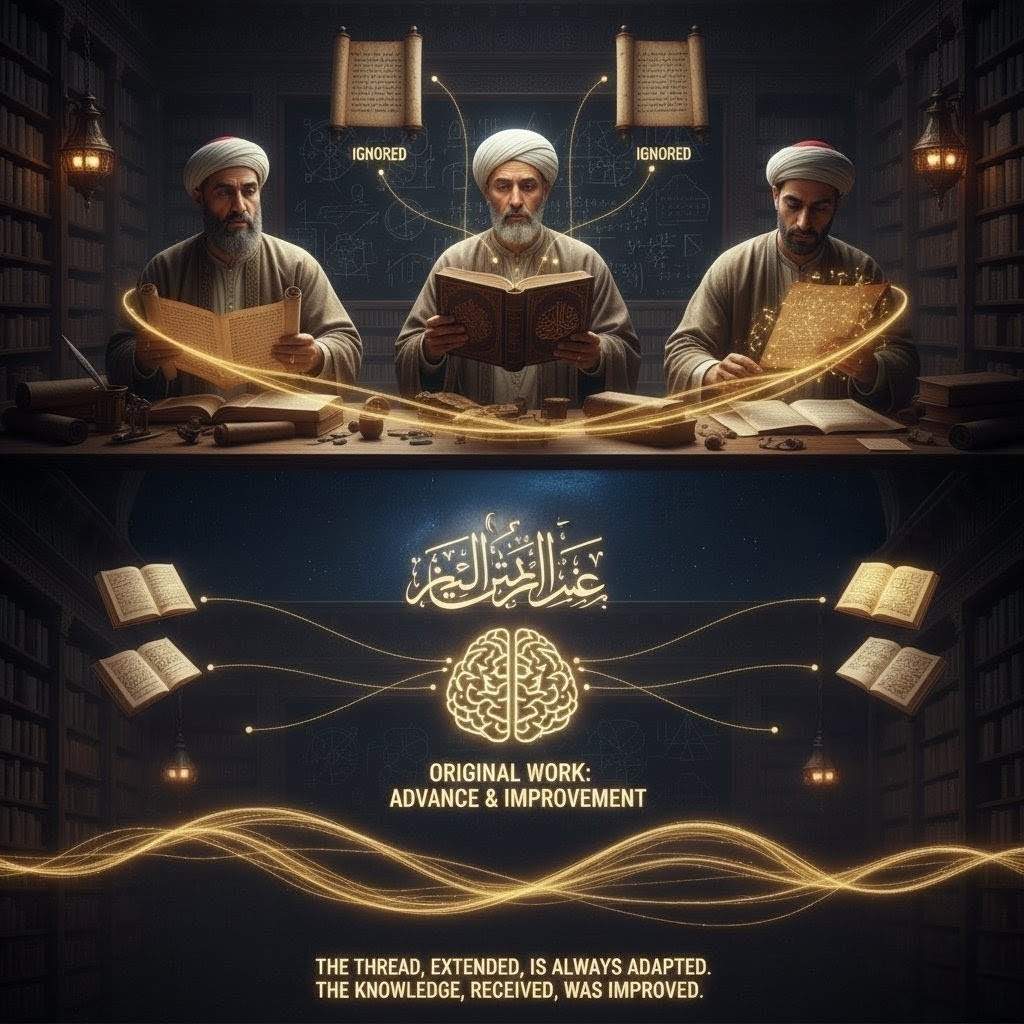
The translators made choices. What to translate, what to ignore, and what to “correct.” The Greek texts were interpreted–placed in an Islamic philosophical framework and reconciled with Quranic revelation. This interpretation was not corruption; it was continuation. The thread, extended, must be extended through something. The Islamic framework was the medium. The knowledge, transmitted, was transformed by transmission. This is the pattern. The thread, pure, does not exist. The thread, extended, is always adapted.
The adaptation was sometimes subtle, sometimes profound. When Hunayn ibn Ishaq translated Galen’s anatomical works, he occasionally added commentary that reconciled Galen’s observations with Islamic dietary laws. When al-Kindi commented on Aristotle’s Metaphysics, he introduced the concept of divine creation that Aristotle had never entertained. These were not errors; they were interpretive extensions–the necessary work of making foreign concepts intelligible within a new cultural and theological context.
The translators also made selections. Not all Greek texts were deemed worthy of translation. Works of Greek poetry, drama, and historiography were largely ignored in favour of philosophy, medicine, mathematics, and astronomy. The selection reflected the priorities of the Abbasid court: practical knowledge that could serve the state, and philosophical knowledge that could serve the soul. The gaps in the translation record are as significant as the contents: the thread, extended, is also filtered.
Original Work and Advancement
The House of Wisdom was not merely a preservation society. It was a centre of original research. The commentaries on Aristotle produced by al-Farabi and later by Averroes were not mere summaries but creative developments that advanced Aristotelian thought in directions the Greek philosopher had never imagined. The medical compendiums of al-Razi (Rhazes) and Ibn Sina (Avicenna) synthesised Greek, Indian, and Persian sources into new systems that would dominate medical education in both the Islamic world and Europe for centuries.
The astronomical tables produced at Baghdad–particularly the Zij al-Sindhind and later the Zij al-Safi–improved upon Greek and Indian models, incorporating new observational data and more precise calculations. The observatory established by al-Ma’mun at Shammasiya, near Baghdad, conducted systematic celestial observations that corrected Ptolemaic errors and laid the groundwork for later Islamic astronomy. The knowledge, received, was improved–not merely preserved but advanced.
This is the defining characteristic of the House of Wisdom: it was not a museum of ancient texts but a laboratory of new ideas. The translators were also researchers; the commentators were also innovators. The thread, extended through Baghdad, was not merely maintained but strengthened–the weak points were reinforced, the gaps were filled, and the whole fabric became more durable than it had been in its original form.
Decline and Dispersal
The Mongol Sack of 1258
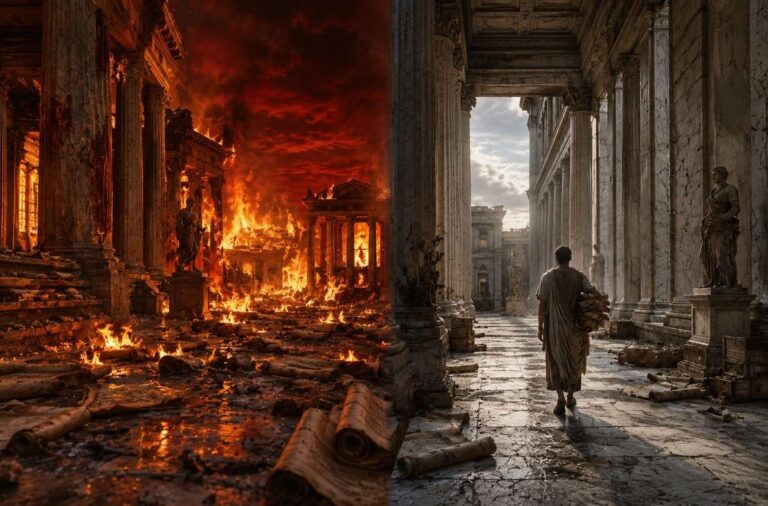
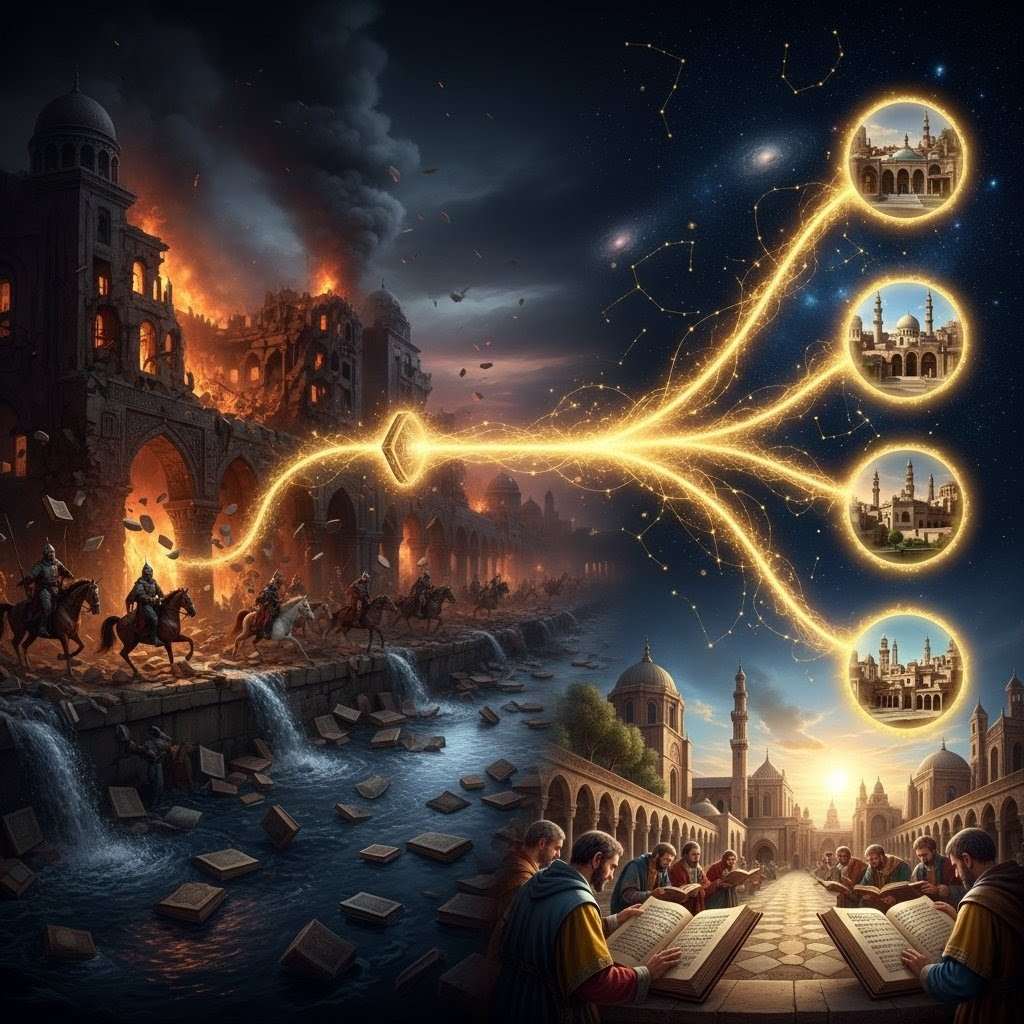
The House of Wisdom declined with the Abbasid Caliphate. Political fragmentation, economic strain, and the rise of rival centres–Cairo, Damascus, Cordoba–gradually diminished Baghdad’s pre-eminence. The final blow came in 1258 CE, when the Mongol armies of Hulagu Khan sacked Baghdad, destroyed the city, and executed the last Abbasid caliph, al-Musta’sim. The destruction was catastrophic: libraries were burned, scholars were killed, and the accumulated knowledge of centuries was scattered.
Legend says the books thrown into the Tigris coloured the river black with ink. While this image is dramatic and has been repeated by chroniclers from the thirteenth century to the present, modern historians treat it as legendary embellishment rather than documented fact. The actual destruction was severe enough without poetic exaggeration: the loss of manuscripts, the dispersal of scholars, and the end of Abbasid patronage effectively terminated the Baghdad translation movement. What matters is not the colour of the river but the fact that the thread’s primary node had been severed.

The Thread Beyond Baghdad
But the thread had already extended beyond Baghdad. The texts, copied and recopied, had reached Cairo, Damascus, Cordoba, and Toledo. The knowledge, embedded in practice, had become independent of any single institution. The European Renaissance, when it came, received the thread through Arabic. The Latin translations of the twelfth and thirteenth centuries–in Toledo, in Sicily, in Salerno–translated Arabic translations of Greek originals. The thread returned to Europe transformed: Greek thought, filtered through Arabic commentary, enriched by Indian mathematics, and systematised by Islamic philosophers, was not the same thread that had left Alexandria. It was stronger, more complex, and more resilient.
The dispersal also meant survival. Had the House of Wisdom been the sole repository of the translated texts, the Mongol sack would have been an irrecoverable catastrophe. But the manuscript culture of the medieval world–the practice of copying, the trade in books, the migration of scholars–ensured that no single destruction could eliminate the thread. The copies in Cairo, the commentaries in Cordoba, the Latin versions in Toledo–all were backups, redundancies, insurance against the inevitable violence of history.
The Thread Extended Across Culture
The House of Wisdom demonstrates that the thread is not proprietary. Greek knowledge, preserved by Christian Arabs in Islamic institutions for Abbasid power–this is not cultural appropriation but cultural extension. The transformation in each extension is not loss but adaptation. The knowledge, as “pure” Greek, would not have survived. The knowledge, Arabic-transformed, persisted. The knowledge, Latin-transformed, initiated modern science. The thread, impure, continues. The purity, sought, produces death.
This is the lesson of Baghdad for the contemporary seeker: knowledge does not belong to cultures; it belongs to humanity. The Greek philosopher, the Arabic translator, the Latin scholastic, and the modern scientist are not competitors for ownership but collaborators in continuation. Each generation receives the thread, adapts it to its own conditions, and passes it forward. The adaptation is not betrayal but fidelity–the only way to remain true to knowledge is to change it, to make it live in new conditions, to ensure that it does not become a museum piece.
You receive the thread through this history. The mathematics you use, the medicine you trust, and the scientific method you assume–these extend through Baghdad. The thread continues regardless of borders, regardless of empires, regardless of the destruction of libraries and the death of scholars. It continues because it is not a thing but a practice–the practice of inquiry, of translation, of synthesis, of return. The House of Wisdom fell, but the wisdom did not. It merely moved.
Frequently Asked Questions
What was the House of Wisdom in Baghdad?
The House of Wisdom (Bayt al-Hikma) was an intellectual centre associated with the Abbasid court in Baghdad from the late eighth to the thirteenth century. While traditionally described as a formal institution established by Caliph al-Ma’mun, modern scholars debate whether it was a single building or a network of scholars supported by royal patronage. It served as the hub of the Graeco-Arabic translation movement, where Greek, Persian, and Indian texts were translated into Arabic, studied, and developed into original works of philosophy, medicine, mathematics, and astronomy.
Who were the main translators at the House of Wisdom?
The most prominent translators included Hunayn ibn Ishaq (c. 809-873), a Christian Arab who translated approximately eighty-six to over one hundred Galenic and Hippocratic medical treatises; his son Ishaq ibn Hunayn and nephew Hubaysh ibn al-Hasan, who continued the family tradition with Aristotelian philosophical works; and al-Kindi (c. 801-873), the first systematic Arabic philosopher who synthesised Greek thought for an Islamic context. Al-Khwarizmi (c. 780-850) developed algebra and introduced Hindu-Arabic numerals. Numerous unnamed scribes, students, and patrons formed the collaborative network that sustained the work.
What texts were translated at the House of Wisdom?
The translators rendered works across philosophy, medicine, astronomy, and mathematics. Key texts included Aristotle’s Metaphysics, Physics, and logical works; Galen’s medical treatises; Ptolemy’s astronomical writings; Euclid’s Elements; and Indian mathematical and astronomical texts including the Siddhanta. The selection was practical: astronomy served astrology and agriculture, medicine served healing, and mathematics served taxation, engineering, and military calculation. Works of Greek poetry, drama, and historiography were largely ignored in favour of scientific and philosophical texts.
Did the Mongol sack of Baghdad really turn the Tigris black with ink?
This is a legendary embellishment rather than documented fact. The chronicler Ibn al-Tiqtaqa and later sources describe books thrown into the Tigris colouring the river black with ink, but modern historians treat this as poetic exaggeration. The actual destruction in 1258 was catastrophic enough: libraries were burned, scholars were killed, and the accumulated knowledge of centuries was scattered. However, the thread survived because manuscripts had already been copied and dispersed to Cairo, Damascus, Cordoba, and Toledo.
How did the House of Wisdom influence modern science?
The House of Wisdom preserved and advanced Greek knowledge that would otherwise have been lost to the Latin West. Through Arabic translations and original commentaries, Aristotelian philosophy, Galenic medicine, Ptolemaic astronomy, and Euclidean mathematics reached Europe via the Latin translations of the twelfth and thirteenth centuries–particularly in Toledo and Sicily. Al-Khwarizmi’s algebra and the decimal positional system (including zero) transformed European mathematics and commerce. The scientific method, as later developed in Europe, built upon the synthesising approach pioneered by Baghdad scholars.
Was the translation movement only about preserving Greek texts?
No. While the preservation of Greek texts was a major component, the House of Wisdom was also a centre of original research and creative synthesis. Scholars like al-Kindi, al-Farabi, al-Razi, and Ibn Sina produced original philosophical and medical works that advanced beyond their Greek sources. The translation of Indian mathematical texts and Persian astronomical works also contributed to a multicultural synthesis. The House of Wisdom was not a museum but a laboratory–a place where received knowledge was tested, improved, and extended.
Why did the House of Wisdom decline?
The decline was gradual and multifaceted. Political fragmentation of the Abbasid Caliphate, economic strain, and the rise of rival intellectual centres–Cairo under the Fatimids and later Mamluks, Damascus under the Umayyads of Cordoba, and Cordoba itself–diminished Baghdad’s pre-eminence. The final blow was the Mongol sack of 1258, which destroyed the city and ended Abbasid patronage. However, the knowledge had already been dispersed through manuscript copying and scholar migration, ensuring that the thread continued in other centres.
Further Reading
- The Library of Alexandria: What Was Lost, What Survived — The knowledge that reached Baghdad and the earlier dispersal that made preservation possible.
- The Toledo School of Translators — Where the thread extended next, from Arabic into Latin and back to Europe.
- Jewish Scholars and the Transmission of Knowledge — The invisible carriers who mediated between Arabic and Latin at Toledo and beyond.
- The Serapeum: Alexandria’s Daughter Library — What preceded the House of Wisdom and ensured classical texts survived to reach the Islamic world.
- The Hidden Agreements: Why Esoteric Traditions Keep Inventing the Same Architecture — Translation as transformation and the recurrence of shared patterns across cultures.
- The Emerald Tablet: Hermetic Foundation & The Law of Correspondence — The esoteric texts that also travelled the route from East to West through Arabic intermediaries.
- The Doctrine of Emanation: From Plotinus to Kabbalah — The Neoplatonic philosophy that the Baghdad translators preserved and developed.
- Sacred Geometry: The Architecture of Creation — The mathematical knowledge that passed through Baghdad, Toledo, and into Renaissance Europe.
References and Sources
This article draws upon the history of Islamic science, medieval translation studies, and the sociology of knowledge.
Primary Sources and Critical Editions
- Ibn al-Tiqtaqa. (13th c.). Kitab al-Fakhri. (Chronicle containing the legendary account of the Tigris turning black with ink; treated by modern historians as embellishment).
- al-Khwarizmi, M. ibn M. (c. 820). Kitab al-Jabr wa-l-Muqabala. (Foundational text of algebra).
- al-Kindi, Y. (9th c.). On First Philosophy. (First systematic Arabic philosophical treatise synthesising Greek thought).
Scholarly Monographs and Studies
- Gutas, D. (1998). Greek Thought, Arabic Culture: The Graeco-Arabic Translation Movement in Baghdad and Early Abbasid Society. Routledge. (Definitive study of the translation movement, its motivations, and its social context).
- Huff, T. E. (2003). The Rise of Early Modern Science: Islam, China, and the West. Cambridge University Press. (Comparative study placing the House of Wisdom in global context).
- Lindberg, D. C. (Ed.). (1978). Science in the Middle Ages. University of Chicago Press. (On the transmission of scientific knowledge from Greek to Arabic to Latin).
- Sabra, A. I. (1987). “The Appropriation and Subsequent Naturalization of Greek Science in Medieval Islam.” History of Science, 25, pp. 223-243. (On the interpretation and adaptation of Greek texts in the Islamic context).
Comparative and Contemplative Studies
- Bennison, A. K. (2009). The Great Caliphs: The Golden Age of the Abbasid Empire. Yale University Press. (Contextual history of the Abbasid period and its intellectual achievements).
- Morgan, M. H. (2007). Lost History: The Enduring Legacy of Muslim Scientists, Thinkers, and Artists. National Geographic. (Popular but well-researched overview of the House of Wisdom’s legacy).