
The Toledo School of Translators: Europe’s Recovery of Lost Knowledge
The thread, extended to Baghdad, returned to Europe through Spain. The Toledo School of Translators–a term coined by nineteenth-century historians to describe a network of scholars active from the twelfth to thirteenth centuries–transformed Latin Christendom’s access to ancient knowledge. Greek texts, lost in the original and preserved in Arabic, were translated into Latin. The thread, extended across the Mediterranean, completed its circuit.
Toledo was strategic. Conquered by Muslims in 711 CE and reconquered by Christians in 1085 CE, the city maintained a multicultural population: Arabic-speaking Christians (Mozarabs), Latin-speaking Muslims (Mudejars), and Jewish scholars fluent in both. This linguistic diversity enabled translation; the political stability under Christian rule enabled the institution. What emerged was not a formal “school” in the modern sense–the term itself was invented by the French Orientalist Amable Jourdain in 1819 and popularised by the German philologist Valentin Rose in 1874–but a collaborative network of translators working under ecclesiastical and later royal patronage.
Table of Contents
- The Strategic City: Why Toledo?
- Archbishop Raymond and the First Phase
- The Texts That Transformed Europe
- The Translators Were Marginal
- Alfonso X and the Shift to Royal Patronage
- A Cumulative Effect
- The Thread Extended West
- Frequently Asked Questions
- Further Reading
- References and Sources
The Strategic City: Why Toledo?
Toledo’s importance was geographical and historical. Situated on a granite hill above the Tagus River, the city had been a Visigothic capital, a Muslim emirate, and now–after Alfonso VI of Castile’s reconquest in 1085–a Christian archbishopric. The reconquest was not a destruction but a transition: the Muslim population remained, the libraries remained, and the scholars remained. The Christian conquerors, aware of their own intellectual poverty relative to the civilisation they had absorbed, did not burn the books. They read them.
The city’s population in the twelfth century was remarkably diverse. Mozarabs–Christians who had lived under Muslim rule and spoke Arabic as their first language–served as the initial bridge. Mudejars–Muslims living under Christian rule–maintained their own scholarly traditions and libraries. Jews, fluent in Hebrew, Arabic, and Latin, mediated between the communities. This was not tolerance in the modern sense; it was pragmatism. The Christians needed the knowledge; the Muslims and Jews needed the protection. The arrangement, mutually beneficial, produced one of the most significant intellectual movements of the medieval period.
Archbishop Raymond and the First Phase
Archbishop Raymond of Sauvetât (r. 1125–1152), a French Benedictine monk from the Cluniac order, initiated the systematic translation programme. Appointed to the archbishopric of Toledo and primate of Spain, Raymond recognised that Latin Christendom had lost access to the philosophical and scientific corpus of antiquity. What remained in the West was fragmentary: a few works of Plato and Aristotle, some compilations by Boethius and Cassiodorus, and the encyclopaedic summaries of Isidore of Seville. The complete Aristotle, the medical corpus of Galen, the astronomical works of Ptolemy–all were available in Arabic, unknown to Latin readers.
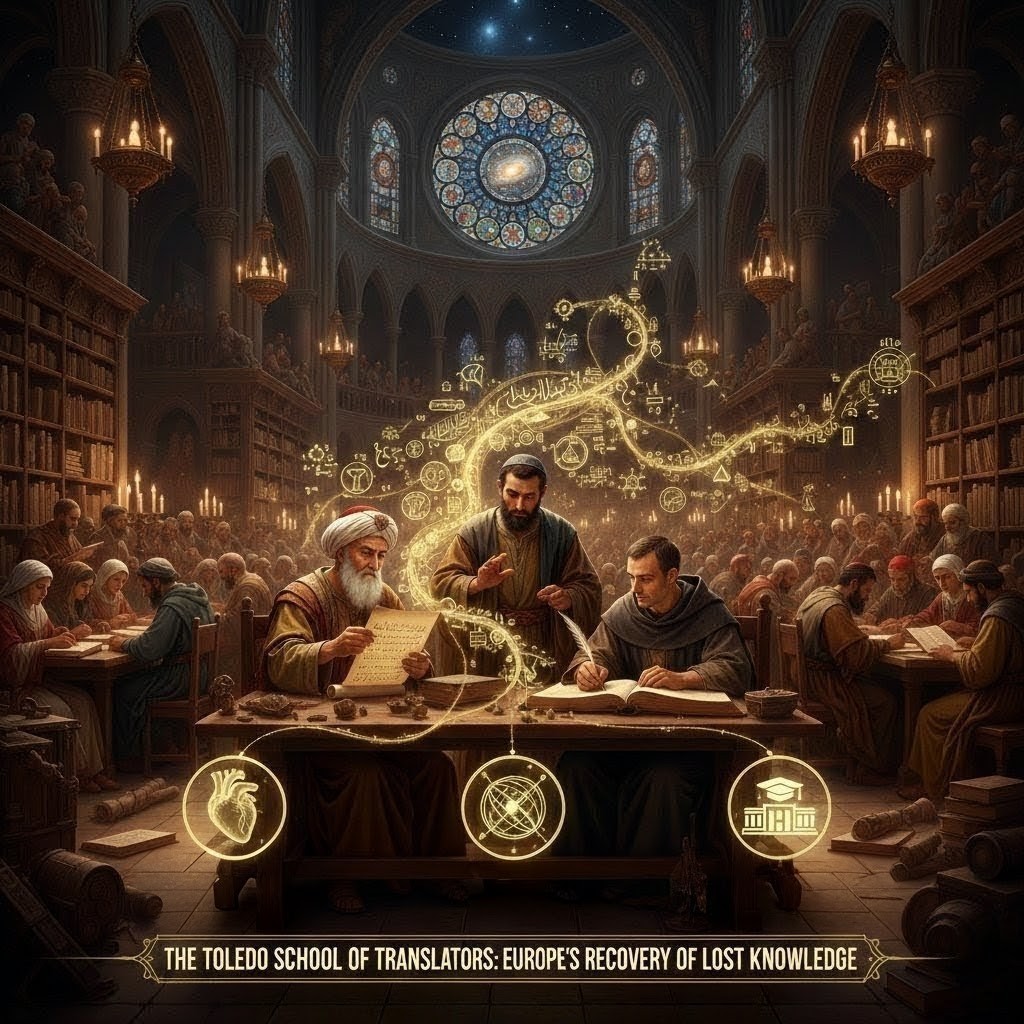
Raymond established a translation centre at the Cathedral of Toledo, recruiting scholars from across Europe and the Mediterranean. The method was collaborative and oral: an Arabic-speaking scholar–often a Mozarab or Jewish mediator–would read the source text aloud in a Romance vernacular (Castilian or Aragonese), while a Latinist simultaneously rendered the spoken words into written Latin. This ad verbum method, though producing Latin that was sometimes awkward and heavily Arabised, ensured a degree of fidelity that direct translation might have compromised. The process was slow, expensive, and error-prone. It was also profoundly effective.
Raymond’s personal patronage focused on philosophical texts, particularly Neoplatonic works and the Fons vitae (Fountain of Life) of the Jewish philosopher Solomon ibn Gabirol (known in Latin as Avicebron). His successor, John of Castellmorum (r. 1152–1166), continued the programme, and under his pontificate the translation of Avicenna’s treatise on the soul marked a significant expansion into medical and psychological texts.
The Texts That Transformed Europe
The recovery extended across all primary fields of human inquiry. The translations were not merely reproductions; they were reconnections–the restoration of a broken lineage that stretched from ancient Greece through the Islamic Golden Age to medieval Europe.
Philosophy: The Return of Aristotle
Aristotle’s complete works, lost to the Latin West for centuries, returned through Arabic intermediaries. The Posterior Analytics, Physics, On the Heavens, On Generation and Corruption, and Meteorology transformed medieval theology, leading to the rise of Scholasticism and the systematic work of Thomas Aquinas. Aquinas, reading Aristotle through Latin translations made from Arabic versions enriched by the commentaries of Averroes and Avicenna, developed his integration of reason and revelation–a synthesis that would dominate Catholic theology for centuries.
It is worth noting that the De Anima (On the Soul) was not translated at Toledo itself; the Toledan translators produced Avicenna’s Kitab al-nafs (Book of the Soul) as a substitute, which became immensely popular. The direct Greek-Latin translation of Aristotle’s De Anima by James of Venice, working from Byzantine manuscripts, only became influential after the turn of the thirteenth century. The Toledan contribution was thus indirect but no less significant: they provided the philosophical vocabulary and conceptual framework through which Aristotle would be received.

Medicine: Galen, Avicenna, and al-Razi
Works by Galen, Ibn Sina (Avicenna, Canon of Medicine), and al-Razi (Rhazes) became the standard curriculum at European universities. Avicenna’s Canon, translated into Latin as Liber Canonis, was used as a medical textbook well into the seventeenth century. The physician, newly trained in the methods of Arabic medicine, extended the thread through healing. The introduction of empirical observation, systematic classification of diseases, and pharmacological knowledge transformed European medicine from a craft into a science.
Astronomy: Ptolemy and the Toledan Tables
Ptolemy’s Almagest, the foundational text of ancient astronomy, preserved in Arabic as al-Majisti, became available to Latin readers through Gerard of Cremona’s translation in 1175. Gerard had travelled to Toledo specifically seeking the Almagest, having heard that it existed only in Arabic. The work became the foundation for European cosmology until the time of Copernicus. Additionally, the Toledan Tables–astronomical tables compiled from Arabic sources–provided the most accurate celestial calculations available in Europe, used for calendar reform, navigation, and astrology.
Mathematics: Arabic Numerals and Algebra
The introduction of Arabic numerals (actually of Indian origin, transmitted through Arabic), algebra (al-jabr), and trigonometry enabled the calculations that built Gothic cathedrals and eventually launched the scientific revolution. Al-Khwarizmi’s On Algebra and Almucabala, translated by Gerard of Cremona, introduced European scholars to systematic methods for solving linear and quadratic equations. The decimal positional system, with its revolutionary zero, replaced the cumbersome Roman numerals and made complex computation accessible. The thread, here, was not merely philosophical but practical–it changed how Europeans built, traded, and thought about quantity.

The Translators Were Marginal
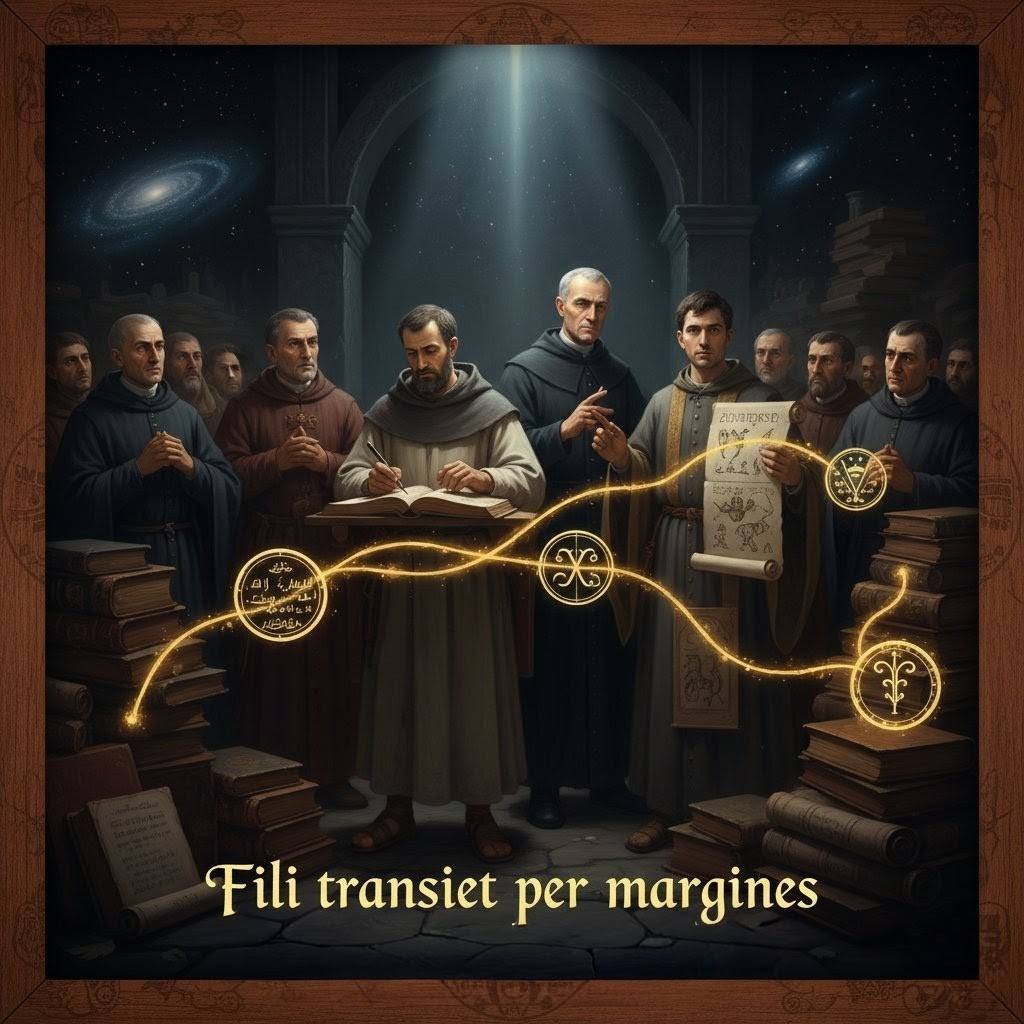
The Toledo translators were not mainstream scholars; they were peripheral. They worked at the edge of Latin Christendom, drawing on Islamic and Jewish learning that was often suspect to orthodox authorities. Their marginality was not a handicap; it was enabling. The mainstream had no access to Arabic learning, but the periphery developed the skills to cross boundaries. The thread extends through edge cases–through those who inhabit the spaces between cultures.
Gerard of Cremona
Gerard of Cremona (c. 1114–1187) was the most prolific of the Toledan translators. An Italian who travelled to Spain seeking Ptolemy’s Almagest, he remained in Toledo for the rest of his life, producing approximately seventy to eighty-seven translations from Arabic into Latin (the exact number varies by scholarly catalog). His output encompassed Aristotle’s natural philosophy, Euclid’s Elements, Archimedes’ On the Measurement of the Circle, al-Khwarizmi’s algebra, Galen’s medical works, and the Liber de causis (Book of Causes), a Neoplatonic text that profoundly influenced medieval metaphysics. Gerard’s method was systematic: he worked through the Arabic curriculum of the seven liberal arts, translating the foundational texts in each discipline.
Dominicus Gundissalinus and Avendauth
Dominicus Gundissalinus (c. 1110–c. 1190), an archdeacon of Segovia who resided in Toledo, collaborated closely with the Jewish scholar Avendauth (likely Abraham ibn Daud, also known as Abraham ibn David ha-Levi). Their partnership exemplified the collaborative method: Avendauth, fluent in Arabic, would read and explain the text, while Gundissalinus rendered it into Latin. Together they produced translations of Avicenna’s De anima and Liber de philosophia prima (metaphysics), as well as al-Ghazali’s Maqasid al-falasifa (Intentions of the Philosophers). Gundissalinus also wrote original philosophical works, blending Arabic and Latin traditions into a distinctive synthesis.
Michael Scot and the Later Phase
Michael Scot (c. 1175–c. 1235), a Scottish scholar who served as court astrologer to Emperor Frederick II, spent his early career in Toledo, where he translated Aristotle’s works on animals (De animalibus) and the commentaries of Averroes. By 1217 he was a canon of Toledo Cathedral. Scot’s translations of Averroes’ commentaries on Aristotle were particularly influential, introducing Latin Europe to the “double truth” controversy–the question of whether philosophical and theological truths could contradict each other. The controversy, though condemned by the Church, stimulated centuries of philosophical debate.
The suspicion from the orthodox was real. They feared “pagan” philosophy and “Islamic” science would corrupt the faith. But the thread, once extended, transforms what it touches. The transformation, though resisted, proceeded regardless. By the thirteenth century, the translations were too numerous, too useful, and too deeply embedded in university curricula to be suppressed.
Alfonso X and the Shift to Royal Patronage
After Archbishop Raymond’s death, ecclesiastical patronage declined, and translation activity in Toledo entered a transitional phase. The second major period began under King Alfonso X of Castile (r. 1252–1284), known as el Sabio (the Wise). Alfonso transferred patronage from the Church to the crown, establishing a royal scriptorium that continued the work of translation with a significant innovation: the target language was no longer Latin but Castilian, the vernacular Romance tongue.
This shift was revolutionary. By translating into Castilian rather than Latin, Alfonso democratised access to knowledge, making scientific and philosophical texts available to a wider audience and promoting Castilian as a language of learning and literature. The Alfonsine Tables (astronomical tables), the Libro conplido en los conoscimientos de astronomia, and the Libro de los juegos (Book of Games) were products of this royal scriptorium. Alfonso’s team included Jewish scholars such as Isaac ibn Sid, who played key roles in rendering Hebrew-Arabic hybrid texts into Castilian.
The shift also reflected Alfonso’s imperial ambitions. By centralising knowledge production under Castilian authority, he sought to establish his kingdom as the intellectual centre of Europe. The strategy worked, in part: Castilian became a major literary language, and the translations produced under his patronage influenced European science for generations. However, Alfonso’s political failures–his unsuccessful bid for the Holy Roman Emperorship and his eventual deposition by his son Sancho IV–overshadowed his intellectual achievements in his own lifetime.

A Cumulative Effect
The transformation was not immediate. The cumulative corpus available by the thirteenth century built the curriculum of the first great universities: Paris, Oxford, and Bologna. The thread, extended, produces effects generations later. The twelfth-century translations influenced the thirteenth-century scholastics, who influenced the fifteenth-century humanists, who eventually influenced the pioneers of modern science.
The Toledo network eventually declined as the multicultural context of Spain was eliminated by the completion of the Reconquista in 1492 with the fall of Granada. The expulsion of Jews in 1492, followed by the forced conversion or expulsion of Muslims, removed the linguistic mediators who had made the translation movement possible. The centre shifted again–to Italy, to Northern Europe, to the printing presses of Venice and Basel. The thread, cut in Toledo, extended elsewhere.
Yet the legacy persisted. The modern Escuela de Traductores de Toledo, revived in the late twentieth century, continues to host international workshops and translation projects, echoing the medieval model of multicultural scholarly collaboration. The thread, it seems, is not easily broken.
The Thread Extended West
The Toledo School demonstrates that recovery is possible. Knowledge that is lost in one culture can be preserved in another and recovered through systematic effort. This reconnection requires four conditions:
- Exposure to other cultures–the willingness to encounter what is foreign, even suspect.
- Linguistic competence–the patient acquisition of languages not one’s own, not for commerce but for understanding.
- Institutional support–the patronage, whether ecclesiastical or royal, that frees scholars from immediate necessity.
- Generational patience–the recognition that the work begun by one generation may only bear fruit in the next.
You are the Toledo School now. Knowledge that has been suppressed or forgotten persists in other forms and other cultures. Your exposure and your commitment to the recovery of these ideas extend the thread. The recovery continues through you.
Frequently Asked Questions
Was the Toledo School of Translators a real school?
No–not in the modern sense. The term Toledo School of Translators was coined by the French Orientalist Amable Jourdain in 1819 and popularised by the German philologist Valentin Rose in 1874. There was no formal institution, curriculum, or faculty. Instead, the term describes a network of scholars working collaboratively in Toledo between the twelfth and thirteenth centuries, translating Arabic and Hebrew texts into Latin and later Castilian, under the patronage of the Archbishop of Toledo and later King Alfonso X.
What texts were translated at Toledo?
The translators rendered works across philosophy, medicine, astronomy, and mathematics. Key texts included Aristotle’s natural philosophy (Physics, Posterior Analytics, On the Heavens), Ptolemy’s Almagest, Euclid’s Elements, Galen’s medical works, Avicenna’s Canon of Medicine and De anima, al-Khwarizmi’s algebra, and numerous works by al-Razi, al-Farabi, and Averroes. These translations reconnected Latin Europe with the classical Greek heritage that had been preserved and developed in the Islamic world.
Who were the main translators at Toledo?
The most prolific was Gerard of Cremona (c. 1114-1187), an Italian who translated approximately seventy to eighty-seven works from Arabic into Latin. Dominicus Gundissalinus (c. 1110-c. 1190), an archdeacon, collaborated with the Jewish scholar Avendauth (Abraham ibn Daud) on Avicenna’s philosophical works. Michael Scot (c. 1175-c. 1235), a Scottish scholar and later court astrologer to Frederick II, translated Aristotle’s De animalibus and Averroes’ commentaries. John of Seville and Hugo of Santalla also made significant contributions.
How did the translation method work?
The method was collaborative and typically oral. An Arabic-speaking scholar–often a Mozarab or Jewish mediator–would read the source text aloud in a Romance vernacular (Castilian or Aragonese), while a Latinist simultaneously rendered the spoken words into written Latin. This ad verbum method, though producing sometimes awkward Latin, ensured fidelity by allowing immediate clarification. Under Alfonso X, the target language shifted to Castilian, democratising access to knowledge.
Why was Toledo chosen as the centre for translation?
Toledo’s strategic importance lay in its multicultural population and its libraries. Conquered by Muslims in 711 CE and reconquered by Christians in 1085 CE, the city retained Arabic-speaking Christians (Mozarabs), Latin-speaking Muslims (Mudejars), and Jewish scholars fluent in both languages. The Cathedral of Toledo possessed extensive Arabic manuscript collections, and the political stability under Christian rule provided the institutional framework for sustained scholarly collaboration.
What was King Alfonso X’s role in the translation movement?
Alfonso X of Castile (r. 1252-1284) shifted patronage from the Church to the crown and introduced a revolutionary change: translation into Castilian rather than Latin. This democratised access to scientific and philosophical knowledge, promoted Castilian as a literary language, and produced works such as the Alfonsine Tables. His royal scriptorium employed Jewish, Christian, and Muslim scholars in a continuation of the multicultural model established a century earlier.
How did the Toledo translations influence modern Europe?
The Toledo translations sparked the twelfth-century Renaissance by reintroducing Aristotelian philosophy, Arabic medicine, and advanced mathematics to Latin Europe. They built the curriculum of the first universities (Paris, Oxford, Bologna), influenced Thomas Aquinas and the Scholastics, and provided the intellectual foundation for the scientific revolution. The introduction of Arabic numerals, algebra, and the decimal system transformed European commerce, architecture, and eventually science.
Further Reading
- The House of Wisdom: Baghdad’s Translation Movement — The Arabic source of the Toledo translations and the earlier multilingual scholarship that made them possible.
- Jewish Scholars and the Transmission of Knowledge — The multilingual mediators who bridged Arabic and Latin at Toledo and beyond.
- The Library of Alexandria: What Was Lost, What Survived — The ultimate origin of the texts that passed through Baghdad, Toledo, and into Europe.
- The Serapeum: Alexandria’s Daughter Library — The earlier dispersal point that ensured classical texts survived to reach the Islamic world.
- The Hidden Agreements: Why Esoteric Traditions Keep Inventing the Same Architecture — Synthesis through translation and the recurrence of shared patterns across cultures.
- The Emerald Tablet: Hermetic Foundation & The Law of Correspondence — The esoteric texts that also travelled the same route from East to West.
- John Dee’s Mathematical Preface: The Occult Foundation of Modern Science — How the recovered mathematical knowledge was later applied in Renaissance esotericism.
- The Doctrine of Emanation: From Plotinus to Kabbalah — The Neoplatonic philosophy that the Toledo translators helped reintroduce to Latin Europe.
References and Sources
This article draws upon the history of medieval translation, Iberian history, and the sociology of knowledge transmission.
Primary Sources and Critical Editions
- Gerard of Cremona. (12th c.). Catalogus translationum. (List of translations; the exact number varies by catalog, from approximately seventy to eighty-seven works).
- Gundissalinus, D., & Avendauth [Abraham ibn Daud]. (12th c.). Latin translations of Avicenna’s De anima and Liber de philosophia prima.
Scholarly Monographs and Studies
- Burnett, C. (2001). “The Coherence of the Arabic-Latin Translation Program in Toledo.” Before the Writing of the Toledo School. Waseda University. (On the systematic nature of Gerard of Cremona’s translation program and the role of Michael Scot).
- Dunlop, D. M. (Various). The Work of Translation at Toledo. Open University of Venice. (On the historical circumstances and the nineteenth-century origin of the term “School”).
- Grokipedia. (2026). “Toledo School of Translators.” (Comprehensive overview of the two periods, key figures, and translation methods).
- Jordan, M. D. (1998). “Gerard of Cremona (1114–87).” Routledge Encyclopedia of Philosophy. (Authoritative biography noting at least seventy translations).
- Martinez, C. de A. (2025). “The Toledo School of Translators: Myth or Reality?” Al-Andalus y la Historia. Universidad Autonoma de Madrid. (Critical analysis of the nineteenth-century origin of the term).
Comparative and Contemplative Studies
- Britannica. (2026). “Don Raimundo.” Encyclopaedia Britannica. (Biography of Archbishop Raymond and his patronage of the translation movement).
- Cambridge Core. (2026). “Michael Scot in Toledo: Natura naturans and the Hierarchy of Being.” Traditio. (On Scot’s early career at Toledo and his translations of Averroes).