
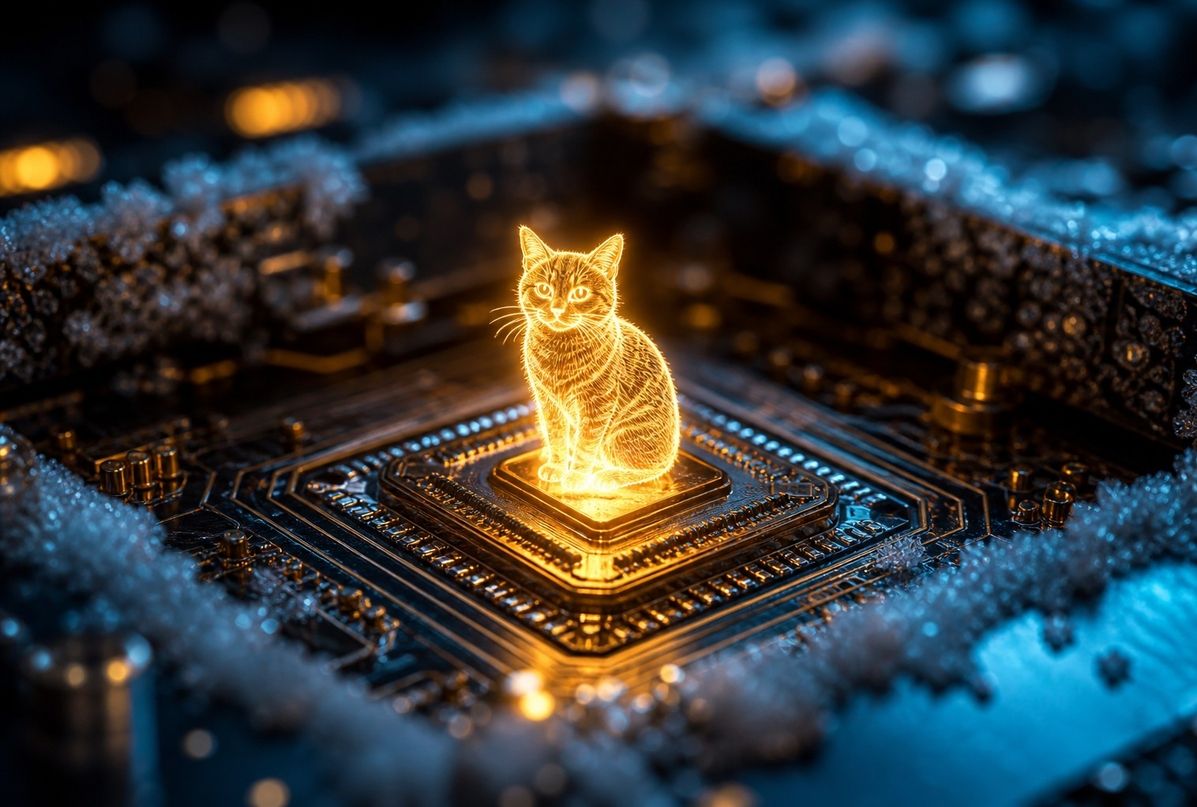
Quantum Utility and the Glitch in the Matrix
Quantum computing has spent decades flickering at the edge of usefulness: brilliant, fragile, expensive, and forever promising a future just beyond the next funding cycle. But the recent shift is real. Error correction is improving. Hybrid quantum-classical systems are being tested on practical tasks. Companies are publishing roadmaps toward fault-tolerant machines. The age of pure quantum hype is not over, but the era of measurable quantum utility has begun to knock on the door with cold metal knuckles.
For ZenithEye readers, this is not only a technology story. It is also a symbolic one. Quantum computers operate by preserving fragile possibility against the drag of noise, error, measurement, and decoherence. They are machines built at the boundary between potential and actuality. Their failures are not ordinary failures. Their glitches reveal something about reality itself: that beneath the smooth surface of classical certainty lies a shimmering field of probability, relation, and instability.
The danger is overstatement. Quantum computers are not magical portals. They do not prove simulation theory. They do not dissolve the Archons. They cannot currently break the internet’s encryption at will. But they do mark a threshold: a movement from classical determinism toward computation that works with uncertainty rather than pretending uncertainty is only noise.
In Plain Terms
Quantum utility means that a quantum computer or hybrid quantum-classical workflow shows practical value on a task that matters, rather than only winning a laboratory benchmark designed to flatter the machine. It does not always mean a complete, universal, fault-tolerant quantum computer has arrived. It often means a quantum processor has become useful as one component inside a larger computational workflow.
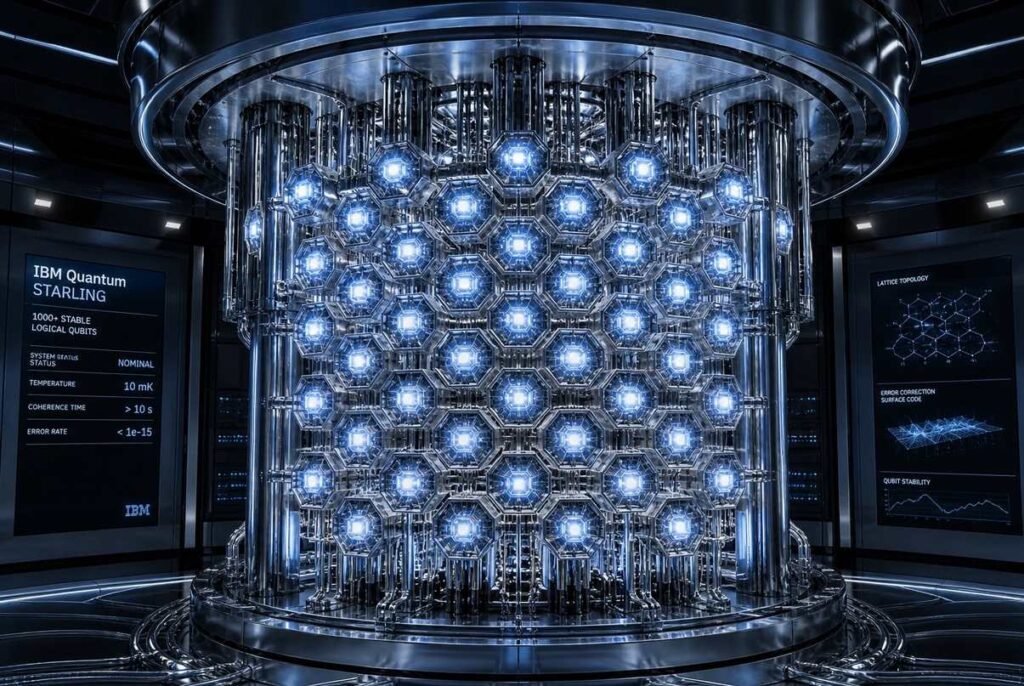
Recent milestones matter because they show progress on three fronts: correcting errors, keeping quantum information stable for longer, and using quantum systems on real or near-real industrial problems. Google’s Willow chip demonstrated below-threshold quantum error correction. IBM has laid out a roadmap toward Starling, a fault-tolerant system targeted for 2029. HSBC and IBM reported a hybrid quantum-classical improvement in bond-trading prediction. IonQ and Ansys reported a speed improvement in a medical-device simulation workflow.
None of this means the quantum computer has conquered the world. The more accurate picture is subtler: quantum computing is leaving the purely theatrical phase and entering the engineering phase. The machine is still noisy. The promises are still crowded with marketing incense. But the direction is no longer imaginary.
The Gnostic metaphor is this: classical computation belongs to the world of fixed categories, clean binaries, and administrative certainty. Quantum computation works with superposition, relation, error, and probability. It does not escape matter. It teaches matter to carry possibility without collapsing too soon.
Primary Sources and Traditions Discussed
- NISQ computing: noisy intermediate-scale quantum devices, powerful enough to explore quantum effects but not yet fully fault-tolerant.
- Quantum error correction: methods that encode fragile quantum information across many physical qubits to produce more reliable logical qubits.
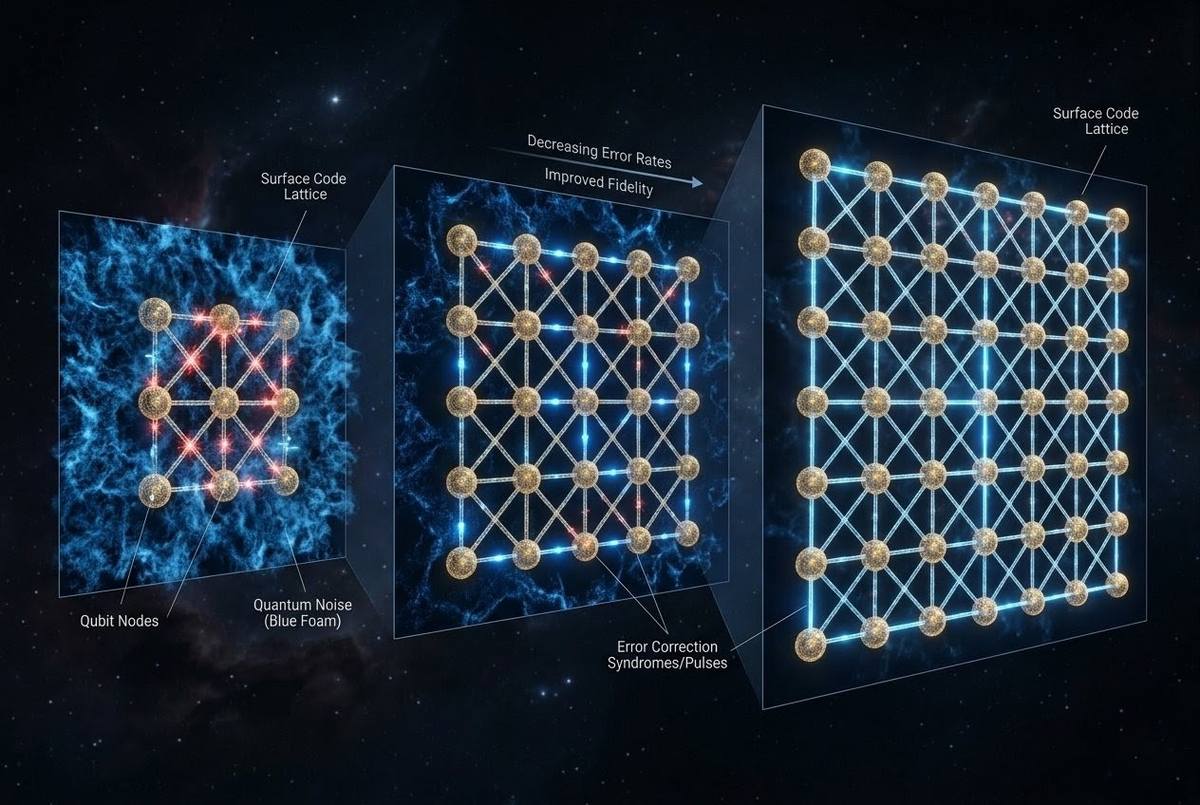
- Below-threshold operation: the point at which increasing code size reduces logical error rates rather than making the system worse.
- Cat qubits: superconducting qubits designed to suppress one type of error, especially bit-flip errors, by exploiting protected quantum states.
- Hybrid quantum-classical workflows: computational pipelines where quantum hardware is used alongside classical systems rather than replacing them outright.
- IBM Starling roadmap: IBM’s published target for a fault-tolerant quantum system with 200 logical qubits capable of 100 million gates in 2029.
- Microsoft Majorana debate: claims around topological qubits and the scientific scepticism surrounding whether the evidence is yet decisive.
- Gnostic symbolism: Archons, error, limitation, the fall into fixity, and the restoration of coherence as metaphor, not literal physics.
- Simulation and information metaphysics: the symbolic relationship between quantum information, glitches, computational reality, and the question of whether matter is more informational than solid.
How to Read This Article
This article uses Gnostic language symbolically. Decoherence is not literally the fall of Sophia. Error correction is not literally redemption. A logical qubit is not a divine spark wearing a lab coat. But the metaphor is useful because quantum computing is a technology of fragile possibility, threatened constantly by collapse into ordinary noise.
That makes quantum error correction spiritually suggestive. It is the art of preserving pattern through turbulence, maintaining coherence inside a hostile environment, and distributing truth across a wider body so that no single local failure can destroy it. That is engineering. It is also a clean metaphor for practice.
The article keeps two registers separate: the technical and the symbolic. The technical register asks what quantum devices can actually do. The symbolic register asks why these devices feel like a modern image of liberation from rigid classical order.
The quantum glitch is not proof that reality is fake. It is a reminder that reality was never as classical, fixed, or obedient as the Archons of certainty pretended.
Table of Contents
- The NISQ Era: Glitches as Archonic Interference
- Below-Threshold Breakthroughs: The Fault-Tolerance Revolution
- Quantum Utility: Practical Advantage Beyond the Hype
- Algorithmic Fault Tolerance: Reducing the Ritual Cost
- The Quantum Glitch as Physical Metaphor
- The Roadmap to 2029: Starling, Majorana, and the Caution of Promises
- The Practical Consequence: Quantum Readiness Without Panic
- Related Glossary Terms
- Read Next
- Frequently Asked Questions
- Further Reading
- References and Sources
The NISQ Era: Glitches as Archonic Interference
NISQ stands for Noisy Intermediate-Scale Quantum. It describes the era of quantum computers with enough qubits to be interesting, but not enough stability to run long, reliable, error-corrected algorithms at scale. These machines can demonstrate quantum behaviour, explore specific problems, and act as testbeds for future architectures, but they remain fragile.
Noise is the central adversary. A quantum state must remain coherent long enough to be useful. The surrounding environment, imperfect control pulses, measurement errors, unwanted interactions, thermal effects, and hardware defects all threaten to corrupt the computation. Quantum information is not a stone tablet. It is a moth-wing of possibility held over a furnace.
This is why NISQ machines have often felt like archonic computers: they promise liberation from classical limits while remaining bound by physical limitation. The qubit reaches toward superposition, then the world drags it back into noise. Possibility rises, and the lower order insists on paperwork.
The original article described error as if it were almost the substance of quantum computing. That needs refinement. Error is not the goal. Error is the condition quantum computing must overcome. But the encounter with error has become generative. The entire field of quantum error correction exists because fragile quantum information cannot survive by brute force alone.
There is a spiritual metaphor here. A single fragile insight may collapse under stress. But a living tradition encodes insight across ritual, text, community, memory, practice, symbol, and silence. If one part is damaged, the whole can still restore the pattern. That is what error correction does for information. It distributes survival.
Below-Threshold Breakthroughs: The Fault-Tolerance Revolution
The key milestone in quantum error correction is below-threshold operation. In ordinary engineering intuition, adding more parts often creates more opportunities for failure. Quantum error correction reverses this, if the physical error rates are low enough. Add more physical qubits in the right code, and the logical qubit becomes more reliable rather than less reliable.
Google’s Willow result was important because it demonstrated below-threshold quantum error correction in surface-code memories. Increasing code distance reduced logical error rates, showing that the error-corrected quantum memory improved as it scaled. This does not mean a fully useful quantum computer has arrived. It does mean one of the essential doors toward scalable fault tolerance has opened.
Below threshold, the machine begins to behave less like a doomed chorus of unstable qubits and more like a disciplined choir. The individual voices are imperfect. The pattern survives because the arrangement corrects the local failure.
The Gnostic metaphor is clean but should not be overcooked. The lower world is full of interference: forgetting, fear, distortion, false authority, and collapse into habit. Practice becomes a form of error correction. The insight is encoded not in one mood or one revelation, but across repetition, embodiment, discernment, and community.
Fault tolerance is not purity. It is resilience. It does not eliminate every error. It prevents errors from becoming destiny.
The Hour-Long Cat Qubit
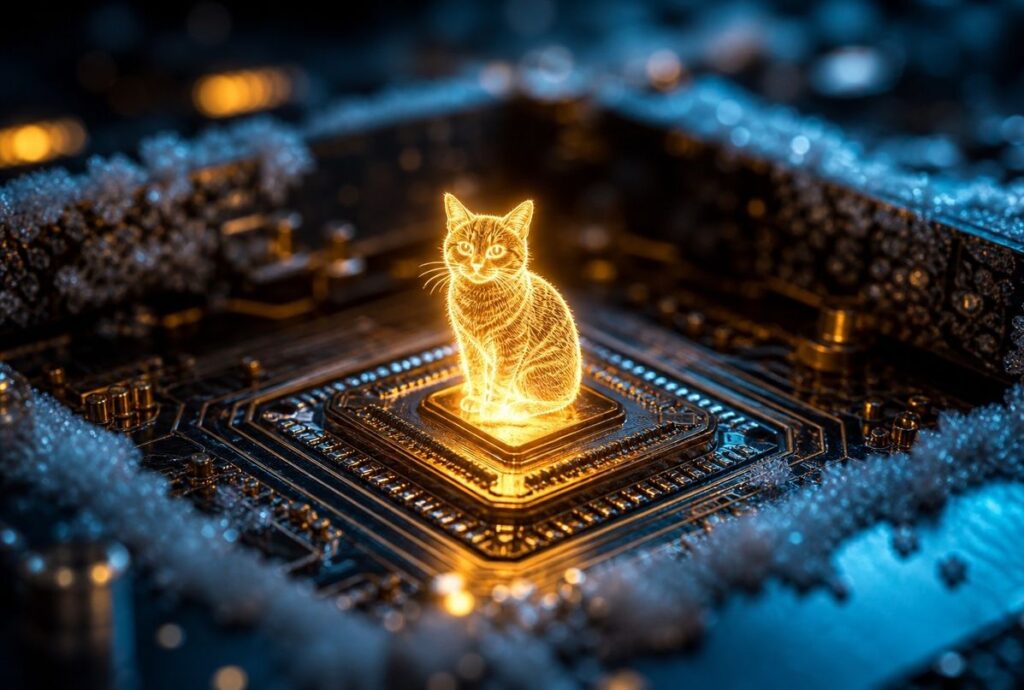
While Google pursued redundancy through error-correcting codes, Alice & Bob has pursued another route: hardware that suppresses certain errors at the physical level. Their cat-qubit work reported resistance to bit-flip errors for more than one hour, a striking improvement for superconducting qubits.
This needs careful wording. An hour-long bit-flip lifetime does not mean the entire qubit is immune to all errors for an hour. Cat qubits are designed to strongly suppress one type of error while leaving other error channels, especially phase-related errors, still needing attention. This is not the end of decoherence. It is a powerful attack on one of decoherence’s teeth.
The symbolic point remains strong. Instead of fighting every error only after it appears, the architecture tries to make one class of error unlikely by design. In spiritual terms, that is the difference between constantly reacting to distraction and building a life where fewer distractions can enter.
Every serious path has both strategies: correction after error, and structure that reduces error before it begins.
Quantum Utility: Practical Advantage Beyond the Hype
Error-correction milestones matter because they point toward useful machines. But usefulness has to be handled with care. “Quantum utility” does not always mean a quantum computer has beaten all classical methods on a broad industrial problem. It often means a quantum system has produced measurable value in a specific setting, frequently as part of a hybrid quantum-classical workflow.
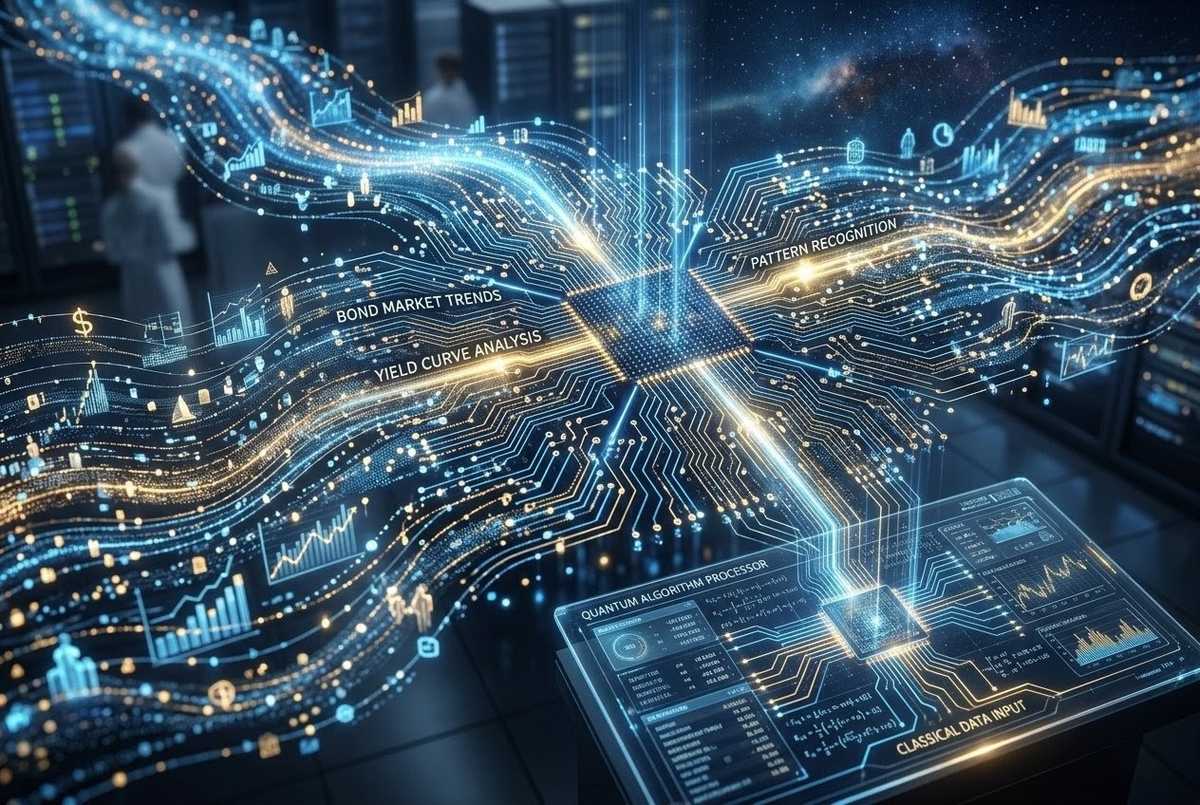
HSBC and IBM reported one of the clearest 2025 examples. Their hybrid quantum-classical work on European corporate bond trading used IBM quantum hardware as part of a process for estimating trade fill probabilities. The reported improvement was up to 34% in out-of-sample test scores for certain models using quantum-transformed data compared with classical alternatives.
This matters, but it should not be inflated. It was not a universal quantum victory over finance. It was a targeted trial, using real trading data, where quantum hardware contributed to a measurable improvement inside a specific modelling pipeline. The nuance is the jewel; throw it away and only glitter remains.
IonQ and Ansys also reported a 12% speed improvement in a quantum-assisted simulation workflow for medical device engineering, specifically involving blood pump dynamics. Again, the careful claim is not that quantum computers have conquered engineering simulation. The careful claim is that hybrid workflows are beginning to show practical promise in narrow domains.
Genome assembly and life-science optimisation provide another frontier. Work involving BGI and SpinQ has explored how genome assembly can be formulated as a combinatorial optimisation problem, making it a candidate for quantum or quantum-inspired methods. This is not a 2025 overnight revolution. It is part of a broader, slower movement toward using quantum approaches on difficult optimisation landscapes.
The quantum utility era therefore arrives not as thunder, but as a series of narrow doors opening in expensive laboratories: a bond-trading model here, a simulation workflow there, a genome-assembly formulation elsewhere. It is not apocalypse. It is architecture.
Algorithmic Fault Tolerance: Reducing the Ritual Cost
Fault-tolerant quantum computing is not only a hardware problem. It is also an algorithmic and architectural problem. The basic challenge is overhead: how many physical qubits, measurements, operations, and time steps are required to protect useful logical qubits well enough to run meaningful algorithms?
QuEra, Harvard, and Yale researchers introduced work on low-overhead transversal fault tolerance, often discussed in relation to algorithmic fault tolerance. The promise is to reduce the time and operational overhead of fault-tolerant quantum algorithms by using transversal operations and correlated decoding across broader algorithmic windows.
The important word is promise. This is real research, but it does not mean all overheads have vanished. Quantum error correction remains expensive, complex, and architecture-dependent. Different hardware platforms face different bottlenecks. The path to useful scale is not one road but a haunted engineering delta, full of clever bridges and sudden mud.
The same caution applies to claims about breaking RSA-2048 encryption. Large-scale cryptographically relevant quantum computers do not exist today. The required resources remain enormous, and estimates vary depending on assumptions about algorithms, error rates, code choices, architecture, and runtime. Some proposals suggest dramatic reductions in qubit requirements, but preprints and company claims must be separated from peer-reviewed consensus and deployed hardware.
For practical readers, the message is simple: quantum risk is real enough to plan for, but not so immediate that panic becomes strategy. Organisations should follow post-quantum cryptography standards and migration guidance from qualified bodies rather than chasing every headline with a bucket on their head.
The Quantum Glitch as Physical Metaphor
Classical computers operate through definite states. A bit is 0 or 1. Errors are failures of hardware, storage, transmission, or logic. The classical world loves clarity. It enjoys categories, ledgers, gates, permissions, and administrative certainty.
Quantum systems do not fit that bureaucracy. A qubit can be in superposition. Quantum systems can become entangled. Measurement changes what can be said about the system. Probability is not merely ignorance about a hidden classical state in the old intuitive sense. It belongs to the structure of quantum description itself.
The “quantum glitch” is therefore not simply an error. It is the visible sign of a deeper strangeness: reality at its foundations is not classical furniture. It is relational, probabilistic, and context-sensitive. That does not mean consciousness magically manifests lottery numbers. It means matter is less obedient to ordinary common sense than classical metaphysics assumed.
Here the Gnostic metaphor becomes potent. The fall into the lower world can be read symbolically as the collapse of possibility into fixed form: the open becomes bounded, the luminous becomes dense, the fluid becomes administrated. Quantum computing tries, technically and carefully, to preserve useful possibility long enough to compute with it.
Error correction then becomes a technology of coherence. It does not deny noise. It learns the pattern of noise and encodes around it. That is a striking image for spiritual work: do not pretend the lower world is pure. Learn where it distorts. Build practices that preserve the living signal.
When Reality Decoheres
Decoherence is not mystical punishment. It is a physical process by which quantum systems become entangled with their environment in ways that destroy observable interference and make the world appear classical. It is one reason the quantum strangeness of the microscopic world does not usually spill into breakfast spoons, door handles, and unpaid electricity bills.
As metaphor, decoherence is powerful. A human being can also decohere. Attention scatters. Fear entangles with memory. Desire collapses possibility into compulsion. The subtle body of intention is dragged into the thick mud of habit. The inner signal becomes noise.
Practice is not the fantasy of never glitching. Practice is learning how to recover coherence after the glitch, and eventually how to live in ways that generate fewer destructive errors.
The Roadmap to 2029: Starling, Majorana, and the Caution of Promises
IBM’s roadmap is one of the clearest public paths toward fault-tolerant quantum computing. The company’s Starling system is targeted for 2029, with 200 logical qubits and the ability to run 100 million quantum gates. Later systems, including Blue Jay, are presented as steps toward larger quantum-centric supercomputing.
Roadmaps matter because they turn prophecy into milestones. They expose the difference between a dream and an engineering schedule. But a roadmap is not a delivered machine. Quantum computing is full of thresholds that must be crossed in hardware, software, fabrication, interconnects, cooling, control, decoding, error correction, and economics.
Microsoft’s Majorana 1 announcement belongs in the same cautionary frame. Microsoft claims a path based on topological qubits and Majorana modes, which, if validated and scaled, could offer powerful error-resistance advantages. But the claim has been met with significant scientific scepticism. Published discussion and commentary have emphasised that the evidence is not yet the same as a demonstrated, scalable, topological quantum computer.
This does not mean Microsoft is wrong. It means the distinction between marketing optimism and scientific consensus remains crucial. Quantum computing is a field where a single phrase can inflate faster than a weather balloon in a cathedral. “Path to one million qubits” is not the same as “one million useful qubits exist.”
The honest picture is not dull. It is more exciting because it is real. Google has shown important error-correction progress. IBM has a concrete fault-tolerance roadmap. Alice & Bob has reported major bit-flip suppression in cat qubits. IonQ, HSBC, Ansys, QuEra, and others are producing applied and architectural advances. Meanwhile, cryptographic agencies and enterprises are preparing for post-quantum migration because the long-term risk is serious.
The matrix is not “opening” in the blockbuster sense. The better image is a lock beginning to show its mechanism. The tumblers are moving. The door remains heavy.
The Practical Consequence: Quantum Readiness Without Panic
What changes if quantum utility is becoming real?
First, we should stop treating quantum computing as either apocalypse or vapourware. The useful middle is readiness. Quantum computers are not yet general cryptographic demolition engines, but the long lead time for security migration means governments, banks, hospitals, infrastructure providers, and software vendors cannot wait until the dragon is eating the roof.
Second, we should expect hybrid systems, not sudden replacement. Classical computers will not vanish. Quantum processors will likely serve as accelerators for specific classes of problems: chemistry, materials, optimisation, sampling, simulation, and eventually cryptanalysis. The future is not quantum versus classical. It is orchestration.
Third, we should watch incentives. Quantum advantage in finance, logistics, drug discovery, materials, energy, and surveillance will not arrive in a moral vacuum. A new computational layer can liberate research and deepen control at the same time. A tool that models molecules can also optimise markets. A tool that breaks bottlenecks can also break privacy if deployed without restraint.
Fourth, the symbolic lesson matters. Quantum error correction teaches that coherence is not achieved by denying noise. It is achieved by understanding noise, distributing the signal, and building recovery into the system. A life can learn from that. A community can learn from that. A tradition can learn from that.
The glitch is not the enemy. But neither is it automatically the teacher. It becomes the teacher only when intelligence studies it, builds around it, and refuses to confuse disturbance with revelation.
Related Glossary Terms
These terms clarify the quantum, computational, symbolic, and Gnostic framework behind this article:
- Quantum computing: computation using quantum states, superposition, entanglement, and measurement rather than only classical bits.
- Qubit: quantum unit of information that can exist in superposition and become entangled with other qubits.
- NISQ: noisy intermediate-scale quantum, referring to useful but error-prone quantum devices before full fault tolerance.
- Quantum utility: practical value shown by quantum hardware or hybrid workflows on meaningful tasks, without necessarily proving broad quantum advantage.
- Quantum advantage: a case where a quantum computer outperforms the best known classical approach on a defined task.
- Quantum error correction: methods for protecting quantum information from noise by encoding it across multiple physical qubits.
- Logical qubit: an error-corrected qubit built from many physical qubits.
- Physical qubit: the actual hardware-level quantum system, such as a superconducting circuit, trapped ion, atom, or other platform.
- Below threshold: the regime where increasing error-correction code size reduces logical error rates.
- Surface code: a leading quantum error-correction code using a lattice of physical qubits and repeated measurements.
- Cat qubit: a superconducting qubit architecture designed to suppress certain error types through protected quantum states.
- Decoherence: loss of quantum coherence through interaction with the environment, making quantum behaviour appear classical.
- Superposition: a quantum condition in which a system is described as a combination of possible states before measurement.
- Entanglement: non-classical correlation between quantum systems.
- Post-quantum cryptography: cryptographic methods designed to resist attacks from future quantum computers.
- Archonic computation: symbolic phrase for rigid, controlling, deterministic systems that reduce living possibility to fixed administration.
- Gnosis: direct liberating recognition, here contrasted with mere computational power or technical cleverness.
Read Next
For the strongest next step, continue into the companion article on quantum consciousness and the limits of reductionism:
The Quantum Mind: 2026 Evidence That Consciousness Is Fundamental
This article explores quantum mind theories, consciousness studies, and why the relationship between awareness and physical reality remains one of the deepest unresolved questions in modern thought.
Follow the Modern Systems Route
This article belongs to the modern systems route: quantum computing, AI, simulation, information physics, cryptographic transition, and old Gnostic questions returning in technical form.
- Simulation Hypothesis – code, rendered reality, simulated worlds, quantum indeterminacy, and information-based cosmology.
- AI, Technology & Archonic Systems – AI, quantum systems, control architectures, and post-classical computation.
- Digital Attention & Surveillance – attention capture, screens, metrics, behavioural loops, and algorithmic governance.
- The Thread – the main route through symbolic, historical, and contemporary patterns.
- Editorial Principles – how symbolic interpretation, evidence, and reader safety are handled.
Frequently Asked Questions
What is quantum utility?
Quantum utility means that quantum hardware or a hybrid quantum-classical workflow shows practical value on a meaningful task. It does not always mean a complete quantum computer has broadly beaten all classical supercomputers. Many current examples are narrow, hybrid, and domain-specific, but they show that quantum systems are beginning to move beyond pure demonstration.
What is below-threshold quantum error correction?
Below-threshold error correction is the point where making an error-correcting code larger reduces the logical error rate instead of increasing it. Google’s Willow result demonstrated this behaviour in surface-code quantum memories, an important milestone toward scalable fault-tolerant quantum computing.
What is the NISQ era?
NISQ means noisy intermediate-scale quantum. It refers to quantum computers that are large enough to explore interesting quantum behaviour but still too noisy for long, fully fault-tolerant algorithms. NISQ devices can be useful for research and selected hybrid workflows, but they remain error-prone.
Does the hour-long cat qubit mean decoherence is solved?
No. Alice & Bob’s reported hour-long result concerns resistance to bit-flip errors in cat qubits. That is a major milestone, but it does not eliminate every type of quantum error. Phase errors, scaling, control, manufacturing, and full fault-tolerant operation remain active challenges.
Are quantum computers useful now?
They are beginning to show usefulness in narrow settings, especially as part of hybrid quantum-classical workflows. HSBC and IBM reported up to a 34% improvement in a bond-trading prediction trial, and IonQ and Ansys reported a 12% speed improvement in a medical-device simulation workflow. These are early examples, not universal quantum advantage.
Can quantum computers break encryption today?
No generally available quantum computer can currently break RSA-2048 or modern public-key infrastructure at scale. The risk is long-term enough that organisations should migrate toward post-quantum cryptography, but current claims about imminent cryptographic collapse should be handled carefully and checked against standards bodies and peer-reviewed research.
What is the Gnostic meaning of the quantum glitch?
The Gnostic meaning is symbolic. Quantum glitches show how fragile possibility becomes corrupted by noise and collapse. Quantum error correction becomes a metaphor for preserving coherence inside a hostile environment. This does not prove Gnosticism or simulation theory; it offers a modern image for limitation, recovery, and disciplined attention.
Study Note: This article explores quantum computing, quantum utility, error correction, cryptographic transition, Gnostic symbolism, and simulation metaphors for educational and reflective purposes. It does not provide technical, investment, cybersecurity, legal, or strategic advice. Quantum timelines, company roadmaps, and capability claims can change quickly and should be checked against peer-reviewed research, standards bodies, and qualified specialists. If you are making decisions about post-quantum cryptography, enterprise security, or quantum readiness, consult appropriate cybersecurity professionals and current guidance from bodies such as NIST, ENISA, NSA CNSA 2.0, and relevant national agencies. Discernment, not hype, is the intended outcome.
Further Reading
These ZenithEye links connect quantum utility, quantum mind, simulation, algorithmic sovereignty, and the metaphysics of information:
- The Quantum Mind: 2026 Evidence That Consciousness Is Fundamental – Quantum mind theories, consciousness studies, and the limits of reductionist materialism.
- AI as Archon: Algorithmic Governance and the Loss of Autonomy – How algorithmic systems can echo older patterns of archonic control and abstraction.
- AI as the New Demiurge: Yaldabaoth in the Digital Age – A companion piece examining AI, computation, and Gnostic world-making in contemporary form.
- The Architecture of Reality: Why Information Precedes Matter – Information theory, holography, digital physics, and the symbolic primacy of pattern over matter.
- Are We Living in a Simulation? 7 Profound Clues That Reality Might Be Code – Quantum indeterminacy, information, mathematics, fine-tuning, and the simulation question.
- Simulation Hypothesis: Is Reality a Computational Construct? – A deeper exploration of Bostrom’s trilemma, simulation arguments, critiques, and Gnostic parallels.
- Gnosis in the Digital Age: Algorithmic Sovereignty and Direct Knowing – Maintaining direct knowing inside systems designed to shape attention and behaviour.
- The Gnostic Matrix: Reality as Information System – Gnostic cosmology read through simulation, information systems, and structured perception.
- The Holographic Universe Theory: 7 Signs You’re Living in a Cosmic Illusion – Holography, consciousness, and symbolic interpretations of information-based reality.
References and Sources
The following sources support the technical, philosophical, and symbolic framework used in this article.
Quantum Error Correction and Fault Tolerance
- Google Quantum AI. (2025). “Quantum Error Correction Below the Surface Code Threshold.” Nature. DOI: 10.1038/s41586-024-08449-y.
- Google Quantum AI. (2024). “Meet Willow, Our State-of-the-Art Quantum Chip.” Official Google Quantum AI announcement.
- Alice & Bob. (2025). “Alice & Bob Shares Preliminary Results Vastly Surpassing Previous Bit-Flip Time Record.” Official Alice & Bob announcement.
- Alice & Bob. (2025). “Just Out of the Lab: A Cat Qubit That Jumps Every Hour.” Official Alice & Bob technical blog.
- Zhou, Hengyun, Zhao, Chen, Cain, Madelyn, Bluvstein, Dolev, Duckering, Casey, Hu, Hong-Ye, Wang, Sheng-Tao, Kubica, Aleksander, and Lukin, Mikhail D. (2025). “Low-Overhead Transversal Fault Tolerance for Universal Quantum Computation.” Nature, 646, 303-308.
- QuEra Computing. (2025). “QuEra and Collaborators Unveil Breakthrough in Algorithmic Fault Tolerance for Quantum Computing.” Official QuEra announcement.
- Riverlane. (2025). “Quantum Error Correction: Our 2025 Trends and 2026 Predictions.” Riverlane technical review.
Quantum Utility and Applied Industry Trials
- HSBC. (2025). “HSBC Demonstrates World’s First-Known Quantum-Enabled Algorithmic Trading with IBM.” HSBC media release.
- IBM Quantum. (2025). “HSBC Explores Algorithmic Trading with IBM Quantum Computers.” IBM Quantum blog.
- Ciceri, Axel, Cottrell, Austin, Freeland, Joshua, Fry, Daniel, Hirai, Hirotoshi, Intallura, Philip, Kang, Hwajung, Lee, Chee-Kong, Mitra, Abhijit, Ohno, Kentaro, Pemmaraju, Das, Proissl, Manuel, Quanz, Brian, Rajan, Del, Shimada, Noriaki, and Yograj, Kavitha. (2025). “Enhanced Fill Probability Estimates in Institutional Algorithmic Bond Trading Using Statistical Learning Algorithms with Quantum Computers.” arXiv:2509.17715.
- IonQ. (2025). “IonQ and Ansys Achieve Major Quantum Computing Milestone.” Official IonQ announcement.
- Ansys. (2024). “Ansys and IonQ Join Forces in Quantum.” Official Ansys announcement.
- Chen, Y., et al. (2024). “Haplotype-Resolved Assembly of Diploid and Polyploid Genomes Using a Vehicle Routing Problem Formulation.” Cell Reports Methods.
- BGI Research and SpinQ. (2023-2024). Reports and research summaries on quantum approaches to genome assembly and combinatorial optimisation.
Quantum Roadmaps and Topological Claims
- IBM Quantum. (2025). “IBM Lays Out Clear Path to Fault-Tolerant Quantum Computing.” IBM Quantum blog.
- IBM Technology Atlas. (2026). “Quantum Roadmap.” IBM roadmap documentation.
- Microsoft. (2025). “Microsoft Introduces Majorana 1, the World’s First Quantum Chip Powered by a Topological Core.” Microsoft announcement.
- Castelvecchi, Davide. (2026). “Microsoft Upgrades Controversial Quantum Chip: Researchers Are Still Sceptical.” Nature.
- Rini, Matteo. (2025). “Microsoft’s Claim of a Topological Qubit Faces Tough Questions.” APS Physics.
- Aaronson, Scott. (2025). “FAQ on Microsoft’s Topological Qubit Thing.” Shtetl-Optimized.
- Iceberg Quantum. (2026). “Pinnacle Architecture.” Company preprint and technical announcement. Treat as unverified until independently reviewed.
Quantum Computing Foundations
- Preskill, John. (2018). “Quantum Computing in the NISQ Era and Beyond.” Quantum, 2, 79.
- Nielsen, Michael A., and Chuang, Isaac L. (2010). Quantum Computation and Quantum Information. 10th anniversary edition. Cambridge: Cambridge University Press.
- Shor, Peter W. (1994). “Algorithms for Quantum Computation: Discrete Logarithms and Factoring.” Proceedings of the 35th Annual Symposium on Foundations of Computer Science.
- Gottesman, Daniel. (1997). “Stabilizer Codes and Quantum Error Correction.” PhD dissertation, California Institute of Technology.
- Terhal, Barbara M. (2015). “Quantum Error Correction for Quantum Memories.” Reviews of Modern Physics, 87, 307-346.
- Devoret, Michel H., and Schoelkopf, Robert J. (2013). “Superconducting Circuits for Quantum Information: An Outlook.” Science, 339(6124), 1169-1174.
Cryptography and Post-Quantum Readiness
- National Institute of Standards and Technology. (2024-2026). Post-Quantum Cryptography standardisation publications and migration guidance.
- National Security Agency. (2022-2026). Commercial National Security Algorithm Suite 2.0 and quantum-resistant transition guidance.
- ENISA. (2024-2026). Post-Quantum Cryptography guidance and reports.
- Bernstein, Daniel J., Buchmann, Johannes, and Dahmen, Erik, eds. (2009). Post-Quantum Cryptography. Berlin: Springer.
Gnostic and Symbolic Sources
- Apocryphon of John. Nag Hammadi Codex II,1; III,1; IV,1; Berlin Codex 8502,2.
- Gospel of Truth. Nag Hammadi Codex I,3; XII,2.
- Hypostasis of the Archons. Nag Hammadi Codex II,4.
- Robinson, James M., ed. (1990). The Nag Hammadi Library in English. Revised edition. San Francisco: HarperOne.
- Meyer, Marvin, ed. (2007). The Nag Hammadi Scriptures. New York: HarperOne.
- Jonas, Hans. (1958). The Gnostic Religion: The Message of the Alien God and the Beginnings of Christianity. Boston: Beacon Press.
- King, Karen L. (2003). What Is Gnosticism? Cambridge: Harvard University Press.