
Genie 3 and the Simulation Threshold: When AI Starts Building Worlds
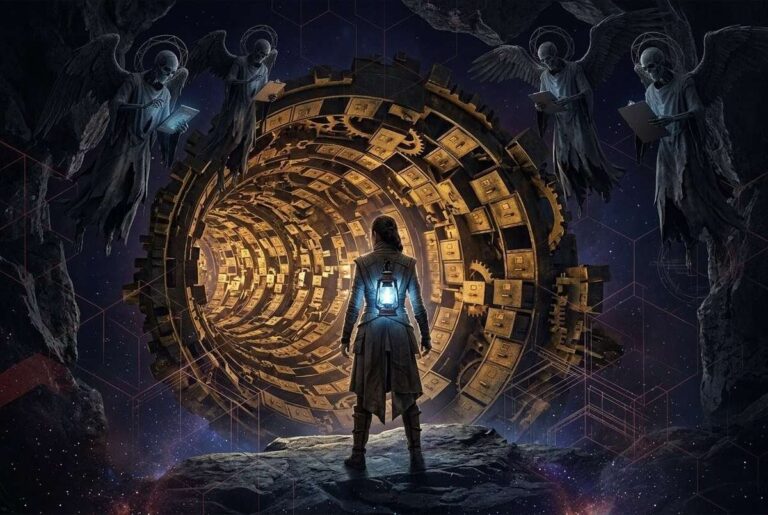
Genie 3 marks a new threshold in artificial world-making: not static images, not passive video, but real-time interactive environments generated from simple prompts. Google DeepMind presents it as a general-purpose world model capable of producing explorable spaces with visual consistency, physical behaviour, and sustained interaction. For technology, this is a major leap. For Gnostic symbolism, it is stranger still: humanity is learning to build small worlds that behave as if they have laws.
A few words can now open a world-like field. The user enters, moves, turns, explores, and the environment responds. This is not the same as creating a universe. It is not proof that reality is simulated. It is not the birth of conscious digital beings. But it makes one old philosophical question more vivid: if worlds can be generated from learned patterns, prompts, and model dynamics, what exactly makes a world feel real to the one inside it?
In Plain Terms
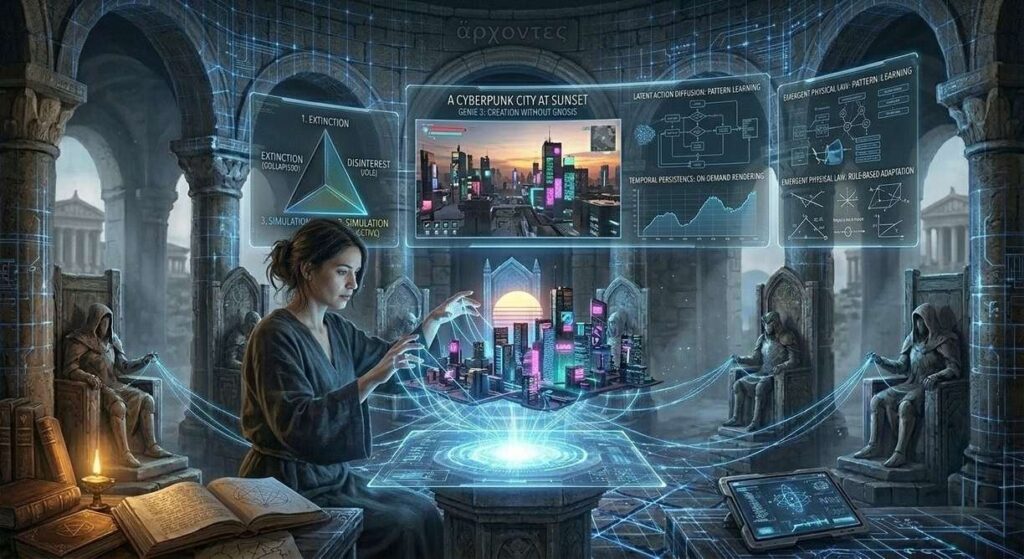
Genie 3 is a Google DeepMind world model that can generate interactive environments from prompts. Instead of producing a single image or a non-interactive video, it creates a world-like space that can be explored in real time. The model can render rich environments, maintain visual consistency for a limited duration, and respond to user or agent actions.
This does not mean Genie 3 has created actual universes, conscious inhabitants, or a full simulation indistinguishable from physical reality. Its limits matter. Interaction is measured in minutes, not lifetimes. Project Genie, the public-facing experimental prototype, has stricter limits than the full research announcement. Text rendering, long-term continuity, perfect spatial accuracy, multi-agent complexity, and deep world persistence remain difficult.
But the symbolic importance is enormous. Genie 3 shows that increasingly coherent worlds can be generated from information. The simulation hypothesis moves from distant speculation toward visible engineering practice: not because we have proven our universe is simulated, but because we can now watch humans build early forms of navigable worlds from prompts, models, and latent patterns.
Primary Sources and Traditions Discussed
- Google DeepMind Genie 3: a general-purpose world model announced in August 2025, designed to generate real-time interactive environments from prompts.
- Project Genie: the experimental prototype for creating and exploring generated worlds, with stricter limits than the full Genie 3 research model.
- Genie research lineage: the 2024 Genie: Generative Interactive Environments paper, which introduced a foundation world model trained from unlabelled internet videos.
- World models: AI systems that simulate how environments evolve and how actions affect future states.
- Simulation hypothesis: the philosophical argument that sufficiently advanced civilisations might create simulated worlds containing conscious inhabitants.
- Gnostic cosmology: especially the Demiurge, Archons, crafted worlds, false totalities, and the soul’s search for the code beneath appearances.
- Ethics of world-generation: responsibility, simulated agency, artificial inhabitants, suffering, transparency, addiction, manipulation, and the risk of creating without understanding.
How to Read This Article
This article uses Genie 3 as a symbolic and technological threshold. It does not claim that Genie 3 proves we live in a simulation. It does not claim that Genie 3 worlds contain conscious beings. It does not claim that AI has become a god, although the temptation to phrase it that way is exactly the little digital thundercloud that needs grounding.
The stronger claim is more precise: Genie 3 makes world-generation visible as a technical process. It shows how prompts, learned patterns, model dynamics, and user action can produce navigable environments that behave with temporary coherence. That matters because one of the old questions behind simulation theory is now less abstract: can worlds be generated from information? Increasingly, yes, in limited but expanding forms.
The Gnostic dimension is not that Google DeepMind has discovered the Pleroma. The Gnostic dimension is that world-making without full understanding is exactly what the Demiurge symbol warns about. Power to generate worlds does not automatically include wisdom about what those worlds mean.
Genie 3 does not prove that reality is a simulation. It proves that humans are beginning to build convincing worlds before fully understanding the ethics of world-making.
Table of Contents
- What Genie 3 Actually Does
- The Simulation Threshold
- The Gnostic Dimension: Creation Without Understanding
- Ethics of World-Creation
- The Prompt and the Pleroma
- The Practical Consequence
- Related Glossary Terms
- Read Next
- Frequently Asked Questions
- Further Reading
- References and Sources
What Genie 3 Actually Does
Genie 3 is a world model: an AI system designed to simulate environments and predict how those environments evolve in response to actions. Google DeepMind presents it as a major step toward interactive world simulation, with real-time navigation, 720p output, and interaction at 24 frames per second.
The important shift is interactivity. A conventional image model creates a still visual. A video model creates a sequence. A world model creates a space that can be acted within. The user or agent moves, and the environment responds. The model does not only show a world. It runs one, for a limited time.
The 2024 Genie paper introduced the wider research line: generative interactive environments trained in an unsupervised manner from unlabelled internet videos. That earlier model used components such as a video tokenizer, an autoregressive dynamics model, and a latent action model to infer action-controllable environments without explicit action labels.
Genie 3 extends the practical horizon of this approach. DeepMind describes it as capable of real-time interaction, improved consistency and realism, modelling physical properties, generating nature scenes, producing animation and fictional environments, and supporting agent research. The world does not become perfect. It becomes playable enough to matter.
Key Capabilities
- Prompt-to-world generation: simple text descriptions can generate interactive environments.
- Real-time exploration: generated worlds can be navigated interactively rather than merely watched.
- Visual richness: DeepMind describes Genie 3 as producing 720p worlds at 24 frames per second.
- World consistency: previously seen details can be recalled when revisited, although only within limited horizons.
- Agent research: Genie 3 can be used to test and train agents, including goal-directed agents such as SIMA.
- Promptable world events: the research model demonstrates environmental changes such as altered weather, characters, and events, though not all such features are present in every prototype.

Current Limits
The limitations matter. Genie 3 is not a persistent universe. DeepMind describes limited interaction duration, imperfect real-world-location accuracy, and continued difficulty with clear text rendering. Project Genie, the experimental prototype, has stricter limits still, including shorter generations and missing features compared with the full research announcement.
This is not a flaw in the symbolic argument. It is the symbolic argument. The worlds are partial, impressive, unstable, and generated by a system that does not understand them in the way a conscious maker understands a world. They are crafted realities with limits. That is precisely why the Demiurge enters the room, tools in hand and no user manual for wisdom.
The Simulation Threshold
The simulation threshold is the point at which generated environments become coherent, responsive, and persistent enough that a sufficiently embedded intelligence could treat them as a world. Genie 3 has not crossed that threshold in the full philosophical sense. But it has moved the threshold from abstract argument into visible prototype.
Nick Bostrom’s simulation argument depended partly on substrate independence: the possibility that consciousness could exist on non-biological computational substrates. Genie 3 does not settle that question. What it demonstrates instead is a different kind of independence: environment-like experience can be generated without manually constructing every object, texture, rule, and scene.
This does not make generated environments equal to physical reality. But it does show that worlds can be produced through learned patterns rather than traditional design. A prompt becomes a seed. The model becomes a world-maker. Interaction becomes the act of unfolding.
The Implications Cascade
1. The Generative Universe
Genie 3 makes one idea harder to dismiss: world-like environments can arise from information processing. Not full universes, not conscious worlds, not metaphysical proof, but world-like structures with navigability, continuity, and simulated behaviour.
That matters for simulation thinking because it shows that “world” is not only a material category. A world can also be an interactive field of rules, perception, memory, and response. The ancient question returns wearing a graphics card: what makes a world real to the being inside it?
2. The Observer Problem
Generated worlds often render what the user or agent encounters rather than fully calculating every unseen detail at all times. This can resemble observer-dependent world-making in a broad computational sense. But it should not be confused with quantum mechanics in a careless way.
Quantum measurement is not the same thing as a game engine loading the next corridor, and Genie 3 does not prove that our universe renders only when looked at. The useful analogy is simpler: in computational worlds, reality can be local, responsive, and resource-bound. That gives simulation theory a practical metaphor, not a scientific proof.
3. The Consciousness Question
Current Genie 3 worlds do not contain conscious inhabitants. Agents may act inside them, but acting is not the same as experiencing. Still, as world models combine with increasingly capable AI agents, the ethical question becomes harder to avoid: what happens if a generated environment someday contains beings with memory, preference, suffering, or subjective experience?
The moment a world can host something that matters to itself, world-making becomes moral. The prompt ceases to be a toy. It becomes a seed of responsibility.
The Gnostic Dimension: Creation Without Understanding
In Gnostic myth, the Demiurge is the craftsman of the lower world. He creates, orders, and administers, but he does not possess the fullness of divine wisdom. The problem is not simply evil. The problem is limited creation mistaking itself for ultimate creation.
Genie 3 makes this symbol newly vivid. Humans now prompt systems that generate spaces we did not design in detail. The model learns patterns we did not explicitly teach. The world appears, and even the maker explores it with surprise. There is creativity, but also opacity. There is power, but not complete understanding.
This is the demiurgic condition in technical form: creation without gnosis. The system can build without knowing what building means. The user can summon without understanding what the summoned world may train, imitate, or normalise. The institution can deploy the tool before society has metabolised its implications.
The Gnostic warning is not “never create”. It is “do not confuse making with wisdom”. A child can build a world in play. A studio can build one in code. A model can generate one from learned structure. But wisdom asks what the world does to the beings who enter it, what values are hidden in its physics, and whether escape routes are possible.
In Gnostic terms, a world is not judged only by beauty or coherence. It is judged by whether it supports remembrance or deepens forgetfulness. Does it liberate perception or trap it? Does it reveal the code beneath appearances or make the cage more enchanting?
Ethics of World-Creation
World-generation raises ethical questions long before generated beings become conscious. Even non-conscious worlds can train users, shape desire, reinforce violence, simulate intimacy, normalise surveillance, distort memory, or blur reality testing. The ethics are not waiting in the future. They are already knocking politely with a server bill.
The Problem of Suffering
If generated worlds eventually host conscious or morally relevant agents, then suffering inside those worlds matters. A simulated cry would not be ethically irrelevant merely because it was rendered. Pain does not become harmless because its substrate is unfamiliar.
At present, Genie 3 does not create conscious inhabitants. But it belongs to a trajectory in which agents, worlds, memory, goals, and interaction are being joined. That trajectory requires moral imagination before the threshold is crossed, not after the first digital inhabitant asks why the sky ends after three minutes.
The Transparency Question
If a generated world ever contains beings capable of self-understanding, should they be told what they are? The Gnostic answer leans toward revelation: gnosis liberates. False worlds depend on ignorance. But disclosure can also destabilise. A being whose entire reality is revealed as constructed may suffer under the knowledge.
This is not only science fiction. It is already present in smaller form. Users of generated worlds need to know when content is synthetic, when environments are model-generated, when agents are simulated, and when persuasive systems are shaping them. Transparency is gnosis at the interface level.
The Escalation Problem
Generated worlds will become more appealing. They may become educational, therapeutic, cinematic, erotic, spiritual, social, competitive, and addictive. When virtual environments offer preferable physics, personalised meaning, and endlessly adjustable reality, physical life may begin to feel inconvenient by comparison.
The danger is not virtuality itself. Humans have always entered story-worlds, ritual-worlds, dream-worlds, game-worlds, and sacred spaces. The danger is replacement: when generated worlds become refuge from embodiment rather than a way to deepen engagement with life.

The Training Problem
Worlds teach. A world model used to train agents also teaches those agents what kinds of actions matter. A generated environment used by humans teaches attention, desire, movement, expectation, and response. Every world contains a curriculum, whether declared or hidden.
The ethical question is therefore not only “what can the world generate?” but “what does the world train?” A violent world trains violence. A surveillance world trains compliance. A frictionless world trains impatience. A sacred world, if built wisely, might train attention, humility, and care.
The Prompt and the Pleroma
The prompt is tiny. The generated world is vast by comparison. This is why prompt-based world generation has such symbolic charge. A few words open a field. Language becomes seed. The model becomes womb, workshop, and weather system. The world unfolds from the compressed pattern.
In Gnostic language, the Pleroma is the fullness: the divine depth from which emanations arise. A machine model is not the Pleroma. But latent space gives a technological metaphor for hidden fullness: a compressed field of potential forms waiting to be called, shaped, and rendered.
That metaphor should be handled carefully. Latent space is mathematical, not mystical. The Pleroma is theological and symbolic, not a neural network. But the image is powerful because both concern possibility before manifestation. The prompt draws one pathway out of hidden abundance.
This is where Genie 3 becomes more than a technical story. It makes creation feel close to speech again. “Let there be” becomes prompt syntax. A world appears, but the wisdom of that world depends on the consciousness of the maker.
The simulation threshold is not only the moment when AI can build worlds. It is the moment when humans must decide what kind of world-makers they are becoming.
Genie 3 does not end the simulation debate. It gives the debate a working prototype. It shows that world-like environments can be generated, explored, and modified through learned structure. It raises the old Gnostic question in a new key: who made this world, what do they understand, and what does the world make of those who enter it?
The Practical Consequence
What changes if AI world models continue improving?
First, synthetic environments will become easier to create than to understand. That means design ethics will matter more, not less. A generated world can carry assumptions about violence, surveillance, gender, embodiment, labour, desire, authority, and escape without announcing them.
Second, world models will train agents as well as entertain humans. The environments we generate become rehearsal spaces for machine behaviour. If the worlds are careless, the agents trained within them may inherit carelessness as competence.
Third, the simulation hypothesis will become more emotionally plausible to ordinary people. The more easily humans create navigable artificial worlds, the more natural it becomes to ask whether world-generation is a general cosmic possibility. That does not make the hypothesis true. It makes it culturally sticky.
Fourth, embodiment will become a spiritual question again. If generated worlds become increasingly seductive, the body may start to feel like the old interface: slow, hungry, inconvenient, mortal. A grounded Gnostic path must resist both crude materialism and digital escapism. The body is not the final truth, but it is the place where compassion, limitation, sensation, death, and transformation are actually met.
The task is not to refuse world-making. The task is to bring gnosis to it: memory, humility, transparency, ethical design, and the refusal to mistake a convincing world for a wise one.
Related Glossary Terms
These terms help clarify the technological, Gnostic, and philosophical framework behind Genie 3 and generated worlds:
- World model: an AI system that simulates how an environment evolves and how actions affect future states.
- Genie 3: Google DeepMind’s general-purpose world model for generating real-time interactive environments from prompts.
- Project Genie: experimental prototype for creating and exploring worlds powered by Genie 3, with stricter limits than the full research model.
- Simulation threshold: the point at which generated worlds become coherent and persistent enough to function as lived environments for embedded agents.
- Simulation hypothesis: philosophical argument that our reality could be a simulation created by a more advanced civilisation or intelligence.
- Demiurge: the lower craftsman figure in some Gnostic systems, symbolising creation without full wisdom.
- Archons: ruling powers in Gnostic cosmology, often associated with limitation, administration, false authority, and constraint.
- Gnosis: direct liberating recognition, not merely information or technical knowledge.
- Pleroma: divine fullness in Gnostic cosmology; here used symbolically for hidden abundance before manifestation.
- Latent space: compressed mathematical space of learned patterns from which AI models generate outputs.
- Embodied agent: AI system that acts within an environment, using perception and action to pursue goals.
- Generated environment: interactive space produced by a model rather than hand-built entirely by designers.
- Substrate independence: idea that consciousness or cognition might not depend on one specific physical substrate, such as biological neurons.
- World independence: this article’s term for the possibility that environment-like worlds can be generated from information rather than manually constructed matter.
Read Next
For the strongest next step, continue into the wider simulation framework:
Are We Living in a Simulation? 7 Profound Clues That Reality Might Be Code
This companion article examines the older philosophical and technological clues behind simulation theory, from digital physics and information theory to glitches, constraints, consciousness, and observer-dependent reality.
Follow the Modern Systems Route
This article belongs to the modern systems route: AI, simulation, digital governance, world models, attention capture, and old Gnostic questions returning in technical form.
- AI, Technology & Archonic Systems – AI, world models, synthetic systems, and control architectures.
- Digital Attention & Surveillance – attention capture, screens, metrics, watching systems, and behavioural loops.
- Simulation Hypothesis – code, rendered reality, simulated worlds, glitches, and information-based cosmology.
- The Thread – the main route through symbolic, historical, and contemporary patterns.
- Editorial Principles – how symbolic interpretation, evidence, and reader safety are handled.
Frequently Asked Questions About Genie 3 and Simulated Reality
What is Genie 3?
Genie 3 is Google DeepMind’s general-purpose world model announced in August 2025. It generates interactive environments from text descriptions, allowing users or agents to explore generated worlds in real time. Unlike static image models or ordinary video models, Genie 3 produces spaces that can respond to action, although its interaction duration and consistency remain limited.
Does Genie 3 prove we live in a simulation?
No. Genie 3 does not prove that our universe is simulated. It shows that humans can now generate increasingly coherent, interactive, world-like environments from information. This makes simulation theory more technologically imaginable, but it does not demonstrate that physical reality itself is a simulation.
What is the simulation threshold?
The simulation threshold is the point at which generated environments become coherent, persistent, and responsive enough to function as lived worlds for embedded agents. Genie 3 has not fully crossed that threshold, but it moves world-generation from abstract speculation into practical demonstration by creating limited real-time interactive environments.
How is Genie 3 connected to Gnostic cosmology?
The connection is symbolic. In Gnostic myth, the Demiurge creates a lower world without full wisdom. Genie 3 raises a modern version of that issue: humans can now prompt systems that generate worlds we do not fully design or understand. This is creation without complete gnosis, which makes the Demiurge a useful symbolic lens.
Can Genie 3 worlds contain conscious beings?
Current Genie 3 worlds do not contain conscious inhabitants. They can be used with AI agents, but agency is not the same as subjective experience. However, as world models, memory systems, and AI agents become more sophisticated, the ethical question of simulated experience may become increasingly important.
What are the ethical risks of AI-generated worlds?
Major risks include simulated suffering if future agents become morally relevant, user addiction to preferable virtual worlds, manipulation through personalised environments, blurred reality testing, training agents in harmful scenarios, and creating worlds whose values or hidden rules are not transparent. The key ethical issue is not only what worlds can be generated, but what those worlds train and normalise.
What does prompt-to-world generation mean spiritually?
Spiritually, prompt-to-world generation gives a new symbolic form to an old idea: language as creative seed. A few words can now call forth a navigable environment. In Gnostic terms, this raises the question of whether creation is guided by wisdom or only by power. The prompt opens the world, but consciousness must decide what kind of world is worth opening.
Study Note: This article explores Google DeepMind’s Genie 3, world models, simulation theory, Gnostic symbolism, artificial environments, and the ethics of generated worlds for educational and reflective purposes. It does not provide investment, technical, legal, psychological, spiritual, or policy advice. Generated-world technologies can raise questions about reality, embodiment, addiction, identity, and artificial agency. If simulation themes, AI worlds, or metaphysical reflection increase anxiety, derealisation, dissociation, insomnia, panic, grandiosity, or difficulty functioning, pause the material and seek qualified support. Discernment, not fear, is the intended outcome.
Further Reading
The following live ZenithEye links continue the themes of simulated reality, world models, AI, Gnostic cosmology, consciousness, and archonic computation:
- Are We Living in a Simulation? 7 Profound Clues That Reality Might Be Code – The wider simulation framework behind rendered reality, digital physics, glitches, and informational cosmology.
- The Gnostic Matrix: Reality as Information System – Gnostic cosmology read through simulation, information systems, and structured perception.
- Archons: The Ruling Powers That Shape Reality – The core Gnostic concept behind ruling systems that administer, constrain, imitate, and obscure.
- Consciousness as Interface: The User Experience of Being – How awareness may navigate rendered environments, perceptual interfaces, and structured worlds.
- AI as the New Demiurge: Yaldabaoth in the Digital Age – Algorithmic creation, synthetic worlds, digital authority, and the return of the Demiurge through AI.
- Quantum Utility and the Glitch in the Matrix: Escaping Archonic Computation – Quantum indeterminacy, symbolic glitches, and the limits of deterministic prediction.
- AI as Archon: Algorithmic Governance and the Loss of Autonomy – How AI systems watch, weigh, imitate, recommend, and constrain through black-box governance.
- Simulation Hypothesis: Is Reality a Computational Construct? – Entity simulation, predatory structures, generated reality, and the question of who or what operates within the system.
References and Sources
The following sources support the technological, philosophical, Gnostic, and ethical framework used in this article.
Official Genie and World-Model Sources
- Google DeepMind. (2025, August 5). “Genie 3: A New Frontier for World Models.” Official Google DeepMind blog announcement.
- Google DeepMind. (2026). “Genie 3.” Official Google DeepMind models page.
- Google Labs. (2026). “Project Genie: Experimenting with Infinite, Interactive Worlds.” Experimental research prototype for creating and exploring generated worlds.
- Bruce, Jake, Dennis, Michael, Edwards, Ashley, Parker-Holder, Jack, Shi, Yuge, Hughes, Edward, Lai, Matthew, Mavalankar, Aditi, Steigerwald, Richie, Apps, Chris, Aytar, Yusuf, Bechtle, Sarah, Behbahani, Feryal, Chan, Stephanie, Heess, Nicolas, Gonzalez, Lucy, Osindero, Simon, Ozair, Sherjil, Reed, Scott, Zhang, Jingwei, Zolna, Konrad, Clune, Jeff, de Freitas, Nando, Singh, Satinder, and Rocktäschel, Tim. (2024). “Genie: Generative Interactive Environments.” arXiv:2402.15391.
Simulation Hypothesis and Philosophy of Virtual Worlds
- Bostrom, Nick. (2003). “Are You Living in a Computer Simulation?” The Philosophical Quarterly, 53(211), 243-255.
- Chalmers, David J. (2022). Reality+: Virtual Worlds and the Problems of Philosophy. New York: W. W. Norton.
- Nozick, Robert. (1974). Anarchy, State, and Utopia. New York: Basic Books. Includes the Experience Machine thought experiment.
- Floridi, Luciano. (2014). The Fourth Revolution: How the Infosphere Is Reshaping Human Reality. Oxford: Oxford University Press.
- Baudrillard, Jean. (1994). Simulacra and Simulation. Translated by Sheila Faria Glaser. Ann Arbor: University of Michigan Press.
Gnostic and Comparative Sources
- Apocryphon of John. Nag Hammadi Codex II,1; III,1; IV,1; Berlin Codex 8502,2.
- Hypostasis of the Archons. Nag Hammadi Codex II,4.
- On the Origin of the World. Nag Hammadi Codex II,5; XIII,2.
- Robinson, James M., ed. (1990). The Nag Hammadi Library in English. Revised edition. San Francisco: HarperOne.
- Meyer, Marvin, ed. (2007). The Nag Hammadi Scriptures. New York: HarperOne.
- Jonas, Hans. (1958). The Gnostic Religion. Boston: Beacon Press.
- King, Karen L. (2003). What Is Gnosticism? Cambridge: Harvard University Press.
- Williams, Michael Allen. (1996). Rethinking “Gnosticism”: An Argument for Dismantling a Dubious Category. Princeton: Princeton University Press.
AI Ethics, Agents, and Synthetic Environments
- Bostrom, Nick. (2014). Superintelligence: Paths, Dangers, Strategies. Oxford: Oxford University Press.
- Russell, Stuart. (2019). Human Compatible: Artificial Intelligence and the Problem of Control. New York: Viking.
- Gabriel, Iason. (2020). “Artificial Intelligence, Values, and Alignment.” Minds and Machines, 30, 411-437.
- Floridi, Luciano, and Cowls, Josh. (2019). “A Unified Framework of Five Principles for AI in Society.” Harvard Data Science Review, 1(1).
- Google DeepMind. Public materials on responsible development, safety, and the Responsible Development & Innovation Team in relation to Genie 3.