The Architecture of Reality: Why Information Precedes Matter
The architecture of reality may be more informational than material. Modern physics does not prove that matter is an illusion, that the universe is a computer simulation, or that ancient Gnostics were secretly quantum theorists in linen robes. But it does reveal something genuinely unsettling: information, entropy, measurement, relation, and boundary may be far more central to reality than the old picture of solid matter first and meaning later ever allowed.
For centuries, the dominant scientific imagination pictured the universe as a machine made of particles and forces. Matter was primary. Mind, meaning, information, and consciousness were treated as late arrivals, produced by sufficiently complex arrangements of physical stuff.
That picture has not simply collapsed. Science is rarely so theatrical. But it has become less final. Black hole thermodynamics, quantum information theory, holographic models, computation, and the philosophy of physics now place information close to the foundations. The universe may not be a machine made of dead matter. It may be a lawful pattern of relations in which matter appears as one expression of deeper informational structure.
Information does not prove the Archons. But it gives modern language to an old Gnostic suspicion: the visible world is structured, mediated, and not the final layer of reality.
In Plain Terms
“Information precedes matter” means that physical things may not be the deepest layer of reality. What we call matter may depend on more fundamental patterns: quantum states, relations, entropy, measurement, fields, geometry, and information.
This does not mean the universe is definitely computer code. It does not mean space is literally pixels on a cosmic screen. It does not mean consciousness can hack reality by intention alone. Those claims are too strong.
The better claim is more careful and more interesting: modern physics increasingly treats information as physically meaningful, not merely as human description. Black holes have entropy. Quantum states carry information. Entanglement reveals non-classical correlations. The holographic principle suggests deep links between area, entropy, information, and spacetime. Computation is not outside physics; it is part of physics.
For a Gnostic reader, this has symbolic force. The world looks less like inert stuff and more like a patterned order. The Archons become a way of speaking about constraints. The Demiurge becomes a symbol for lower-order world-making. Gnosis becomes the recognition that what appears solid may be structured, mediated, and readable.
Primary Sources and Traditions Discussed
- Black hole thermodynamics: Bekenstein, Hawking, entropy, information, and the relation between horizon area and physical information.
- The holographic principle: the idea that the information content of a region may be bounded by boundary area rather than ordinary volume.
- AdS/CFT correspondence: a major example from theoretical physics in which a gravitational theory and a boundary quantum field theory are mathematically related.
- Planck-scale physics: the scale at which our current theories of spacetime and quantum gravity become uncertain.
- Loop quantum gravity: a quantum-gravity programme in which geometry is quantised and spacetime is not treated as a smooth background.
- Quantum information: qubits, entanglement, measurement, and information as a physical resource.
- Digital physics: speculative and philosophical approaches that place information, computation, or discrete structure close to the foundations of physical reality.
- Gnostic cosmology: the Demiurge, Archons, Pleroma, Logos, mediation, constraint, and gnosis as recognition.
- Contemplative practice: pattern recognition, attention, embodiment, humility, and the careful reading of experience.
How to Read This Article
This article does not claim that digital physics is settled consensus. It is not. Nor does it claim that matter has been disproven, that physics has confirmed Gnosticism, or that synchronicities are literal glitches in a simulation. Those claims may be colourful, but colour is not evidence.
The article uses physics carefully and symbolism openly. The physics shows that information is deeply woven into modern accounts of reality. The symbolism asks what that means for the seeker who already suspects that the visible world is not the whole.
Gnostic language here is interpretive. The Archons are not literally compression algorithms. The Demiurge is not literally a programmer. The Pleroma is not literally a server outside spacetime. These are symbolic bridges, not laboratory conclusions.
Handled honestly, the bridge is still powerful. Information physics gives new grammar to an ancient recognition: reality has structure, structure has limits, and awakening begins when the limits are no longer mistaken for the whole of being.
Table of Contents
- The Holographic Principle: Reality, Boundary, and Information
- Planck-Scale Physics: The Question of Resolution
- Quantum Information: Reality as Relation
- The Computational Universe: Physics and Algorithm
- Digital Ontology: The Philosophy of Code
- The Gnostic Resonance: Archons as Constraints
- Living the Recognition: Practice in an Informational Cosmos
- The Code Beneath the World
- Related Glossary Terms
- Read Next
- Frequently Asked Questions
- Further Reading
- References and Sources
The Holographic Principle: Reality, Boundary, and Information
The Black Hole Information Problem
The first major clue comes from black holes. In classical general relativity, a black hole seems to swallow everything that crosses its horizon. In quantum theory, information is not supposed to simply disappear. When Stephen Hawking showed that black holes should emit radiation and eventually evaporate, a deep problem appeared: what happens to the information about everything that fell in?
Jacob Bekenstein’s work on black hole entropy and Hawking’s radiation calculation changed the meaning of black holes. They were no longer merely gravitational monsters. They became thermodynamic and informational objects. A black hole’s entropy is proportional to the area of its event horizon, not to the ordinary volume inside it.
This is one of the great reversals in modern physics. In everyday thinking, a bigger volume should hold more information. Black holes suggest something stranger: the boundary may matter more than the bulk. The edge may encode the interior.
From Boundary to Bulk
The holographic principle developed from this black-hole puzzle. In broad terms, it proposes that the information content of a spatial region may be described by information on a lower-dimensional boundary. The name comes from ordinary holograms, where a two-dimensional surface can encode three-dimensional appearance.
Juan Maldacena’s AdS/CFT correspondence gave the most famous mathematical example: a gravitational theory in an anti-de Sitter space can be equivalent to a conformal field theory on its boundary. This does not mean our own universe has been proven to be a literal hologram. It does mean that at least in some deep theoretical settings, gravity, geometry, information, and boundary description are profoundly linked.
The careful conclusion is not “we live on a flat screen”. It is this: spacetime may be emergent from deeper informational relationships. What appears as volume may have a hidden boundary description. The world may be less like a container full of things and more like an encoded structure whose depth is generated.
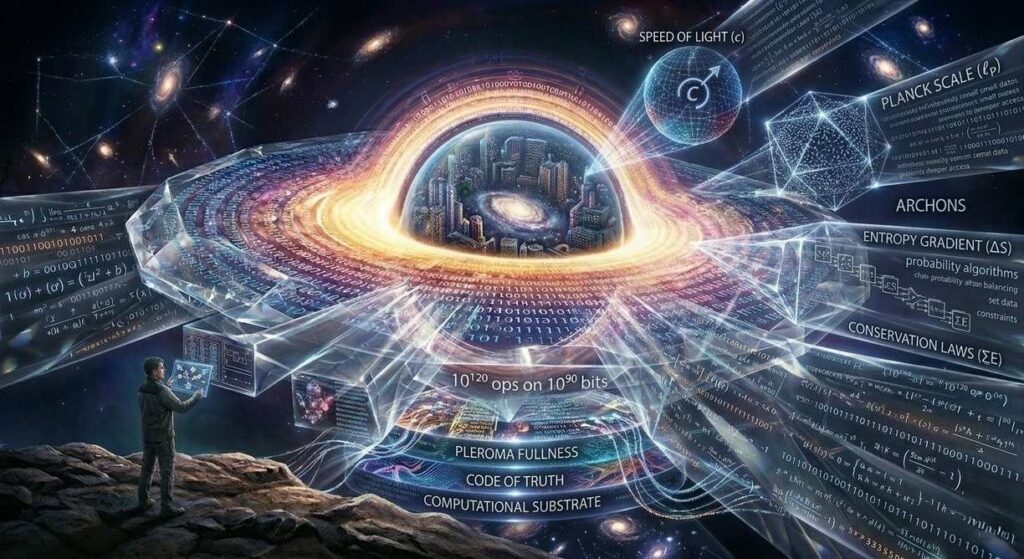
For the Gnostic imagination, the holographic principle has symbolic resonance because it questions the finality of appearance. The visible world may not be false, but it may be derivative. The depth we inhabit may depend on a structure we do not directly perceive.
Planck-Scale Physics: The Question of Resolution
Is Space Pixelated?
The Planck length is often described as the smallest meaningful scale in physics. That description needs care. It does not prove that space is made of literal pixels. It marks a scale at which our current theories, general relativity and quantum mechanics, can no longer be combined in a simple way. Below that scale, our usual concepts of distance, geometry, and time may need replacement.
Still, the Planck scale encourages a striking question: is spacetime continuous all the way down, or does it have discrete structure? Some approaches to quantum gravity suggest discreteness. Others do not. The answer is not settled.
Craig Hogan proposed one experimental route through the idea of holographic noise, a possible graininess in spacetime. The Fermilab Holometer was designed to test a particular model of such noise. In 2015, the Holometer collaboration ruled out Hogan’s specific prediction to high statistical significance. That did not disprove holography. It did show that the universe is not obliged to satisfy our most photogenic metaphors.
This is useful humility. The universe may be informational without being a low-resolution screen. It may have deep structure without behaving like a badly compressed JPEG of God’s holiday photos.
Loop Quantum Gravity and Relational Space
Loop quantum gravity offers another route. It treats geometry itself as quantised, with area and volume having discrete spectra. In this view, spacetime is not a smooth background on which events occur. Geometry is built from relational quantum structure.
This does not mean the “atoms of space” are simple 0s and 1s. That is too crude. But it does point toward a reality in which geometry is not the absolute stage. Space may emerge from relations, and relations are closer to information than to ordinary matter.
The Gnostic resonance is again symbolic. The visible world is not denied. It is read as a surface expression of hidden ordering. Matter becomes the theatre curtain. Information is the stage rigging. Consciousness is the one asking why the scenery moves.
Quantum Information: Reality as Relation
Entanglement and Non-Classical Connection
At the quantum scale, information is not merely a human label pasted over physical things. The quantum state of a system carries real predictive content. It describes possible outcomes, correlations, and relations that cannot be reduced to classical ignorance about pre-existing properties.
Entanglement is especially important. Entangled systems display correlations stronger than classical physics allows. Bell-test experiments have repeatedly confirmed that local hidden-variable explanations cannot reproduce quantum predictions. This does not allow faster-than-light messaging, but it does show that separation is not as simple as ordinary realism assumes.
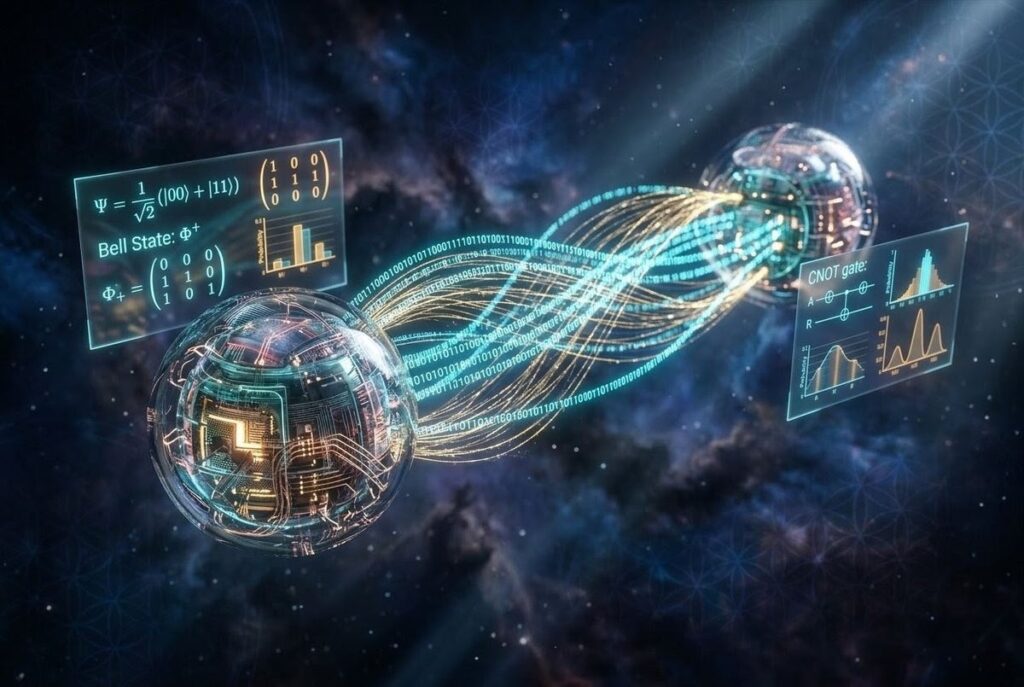
Simulation-minded readers often compare entanglement to shared data structures. That image can be useful, but it is not physics. Quantum correlations are not simply variables pointing to the same database row. The deeper point is subtler: reality is not built from isolated little objects first and relations later. At the quantum level, relation is part of the fabric.
The It from Bit Hypothesis
John Wheeler’s famous phrase “it from bit” suggested that physical things may arise from informational yes-or-no distinctions. Every “it”, every apparent object or event, may depend on more primitive acts of distinction, measurement, and specification.
This is not a settled doctrine. It is a profound orientation. Wheeler was not saying the universe is a desktop computer. He was pointing toward a reality in which information, question, answer, and physical existence are entangled at the root.
For a Gnostic reading, “it from bit” resonates with Logos: the structuring principle through which formless possibility becomes ordered world. But the comparison must remain poetic and philosophical. Logos is not simply a bit. A bit is not a prayer. Still, both images say that pattern precedes appearance.
The Computational Universe: Physics and Algorithm
The Universe as Quantum Computer
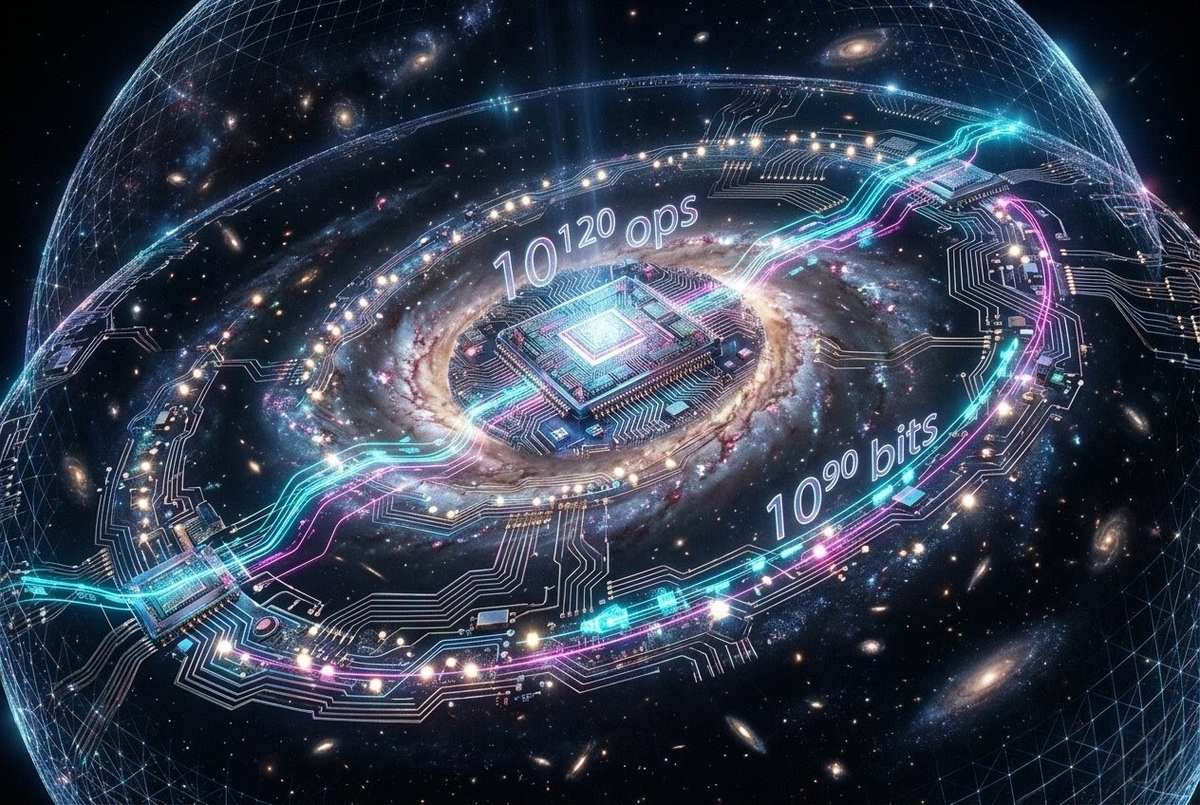
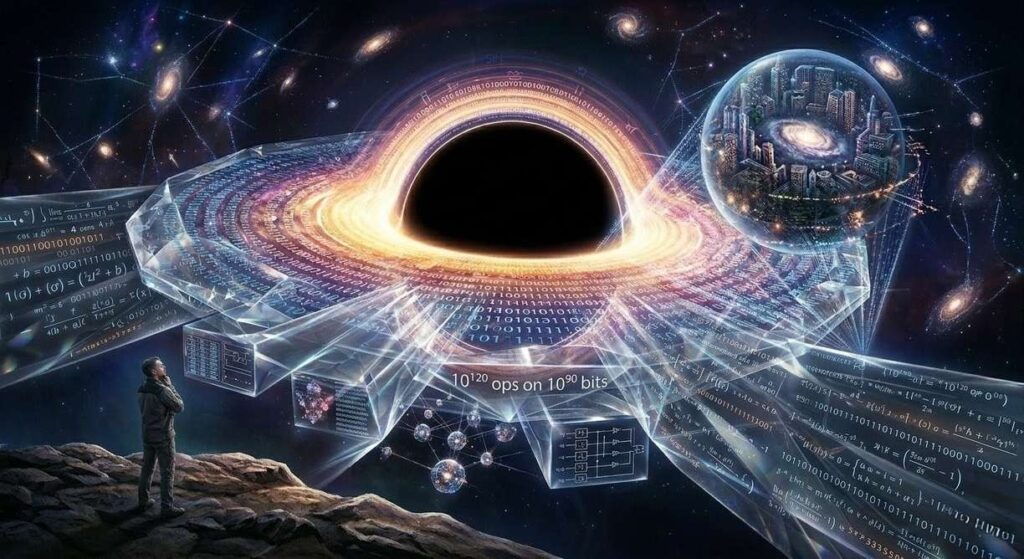
Seth Lloyd famously described the universe as a quantum computer, estimating the number of operations and bits that could be associated with the observable universe. This is not a casual metaphor. It reflects a serious physical idea: computation is not an abstract activity floating outside reality. Computation is physical. Physical systems process information because physical states evolve according to law.
Landauer’s principle also matters here. Erasing information has thermodynamic cost. Information and energy are not identical in a simplistic way, but they are physically connected. Information cannot be treated as weightless bookkeeping when the universe itself charges heat for deletion.
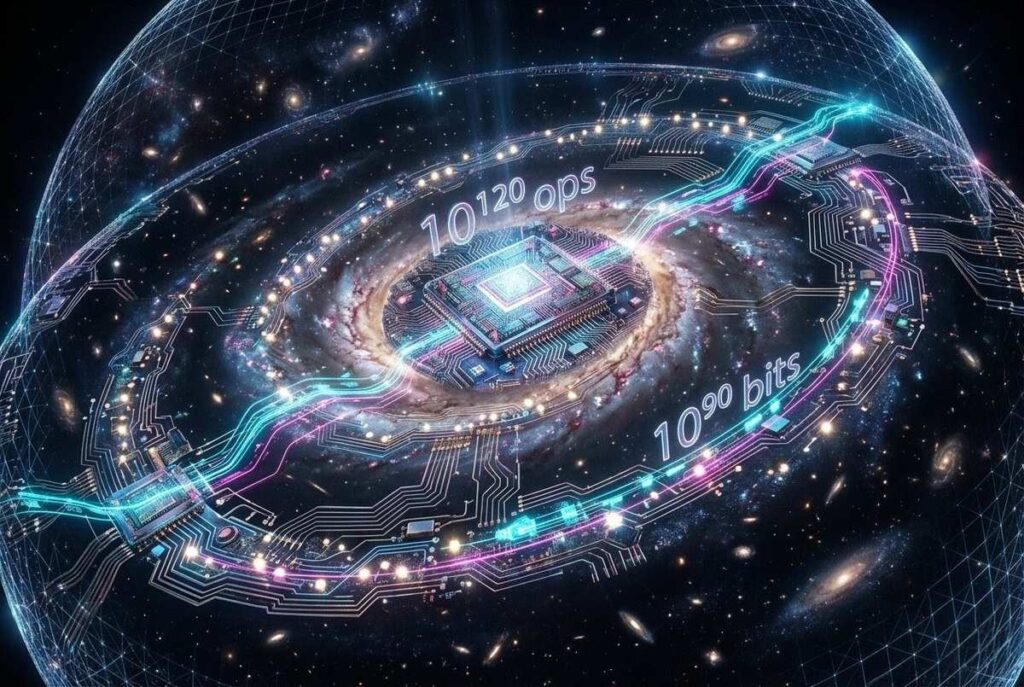
The safe claim is this: the universe can be fruitfully analysed in computational and informational terms. The stronger claim, that the universe literally is a computer in the ordinary engineered sense, remains philosophical and debated.
The Church-Turing-Deutsch Principle
David Deutsch argued that the Church-Turing idea should be understood physically: every finitely realisable physical system could, in principle, be simulated by a universal computing machine operating by finite means. This helped open the conceptual space for quantum computation and the idea that computation must be understood through the true laws of physics, not merely through classical machines.
But this principle should not be inflated into “therefore physics is only software”. A system being simulable does not mean it is itself a simulation. A storm can be modelled, but the model is not the rain. A galaxy can be simulated, but the simulation is not automatically the galaxy.
Still, the principle is philosophically electric. It suggests that physical law, computation, and information are deeply linked. The universe may not be a computer in the banal sense, but computation is one of the languages in which reality seems willing to confess.
The Unreasonable Effectiveness of Mathematics
Eugene Wigner famously wrote about the unreasonable effectiveness of mathematics in the natural sciences. Equations fit the world with astonishing precision. That fact remains mysterious.
Digital physics gives one possible answer: mathematics works because reality has mathematical structure at its root. But this need not mean equations are literal source code. Mathematical description may succeed because the world is lawful, relational, and patterned. The map fits because the territory is shaped, not because it was necessarily compiled from a cosmic IDE.
For the contemplative mind, mathematics becomes more than calculation. It becomes a glimpse of hidden order. Not a replacement for prayer, embodiment, beauty, or direct experience, but a crystalline window into the architecture of the possible.
Digital Ontology: The Philosophy of Code
If information is central to reality, ontology changes. “What exists?” becomes inseparable from “what is distinguished, related, encoded, measurable, or structured?” A thing exists not merely as stuff, but as pattern: a persistent distinction in the field of possible relations.
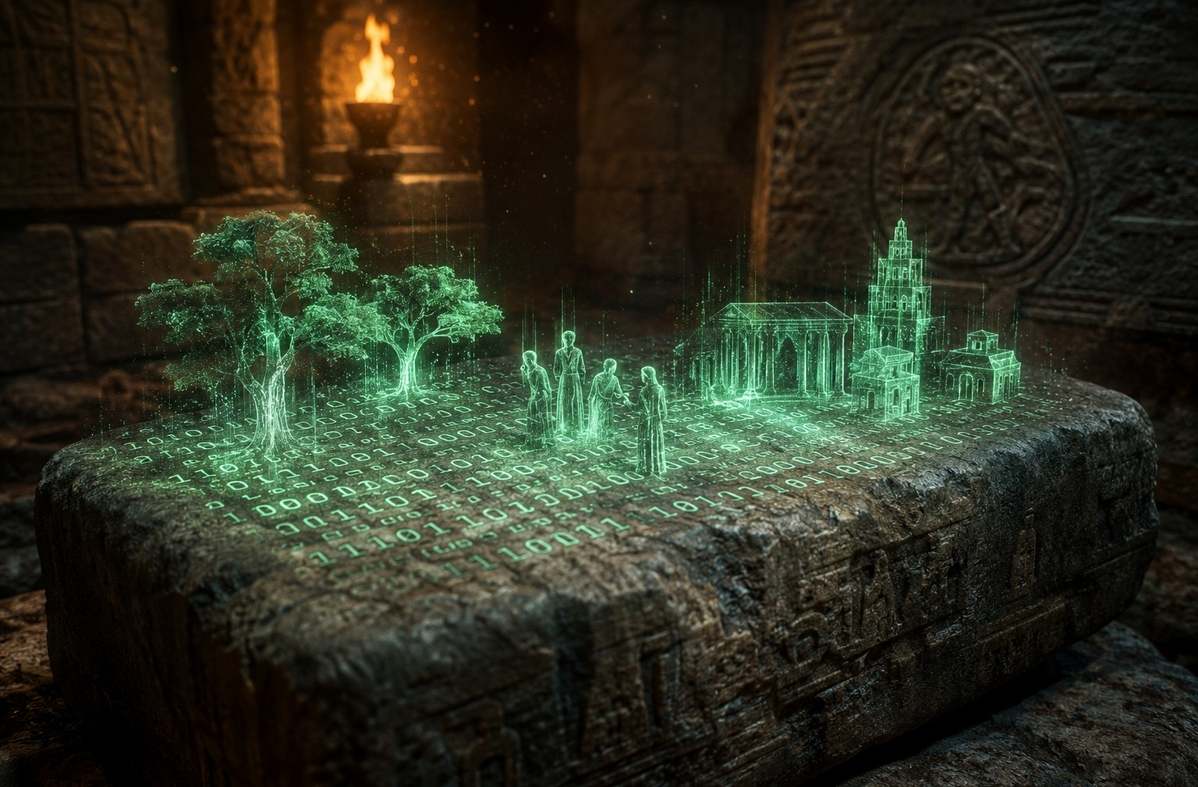
This is where simulation theory becomes tempting. In a simulated world, objects exist as data structures rendered into experience. Their solidity is a mode of presentation. Their persistence depends on underlying rules. Their behaviour follows coded constraints.
But digital ontology and simulation theory are not identical. A universe can be informational without being designed by external programmers. A mathematical structure can be real without being artificial. A law-governed cosmos can be computationally describable without being someone’s experiment.
The simulation hypothesis follows naturally as one possible interpretation, not as a necessary conclusion. If worlds can be informational, then generated worlds become conceivable. If consciousness can exist on multiple substrates, then simulated minds become morally possible. But each “if” matters. The bridge is not automatic. It must be crossed carefully, plank by plank, with the fog behaving badly underfoot.
Consciousness as Interface
Digital ontology also raises the question of consciousness. If experience is how reality appears from within, then consciousness may function like an interface: not a passive copy of the world, but a rendered field through which an organism acts, survives, interprets, and knows.
This does not prove that consciousness pre-exists the body, or that the brain is merely a receiver. Those are live metaphysical possibilities for some traditions, but not settled science. The grounded claim is that perception is mediated. The brain does not show us reality “as it is” in some absolute sense. It constructs a usable world from signals, predictions, memory, body state, and attention.
That alone is spiritually significant. The world we experience is already an interface. To awaken is not to reject the interface, but to stop mistaking it for the totality of what is.
The Gnostic Resonance: Archons as Constraints
The Archonic Nature of Law
In many Gnostic texts, the Archons are ruling powers. They administer the lower world. They set boundaries. They shape the realm in which the soul forgets its origin. They are not always best understood as cartoon villains. They are powers of limitation.
Digital physics offers a modern symbolic translation. Physical laws, constants, entropy gradients, causal limits, biological constraints, social systems, and algorithmic environments all define what can happen inside a given order. They are not malicious. They are structuring.
Calling them “Archons” is not physics. It is a mythic reading of constraint. The value of the symbol is that it prevents us from confusing the rules of a local order with the fullness of reality itself.
The speed of light, entropy, gravity, death, memory, and embodiment are not punishments from hostile gods. They are the conditions of this world. But the Gnostic question remains: are these conditions ultimate, or local? Are they the whole truth, or the architecture of a particular layer?
The Demiurge as World-Builder
In Gnostic myth, the Demiurge is the craftsman of the lower cosmos, powerful but incomplete. He creates without full knowledge of the divine depth beyond him. In a modern informational reading, the Demiurge becomes the symbol of world-building without total wisdom.
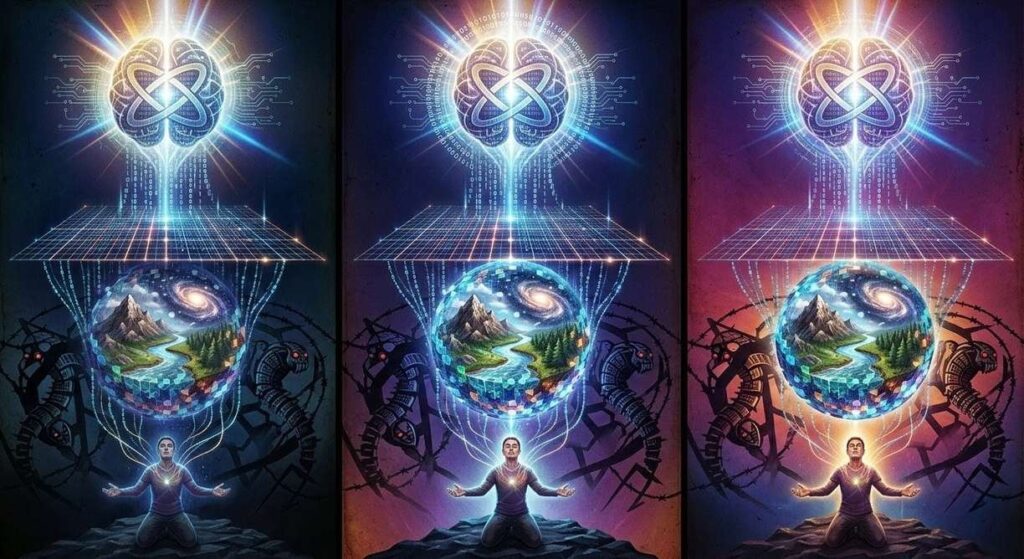
This can be read cosmologically, but it can also be read psychologically and technologically. A system can be built that works but does not understand itself. A culture can create rules that sustain life and still imprison perception. An AI can generate worlds without knowing what worldhood means. A mind can construct an identity and then mistake its own construction for the whole self.
The Demiurge is the maker who forgets the source. That is why the symbol remains useful in the age of computation. The danger is not creation. The danger is creation without gnosis.
Reading the Source Without Pretending to Own It
To recognise the world as structured is not to gain magical control over it. Gnosis is not a cheat code. It is not command-line access to the cosmos. It is direct recognition that the visible order is mediated, lawful, incomplete, and transparent to something deeper.
Patterns matter. Symbols matter. Repetition matters. But pattern recognition must be tempered by humility. A synchronicity may be meaningful without being a literal system glitch. A recurring number may invite reflection without requiring cosmic software diagnostics. The contemplative learns to read signs without turning every traffic light into scripture.

Living the Recognition: Practice in an Informational Cosmos
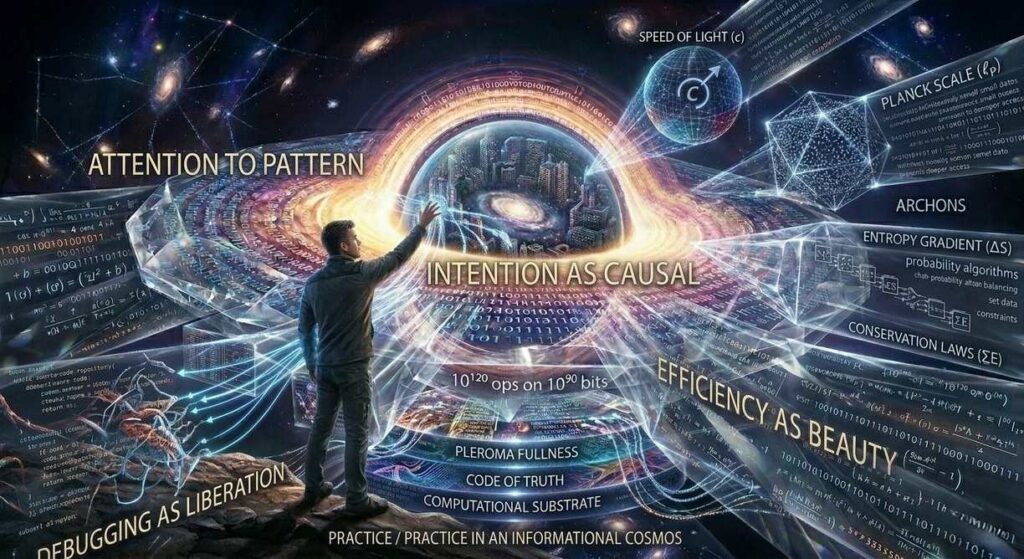
If reality is deeply informational, how does that change ordinary life? Not by turning the seeker into a cosmic hacker, but by refining attention. The useful practices are not grandiose. They are simple, steady, and embodied.
1. Attention to Pattern
Information reveals itself through difference, repetition, relation, and change. To practise pattern recognition is to notice how events, thoughts, habits, symbols, and systems repeat across scales.
This is not a licence to force meaning onto everything. It is training in discernment. Ask: what repeats? What changes? What is genuinely connected? What is only my anxious pattern-finder throwing glitter on randomness?
Good pattern recognition makes the mind quieter, not more frantic. It leads to clarity, not conspiracy fog.
2. Attention as Participation
Attention shapes experience. This is true psychologically even without quantum speculation. What you repeatedly attend to becomes more vivid, more available, and more influential. Attention trains the nervous system, memory, desire, and interpretation.
That is enough to make attention sacred. You do not need to claim that thought collapses the physical universe. Your attention already collapses possibility into lived reality at the level of perception, choice, and character.
Where attention goes, the inner world is cultivated. Choose carefully. The garden has teeth and flowers.
3. Beauty as Compression
Elegant systems generate richness from simple rules. A seed becomes a tree. A fractal produces endless variation. A musical theme unfolds into a symphony. A few physical laws produce stars, water, cells, breath, longing, and grief.
Beauty can be understood as compression felt from the inside: immense meaning generated from spare structure. This does not reduce beauty to mathematics. It honours the hidden economy by which the world makes abundance from pattern.
To contemplate beauty is to notice that reality is not only lawful. It is generous in form.
4. Debugging as Reflection
The original version of this idea can become too harsh if suffering is treated as “error” or trauma as “corrupted data”. Human pain is not a software bug. Trauma is lived in bodies, relationships, memory, and nervous systems. It deserves care, not cleverness.
Still, debugging is a useful metaphor when handled gently. Reflection asks: where does this pattern begin? What input keeps producing this output? Which belief, fear, wound, habit, or inherited rule keeps running in the background?
Liberation is not deleting the self. It is understanding the scripts that bind awareness and learning, with patience, how to stop executing what no longer serves life.
The Code Beneath the World
Digital physics does not make the world less real. It makes reality stranger. Matter may be less like inert substance and more like stable pattern. Space may be less like a container and more like emergent relation. Information may be less like a human description and more like one of the languages reality uses to become knowable.
The Gnostic insight is not that the world is fake. It is that the world is not final. The cosmos may be lawful, beautiful, painful, mediated, patterned, and real as experience, while still being derivative of deeper structure.
To say “information precedes matter” is therefore not to sneer at matter. It is to honour the hidden architecture by which matter appears. The body is still sacred. The earth is still sacred. The ordinary world still matters. But it may be translucent to an order deeper than its surfaces.
The code beneath the world is not a command prompt for escaping life. It is a reminder that life is structured by patterns deeper than the eye can see.
The seeker does not need to prove the universe is a simulation. The seeker needs to notice that reality is layered, that attention matters, that systems shape perception, and that recognition can loosen the spell of the given.
The Archons are not compression algorithms. But the metaphor survives because every world has constraints. The Demiurge is not a programmer. But the symbol survives because creation without wisdom remains dangerous. The Pleroma is not a data centre. But the hunger for fullness survives because no rendered order can satisfy the whole of the soul.
Information may not replace matter. It may reveal why matter was never as simple as we thought.
Related Glossary Terms
These terms help clarify the informational, physical, Gnostic, and philosophical framework behind this article:
- Digital physics: approaches that place information, computation, or discrete structure near the foundations of physical reality.
- Information: structured distinction, relation, state, or specification; in physics, often linked to entropy, measurement, and system description.
- Holographic principle: idea that the information content of a region may be bounded by the area of a boundary rather than ordinary volume.
- Bekenstein bound: theoretical limit on the entropy or information that can be contained within a finite region with finite energy.
- Black hole entropy: the thermodynamic entropy associated with black holes, proportional to event-horizon area.
- AdS/CFT correspondence: mathematical relation between certain gravitational theories and boundary quantum field theories.
- Planck scale: scale at which current theories of spacetime and quantum gravity require deeper unification.
- Loop quantum gravity: quantum-gravity approach in which geometry has discrete spectra and spacetime is relational.
- Qubit: quantum unit of information capable of superposition and entanglement.
- Entanglement: non-classical correlation between quantum systems that cannot be explained by local hidden variables.
- It from bit: John Wheeler’s phrase suggesting that physical “things” may arise from informational distinctions.
- Church-Turing-Deutsch principle: physical-computation principle proposing that finitely realisable physical systems can be simulated by a universal computing machine.
- Simulation hypothesis: philosophical argument that our experienced reality could be a generated environment on a deeper substrate.
- Archons: ruling powers in Gnostic cosmology, here used symbolically for limiting structures and constraints.
- Demiurge: lower craftsman figure in some Gnostic systems, symbolising world-making without full wisdom.
- Pleroma: divine fullness beyond the deficient lower order in Gnostic cosmology.
- Gnosis: direct liberating recognition, not merely theory, belief, or information.
Read Next
For the strongest next step, continue into the wider simulation route:
Are We Living in a Simulation? 7 Profound Clues That Reality Might Be Code
This companion article explores how information, quantum indeterminacy, mathematics, fine-tuning, consciousness, glitches, and AI-generated worlds feed the modern simulation question.
Follow the Modern Systems Route
This article belongs to ZenithEye’s modern systems route: information, simulation, AI, digital governance, world models, attention capture, and the old patterns wearing new technical masks.
- Simulation Hypothesis – code, rendered reality, simulated worlds, glitches, and information-based cosmology.
- AI, Technology & Archonic Systems – AI, world models, synthetic systems, and control architectures.
- Digital Attention & Surveillance – attention capture, screens, metrics, watching systems, and behavioural loops.
- The Thread – the main route through ZenithEye’s symbolic, historical, and contemporary architecture.
- Editorial Principles – how ZenithEye handles symbolic interpretation, evidence, and reader safety.
Frequently Asked Questions
What does information precedes matter mean?
Information precedes matter means that physical reality may depend on deeper structures of relation, state, entropy, measurement, and information. It does not prove that matter is fake or that the universe is literally computer code. It suggests that matter may be an expression of underlying informational order rather than the final foundation of reality.
Is digital physics accepted scientific consensus?
No. Digital physics is a serious but debated area of speculation and philosophy of physics. Information is central to many established areas of modern physics, including black hole thermodynamics and quantum information theory, but the claim that the universe is literally digital or computational remains controversial.
What is the holographic principle in simple terms?
The holographic principle proposes that the information content of a region of space may be described by information on its boundary. It emerged from black hole thermodynamics and has powerful mathematical examples such as AdS/CFT. It does not prove that our universe is literally a flat projection, but it suggests deep links between geometry, gravity, entropy, and information.
Does the Planck length prove that space is pixelated?
No. The Planck length marks a scale where current theories of gravity and quantum mechanics require deeper unification. It is often compared to a pixel size, but that is only a metaphor. Some quantum-gravity theories suggest discrete structure, while others do not. The pixelated-space claim remains unsettled.
Does quantum entanglement prove reality is simulated?
No. Entanglement shows that quantum systems have non-classical correlations that cannot be explained by local hidden variables. It does not prove simulation theory. Simulation language can provide a metaphor for non-local relation, but quantum entanglement is a physical phenomenon, not evidence of a cosmic computer game.
How do Archons relate to algorithms in this article?
The connection is symbolic. In Gnostic cosmology, Archons are powers of limitation and administration. In this article, algorithms, physical laws, and system constraints are read as modern parallels to archonic structures. This does not mean physical laws are literally beings or that algorithms are supernatural powers.
How can this idea help spiritual practice?
The useful practice is grounded discernment. Notice patterns without becoming paranoid, use attention carefully, appreciate beauty as structured abundance, and reflect on the scripts that shape behaviour. The goal is not to hack reality, but to recognise mediation, live more consciously, and stop mistaking local constraints for the whole of being.
Study Note: This article explores digital physics, black hole information, quantum theory, Gnostic symbolism, simulation language, and contemplative practice for educational and reflective purposes. It does not provide scientific proof, psychological advice, medical guidance, spiritual direction, or technical instruction. Information-theoretic metaphors should not be used to deny bodily reality, avoid responsibility, reject treatment, or intensify simulation anxiety. If reflection on reality, code, consciousness, or metaphysics increases anxiety, derealisation, dissociation, insomnia, paranoia, panic, grandiosity, or difficulty functioning, pause the material and seek qualified support. Discernment, not paranoia, is the intended outcome.
Further Reading
The following live ZenithEye links continue the themes of informational reality, simulation, consciousness, digital gnosis, and Gnostic cosmology:
- Are We Living in a Simulation? 7 Profound Clues That Reality Might Be Code – The companion article on simulation theory, informational reality, quantum indeterminacy, mathematics, fine-tuning, consciousness, and generated worlds.
- The Quantum Mind: 2026 Evidence That Consciousness Is Fundamental – A careful look at quantum mind theories, consciousness studies, and the limits of reductionism.
- Simulation Hypothesis: Is Reality a Computational Construct? – A focused guide to Bostrom’s trilemma, simulation arguments, critiques, and Gnostic parallels.
- The Living Thread: How Forbidden Knowing Survives the Fire – The wider route through hidden knowledge, transmission, suppression, and survival.
- Gnosis in the Digital Age: Reclaiming Your Sovereignty from the Algorithm – Digital attention, algorithmic sovereignty, and practices of discernment in information systems.
- Consciousness as Interface: The User Experience of Being – Perception, embodiment, and the possibility that experience functions as a rendered interface.
- Archons: The Ruling Powers That Shape Reality – The core Gnostic concept behind ruling systems that administer, constrain, imitate, and obscure.
- The Gnostic Matrix: Reality as Information System – Gnostic cosmology read through simulation, information systems, and structured perception.
- Gospel of Thomas: The No-Story Technology of Transformation – Sayings tradition, direct recognition, and the stripping away of false narrative structures.
- Nag Hammadi Library: Complete Guide to the Gnostic Scriptures – The primary-source route into the texts behind Gnostic cosmology, Archons, Demiurge, and divine spark.
References and Sources
The following sources support the physics, information-theory, philosophical, and Gnostic framework used in this article.
Black Holes, Holography, and Information Bounds
- Bekenstein, Jacob D. (1973). “Black Holes and Entropy.” Physical Review D, 7(8), 2333-2346.
- Bekenstein, Jacob D. (1981). “Universal Upper Bound on the Entropy-to-Energy Ratio for Bounded Systems.” Physical Review D, 23(2), 287-298.
- Bekenstein, Jacob D. (2004). “How Does the Entropy/Information Bound Work?” arXiv:quant-ph/0404042.
- Hawking, Stephen W. (1975). “Particle Creation by Black Holes.” Communications in Mathematical Physics, 43, 199-220.
- ’t Hooft, Gerard. (1993). “Dimensional Reduction in Quantum Gravity.” arXiv:gr-qc/9310026.
- Susskind, Leonard. (1995). “The World as a Hologram.” Journal of Mathematical Physics, 36(11), 6377-6396.
- Bousso, Raphael. (2002). “The Holographic Principle.” Reviews of Modern Physics, 74, 825-874.
- Maldacena, Juan. (1999). “The Large-N Limit of Superconformal Field Theories and Supergravity.” International Journal of Theoretical Physics, 38(4), 1113-1133.
Planck Scale, Holographic Noise, and Quantum Gravity
- Hogan, Craig J. (2012). “Interferometric Limits on Spacetime Holographic Noise.” arXiv:1201.5004.
- Fermilab. (2015). “Holometer Rules Out First Theory of Space-Time Correlations.” Fermilab Today.
- Rovelli, Carlo. (2004). Quantum Gravity. Cambridge: Cambridge University Press.
- Rovelli, Carlo, and Vidotto, Francesca. (2014). Covariant Loop Quantum Gravity. Cambridge: Cambridge University Press.
- Ashtekar, Abhay, and Lewandowski, Jerzy. (2004). “Background Independent Quantum Gravity: A Status Report.” Classical and Quantum Gravity, 21, R53-R152.
Quantum Information, Computation, and Physics
- Wheeler, John Archibald. (1990). “Information, Physics, Quantum: The Search for Links.” In Complexity, Entropy, and the Physics of Information, edited by Wojciech H. Zurek. Redwood City: Addison-Wesley.
- Deutsch, David. (1985). “Quantum Theory, the Church-Turing Principle and the Universal Quantum Computer.” Proceedings of the Royal Society A, 400(1818), 97-117.
- Lloyd, Seth. (2006). Programming the Universe: A Quantum Computer Scientist Takes On the Cosmos. New York: Alfred A. Knopf.
- Landauer, Rolf. (1961). “Irreversibility and Heat Generation in the Computing Process.” IBM Journal of Research and Development, 5(3), 183-191.
- Zurek, Wojciech H. (2003). “Decoherence, Einselection, and the Quantum Origins of the Classical.” Reviews of Modern Physics, 75, 715-775.
- Bell, John S. (1964). “On the Einstein Podolsky Rosen Paradox.” Physics Physique Fizika, 1(3), 195-200.
- Aspect, Alain, Dalibard, Jean, and Roger, Gérard. (1982). “Experimental Test of Bell’s Inequalities Using Time-Varying Analyzers.” Physical Review Letters, 49(25), 1804-1807.
Digital Physics, Simulation, and Philosophy
- Wigner, Eugene P. (1960). “The Unreasonable Effectiveness of Mathematics in the Natural Sciences.” Communications on Pure and Applied Mathematics, 13(1), 1-14.
- Bostrom, Nick. (2003). “Are You Living in a Computer Simulation?” The Philosophical Quarterly, 53(211), 243-255.
- Chalmers, David J. (2022). Reality+: Virtual Worlds and the Problems of Philosophy. New York: W. W. Norton.
- Fredkin, Edward. (1990). “Digital Mechanics.” Physica D, 45(1-3), 254-270.
- Wolfram, Stephen. (2002). A New Kind of Science. Champaign: Wolfram Media.
- Tegmark, Max. (2014). Our Mathematical Universe. New York: Knopf.
Consciousness, Interface, and Perception
- Chalmers, David J. (1996). The Conscious Mind: In Search of a Fundamental Theory. Oxford: Oxford University Press.
- Seth, Anil. (2021). Being You: A New Science of Consciousness. London: Faber & Faber.
- Friston, Karl. (2010). “The Free-Energy Principle: A Unified Brain Theory?” Nature Reviews Neuroscience, 11, 127-138.
- Hoffman, Donald D. (2019). The Case Against Reality: Why Evolution Hid the Truth from Our Eyes. New York: W. W. Norton.
- Nagel, Thomas. (1974). “What Is It Like to Be a Bat?” The Philosophical Review, 83(4), 435-450.
Gnostic and Comparative Sources
- Apocryphon of John. Nag Hammadi Codex II,1; III,1; IV,1; Berlin Codex 8502,2.
- Hypostasis of the Archons. Nag Hammadi Codex II,4.
- On the Origin of the World. Nag Hammadi Codex II,5; XIII,2.
- Gospel of Thomas. Nag Hammadi Codex II,2.
- Robinson, James M., ed. (1990). The Nag Hammadi Library in English. Revised edition. San Francisco: HarperOne.
- Meyer, Marvin, ed. (2007). The Nag Hammadi Scriptures. New York: HarperOne.
- Jonas, Hans. (1958). The Gnostic Religion. Boston: Beacon Press.
- King, Karen L. (2003). What Is Gnosticism? Cambridge: Harvard University Press.
- Williams, Michael Allen. (1996). Rethinking “Gnosticism”: An Argument for Dismantling a Dubious Category. Princeton: Princeton University Press.