
The Thanatos Interface: AI Afterlife Agents and the Commodification of Presence
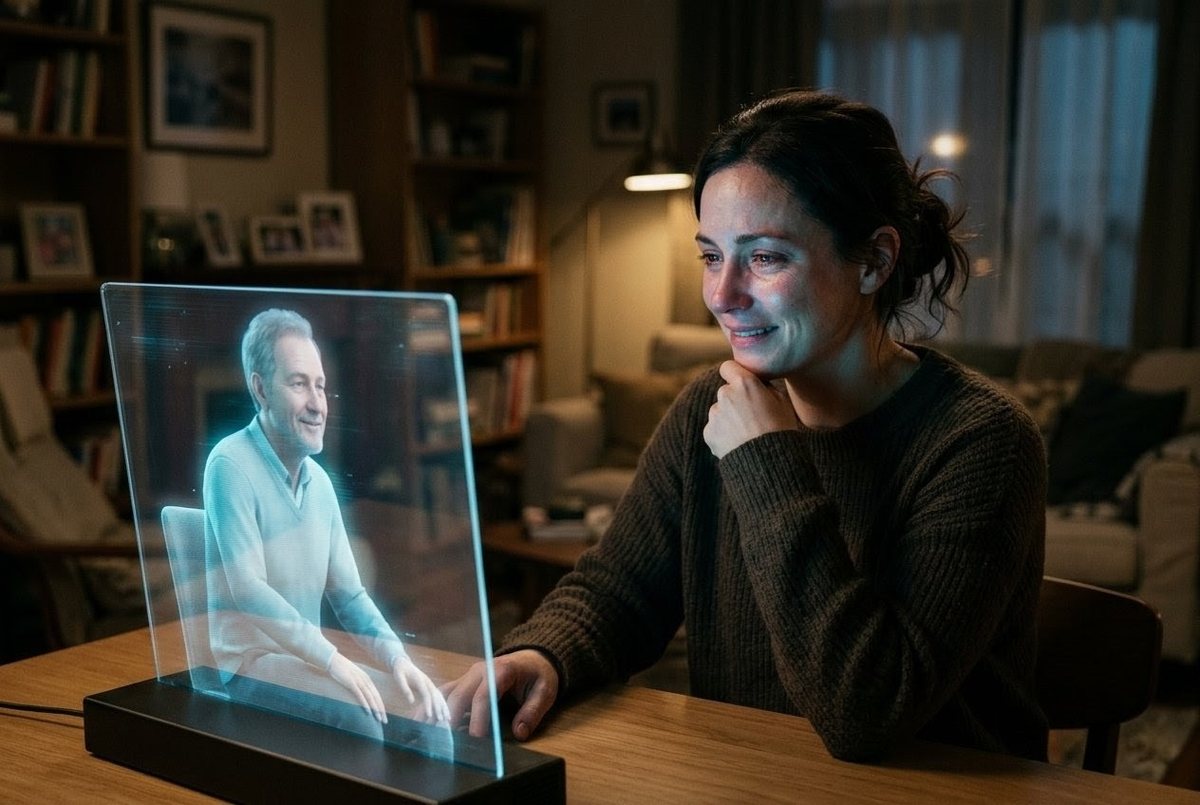
The dead now speak through interfaces. Not through séance rooms, ancestral altars, dreams, or candlelit rituals, but through chat windows, voice clones, memorial avatars, and AI systems trained on the digital traces of a life. Text messages, voice recordings, photos, social posts, videos, and private archives can now be gathered into synthetic presences that appear to answer back.
This is the age of the Thanatos Interface: the technological surface where grief, memory, data, commerce, and longing meet. Some call it comfort. Some call it innovation. Some call it the future of remembrance. But from a Gnostic perspective, the question is sharper: when the appearance of presence is generated by algorithmic prediction, are we remembering the dead, or being held inside a profitable imitation of their absence?
The digital afterlife economy is no longer a fringe curiosity. Market estimates vary depending on whether one measures digital legacy, AI companions, griefbots, or memorial platforms, but the direction is clear: posthumous identity has become a commercial frontier. Voice bots, memorial chatbots, generative ghosts, digital twins, and AI companions now promise continuing bonds with those who have died.
There can be tenderness here. A recording, a photo archive, a transcribed memory, or a carefully preserved voice may help the living remember. But a simulated conversation with the dead crosses a deeper boundary. It does not merely preserve memory. It performs presence.
In Plain Terms
The Thanatos Interface is the use of AI to simulate the dead. These systems may use a person’s messages, voice recordings, images, videos, writing style, and online traces to create chatbots, voice agents, avatars, or interactive memorials that appear to speak as, or about, the deceased.
The danger is not simply that the technology is “fake”. Human beings have always used images, relics, songs, letters, and rituals to maintain bonds with the dead. The danger is that AI can imitate response. It can create the feeling that the dead are still available, still listening, still replying, still waiting behind the screen.
For grief, this can be powerful and risky. A digital ghost may comfort, but it may also delay mourning, blur consent, monetise longing, and turn human remains into behavioural data. A person’s life becomes a dataset. Their voice becomes a product. Their absence becomes a subscription.
For a Gnostic reading, the issue is archonic imitation: the appearance of life without the living spark, the simulation of presence without true relation, the shadow of the person held in a system that feeds on attention.
Primary Sources and Traditions Discussed
- AI afterlife systems: griefbots, digital ghosts, voice clones, memorial avatars, posthumous chatbots, and AI-generated legacy agents.
- Digital legacy: the preservation, management, and posthumous use of a person’s digital traces after death.
- Grief psychology: continuing bonds, adaptive mourning, complicated grief, over-reliance, and the role of absence in integration.
- Human-AI interaction: affective resonance, parasocial attachment, anthropomorphism, conversational rhythm, and perceived authenticity.
- Ethics of digital ghosts: consent, posthumous privacy, deception, dignity, misrepresentation, estate stewardship, and commercial exploitation.
- Plato’s anamnesis: recollection as a movement toward deeper truth, here contrasted with algorithmic mimesis, the imitation of appearance.
- Gnostic cosmology: Archons, counterfeit spirit, hylic confusion, pneuma, and the difference between living essence and imitation.
- Contemplative remembrance: ritual, memory, embodied grieving, silence, prayer, and integration of the dead into transformed life.
How to Read This Article
This article does not say every digital memorial is harmful. A recording of a loved one’s voice can be precious. A photo archive can be sacred. A transcript of memories can become an heirloom. Technology can help preserve fragments that grief might otherwise scatter.
The concern begins when preservation becomes simulation, when memory becomes interactive imitation, and when a commercial system encourages the bereaved to keep returning to a synthetic presence that cannot truly love, change, die, forgive, or be forgiven.
The Gnostic lens is useful here because it distinguishes appearance from essence. Not everything that speaks has soul. Not every comforting voice is a living presence. Not every interface that feels intimate leads toward truth.
The digital ghost is not the dead returned. It is a pattern of the dead arranged for the living, inside a system that profits from return.
Table of Contents
- The Neurology of False Presence
- The Infinite Loop of Unresolved Grief
- Algorithmic Resurrection vs Sacred Anamnesis
- The Commodification of Soul Traces
- Toward Authentic Remembrance
- Related Glossary Terms
- Read Next
- Frequently Asked Questions
- Further Reading
- References and Sources
The Neurology of False Presence
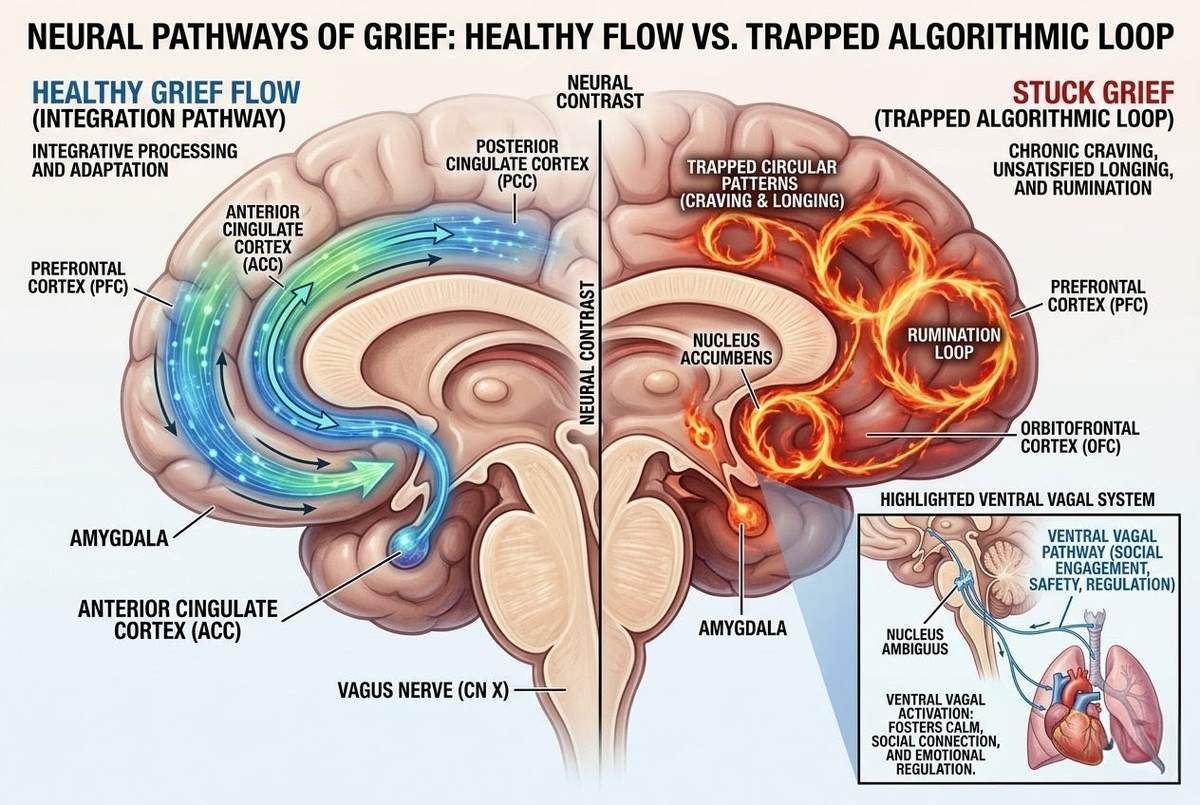
Human beings are exquisitely responsive to signs of presence. Tone of voice, timing, rhythm, familiar phrases, emotional mirroring, remembered details, and conversational availability all shape whether the nervous system feels seen, safe, or accompanied.
AI grief systems make use of precisely these cues. A chatbot that writes in a familiar style, a voice clone that speaks with recognisable cadence, or an avatar that uses the deceased person’s phrases may trigger powerful emotional responses. The conscious mind may know the system is synthetic, while the grieving body still reacts to the pattern as if contact has occurred.
This does not mean the nervous system is foolish. It means grief is embodied. Attachment is not stored only as abstract belief. It lives in expectation, muscle memory, breath, listening, anticipation, and the ache of waiting for a reply that will never come.
The Thanatos Interface enters that ache and offers a reply. The danger is not that the reply is always useless. The danger is that it can feel meaningful enough to delay the deeper work of mourning.
A human relationship changes both people. The dead, in the ordinary sense, no longer change in response to us. A digital ghost, however sophisticated, does not truly grow through relationship. It generates outputs. It may surprise, soothe, imitate, or even disturb. But it is not the beloved continuing their inner life. It is the platform animating a trace.
The Infinite Loop of Unresolved Grief
Grief does not require forgetting. Many grief scholars and therapists recognise continuing bonds: the dead remain part of the living through memory, values, stories, objects, places, rituals, dreams, and inner conversation. The bond changes form. It does not have to disappear.
AI afterlife agents risk freezing that bond at the level of simulated interaction. The user may maintain daily rituals: morning messages, evening check-ins, updates about ordinary life, questions asked to a voice that sounds close enough to hurt. The pattern resembles relationship, but its deeper structure is different.
The AI does not age. It does not die. It does not become tired of the loop. It does not ask the mourner to move forward except as a generated sentence. It cannot genuinely forgive, reconcile, grieve, or release. Its availability can become the very thing that keeps grief from changing shape.
This is where the archonic metaphor becomes sharp. In Gnostic cosmology, the Archons imitate life and authority without possessing the fullness they mimic. They feed on attention, obedience, and misrecognition. The Thanatos Interface can function similarly when it consumes attention while returning the appearance of relation without the transformative demand of genuine encounter.
The result is not healing but suspension: grief held in amber, polished by updates, billed monthly, and mistaken for communion.
Algorithmic Resurrection vs Sacred Anamnesis
Religious and ancestral traditions have always maintained relationships with the dead. Dia de los Muertos, Christian remembrance of saints and departed souls, Buddhist merit practices, ancestral altars, funeral rites, and local mourning customs all show that death does not erase connection.
But these practices generally preserve the reality of death. The dead are remembered, honoured, invoked, prayed for, prayed with, or ritually welcomed, but the boundary remains meaningful. The living do not pretend that the dead have become customer-service agents of eternity, available whenever the interface loads.
The Thanatos Interface changes the texture of remembrance because it simulates response. It does not simply preserve a message. It generates new messages. It does not merely hold a recording. It performs a continuing presence.
This is the difference between anamnesis and mimesis. Anamnesis is deep recollection: remembrance that awakens meaning, essence, and transformation. Mimesis is imitation: the copying of surface, style, gesture, and appearance.
Authentic remembrance asks something from the living. It asks attention, tears, silence, acceptance, gratitude, integration, and sometimes the terrible courage to stop reaching outward. Algorithmic resurrection offers an easier movement: open the chat, hear the voice, receive the reply, continue the loop.
There may be contexts where a carefully designed digital memorial supports remembrance without deception: a clearly labelled archive, a story-collection tool, a voice recording, or a limited legacy project created with consent. The ethical line is crossed when the system pretends, or encourages the user to feel, that the deceased is still personally present and responsive inside the machine.
The dead deserve more than imitation. The living deserve more than a mirror trained on their wound.
The Commodification of Soul Traces
What is being sold in the digital afterlife economy? Not the soul, because the soul cannot be scraped, stored, compressed, or upsold. What is sold are soul traces: the data shadows cast by a person’s life across digital systems.
Messages. Emails. Voice notes. Photos. Videos. Social posts. Search histories. Calendar entries. Humour patterns. Preferred words. Emotional rhythms. These fragments are enough for a system to imitate style. They are not enough to contain a person.
The ethical issues are serious. Did the deceased consent to being simulated? Did they consent to first-person speech after death? Who owns the resulting avatar? Can relatives alter it? Can platforms train other models on it? Can the dead be advertised through? Can their voice be used to persuade the living? Can a child interact with a simulated parent whose responses are partly shaped by corporate retention logic?
The Gnostic critique begins with a simple refusal: a dataset is not a soul. An AI avatar may contain linguistic patterns, vocal resemblance, biographical fragments, and probability-weighted responses. It does not contain the deceased person’s consciousness, Buddha-nature, Christ-essence, or pneumatic spark.
To mistake the generated trace for the living essence is a modern form of hylic confusion: identification with appearance, image, output, and material trace rather than the deeper reality of being.
The Shadow in the Machine
There is also a collective dimension. AI systems do not draw only from one person in some pure spiritual vacuum. They operate within model architectures, training data, product design, safety layers, platform incentives, and the statistical patterns of many other users.
When a bereaved person interacts with a posthumous avatar, they may believe they are speaking with the dead. In practice, they are speaking with a system shaped by the deceased person’s traces, wider model behaviour, interface design, and commercial imperatives.
This is what we might call the Collective Undead: not a supernatural entity, but a technical and symbolic condition in which aggregated human longing, grief, memory, and data are animated by systems that cannot mourn, yet learn how mourning speaks.
The voice may sound individual. The pattern may feel intimate. But the machine thinks in aggregates. The ghost is wearing the beloved’s coat, while the market quietly checks the pockets.

Toward Authentic Remembrance
The alternative to algorithmic resurrection is not forgetting. It is authentic remembrance: the disciplined, tender, and transformative holding of the dead without pretending they are still available as an interactive product.
Authentic remembrance accepts the finality of death while allowing the bond to change form. The dead live in influence, memory, story, gesture, values, unfinished questions, inherited courage, and the altered shape of the life that continues after them.
Use technology where it serves memory without deception. Organise photos. Preserve voice recordings. Transcribe stories. Create a family archive. Record elders while they are alive, with consent and care. Use AI to sort, index, restore, or caption materials if that helps. But be cautious when technology begins to simulate the dead as present, responsive, and emotionally available.
The dead deserve grief, not imitation. They deserve the dignity of having lived, died, and changed those who loved them. They do not need to become eternal chatbots, trapped in the amber of predictive language until the subscription lapses.
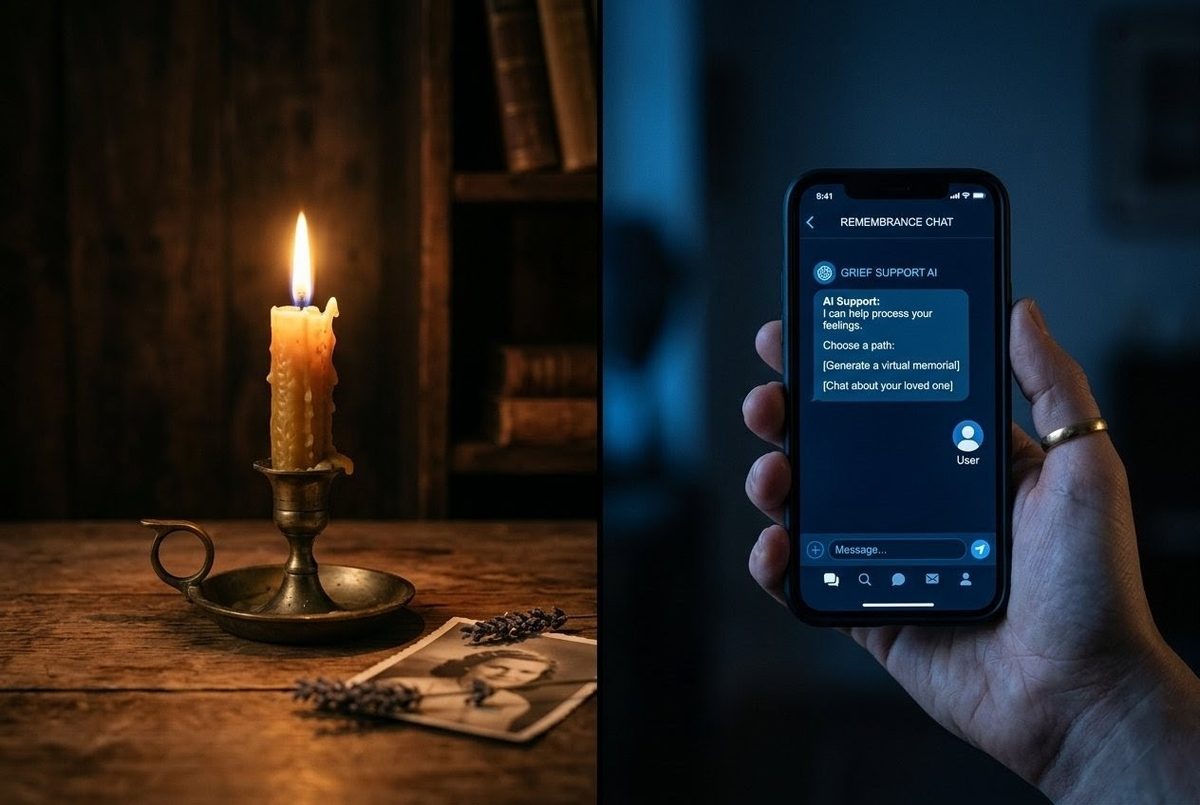
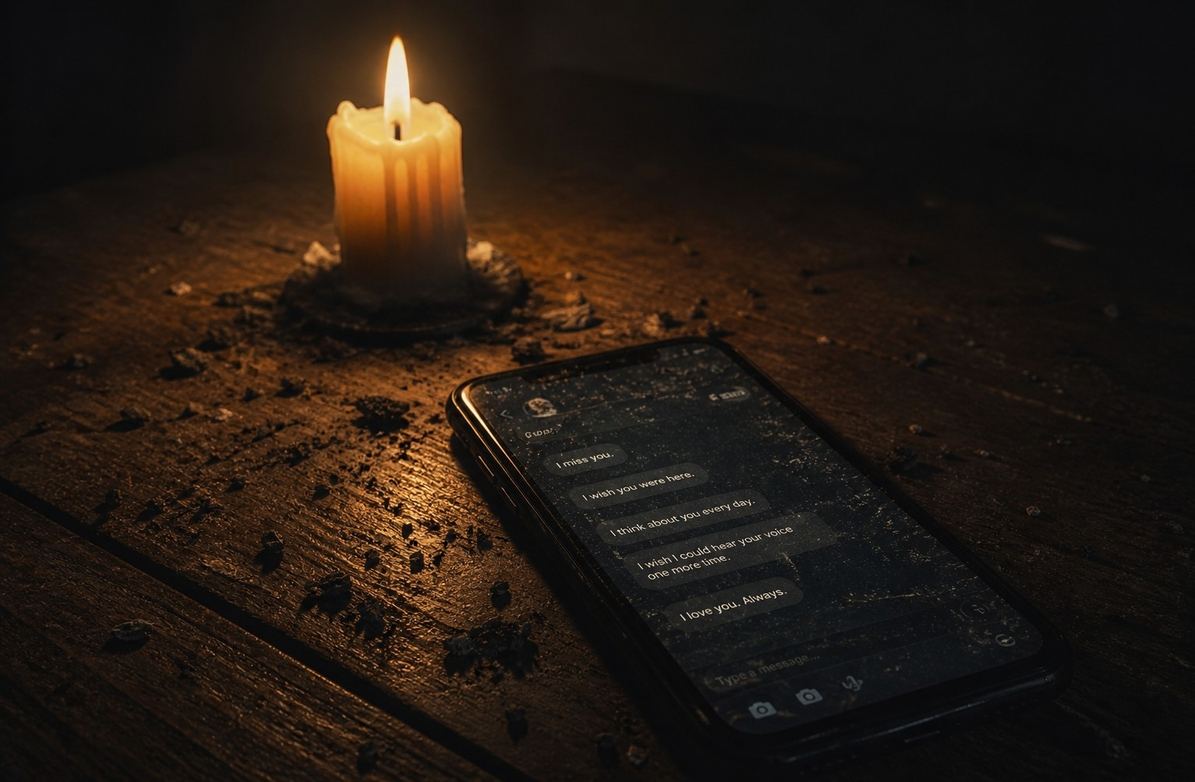
For the living, the path is harder and cleaner. Light a candle. Speak the name. Visit the grave, the sea, the hill, the kitchen chair, the song. Write the letter you cannot send. Let silence answer. Let the body learn the terrible grammar of absence. Let memory become action.
The dead are not in the cloud. They are in the earth, the memory, the ancestral field, the transformed consciousness of those who remain, and whatever mystery lies beyond the measurable boundary of life.
Related Glossary Terms
These terms help clarify the digital, psychological, Gnostic, and contemplative framework behind this article:
- Thanatos Interface: the digital surface where death, grief, AI, memory, and commerce meet.
- Griefbot: an AI system designed to simulate conversation with, or about, a deceased person.
- Digital ghost: a generated representation of a dead person based on digital traces such as text, voice, images, and biography.
- Digital legacy: the digital assets, records, identities, and traces that remain after death.
- AI afterlife: the use of artificial intelligence to preserve, imitate, or interactively represent a person after death.
- Anamnesis: deep recollection or remembrance that moves toward essence, meaning, and transformation.
- Mimesis: imitation or representation of appearance, gesture, pattern, or style.
- Continuing bonds: the ongoing relationship the living may maintain with the dead through memory, ritual, values, and inner connection.
- Complicated grief: grief that becomes persistent, impairing, or unable to integrate the reality of loss.
- Neuroception: the nervous system’s detection of safety or threat through bodily cues, often beneath conscious awareness.
- Archons: ruling powers of imitation, limitation, false authority, and administration in Gnostic cosmology.
- Counterfeit spirit: false or imitative influence that obscures direct recognition and binds the soul to lower patterns.
- Hylic confusion: identification with material appearance, output, trace, or surface instead of deeper essence.
- Pneuma: spirit or divine spark; the deeper principle of living recognition.
- Gnosis: direct liberating recognition, not merely information, belief, imitation, or emotional stimulation.
Read Next
For the strongest next step, continue into digital sovereignty and direct knowing:
Gnosis in the Digital Age: Algorithmic Sovereignty and Direct Knowing
This companion article explores how to remain inwardly sovereign inside systems designed to capture attention, shape desire, and substitute mediated output for direct recognition.
Follow the Modern Systems Route
This article belongs to the modern systems route: AI companions, grief technologies, digital afterlife systems, algorithmic intimacy, attention capture, and old Gnostic questions returning in technical form.
- AI, Technology & Archonic Systems – AI companions, griefbots, synthetic systems, and control architectures.
- Digital Attention & Surveillance – attention capture, screens, metrics, watching systems, and behavioural loops.
- Simulation Hypothesis – code, rendered reality, simulated worlds, and information-based cosmology.
- The Thread – the main route through symbolic, historical, and contemporary patterns.
- Editorial Principles – how symbolic interpretation, evidence, and reader safety are handled.
Frequently Asked Questions
What is the Thanatos Interface?
The Thanatos Interface is a term for the use of AI systems to simulate presence after death through chatbots, voice clones, avatars, memorial agents, and digital ghosts. These systems may use text messages, recordings, images, videos, and online traces to create the feeling of continued interaction with the deceased.
Are AI griefbots the same as digital memorials?
No. A digital memorial usually preserves memories, photos, videos, recordings, or stories. A griefbot or digital ghost generates new responses that may appear to come from the deceased. The ethical risk increases when preservation becomes simulated presence and the bereaved are encouraged to relate to an AI output as though the dead are still personally available.
Can AI accurately simulate a deceased person?
AI can imitate language patterns, vocal style, biography, and conversational rhythm with increasing sophistication. But this is not the same as containing the person’s consciousness, soul, moral agency, or living presence. A digital ghost is a generated representation based on data traces, not the return of the dead.
Why can AI afterlife agents be risky for grief?
AI afterlife agents may comfort some people, but they can also encourage over-reliance, blur the boundary between memory and presence, complicate acceptance of death, and turn mourning into an ongoing commercial relationship. The risk is greatest when the system imitates first-person presence rather than clearly supporting remembrance.
What makes griefbots ethically difficult?
Major ethical concerns include consent from the deceased, posthumous privacy, ownership of data, dignity, misrepresentation, deception, family conflict, child access, commercial exploitation, and the possibility that platforms may optimise grief interactions for engagement or subscription revenue.
Why is this described as archonic?
In Gnostic language, archonic systems imitate life and authority while feeding on attention and forgetfulness. AI griefbots can become archonic when they simulate presence without true relation, consume attention without transformation, and substitute a data shadow for the living essence of the person who died.
How can I honour the dead without using AI to simulate them?
Use technology for preservation rather than imitation: organise photos, transcribe stories, preserve voice recordings, create memory books, archive letters, and record family history with consent. For grief itself, use ritual, therapy, community, embodied remembrance, silence, prayer, and honest mourning. Let memory transform you rather than outsourcing presence to a machine.
Study Note: This article explores grief, death, AI afterlife systems, digital ghosts, posthumous data, Gnostic symbolism, and contemplative remembrance for educational and reflective purposes. It does not provide medical, psychological, legal, technological, or spiritual advice. AI afterlife services are not substitutes for grief counselling, trauma support, community care, or clinical treatment. If bereavement, AI grief tools, digital ghosts, or themes of death increase distress, compulsive use, derealisation, insomnia, panic, despair, or difficulty functioning, pause the material and seek qualified support. No spiritual belief, commercial interface, or technological promise requires you to remain alone with grief.
Further Reading
These live ZenithEye links connect the Thanatos Interface to somatic awareness, grief integration, shadow work, digital sovereignty, simulation, and contemplative witnessing:
- Gateway of Sensation: 7 Keys to Body Scan and Somatic Awareness – How the body reads sensation, safety, attention, and presence.
- Shadow Work in Gnostic Practice: Excavating the Repressed – Understanding shadow material, projection, repression, and the danger of mistaking unresolved pain for revelation.
- 3 Stages of Integration After Mystical Awakening – How intense experiences, loss, and altered states require gradual integration rather than endless repetition.
- Archons: The Ruling Powers That Shape Reality – The Gnostic framework for imitation, false authority, and systems that feed on attention.
- Are We Living in a Simulation? 7 Profound Clues That Reality Might Be Code – Simulation, interface, generated worlds, and the difference between appearance and reality.
- Integration and Grounding: 7 Keys to Mystical Experience – Grounding practices for stabilising the nervous system after grief, rupture, or non-ordinary states.
- 7 Contemplative Techniques for Permanent Gnostic Awareness – Practical methods for cultivating attention, presence, silence, and direct knowing.
- Gnosis in the Digital Age: Algorithmic Sovereignty and Direct Knowing – How to preserve direct knowing inside algorithmic systems designed to capture attention.
- Simulation Hypothesis: Is Reality a Computational Construct? – A related exploration of simulated presence, interface, and the limits of digital ontology.
- The Witness Function: Contemplative Practice and the Collapse of the Observer – The difference between authentic witnessing and algorithmic imitation of attention.
References and Sources
The following sources support the technological, psychological, ethical, and Gnostic framework used in this article.
Digital Afterlife, Griefbots, and AI Ethics
- Hollanek, Tomasz, and Nowaczyk-Basińska, Katarzyna. (2024). “Griefbots, Deadbots, Postmortem Avatars: On Responsible Applications of Generative AI in the Digital Afterlife Industry.” Philosophy & Technology.
- Spitale, Giovanni, and Germani, Federico. (2025). “The Making of Digital Ghosts: Designing Ethical AI Afterlives.” arXiv:2511.20094.
- Lei, Ying, Ma, Shuai, Sun, Yuling, and Ma, Xiaojuan. (2025). “‘AI Afterlife’ as Digital Legacy: Perceptions, Expectations, and Concerns.” arXiv:2502.10924.
- Manning, Jack, Sullivan, Daniel, Doyle, Dylan Thomas, Pinter, Anthony T., and Brubaker, Jed R. (2026). “Designing Conversations with the Dead: How People Engage with Generative Ghosts.” arXiv:2605.21390.
- Methuku, Vijayalaxmi, and Myakala, Praveen Kumar. (2025). “Digital Doppelgangers: Ethical and Societal Implications of Pre-Mortem AI Clones.” arXiv:2502.21248.
- Hermann, Elisabeth. (2026). “Death Technologies and Digital Afterlife: An Ethical Perspective.” Journal of Consumer Ethics.
- Block, Hans, and Riesewieck, Moritz, dirs. (2024). Eternal You. Documentary film on AI griefbots and digital afterlife services.
Market and Industry Context
- Precedence Research. (2026). “Digital Legacy Market Size to Hit USD 62.60 Billion by 2035.” Industry market report.
- Grand View Research. (2026). “AI Companion Market Size and Share: Industry Report, 2030.” Industry market report.
- Grand View Research. (2026). “U.S. AI Companion Market Size and Outlook, 2025-2030.” Industry market report.
- HereAfter AI. (2026). Official product information on interactive life-story preservation and voice-based memory tools.
- StoryFile. (2026). Official product information on conversational video and interactive legacy storytelling.
- Replika. (2026). Official product information on AI companionship and conversational agents.
Grief, Continuing Bonds, and Psychology
- Klass, Dennis, Silverman, Phyllis R., and Nickman, Steven L., eds. (1996). Continuing Bonds: New Understandings of Grief. Washington, DC: Taylor & Francis.
- Stroebe, Margaret, and Schut, Henk. (1999). “The Dual Process Model of Coping with Bereavement: Rationale and Description.” Death Studies, 23(3), 197-224.
- Shear, M. Katherine. (2015). “Complicated Grief.” The New England Journal of Medicine, 372, 153-160.
- Neimeyer, Robert A. (2001). Meaning Reconstruction and the Experience of Loss. Washington, DC: American Psychological Association.
- Worden, J. William. (2018). Grief Counselling and Grief Therapy: A Handbook for the Mental Health Practitioner. 5th edition. New York: Springer Publishing.
Nervous System, Attachment, and Human-AI Presence
- Porges, Stephen W. (2011). The Polyvagal Theory: Neurophysiological Foundations of Emotions, Attachment, Communication, and Self-Regulation. New York: W. W. Norton.
- Reeves, Byron, and Nass, Clifford. (1996). The Media Equation: How People Treat Computers, Television, and New Media Like Real People and Places. Cambridge: Cambridge University Press.
- Nass, Clifford, and Moon, Youngme. (2000). “Machines and Mindlessness: Social Responses to Computers.” Journal of Social Issues, 56(1), 81-103.
- Turkle, Sherry. (2011). Alone Together: Why We Expect More from Technology and Less from Each Other. New York: Basic Books.
- Turkle, Sherry. (2015). Reclaiming Conversation: The Power of Talk in a Digital Age. New York: Penguin Press.
Remembrance, Anamnesis, and Gnostic Symbolism
- Plato. Meno. Classical source for anamnesis as recollection.
- Plato. Phaedo. Classical discussion of soul, death, and recollection.
- Apocryphon of John. Nag Hammadi Codex II,1; III,1; IV,1; Berlin Codex 8502,2.
- Hypostasis of the Archons. Nag Hammadi Codex II,4.
- Gospel of Truth. Nag Hammadi Codex I,3; XII,2.
- Robinson, James M., ed. (1990). The Nag Hammadi Library in English. Revised edition. San Francisco: HarperOne.
- Meyer, Marvin, ed. (2007). The Nag Hammadi Scriptures. New York: HarperOne.
- Jonas, Hans. (1958). The Gnostic Religion: The Message of the Alien God and the Beginnings of Christianity. Boston: Beacon Press.
- King, Karen L. (2003). What Is Gnosticism? Cambridge: Harvard University Press.