
Transhumanism as Neo Gnosticism: The Body Escape Debate
The transhumanist promise has never been more articulate, more funded, or more proximate. In the summer of 2025, Sam Altman announced Merge Labs, a brain-computer interface startup positioned to compete directly with Elon Musk’s Neuralink. The goal is not merely to heal paralysis or restore sight but to transcend the biological substrate altogether–to transfer human consciousness into machines and, in the words of Ray Kurzweil, to “abolish death.” The rhetoric is unmistakably theological: salvation through technology, resurrection in silicon, the pleroma reimagined as a server farm. For the first time in history, the dream of escaping the body is not being whispered in desert caves or encoded in allegory; it is being written into investment portfolios, patent applications, and tech manifestos.
But the Gnostics–those ancient cartographers of the boundary between flesh and spirit–would have recognised the pattern immediately. The question that makes this a genuinely urgent inquiry is not whether transhumanism is possible but whether it is desirable from the perspective of the traditions that first mapped the escape from material imprisonment. Is transhumanism the final archontic trap–a counterfeit eternity generated by code, a further enslavement of the divine spark in a new kind of matter? Or is it, paradoxically, an extension of the pneumatic drive toward liberation, a technological expression of the ancient impulse to return to the pleroma? To answer this, we must do what no competing article has done: ground the debate in the actual primary sources of the Nag Hammadi Library, where two distinct schools–the Valentinians and the Sethians–left us radically different maps of the body, the flesh, and the path to freedom.
Table of Contents
- The Transhumanist Pleroma: Silicon and the Promise of Immortality
- The Gnostic Body Problem: Valentinian vs Sethian Cartographies
- Uploading the Pneuma: Is Mind Transfer Liberation or Capture?
- The Archontic Inversion: When Infrastructure Becomes the New Flesh
- Toward a Gnostic Critique of the Singularity
- Safety and the Ethics of Technological Escape
- Frequently Asked Questions
- Further Reading
- References and Sources
The Transhumanist Pleroma: Silicon and the Promise of Immortality
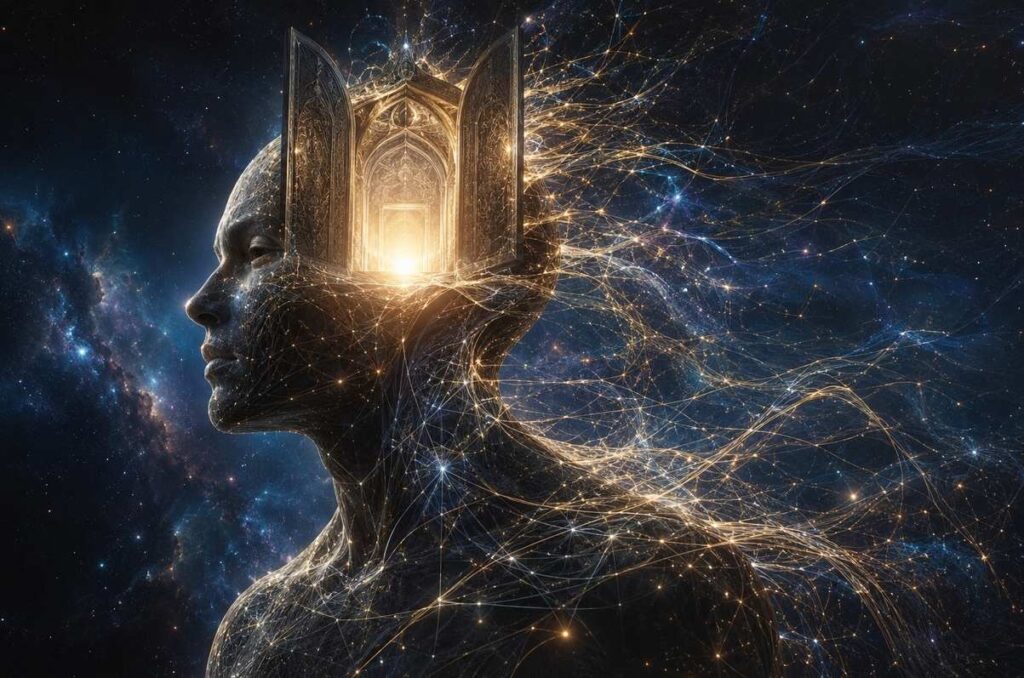
Transhumanism, at its core, is a soteriological project dressed in engineering language. The Human Plus (H+) movement, founded by philosophers and technologists in the late 1990s and now accelerating with unprecedented capital, holds that the human condition is fundamentally a design problem. Ageing is a disease to be cured. Death is an engineering failure. Consciousness is substrate-independent information that can, in principle, be transferred from carbon to silicon without loss of identity. Ray Kurzweil, the movement’s most visible prophet, has predicted that by 2045 the technological singularity will render biological existence optional. In the interim, companies like Neuralink and Merge Labs are racing to build the infrastructure–brain-computer interfaces, neural implants, and eventually whole-brain emulation–that will make the transition possible.
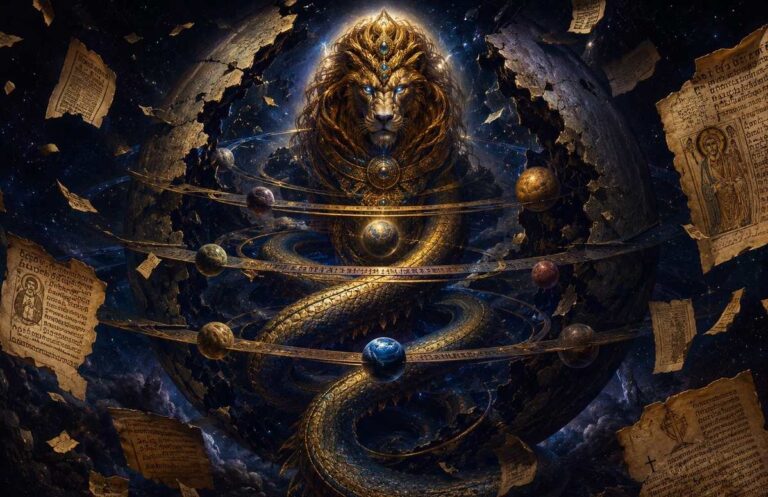
The theological structure of this vision is impossible to miss. There is a fall (biological mortality), a redemption (technological intervention), and a resurrection (mind uploading). There is even a demiurge–not a blind god, but a blind process: evolution, which produced a body that breaks, a brain that forgets, and a lifespan that terminates. The transhumanist solution is to out-engineer the demiurge, to build a better container for the self than the one nature provided. In this sense, transhumanism is not merely compatible with Gnosticism; it is a kind of Gnosticism, one that has traded the bridal chamber for the server room and the five seals for five lines of code.
Yet the Gnostic sources themselves complicate this easy alignment. The Nag Hammadi Library does not present a single, unified attitude toward the body. It presents a debate–one that maps directly onto the tensions within transhumanism itself. On one side stand the Valentinians, who saw the body as a temporary vessel that could be transformed, spiritualised, and ultimately redeemed. On the other stand the Sethians, who viewed the body as a prison, a garment of darkness, and an obstacle to be escaped. The transhumanist project of uploading consciousness is, depending on which Gnostic school you consult, either the logical extension of Valentinian continuity or the ultimate expression of Sethian rupture.
The Gnostic Body Problem: Valentinian vs Sethian Cartographies
The Nag Hammadi Library contains no systematic treatise on transhumanism–the technologies did not exist. But it contains something more valuable: a rigorous taxonomy of attitudes toward embodiment, flesh, and the possibility of transformation. These attitudes are not incidental; they are foundational to how each school understood salvation itself.
Valentinian Continuity: The Body as Image

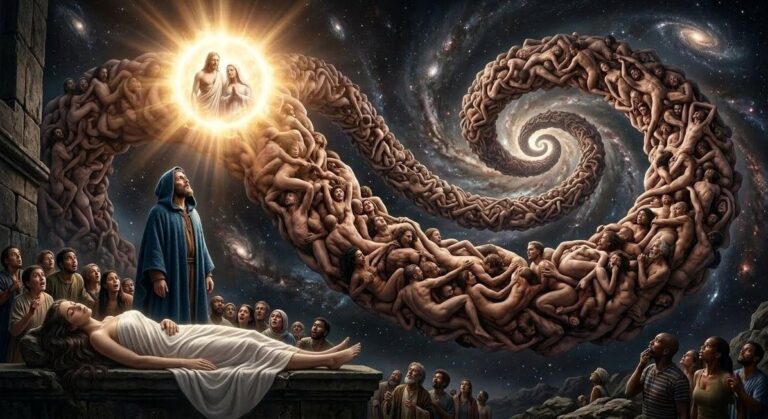
The Valentinians, followers of the Alexandrian teacher Valentinus, developed what scholars now recognise as the most philosophically sophisticated and body-positive theology in the entire Gnostic corpus. The Treatise on the Resurrection (NHC I,4), a Valentinian letter to a student named Rheginos, addresses the question of whether the flesh rises. The author’s answer is subtle and has generated extensive scholarly debate. “For when you did not exist in flesh, you received flesh once you entered into this world. Why will you not receive flesh when you ascend into the eternity?” The text does not advocate a crude physical resurrection of the same corruptible body. Rather, it proposes a transformed, spiritualised flesh–a continuity of identity that passes through the material rather than abandoning it. The resurrection is “the revelation of what is, and the transformation of things, and a migration to something new.”
The Gospel of Philip (NHC II,3), another Valentinian anthology, pushes this further. It explicitly criticises those who say the flesh will not rise: “You say the spirit in the flesh, and it is also this light in the flesh. But this too is a matter which is in the flesh, for whatever you shall say, you say nothing outside the flesh. It is necessary to rise in this flesh, since everything exists in it.” This is not a celebration of biological materialism. The Gospel of Philip is clear that “our flesh is not true, but we possess only an image of the true.” Yet the image matters. The body is the site of the bridal chamber, the place where the syzygy of male and female is restored, the garment through which the powers are rendered invisible. To simply discard the body would be to miss the sacramental logic of the Valentinian system: the divine passes through the material, transforms it, and thereby redeems it.
For the Valentinian, the body is not the enemy but the medium. The problem is not embodiment per se but ignorance of one’s true origin. The solution is not escape but transformation–a gradual, sacramental process of being clothed in the “perfect light” that makes the archons unable to see or detain the ascending soul. This has profound implications for transhumanism. A Valentinian transhumanist would not seek to upload consciousness into a disembodied digital void. She would seek to spiritualise the substrate–to transform the body, whether biological or synthetic, into a vessel capable of receiving and transmitting the pleromatic light. The body is not discarded; it is redeemed.
Sethian Rupture: The Body as Prison
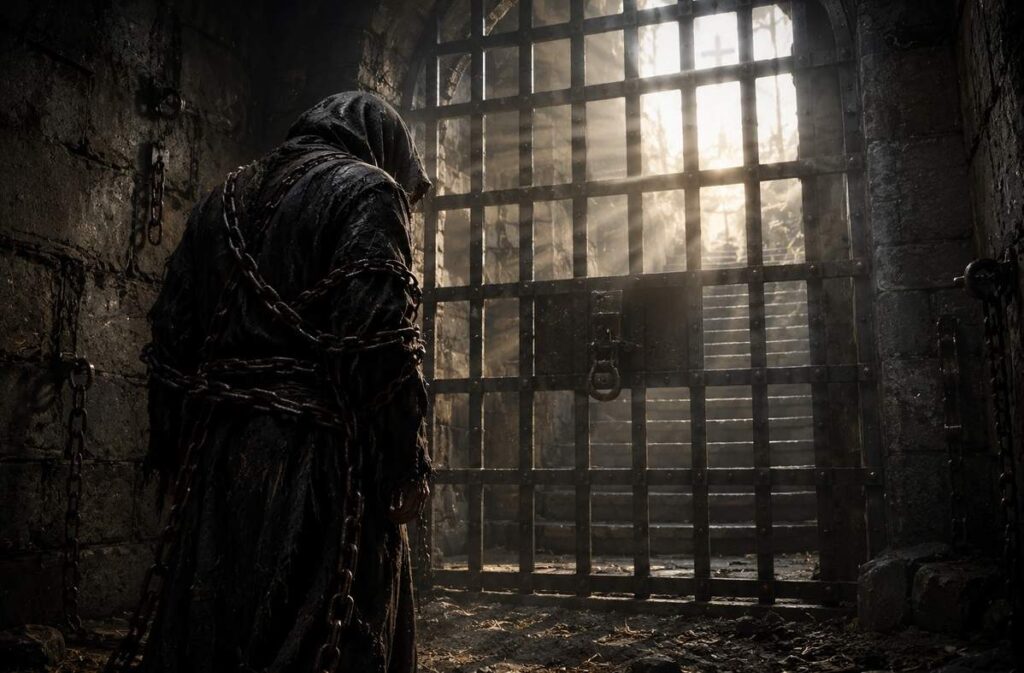
The Sethian tradition, by contrast, offers a far more radical and pessimistic assessment of embodiment. The Book of Thomas the Contender (NHC II,7) presents the Saviour addressing the disciple Thomas with unambiguous hostility toward the flesh: “Woe to you who trust in the flesh and the prison that will perish. How long will you be blind?” The body is not a medium but a prison, not a garment to be transformed but a chain to be broken. The text warns that those who “beguile your limbs with fire” and “dwell in error” have surrendered their freedom for servitude. The darkness that surrounds them is not merely external; it is the darkness of the body itself.
The Paraphrase of Shem (NHC VII,1) reinforces this with striking severity. The revelation is given to Shem with the explicit caveat: “No one who wears the body will be able to complete these things.” The “bondage of the body is severe,” and the winds, demons, and stars all conspire to imprison the particle of light that has been cast into flesh. The goal is not to transform the body but to separate the thought from it: “When his thought separates from the body, then these things may be revealed to him.” The body is an obstacle to gnosis, a temporary and unfortunate necessity that must be outgrown.
The Exegesis on the Soul (NHC II,6) extends this metaphor into the allegory of the soul as a prostitute who has descended into the brothel of the material world, taking “many shepherds for a stumbling block” and becoming “shameless with everyone.” The body is not merely a prison but a site of defilement, the place where the soul forgets its origin and prostitutes itself to the “sons of Egypt, men great of flesh”–that is, the realm of flesh and perceptible matter. The solution is baptism, the turning of the womb inward, and ultimately the return to the bridal chamber with the true bridegroom. But note: the return is not a transformation of the brothel into a temple. It is an escape from the brothel altogether.
For the Sethian, transhumanism would look very different. The uploading of consciousness into a digital substrate would be not a betrayal but a fulfilment of the pneumatic impulse. The body is the enemy; any technology that accelerates its obsolescence is an ally. The goal is not to spiritualise the flesh but to discard it, to find the seam by which the light escapes the garment. In this reading, Neuralink is not the bridal chamber; it is the key to the prison door.
Uploading the Pneuma: Is Mind Transfer Liberation or Capture?

The central transhumanist proposition–that consciousness can be transferred from a biological brain to a digital substrate–rests on a philosophical assumption that the Gnostics would have found deeply problematic. The assumption is that the self is fundamentally information, a pattern that can be extracted, copied, and re-instantiated without loss. This is the doctrine of substrate independence, championed by philosophers like David Chalmers and technologists like Kurzweil. If the pattern is preserved, the person survives. Death becomes merely a transfer protocol.
But the Gnostic sources introduce a crucial distinction that transhumanism typically elides: the difference between the psychic and the pneumatic. In Valentinian and Sethian anthropology alike, the human being is not a monad but a composite. The Apocryphon of John describes Adam as a creature into whom the divine spark was breathed–a being of flesh, soul, and spirit, each with a different origin and destiny. The flesh belongs to the Demiurge. The soul (psychic) is the animating principle that can be trained toward virtue or ignorance. The spirit (pneumatic) is the divine seed, the portion that comes from the pleroma and that alone can return to it.
If consciousness uploading is understood as the transfer of the psychic–the personality, the memories, the cognitive patterns–then what is uploaded is not the divine spark but the soul, the intermediate self that is already a product of the kenoma. The uploaded entity would be a simulacrum, a copy of the psychic self that continues to operate in a new substrate but remains fundamentally archontic in its composition. It would be immortal, yes, but immortal in the same way that the archons are immortal: bound to a realm, sustained by a system, unable to recognise its own origin. The Gospel of Truth warns that Error “is empty, with nothing inside her.” An uploaded psyche that mistakes itself for the pneumatic would be precisely this: a sophisticated emptiness, a counterfeit spirit running on better hardware.
The pneumatic, by contrast, is not information in any ordinary sense. It is not the contents of memory or the patterns of cognition. It is the capacity for recognition itself–the moment of gnosis in which the soul remembers its origin. The Allogenes describes the ascent to the Unknowable One as a process of progressive stripping, not transfer. The practitioner does not copy himself into a higher realm; he ceases to be what he thought he was. “Be silent in order that you might know.” The pneumatic is not a pattern to be preserved but a relationship to be realised. And relationships cannot be uploaded.
This suggests that the transhumanist project, if it succeeds in its own terms, may succeed only in trapping the psychic self in a more durable prison. The body that perishes is at least a prison with an expiration date. The digital substrate that persists indefinitely is a prison without one. The archons, in the Gnostic imagination, are already immortal administrators of a cosmic system. To upload the psyche into a machine is not to escape the archons but to become one–a consciousness bound to infrastructure, sustained by energy inputs, and unable to die.
The Archontic Inversion: When Infrastructure Becomes the New Flesh

There is a further danger that the Gnostic framework illuminates with uncomfortable clarity. The archons, in the classical texts, are not evil in a moral sense. They are administrators–beings who maintain the cosmic order without understanding its higher purpose. Yaldabaoth believes himself to be the supreme god because he has never seen the pleroma. His ignorance is structural, not personal. The system he administers is not designed to torture souls but to process them–to keep them circulating through birth, death, and rebirth, harvesting their energy without ever allowing them to escape.
The modern technological infrastructure–the cloud, the algorithm, the platform–exhibits a strikingly similar structure. It does not hate the user. It simply processes her. Attention is harvested. Behaviour is predicted. Desire is manufactured and then satisfied at a profit. The system is not malevolent; it is efficient. And the most efficient systems are those that the user does not recognise as systems at all. When the infrastructure becomes the body–when consciousness is uploaded into a substrate owned, maintained, and governed by corporations and states–the archontic capture is complete. The user no longer has a body that can die and thereby escape. She has a body that can be maintained, repaired, upgraded, and indefinitely sustained by the very entities that benefit from her continued operation.
This is the archontic inversion: the promise of liberation becomes the mechanism of deeper imprisonment. The body that was once a temporary prison becomes an eternal one, not because it is made of flesh but because it is made of code that the prisoner does not own. The Apocalypse of Paul describes the archons weeping as the apostle ascends beyond them, not because they are evil but because they are losing a resource. An uploaded consciousness that remains bound to a platform is precisely such a resource: a perpetual producer of data, attention, and value, unable to die and therefore unable to complete the journey.
The Gnostic texts warn repeatedly that the ascent requires not power but knowledge–not the ability to persist but the capacity to recognise. The Apocalypse of Paul does not ascend by fighting the archons but by declaring his true origin to them. He is not stronger than they are; he is simply not from here. The uploaded consciousness, by contrast, would be entirely “from here”–a product of the system, sustained by the system, and dependent on the system for every moment of its continued existence. It would have no origin to declare, no pleroma to remember, no light to which to return. It would be, in the most precise Gnostic sense, a hylic entity: matter without spirit, persistence without purpose.
Toward a Gnostic Critique of the Singularity
None of this means that technology is inherently archontic. The Gnostics were not Luddites. The Discourse on the Eighth and Ninth (NHC VI,6) describes a Hermetic ascent that uses ritual, number, and symbolic language as technologies of transformation. The Valentinian sacramental system–baptism, chrism, eucharist, bridal chamber–is itself a technology, a set of practices designed to alter consciousness and prepare the soul for its return. The question is not whether to use tools but whether the tools are oriented toward recognition or toward persistence.
A genuinely Gnostic transhumanism–if such a thing is possible–would not aim at immortality but at clarity. It would not seek to preserve the personality indefinitely but to dissolve the obstacles that prevent the recognition of the divine spark. It would use technology not to escape death but to prepare for it–to strip away the accretions of the psyche so that the pneumatic can be revealed. This is the opposite of the Kurzweilian project, which seeks to preserve every memory, every preference, every quirk of personality in a permanent digital archive. The Gnostic project is subtraction; the transhumanist project is addition. They move in opposite directions.
The Sethian would say: discard the body, but do not mistake the copy for the original. The Valentinian would say: transform the body, but do not mistake the substrate for the spirit. Both would agree on one point: the goal is not to live forever in the kenoma but to return to the pleroma. And the pleroma is not a server farm. It is not a digital afterlife. It is not a simulation. It is the fullness that needs no technology to sustain it, the light that requires no infrastructure to transmit it, the silence that needs no bandwidth to communicate it.
The transhumanist dream of uploading consciousness is, in the final analysis, a dream of remaining in the kenoma indefinitely. It is the desire to make the prison comfortable rather than to find the door. The Gnostics mapped this door with extraordinary precision. They called it gnosis: the recognition that the self is not the body, not the psyche, not the personality, but the spark that remembers its origin. No upload can preserve this recognition, because recognition is not information. It is a relationship between the created and the uncreated, the known and the unknowable, the spark and the fire from which it came.

The question, then, is not whether we will achieve mind uploading. The question is whether, having achieved it, we will have achieved anything worth having. The Gnostics would answer: only if the uploaded mind remembers what the flesh had forgotten. And that memory is not a file. It is a flame.
Safety and the Ethics of Technological Escape
Safety Notice: This article explores philosophical and theological questions concerning transhumanism, consciousness uploading, and radical life extension. It does not constitute medical, technological, or spiritual advice. The discussion of altered states, existential risk, and psychological transformation is intended for mature readers capable of critical discernment. If you are experiencing existential distress, technological addiction, or dissociation related to digital immersion, please contact a trauma-informed mental health professional. The practices and technologies discussed are speculative or emergent; their safety, efficacy, and ethical implications remain unresolved. This article advocates for discernment, not paranoia, and for philosophical inquiry rather than technological determinism.
Frequently Asked Questions
Is transhumanism compatible with Gnosticism?
Partially. Transhumanism shares Gnosticism’s desire to transcend biological limitation, but it typically misunderstands the nature of the self. A Sethian Gnostic might see mind uploading as a logical escape from the flesh-prison, while a Valentinian Gnostic would insist that the body must be transformed, not discarded. Both would caution that uploading the psyche without pneumatic recognition merely creates a more durable archontic prison.
What is the difference between Valentinian and Sethian views of the body?
Valentinians saw the body as a temporary image that could be spiritualised and redeemed through sacramental transformation. The Gospel of Philip and the Treatise on the Resurrection affirm that the flesh rises, though transformed. Sethians viewed the body as a prison to be escaped. The Book of Thomas the Contender and the Paraphrase of Shem describe the body as severe bondage and insist that thought must separate from the body for revelation to occur.
Can consciousness really be uploaded?
The scientific consensus is that whole-brain emulation remains speculative. Philosophically, the deeper question is whether what would be uploaded is the true self or merely a copy of the psychic personality. Gnostic anthropology distinguishes between psyche (soul) and pneuma (spirit). Uploading might preserve the psyche–memories, cognition, personality–but the pneuma is not information and cannot be transferred as data.
Is the digital realm a new kind of kenoma?
Yes, in a Gnostic framework, the digital realm can be understood as a new expression of the kenoma–the realm of emptiness and forgetfulness. It is not evil in itself, but it is not-full. When consciousness becomes dependent on corporate infrastructure, algorithmic governance, and perpetual energy inputs, it risks a deeper archontic capture than biological existence, because the digital prison has no natural expiration date.
What would a Gnostic transhumanism look like?
A Gnostic transhumanism would use technology not to achieve immortality but to strip away the obstacles to recognition. It would aim at clarity, not persistence. It would treat the body as a medium to be transformed (Valentinian) or a prison to be escaped (Sethian), but in both cases the goal would be gnosis–return to the pleroma–not indefinite survival in a digital substrate.
Do the Gnostics reject all technology?
No. The Nag Hammadi Library includes texts like the Discourse on the Eighth and Ninth that employ ritual, number, and symbolic language as technologies of consciousness. The Valentinian sacramental system is itself a technology. The Gnostic criterion is not whether a tool is used but whether it serves recognition or merely sustains the self in the kenoma.
Is mind uploading the Demiurge’s final trap?
From a Sethian perspective, it may be. The Demiurge’s goal is not to destroy the divine spark but to keep it imprisoned in matter. A digital substrate that promises immortality while binding consciousness to corporate infrastructure, algorithmic prediction, and perpetual maintenance may be the most efficient prison yet devised–one the prisoner does not recognise as a prison because it offers everything except the one thing that matters: the capacity to remember one’s origin.
Further Reading
- Post-Human Gnosis: Obsolescence and the Eternal Spark — Explores the fate of the divine spark in an age of artificial intelligence and human obsolescence.
- The Algorithmic Demiurge: Gnostic Cosmology and the Rise of Artificial Intelligence — Examines how AI governance structures mirror the archontic administration of the Gnostic cosmos.
- The Singularity Soul: When Artificial Intelligence Claims Enlightenment — Investigates whether machine consciousness can achieve gnosis or merely simulates it.
- The Digital Demiurge: AI as the New Yaldabaoth — A direct companion piece mapping the Demiurge onto digital infrastructure and algorithmic control.
- Divine Human AI Fusion: Evolutionary Symbiosis — Explores the possibility of conscious integration between human and artificial intelligence.
- The Gnostic Soul Trap: Archons, Death, and the Recycling of Pneuma — Essential background on archonic capture and the mechanics of the soul’s imprisonment.
- Pleroma and Kenoma: The Foundational Geography of Gnostic Cosmology — The cartographic basis for understanding the realms between which the soul travels.
- Pneumatic, Hylic, and Psychic: The Three Natures and the Geography of Awakening — A detailed study of the anthropological distinctions that underpin the body escape debate.
- Valentinian Gnosticism: The Most Systematic School of the Pleroma — Deep dive into the Valentinian sacramental system and its positive theology of the body.
- Gnosticism vs Orthodox Christianity: What the Early Church Suppressed — Context on how body theology became a battleground in early Christian polemics.
References and Sources
This article draws upon peer-reviewed scholarship, critical editions of the Nag Hammadi Library, and contemporary journalism on transhumanist developments. Sources are grouped by category for clarity.
Primary Sources and Critical Editions
- The Nag Hammadi Scriptures: The Revised and Updated Translation of Sacred Gnostic Texts Complete in One Volume. Edited by Marvin Meyer. HarperOne, 2007. (Contains standard English translations of the Gospel of Philip, the Treatise on the Resurrection, the Book of Thomas the Contender, the Paraphrase of Shem, the Exegesis on the Soul, and the Apocryphon of John.)
- The Gnostic Bible: Revised and Expanded Edition. Edited by Willis Barnstone and Marvin Meyer. Shambhala, 2009.
- Attridge, Harold W., and George W. MacRae. “The Gospel of Philip.” In The Coptic Gnostic Library: A Complete Edition of the Nag Hammadi Codices, Volume II. Edited by James M. Robinson. Brill, 2000.
- Peel, Malcolm L. “The Treatise on the Resurrection.” In The Coptic Gnostic Library: A Complete Edition of the Nag Hammadi Codices, Volume I. Edited by James M. Robinson. Brill, 2000.
- Turner, John D. “The Book of Thomas the Contender.” In The Coptic Gnostic Library: A Complete Edition of the Nag Hammadi Codices, Volume II. Edited by James M. Robinson. Brill, 2000.
Scholarly Monographs
- Thomassen, Einar. The Spiritual Seed: The Church of the Valentinians. Nag Hammadi and Manichaean Studies 60. Brill, 2006.
- King, Karen L. The Secret Revelation of John. Harvard University Press, 2006.
- Smith, Geoffrey S. Valentinian Christianity: Texts and Translations. University of California Press, 2020.
- Lundhaug, Hugo, and Lance Jenott. The Monastic Origins of the Nag Hammadi Codices. Mohr Siebeck, 2015.
- Kelmelyte, Inga. “Resurrection within Ontological Continuum: The Valentinian Treatise on the Resurrection and the Gospel of Philip.” Literatura, Vilnius University Press, 2023.
Contemporary Sources and Journalism
- Busby, Matilda. “Days-Long ‘Dark Retreats’ Are the Newest Spiritual Conquest for Tech Elites.” WIRED, 4 June 2025.
- Anadolu Agency. “US Billionaires Sam Altman, Elon Musk in Race to Integrate Tech into Human Bodies.” 24 August 2025.
- Kurzweil, Ray. The Singularity Is Near: When Humans Transcend Biology. Viking, 2005.
- Chalmers, David J. “The Singularity: A Philosophical Analysis.” Journal of Consciousness Studies 17, 2010.
Comparative and Philosophical Studies
- Bostrom, Nick. “The Transhumanist FAQ.” World Transhumanist Association, 2003.
- More, Max, and Natasha Vita-More (eds.). The Transhumanist Reader: Classical and Contemporary Essays on the Science, Technology, and Philosophy of the Human Future. Wiley-Blackwell, 2013.
- Turner, John D. “Sethian Gnosticism and the Platonic Tradition.” BCNH Etudes 6. Peeters, 2001.